Home » usage limit » Recent Articles:

Notorious Usage-Capping Sunflower Broadband Close to Sale to Knology; Caps Could Be History

Courtesy Ben Spark

The days may be numbered for Sunflower Broadband

A Kansas cable system notorious for Internet Overcharging is nearing a deal to be acquired by a cable overbuilder that does not usage cap broadband customers.

Sunflower Broadband, an independent cable system providing cable, phone, and broadband service to 30,000 Lawrence residents, is expected to be acquired by Georgia-based cable overbuilder Knology, which has been on a buying spree of late.  The asking price – $127 million dollars, according to a report in the cable trade journal Multichannel News.

Sunflower has been overcharging their broadband customers for years with schemes like usage caps and a flat rate service plan that delivers speed throttled broadband service to customers.  Sunflower has remained a hot topic for Stop the Cap! because we hear so many complaints from their long-suffering customers.  In fact, no independent cable operator has generated more reader complaints than Sunflower Broadband, almost all targeting the company’s unjustified usage caps.

Broadband Reports reminds us Sunflower was among the first to implement the idea of low caps and high overages ($2 for each additional gigabyte).  Customers also routinely complain about Sunflower’s stingy upstream speeds, maxed out at just 1Mbps for their $60 Gold tier.

None of the details about Sunflower Broadband’s impending sale can be found in the local newspaper — the Lawrence Journal-World or the local “Channel 6” news operation.  That’s ironic, considering the same parent company that owns Sunflower Broadband, The World Company, also happens to own the newspaper and Channel 6.  It took a cable trade publication based hundreds of miles away to break the story — not exactly a shining moment for journalism in Lawrence, especially considering an LJWorld reporter need not break a sweat to chase the story.

Part of the reason for the sale may have been AT&T bringing U-verse competition to Lawrence.  U-verse does not have customer unfriendly usage limits.  With AT&T ready to usher away many of Sunflower’s customers, management may have decided now was a good time to sell.

The good news for Lawrence residents is that none of Knology’s cable systems engage in Internet Overcharging schemes, so Sunflower’s usage caps may be gone after the sale.

Still, some Lawrence residents are concerned about the implications of a Knology takeover.  The Lawrence Broadband Observer is among them:

I browsed Knology’s corporate web site and was actually pretty unimpressed. To put it mildly, Knology is well behind Sunflower both geographically and technically. Knology offers service in rural areas much smaller then Lawrence, like Storm Lake, Iowa and Dothan, Alabama. They also offer service in a few towns that are equal or larger then Lawrence like Charleston, South Carolina.

Technically, Knology is well behind Sunflower in what they offer customers in other cities. Top internet speeds (albeit cap-free) are only in the 8-10 megabit range, five times slower then Sunflower’s new DOCSIS 3 offerings. On the television side, while it varies from city to city, Knology generally offers only 30 or so HD channels, which is less then half of what Sunflower offers. Knology offers a rudimentary DVR, but nothing like Sunflower’s multi-room options.

Perhaps Knology is interested in buying Sunflower to learn how to offer more advanced services, knowledge they can take to their other markets. I don’t know, but it seems like this is a case of a large buggy-whip manufacturer buying out a smaller company that makes automobiles.

Most of Knology’s network of systems have been acquired from other companies and providers.  Technically, they are a cable “overbuilder” because they do overlap other providers in some areas, such as Knoxville, Tenn., where they compete with Comcast.  In many communities, they are most common in rental parks and apartments.

Knology’s customers in other cities have usually suffered some transitional glitches (Knology uses a more “advanced e-mail system” they eventually forced their PrairieWave customers to join), but overall they have usually increased broadband speeds in their markets and add lots of new HD channels.  Knology is aggressively deploying DOCSIS 3, something Sunflower already has, so few changes should be expected there.  They do not have a history of downgrading customers.

Clues about the impact of a Knology buy can be found in communities like Rapid City, S.D., who saw their cable system switched from Black Hills FiberCom to PrairieWave to Knology.  Rapid City residents first saw changes to the cable system’s technology and billing.  That was followed by the introduction of new services and packages, and then finally the name change to Knology.

With the anticipated sale, existing Sunflower customers (and ex-customers) might want to impress on the new owner that Internet Overcharging schemes like usage caps and throttled speeds are unacceptable, and you want an immediate end to both.

Remember too it could be worse — Mediacom could have been the buyer.

Netflix to Launch Unlimited Streaming for Canadians Stuck With Limited Broadband

Netflix is coming to Canada.  Sort of.

Canadians will be able to sign up for Netflix’s on-demand video streaming service beginning this fall, but will Canadians be interested in using the unlimited service on their usage-limited broadband accounts?

Netflix is not planning on bringing its rental-by-mail service to Canada, instead relying exclusively on streaming its library on-demand over the Internet. Netflix currently licenses streaming rights for over 17,000 titles in its 100,000 plus library.  How many of those titles with be licensed for Canadian subscribers is not yet known, nor is an exact price for the service.  Netflix will launch for English-speaking Canadians at the outset, with French to come later.  This is the first time Netflix is making its service available outside of the United States.

But many Canadians are questioning the value of Netflix in their heavily-usage-limited country.  Most Canadian ISPs have either chosen or been forced to limit subscribers’ broadband usage.  Even ISPs that want to offer unlimited service find flat rate wholesale pricing nearly impossible to get because of Bell’s stranglehold on the market.  Cable providers like Rogers have implemented their own usage limits to boost revenue and keep costs down.

For Canadians living under an average usage cap of 40-60 gigabytes per month, adding streaming video will only eat their allowance that much faster.

“Netflix and the Canadian press covering this story have ignored the reality of bit-capped Canada,” writes Stop the Cap! reader Jeffrey from Calgary.  “I would be paying $75 a month for a broadband account and be limited in how I could use the service.  The CRTC (Canada’s equivalent of the Federal Communications Commission) has been in the providers’ pockets for years and this is why high bandwidth services bypass Canada or risk failure if offered here.”

Rogers, one of Canada's biggest cable companies, also happens to own one of the largest chains of video rental stores: Rogers Plus

Jeffrey believes Canada’s largest broadband providers, including Bell, Rogers, Shaw, Telus, and Vidéotron will never allow Netflix.ca to gain the kind of foothold it has in the United States.

“These companies all own or control Canada’s cable, IPTV, and satellite TV services, all of which are threatened by an American company like Netflix,” Jeffrey notes. “They’ve already got universal usage limits on their accounts, but these guys will also run to the CRTC and Canadian government to throw up roadblocks over everything from copyright and licensing issues to Canadian content rules and the initially ignored Québécois.”

Jeffrey believes more than anything else, Internet Overcharging schemes will serve their role in keeping would-be competitors under control.

“In Canada, we already had the debate about who gets to use our pipes for free,” he says. “Thanks to the CRTC, only the providers get to use them for free.  Everyone else pays a usage tax to them which fattens their bottom lines while stunting the growth of Canadian broadband.”

In Quebec, it’s much the same story.  Asperger notes Zip.ca, a Canadian rent-by-mail service, can get him 20 new DVD releases a month for around $25.  If he signed up for Netflix, anything beyond five DVD’s a month would put him over his limit forcing him to “pay and pay, and then pay some more.”  With Canadian ISP’s increasing their penalty rates for exceeding usage allowances, the overlimit fee could easily exceed the cost of just sticking with Zip.ca’s by-mail service.

Or, for many Quebecers, the next best alternative is Bibliothèque et Archives nationales du Québec, which offers an enormous collection of DVD’s that can be checked out for free.

Canadian press accounts of Netflix’s imminent entry into Canada have largely ignored the limits Canadian Internet providers impose on their subscribers, something readily noted by readers who comment on those stories.  Canadian consumers are well aware of their usage limits, and they avoid services that could expose them to even higher broadband bills.

Those who use their Internet service heavily, unaware of overlimit fees up to $5 per gigabyte, will be educated by bill shock when their next bill arrives in the mail.  After that, no more Netflix.ca for them.

Still, Netflix.ca will probably deliver a challenge to the already-stressed Canadian video rental market where Blockbuster and Rogers Plus duke it out for a dwindling number of renters.  Price cuts have not stopped the erosion of interest in DVD rentals, and Blockbuster is mired in more than $900 million in debt, trying to avoid bankruptcy.

The Canadian Radio-television Telecommunications Commission's support of industry-promoted Internet Overcharging schemes may limit Netflix's success in Canada.

If Netflix’s streaming library, mostly of titles two or more years old, is deemed sufficient by many Canadians, it could also cause a wave of cancellations of premium movie channels and other cable services.

The Ottawa Citizen reports some analysts believe Netflix.ca will cause an earthquake in the Canadian entertainment marketplace.

Carmi Levy, an independent technology analyst based in London, Ont., believes Canadians can expect a major entertainment industry shakeup this fall.

Levy says Netflix will sound the death knell for movie-rental services such as Blockbuster and Rogers Video and will force a pricing war among traditional cable and satellite TV providers who will be forced to scramble to keep customers.

“Netflix is not some Johnny-Come-Lately to the market. Even though they are new to Canada, they have been so successful in the U.S. that only a Canadian living underneath a rock wouldn’t be aware of their brand,” Levy said. “It’s the most seismic change to the content distribution system landscape that we have seen. It forces the incumbents to change their business model.”

Levy said the arrival of Netflix will allow casual TV watchers to cut their satellite and cable TV bills in favour of Netflix’s all-you-can-eat monthly offering. He said the $9 U.S. a month charged by the company was carefully thought out and he expects to see a similar price on the service later this year.

[flv width=”640″ height=”500″]http://www.phillipdampier.com/video/CBC News Netflix Comes to Canada 7-19-10.flv[/flv]

CBC News discussed the introduction of Netflix Canada and how it will work with Netflix vice president Steve Swasey.  (5 minutes)

[flv width=”512″ height=”388″]http://www.phillipdampier.com/video/CTV News Netflix Canada 7-19-10.flv[/flv]

CTV News and its Business News Network ran four reports on the impact usage caps might have on the service, what kinds of titles will be available, and what it means for Canada’s entertainment businesses.  (12 minutes)

Time Warner Cable Now Pushing One Road Runner Mobile Plan: National Elite’s Unlimited 3G/4G Service

Phillip Dampier July 20, 2010 Competition, Data Caps, Wireless Broadband Comments Off on Time Warner Cable Now Pushing One Road Runner Mobile Plan: National Elite’s Unlimited 3G/4G Service

"Without limits" is ironic from Time Warner Cable, whose CEO still believes in Internet Overcharging schemes, even if customers don't.

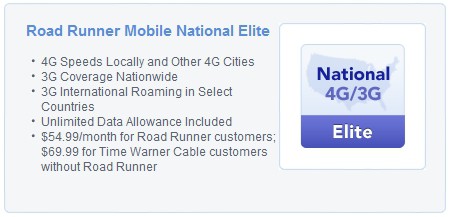
Time Warner Cable has stopped promoting three different service plans for its Road Runner Mobile wireless broadband service.  The company’s new promotional literature and website now promotes just one mobile plan  — National Elite, with three different prices depending on what kind of business you do with the cable company.  It also does away with Internet Overcharging schemes, promoting an “unlimited data allowance” regardless of whether you access the service over 3G or 4G networks.  That’s ironic, because Time Warner Cable’s CEO Glenn Britt is still a big believer in consumption billing schemes and usage limits.  Should Time Warner Cable ever return with new overcharging schemes, we’ll be sure to remind them about the implications of providing unlimited wireless service while trying to restrict the much larger wired pipeline Road Runner’s cable-based network provides.

As we reported last year, when Time Warner Cable introduced Road Runner Mobile last winter in North Carolina, the company offered three different service plans for customers considering signing up:

  • National Elite: Unlimited access to Clear WiMax and Sprint’s 3G EVDO Rev. A network for $79.95 per month to customers who also take the Road Runner Standard or Turbo cable modem service. Time Warner promises further discounts if customers subscribe to the cable provider’s double or triple-play cable service bundle which includes cable internet access and digital phone service.
  • Mobile Elite: Unlimited access to mobile WiMax for $49.95 per month and pricing also applies when bundled with the Standard or Turbo cable modem service with an additional bundle discount available.
  • Mobile 4G Choice: Caps mobile WiMax use at 2 gigabytes per month and will sell for $39.95 per month if customers add at least one other Time Warner cable service.

Now, as the company introduces the service in upstate New York, customers are getting promotions online and off for only one plan — National Elite.

Pricing appears to be standardized in most regions of the country, depending on what kinds of services you already receive from Time Warner Cable:

  • Current Road Runner subscribers will pay $54.99 per month for National Elite;
  • Current Time Warner Cable subscribers and those without cable or broadband service will pay up to $69.99 per month.

(Several cities in Texas can obtain special pricing promotions reducing the cost to $49.99 per month for 12 months.  Ask about special promotional pricing if you intend to sign up.)

Customers can select a plan that includes a two year service agreement with a $175 early termination fee (reduced by $7.50 for each month you remain a customer) and receive a substantial discount on a wireless modem and get the $35 activation charge waived.  Non-contract customers will have to buy their equipment at full price and pay the activation fee.  4G network speeds are up to 6 Mbps for downloads, and up to 1 Mbps for uploads. 3G network speeds are up to 1400 Kbps for downloads, and up to 500 Kbps for uploads, according to the Time Warner Cable website.

Plans directly available from Clear, which actually provides the Road Runner Mobile service are different:

  • Clear On-the-Go provides 4G-only service for $40 a month.  No 3G service.
  • Clear On-the-Go 3G Upgrade includes unlimited 4G service and up to 5GB of 3G usage for $55 a month.
  • Get Two: Home + On-the-Go includes service for one home computer and one portable computer, with no 6Mbps download speed cap, for $55 a month (add $15 for 3G service)
  • Get Two: On-the-Go includes service for two portable computers, with no download speed cap, for $65 a month (add $15 for 3G service for one computer, $30 for two)

A $35 activation fee applies to non-contract customers.  If you agree to a two-year contract, you can lease your equipment from Clear starting at around $5 per month and have the activation fee waived.

Now the fine print.

Although Clear markets its 4G service as “unlimited,” the fine print suggests they can make life difficult for customers they consider “disrupting or degrading” the service for others (underlining ours):

Excessive Utilization of Network Resources. Wireless networks have capacity limits and all customers can suffer from degraded or denied service when one or a small group of users consumes disproportionate amounts of a wireless network’s resources. Clearwire, therefore, will monitor both overall network performance and individual resource consumption to determine if any user is consuming a disproportionate amount of available resources and creating the potential to disrupt or degrade the Clearwire network or network usage by others. This process of monitoring both overall network performance and individual resource consumption is consistent with the description of the nature of the Service previously described in this AUP. Clearwire reserves the right to engage in reasonable network management to protect the overall network, including analyzing traffic patterns and preventing the distribution of viruses or other malicious code.

During periods of congestion, Clearwire uses various techniques such as reducing the data rate of individual bandwidth intensive users whose use is negatively impacting other users. This temporarily limits the amount of bandwidth available to the bandwidth intensive users until the congestion has diminished, at which point Clearwire will endeavor to lift any limits it may have imposed on bandwidth intensive users during the period of congestion. Clearwire may also consider historical usage patterns when temporarily reducing the data rate of bandwidth intensive users during periods of congestion. When feasible, upon observation of an excessive use pattern, Clearwire will attempt to contact you by telephone at the telephone number you gave to us or otherwise to alert you to your excessive use of bandwidth and to help you determine the cause. Clearwire representatives also are available to explain this AUP and to help you avoid excessive use incidents. If you are unavailable or do not respond to Clearwire’s attempt to contact you regarding excessive use, or if excessive use is ongoing or recurring and repeatedly having negative effects on other subscribers of the Service, Clearwire reserves the right to immediately restrict, suspend or terminate your Service without further notice in order to protect the network and minimize congestion caused by the excessive use. While the determination of what constitutes excessive use depends on the specific state of the network at any given time, excessive use is determined by resource consumption relative to that of a typical individual user of the Service and not by the use of any particular application.

Unlimited Use Plans.If you subscribe to a service plan that does not impose limits on the amount of data you may download or upload during a month, you should be aware that such “unlimited” plans are nevertheless subject to the provisions of this AUP. What this means is that all of the provisions described in this AUP, including those that describe how Clearwire may perform reasonable network management such as reducing the data rate of bandwidth intensive users during periods of congestion, will apply to your use of the Service. The term “unlimited” means that we will not place a limit on how much data you upload or download during a month or other particular period, however, it does not mean that we will not take steps to reduce your data rate during periods of congestion or take other actions described in this AUP when your usage is negatively impacting other subscribers to our Service.

Earthlink Imposes 250GB Usage Limit on Their Customers Getting Service from Comcast

Phillip Dampier July 12, 2010 Comcast/Xfinity, Data Caps, Earthlink 1 Comment

Earthlink, which depends on phone and cable companies to deliver its broadband service, has imposed a monthly usage limit of 250 gigabytes on its customers obtaining service from Comcast.

Customers began receiving postcards in May notifying them about the change in service terms which took effect July 1st.  Earthlink blamed the usage limits solely on Comcast, noting they were dependent on other companies to provide the infrastructure necessary to reach customers:

Comcast and other cable providers provide portions of the network that EarthLink High Speed Cable service uses to deliver broadband Internet access. EarthLink provides the other portions of the network and services like Webmail and the myEarthLink Start Page®.  EarthLink works with its business partners, like Comcast, to manage the network infrastructure.  […]Because Comcast is EarthLink’s business partner in providing the EarthLink Powered by Comcast Service, EarthLink is working closely with Comcast in implementing this Usage Cap.

Internet providers routinely sell the benefits of their broadband accounts to better accomplish data-heavy activities like online video using their service, even though in some cases all of that "heavy use" is being used as an excuse to implement usage limits on customers.

In reality, Earthlink offers little more than a handful of its own services to customers.  Most of its network connectivity, billing, and other services are handled by the providing cable or phone company.  Customer support with many technical issues is handled by Earthlink’s own off-shore technical support staff.

Still, Earthlink had offered an alternative to those threatened with Internet Overcharging schemes by Time Warner Cable and Comcast because the company had not adopted those usage limits until Comcast insisted they follow suit.  Presumably with this precedent in place, any other Overcharging schemes imposed by these providers would also impact their respective Earthlink customers.

For those violating the usage limits, enforcement won’t come from Earthlink.  Instead, the provider warns, Comcast will be the entity that comes down on your head.

The vast majority – more than 99% – of customers will not be impacted by the monthly 250 GB Usage Cap. In the event that you exceed more than 250 GB, you may receive a telephone call from Comcast notifying you that you exceeded the 250 GB Usage Cap in the previous month.  The customer service representative on this telephone call  will (i) tell you how much data per month the account has used, (ii) help you identify the source of excessive use, (iii) explain ways to moderate  and reduce your data usage, and (iv) explain the consequences of continuing overusage including termination of the EarthLink Powered By Comcast Service.

Based on Comcast’s past records, the vast majority of customers voluntarily reduce their data usage after this initial call.  However, if after you receive this telephone call from Comcast, you continue to exceed the 250 GB Usage Cap during any month within the six month period after this first telephone call, your EarthLink Powered by Comcast Service may be terminated.  For example, if your account exceeded the Usage Cap in the month of August and Comcast contacted you the first week of September informing you that your account exceeded the 250 GB Usage Cap in August, if your account exceeds the monthly Usage Cap in September, October, November, December, January or February, your EarthLink Powered By Comcast Service may be terminated.   In the event that your EarthLink Powered by Comcast Service is terminated as a result of exceeding the 250 GB monthly Usage Cap, you will have to wait one year from the termination date to be able to subscribe to the EarthLink Powered by Comcast Service again.

[…]Comcast has found that most customers who exceed the Usage Cap during one month change their usage patterns or make other adjustments in their data usage. It is our expectation that only a small fraction of the tiny number of customers whose accounts exceeded the monthly Usage Cap for at least two months during a six month period will have their EarthLink Powered By Comcast Service terminated for one year.

For now, Earthlink customers will have to call the company (888-327-8454) to determine how much data they’ve used during the month as the Comcast data usage meter is apparently only for Comcast customers.

[Updated] Clearwire Launches 4G Service in Rochester & Syracuse, Road Runner Mobile Also Forthcoming

[The article was updated at 10:30am to include promotional and coverage information not available when the article was published late last night]

Clearwire today announced the launch of its 4G mobile broadband service for businesses and consumers in Rochester and Syracuse, New York.  Designed to deliver the Internet at speeds four times faster than 3G, CLEAR is priced comparably to many wireless broadband plans, but has no usage caps.

Pricing from their website offers customers stay-at-home and mobile service plans (or both).  Customers choosing month-to-month service have to buy the equipment up front, starting at $70 and pay a $35 activation fee.  Those who commit to a two-year service contract can lease the equipment for $4-6 a month and skip start-up fees.  Packages start at $40 a month for 6/1Mbps service.  At $55 a month, they take the speed limit off, providing occasional bursts of wireless speed up to 10Mbps.  Another $15 on top of that buys you nationwide 3G roaming.  Sales tax is not included.  Customers get a 14 day trial period to evaluate the service and can cancel within that window with no obligation, although our Jay Ovittore reports they’ll drag you through the cancellation process.

At $40 for unlimited use, CLEAR’s 4G service beats Cricket, which charges the same price for 3G speeds, but limits consumption to 5GB per month before they start throttling your speed to dial-up.  Other mobile broadband services typically charge up to $60 for 5GB of usage at 3G speeds.  Ironically, while 4G service from Clearwire is unlimited, the slower 3G speed service is not — there is a usage limit of 5GB per month on the 3G network, and then overlimit fees of five cents per megabyte kick in.

A statement from the company released early this morning talks up the fact CLEAR does not burden their 4G customers with Internet Overcharging schemes like other wireless broadband providers.

“Our residents now have a fast Internet connection that’s as mobile as they are,” said Jerry Brown, regional general manager for CLEAR. “And we’re thrilled to offer affordable rate plans with no limits on the amount of data customers use. No caps on usage, no penalties – our customers just use the Web as much as they want wherever they go – it’s that simple.”

Clearwire's coverage area in Rochester & Syracuse

In Rochester, CLEAR covers approximately 560 square miles and more than 600,000 people with service extending as far north as Lake Ontario, as far south as Canandaigua and Geneva (Ontario County), as far west as Spencerport, and as far east as Webster.

In Syracuse, CLEAR covers nearly 230 square miles and more than 265,000 people with service extending as far north as Brewerton, as far south as Nedrow, Auburn, and Cortland; as far west as Village Green, and as far east as Fayetteville and Manlius.

However, the company’s 4G coverage area is spotty in many areas in both cities.  Verifying coverage from their website is essential before considering CLEAR.  Anecdotal reports from some of our readers and others suggest 4G service from Clearwire is not nearly as robust as 3G service from some other providers, and dead zones and slow speeds have caused some to cancel service.  Here’s an example of their coverage in my part of the town of Brighton, just southeast of Rochester:

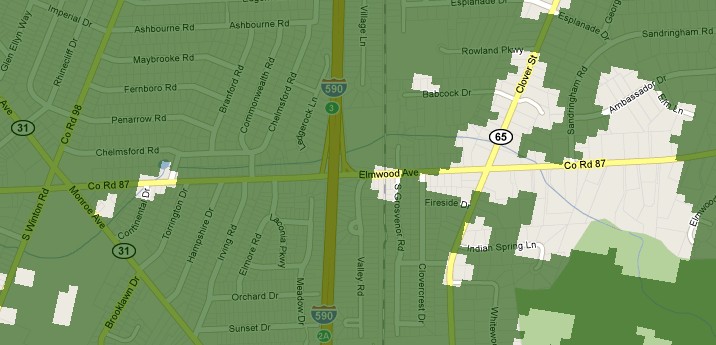
Clearwire's coverage of the 12 Corners/Elmwood Avenue area of Brighton, N.Y.

Some minor gaps in coverage are apparent near Commonwealth Drive, and if you were getting gas at the 12 Corners Mobil station or visiting Citizens Bank behind it, you’d be out of luck, but otherwise coverage looks fairly good to the west of Interstate 590.  However, a very strange gap pops up between Valley Road and South Grosvenor Road, also impacting a few apartment buildings at Elmwood Court Apartments, 3100 Elmwood Avenue.  That’s odd because although that part of Elmwood slopes slightly downwards, it’s still much higher than the homes on Valley Road or the apartments further back in the complex.  A major service gap opens up on Elmwood at Clovercrest Drive and extends into the very tony neighborhoods around Ambassador Drive and Clover Street.  But the country club set will do fine browsing away on the golf course at the Rochester Country Club further east.

In short, service can vary dramatically street by street, block by block, from nothing at all to full speed ahead.  Be sure to check your area before you commit to keeping the service, much less sign a two year contract for it.

For the rest of Rochester, if you live in the city or an inner-ring suburb, coverage is generally available.  Those further out in towns like Henrietta, North Chili, southern Pittsford, Honeoye Falls, Avon, Scottsville, Churchville, Brockport, Penfield and Perinton face significant gaps or no coverage at all.  Things improve dramatically in Ontario County in towns like Farmington and Victor and the cities of Canandaigua and Geneva.

For the greater Syracuse area, coverage pops up in Auburn and then disappears eastward until reaching Camillus.  Generally, coverage in Syracuse is not nearly as dense as in Rochester, with large gaps opening between suburbs and the city itself.  Mattydale is solidly covered, for instance, while Minoa isn’t.

Now that CLEAR has launched 4G service in Rochester and Syracuse, Road Runner Mobile, which is simply CLEAR rebranded as a Time Warner Cable service (they partly own Clearwire) will also soon be on the way.  Pricing in other Time Warner Cable cities wasn’t much different than from Clearwire direct, and some cable plans really push service contracts, which you really do not want on a service this new.  Do not commit to one unless you are satisfied with the service where you plan on using it.

Clearwire’s 4G Network in 2010

CLEAR 4G service is currently available in 44 markets across the United States, including: Syracuse and Rochester, N.Y.; Atlanta and Milledgeville, Ga.; Baltimore, Md.; Boise, Idaho; Chicago, Ill.; Las Vegas, Nev.; St. Louis and Kansas City, Mo.; Philadelphia, Harrisburg, Reading, Lancaster and York, Pa.; Charlotte, Raleigh, and Greensboro, NC; Honolulu and Maui, Hawaii; Seattle, Tri-Cities, Yakima and Bellingham, Wash.; Salem, Portland and Eugene, Ore.; Merced and Visalia; Calif.; Dallas/Ft. Worth, Houston, San Antonio, Austin, Abilene, Amarillo, Corpus Christi, Killeen/Temple, Lubbock, Midland/Odessa, Waco and Wichita Falls, Texas; central Washington, D.C.; Richmond, Va.; and Salt Lake City, Utah.

In the summer of 2010, CLEAR 4G will launch in Tampa, Orlando and Daytona, Fla.; Nashville, Tenn.; Modesto and Stockton, Calif.; Wilmington, Del.; and Grand Rapids, Mich. By the end of 2010, CLEAR 4G will also be available in major metropolitan areas such as New York City, Los Angeles, the San Francisco Bay Area, Boston, Denver, Minneapolis, Miami, Cincinnati, Cleveland and Pittsburgh.

You can read a company-provided tutorial about the service below the jump.

… Continue Reading

Search This Site:

Contributions:

Recent Comments:

Your Account:

Stop the Cap!