Home » time warner cable » Recent Articles:

AT&T U-verse Arrives in the Triad, But Savings Are Elusive As Rate Hikes Continue

AT&T unveiled it’s U-verse system Monday in the Triad region of North Carolina, hoping to poach customers from Time Warner Cable’s “triple play” package of phone, broadband, and cable service.

AT&T U-verse services, which are delivered over AT&T’s Internet Protocol (IP) hybrid fiber-copper network, offer an alternative to cable with a DVR that can record more programming than the competition, features and apps not available from the local cable company, and additional channels new to the region. AT&T U-verse can combine every AT&T service a customer subscribes to onto a single monthly bill.

The most popular Internet-only tier of service has somewhat anemic download speeds up to 6 Mbps for $43 a month — other packages range from $38 for 3 Mbps to $65 for 24 Mbps.

U-verse TV packages include “local-channel only” service for $19 a month (with a stinging $199 installation fee), to more than 390 channels for $112 a month, with a $29 activation fee.  Other packages include U-100 with 130 channels for $54 a month and U-200 with 230 channels for $67.  High definition channels, now numbering more than 130, cost $10 extra per month.  Want premium channels in HD?  That’s another $5 a month.

Like other providers, AT&T has tinkered with pricing to deliver the most savings to customers who bring all of their business to AT&T with a triple-play bundle subscription.

“Today’s expansion of AT&T U-verse reflects our commitment to make the investments necessary to bring consumers across the Piedmont Triad a new era of true video competition,” Cynthia Marshall, AT&T North Carolina president said in a statement. “Local residents have asked for more choices in television service and today we’re delivering.”

[flv width=”640″ height=”500″]http://www.phillipdampier.com/video/ATT U-verse introduction.flv[/flv]

Watch this comprehensive video from AT&T explaining the many types of services U-verse offers and helpful tips to prepare for service installation.  Then view an actual installation in a customer’s home who shows off the equipment.  Stop the Cap! recommends you let AT&T do all of the required wiring for you.  That’s why you are paying that installation fee!  (22 minutes)

Brubaker

But despite the company’s claims that competition will deliver lower prices for consumers, the evidence suggests otherwise.

AT&T credits a statewide video franchising bill passed in the North Carolina legislature for making U-verse possible in the state.  Company officials showed their thanks by inviting the two state legislators instrumental in shepherding AT&T’s agenda through the General Assembly to be on hand to take credit for introducing cable competition in the state.  They also publicly thanked them in their press release.

Seventeen term House Rep. Harold Brubaker (R-Randolph) congratulated AT&T for its accomplishments.  Brubaker received $4,000 in campaign contributions from AT&T in the first quarter of 2010.

The representative from Asheboro co-sponsored the 2006 Video Service Competition Act which stripped local oversight of cable operators and made AT&T’s entry into North Carolina effortless.  For other would-be competitors, especially municipalities seeking to build their own fiber networks, Brubaker has been far less helpful.  Most recently, he voted against an effort to bring broadband service to Caswell County in areas incumbent provider CenturyLink has ignored for years.

Adams

“Prior to the legislation, you had geographic areas where you operated in, so it kind of like took the walls down. The legislation took the walls down to allow for more direct competition for the consumer. Competition is great.  The consumer’s the one that benefits,” said Brubaker.  “AT&T’s presence in the market will very definitely save customers money.”

Rep. Alma Adams (D-Guilford), another co-sponsor, said AT&T’s arrival was exactly what she hoped for when she supported the legislation.

“As policymakers, our goal was to increase investment in North Carolina and give consumers more choices and innovative new services,” said Adams. “Today’s announcement makes that goal a reality for Triad residents.”

Adams added that AT&T U-verse also provided a safety valve for consumers who want an alternative to incumbent provider Time Warner Cable.

“Even if they like a particular company, they always like to know that there’s some other opportunities out there that they can look at as well, so they can do some comparing,” she said.

[flv width=”480″ height=”380″]http://www.phillipdampier.com/video/Important Information about ATT U-Verse system.flv[/flv]

AT&T delivered more time and attention to North Carolina legislators at their launch event than they ever will on U-verse.  AT&T segregates Public Access, Educational, and Government channels on a single U-verse TV channel that makes for tedious viewing.  Watch this demonstration from the California Public Utilities Commission.  (4 minutes)

AT&T announced the service would initially be available in limited areas of Forsyth, Davidson, Guilford, Rockingham and Alamance counties, and we do mean “limited.”  Many Triad residents who checked to see if the service was available in their area found it was not.  In fact, AT&T refuses to disclose exactly how many customers in the region can actually sign up for the service.  We couldn’t find anyone who could order the service when it officially launched.

“There will be small pockets around most of the entire area,” Chuck Greene, AT&T’s regional director for the Piedmont Triad told the News-Record. “Once we complete the build-out, it will include parts of Davidson, Caswell and Randolph.”

AT&T lobbied hard to sweep away earlier provisions in local video franchises that committed providers to rapidly expand service to every possible customer in their respective service areas.  Under the Video Services Competition Act, AT&T can take its sweet time, perhaps for years before service becomes widely available across the region.  Some areas will never receive the service.

Time Warner Cable welcomed competition from AT&T U-verse.

“For a long time, Time Warner Cable has faced competition from satellite and dish providers,” Scott Pryzwansky, the company’s local public affairs manager, wrote to the News-Record. “We continue to invest in our network and remain committed to bring the best products and services to the Triad. We are confident we will maintain positive relationships with our customers.”

Time Warner Cable has little to fear from AT&T’s arrival.  Pryzwansky said Time Warner Cable has not lowered its pricing in any of the markets where it faces AT&T U-verse competition.  Both AT&T and Time Warner Cable have raised prices at least annually for their respective subscribers.  The only exception in North Carolina has been in Wilson, where municipal provider Greenlight has kept Time Warner Cable from increasing prices.
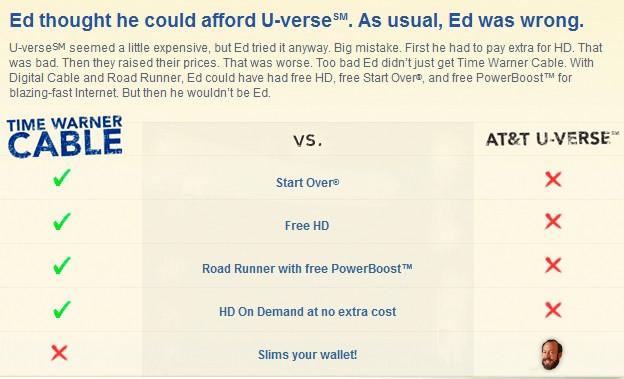
Time Warner Cable maintains a special website to cope with competition from AT&T U-verse and satellite providers. Hilariously, the site quotes a piece from DSL Reports about U-verse price increases. Time Warner subscribers might not want to venture too far beyond that piece, because editor Karl Bode reports on the cable company's own rate hikes as well. (Click image to visit TWC site)

Stop the Cap! reader Sam in Greensboro thinks AT&T’s arrival is much ado about nothing.

“AT&T prices their U-verse service nearly the same or more as Time Warner Cable, especially after the introductory rate expires,” he says.  “Few people are going to be bothered switching back to Time Warner after the year is up, so they’ll be paying the same high prices for cable service to AT&T instead of the cable company — a distinction with no difference.”

Sam won’t bother with U-verse because he is disgusted with AT&T’s lobbying efforts to stop consumer broadband reform and Net Neutrality.

“It’s like dealing with the devil,” Sam writes.  “Why would I want to pay AT&T my money so they can turn around and spend it working against my interests as a consumer?”

The only good thing about U-verse’s arrival is that it may stall Time Warner Cable from trying another Internet Overcharging scheme in the area.

“Time Warner has to think twice about another usage cap and overlimit fee ‘experiment’ in the Triad if customers can simply flee to U-verse, although knowing AT&T they’d love to have the same rationing of the Internet they force on their wireless customers,” Sam said.

[flv width=”636″ height=”373″]http://www.phillipdampier.com/video/TWC Fights Back U-verse.flv[/flv]

Time Warner Cable maintains a sometimes-bizarre web campaign to convince customers not to switch to U-verse or satellite.  We’ve put together the various videos so you can watch them all at once.  (4 minutes)

Like Time Warner Cable, AT&T does not offer a-la-carte cable programming, either.  Customers can only choose from large packages of programming, not individual channels.

Triad area cable customers told local media they were tentatively glad U-verse is competing, but many are taking a wait and see approach as to whether they’ll actually see any savings.

WFMY News 2 spoke with cable customers today. One man said he feels like a “hostage” to his cable company because they have a monopoly on TV, Internet and phone bundles. A woman said cable and satellite companies drive her “crazy,” so she gave up and now simply rents movies.

“I am happy, but it’s hard times. I have three children. We live on one income,” Jamie Rettie, a Time Warner Cable customer told News 2. Whether she switches to AT&T or not, she’s said she’s hoping for a change in her bill.

“Hopefully they’ll keep competing against each another and have better and better prices for their services,” she said. “(I’ll) wait out my contract and we’ll see what happens.”

Some residents, like Thomas, are left picking the lesser of two evils:

“I don’t know who’s worse at their game, as Time Warner Cable and AT&T are both evil corporate entities that care only about their bottom line,” he writes. “Search the Internet and understand this service limits the amount of TV’s that can be used at one time.”

[flv width=”640″ height=”500″]http://www.phillipdampier.com/video/Greensboro Media Cover U-Verse Launch 9-13-10.flv[/flv]

Watch several news reports from Triad area TV stations about the introduction of AT&T U-verse.  In order, we include reports from WXII, WGHP, and WFMY-TV.  (7 minutes)

Sarasota Florida Quietly Builds Fiber Network for “Traffic Control” That Could Do Much More

Phillip Dampier September 13, 2010 Broadband Speed, Community Networks, Competition, Editorial & Site News, Public Policy & Gov't Comments Off on Sarasota Florida Quietly Builds Fiber Network for “Traffic Control” That Could Do Much More

Sarasota County's current fiber networks are depicted on this map produced by the Sarasota Herald-Tribune

In many communities across America, there is more fiber optic cable on telephone poles and buried in underground conduit than you may realize.  But as a consumer, you’ll never get to benefit from it because of a broadband duopoly that works hard to keep municipal fiber networks away from your home and out of your reach.

Take Sarasota County, Florida.  The county is making preparations to build a 96-strand fiber network across the county, capable of delivering 100Gbps service over each strand, and early plans suggest they’ll use it for… controlling traffic signals and viewing traffic cameras.  Taxpayers are ultimately paying the costs to construct the $1,000-per-mile fiber network, but current plans won’t allow any of them to access it.

Why?  Because companies like Comcast and Verizon want it that way.

It’s nothing new and it’s not limited to Sarasota.  In cities across the country, enormous capacity networks are devised and constructed to deliver high speed data connections to local hospitals, schools, and public safety institutions.  Many states’ transportation departments have enormous excess fiber capacity, installed from federal and state grant money to develop intelligent traffic systems.  But almost all of these networks are strictly off-limits to the general public and small business entrepreneurs who are stuck with the far slower broadband service the phone and cable companies deliver at ridiculously high prices.

Sarasota has had ultra-fast connections for years, delivering a dedicated 10Gbps connection to one area hospital and insanely fast connections to police departments and other government buildings.  It’s managed by Comcast and was built for $3 million, paid for directly by Comcast subscribers.  Comcast built the county I-Net network with the understanding that commercial use of the network was strictly prohibited.

The result is blazing fast speeds for institutions that can’t possibly utilize all of the capacity they have, and a broadband cartel delivering less service than local residents and businesses need.

The Sarasota Herald-Tribune considered the county’s fiber future so important, it dedicated a week of coverage to municipal fiber, and the providers and politics that get in the way.

The newspaper reports that the existing broadband duopoly under-delivers access to digital entrepreneurs that need those speeds the most.

The co-called creative class — bandwidth entrepreneurs on a budget — struggle to get by on mediocre connections that are largely repackaged retail offerings.

Over and over, businesses surveyed by the Herald-Tribune pointed to the tell-tale distinction between business-class service and retail.

“Businesses upload stuff, while consumers download,” said Rich Swier Jr., who works from a Central Avenue office where the only service comes from Comcast. Swier, the only entrepreneur on the Sarasota Broadband Task Force, is not happy with what he gets from Comcast. “They are repackaging a consumer grade service as a business service and charging three times more.”

Swier is paying about $200 per month for what is supposed to be 50 megabits per second download and 5 megabits up. But in reality, it operates at half those speeds, he said.

Thaxton

The newspaper’s conclusion: Fiber access is to modern business what train stations and interstate connections used to be.

Sarasota’s fiber project has grown considerably since its original proposition — 24 strands of fiber installed for $11 a foot. Then the county received an estimate that said they could have triple the amount of fiber for just 20 cents more per mile.  Broadband enthusiasts urged the county to upgrade the network to 96 strands and they agreed.

Commissioner Jon Thaxton told the newspaper he views the planned fiber network as an insurance policy as Internet speed becomes more and more important.

“It does, at a minimum, put us in a position of not being wholly dependent on some other service provider,” Thaxton said.

The newspaper notes the economic implications of superior broadband are enormous.

Google sparked the issue when it announced plans earlier this year to hot-wire a city or cities somewhere in the United States, creating what could be a prototype for a community with the broadband speeds to more than command its economic future.

Our political leaders clearly saw the import of this. Heck, City Commissioner Dick Clapp even jumped into a shark tank to show Google the community’s spirit (yeah, they were pretty small sharks, but I wouldn’t do it, fiber or no fiber).

Businesses of the 21st century are hungry for fast speeds, and this region has been fortunate to land some with voracious appetites.

[…]Who would have pegged Lafayette, La., as a place where Hollywood would set up a first-rate special-effects studio? (Can you say the Walt Disney Co. as a customer?) But the fiber was there, and the big dogs came.

South of us, in Naples, it is private enterprise driving high-octane broadband, the work of a technology-savvy entrepreneur and a like-minded group of millionaires who want what many of us raising families in Southwest Florida are after: an economy that would allow our kids to remain here with good jobs.

In the Information Age, connectivity is going to be critical in attracting the kind of companies we want, and the well-heeled folks in Collier County know that. (They also clearly know how to make a lot of money, so don’t read their efforts too much as altruism).

Then you have one of the new 800-pound gorillas of the fiber effort, Allied Fiber, a New York-based company in the midst of creating a trans-continental broadband push akin to what the railroad barons of the 1800s accomplished.

Southwest Florida has a good chance of tapping into their $500 million (or more) play.

Competition from Municipal Providers Drives Prices Down and Speeds Up (New Rules Project)

The county established a Broadband Task Force, but made the same mistake so many other municipalities make when they create these panels: consumers are not represented at all and small business representation is limited to a single participant. Consumers will ultimately be a major source of revenue from municipal broadband projects and their needs and interests must be represented.  Since incumbent commercial providers will seek to impede municipal competition by organizing consumer opposition to such projects, getting trusted consumer advocates and broadband evangelists on your side at the outset can make the difference between enthusiastic support for additional broadband choice or a mind-numbing, incumbent provider-driven sideshow about a “socialist government takeover of the Internet.”

The rest of the panel is made up of public officials from the school district, county and city government and the local hospital.

The newspaper hints these are exactly the wrong people to invite onto a Broadband Task Force.  Virtually all already enjoy the generous bandwidth already provided by Comcast’s I-Net, few are likely to be well informed on broadband technology issues, and apart from the lone businessman on the panel, the group is unlikely to grasp the commercial implications of better broadband for the local digital economy.

Since these individuals all earn a paycheck protecting their own institutional interests, the larger vision of community broadband can easily get lost in turf wars and political disputes, or interference from incumbent providers.

Providers can cut the bottom out of such task forces with rewarding side deals for friends — enhanced services at fire sale prices. For institutional opponents — intransigence and crippling rate increases.

On Florida’s East Coast, Martin County’s public service institutions learned first hand what kind of pricing Comcast is capable of bringing to the table when an existing contract expired.  Comcast demanded a whopper of a rate hike.

“We decided for the kind of money these people are asking us, we would be better off doing this on our own,” Kevin Kryzda, the county’s chief information officer, told the Sarasota paper. “That is different from anybody else. And then we said we would like to do a loose association to provide broadband to the community while we are spending the money to build this network anyway. That was unique, too.”

The last straw for county officials was the loss of a lucrative deal with California-based Digital Domain to build a Florida branch campus.  The company chose St. Lucie County instead.  John Textor, Digital Domain’s co-chairman, told the Herald-Tribune that having a local all-fiber network connection and being able to set up an all-fiber direct connection to remote servers in Miami was a key advantage of the site in Port St. Lucie.

After that, Martin County commissioners voted unanimously to obtain bids for their own network.

Martin County’s fiber network will combine a publicly-constructed institutional network and a tiny rural phone company paying part of the costs to resell excess capacity to commercial users. The downside is that consumers will not be offered service.

In Florida’s Lee and Collier Counties, U.S. Metro network has proved fiber’s ability to transform entire regions economically.

“If you build it, they will come” is a common rallying cry for fiber proponents.  In both counties, they came.  The latest arrival?  Jackson Laboratory of Bar Harbor, Maine, now being showered with more than $200 million in government grants to build a genetic research campus in Collier County.  A large portion of that money will end up staying in Collier County, stimulating the local economy and creating jobs.

Why all the clamor?  Because U.S. Metro runs a network that puts incumbent phone and cable companies to shame.  When a business requests service, owner Frank Mambuca doesn’t tell them what speeds they’ll have to live with.  Instead, he asks, “how many gigabits do you want?”

Unfortunately, U.S. Metro also only sells service to businesses, but they have some wholesale customers that do serve consumers.  Marco Island Cable and a sister company, NuVu are cable overbuilders that offer access to U.S. Metro’s broadband network at speeds and prices Comcast and CenturyLink can’t touch.

Marco Cable, a tiny independent provider, delivers faster speeds at lower prices.

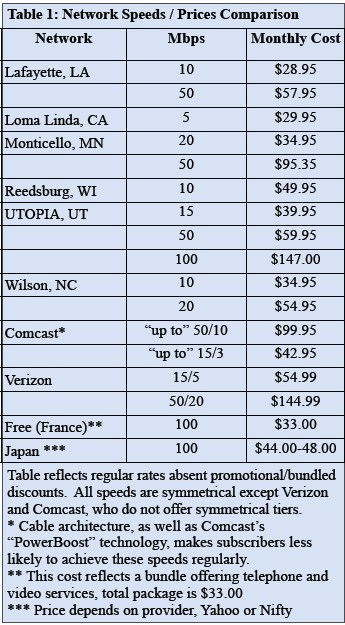
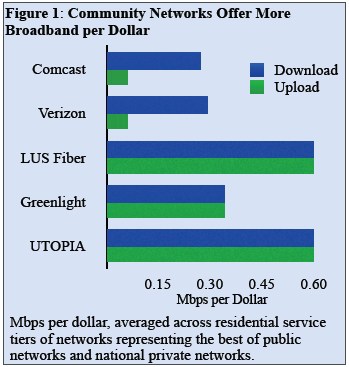
Marco Cable is preparing to deliver fiber-based 75Mbps service for $99 a month, along with several other access plans that save at least $12.95 per month over Comcast’s prices, and undercuts CenturyLink’s DSL plans as well.  The company also does something Comcast won’t — it promises unlimited Internet access and email accounts.

If someone wants even faster speeds, say 100Mbps, they can call Marco Cable and request it.

The highest download speed that Verizon offers [locally] at present is 50 megabits per second for $149.99 a month, according to spokesman Bob Elek.

NuVu is currently installing competing service in condos on the mainland.  For the father and son team that run both Marco Cable and NuVu, their philosophy is radically different from most cable and phone companies — delivering as much broadband speed as customers can use at prices they can afford.

For existing providers, who have “marked up” prices for years, the competition’s lower prices threaten profits from delivering “good enough for you” speeds at the highest possible price.

For some, simply lowering prices and enhancing service to compete isn’t the answer — putting a stop to municipal competition at all costs is.

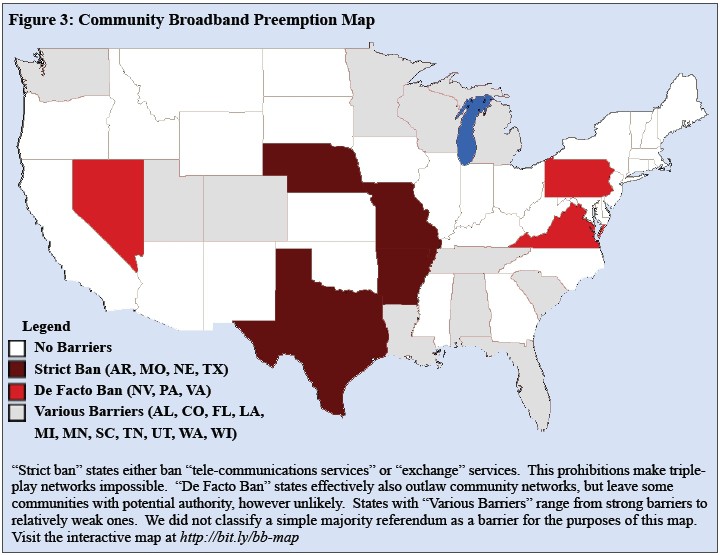
In 18 states, high priced lobbying campaigns financed by giant phone and cable operators have succeeded in restricting or banning competing providers.  AT&T has been the most aggressive, successfully impeding competition in states like Texas, Wisconsin, Missouri, Arkansas, Michigan, Tennessee, and others.  Comcast helped stop competition in its home state of Pennsylvania.

Click image to view interactive map

Year after year, Time Warner Cable and AT&T continue efforts to try and do the same in North Carolina, a potential hotbed of locally run, community-owned providers.

For some towns and cities who have spent years begging for improved service, the clock has run out.  The Sarasota Herald-Tribune used Wilson, N.C., as an excellent example.  The city of 50,000 east of Raleigh decided it was through asking Time Warner Cable to provide a platform for a digital economic revival.

Brian Bowman, public affairs manager for the city, told the newspaper the city faced economic disaster from twin blows — the loss of the textile industry and America’s waning interest in tobacco products. Giving the keys to the local cable company to drive Wilson’s nascent digital economy into Lake Wilson was simply not an option.  The town would build its own digital highway — a municipal fiber to the home system for consumers and businesses.

For both, Wilson’s Greenlight system provides up to 100 megabits per second in both directions.  Time Warner Cable residential customers, in comparison, max out at 15/2 Mbps service.

“The way we see it, you’re going to have haves and have-nots in the next generation broadband world,” Bowman said. “The fact is we wanted to invest in our own future; that’s why we did this.”

Cable and phone giants always are going to say that current speeds are adequate and that there is no need for cities to build expensive networks themselves, Bowman said.

“I have heard that here from some of the incumbents, that you don’t need to go that fast. I’m sure the folks in Florida were doing OK without I-4,” Bowman said, noting the state never would have gotten Disney World if not for that interstate access.

People in Sarasota County are about to hear all of the usual arguments against municipal service:

  • “Taxpayers will pay for it.” — Not with revenue bonds they won’t.  These bonds deliver returns to investors from revenue earned by the municipal provider, not from taxpayer dollars.
  • “We want a level playing field.” — This cable industry opposed providing one when satellite and phone company IPTV showed up, as they tried to withhold programming and lobbied against both.
  • “The government should stay out of the private sector.” — Christopher Mitchell, writing for the New Rules Project, tore apart that argument:

Governments “compete” with the private sector in many ways on a daily basis. Libraries compete with book stores, schools with private schools, public transit with taxis, police with security firms, even lumber yards, liquor stores, municipal golf courses and swimming pools with privately owned counterparts. Without public competition in the form of the Rural Electrification Authority, much of the country would still not be wired for electricity or phones.

The focus on whether local governments, who have a wholly different motivation than private companies, are “competing” with the private sector is a red herring to distract the public from incumbent providers’ failures to build modern networks. On matters of infrastructure, a community should always have the option to build the network it needs, just as it can build roads, bridges, water systems, and other modern necessities.

Ultimately, Sarasota County residents have two choices:

  1. Obtain the best traffic control and monitoring system America has ever seen, capable of delivering crisp, clear 1080p HD feeds of traffic tieups on Route 301.
  2. Deliver Sarasota County 21st century broadband that will power the digital economy and bring hundreds of millions in investment dollars, create thousands of new, high-paying jobs, and save local consumers and businesses a lot of money from broadband competition.

Update #2 – Time Warner Cable Announces Yet Another Rate Increase: DVR Prices Up in Selected Cities

Phillip Dampier September 9, 2010 Consumer News 18 Comments

For the third time this year, Time Warner Cable is increasing prices on some of its cable products in upstate New York.

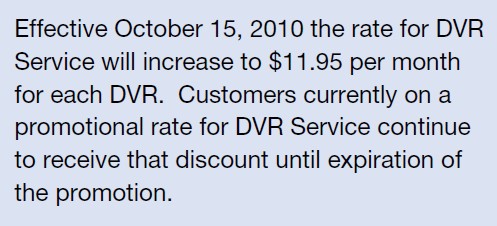
Some customers in western New York are receiving notification that effective this October, the price for the cable company’s digital video recorder (DVR) box is increasing by 18 percent from $10.95 to $12.95 per month (remote control included). Time Warner Cable charges different prices for DVR service, depending on what each local market will tolerate and how much competition the company receives.  A representative of Time Warner Cable in Buffalo told us the company was trying to “standardize rates” across Upstate New York.  If true, residents in Buffalo who already experienced one recent rate increase for DVR service will get a big shock if rates are “standardized” in the same direction Rochester and Syracuse are experiencing.  More details below.

After multiple contacts, we’ve managed to sort out what we believe the increases to be.

Buffalo:  Verizon FiOS and the Buffalo economy have conspired to keep prices considerably lower in Buffalo than other upstate cities.  Buffalo residents pay just $9.95 a month for DVR service and will experience no increase in rates… for now.  If the Buffalo representative was correct about rate standardization, residents there will eventually see a $3 a month rate hike for DVR service.

Rochester: Effective October 15th, DVR service will increase $2 a month from $10.95 to $12.95, an 18 percent increase [Update 9/20 — Many areas are being notified on their bill it is $1, not $2 — see update below.]  Each additional DVR box will cost $11.95.  Originally, we were told the increase was a dollar a month.  Not so fast, says our reader Tim who tipped us off to the story.  He lives in a Rochester suburb and his September bill contained a notification the rate was increasing two dollars a month.  The bill was correct and the original representative we spoke with was wrong.

Syracuse: Residents of the Salt City are in the same boat as residents in Rochester.  On October 15th, DVR service there also increases by two dollars a month, from $10.95 to $12.95.  Apparently Verizon FiOS has not made as much of a competitive difference in Syracuse, probably because it is not widely available yet.

Ironically, if you register for TWC's MyServices control panel and shop the cable company's services online, you can grab a DVR box free for 12 months.

In February, Time Warner broadly increased rates on its cable and broadband services.  In September, rates for broadband-only customers also increased.  The latest increase will not affect customers on promotions or bundled packages that include a DVR.

Our reader Tim says he’s not going to stand for it.

“Time to trim another item off of my TWC bill,” he writes. “I already quit HBO, I guess the DVR is next.”

The Time Warner Cable representative we spoke with only learned about the rate increase “an hour ago.”  She told us, “We’re probably going to get some calls on this.”

Ironically, Time Warner Cable is giving away a year of free DVR service to customers in the northeast using its recently introduced “My Services” control panel and online shopping section.

Our advice to those who don’t want to pay the increase:

  • Complain to Time Warner and ask for a credit for the difference in price for a year.
  • Turn in your DVR box, wait a week and then take advantage of their “online only” offer, if available in your area, for a year’s free service. (Registration for MyServices required.)
  • Cancel something else in your package that will make up the difference.  Are you still watching HBO or Showtime?  Many TWC systems charge $13.95 for HBO and $10.95 for Cinemax and other pay channels.  That’s up to $167 a year per premium network!  Many HD subscribers might still be paying for a Digital HD Tier that used to include HDNet and HDNet Movies.  Now you’re paying an extra $4.95 a month for MGM HD, Universal HD, Smithsonian, and the cattle auctions on RFD-TV.  Not watching those?  Drop that tier and save $60 a year.  If you still want commercial free movies, consider Encore’s Movie Pack instead of HBO, et al.  Encore only charges $5 a month for seven theme-based movie channels.

Believe the bill -- for residents in the city of Rochester and adjacent suburbs, the rate increase turns out to be $1 for DVR service, despite repeated assertions from TWC reps back on the 9th).

[Updated 3:30pm ET — We have been on the phone with Time Warner Cable reps in Buffalo, Rochester, and Syracuse a total of eight times to re-verify some of the information for this story after the first representative we spoke with gave us conflicting information.  Subsequent contacts also gave us a range of responses from “I’ve worked here four years and am telling you there is no price increase” to “Unfortunately we are increasing the price and I don’t know why.”  We’ve updated and corrected the details below.]

[Update #2: 9:15am ET 9/20 — I pulled up a copy of my October statement and discovered a dollar increase in the town of Brighton for DVR service, which triggered another call to TWC this morning to learn why the information I was given on the 9th was different from what the bill showed.

The latest explanation is that different areas are subject to paying different amounts.  Apparently.

For folks in the city of Rochester and adjacent suburbs, “less is more,” so the dollar increase is slightly better than the two dollar increase.  I just wish representatives were better trained to answer simple questions accurately.]

Time Warner Cable Tease: Road Runner Extreme Advertised Where It’s Not Available

Phillip Dampier September 8, 2010 Broadband Speed, Competition, Data Caps, Video 14 Comments

Advertisements for Road Runner Extreme, Time Warner Cable’s DOCSIS 3 “wideband” service, began running in Rochester, N.Y., this week despite the fact Time Warner Cable has no intention of providing the service in the area anytime soon.

The ad offers Road Runner subscribers the chance to obtain 30/5 Mbps service “for just $20 more per month” and invites viewers to “call now to order.”

So that’s what we did.

Time Warner Cable representatives in Buffalo confirmed the service is not available in Rochester, but figured if they were advertising it here it must be coming soon.  Even they were surprised with the answer they got ‘from upstairs’ when inquiring further.

“No, it’s not coming to Rochester anytime soon,” we were told.

We asked if there was any timetable to bring DOCSIS 3 upgrades to the area.  The response was both illuminating and candid:

“I wouldn’t hold your breath.  We’ve had some issues in the Rochester area and, for now, we feel comfortable offering the service only in the Buffalo area in western New York.”

When we asked why the company was now heavily advertising a product on Rochester TV screens that isn’t available here, we were told Time Warner Cable was increasingly consolidating its operations in western New York through its Buffalo office, which is where “most customer service” and “local advertising you see on cable channels” is now originating.  Since Road Runner Extreme is available in Buffalo, Rochester viewers are accidental witnesses to a service intended for residents of The City of Good Neighbors.

So what are “the issues” in the Rochester area?

Time Warner Cable bypassed Rochester for promised upgrades after the defeat of their proposed Internet Overcharging plan, which would have tripled broadband prices for an equivalent level of service.  Consumer outrage and political headaches combined to kill the experiment.

Meanwhile, Time Warner Cable isn’t compelled to hurry DOCSIS 3 into an area underserved by Frontier Communication’s slow speed DSL service.  Neighboring communities in Buffalo and Syracuse have access to Verizon’s fiber-to-the-home service FiOS, which has driven Time Warner to enhance services in both communities to avoid losing customers.

Despite the slow pace of upgrades, Time Warner Cable previously stated it intended to upgrade a significant number of its cable systems to DOCSIS 3 technology by the end of the year.  So it will eventually reach the area.  As Time Warner Cable recommends… just don’t hold your breath.

[flv width=”490″ height=”380″]http://www.phillipdampier.com/video/Time Warner Cable at the NYS Fair.flv[/flv]

The closest residents of the Flower City will get to Road Runner Extreme is at the New York State Fair in Syracuse, at the Time Warner Cable booth.  (Their advertised ‘celebrity’ is Mike O’Malley.  Who???)  (1 minute)

Time Warner Cable Rolls Over: Makes Agreement With Disney to Raise Your Cable Bill

Phillip Dampier September 4, 2010 Consumer News, Online Video, Video 7 Comments

Time Warner's "Get Tough" Campaign Caved In to Disney/ABC's Demands

So much for “getting tough.”

Time Warner Cable averted a blackout of several Disney-owned cable and broadcast outlets Thursday when it cut a deal with Disney to keep programming on Time Warner Cable.  As part of the agreement, the nation’s second largest cable operator agreed to add several Disney-owned networks subscribers will ultimate pay higher cable bills to receive in 2011.

The cable trade and business press are applauding the agreement.  The Wall Street Journal said the two sides surprised the TV industry by avoiding the level of public acrimony common with similar disputes in the past, avoided nasty publicity campaigns, and reached an agreement that avoided a standoff.

“We are pleased to have reached an agreement without any interruption in service,” said Time Warner Cable Chief Executive Glenn Britt.

Subscribers may also appreciate they aren’t facing the loss of programming they would still pay for as part of their monthly cable bill.

Disney wins new fees for carriage of ABC shows approaching 50 cents a month per subscriber, according to sources close to the negotiations.  The programmer also will receive substantial increases in payments from the cable company for ABC Family and The Disney Channel, along with the right to repurpose that programming online through services like Hulu and ABC.com.

Time Warner Cable has argued that programming costs make up the bulk of rate increases, yet its newest agreement with Disney compels the cable company to add additional networks and services cable subscribers may have no interest in receiving, much less paying to receive.

Among them are:

  • Disney, Jr., a new 24-hour cable network targeting preschoolers which will replace ABC SoapNet in early 2012;
  • ESPN Goal Line, a new network showing reruns of college football games;
  • ESPN Buzzer Beater, still another new network rerunning college basketball games is also under development and will be added to Time Warner Cable’s lineup when launched.
  • ESPN 3D, which will show-off sporting events on newly available 3D televisions.
  • The addition of ESPN Deportes HD to Time Warner Cable’s larger footprint.
  • Availability of ESPN Radio feeds in New York, Los Angeles and Dallas to Time Warner Cable’s video platform.
  • A Time Warner Cable/ESPN Deportes co-branded, Spanish language sports website in Los Angeles.

One of the most contentious issues in the debate had been online video programming.  Time Warner Cable agreed to add ESPN3, an online network, for “authenticated” cable subscribers who have a package that includes ESPN.  That’s a departure from Disney’s usual demand that operators pay a fee for every broadband customer they have in return for access. That means Time Warner Cable customers who subscribe to a TV package will soon be able to access ESPN, ESPN2, ESPN3, and ESPNU even if they don’t subscribe to Road Runner.  But it also means Road Runner customers who don’t take cable-TV will not have access.

Finally, Time Warner Cable won the right to include on-demand access to popular ABC and Disney Channel shows.

Ultimately cable customers will pay a price for this agreement, facing even higher cable rate increases in 2011 to cover the costs for additional programming.  Many critics contend Time Warner Cable’s “Roll Over or Get Tough” campaign is more public relations than substance.  The company can claim they are fighting for subscribers when an intransigent programmer forces the cable company to take networks off the air, but in reality most of the time agreements are reached that look to many more like “rolling over” than “getting tough,” especially when the company simply passes along the added costs to cable customers.

[flv]http://www.phillipdampier.com/video/CNBC Disney Time Warner Agreement 9-2-10.flv[/flv]

CNBC covered the announced agreement between Time Warner Cable and Disney, reporting it was Disney’s largest carriage deal ever.  (2 minutes)

Search This Site:

Contributions:

Recent Comments:

Your Account:

Stop the Cap!