Home » time warner cable » Recent Articles:

Clearwire in Big Trouble: Laying Off 15% of Staff, Unhappy Customers Fleeing, Money Running Out

A Facebook group has been established to oppose Clear's Internet Overcharging schemes

The clock may be running out on Clearwire, America’s “4G-WiMax” wireless broadband provider controlled by Sprint, with close investment ties to Comcast and Time Warner Cable, who both resell Clear wireless broadband under their own brands.

At issue is money — the lack of it, and the wireless company’s cash on hand has grown so perilously low, Clearwire was forced to admit to its investors it may not survive beyond the first half of next year:

Based on our current projections, we do not expect our available cash and short-term investments as of September 30, 2010 to be sufficient to cover our estimated liquidity needs for the next 12 months. We also do not expect our operations to generate positive cash flows during the next 12 months. Without additional financing sources, we forecast that our cash and short-term investments would be depleted as early as the middle of 2011.

The Securities and Exchange Commission rules governing public companies represent a public relations nightmare for anyone trying to put a positive spin on bad news, and Sprint chief Dan Hesse desperately tried to make lemonade out of the financial lemon Clearwire increasingly represents for the wireless company.

“If you get to the point where you don’t have 12 months of cash in the till, even if you’ve got negotiations going on, or what have you, you have to, from an accounting perspective, say you have a going-concern issue,” Hesse said. “That doesn’t mean that Sprint and other partners won’t continue to fund Clearwire.”

With Sprint’s 54 percent stake in Clearwire defining the entity as a subsidiary of Sprint, its demise could risk Sprint’s own financial well-being, something Sprint plans to address in 2011, potentially ending its majority stake in the company.

For Hesse and his cable partners, Clearwire’s financial problems are being spun as a result of the venture’s success.  The company says it cannot afford the rapid expansion it has undertaken to expand its WiMax network into additional cities across the country, and faces serious financial challenges from the subsidies consumers demand when buying smartphones.

Hesse particularly complains about the latest whiz-bang smartphones consumers demand, many costing upwards of $600.  Consumers in the United States don’t pay full retail price.  In return for two year contracts carrying steep cancellation penalties, carriers cut the price of most high end phones to $200 or less.

“Subsidies are going through the roof in our industry,” Hesse said. Nearly 40 percent of Sprint customers use the company’s 4G network, and that number is rising.

Revenues are up 114 percent from a year earlier to US$147 million. But Clearwire’s losses for the last quarter alone amounted to $139 million, or $0.58 per share.

As a result, Clearwire slashed 15 percent of its staff, laying off nearly 600 employees and has indefinitely suspended its expansion plans to bring the network to additional cities.  Clearwire will also shutter many of its planned retail outlets — some already built — and delay the introduction of its own branded smartphone.

But even that may not be enough.

Although Clearwire’s growth has been double the level anticipated, achieving a net gain of 1.23 million subscribers in the third quarter — reaching 2.84 million total subscribers, not all of those customers are sticking around once they begin using the service.

Complaints about the company’s poorly disclosed speed throttling continue to be a regular topic on Clear’s support forums.  At least 1,000 complaints have been logged on Clear’s own support forums and elsewhere online about the speed traps.  A Facebook group opposing the schemes has also been established.

Stop the Cap! filed a formal complaint with the New York Attorney General’s office accusing the company of false and misleading advertising and fraud for claiming customers would enjoy “blazing fast speeds” with no limits or speed throttling, despite the fact company officials later admitted they were throttling customers deemed to be “using the service excessively.”  Dozens of additional complaints from Clearwire customers have been filed with state Attorneys General across the country, as well as with the Federal Trade Commission in Washington.

Just how much is too much has never been made clear by the company, but many users report the speed throttle reduces speeds to 250kbps, often for hours at a time.
Clearwire told Electronista:

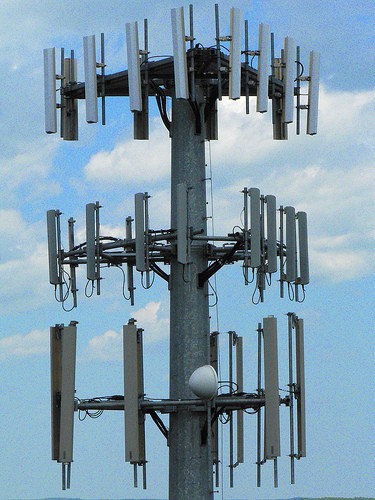
Throtting is based on the current utilization for each cell tower, and many low-use towers do not throttle speeds at all. For high-use towers, throttling occurs during peak-use times.

A customer’s maximum speed is based on the number of gigabytes of data transferred in the past seven days and the download speeds for the past 15 minutes. Speeds are recalculated every 15 minutes, at which point a throttled customer will be bumped up to a higher speed. Rather than implementing one speed for throttling, the calculations will move customers between 48 different speed brackets.

The worst offenders using peer-to-peer software on Clearwire’s network may face repeated throttling.

Clearwire’s network management speed throttles come despite claims made last March by Chief Commercial Officer Mike Sievert, who said the average subscriber was consuming around 7GB of usage per month and this posed no problem for the provider, which owns up to 150 MHz of wireless spectrum in some markets.

Clearwire advertises a faster Internet experience for their 4G service, but many report they receive speeds far slower, even if they have engaged in very little usage.

Many consumers are also unknowingly finding themselves back on Clear’s network even though they signed up with a third party provider.  Clear resells access to its network under a variety of different brands not limited to Sprint, Road Runner Mobile, Comcast Internet2Go, and Best Buy Mobile/Wireless.

[flv width=”640″ height=”380″]http://www.phillipdampier.com/video/Clear Speed Woes 11-10-10.flv[/flv]

This Clearwire customer visits a Clear hotspot location and discovers even on a Wi-Fi network, Clear’s speeds don’t match their advertising claims.  Then, he discovers just how sneaky Clearwire gets in disclosing important information about the company’s wireless speeds customers might want to know before signing up.  (5 minutes)

Time Warner Cable Gets Innovative to Stem the Flow of Departing Cable TV Customers

Phillip Dampier November 9, 2010 Competition, Consumer News, Online Video, Video 6 Comments

Although the cable trade press reports it is business as usual at most of the nation’s largest cable companies, news that several companies are losing more cable-TV subscribers than they are adding is creating concern in boardrooms and on Wall Street.  Although the power of the perennial “rate increase” has kept revenues up, cable operators like Time Warner Cable are beginning to realize they can’t just keep raising rates expecting customers to sit still for it.

For more than 30 years, cable operators have assumed (correctly) that raising rates far in excess of inflation will bring about a lot of grumbling from upset subscribers, but few will actually resort to cutting the cord and going back to free TV (or books).  But as many cable households now routinely pay “triple-play” bills well in excess of $200 a month, that is finally starting to change:

  • For many households, the switch to digital TV and an increasing number of sub-channels has proved adequate to meet the needs of many viewers, so long as they receive a decent picture and at least a handful of digital sub-channels;
  • Online access to at least some cable programming, movies, and television shows on-demand has solved the problem of having too few viewing options.  If nothing of interest is running on local channels, a quick visit to Netflix or Hulu can satisfy most viewers;
  • Many increasingly prefer spending their free time online instead of parked in front of the television;
  • The realities of the current economy and tightened middle class budgets make many cable packages simply unaffordable, even if customers wanted them.

Time Warner Cable has recognized the growing strain on their video side of the business and has initiated some strong marketing efforts to hold onto customers who are one rate increase away from canceling.

This fall, the cable company unveiled its $33 per service promotion, charging that price for each component of their triple-play package for a year.  While Time Warner has more aggressively priced individual services in the past for new customers, this one is unique because it is open to existing customers as well.  Customers speaking to Time Warner’s retention agents are being offered this package in an effort to keep customers hooked up to the company’s video, broadband, and phone services.  Currently, many markets also include a free year of Showtime or at least six months of DVR service, and a year of Road Runner Turbo.  In highly competitive markets, informal promotions can bring even lower prices or extra add-ons.

A few weeks ago, the cable company unveiled online video streaming of ESPN Networks for existing cable subscribers, and an online remote DVR-programming application that lets subscribers set up recordings while away from home.

Now the company is further bolstering its video packages:

  1. As part of its long term agreement with Disney, ABC and ESPN, this week Time Warner Cable added over 300 hours of new On Demand programming content from ABC, Disney and ESPN. In addition, the company will launch Primetime HD On Demand tomorrow, which will also be available to Digital Cable customers at no additional cost.  The new channel Primetime HD On Demand will carry primetime programming from ABC, NBC and CBS in High Definition. Subscribers will have over 100 hours of the networks’ popular primetime programs including NBC’s 30 Rock and The Office; ABC’s Grey’s Anatomy and Desperate Housewives; and CBS’ Medium and CSI.
  2. Time Warner Cable Look Back will bolster the existing “Start Over” feature by archiving up to three days of programming on more than two dozen different networks and cable channels.  Now, if you missed a favorite show that aired the evening before, you can watch it on demand.  As with “Start Over,” Time Warner has disabled fast-forwarding, so no zipping through commercials is allowed.  But the service comes free of charge, and includes an impressive lineup of participating networks including ABC, NBC, Fox Cable Networks, Discovery Networks, and Scripps’ Food Network, Cooking Channel, HGTV, and DIY.
  3. HBO Max and Go Max, part of TV Everywhere, will reach more than 50 million Time Warner Cable customers by the end of the month.  These services deliver online on-demand access to movies, series, and specials airing on HBO and Cinemax and will be available to customers paying for the premium channels at no additional charge.  More than 70 million customers will have access by the second quarter of 2011.
  4. Time Warner Cable CEO Glenn Britt told investors on a conference call held last week that the cable company is aggressively pursuing renewal agreements with programmers that allow the cable company to begin offering smaller, budget priced packages of cable-TV programming.  While it won’t be the a-la-carte option many consumers crave, cable programming packages could begin to resemble what home satellite dish customers used to receive — a core package of two dozen channels with theme or network-based add-on “programming packs” for additional fees.  For example, customers looking for reality or educational programming might buy a “Home and Garden” package consisting of Food TV, HGTV, The Weather Channel, Discovery and The Learning Channel.  Movie fans might get a package of Encore, AMC, Turner Classic Movies, Fox Movies and MGM.  “We have negotiated some additional flexibility beyond what we had a few years ago that will allow us to begin to offer some smaller packages at lower prices. Probably not all the way where we’d like to be. But we’re moving in the right direction,” Britt told investors.

The cable company’s friendly former owner — Time Warner, Inc.,  has also helped man the barricades against cable’s competitors.  For Netflix and Redbox customers: longer waiting times for access to the latest Time Warner movies are likely.  The current delay of 28 days could be extended, according to CEO Jeff Bewkes.

“So far the 28-day window has clearly been a success versus no delay,” Bewkes told investors. “The question of whether we ought to go longer is very much under scrutiny. It may well be a good idea.”

Even local movie theaters face some potential competition, as Time Warner considers introducing a premium pay-per-view option that would allow cable customers to watch movies currently in theaters at home.  But they’ll pay a heavy price to watch — reportedly between $30-50 per title, and the cable operator will insert anti-recording technology into the signal to prevent digital recordings.

Will these new services ultimately stop the bleeding from departing cable customers?  For most it’s a matter of dollars and sense.

[flv width=”640″ height=”500″]http://www.phillipdampier.com/video/Cutting Cable’s Cord 11-9-10.flv[/flv]

The media has gotten aggressive about talking to viewers about how they can get rid of their cable-TV subscription and save plenty.  (10 minutes)

Thomas Clancy Jr., 35, in Long Beach, N.Y., canceled the family’s Cablevision subscription this spring. He said he has been happy with Netflix and other Internet video services since then, even though there isn’t a lot of live sports to be had online.

“The amount of sports that I watched certainly didn’t justify a hundred-dollar-a-month expense for all this stuff. I mean, that’s twelve hundred dollars a year,” Clancy told the Associated Press. “Twelve hundred dollars is … near a vacation.”

Customers like Clancy are comfortable with technology and well-versed on how to hook up Internet video and integrate it with the family’s TV sets.  For customers like him, online video will increasingly be an attractive alternative to high cable TV bills.

For some western New Yorkers, Wegmans' Redbox kiosk is their new "cable company."

For homes with less tech-savvy subscribers who have watched their wages fall over the past decade even as cable rates keep increasing, economic realities driven home by the Great Recession are making the decision for them.

“The price of cable TV has risen to the point where it’s simply not affordable to lots of lower-income homes. And right now there are an awful lot of lower-income homes,” Craig Moffett, a Wall Street analyst who favors the cable industry said. “The evidence suggests that what we’re seeing is a poverty problem rather than a technology phenomenon.”

For these customers, including many in the middle class, each time cable companies like Time Warner increase cable rates, they drop a service or two.

“First it was Showtime, the Movie Channel, and Starz!,” writes Stop the Cap! reader Joanne in Penfield, N.Y., a suburb of Rochester. “Then when they raised the rates again on the premium channels, we dropped them all — bye bye HBO and Cinemax.”

“When Time Warner sends us their rate increase notice right after Christmas as they’ve done for years, we’re dropping digital cable and returning our cable boxes,” she writes.  “If they keep it up, we’ll drop cable altogether — something we might have done earlier if we had some competition around here.”

“I don’t care how much they claim it’s a ‘great value,'” Joanne says. “My husband got laid off from his job at Xerox in 2009 and was just let go from his new job at Carestream.  I already work myself and we have three kids, and our health insurance premiums are skyrocketing at the end of the year.  We haven’t had a real raise in five years, so that made the decision for us.”

Joanne now rents movies from Redbox just inside the local Wegmans grocery store and has a $9 monthly subscription with Netflix, mostly for online streaming.

“It’s more than made up for the $40+ a month we used to spend on premium channels with Time Warner,” she said.

[flv width=”640″ height=”500″]http://www.phillipdampier.com/video/WISN Milwaukee Time Warner Cable Offers Start Over For WISN 12 ABC Programs 11-9-10.flv[/flv]

WISN-TV in Milwaukee introduces viewers to Time Warner Cable’s newest on-demand features.  (1 minute)

Fibrant Blows Past Time Warner Cable: 200/200Mbps Planned, 50/50 Already Available

Fibrant ruins Time Warner Cable's Speed Party by delivering faster service at a lower price, without the cable company's rate increase notice sitting in Charlotte-area mailboxes.

Residents of Salisbury, N.C. are going to get some of the state’s fastest broadband speeds as the community-owned broadband provider prepares to introduce 200/200Mbps service, leaving Time Warner Cable’s Road Runner service behind in the dust.

Time Warner Cable enjoyed a few moments in the spotlight last week announcing free speed upgrades for the Charlotte region, which includes Salisbury.  But Fibrant’s fiber to the home network is well-equipped to turn Time Warner’s temporary speed advantage on its head.

Last week, the cable operator promoted the introduction of its new maximum speed 50/5Mbps Road Runner Wideband service, which carries a monthly price of $99.95.

But Salisbury city officials were unimpressed, claiming Fibrant already offers 50/50Mbps service — they just haven’t advertised it.

Assistant City Manager Doug Paris said Fibrant’s top available speed is 10 times faster than the cable giant’s when uploading.

“We’re cheaper, and we’re faster,” Paris told the Salisbury Post.  Fibrant sells the 50Mbps service for $85 a month, about 15 dollars less than Time Warner Cable’s slower Wideband service.

City officials also weren’t surprised that Time Warner announced faster Internet speeds the day after Fibrant launched.

“We’ve seen this in every other city that has invested in fiber optics,” he said. “They are trying to match our speeds, but they can’t.”

The Salisbury Post needs a few cans for its message boards, filled with anonymous lunacy.

Time Warner Cable claimed its new speeds were not in response to Fibrant but were part of a service upgrade for the entire Charlotte area, a claim every cable company makes in response to new competition on their doorstep.

Fibrant’s upstream streams are dramatically better than those offered by Time Warner Cable, which uses an inferior network architecture not currently capable of delivering the same upstream and downstream speeds to consumers.  Cable broadband networks are constructed with the assumption most users will download far more than they upload, so the networks emphasize downstream speeds.  Time Warner Cable has dramatically increased those download speeds, but has been forced so far to limit uploads to just 5Mbps.

Fiber to the home networks like Fibrant do not suffer those limitations, and the city plans to exploit that in their marketing.

Fibrant has the capacity to provide up to 1 gigabit per second upload and download, Paris said. Forthcoming are plans offering 100/100 and 200/200Mbps service, with prices yet to be determined.

Fibrant continues to have a waiting list of several hundred area residents waiting for service, but you wouldn’t know it from the raucous anonymous postings on the Post’s website.  Virtually all of the anonymous comments about Fibrant have been negative and wildly uninformed, to the point of hilarity.  From a Korean War veteran talking about eating blueberries and living life in the Windstream DSL slow lane (and loving it) to comments proclaiming fiber optics as woefully slower than WiMax, the Internet trolls have managed to prove why an increasing number of newspapers have learned to adopt “real names-only” posting policies or have just turned the comment section off altogether.

For those fans of  Time Warner Cable, the price of that love is about to go up.

Time Warner is mailing notices to Charlotte area customers announcing broadband rate hikes for some customers this December.  Time Warner customers who bundle their services or are on price protection promotions will be exempted from the rate increases… for now.

Charlotte, N.C. Gets Speed Boost Same Week Fibrant Arrives; TWC Recaptures Speed Leader Status

Charlotte, N.C. Time Warner Cable customers can thank city officials in nearby Salisbury for finally provoking Time Warner Cable into boosting speeds for residents across the region.  Just as community-owned Fibrant was opening its doors for business promoting its new fiber to the home service, the area’s dominant cable company managed to steal some of their thunder.

Time Warner Cable this week announced the entire Charlotte service region, which encompasses Salisbury, is getting a free broadband speed upgrade this week.

“We substantially increased our download speeds and essentially doubled upload speeds for all of our Turbo and Standard Internet service customers,” said Mike Smith, area vice president for Time Warner Cable’s Charlotte operation.

Product Name New Speed Old Speed
Turbo Internet 15/1Mbps 10Mbps/512kbps
Standard Internet 10/1Mbps 7Mbps/384kbps

The announcement allows Time Warner Cable to maintain its position as the fastest downstream Internet provider in the Charlotte region because Fibrant’s marketing department decided that 25Mbps service was fast enough.  No, it’s not, and Time Warner Cable showed them up.

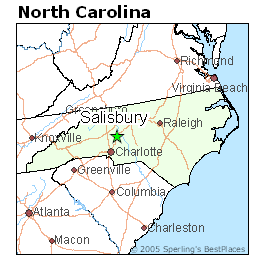
Salisbury is located northeast of the city of Charlotte, N.C.

“This service upgrade demonstrates our commitment to deliver enhanced value to our customers. We are satisfying their thirst for more throttle,” said Smith. To access the new speeds, customers need to reboot their cable modem which is easily accomplished by leaving it unplugged for about one minute.

The company is also introducing two speed tiers in Charlotte this week. Customers will have the option of purchasing or upgrading to DOCSIS 3 Wideband Internet or Road Runner Extreme service. Wideband Internet–the fastest residential Internet experience in Charlotte–provides customers with speeds up to 50 Mbps downstream and 5 Mbps upstream for $99.95 per month.

Road Runner Extreme delivers speeds up to 30 Mbps downstream and 5 Mbps upstream for as low as $64.95 per month when bundled with any other Time Warner Cable Service.

As Stop the Cap! has strongly advised all municipal providers — there is not much point in providing fiber to the home service if you are not willing to capitalize on its benefits.  Offering a maximum speed of 25Mbps just is not going to cut it, as Time Warner Cable demonstrates.

Fibrant’s pricing models are also endangered by this week’s developments.  Road Runner Extreme delivers 30Mbps downstream for $65 a month (admittedly a bundled price) while Fibrant offers 25Mbps service for the same price (standalone service).  Fibrant still kills Time Warner on upload speed, but that’s a distinction that could be lost among many potential customers, and is easily solved by boosting download speeds as well.

Fibrant must immediately consider speed upgrades for their existing tiers to assure its value proposition and launch a new super-premium speed tier that can show off fiber to the home’s true capacity to deliver the best possible Internet speeds in the region.

Shut Up About Peer-to-Peer Traffic: Video Now Biggest Broadband Traffic Source on the Net

Peer to peer traffic no longer represents the largest single source (by application) of broadband traffic on the Internet.  Cisco’s Visual Networking Study now finds online video streamed from websites like Hulu and Netflix to account for more than one-quarter of all broadband traffic, displacing file swapping from the number one position.

File sharing activity has routinely been used by providers dreaming of Internet Overcharging as an excuse to introduce usage limits and throttled speeds for their broadband customers.  Peer to peer software allows customers to exchange pieces of files back and forth until everyone manages to secure their own copy.  Cable operators, in particular, have complained this network traffic saturates their shared broadband lines because customers upload far more data than they would without this software.  Up to 44 percent of all upstream traffic from residential accounts comes from peer to peer traffic, according to Cisco.

Providers and their friends have started to give up on their scare stories of peer-to-peer “exafloods” and data tsunamis triggered from too many online users engaged in file swapping.  As we’ve argued for two years now, the glory days of growth in peer to peer are behind us for a variety of reasons:

  1. Downloading copies of TV shows and movies, always popular on file sharing networks, has declined now that content producers are finally serving the growing market for on-demand video programming;
  2. The growing popularity of downstream delivery direct to consumers has reduced wait times for downloading to near nothing — to the point where some users are abandoning peer-to-peer altogether;
  3. An increasing amount of fake files filled with viruses and spyware has made peer to peer-sourced files from underground websites more risky;
  4. Copyright enforcement and other legal actions have made file trading less palatable for some.

While peer-to-peer traffic is still growing along with other online usage, online video is growing far faster.

Now some want to move the goal post — blaming online video for “forcing their hand” to implement overcharging schemes.

Broadband Traffic by Application Category, 3rd Quarter – 2010

Traffic Share
Data* 28.05%
Online Video* 26.15%
Data Communications (Email and Instant Messaging) 0.28%
Voice and Video Communications* 1.71%
P2P File Sharing 24.85%
Other File Sharing 18.69%
Gaming Consoles* 0.16%
PC Gaming 0.65%
  • The marked categories contain video.

Karl Bode at Broadband Reports writes that he found Sanford Bernstein analyst and cable stock fluffer Craig Moffett telling CNET that if customers cut the cord, cable broadband companies will simply turn around and begin metering broadband customers’ bandwidth. In fact, Karl adds, Moffett goes so far as to insist ISPs will have “no choice” in the matter as streaming services like Netflix gain popularity.

Instead of simply raising prices on cable broadband, Moffett said it’s more likely that cable operators would move toward usage-based pricing. That way consumers who use more bandwidth to stream movies and TV shows end up paying more per month for service than people who may be getting their video from the traditional cable TV network. Time Warner has tested usage-based billing, but the company faced a huge backlash from consumers. Still, Moffett said that broadband service providers may have no choice as bandwidth-intensive video streaming services like Netflix become more popular.

CNET’s Marguerite Reardon calls that scenario a “heads we win; tails we win” situation, especially for cable companies.

Would you tell this man you are dropping your Comcast video package to watch everything online for free? (Neil Smit, president - Comcast's cable division)

Last quarter, some companies saw the number of subscribers actually drop for the first time ever.  Now Comcast reports in its latest earnings call the same thing is happening to them — losing 56,000 TV package subscribers during the third quarter.  Comcast surveyed some of their customers calling to fire their cable company.  Most of them are not switching to a pay TV competitor, said Neil Smit, president of Comcast’s cable division.  Comcast characterized them as “going to over the air free TV,” but would you tell your cable company you are dropping their video package to watch everything on their broadband service for free?  For a lot of cable customers, that would be tantamount to calling them up and saying you are now getting free HBO on your TV.

Both companies are still denying online video is cutting into their cable TV package business, but it’s an argument some stock analysts have begun to make as they watch cable profits struggling to hit targets.  Watching extra fat profits bleed away because “broadband piggies are watching all of their TV online for free” just won’t do for folks like Mr. Moffett, who will be among those leading the call to slap limits on broadband usage to protect industry profits.  Why leave good money on the table?

But before Moffett encourages cable companies to install coin slots and credit card readers on cable modems, he has another idea: jack up the prices of broadband higher than ever while cutting video pricing, making it pointless for customers to jump ship:

“Cable’s broadband dominance opens the door for renewed share gains in the adjacent video market,” Moffett said in his report. “Cable companies could simply increase their a la carte broadband prices (since in most markets, households have no other choice for sufficiently fast broadband) and simultaneously drop their video pricing, leaving the price of the bundle unchanged, to recapture video share.”

He pointed to an example of this in Albany, N.Y., where Time Warner Cable raised its broadband price by 10 percent for its Internet-only customers to a rate just $2 below its promotional bundled rate for both services. The Internet-only price increased to $54.95 from $49.95. The 12-month promotional rate for video and data was $56.95.

Of course, Albany has Verizon FiOS breathing down Time Warner’s neck.  In late October, Verizon announced it was launching its video FiOS service in Scotia, just outside of nearby Schenectady. Bethlehem, Colonie, Schenectady and Guilderland already have FiOS phone and Internet services available, so getting a TV franchise to deliver competition to Time Warner Cable isn’t a big leap.

In Rochester (where Frontier Communications idea of video is a satellite dish), a similar promotional package from Time Warner runs $84.90 a month.

Highlights of the Cisco Report

  • The average broadband connection generates 14.9 GB of Internet traffic per month, up from 11.4 GB per month last year, an increase of 31 percent;
  • “Busy hour” traffic grew at a faster pace than average traffic, growing 41 percent since last year. Peak-hour Internet traffic is 72 percent higher than Internet traffic during an average hour. The ratio of the busy hour to the average hour increased from 1.59 to 1.72, globally;
  • Peer-to-peer (P2P) file sharing is now 25 percent of global broadband traffic, down from 38 percent last year, a decrease of 34 percent. While still growing in absolute terms, P2P is growing more slowly than visual networking and other advanced applications;
  • Peer-to-peer has been surpassed by online video as the largest category. The subset of video that includes streaming video, flash, and Internet TV represents 26 percent, compared to 25 percent for P2P;
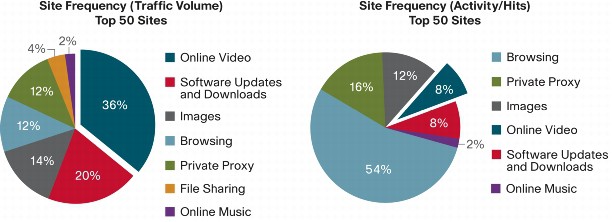
  • Over one-third of the top 50 sites by volume are video sites. There is a high degree of diversity among the video sites in the top 50, including video viewed on gaming consoles, Internet TV, short-form user-generated video, commercial video downloads, and video distributed via content delivery networks (CDNs). Video sites appeared more frequently than any other type of site in the top 50.

Search This Site:

Contributions:

Recent Comments:

Your Account:

Stop the Cap!