Home » time warner cable » Recent Articles:

Time Warner Cable’s iPad ‘TV Everywhere’ App Crashes Under Heavy Demand

Phillip Dampier March 16, 2011 Online Video, Video, Wireless Broadband 1 Comment

Time Warner Cable’s new free iPad application, giving authenticated cable customers a selection of live cable channels to watch on the portable device, crashed under heavy demand last evening, hours after the company unveiled it in a mass e-mail campaign to customers.

Time Warner Cable TV for iPad is Time Warner’s first serious effort at delivering a cable TV experience to an online audience, initially streaming 31 cable channels in HD to customers who pay for both cable television and broadband from the company.

Several of the featured networks were part of earlier contract battles with the cable company. Scripps-Howard’s Food Network and HGTV are there, as is Fox’s FX and Fox News.  Some smaller “less-connected” networks like Hallmark Channel also made the cut.  Comcast-NBC’s networks also have a prominent place, including Bravo and CNBC.  All four major cable news channels are included.  Time Warner has been making a point to negotiate for on-demand and streaming rights with cable networks as part of contract negotiations.

Channel Lineup

A&E
ABC Family AMC
Animal Planet
BET
Bravo
CMT
CNBC
CNN
Comedy Central
Discovery
Disney Channel
E!
Food Network
Fox News
FX
Galavision
Hallmark Channel
HGTV
History
HLN
Lifetime Movie Network
MSNBC
MTV HD
National Geographic
Nick
Spike
SyFy
TLC
Travel Channel
USA
VH1

Requirements

  • iPad™ with iOS 4.
  • Time Warner Cable video package at the Standard (Expanded Basic) level or higher.
  • Time Warner Cable Internet Service (Road Runner® Standard or higher recommended for best experience. EarthLink® High Speed or EarthLink® Cable Max is also supported).

[flv width=”416″ height=”254″]http://www.phillipdampier.com/video/TV for iPad Time Warner Cable Ad.flv[/flv]

Time Warner Cable advertises its new iPad app for online viewing.  (15 seconds)

Time Warner Cable's new app for the iPad delivers 31 channels of live cable network viewing for free -if- you are a cable subscriber willing to watch from home.

Plenty of channels are missing though, including local broadcasters, Turner Broadcasting-owned networks like TNT and Turner Classic Movies, and sports networks.

But the most obvious limitation is that the service only works from inside of your own home, over a Time Warner Wi-Fi broadband connection.  You cannot take your viewing on-the-go.  This limitation seemed curious, considering other companies provide similar online viewing apps that can be used anywhere a wireless connection exists. 

Despite the limits, AdWeek reports several unnamed cable networks fired off warning shots yesterday to Time Warner Cable executives warning them they were streaming networks without permission.

Network legal reps are issuing a flock of heated missives to the nation’s No. 2 cable operator, calling for an immediate halt to a new service that allows subscribers to stream video content to iPads and other tablet devices. Although Time Warner Cable introduced the free app just 24 hours ago, a number of cable network groups have already made it abundantly clear that they had not signed off on any such distribution arrangement.

[…] “Distribution via any sort of third-party app is not addressed in our carriage deals with Time Warner Cable or any other operator,” said one affiliate chief. “There is going to be a messy dissection of what the rights are, but our position is that [this sort of distribution] is not authorized by our affiliate agreements.”

TWC CEO Glenn Britt has cautiously navigated the syntactic rapids, offering carefully worded assessments about the nature of the service. “Certainly all the business structures with the owners of copyrights are not fully in place, but you can begin to see a very exciting future for this set of industries and for the American consumer,” Britt said last August, after announcing plans to bow the iPad app. “There is great potential in all these devices…But it’s also a complicated process.”

Cable networks are concerned viewers who are not authenticated cable subscribers could get free access to programming from account sharing.  But considering Time Warner Cable has locked down viewing to inside the home for the time being, it is unlikely Time Warner Cable faces the same degree of wrath that could be heaped on Comcast and satellite dish TV providers who deliver apps that permit anywhere-viewing.
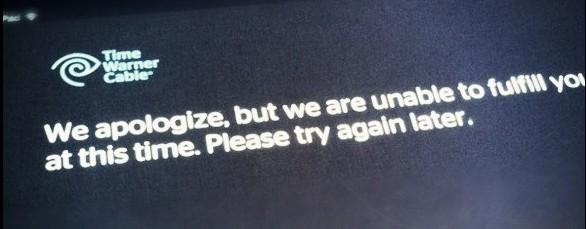
Time Warner Cable's new iPad app crashed under a heavy load last night.

The cable company’s heavy promotion of the newly-available app in mass e-mail announcements was probably a mistake, however.  The online viewing party came to a rapid end last night when the company’s servers, unprepared for the demand, ended up turning away many would-be viewers.

Jeff Simmermon, director of digital communications for the cable company, said they did not anticipate the level of demand they got last night.

“At about 8 o’clock last night the app crashed under a much heavier load than we anticipated. Our engineering team is working as hard as they can to put a fix in place and get everything up and running as soon as they can,” Simmermon wrote on Time Warner’s blog.

“For the time being, the app is running with only 15 channels. We have found that by temporarily reducing the number of available channels, we can ease strain on the authentication process. This will enable us to offer at least some sort of an experience to our customers while we get a fix in place. We’ll add the other 17 channels back in as soon as we can fix the underlying issue, and we’ll be adding more channels in future iterations of the app as well.”

[flv width=”640″ height=”380″]http://www.phillipdampier.com/video/BTIG Time Warner Cable iPad App.flv[/flv]

Rich Greenfield demonstrates Time Warner’s new iPad app.  (3 minutes)

 

North Carolina Action Alert: Anti-Broadband Bill Railroad Stops at Finance Committee Tomorrow Morning

Phillip Dampier March 16, 2011 Astroturf, Broadband Speed, Community Networks, Competition, Consumer News, Editorial & Site News, Public Policy & Gov't, Rural Broadband Comments Off on North Carolina Action Alert: Anti-Broadband Bill Railroad Stops at Finance Committee Tomorrow Morning

Don't allow a "dollar-a-holler" mouthpiece for the broadband industry to speak on your behalf. Get on the phones and send those e-mail messages today!

H.129, Rep. Marilyn Avila’s (R-Time Warner Cable) anti-broadband bill has been moving full speed ahead as she hurries it through the state legislature before consumer outrage gets a chance to block it.  Tomorrow morning, it will make a stop at the Finance Committee, where we expect the bill’s broadband-killing language will remain largely intact, thanks to hard work from Time Warner Cable and their astroturf friends.

While Ms. Avila is e-mailing copies of a so-called “independent article” about H.129 written by a man who received a $20,000 check from Time Warner Cable and works for a telecommunications company-funded think tank to her colleagues, you need to be e-mailing, tweeting, and calling your friends and neighbors and get everyone to call or write the individual members of the Finance Committee immediately.

Here are the points you need to raise:

  1. Please vote NO on H.129, an unnecessary bill that does nothing to improve broadband in North Carolina;
  2. H.129 is sponsored by the state’s biggest cable and phone companies to protect their anti-competitive markets and guarantee high rates for slow service indefinitely;
  3. The fastest broadband at the fairest prices in the state comes from 21st century fiber optic networks that will be driven out of business if this bill becomes law;
  4. Although Ms. Avila and Chairwoman Howard promised to protect and exempt existing community broadband networks from the terms of this bill, they have not yet kept their promise;
  5. If the companies supporting this bill delivered broadband at the speed they are rushing H.129 through the legislature, North Carolina would not have a broadband problem;
  6. If rural communities cannot solve their own broadband problems, who will?  The companies that refused to provide appropriate service yesterday, today, and will continue to not do so tomorrow?

Make sure you remind your legislator this is not a Republican of Democratic issue — it’s a consumer issue, it’s an issue for every rural community, and it’s an issue for the future economic well-being of a state that needs digital economy jobs.

Finance Committee Members

(click each name for contact information)

Senior Chairman Rep. Howard
Chairman Rep. Folwell
Chairman Rep. Setzer
Chairman Rep. Starnes
Vice Chairman Rep. Lewis
Vice Chairman Rep. McComas
Vice Chairman Rep. Wainwright
Members Rep. K. Alexander, Rep. Brandon, Rep. Brawley, Rep. Carney, Rep. Collins, Rep. Cotham, Rep. Faison, Rep. Gibson, Rep. Hackney, Rep. Hall, Rep. Hill, Rep. Jordan, Rep. Luebke, Rep. McCormick, Rep. McGee, Rep. Moffitt, Rep. T. Moore, Rep. Rhyne, Rep. Ross, Rep. Samuelson, Rep. Stam, Rep. Stone, Rep. H. Warren, Rep. Weiss, Rep. Womble

Multiple Time Warner Cable Service Outages – Get Those Credits

Phillip Dampier March 16, 2011 Consumer News Comments Off on Multiple Time Warner Cable Service Outages – Get Those Credits

Time Warner Cable has experienced several significant outages this week in different areas of the country.  When service conks out, customers are entitled to service credits, but you must request them — they do not come automatically.

The most significant problems:

  • Yesterday: Northeastern U.S. — Telephone and broadband service was knocked out for several hours, causing a flood of calls to area newsrooms and clogging up Time Warner’s own call centers;
  • This Morning: Ohio — Telephone and broadband service down in many areas.

The easiest and fastest way to request credit is sending a message to Time Warner Cable using their Online E-Mail form, select Billing Inquiry, and send a message like this (edit it as appropriate):

I am writing to request one day service credit for the Internet and phone service outage that occurred in my area yesterday. Please credit my account.

Updated: Dollar-a-Holler Industry Lobbyist Attacks North Carolina’s Community Networks

Phillip Dampier March 14, 2011 Astroturf, Broadband Speed, Community Networks, Competition, Consumer News, Editorial & Site News, Public Policy & Gov't, Rural Broadband Comments Off on Updated: Dollar-a-Holler Industry Lobbyist Attacks North Carolina’s Community Networks

Bennett

We received word this afternoon proponents of community-0wned broadband in North Carolina were under attack by the ironically-named Innovation Policy Blog from the Information Technology & Innovation Foundation (ITIF), a thinly-disguised, industry-funded think tank.

Charges and counter-charges are flying fast and furious. Well-travelled muni broadband consultant Craig Settles says the authors are in the pockets of Time-Warner Cable, and urges people around the country to lobby NC legislators to kill the bills:

The battle is now fully joined in NC. But it’s not just their fight, and it’s not a fight solely about broadband. This fight affects everyone who believes that communities deserve the freedom to choose their own best solutions to key problems involving economic development. Communities own the problems of this terrible economy.

Philip Dampier, the supporter of former New York Congressman Eric Massa who joined the broadband policy fight when Time Warner was experimenting with metered pricing, is even more shrill than Settles.

I suppose being called “shrill” is a little better than “mean and nasty,” even if perennial industry defender and comment troll Richard “I Don’t Work for a K Street Lobbyist, But I Do” Bennett doesn’t bother to spell my name correctly.

Bennett’s read of North Carolina’s H.129 is that it’s a minor little bill that does no harm.

I don’t see what our perpetual network operator-haters are so worked up about, although I can certainly see that the network equipment vendors want more outlets for their gear; more power to them. The bills actually don’t place any restrictions at all on unserved communities (where 90% or more can’t get broadband) who want to build themselves a first-class, triple-play enabled, broadband network or anything else better than dial-up. If there weren’t such an exemption, I’d be just as riled as the people I’ve quoted.

Supporting innovation from the right kind of companies.

I suspect Bennett may have trouble seeing the facts on the issue because they are obscured by the $20,000 stipend he picked up from Time Warner Cable.  That is in addition to his regular salary provided by players with a dog in the fight.

Unfortunately for those who accidentally stumble their way into the warped world of “innovation” some of our biggest telecommunications companies have in store for us, Bennett forgets to disclose who pays him.

Our argument (the one that comes without industry money-strings attached) is explored in great detail here.

For the benefit of those who don’t want to dirty themselves wading through the ITIF’s blog, here is our response in full:

Richard and I have discussed several issues impacting the broadband community over the past two years.  He always takes the side of the industry that pays him well to serve as their mouthpiece, and I represent actual consumers and do not take a penny of industry money.

The ironically named “Innovation” blog attacks the very innovation that community broadband brings to hard-pressed communities in North Carolina who want to reinvent themselves from their tobacco and cotton-past.  The reason these networks exist is because existing companies refused to provide the service needed to accomplish this task.  Richard has no idea what these communities and ordinary North Carolina consumers are going through because his article exists merely as a “drive-by” hit piece that mischaracterizes the bill, the people that oppose it, and leaves his readers thinking he doesn’t have direct ties to a company that helped write the bill.

Gone undisclosed: Bennett accepted a $20K stipend from Time Warner Cable and does work on behalf of a K Street lobbyist.  That’s “dollar a holler” reporting.

Folks, follow the money.  If a Big Telecom company is involved, Richard reflexively adopts their position, often to the detriment of consumers.  He is also factually wrong.

1) Wilson did not “buy” their fiber to the home network, they built it.
2) Davidson and Mooresville bought a bankrupt Adelphia system that needed major upgrades.  Time Warner would have done precisely the same thing the community did, only they would pay for it with rate hikes across the state (except in Wilson which has avoided rate increases from Time Warner precisely because GreenLight is running there).
3) Salisbury has had a waiting list for signups.  Not bad for a “failure.”  EPB just finished their award-winning network in Chattanooga ahead of schedule.

The public-private partnership idea has no opposition, except among providers who won’t hear of anything they don’t own, operate, and control outright.  It is telling ongoing negotiations over Ms. Avila’s Time Warner-written bill have broken down because she still objects to language that would keep those networks in business to create those kinds of success stories.

All of the pipe dreams in this piece come from the author.  I’m not an industry consultant.  I just know a much better deal when I see one.  GreenLight, EPB, and Fibrant all deliver better service than the cable company or phone company and the money paid to them remains in those communities.  They also deliver unlimited service, an issue that now becomes more important than ever with AT&T’s attempt to launch its Internet Overcharging scheme.

The key question Bennett never asks is exactly how H.129 will improve broadband in the state, whose broadband rankings are unworthy of its potential.  Answer: it won’t.  It simply delivers protection for incumbent providers who will continue to not deliver the kind of service people want and will continue to ignore rural areas they have always ignored.  When a “small government” conservative like Marilyn Avila writes micro-management requirements for these networks right down to banning them from promoting themselves and arguing over service area boundaries (conditions Time Warner is exempted from), it tells you how far certain legislators will go on behalf of large telecom companies.

As for voter approval, it already exists in the form of elections.  I haven’t seen any “throw the bums out” movement in Tennessee or North Carolina over this issue.  In fact, the only ones out of office are the last two legislators that proposed these anti-community broadband bills.  Ty Harrell resigned in disgrace and David Hoyle left office admitting, on camera, Time Warner Cable wrote the bill he introduced.

Nice try, Richard.  Maybe if Time Warner gave you $40k, you would have spent more time coming up with legitimate arguments instead of just attacking the “music men” who can name your tune after the first predictable note.

Phillip M. Dampier
Editor, Stop the Cap!

[Update 3:42pm — We just received a carbon copy of an e-mail Rep. Marilyn Avila (R-Time Warner Cable) sent out after Bennett’s piece was published (coordinated effort, anyone?).  Amusingly, she forgot to hide the carbon copy list.  Among the recipients — two lobbyists from Time Warner Cable, the state’s top cable association lobbyist, and CenturyLink.  The most hilarious part of all — her claims Bennett’s piece represented an “independent explanation” to correct the “false record” on her anti-consumer bill.  Every resident in North Carolina should be on the phones and e-mail today telling the Finance Committee to oppose H.129, and also let them know Ms. Avila’s office is sending out distorted articles written by a K Street lobbyist who accepted a $20k stipend from Time Warner Cable, the company that most strongly supports this bill.  How “independent” is that?]

Cable Stock Booster Predicts AT&T Provides ‘Safe Passage’ for Cable Internet Overcharging Schemes

Phillip Dampier March 14, 2011 AT&T, Charter Spectrum, Cox, Data Caps, Online Video 4 Comments

Craig E. Moffett joined Sanford C. Bernstein & Co. as the Senior Analyst for U.S. Cable and Satellite Broadcasting in 2002.

Craig Moffett, perennial cable stock booster, predicts AT&T’s move to implement usage limits on its broadband customers will provide cover for cable operators to rush in their own Internet Overcharging schemes, starting with budget-priced usage plans.

Moffett released a research note Monday claiming Charter Communications, Cox Communications, and Time Warner Cable are among the first most likely to move towards limiting their customers’ broadband usage, with Comcast standing on the sidelines, at least for the moment.

Moffett thinks AT&T’s announcement is excellent news for wired providers, who could reap enormous new profits on top of some of the world’s most expensive broadband packages.

“AT&T’s move provides air cover that makes it easier for all of them to follow,” Moffett told his clients. “We view the move as good news for all the terrestrial broadband operators.”

Moffett believes usage caps have everything to do with stopping the torrent of online video.  He notes AT&T’s caps are set high enough to target AT&T customers who use their connections to watch a considerable amount of video programming online.

“Only video can drive that kind of usage,” Moffett writes.

Moffett has repeatedly predicted any challenge to pay television models from online video will be met with pricing plans that eliminate or reduce the threat:

“[I]f consumption patterns change such that web video begins to substitute for linear video, then the terrestrial broadband operators will simply adopt pricing plans that preserve the economics of their physical infrastructure,” Moffett said. “Of course, any move to preserve their own economics has far-ranging implications. Any move towards usage-based pricing doesn’t just affect the returns of the operators, it also affects the demand of end users (the ‘feedback loop’).”

Search This Site:

Contributions:

Recent Comments:

Your Account:

Stop the Cap!