Home » time warner cable » Recent Articles:

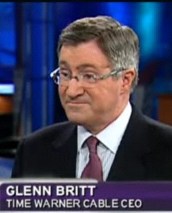
Time Warner’s Glenn Britt: The Marie Antoinette of Cable – Rate Hikes, Metered Internet In Your Future

More than halfway into Glenn Britt’s appearance last week at a Wall Street-sponsored investor event, the head of the nation’s second largest cable company candidly admitted years of price hiking is finally driving a growing segment of America’s hard-pressed middle class out of the market:

“There is a segment of our economy that should be of concern.  We have a bifurcating economy where people who are college educated and like everybody in this room are doing okay.  For that segment, pay TV [pricing] is fine.  There is another group of people who are sort of falling out of the middle class.  For some of those people, pay TV is too expensive.”

That’s a remarkable admission from a cable company that has consistently raised prices for its products well in excess of inflation for at least a decade, and judging from the rest of his comments, there is plenty more of the same on the way.

Britt is nearing his 10th anniversary as CEO of what is now Time Warner Cable, formerly a division of AOL/Time-Warner.  In the past decade, the company he oversees has undergone a transformation in its business model. In 2001, digital cable was all the rage, delivering the 500-channel television universe at the cost of rapidly increasing cable bills.  Cable broadband was just coming back from the dot.com crash, with many Americans still mystified by the concept of “www” and whether a web address had a “/” or a “\” in it.

Time Warner Cable CEO Glenn Britt tells Wall Street investors at the Sanford Bernstein conference the company is using their customers’ addiction to high speed broadband as leverage for rate increases — three in the last three years. Britt’s world view for Internet Overcharging schemes like consumption billing are reinforced in a room where ordinary customers aren’t invited and the Wall Street types in attendance dream about the enormous profits such pricing would bring. June 1, 2011. (6 minutes)
You must remain on this page to hear the clip, or you can download the clip and listen later.

Today, broadband is threatening to become the cable industry’s most important product — one that Americans will crawl through broken glass to buy.  In larger cities, the competitive war between DSL and cable broadband has been settled and DSL lost.  That has brought Time Warner a steady stream of customers departing their local phone company and bringing their telecommunications business with them.  Even during the economic downturn, Britt notes, one of the last products people will agree to give up is their broadband Internet access.

“Broadband is becoming more and more central to people’s lives,” Britt said. “It is becoming our primary product. People are telling us that if they were down to their last dollar, they’d drop broadband last.”

Britt openly tells investors Time Warner Cable will take that last dollar, and many more.

“We are able to raise prices,” Britt notes. “As broadband becomes a utility, you can charge more.  So after a dozen years of not raising prices for broadband service, for the last three years we have been raising prices.”

Britt notes the company is also enjoying increased average revenue per customer as many upgrade their broadband service to higher speed tiers which deliver higher revenue to the cable operator.

But as the market for broadband matures, the next level of profits could come from so-called “consumption pricing,” which could make yesterday’s rate increases look like a miniscule price adjustment.  In 2009, Time Warner Cable sought to test new broadband pricing that would have tripled the cost of unlimited broadband from $50 a month to an astonishing $150 a month.  A firestorm of protests for this level of Internet Overcharging temporarily killed the prospect of OPEC-like profits, unsettling some Wall Street investors and analysts, many who refuse to let the dream die.

Among the biggest proponents of this kind of metered pricing is, in fact, Sanford Bernstein — the sponsor of the conference.  So it came as no surprise Britt faced additional browbeating in the hour-long interview to reintroduce these pricing schemes.  After all, Britt is told, AT&T has implemented a usage cap and Cable One has (what the interviewer calls) a “quite interesting” pricing model — delivering the smallest usage caps to customers with the highest speed tiers.  So when will Time Warner follow suit?

Once again, Britt said he’s a true believer in consumption billing and thinks the industry will move in that direction, but refused to give an exact timetable.  “Consumption billing” goes beyond traditional usage caps by establishing a combination of a flat monthly service fee, and additional charges for the amount of data you use.  Time Warner’s original proposal limited consumption to 40GB per month at today’s broadband prices, but added an overlimit fee of $1-2 for each additional gigabyte.

The strangest part of the hour was Britt’s defense of usage pricing with an impromptu discussion with his wife the evening before about the pricing models of public transit in European capitals (they’ve no doubt visited), and metropolitan New York City.
Britt shared that in the finest cities of Old Europe, bus and train travelers paid different rates based on how far they traveled within the city.  In New York, his wife noted, one price gets you access to any point in the city on the subway.  

How fair is that?

Aside from the hilariously unlikely scenario either Britt or his wife have stepped foot on a New York City public bus or subway train in the last decade, his rendition of “consumption billing is fairer”-reasoning fell flat because it argues a false equivalence between the cost to move data and the expenses of a public transit system.  Remember, Time Warner is the cable company that pitches unlimited long distance calling on the one platform that most closely resembles broadband — telephone service.

“People want us to invest more to keep up with the traffic,” Britt argued.  “People who use it should pay less — people who want to spend eight hours a day watching video online is fine with me, but they should pay more than somebody who reads e-mail once a week.”

This is the same Glenn Britt who just minutes earlier confessed the cable company has been raising prices on all of its broadband customers for three years in a row because they can.  Earlier attempts at consumption billing saved nobody a penny.  Light users were given a paltry usage allowance that could be largely consumed by downloads of security patches and software updates, after which a very punitive overlimit fee kicked in.  Besides, Time Warner Cable already sells a “lite” usage plan today that has few takers.  Most consumers want, and are willing to pay for a standard, flat rate broadband account.  That’s the account Britt and his Wall Street cheerleaders want to get rid of come hell or high water.

Britt is asked whether pay television is getting too expensive for the hard-pressed middle class. For many consumers, it is, which is why the company is developing its “welfare” tier called TV Essentials — a sampling of cable networks with plenty of holes in the lineup to remind subscribers what they are missing if they make do with this less expensive package. June 1, 2011. (3 minutes)
You must remain on this page to hear the clip, or you can download the clip and listen later.

Throughout the hour long interview, Britt’s read of the hard-pressed common American family comes across as more than a little hollow — more like hopelessly out of touch.  One part Marie “Let Them Eat Cake” Antoinette and one-part “we’ll throw a bone to some and raise prices on the rest,” Britt is content lecturing consumers — discouraging them from crazy ideas like “a-la-carte” cable pricing and reasonably priced broadband.

The Wall Street crowd loved every minute, and the friendly echo chamber atmosphere made Britt feel more than welcome at the conference.  While Time Warner Cable’s CEO spent more than a hour talking to Wall Street, he has no time to actually sit down and talk with his customers — the ones that want nothing to do with his Internet pricing schemes.  Indeed, at one point Sanford Bernstein’s host dismisses customers as “people who want everything for free,” a contention Britt partly agreed with.

Have another piece of cake.

If you are still wealthy enough to buy an iPad and are enjoying Time Warner Cable’s free streaming app, watch out. It may not be free for long. As Britt partially admits, Time Warner Cable is using the online video service as a “Trojan Horse” to get subscribers hooked on their online video, before they attach a price tag to the service. June 1, 2011. (3 minutes)
You must remain on this page to hear the clip, or you can download the clip and listen later.

And what about all of this much-ballyhooed “investment” in tomorrow’s broadband networks?

Britt confesses the cable company is spending less than ever on system upgrades and capital construction projects.  Why?  The company forecasts its demand and growth five years out and budgets accordingly.  The current target is to spend just 15 percent of revenue on such projects, and based on budget planning, there is no urgent need to upgrade Time Warner’s broadband networks to keep up with demand.  In fact, it was all smiles when Britt revealed one of the company’s biggest expenses — the costly set top box — may not be a permanent part of America’s cable future after all.  Britt offered there was a good chance capital spending might even decline further in the future.

Britt suggests the next generation of television sets will deliver the same functionality as today’s set top box at a cost paid by the consumer.  Time Warner’s slow march to all digital cable means the need for wholesale upgrades of cable systems is over for perhaps a generation.  And with an IP-based cable delivery platform, software upgrades and improvements can be made without paying the high asking price charged by today’s handful of set top manufacturers.

In fact, outside of programming costs, Britt doesn’t see any long term challenges to years of good times for investors. Even minor competition from the telephone companies, who generally charge prices very similar to what Time Warner Cable charges, pose no big threat.

His biggest nightmare?  A check on the industry’s near-unfettered power by Washington regulators.  Despite Britt’s claims the cable industry is already well-regulated, in fact it is not.  Since 1996, cable companies can charge whatever they choose for standard cable, phone and Internet service.  Consumption billing, which will almost certainly be seen as gouging by consumers, may trigger an unwelcome intrusion by Congress, especially if the industry continues to cause a drag on America’s broadband ranking, already waning.

For investors, the glory days of huge rate hikes for cable television are likely behind us, Britt warns.  But have no fear: for the generally well-heeled and barely-hanging-on there is plenty of room for more rate increases on broadband — and meters, too.

Once again, Britt unintentionally admits the truth: Time Warner Cable does not have a broadband congestion problem that requires an Internet Overcharging scheme to solve. In fact, he admits the cable company is spending less than ever on network upgrades for residential subscribers, and expects that trend to continue. He’s also avoiding overpaying for merger and acquisition opportunities. June 1, 2011. (6 minutes)
You must remain on this page to hear the clip, or you can download the clip and listen later.


Time Warner Cable Launches Fiber Project for Bangor Businesses

Phillip Dampier June 7, 2011 Broadband Speed, Public Policy & Gov't, Video 1 Comment

Downtown Bangor, Maine

Broadband will be considerably faster in downtown Bangor, Maine — if you are a business doing business with Time Warner Cable.

The cable operator is working with the city of Bangor to ease the construction of a four-mile long fiber stretching across the downtown business district, with completion expected this October.

The Bangor city government is helping ease the paperwork and permits required to efficiently complete the project as quickly as possible to minimize disruptions to traffic and ongoing business.

Our readers tell us Maine has been a problem area for Time Warner Cable, with congestion problems in several areas because of lack of periodic upgrades.  Oversold broadband symptoms typically include peak usage slowdowns for downstream speeds, even as upstream speeds remain close to their advertised levels.

Businesses in Bangor report existing speeds to be a headache when trying to conduct business or assist customers.

The upgrade is expected to primarily serve business customers, although the cable company is progressing on DOCSIS 3 upgrades across their Maine service areas.

[flv width=”640″ height=”450″]http://www.phillipdampier.com/video/WCSH Portland High speed Internet coming soon for downtown Bangor businesses 6-3-11.flv[/flv]

WCSH-TV in Portland covered the potential impact a fiber upgrade will have for downtown Bangor businesses.  (2 minutes)

Clearwire’s Credit Standards: If You Had a Pulse You Were Approved, Say Dealers

Phillip Dampier June 6, 2011 Broadband Speed, Consumer News, Wireless Broadband Comments Off on Clearwire’s Credit Standards: If You Had a Pulse You Were Approved, Say Dealers

In a desperate bid to inflate subscriber numbers, dealer commissions, and attract additional investors, some Clearwire retailers slashed credit standards resulting in widespread approval of customers who would later skip out on paying the bill.  At least one dealer offered to override any failed credit check for even the most credit risky customers, according to a Bloomberg News investigation.

Those charges, made by three former dealers and distributors, bring additional controversy to a wireless venture already facing lawsuits for false advertising and misleading business practices.

From late 2009 until earlier this year, Clearwire dealers were strongly encouraged to sign up new customers for its wireless services, which include a home broadband replacement offering “unlimited wireless broadband” to customers.  In many markets, scores of would-be customers in urban and poor areas failed the company’s credit checks.  One former salesman told Bloomberg as many as 60 percent of his would-be customers couldn’t pass the credit check without a manual override, often done with a copy of a driver’s license and evidence of residence in the area, such as two consecutive utility bills.

Millions of new Clearwire customers were signed up for service during 2010, with dealers and salesmen earning significant sign-up commissions and parent company Clear winning favorable media coverage for its high subscriber growth, used to attract new investment.

One distributor called the lax credit standards “a time bomb,” one that began going off as customers reneged on their contracts, didn’t bother to pay the bills, or simply canceled service while ignoring collection efforts.  But the credit standards remained surprisingly loose for an industry that routinely profiles potential customers before signing them up to service.

By mid-2010, Clearwire dealers were no longer even required to pull a hard credit report with a Social Security number.  Scores of immigrants, many without documentation, could now sign up for Clearwire service showing proof they had managed to make at least one rent payment on time.  Even customers with no credit experience were signed up for service, some who paid exclusively in cash.

One Texas dealer reported as many as 80 percent of his customers were approved with credit overrides.

Much of Clear’s dealer network is independently owned and operated, especially now that the company faces financial challenges.  The company provides dealers with strong financial incentives, including bonuses, for new customer signups.  Several former salespeople report distributors and dealers routinely pressured salespeople to sign up new customers at all costs.

“I always hear from reps ‘I’m not selling because no one can pass credit checks’,” one manager wrote. “The time has come for you to call BS and on your reps (and yourself if needed!) and for the credit excuse to END now! I will personally enter in the credit overrides under your dealer code.”

“PS, you can thank me later for DOUBLING YOUR COMMISSIONS!” the e-mail dated March 2010 read.

Some ex-Clearwire customers were not happy when their speeds were reduced to 250kbps on the company's overcrowded network.

Some customers even managed to skip out paying on one Clearwire account while establishing another.  The runaway growth propelled network traffic for Clearwire, leading the company to implement “fair use” policies that restricted the use of the service, despite being pitched as “unlimited.”  In addition to customers who simply refused to pay their bills, some creditworthy customers signing up for service were gone within weeks after finding the service unusable.

Bloomberg notes Clear’s own numbers suggest the company had 688,000 customers at the end of 2009.  As of the end of the first quarter of 2011, that number is now 6.15 million.  But Clear’s numbers show the churn rate — customers coming and going — is high for the wireless industry at 3 percent or higher for the past seven quarters.  Verizon Wireless, in contrast, has a churn rate of 1.33 percent.

A high churn rate is a major problem because it requires Clear to spend more in marketing and sign up promotions to entice a steady supply of new customers replacing those who have left or been shut off.

Most providers who find a would-be customer saddled with sub-prime credit scores ask for a substantial deposit for service, or encourage a prepaid calling plan instead.  But Clear shows no indications of moving in either direction.

The company has managed to protect itself from financial losses from the customer merry-go-round, often at the expense of dealers who over-enthusiastically signed up deadbeat customers.  If a customer leaves or is shut off within the first six months, the dealer commission is forfeited back to Clear.

For some, this has meant the end of their business.  One dealer lost more than $500,000 in “chargebacks,” while others owe tens of thousands in repayments to Clear.

Clear’s business depends on more than just its own Clearwire customers.  Several cable companies, including Time Warner Cable and Comcast, resell Clearwire service under their respective brand names.  So does Best Buy.

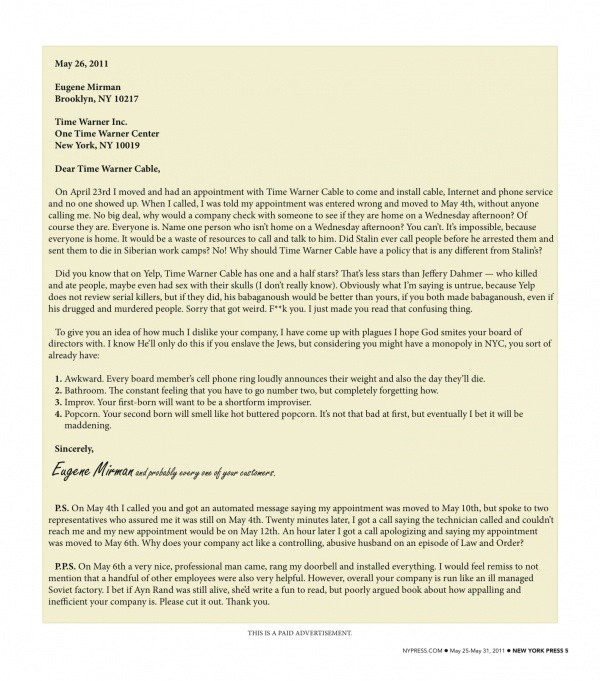
Eugene Mirman vs. Time Warner Cable = Full Page Advertising Rant

Phillip Dampier May 31, 2011 Consumer News 2 Comments

Eugene Mirman, a Brooklyn comedian trying to relocate his cable service, had the last laugh at Time Warner Cable’s expense when the cable company failed to show for his scheduled appointments (twice).  It turns out Time Warner technicians like to call customers before arriving — a problem for Mirman because he never received the call.  As Time Warner employees debated amongst themselves over whether his appointment was scheduled for May 4th or 12th, they evidently tried to resolve the issue with a compromise, showing up May 6th to finally install his service.

Not content with any of this, Mirman spent $1,100 to take out full page ads in two weekly New York-area newspapers to register his displeasure:

Dear Time Warner Cable,

On April 23rd I moved and had an appointment with Time Warner Cable to come and install cable, Internet and phone service and no one showed up. When I called, I was told my appointment was entered wrong and moved to May 4th, without anyone calling me. No big deal, why would a company check with someone to see if they are home on a Wednesday afternoon? Of course they are. Everyone is. Name one person who isn’t home on a Wednesday afternoon? You can’t. It’s impossible, because everyone is home. It would be a waste of recourses to call and talk to him. Did Stalin ever call people before he arrested them and sent them to die in Siberian work camps? No! Why should Time Warner Cable have a policy that is any different from Stalin’s?

Did you know that on Yelp, Time Warner Cable has one and a half stars? That’s less stars than Jeffery Dahmer — who killed and ate people, maybe even had sex with their skulls (I don’t really know). Obviously what I’m saying is untrue, because Yelp does not review serial killers, but if they did, his babaganoush would be better than yours, if you both made babaganoush, even if his drugged and murdered people. Sorry that got weird. F**k you. I just made you read that confusing thing.

To give you an idea of how much I dislike your company, I have come up with plagues I hope God smites your board of directors with. I know He’ll only do this if you enslave the Jews, but considering you might have a monopoly in NYC, you sort of already have:

  1. Awkward. Every board member’s cell phone ring loudly announces their weight and also the day they’ll die.
  2. Bathroom. The constant feeling that you have to go number two, but completely forgetting how.
  3. Improv. Your first-born will want to be a short form improviser.
  4. Popcorn. Your second born will smell like hot buttered popcorn. It’s not that bad at first, but eventually I bet it will be maddening.

Sincerely,

Eugene Mirman and probably every one of your customers.

P.S. On May 4th I called you and got an automated message saying my appointment was moved to May 10th, but spoke to two representatives who assured me it was still on May 4th. Twenty minutes later, I got a call saying the technician called and couldn’t reach me and my new appointment would be on May 12th. An hour later I got a call apologizing and saying my appointment was moved to May 6th. Why does your company act like a controlling, abusive husband on an episode of Law and Order?

P.P.S. On May 6th a very nice, professional man came, rang my doorbell and installed everything. I would feel remiss to not mention that a handful of other employees were also very helpful. However, overall your company is run like an ill managed Soviet factory. I bet if Ayn Rand was still alive, she’d write a fun to read, but poorly argued book about how appalling and inefficient your company is. Please cut it out. Thank you.

Still Fighting for Net Neutrality: Does the Internet Belongs to Corporations?

Phillip Dampier

Stop the Cap! reader Kimon discovered the debate over Net Neutrality is far from over when alerting us to a strong rebuke of the net policy in a number of newspapers published regionally by GateHouse Media.

Macedon, N.Y. resident Cheryl Miller doesn’t like the federal government involving itself in the Internet, and considers the “physical part of the Internet” the private property of Internet Service Providers:

When a progressive liberal takes up a cause, you can bet he’s found another way to undermine someone else’s liberty. The issue of “net neutrality” is a prime example of this rule.

The concept of net neutrality has piggybacked into recent public interest stories about groups with high-minded names like Free Press and Public Knowledge — stories about Internet-assisted food, clothing and book drives for the needy around the world, and other such humanitarian and environmental endeavors. It is sneakily implied that the success of such undertakings are the result of net neutrality principles, but they are not.

[…] Proposed net neutrality legislation would prohibit ISPs from charging different rates for various types of content or services, such as is done with cable and satellite television (think pay-per-view and premium channels). Restricting ISPs from operating in profitable ways is a disincentive to invest in more bandwidth to better serve customers, and likewise discourages innovations that could benefit consumers. More regulation will result in less profit, less competition, higher prices and a stunted Internet.

For Miller, any government policy that interferes with AT&T, Verizon, and Comcast’s view of how the Internet should be ordered amounts to a government takeover of the Internet, especially when the government can tell providers they cannot prioritize traffic or charge customers different prices to access different content.

Here at Stop the Cap!, we were unimpressed with Miller’s arguments and partisan cheap shots, especially at the expense of public policy groups like Free Press and Public Knowledge.  Perhaps she does not realize conservative groups like the Christian Coalition of America are also supporters of Net Neutrality.  But we don’t necessarily blame her either, considering all of the money being spent by corporate-funded groups to distort Net Neutrality’s ultimate goal: to ensure the same formula that made the Internet a runaway success is kept firmly in place.

Our formal response appeared in the same newspapers this afternoon:

Canandaigua, N.Y. — The most ironic part of Cheryl Miller’s commentary, “The Internet is no place for neutrality” (May 17 Daily Messenger), is that the Internet itself was created by the government. Government can do some things right, and succeeded with the Internet’s founding principle that all content was to be treated equally — judged on its merits, not the asking price some Internet service providers want to charge for unimpeded access.

Miller has fundamentally misunderstood what “net neutrality” is all about, and that may not be her fault. Millions are being spent by big cable and phone company lobbyists and their “dollar-a-holler” advocacy groups to distort net neutrality’s guarantee of a free and open Internet. This is not a government takeover of the Internet. It’s an insurance policy that keeps rapacious phone and cable companies from finding new ways to raise prices for Internet access and control which websites get priority and which go to the back of the line.

The concept is simple. You already pay plenty to your local phone or cable company to cover their costs providing access to the Internet and the online content you enjoy. Our website, along with every other, contributes our fair share by paying a web hosting company to make that content available online. Now big cable and phone companies want to be paid twice to deliver that content — once by you and once again by me. Imagine paying for a long-distance call and learning AT&T also wants to bill whoever answers.

What happens if a website refuses to pay? They can block access, artificially slow it down or charge a pay-per-view fee each time you visit, on top of your monthly Internet bill. Here’s the real kicker. They could charge you extra to read this newspaper online, and keep all of the proceeds for themselves.

That sure sounds like making money off someone else’s hard work. I’m sure Miller would be displeased if I billed everyone $5 to read her column in a newspaper I don’t own.

The truth is, companies like Verizon and Time Warner Cable are well-paid, overpaid if you ask me, to deliver broadband service they collectively earn billions in profits providing. But anyone who pays a cable bill already knows it’s never enough. These are the same companies that want the right to charge you for every website you visit while opposing letting you pay for only the TV channels you want to watch.

Phillip M. Dampier of Brighton is the editor of Stop the Cap!, a consumer broadband advocacy website.

Search This Site:

Contributions:

Recent Comments:

Your Account:

Stop the Cap!