Home » telephone service » Recent Articles:

Illinois’ ‘Free AT&T from Regulation and Responsibility’ Bill Returns in 2015

Nobody raises phone rates after deregulation like AT&T.

Nobody raises phone rates after deregulation like AT&T.

AT&T’s bill to maximize profits and minimize responsibility to its customers is back for consideration in the Illinois state legislature.

The Illinois Telecom Act is up for review in the spring and AT&T’s team of lobbyists are gearing up to advocate killing off AT&T’s legal obligation to provide low-cost, reliable landline service to any resident that wants service. AT&T says the measure is a reasonable response to the ongoing decline in its landline customer base, but rural and fixed-income residents fear the phone company will walk away from areas deemed unprofitable to serve and force customers to expensive wireless phone alternatives.

Areas in central and southern Illinois are served by a variety of rural phone companies including AT&T and Frontier Communications. Northeast Illinois is the home of metropolitan Chicago, where businesses depend on reliable phone service and the urban poor and senior residents depend on predictably affordable basic landline service.

The state still has as least 1.3 million residential landline customers paying rates starting at $3 a month for basic “Lifeline” service in Chicago to $9.50 a month for rural flat rate service with a limited local calling area. Cell service costs several times more than AT&T’s basic landline rates and signal quality is often challenged in rural areas. In large sections of Illinois where AT&T has elected not to bring its U-verse fiber to the neighborhood service, customers with basic voice calling and DSL broadband service could find themselves eventually disconnected and forced to switch to AT&T’s wireless residential service.
fat cat attAT&T’s Wireless Home Internet plan charges $60/month for 10GB of Internet use, $90/month for 20GB, and $120/month for 30GB. The overlimit fee is $10 per gigabyte. Telephone service is extra.

Customers will need smartphones or hotspot equipment to reach AT&T’s wireless services. Although often discounted or free for those who sign two-year contracts, credit-challenged customers will be required to pay a steep deposit or buy equipment outright.

“Smartphones are wonderful technology but they don’t come cheap and anybody who has traveled across Illinois knows they’re not always reliable,” David Kolata, executive director of Citizens Utility Board, said at a recent news conference. “Traditional home phone service is the most affordable, reliable option for millions of people and we shouldn’t take away that choice.”

The Federal Communications Commission is currently allowing AT&T to experiment with discontinuing landline service in parts of Alabama and Florida. Customers in urban areas are switched to AT&T’s U-verse service, those in rural areas are switched to cell service. Both services are unregulated. If AT&T can sell the Illinois legislature on abandoning its need to serve as a “carrier of last resort,” the company will have the unilateral right to disconnect service, set rates at will, and be under few, if any, customer service obligations.

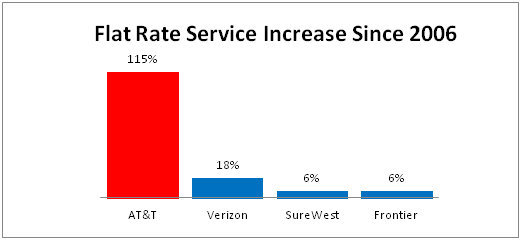
In states where AT&T won the near-total deregulation it now seeks in Illinois, phone rates quickly soared. In California, AT&T flat rate calling shot up 115% between 2006 and 2013 — from $10.69 to $23 a month. AT&T also raised prices on calling features and other services.

In earlier trials run by Verizon, similar wireless landline replacement devices lacked support for home medical and security alarm monitoring, did not handle faxes or credit card authorizations, and often lacked precision in locating customers calling 911 in an emergency. The equipment also failed during power outages if the customer lacked battery backup equipment.

Welcome to 2015; Another Year Fighting for a Square Deal for Essential Broadband Service

Phillip Dampier January 5, 2015 Editorial & Site News Comments Off on Welcome to 2015; Another Year Fighting for a Square Deal for Essential Broadband Service
Phillip Dampier

Phillip Dampier

Welcome to 2015!

This is the seventh year Stop the Cap! has fought for better broadband across North America and beyond. Whether your provider is Comcast, Time Warner Cable, Rogers, Bell, AT&T, Verizon or a (dwindling) number of other cable and telephone companies, there is plenty of room for improvement.

When we began in the summer of 2008, Frontier Communications was contemplating a usage cap of just 5GB a month on their broadband service. A year later Time Warner Cable market tested caps as high as 40GB a month. For almost as long as we’ve existed, Comcast has believed 250GB a month was all most customers ever needed. Rogers’ most popular Internet package today offers 60GB a month, despite the fact Canadians on average watch more online video than anyone else. AT&T thinks 150GB a month is fine for DSL and 250GB is all you’d need as a U-verse customer. Verizon doesn’t see a need for limits on either its DSL or fiber optic networks. Neither does Cablevision.

Usage caps and so-called “usage-based billing” continue to be one of the most under-reported stories in the tech press. Touted as “fair pricing,” these plans are in fact little more than profit-padding for a service that already earns companies as much as 90% gross margin. There is nothing fair about usage-based billing in North America. Customers face the same prices they have always paid for unlimited service, but now endure an arbitrary usage allowance that usually includes a stiff overlimit fee. Those providers charging usage pricing do not offer the fastest service, have not made significant improvements above and beyond other providers that still charge flat rate prices, and frequently also charge excessive modem rental fees.

The duopoly most Americans have for broadband service has become quite fat and happy collecting ever-increasing amounts of money for service that only seems to improve after an upstart competitor like Google arrives ready to offer better service at a lower price. Customers in Kansas City, Austin, and a handful of other communities are getting the best upgrades and are empowered to negotiate a lower price for service. The rest of the country is not so lucky. A handful of often-under capitalized fiber competitors have arrived in some areas, but their market share generally remains a fraction of what the cable and phone companies have locked up.

We have always believed broadband was destined to become the next must-have utility service, following clean water, electricity, gas and some form of telephone service. Unfortunately, Washington policymakers continue to treat Internet access as an optional extra, allowing one or two companies to dominate access in most communities. Policymakers and regulators have done very little to protect consumers from the effects of marketplace concentration, allowing cable and phone companies to merge and raise prices, remain uncommitted to protecting the Open Internet with strong Net Neutrality protections, and not taking the effects of usage caps seriously.

One of the most effective ways a community can combat bad service and high prices is to support launching its own public broadband network. Throughout the United States, local town and counties enduring “good enough for you” broadband (or no service at all) are constructing their own fiber optic networks to better meet the realities of the 21st century digital economy. They face industry-funded opposition in at least 20 states where lawmakers have banned or severely curtailed these networks to protect private telecom giants from the effects of serious competition.

In 2015, Stop the Cap! will continue to fight for consumers looking for a better deal:

  • We continue to oppose industry consolidation. Mergers and buyouts benefit executives and shareholders. They almost never benefit customers who soon find rate increases, fewer choices, and often worse service as a result. Connecticut residents know that first hand enduring Frontier Communications’ recent bungled transition from AT&T service. Customers that dislike Time Warner Cable will likely loathe Comcast if that merger wins regulator approval. AT&T’s buyout of DirecTV leaves one less competitive choice for customers living in AT&T’s service areas looking for an alternative to U-verse television. Imagine if the government had approved AT&T’s attempted buyout of T-Mobile, the one wireless carrier now willing to throw a monkey-wrench into the current dominance of almost-identical expensive wireless service plans from AT&T and Verizon.
  • Usage caps and consumption billing remain unjustified, particularly for wired broadband. Despite industry claims that usage caps and usage billing stimulate investment, in most cases the costs of delivering broadband service and the amounts companies invest in network upgrades continue their relentless decline on a per customer basis. Usage billing is no prescription for congestion problems either. Most congestion problems occur during peak usage levels — when light and heavy users alike are most likely to be online. A truly fair usage pricing scheme would charge a fair price for actual usage and nothing else. But such a pricing scheme would likely cut broadband bills and profits. So providers offer pre-determined compulsory usage allowances at current prices instead, and do not offer a flat rate option or rollover unused usage to a future month. As a result, customers often pay more for less service and constantly have to check their usage to make sure they do not get an unexpected surprise on their bill.
  • Strong Net Neutrality protection is the best guarantee of preserving the Internet as it exists today – where success or failure of an online venture is based on what it offers customers, not on the size of its bank account. A nationwide end to laws restricting the development and expansion of community broadband is also essential to give communities self-determination of their broadband future.
  • We will continue to educate consumers on how to negotiate a better deal with your provider and avoid expensive surcharges like modem rental fees. We will also continue to enlighten you about the pervasive influence of Big Telecom money on non-profits, state and federal governments, and researchers that support the various agendas of some of the largest telecom corporations in the country.

Broadband is improving at an incredible pace around the world, but back home prices continue to rise while Internet speed improvements are often met by usage cap road bumps. Internet affordability remains as much of a problem as rural broadband access. The more you know, the more effective you can argue for a change in telecom policies, where the public interest is better-balanced against corporate profits and duopoly prices.

Thank you for being a part of our efforts to make things better.

AT&T Sneaks Telecom Deregulation Amendment into Ohio’s Agriculture/Water Quality Bill

Phillip Dampier December 2, 2014 AT&T, Consumer News, Public Policy & Gov't, Rural Broadband 7 Comments
Ohio Gov. John Kasich is threatening to veto the state's Agriculture Bill if it reaches his desk with telecom deregulation inserted as an amendment.

Ohio Gov. John Kasich is threatening to veto the state’s Agriculture Bill if it reaches his desk with telecom deregulation inserted as an amendment.

AT&T’s lobbyists in Ohio have convinced state legislators to ignore a veto threat from the governor’s office and insert a deregulation amendment into an unrelated water quality and agriculture measure.

Retiring House Speaker Bill Batchelder (R-Medina) is shepherding AT&T’s latest attempt at total deregulation through the Ohio House of Representatives, claiming it will break down barriers for businesses in Ohio and give new businesses the infrastructure they need to make Ohio their home. Among Batchelder’s top donors is AT&T.

Critics contend the measure will disconnect up to 5% of rural Ohio from all telephone service because they live in “no signal bar” areas of the state.

The amendment, inserted into HB490 (at Sec. 4905.71), would end AT&T’s requirement to serve as a Provider of Last Resort, which has guaranteed that every Ohio resident seeking telephone service has had it for nearly 100 years. If the measure passes, AT&T can unilaterally disconnect service and leave unprofitable service areas, mostly in rural and poor sections of the state. Current Ohio law only permits a telephone company to end service if it can prove financial hardship and show that reasonable alternatives are available to affected residents. AT&T earned $128.75 billion in revenue in 2013 and is unlikely to meet any hardship test.

Although AT&T is unlikely to stop service in suburban and urban areas, ratepayers across the state would lose oversight protections from lengthy service outages, unreasonable billing standards and credit requirements, the ability to quickly connect or disconnect service and access to important low-income programs like Lifeline. Rural customers could be forced away from traditional landline and DSL service in favor of AT&T’s wireless network, which costs considerably more.

Current AT&T customers in Ohio can subscribe to landline service for around $20 a month in rural areas and broadband DSL for as little as $15 per month. AT&T’s wireless alternative costs $20 a month for voice service and at least $60 a month for wireless broadband (with a usage cap of 10GB per month and an overlimit fee of $10 per gigabyte). An average landline customer consuming 20GB of data would pay $35 a month for both voice and data services. The same customer using AT&T’s wireless voice and data alternative would pay $180 a month, mostly in overlimit penalties.

AT&T’s lobbying has riled Ohio’s Republican governor, John Kasich, who has threatened to veto any agriculture bill that reaches his desk with telephone deregulation attached.

att_logo“The telecommunications language will force the governor to veto this bill, as he has personally said and has also been repeated several times by other members of the administration,” Jim Zehringer, director of the Ohio Department of Natural Resources told the Ohio Senate’s Agriculture Committee during an informal hearing on the legislation. “We would be sacrificing all the great work done so far on this bill if these provisions are not removed.”


The AARP is concerned the measure will not only hurt rural Ohio, but elderly and poor residents who cannot afford wireless service.

“They will only have wireless telephone service with no price controls or guarantees for low-income Ohioans in these areas,” AARP Ohio wrote in a released statement about the proposal. “Additionally, there are areas of Ohio where wireless service is minimal, and to provide the speed needed for those receiving tele-health services in those areas will be even more expensive.”

Interested Ohio residents can share their feelings with their state legislators and the governor’s office.

  • Locate your Ohio House Representative: http://www.ohiohouse.gov/ or call 1-800-282-0253 and ask to be connected to your local representative.
  • Governor John Kasich’s Office Phone: (614) 466-3555

Frontier to Introduce $4.99 Security Landline Service, Gives Up on Expanding Video Services

Frontier is introducing a new $5 a month disaster landline service in June.

Frontier is introducing a new $5 a month disaster landline service in June.

With plenty of talk about the impact of global climate change, Frontier Communications will soon introduce a new inexpensive landline service to help customers plagued by weather disasters.

Frontier Security Phone is a $5 a month landline that can only reach 411 and 911 — perfect for those who lose their Voice over IP phone service in a power failure or find cell service clogged or otherwise unavailable.

“Our [service areas] are very prone to severe weather, lots of hurricanes, tornadoes and the mud slides in Washington State,” said Frontier CEO Maggie Wilderotter. “We have markets that are very plagued by bad weather and having a landline phone that works when your power goes out where we have a density of 34 homes a mile is important.”

Frontier will market the bare bones landline service to customers planning to disconnect service in favor of another provider as well as those that already have. Unlike basic budget service, Frontier Security Phone will not be able to make or receive regular phone calls — it is intended for emergency-use only.

Little known to most Frontier customers (and only mentioned on their website in a thicket of tariff filings) is that different types of landline service are available. By switching away from flat rate service to a measured-rate plan, where each local outgoing call is charged at a prevailing per-call rate (usually under 10 cents), customers can still have the option of making and receiving calls on a budget, especially considering incoming calls are free. In large cities like Rochester, Frontier charges $18.03 a month for flat rate local calling. If one switched to a measured-rate plan, the charge is $12.07 a month. Those interested will have to call Frontier at 1-800-921-8101 and specifically inquire about measured rate local telephone service.

Frontier is also exploring a market trial of a new Voice over IP landline service sold as a bundle with DSL.

Wilderotter told investors attending the JPMorgan Global Technology, Media and Telecom Conference that Frontier believes streaming, on-demand video is the future of Frontier, not traditional linear/live television.

Wilderotter

Wilderotter

Therefore, despite the fact Frontier will continue to support legacy FiOS TV services in adopted Verizon markets in Indiana and the Pacific Northwest, and will likely take ownership of AT&T U-verse in Connecticut, the company has no plans to introduce cable-TV service anywhere else. The biggest reason is the cost of video programming for smaller competitors like Frontier.

“We’re never to going to be big like some of these big guys are, which is why we have a partnership with the Dish Network, because they’re big,” Wilderotter explained. “They go negotiate all the content deals and then we offer those packages to our customers and we get paid a sales commission and a monthly customer service and billing fee from Dish on behalf of that service.”

Although Frontier applauded AT&T for its announced intention to acquire DirecTV, Frontier customers in Connecticut currently subscribed to DirecTV through AT&T will eventually be switched to Dish Network — Frontier’s chosen video partner.

Wilderotter explained that Frontier can leverage its broadband network to support streaming video services without assuming the costs of licensing the content. As Comcast and AT&T grow larger, they can negotiate better volume discounts unheard of among smaller competitors, keeping companies like Frontier at a major cost disadvantage. But if a customer wants Netflix or YouTube, they will need a broadband connection to get it, which is where Frontier comes in.

“If you think about Frontier, we’re in 27 states today, soon to be 28 with the Connecticut acquisition, about 30,000 communities, predominantly rural and suburban. That’s sort of our footprint,” said Wilderotter. “So when we think strategically about the assets that we have as a company, first and foremost is [the] networks in all of those markets, and those networks have been upgraded. So for us, the cost of adding another customer to broadband is really the upfront sales cost, because the network is already in place and the capabilities are already [there].”

Wilderotter adds Frontier’s average payback on its investment to hook up a new broadband customer is about three months.

“We also have industry-leading margins in our company,” Wilderotter said. “Our margins are in the mid-40% range and we’ve typically always had very strong margins in terms of how we run the business from an efficiency and effective perspective.”

Wilderotter also told investors that Frontier plans to add several additional services powered by its broadband network over the course of this year.

“We’re really looking in the categories of home automation, security, lifestyle products and monitoring products,” Wilderotter said. “And with that, there is ongoing monthly recurring revenue in terms of the tech support that we put with that product set when we sell it to a customer.”

When Wilderotter was asked about recent price hikes implemented by Frontier, she admitted the primary reason for the increase was the lack of competitive cable pricing in the market.

“If you look at what cable is offering in our markets, they offer a standalone broadband product somewhere $35 and $65,” she said. “And that doesn’t include the modem. So we felt we could increase the price, still be very competitive in the marketplace and have a product set that made more sense for our customers at a convenient price.”

Verizon’s Idea of a “Modest Rate Increase” in New Jersey: 440%; $15 Billion Collected for Phantom Fiber

Verizon-logoWhile the New Jersey Board of Public Utilities was able to quickly settle its differences with Verizon by granting the phone company’s wish to walk away from its commitment to offer 45Mbps broadband across the state, New Jersey ratepayers are out $15 billion in excess phone charges levied since 1993 for promised upgrades many will never get.
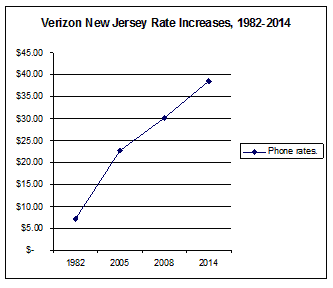
The Opportunity New Jersey plan the state government signed with Verizon was supposed to expand advanced broadband across the state in return for “a modest amount of pricing flexibility” in the fees Verizon charged customers in New Jersey. But Verizon is not a modest company and a new report shows the phone company used the agreement to boost rates as much as 440% — primarily through ancillary surcharges including inside wire maintenance, wire investment, an investment recovery fee, a local number portability surcharge, merged local calling area charge, and various other charges for phone features including Caller ID, Call Waiting, etc.

Tom Allibone, the president of LTC Consulting joined forces with New Networks’ Bruce Kushnick to analyze more than 30 years of Verizon New Jersey phone bills and discovered when it comes to tallying up rate increases, Verizon’s addition skills are akin to taking out a bag of M&M’s and only counting the yellow ones.

“This Verizon New Jersey bill from April 2002 […] has an “FCC Subscriber Line Charge”, which was $6.21 cents per line. Verizon’s quote doesn’t include this charge in their analysis of no increases between 1985 to 2008,” Kushnick writes. “The FCC Line Charge (it has many names), is on every local phone bill and the charge started in 1985. You can’t get service without paying this charge and the money does NOT go to fund the FCC but is direct revenue to Verizon New Jersey.”

verizonnjrateincreaseAfter adding up various other surcharges, Kushnick’s bill increased a lot.

“Add up the ‘Total Monthly Charges’ for 2 phone lines— It’s ugly,” Kushnick said. “While the cost of the ‘monthly charges’ was $25.62, there’s an extra $17.70 cents — 70%. I thought that Verizon said there were no ‘increases.’”

“Anyone who has ever bought a bundled package of services from Verizon (or the other phone or cable companies) knows that they all play this shell game; the price of service you have to pay is always 10-40% more than the advertised price. That’s because the companies leave out the cost of these ancillary charges and taxes in their sale pitch,” he added.

Verizon raised local residential service rates 79% in 2008, according to Kushnick. Business customers paid 70 percent more. Caller ID rates increased 38% — remarkable for a service that has a profit margin of 5,695%. But Verizon did even better boosting the charge for a non-published number by 38% — a service that has a 36,900% profit margin as of 1999 — the services are even cheaper to offer now.

Telephone service is one of those products that should have declined in price, especially after phone companies fully depreciated their copper wire networks — long ago paid off. Companies like Verizon have cut the budgets for outdoor wire maintenance and the number of employees tasked with keeping service up and running has been reduced by over 70 percent since 1985, dramatically reducing Verizon’s costs. But Verizon customers paid more for phone service, not less.

The cost of service might not have been as much of an issue had Verizon taken the excess funds and invested them in promised upgrades, but that has not happened for a significant percentage of the state and likely never will. Instead, they just increased company profits. More recently, Verizon has directed much of its investments into its more profitable wireless division.

Even though Verizon achieved total victory with the Christie Administration-dominated BPU, the company is still making threats about any future plans for investment.

“It’s important that regulators and legislators support public policies that encourage broadband growth in New Jersey rather than ones that could jeopardize the state’s highly competitive communications industry, or risk future investments by providers like Verizon,” wrote Sam Delgado, vice president of external affairs.

Search This Site:

Contributions:

Recent Comments:

Your Account:

Stop the Cap!