Home » telephone service » Recent Articles:

Europe is Now a Toll-Free Local Call for Most Time Warner Cable Phone Customers

Phillip Dampier September 8, 2015 Consumer News 1 Comment

Flag_of_Europe.svgTime Warner Cable’s unlimited local calling area expands to most of Europe today, which means making and receiving calls from across the pond now costs the same as calling your neighbor next door.

Time Warner Cable customers with Nationwide Calling telephone service ($10/mo) can now place unlimited toll-free calls across the U.S., Canada, Puerto Rico, the U.S. Virgin Islands, the Northern Marianas/Guam, American Samoa, Mexico, the People’s Republic of China, Hong Kong, India, and the 28 nations making up the European Union:

Austria, Belgium, Bulgaria, Croatia, Republic of Cyprus, Czech Republic, Denmark, Estonia, Finland, France, Germany, Greece, Hungary, Ireland, Italy, Latvia, Lithuania, Luxembourg, Malta, Netherlands, Poland, Portugal, Romania, Slovakia, Slovenia, Spain, Sweden, and the United Kingdom. (Norway, not an EU member nation, is also now toll-free. Surprisingly, no similar accommodation was made for neutral Switzerland.)

The changes mean no more long distance charges, no calling cards and pin numbers, and no varying rates. The free calling is included in your basic rate for home phone service — there are no add-on plans required. Some customers grandfathered on limited long distance or local-calling only phone plans do not qualify. Those customers are probably now paying more for those older plans than Time Warner today charges for its unlimited calling service.

timewarner twcJust like broadband, the cost to transport phone calls around the world has never been cheaper, and rates continue to fall in most other countries, often below 25 cents a minute. The exceptions are usually high-cost service areas, countries where phone tariffs are set artificially high as a revenue generator or to discourage international calling, or places that have to rely on satellite-delivered telephone service. Some examples:

  • Antarctica: It costs $3+ a minute, starting as soon as someone takes their gloves off to pick up the phone;
  • Ascension Island: Expect to pay $2.30 a minute to make a call to this isolated island in the South Atlantic Ocean that needs no more than 4-digit phone numbers;
  • Cambodia: High tariffs are a decision of the government in Phnom Penh, boosting the price of an international call to about $2.34 a minute.
  • Chad: The corrupt one-party administration in N’Djamena uses international calling revenue to line its pockets, costing $2.40 or more a minute in many cases.
  • Cook Islands: Like many South Pacific island territories, Cook Islands relies on satellite-based telephone services which are expensive. Calling someone there runs about $3 a minute;
  • Equatorial Guinea: A tiny African state with a big appetite for foreign currency, the authoritarian government in Malabo thanks you for paying $2.15+ a minute to call the country;
  • North Korea: Yes you can call North Korea and it’s a relative bargain at just $1.30+ a minute. Just assume the conversation won’t be private;
  • Laos: Around $2.40 a minute. Laos is one of the five remaining Communist states (the others: North Korea, China, Cuba and Vietnam) Don’t call us, we won’t call you;
  • Wallace and Futuna: Like other remote Pacific islands, making and receiving phone calls is dependent on expensive satellite circuits. The bureau responsible for overseeing French territories overseas also takes their cut, which makes calls to these two islands especially expensive at around $4 a minute.

Still Paying After All These Years: Verizon Raised NY Landline Rates for Phantom FiOS

Phillip Dampier July 15, 2015 Consumer News, History, Public Policy & Gov't, Verizon 1 Comment

Verizon's FiOS expansion is still dead.

Verizon customers in New York are paying artificially higher telephone rates justified to encourage Verizon investment in FiOS fiber to the home upgrades most New York State communities will never receive.

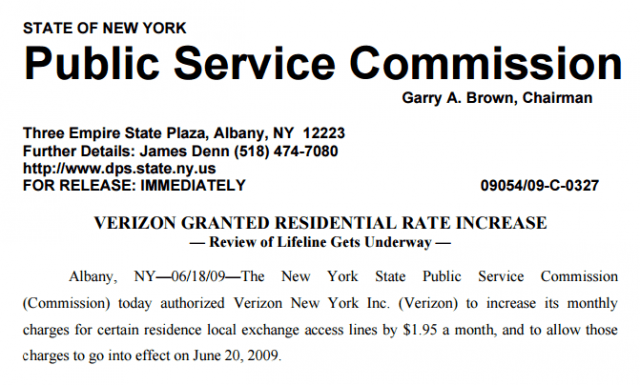
Starting in 2006, the New York Public Service Commission granted Verizon rate increases for residential flat-rate and message-rate telephone service and a 2009 $1.95 monthly increase for certain residence local exchange access lines to encourage Verizon’s investments to expand FiOS fiber to the home Internet across New York State.

“We are always concerned about the impacts on ratepayers of any rate increase, especially in times of economic stress,” said then-Commission chairman Garry Brown in June 2009. “Nevertheless, there are certain increases in Verizon’s costs that have to be recognized. This is especially important given the magnitude of the company’s capital investment program, including its massive deployment of fiber optics in New York. We encourage Verizon to make appropriate investments in New York, and these minor rate increases will allow those investments to continue.”

After Verizon announced it was suspending further expansion of its FiOS project a year later, the company continued to pocket the extra revenue despite reneging on the investments the PSC considered an important justification for the rate increases.
nypsc

“The commission allowed Verizon rate increases in 2006 and 2008 based, in significant part, upon the assumption that the revenue from the higher rates would lead Verizon to invest in fiber optic lines, presumably for the benefit of wireline customers,” argues a coalition of state legislators, consumer groups, and unions. “Serious questions exist regarding the extent to which funds may instead have been used to build out the network for the benefit of wireless customers. Publicly available reports, while fragmentary, suggest that Verizon may have included construction costs for significant benefit of its wireless affiliate to be included in the costs of the Verizon New York wireline company, thus adding to its costs and tax losses.”

shellAlmost a decade later, Verizon is still receiving the extra revenue while some public officials complain Verizon is not meeting its commitments even in cities where Verizon has introduced FiOS service.

Last week New York City Mayor Bill de Blasio ordered all future city contracts with Verizon be reviewed and authorized by City Hall. City officials complain Verizon promised in 2008 it would make FiOS available to every city resident no later than mid-2014. A year later, the service is still not available in some areas.

Verizon has blamed access issues and uncooperative landlords for most of the delays, but city officials are not happy with Verizon’s explanations.

“They [Verizon] have to demonstrate to us that they are good corporate actors if they want us to use our discretion in ways that benefit them,” the mayor’s counsel, Maya Wiley, told the New York Post.

Meanwhile, upstate New York residents now indefinitely bypassed by Verizon FiOS want a refund for the rate increases that were supposed to inspire Verizon to keep expanding fiber optics.

“Verizon has made at least $250 from me and every other upstate customer for nine years of broken promises,” said Penn Yan resident Mary Scavino. “Not only don’t they offer us fiber optics, we cannot even qualify for DSL service from them. If you can’t get Time Warner Cable in the Finger Lakes, you often don’t have broadband at all. It is them or nothing. Where did our money go?”
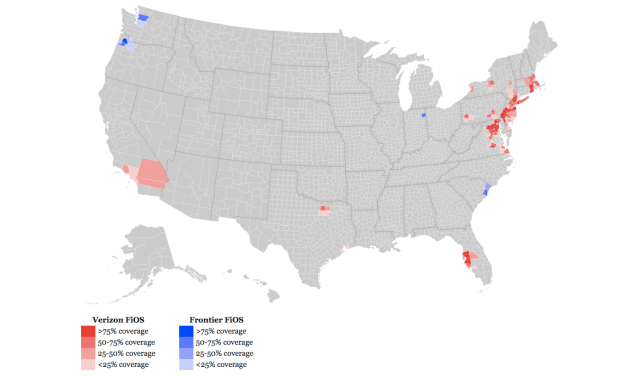
And, we're done. Verizon FiOS availability map also showing areas subsequently sold to Frontier.

And, we’re done. Verizon FiOS availability map also showing areas later sold to Frontier.

Fred, a Stop the Cap! reader in the city of Syracuse, thinks the PSC should immediately revoke the rate increases and force Verizon to refund the money to customers who will not get upgraded service.

“It’s not like Verizon cannot make money in a city like Syracuse,” writes Fred. “It’s clear the CEO thinks even more money can be made off Verizon Wireless customers off the backs of landline customers, and the PSC continues to look the other way while they do it.”

Verizon claims it has lost money on its copper wireline network for years, something the PSC seems to accept in its 2009 press release announcing rate increases:

The rate increases will generate much needed additional short-term revenues as the company faces the dual financial pressures created by competitive access line losses and the significant capital it is committing to its New York network. For 2008, Verizon reported an overall intrastate return of negative 6.7 percent and a return on common equity of negative 48.66 percent. The current trend in the market is toward bundled service offerings, and Verizon believes the proposed price changes to its message rate residential service will encourage the migration of customers towards higher-value service bundles.

That migration costs New York ratepayers even more for telephone service. Verizon’s website prompts customers seeking new landline service to bundle a package of long distance discounts and calling features that costs in excess of $50 a month before taxes, fees, and surcharges. Bundling broadband costs even more. Verizon does not tell customers ordering online they qualify for a bare bones landline with no calling features and pay-per-call billing for less than half the cost of Verizon’s recommended bundle.
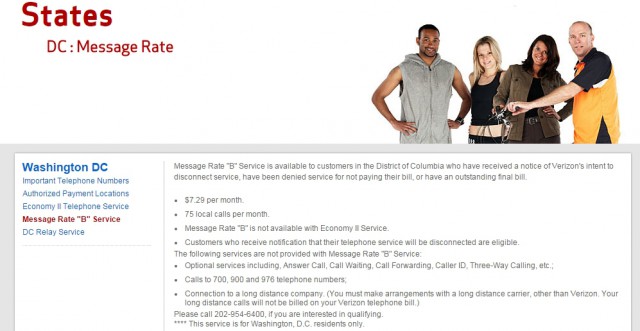
Verizon's discount calling program "Message Rate B" is only available to Washington, D.C. residents who have been threatened with final disconnection by Verizon.

This Verizon discount calling program known as “Message Rate B” is only available to Washington, D.C. residents who have been threatened with disconnection or have an outstanding balance owed to Verizon. It costs $7.29 a month and includes 75 local calls.

More than three dozen New York State legislators also question whether Verizon’s “losses” are actually the result of Verizon’s purposeful “misallocation of costs” — moving expenses to the landline business even if they were incurred to benefit Verizon’s more profitable wireless division.

“The result has been massive cost increases for consumers, especially for the garden-variety dial tone service at the bottom of the technological ladder,” argues their 2014 petition. “For example, in New York City […] since 2006 the price of residential ‘dial tone’ service (one line item on the bill) went up 84%, while other services, such as inside wire maintenance, went up 132%.”

The petitioners claim there is evidence to dispute Verizon’s assertion its legacy copper network is as big of a money loser as the company suggests, thanks to “cooking the books” with accounting tricks. The petitioners want the PSC to order a review of Verizon’s books to be certain consumers are not being defrauded or manipulated.
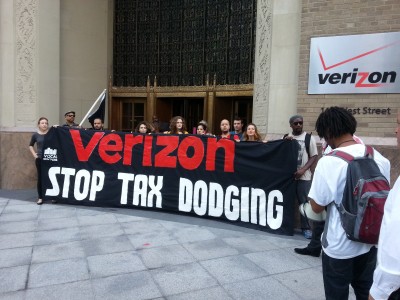
Verizon-Tax-Dodging-banner

Community leaders were arrested in 2013 during a protest outside Verizon’s NYC headquarters (at 140 West Street at the West Side Highway) to out the company for its history of avoiding taxes. (Image: Vocal NY)

From 2009-2013, Verizon New York reported losses of over $11 billion dollars, with an income tax benefit to Verizon Communications of $5 billion, and significant tax revenue losses for state, city and federal governments. Verizon New York has apparently paid no state, city or federal income tax for the last five years or more.

If Verizon is using accounting tricks to inflate the cost of legacy landline service while reducing costs to its wireless service, it could prove a win-win for Verizon and a lose-lose to ratepayers. Verizon could use its “losses” to argue for greater rate increases for landline customers while further reducing its tax obligations. On the wireless side, Verizon would enjoy praise from Wall Street analysts and shareholders pleased by the company’s apparently effective cost controls.

The best evidence of these techniques in action are the statements of company officials which suggest wireless costs are being paid by wireline customers.

Verizon’s chief financial officer, Fran Shammo, indicated to investors that Verizon wireline construction budgets are charged for expenses related to wireless service.

“The fact of the matter is wireline capital — and I won’t get the number but it’s pretty substantial — is being spent on the wireline side of the house to support the wireless growth,” Shammo told investors at Verizon at Goldman Sachs Communacopia Conference, Sept. 20, 2012. “So the IP backbone, the data transmission, fiber to the cell, that is all on the wireline books but it’s all being built for the wireless company.”

“It seems to me Verizon Wireless, already considered the Cadillac of wireless companies, doesn’t need a hidden subsidy from Verizon paid for by ratepayers all over the state,” Fred argues. “It seems very curious to me Verizon pioneered a large regional fiber optic upgrade that just a few years later it considers too costly to continue expanding, even as AT&T, Google, Comcast, and other companies are now entering the fiber business. A Public Service Commission that wants better broadband for New Yorkers ought to get to the bottom of this because it just doesn’t look right.”


Big City Telecom Infrastructure is Often Ancient: Conduits 70+ Years Old, Wiring from 1960s-1980s

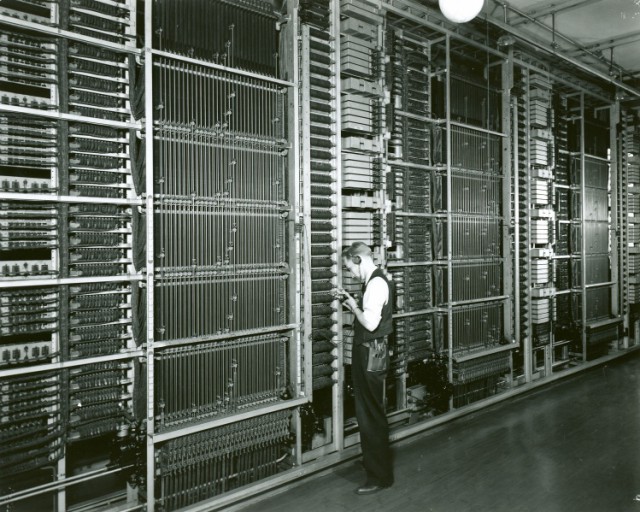
A panel electromechanical switch similar to those in use in New York until the 1970s.

A panel electromechanical switch similar to those in use in New York until the 1970s. They were installed in the 1920s.

As late as the 1970s, New York Telephone (today Verizon) was still maintaining electromechanical panel switches in its telephone exchanges that were developed in the middle of World War I and installed in Manhattan between 1922-1930. Reliance on infrastructure 40-50 years old is nothing new for telephone companies across North America. A Verizon technician in New York City is just as likely to descend into tunnels constructed well before they were born as is a Bell technician in Toronto.

Slightly marring last week’s ambitious announcement Bell (Canada) was going to commence an upgrade to fiber to the home service across the Greater Toronto Area came word from a frank Bell technician in attendance who predicted Bell’s plans were likely to run into problems as workers deal with aging copper infrastructure originally installed by their fathers and grandfathers decades earlier.

The technician said some of the underground conduits he was working in just weeks earlier in Toronto’s downtown core were “easily 60-70 years old” and the existing optical fiber cables running through some of them were installed in the mid-1980s.

At least that conduit contained fiber. In many other cities, copper infrastructure from the 1960s-1980s is still in service, performing unevenly in some cases and not much at all in others.

Earlier this year, several hundred Verizon customers were without telephone service for weeks because of water intrusion into copper telephone cables, possibly amplified by the corrosive road salt dumped on New York streets to combat a severe winter. Verizon’s copper was down and out while its fiber optic network was unaffected. On the west coast, AT&T deals with similar outages caused by flooding. If that doesn’t affect service, copper theft might.

munifiber

Fiber optic cable

Telephone companies fight to get their money’s worth from infrastructure, no matter how old it is. Western Electric first envisioned the panel switches used in New York City telephone exchanges until the end of the Carter Administration back in 1916. It was all a part of AT&T’s revolutionary plan to move to subscriber-dialed calls, ending an era of asking an operator to connect you to another customer.

AT&T engineer W.G. Blauvelt wrote the plan that moved New York to fully automatic dialing. By 1930, every telephone exchange in Manhattan was served by a panel switch that allowed customers to dial numbers by themselves. But Blauvelt could not have envisioned that equipment would still be in use fifty years later.

As demand for telephones grew, the phone company did not expand its network of panel switches, which were huge – occupying entire buildings – loud, and very costly to maintain. It did not replace them either. Instead, newer exchanges got the latest equipment, starting with more modern Crossbar #1 switches in 1938. In the 1950s, Crossbar #5 arrived and it became a hit worldwide. Crossbar #5 switches usually stood alone or worked alongside older switching equipment in fast growing exchanges. It occupied less space, worked well without obsessive maintenance, and was reliable.

It was not until the 1970s that the Bell System decided to completely scrap their electromechanical switches in favor of newer electronic technology. The advantages were obvious — the newer equipment occupied a fraction of the space and had considerably more capacity than older switches. That became critical in New York starting in the late 1960s when customer demand for additional phone lines exploded. New York Telephone simply could not keep up with and waiting lists often grew to weeks as technicians looked for spare capacity. The Bell System’s answer to this growth was a new generation of electronic switches.

The #1 ESS was an analog electronic switch first introduced in New Jersey in 1965. Although it worked fine in smaller and medium-sized communities, the switch’s software bugs were notorious when traffic on the exchange reached peak loads. It was clear to New York Telephone the #1 ESS was not ready for Manhattan until the bugs were squashed.

Bell companies, along with some independent phone companies that depended on the same equipment, moved cautiously to begin upgrades. It would take North American phone companies until August 2001 to retire what was reportedly the last electromechanical switch, serving the small community of Nantes, Quebec.

ATT-New-York-central-office-fire-300x349

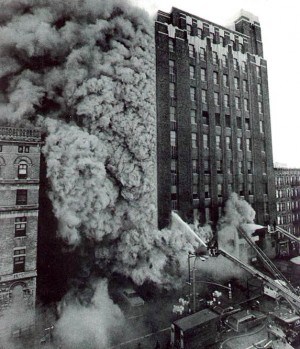
A notorious 1975 fire destroyed a phone exchange serving lower Manhattan. That was one way to guarantee an upgrade from New York Telephone.

On rare occasions, phone companies didn’t have much of a choice. The most notorious example of this was the Feb. 27, 1975 fire in the telephone exchange located at 204 Second Avenue and East 13th Street in New York. The five alarm fire destroyed the switching equipment and knocked out telephone service for 173,000 customers before 700 firefighters from 72 fire units managed to put the fire out more than 16 hours later. That fire is still memorialized today by New York firefighters because it injured nearly 300 of them. But the fire’s legacy continued for decades as long-term health effects, including cancer, from the toxic smoke would haunt those who fought it.

The New York Telephone building still stands and today also houses a street level Verizon Wireless retail store.

New York Telephone engineers initially rescued a decommissioned #1 Crossbar switch waiting to be melted down for scrap. It came from the West 18th Street office and was cleaned and repaired and put into emergency service until a #1 ESS switch originally destined for another central office was diverted. This part of Manhattan got its upgrade earlier for all the wrong reasons.

Throughout the Bell System in the 1970s and 80s, older switches were gradually replaced in favor of all electronic switches, especially the #5 ESS, introduced in 1982 and still widely in service today, serving about 50% of all landlines in the United States. Canadian telephone companies often favored telephone switches manufactured by Northern Telecom (Nortel), based in Mississauga, Ontario. They generally worked equally well as the American counterpart and are also in service in parts of the United States.

The legacy of more than 100 years of telephone service has made running old and new technology side by side nothing unusual for telephone companies. It has worked for them before, as has their belief in incremental upgrades. So Bell’s announcement it would completely blanket Toronto with all-fiber service is a departure from standard practice.

For Bell in Toronto, the gigabit upgrade will begin by pushing fiber cables through existing conduits that are also home to copper and fiber wiring still in service. If a conduit is blocked or lacks enough room to get new fiber cables through, the Bell technician predicted delays. It is very likely that sometime after fiber service is up and running, copper wire decommissioning will begin in Toronto. Whether those cables remain dormant underground and on phone poles for cost reasons or torn out and sold for scrap will largely depend on scrap copper prices, Bell’s budget, and possible regulator intervention.

But Bell’s upgrade will clearly be as important, if not more so, than the retirement of mechanical phone switches a few decades earlier. For the same reasons — decreased maintenance costs, increased capacity, better reliability, and the possibility to market new services for revenue generation make fiber just as good of an investment for Bell as electronic switches were in the 1970s and 1980s.

[flv]http://www.phillipdampier.com/video/ATT Reconnecting 170000 Phone Customers in NYC After a Major Fire 1975.mp4[/flv]

AT&T produced this documentary in the mid-1970s about how New York Telephone recovered from a fire that destroyed a phone exchange in lower Manhattan and wiped out service for 173,000 customers in 1975. The phone company managed to get service restored after an unprecedented three weeks. It gives viewers a look at the enormous size of old electromechanical switching equipment and masses of phone wiring. (22:40) 

Net Neutrality Rule Changes At FCC May Open the Door to New Surcharge on Broadband Service

fccAs a consequence of reclassifying broadband as a utility service to protect Net Neutrality, the FCC may have unintentionally opened the door for a Universal Service Fund surcharge on broadband service.
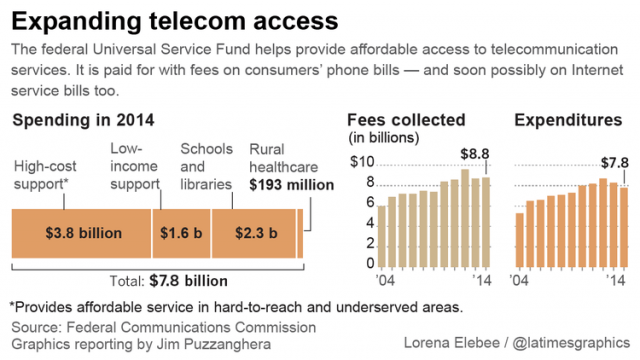
Telephone customers have been accustomed to paying “USF” fees as part of their monthly phone bill since 1997. The average household pays just under $3 a month into the fund, which subsidizes four key programs:

  • Connect America Fund: Originally designed to subsidize telephone service in high cost rural areas, the program has increasingly shifted towards subsidizing broadband expansion in remote areas where private telephone companies won’t expand service without monetary assistance from the fund. In 2013, $4.17 billion was paid in the form of subsidies to mostly rural and independent telephone companies;
  • Lifeline: The Lifeline program pays up to $10 a month to a participating telephone or wireless company to subsidize basic telephone service for Americans living below 135% of the poverty line. More than 17 million households take part, most getting basic landline service for around $1 a month;
  • Rural Telemedicine: By subsidizing video conferencing and high-speed Internet access, rural doctors can consult with specialists in larger urban areas to help treat rural patients without the cost and risk of transporting the sick or injured to distant hospitals;
  • E-Rate: A needs-based subsidy program for schools and libraries seeking telecom services and Internet access. The subsidies help defray the cost of the services on a sliding scale, with rural and urban poor areas getting the largest subsidies.

feesThe fund has increasingly shifted towards Internet connectivity and service, but only telephone customers now pay a USF surcharge on their bill.
Net Neutrality critics warned that reclassifying broadband under Title II as a telecommunications service would open the door for new fees on broadband bills, some predicting as much as $11 billion a year in new fees. But because the FCC caps the amount of the fund each year, FCC chairman Thomas Wheeler predicted even if broadband customers are asked to contribute to the USF fund, the amount would be split between phone and broadband service, resulting in no additional out-of-pocket costs. Under that scenario, a phone customer currently paying $3 a month in USF charges would see that amount reduced to $1.50 a month on their phone bill, with a new $1.50 charge on broadband. The end amount is the same.

At least for now.

The FCC has been gradually increasing the size of the fund over the years, up 47% since 2004. Last year the FCC increased the fund by $1.5 billion to raise $8.8 billion from ratepayers nationwide. Most of the increase went to rural broadband deployment.

Industry-funded Net Neutrality critics are pushing a Los Angeles Times story about the potential for new fees, calling them ‘runaway government spending.’ But in perspective, the FCC’s $8.8 billion dollar effort to improve broadband accessibility is a fraction of the amount spent on highly controversial military projects. The F-35 Lightning II aircraft, for example, will cost taxpayers $1.5 trillion, and the Republican Congress approved $500 billion in extra funding this year for the project, funds above and beyond what the Pentagon requested. If that extra funding was spent on broadband improvements, every home in America could be wired for fiber optic Internet access. For $1.5 trillion, every home in the western hemisphere could be guaranteed broadband.

If USF fees are applied to broadband service, it is safe to expect your provider will pass along the fee as a new line item on your bill.

Verizon Cutting Wireline Broadband Investments: Still No FiOS Expansion, Less Money for Wired Networks

Verizon's FiOS expansion is still dead.

Verizon’s FiOS expansion is still dead.

Verizon Communications signaled today it plans further cuts in investments for its wireline network, which includes traditional copper-based telephone service and DSL as well as its fiber-optic network FiOS.

“We will spend more CapEx in the wireless side and we will continue to curtail CapEx on the wireline side,” Verizon’s chief financial officer Fran Shammo told investors this morning. “Some of that is because we are getting to the end of our committed build around FiOS.”

Instead of expanding its FiOS fiber to the home network to new areas, Verizon is trying to increase its customer base in areas previously wired. It is less costly to reconnect homes previously wired for FiOS compared with installing fiber where copper wiring still exists.

Verizon continues to lose traditional landline customers, so the company is increasingly dependent on FiOS to boost wired revenue. The fiber network now accounts for 77% of Verizon’s residential wireline revenue.

Wherever FiOS exists, it has taken a significant number of customers away from cable competitors. FiOS Internet has now achieved 41.1% market penetration, with 6.6 million customers, up 544,000 from last year. Of those, the majority want broadband speeds they were not getting from the cable company. At the end of 2014, 59% of FiOS Internet customers subscribe to broadband speeds above 50Mbps, up from 46% at the end of 2013.

Verizon-logoDespite the success of FiOS, Verizon’s senior management continues to devote more attention to its highly profitable Verizon Wireless division, spending an even larger proportion of its total capital investments on wireless services.

In 2014, Verizon spent $17.2 billion on capital expenditures, an increase of 3.5% over 2013. But only $5.8 billion was spent on maintaining and upgrading Verizon’s landline and FiOS networks, down 7.7% over 2013. Verizon Wireless in contrast was given $10.5 billion to spend in 2014. The company is using that money to add network density to its increasingly congested 4G LTE network. In many cities, Verizon Wireless is activating its idle AWS spectrum to share the traffic load and is accelerating deployment of small cell technology and in-building microcells to deal with dense traffic found in a relatively small geographic area — such as in sports stadiums, office buildings, shopping centers, etc.

Verizon Wireless is branding its network expansion “XLTE,” which sounds to the uninitiated like the next generation LTE network. It isn’t. “XLTE” simply refers to areas where expanded LTE bandwidth has been activated. Unfortunately, many Verizon Wireless devices made before 2014 will not benefit, unable to access the extra frequencies XLTE uses.

With Verizon increasing the dividend it pays shareholders, the company is also cutting costs in both its wired and wireless divisions:

  • Verizon Wireless’ 3G data network will see a growing amount of its available spectrum reassigned to 4G data, which is less costly to offer on a per megabyte basis. As Verizon pushes more 4G-capable devices into the market, 3G usage has declined. But the reduced spectrum could lead to speed slowdowns in areas where 3G usage remains constant or does not decline as quickly as Verizon expects;
  • Verizon will push more customers to use “self-service” customer care options instead of walking into a Verizon store or calling customer service;
  • The company will continue to move towards decommissioning its copper wire network, especially in FiOS areas. Existing landline customers are being encouraged to switch to FiOS fiber, even if they have only landline service. Copper maintenance costs are higher than taking care of fiber optic wiring;
  • Verizon has accelerated the closing down of many central switching offices left over from the landline era. As the company sells the buildings and property that used to serve its network, Verizon’s property tax bill decreases;
  • Verizon will continue cutting its employee headcount. Shammo told investors in December, Verizon Communications cut an extra 2,300 employees that took care of its wired networks.

Search This Site:

Contributions:

Recent Comments:

Your Account:

Stop the Cap!