Home » telephone service » Recent Articles:

Historical Truths: The Telecom Act of 1996 Sowed the Seeds of a Telecom Oligopoly

How exactly did America get stuck with a broadband monopoly in many areas, a duopoly in most others? It did not happen by accident. In this occasional series, “Historical Truths,” we will take you back to important moments in telecom public and regulatory policy that would later prove to be essential for the creation of today’s anti-competitive, overpriced marketplace for broadband internet service. By understanding the trickery and legislative shell games practiced by lobbyists and their elected partners in Congress, you will learn to recognize when the telecom industry and their friends are preparing to sell you another bill of goods. 
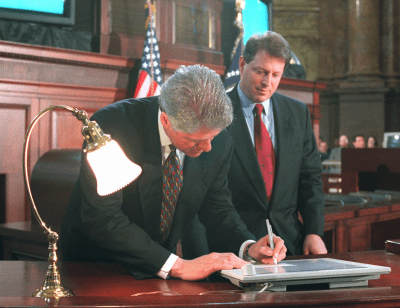
Vice President Al Gore watches President Bill Clinton digitally sign the 1996 Telecom Act into law on February 8, 1996.

By the end of the first term of the Clinton Administration, the president faced a major backlash from Republicans two years into the Gingrich Revolution. A well-funded chorus of voices in the business community, the Democratic Leadership Council — a business-friendly group of moderate Democrats, as well as commentators and pundits had the attention of the Beltway media, complaining in unison that the Democrats shifted too far to the left during the first term of the Clinton Administration, leaving it exposed in the forthcoming presidential election to another voter backlash like the one that installed the Gingrich revolutionaries in the House of Representatives and delivered a Republican takeover of the U.S. Senate in 1994.

With pressure over the growing lack of bipartisanship, and a presidential election ahead in the fall, the Clinton Administration was looking for ideas to prove it could work across the aisle and pass new laws that would deliver for ordinary Americans.

Revamping telecommunications policies would definitely touch every American with a phone line, computer, modem, and a television. Before 1996, America’s telecommunications regulation largely emanated from the Communications Act of 1934, which empowered the Federal Communications Commission to establish good order for the growing number of radio stations, telephone, and wire lines crisscrossing the country.

The 1934 Act’s legacy remains today, at least in part. It created the FCC, firmly established the concept of content regulation on the public airwaves, and established a single body to conduct federal oversight of the nation’s telephone monopoly controlled by AT&T.

Efforts to replace the 1934 Act began well before the Clinton Administration. In the early 1980s, Sen. Bob Packwood (R-Ore.) attempted to push for a legislative breakup of AT&T and a significant reduction in the oversight powers of the FCC. The bill met considerable opposition from AT&T, spending $2 million lobbying against the bill in 1981 and 1982. Alarm companies also heavily opposed the measure, terrified AT&T would enter their market and put them out of business. AT&T preferred a more orderly plan of divestiture being carefully negotiated in a settlement of a 1974 antitrust lawsuit by the Justice Department. A 1982 consent decree broke off AT&T’s control of local telephone lines by establishing seven Regional Bell Operating Companies independent of AT&T (NYNEX, Pacific Telesis, Ameritech, Bell Atlantic, Southwestern Bell Corporation, BellSouth, and US West). AT&T (technically an eighth Baby Bell) kept control of its nationwide long distance network.

Also in the 1980s, the cable television industry gained a much firmer foothold across the country, quickly gaining political power through well-financed lobbyists and close political ties to selected members of Congress (particularly Democrat Tim Wirth, who served in the House and later Senate representing the state of Colorado) that allowed them to push through a major amendment to the 1934 Act in 1984 deregulating the cable industry. The result was an early wave of industry consolidation as family owned cable companies were snapped up by a dozen or so growing operators. These buyouts were largely financed by dramatic rate increases passed on to consumers, resulting in cable bills tripling (or more) in some areas almost immediately. By the end of the 1980s, a major consumer backlash began, creating enormous energy for the eventual passage of the 1992 Cable Act, which re-regulated the industry and allowed the FCC to order immediate rate reductions.
The Progress and Freedom Foundation, with close ties to former House Speaker Newt Gingrich, closed its doors in 2010.

The biggest push for a near-complete revision of the 1934 Act came during the Gingrich Revolution. In 1995, the conservative Progress & Freedom Foundation — a group closely tied to then-Speaker Newt Gingrich (R-Ga.) floated a trial balloon calling for the elimination of an independent Federal Communications Commission, replaced by a stripped-down Office of Communications that would be run out of the White House and be controlled by the president. A small army of telecom industry-backed scholars also began proposing privatizing the public airwaves by selling off spectrum to companies to be owned as private property. The intense interest in the FCC by the group may have been the result of its veritable “who’s who” of telecom industry backers, including AT&T, BellSouth, Verizon, the National Cable & Telecommunications Association, cable companies like Comcast and Time Warner; cell phone companies like T-Mobile and Sprint; and broadcasters like Clear Channel Communications and Viacom.

The proposal outraged Democrats and liberal groups who called it a corporate-friendly sell-off and giveaway of the public airwaves. Then FCC Chairman Reed Hundt took the proposal very seriously, because at the time Gingrich lieutenant Tom DeLay’s (R-Tex.) secretive Project Relief group had 350 industry lobbyists, including some from BellSouth and Southwestern Bell literally drafting deregulation bills and a regulatory moratorium on behalf of the new Republican majority, coordinating campaign contributions for would-be supporters along the way. The proposal ultimately went nowhere, lost in a sea of the House Republicans’ constantly changing agendas, but did draw attention to the fact a wholesale revision of telecommunications policy would attract healthy campaign contributions from all corners of the industry — broadcasters, cable companies, phone companies, and the emerging wireless industry.

When it became known Congress was once again going to tackle telecommunications regulation, lobbyists immediately descended from their K Street perches in relentless waves, with checks in hand. There were two very important agendas in mind – deregulation, which would remove FCC rate regulation, service oversight, cross-competition prohibitions, and ownership caps, and ironically, protectionism. The cable and satellite companies had become increasingly fearful of the regional Baby Bells, which arrived in Congress in the early 1990s promoting the idea of entering the cable TV business. The cable industry feared phone companies would cross-subsidize the development of Telco TV by charging telephone ratepayers new fees to finance that entry. The cable industry had carefully developed a de facto monopoly over the prior decade of consolidation. Companies learned quickly direct head-to-head competition between two cable operators in the same market was bad for business.

The original premise of the 1996 Telecom Act was that it would eliminate regulations that discouraged competition. Promoters of the legislation asked why there should only be one phone or cable company in each city and why maintain regulations that kept cable and phone companies out of each others’ markets. Fears about market power and allowing domineering cable and phone companies to grow even larger were dismissed on the premise that a wide open marketplace, with regulations in place to protect consumers and competition would avoid creating telecom robber barons.

The checks handed out by industry lobbyists were bi-partisan. Democrats could crow the new rules would finally give consumers a new choice for cable TV or phone service, and help bring the “information superhighway” of the internet to schools, libraries, and other public institutions. Republicans proclaimed it a model example of free market deregulation, promoting competition, consumer choice, and lower prices.

At a high-brow bill signing ceremony held at the Library of Congress, both President Bill Clinton and Vice President Al Gore were on hand to “electronically sign” the bill into law. Both the president and vice-president emphasized the historical significance of the emerging internet, and its ability to connect information-have’s and have-not’s in an emerging digital divide. Missing from the discussion was an exploration of what industry lobbyists and their congressional allies were doing inserting specific language into the 1996 Telecom Act that would later haunt the bill’s legacy.

On hand to celebrate the bi-partisan bill’s signing were Speaker Gingrich, Sen. Larry Pressler (R-S.D.); Sen. Ernest F. Hollings (D-S.C.); Rep. Thomas J. Bliley Jr. (R-Va.); Rep. John Dingell (D-Mich.); and Ron Brown, the Secretary of Commerce. Pressler was among the soon-to-be-endangered moderate Republicans, Hollings was a holdout against the gradual wave of Republican takeovers in southern “red states,” and Dingell was a veteran lawmaker with close ties to the broadcasting industry.
Some of the bill’s industry backers were also there, some who would ironically see its signing as directly responsible for the eventual demise of their independent companies. John Hendricks of the Discovery Channel, Glenn Jones of Jones Intercable (acquired by Comcast in 1999), Jean Monty of Northern Telecom (later Nortel), Donald Newhouse of Advance Publications (eventual part owner of Bright House Networks and later Charter Communications), William O’Shea of Reuters Ltd. and Ray Smith of Bell Atlantic (today part of Verizon) were on hand. Also in the audience was Jack Valenti of the Motion Picture Association of America, representing Hollywood Studios.

Among the fatal flaws in the Telecom Act of 1996 were its various ‘competition tests,’ which were open to considerable interpretation and latitude at the FCC. The Republican supporters of the bill argued that the presence of an open and free marketplace would, by itself, induce competition among various entrants. They were generally unconcerned with the question of whether new competition would actually arrive. Their priority was lifting the protective levers of legacy regulation as soon as possible. Many Democrats assumed what appeared to be carefully drafted regulatory language would protect consumers by preventing the FCC from lifting protections too early in the competitive process. But lobbyists consistently outmaneuvered lawmakers, finding ways to insert loopholes and compromise language that introduced inconsistencies that could be dealt with and eliminated either by the FCC or the courts later.

For example, lawmakers insisted on unbundling telecommunications network elements, an arcane way of saying new competitors must be granted access to existing networks to be shared at wholesale rates. In practice, this meant if a phone company entered the internet service provider business, it must also make its network available for other ISPs as well. In some areas, competing local telephone companies also offered landline service over existing telephone lines, paying wholesale connection fees to the incumbent local phone company. As competition emerged, the incumbent company usually petitioned for a lifting of the regulations governing their business, claiming competition had arrived.

The first warning the 1996 Act was going awry came a year after the bill was signed into law. Phone companies started raising rates from $1.50-6 a month on average. AT&T was petitioning to hike rates $7 a month. Someone would have to pay to replace the scrapped subsidy system in a competitive market — subsidies that had been in place at the nation’s phone companies for decades. By charging higher rates for phone service in cities and for pricier long distance calls before the arrival of companies like MCI and Sprint, the phone companies used this revenue to subsidize their Universal Service obligations, keeping rural phone bills low and often below the real cost of providing service. To establish a truly competitive phone business, the subsidies had to be reformed or go, and that meant someone had to cover the difference.

“This game is called ‘shift and shaft,'” Sharon L. Nelson, the chairwoman of the Washington Utilities and Transportation Commission, said in 1997. “You shift the costs to the states and shaft the consumer.”

Sam Brownback (R-Kansas)

Gradually, consumers suddenly discovered their phone bill littered with a host of new charges, including the Subscriber Line Charge and various regulatory recovery fees and universal service cost recovery schemes. Phone companies also boosted rates on their unregulated Class phone features, like call waiting, caller ID, and three-way calling. The proceeds helped make up for the tens of billions in lost subsidies, but the end effect was that phone bills were still rising, despite promises of competitive, cheap phone service.

At a hearing of the Senate Commerce Committee later that year, several angry senators said they would never have voted in favor of the Telecommunications Act of 1996 if they had thought it would lead to higher rates. Sam Brownback, a Kansas Republican, was in the line of fire because of his rural constituents. Rates for those customers are subsidized more heavily than elsewhere because of the cost of extending service to them. Rates were threatening to skyrocket.

“We would be foolish to build up all these expectations about competition without saying to the American people, ‘We’re going to have to raise your phone bill,'” Brownback said.

But the rate hikes were just beginning. By the beginning of the George W. Bush administration, telecom lobbyists brought a thick agenda of action items to Michael Powell’s FCC. Despite promises of competition breaking out everywhere, that simply was not the case. Republicans quickly blamed the remaining regulatory protections still in place in noncompetitive markets for ‘deterring competition.’ But the companies knew the only thing better than deregulation was deregulation without competition.
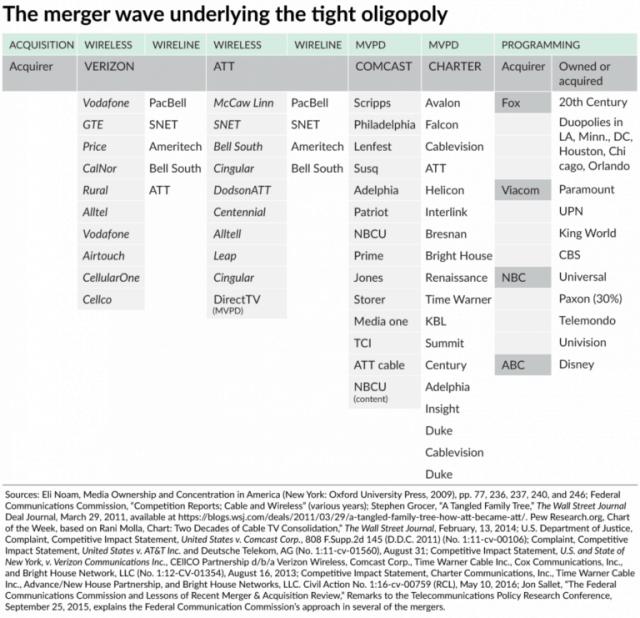
Consolidation wave

The Republican-dominated FCC quickly began removing many of those protective regulations, claiming they were outdated and unnecessary. The very definition of competition was broadened, allowing the presence of virtually any company offering almost any service good enough to trip the deregulation levers. Later, even open access to networks by competitors was often limited to pre-existing networks, not the future next generation networks. Republicans argued those networks should be managed by their owners and not subject to “unbundling” requirements.

The weakened rules also sparked one of the country’s largest consolidation waves in history. Cable companies bought other cable companies and the Baby Bells gradually started putting themselves back together into what would eventually be AT&T, Verizon, and Qwest/CenturyLink. For good measure, phone companies even snapped up a handful of independent phone companies, most notably General Telephone and Electronics, better known as GTE by Verizon and Southern New England Telephone (SNET) by AT&T.
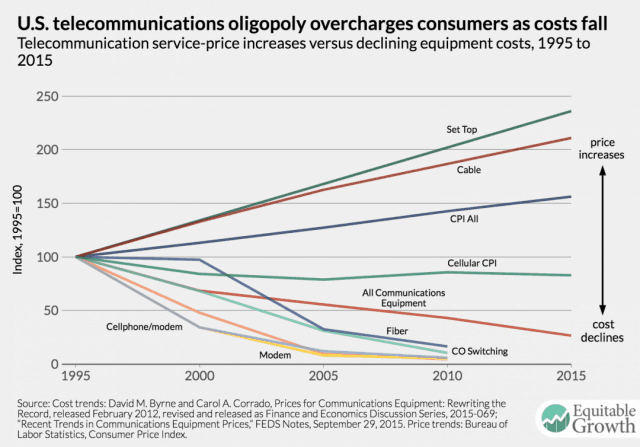
Prices rising as costs dropping.

The cable industry, under the premise it needed territories of scale to maximize potential ad insertion revenue from selling commercials on cable networks, gradually shrunk from at least a dozen well-known companies to two very large ones – Comcast and Charter, along with a few middle-sized powerhouses like Cox and Altice. Merger and acquisition deals faced little scrutiny during the Bush years of 2002-2009, usually approved with few conditions.

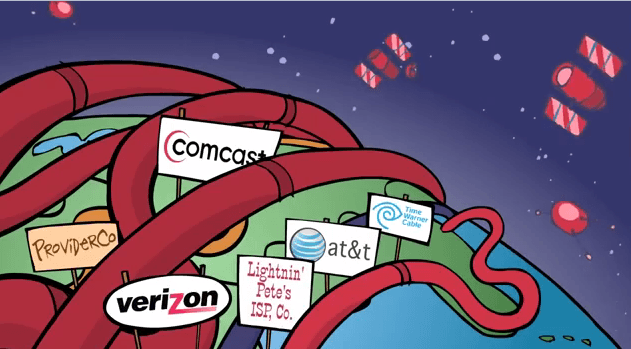
The result has been a rate-raising oligopoly for telecom services. In broadcasting, the consolidation wave started in radio, with entities like Clear Channel buying up hundreds of radio stations (and eventually putting the resulting giant iHeartMedia into bankruptcy) and Sinclair and similar companies acquiring masses of local television outlets. On many, local news and original programming was sacrificed, along with a significant number of employees at each station, in favor of inexpensive music, network or syndicated programming. Some stations that aired local news for 50 years ended that tradition or turned newsgathering over to a co-owned station in the same city.

Although telephone service eventually dropped in price with the advent of Voice over IP service, consumers’ cable TV and internet bills are skyrocketing at levels well in excess of inflation. Last year, the Washington Center for Equitable Growth demonstrated that the current consolidated, anti-competitive telecom marketplace results in rising prices for buyers and falling costs for providers.
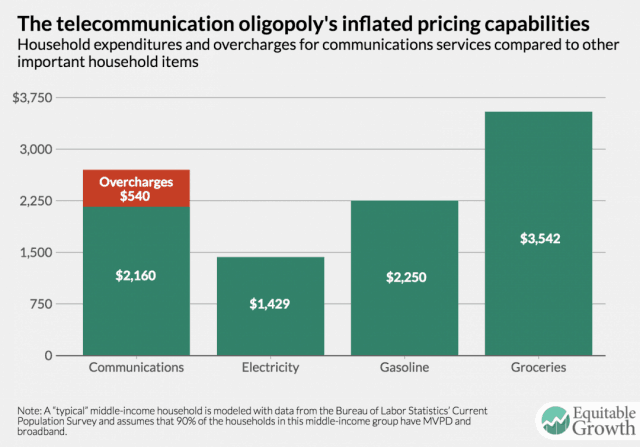
Your oligopoly tax.

“In truly competitive markets, a significant part of cost reductions would be passed through to consumers,” the group wrote. “Based on a detailed analysis of profits—primarily EBITDA—we estimate that the resulting overcharges amount to more than $45 per month, or $540 per year, an aggregate of almost $60 billion, or about 25 percent of the total average consumer’s monthly bill.”

That is one expensive bill, paid by subscribers year after year with no relief in sight. Several Republicans are proposing to double down on deregulation even more after eliminating net neutrality, which could cause your internet bill to rise further. Several Republicans want to rewrite the 1996 Telecom Act once again, and lobbyists are already sharing their ideas to further curtail consumer protections, lift ownership caps, and promote additional consolidation.
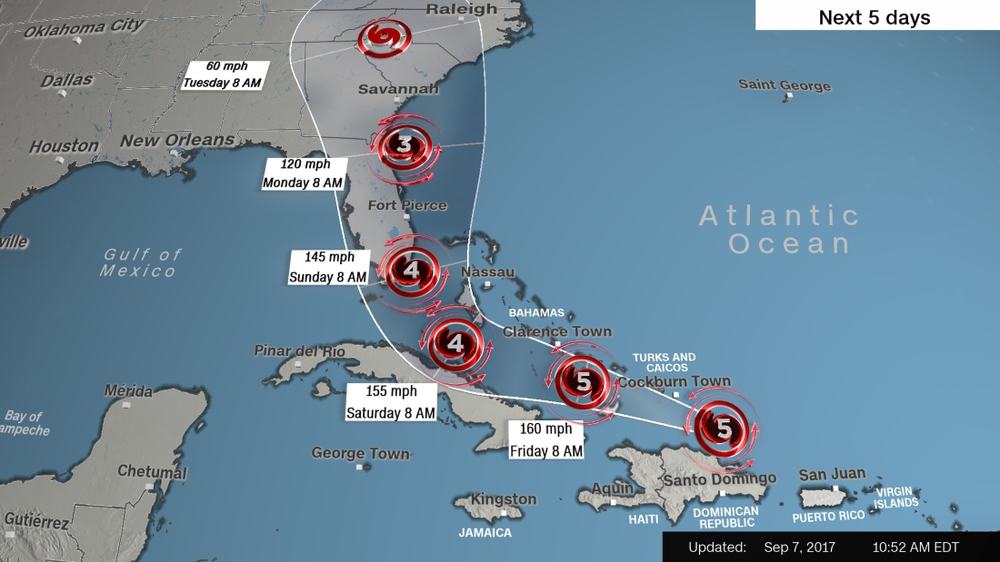
Telecom Companies Prepare for Hurricane Irma

Phillip Dampier September 7, 2017 AT&T, Comcast/Xfinity, Consumer News, Frontier, Public Policy & Gov't, Sprint, T-Mobile, Verizon, Virgin Mobile, Wireless Broadband Comments Off on Telecom Companies Prepare for Hurricane Irma

AT&T, Verizon Wireless, Sprint, and T-Mobile are sending technicians to hundreds of cell sites across Florida to top off fuel generators, test back up batteries, and protect facilities from Hurricane Irma’s anticipated storm surge and associated flooding.

“Customers rely on us, especially during major storms,” said Joe York, AT&T Florida president. “That’s why we practice readiness drills and simulations throughout the year. We do all we can to have our networks prepared when severe weather strikes. We’ve worked for the past few days to position equipment and crews to respond to the storm. We’re closely linked with Florida public officials in their storm response efforts. With a storm of this size, we may have some outages. But if service goes down, we’ll do all we can to get it back up as fast as possible.”

With landfall possible along the Florida coast or inland, Verizon pointed out that in Florida, since last hurricane season, it has densified its network with 4G, fortified coverage along evacuation routes, put cell sites equipment on stilts and installed new systems in hospitals, government and emergency facilities, and high-traffic public areas.

“The country is only beginning to wrestle with recovery efforts from Harvey, and already, residents of Florida and the Caribbean are bracing for another potentially devastating storm in Hurricane Irma,” said Sprint CEO Marcelo Claure. “During times like these, the cost of staying connected to friends and loved ones should be the last thing on anyone’s mind, and we want to do what we can to support our customers across impacted areas.”

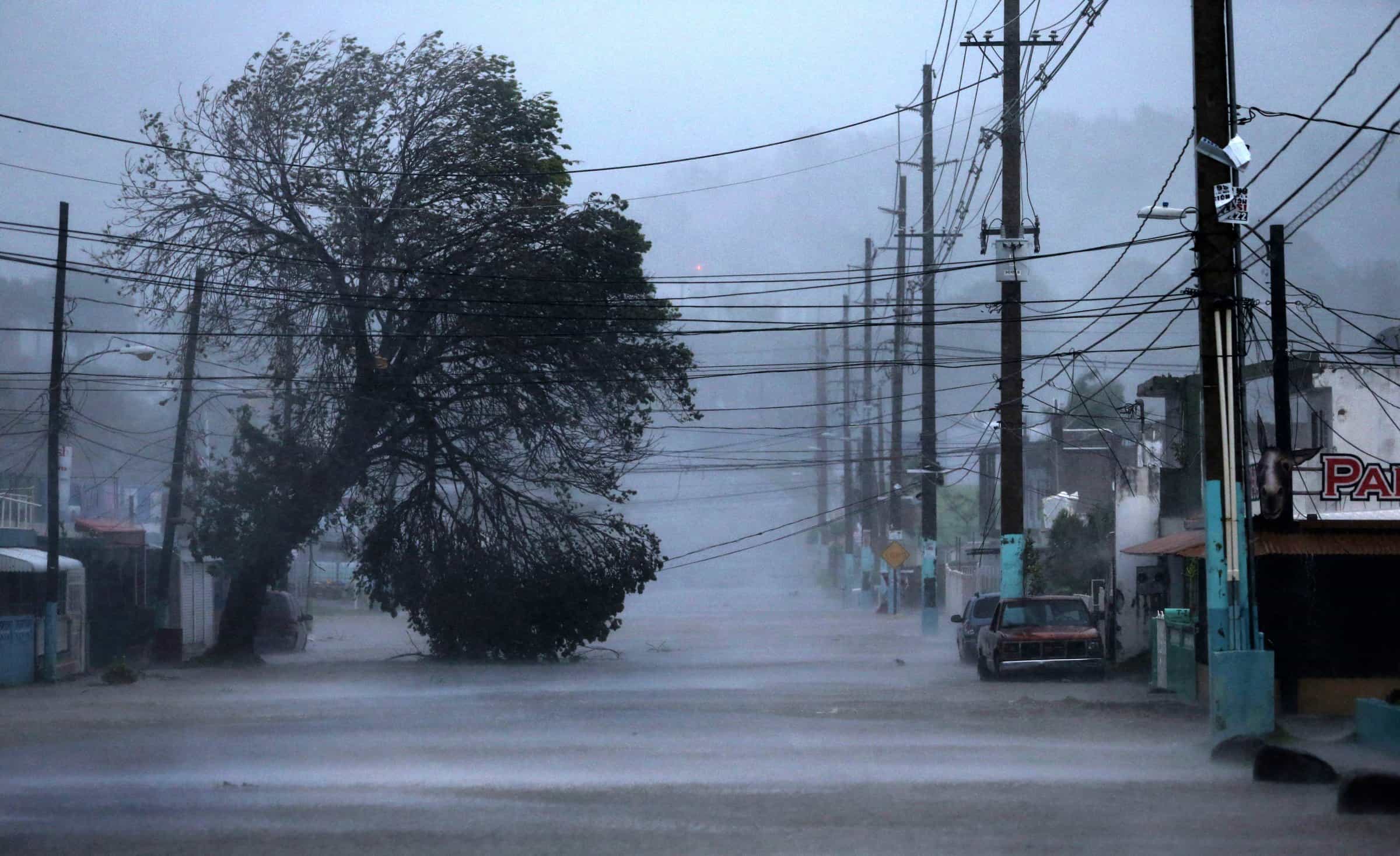
Hurricane Irma’s impact on Puerto Rico.

AT&T and Verizon Wireless are positioning portable cell tower trailers just outside of areas anticipated to take the brunt of the hurricane. AT&T in particular has a lot to prove as its network now includes FirstNet — a public private wireless broadband network for emergency responders that also depends on AT&T’s wireless networks. States are still in the process of opting in to AT&T’s FirstNet. The company has more than 700 pieces of emergency cellular equipment, including Cell on Wheels, Cell on Light Trucks, portable trailers and generators, and even the possibility of deploying Cells on Wings — airborne cell towers that can restore cell service in areas where roads are inaccessible because of floods.

Wireline companies are also positioning repair crews in the region to bring service back online. Other technicians are checking on emergency generator and battery backup power, particularly for maintaining landline service.

“Our team is working to prepare for extreme weather and will be there for our business and residential customers to quickly and safely restore any affected network services,” reports Frontier Communications, which provides service in former Verizon landline service areas.

The phone company is reminding landline customers that not all phones will operate during a power outage, but that does not mean Frontier’s landline network is down.

“Customers who rely on cordless phones should consider plugging a traditional corded phone directly into the wall. In the event of a commercial power outage, corded phones on the copper network will still operate; cordless ones will not,” the company says. “If commercial power is unavailable, generators and batteries in Frontier’s central offices serve as a backup. Phone lines generally will have enough power in them to use a corded phone. For customers using FiOS phone services, the battery backup will supply voice service for up to eight hours.”

The company also warns customers to watch out for damaged utility lines after the storm is over.

“Stay far away from any downed cables or power lines. Contact Frontier at 800-921-8102 (business) or 800-921-8101 (residential) to report any fallen telephone poles or cables.”

Some companies are offering customers a break on their bills:

  • Verizon: Landline customers will not pay any long distance charges for calls to Anguilla, the British Virgin Islands, Puerto Rico, Dominican Republic, Haiti, and the Turks and Caicos Islands from Sept. 6-9. Taxes and any government surcharges applicable will still apply. Verizon Wireless customers inside the U.S. will not be charged for texts or calls originating in the U.S. to those same countries and territories for the same period.
  • T-Mobile and MetroPCS customers in affected areas of Puerto Rico:  Will get calls, texts, and unlimited data free from Sept. 6th through Sept. 8th. This free service will be available to customers in the 787 and 939 area codes.
  • Sprint: Effective today through Sept. 9, 2017, Sprint will waive call, text and data overage fees for its Sprint, Boost Mobile and Virgin Mobile customers in Puerto Rico and the U.S. Virgin Islands. For Sprint, Boost Mobile and Virgin Mobile customers in the U.S., the company will also waive all international call and text overage fees to the following: Anguilla, Dominican Republic, Haiti, Turks and Caicos, and British Virgin Islands. For the same period, Sprint will also waive roaming voice and text overage fees for its customers in those locations. Fees will be waived during the time specified.
  • Comcast: Opening more than 137,000 XFINITY Wi-Fi hotspots throughout Florida to anyone who needs them, including non-XFINITY customers, for free. For a map of XFINITY Wi-Fi hotspots, which are located both indoors and outdoors in places such as shopping districts, parks and businesses, visit Xfinity.com/wifi. Once in range of a hotspot, select the “xfinitywifi” network name in the list of available hotspots and then launch a browser. Comcast internet customers can sign in with their usernames and passwords and they will be automatically connected to XFINITY Wi-Fi hotspots in the future. Non-Comcast internet subscribers should visit the “Not an Xfinity Internet Customer” section on the sign-in page to get started. Non-customers will be able to renew their complimentary sessions every 2 hours through Sept. 15, 2017.

AT&T Offers These Customer Tips:

  • Keep your mobile phone battery charged. In case of a power outage, have another way to charge your phone like an extra battery, car charger or device-charging accessory. Applicable sales tax holidays are a great time to stock up on cell phone accessories.
  • Keep your mobile devices dry. The biggest threat to your device during a hurricane is water.  Keep it safe from the elements by storing it in a baggie or some other type of protective covering, like an Otterbox phone cover.
  • Have a family communications plan. Choose someone out of the area as a central contact.   Make sure all family members know who to contact if they get separated. Most importantly, practice your emergency plan in advance.
  • Program all of your emergency contact numbers and e-mail addresses into your mobile phone. Numbers should include the police department, fire station and hospital, as well as your family members.
  • Forward your home number to your mobile number in the event of an evacuation. Call forwarding is based out of the telephone central office. This means you will get calls from your landline phone even if your local telephone service is disrupted. If the central office is not operational, services such as voicemail and call forwarding may be useful.
  • Track the storm and access weather information on your mobile device. Many homes lose power during severe weather. You can stay up to speed as a DIRECTV customer, by streaming local weather channels using the DIRECTV application on your smartphone. If you subscribe to mobile DVR, you can also stream every channel directly to your phone.
  • Camera phones provide assistance. If you have a camera phone, take, store and send photos and video clips of damage to your insurance company.
  • Use location-based technology.  Services like AT&T Navigator and AT&T FamilyMap can help you find evacuation routes or avoid traffic from downed trees or power lines. They can also track a family member’s wireless device if you get separated.
  • Limit social media activity. Keep social media activity to a minimum during and after a storm to limit network congestion and allow for emergency communications to go through.

Business Tips:

  • Set up a call-forwarding service to a backup location. Set up a single or multiple hotline number(s) for employees, their families, customers and partners so they all know about the business situation and emergency plan.
  • Back up data to the Cloud. Routinely back up files to an off-site location.
  • Outline detailed plans for evacuation and shelter-in-place. Practice these plans (employee training, etc.). Establish a backup location for your business and meeting place for all employees.
  • Assemble a crisis-management team. Coordinate efforts with neighboring businesses and building management. Disasters that affect your suppliers also affect your business. Outline a plan for supply chain continuity for business needs.

Keeping the lines open for emergencies:

During evacuations, the storm event and its aftermath, network resources will likely be taxed. To help ensure that emergency personnel have open lines, keep these tips in mind:

  • Text messaging. During an emergency situation, text messages may go through more quickly than voice calls because they require fewer network resources. Depending on your text or data plan, additional charges may apply.
  • Be prepared for high call volume. During an emergency, many people are trying to use their phones at the same time. The increased calling volume may create network congestion, leading to “fast busy” signals on your wireless phone or a slow dial tone on your landline phone. If this happens, hang up, wait several seconds and then try the call again. This allows your original call data to clear the network before you try again.
  • Keep non-emergency calls to a minimum, and limit your calls to the most important ones. If there is severe weather, chances are many people will be attempting to place calls to loved ones, friends and business associates.

Additional information and tips for disaster preparedness can be found at www.att.com/vitalconnections.

Spring 2016: An Update and Progress Report for Our Members

stcDear Members,

We have had a very busy winter and spring here at Stop the Cap! and we thought it important to update you on our efforts.

You may have noticed a drop in new content online over the last few months, and we’ve had some inquiries about it. The primary reason for this is the additional time and energy being spent to directly connect with legislators and regulators about the issues we are concerned about. Someone recently asked me why we spend a lot of time and energy writing exposés to an audience that almost certainly already agrees with us. If supporters were the only readers here, they would have a point. Stop the Cap! is followed regularly by legislators, regulators, public policy lobbyists, consumer groups, telecom executives, and members of the media. Our content is regularly cited in books, articles, regulatory filings, and in media reports. That is why we spend a lot of time and energy documenting our positions about data caps, usage billing, Net Neutrality, and the state of broadband in the United States and Canada.

A lengthy piece appearing here can easily take more than eight hours (sometimes longer) to put together from research to final publication. We feel it is critical to make sure this information gets into the hands of those that can help make a difference, whether they visit us on the web or not. So we have made an extra effort to inform, educate, and persuade decision-makers and reporters towards our point of view, helping to counter the well-funded propaganda campaigns of Big Telecom companies that regularly distort the issues and defend the indefensible.

Four issues have gotten most of our attention over the last six months:

  1. The Charter/Time Warner Cable/Bright House merger;
  2. Data cap traps and trials (especially those from Comcast, Blue Ridge, Cox, and Suddenlink);
  3. Cablevision/Altice merger;
  4. Frontier’s acquisition of Verizon landlines and that phone company’s upgrade plans for existing customers.

We’ve been successful raising important issues about the scarcity of benefits from telecom company mergers. In short, there are none of significance, unless you happen to be a Wall Street banker, a shareholder, or a company executive. The last thing an already-concentrated marketplace needs is more telecom mergers. We’re also continuing to expose just how nonsensical data caps and usage-based billing is for 21st century broadband providers. Despite claims of “fairness,” data caps are nothing more than cable-TV protectionism and the further exploitation of a broadband duopoly that makes it easy for Wall Street analysts to argue “there is room for broadband rate hikes” in North America. Stop the Cap! will continue to coordinate with other consumer groups to fight this issue, and we’ve successfully convinced at least some at the FCC that the excuses offered for data caps don’t hold water.

Dampier

Dampier

FCC chairman Tom Wheeler’s broadening of Charter’s voluntary three-year moratorium on data caps to a compulsory term as long as seven years sent a clear message to broadband providers that the jig is up — data caps are a direct threat to the emerging online video marketplace that might finally deliver serious competition to the current bloated and overpriced cable television package.

Wheeler’s actions were directly responsible for Comcast’s sudden generosity in more than tripling the usage allowance it has imposed on several markets across the south and midwest. But we won’t be happy until those compulsory data caps are gone for good.

More than 10,000 Comcast customers have already told the FCC in customer complaints that Comcast’s data caps are egregious and unfair. Considering how unresponsive Comcast has been towards its own customers that despise data caps of any kind, Comcast obviously doesn’t care what their customers think. But they care very much about what the FCC thinks about regulatory issues like data caps and set-top box monopolies. How do we know this? Because Comcast’s chief financial officer this week told the audience attending the JPMorgan Technology, Media and Telecom Broker Conference Comcast always pays attention to regulator headwinds.

“I think it’s our job to make sure we pivot and react accordingly and make sure the company thrives whatever the outcome is on some of the regulatory proposals that are out there,” said Comcast’s Mike Cavanagh. We suspect if Chairman Wheeler goes just one step further and calls on ISPs to permanently ditch data caps and usage billing, many would. We will continue to press him to do exactly that.

Stop the Cap! supports municipal and community-owned broadband providers.

Stop the Cap! supports municipal and community-owned broadband providers.

Other companies are also still making bad decisions for their customers. Besides Comcast’s ongoing abusive data cap experiment, Cox’s ongoing data cap trial in Cleveland, Ohio is completely unacceptable and has no justification. The usage allowances provided are also unacceptably stingy. Suddenlink, now owned by Altice, should not even attempt to alienate their customers, particularly as the cable conglomerate seeks new acquisition opportunities in the United States in the future. We find it telling that Altice feels justified retaining usage caps on customers in smaller communities served by Suddenlink while denying they would even think of doing the same in Cablevision territory in suburban New York City. Both Suddenlink and Cablevision have upgraded their networks to deliver faster speed service. What is Altice’s excuse about why it treats its urban and rural customers so differently? It frankly doesn’t have one. We’ll be working to convince Altice it is time for Suddenlink’s data caps to be retired for good.

We will also be turning more attention back on the issue of community broadband, which continues to be the only competitive alternative to the phone and cable companies most Americans will likely ever see. The dollar-a-holler lobbyists are still writing editorials and articles claiming “government-owned networks” are risky and/or a failure, without bothering to disclose the authors have a direct financial relationship to the phone and cable companies that don’t want the competition. We will be pressing state lawmakers to ditch municipal broadband bans and not to enact any new ones.

We will also continue to watch AT&T and Verizon — two large phone companies that continue to seek opportunities to neglect or ditch their wired services either by decommissioning rural landlines or selling parts of their service areas to companies like Frontier. AT&T specializes in bait-n-switch bills in state legislatures that promise “upgrades” in return for further deregulation and permission to switch off rural service in favor of wireless alternatives. That’s great for AT&T, but a potential life-threatening disaster for rural America.

We continue to abide by our mandate: fighting data caps and consumption billing and promoting better broadband, regardless of what company or community supplies it.

As always, thank you so much for your financial support (the donate button that sustains us entirely is to your right) and for your engagement in the fight against unfair broadband pricing and policies. Broadband is not just a nice thing to have. It is an essential utility just as important as clean water, electricity, natural gas, and telephone service.

Phillip M. Dampier
Founder & President, Stop the Cap!

Big Headaches for Frontier Takeover of Verizon Landlines/DSL/FiOS in Texas, Florida, and California

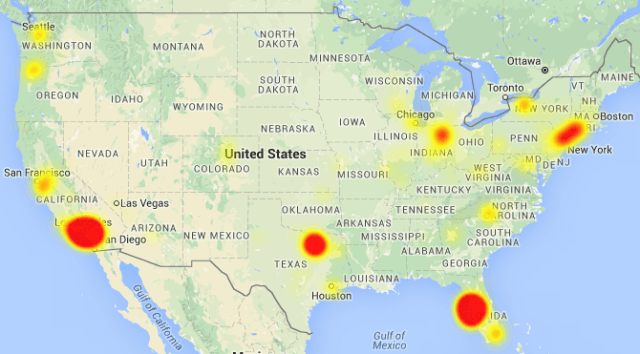
As of late Monday afternoon, Downdetector.com still shows widespread outages for Frontier customers in North Texas, western Florida and parts of California.

As of late Monday afternoon, Downdetector.com still shows widespread outages for Frontier customers in North Texas, western Florida and parts of California.

Despite promises this past weekend’s transition from Verizon Communications to Frontier Communications would result in little more than “a logo change,” countless customers in the affected states of Florida, Texas, and California reported long service outages, website problems, and long holds waiting to talk to customer service representatives about when service would be back.

The outages were most widespread on Friday morning, April 1, when many subscribers awoke to discover they no longer had phone, television, or broadband service. A blitz on social media directed at Frontier quickly followed on Facebook and Twitter, many summing up their first experience with Frontier to be like “dealing with a third-rate phone company.”

Louise Thompson called the transition “a total fiasco” and some businesses lost thousands of dollars on Friday alone. The “Happy Grasshopper” was one of them, after losing Internet and phone service.

“We have 20 employees who can’t get any work done here today,” said owner Dan Stewart.

Gerard Donelan, a real estate appraiser who works from home in South Tampa, was still without service Friday afternoon. “I talked to customer service about 10:30. … He told me service was down in the Tampa Bay area, and he didn’t know when it was coming back, and there was nothing he could do,” Donelan told the Tampa Tribune. “What a joke. These guys were telling us just yesterday how seamless this was going to be. My next phone call is to Bright House.”

welcome frontierThe popular Zudar’s sandwich shop downtown was still unable to swipe credit cards or take phone or Internet orders at mid-afternoon. “It’s having a terrible effect on business,” said owner Eric Weinstein. “It’s absolutely an epic failure on their part. An amazing lack of customer service and communication.”
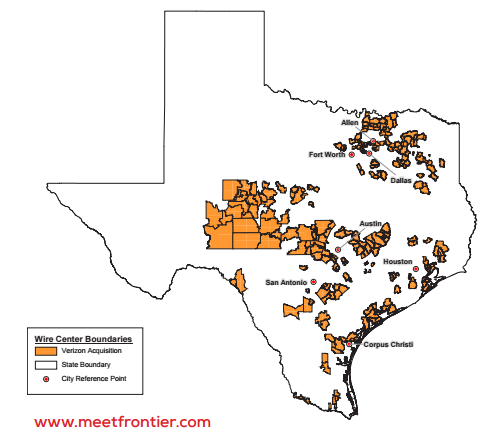
frontier texasThe City of Plano (Tex.) lost its website in the transition. Frontier shared its failure with AT&T mobile customers in parts of Florida, who found cell service not working because Frontier also took control of fiber links connecting many of AT&T’s cell towers to AT&T’s network. Many of those were down too.
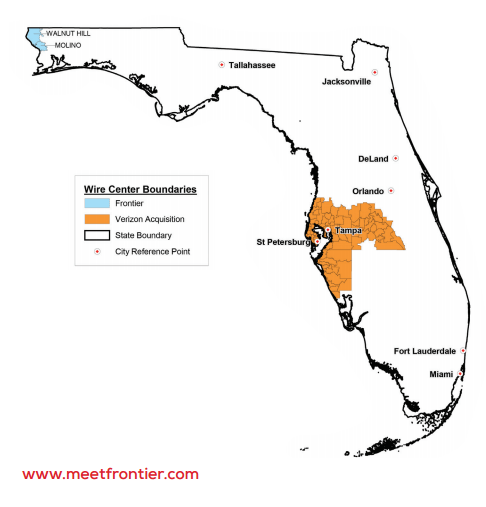
“During the early morning of April 1, 2016, a technical issue occurred during the integration of the systems Frontier acquired from Verizon that impacted service to some enterprise and carrier customers in Florida, Texas and California.  As of 9:30 am eastern, the issue was resolved,” the company’s statement said.  “In addition, an unrelated fiber cut occurred that impacted customers in the Tampa market.”

Across all three states, Frontier officials hurried to downplay the impact of the service outages, which are continuing to this day for some customers. In some statements, Frontier claimed only about 500 business customers lost service, and there were no widespread problems. But many of the 3.7 million customers in Texas, Florida and California enduring the transition say those outages and problems affect residential accounts.

“There is ‘absolutely nothing widespread going on?'” asked Eric Petty, an adjunct professor at St. Petersburg College. “What a bunch of liars. How stupid do they think their customers are?”

One of the biggest problems customers are encountering is the procedure to transition their online access from Verizon to Frontier. To begin that process, customers need a new Frontier ID, but that is easier said than done if you lack landline service. As part of the registration process, customers need to enter the account PIN number usually displayed on landline bills, but often missing from broadband-only service bills.

frontier floridaLee Allen of Dallas was one of many frustrated customers. He spent an hour trying to manage the Frontier MyAccount registration process and when he tried to sync his Verizon and Frontier account together, it was a flop.
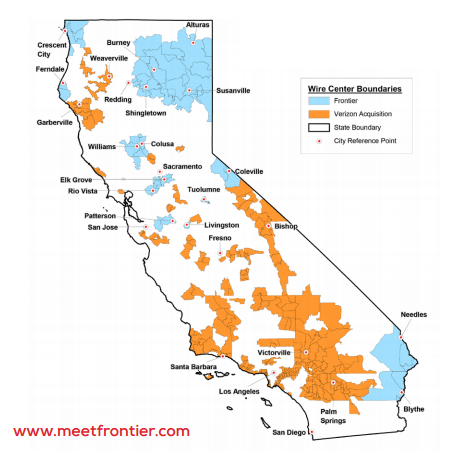
Two calls to Frontier customer service and still no joy reports the Dallas Morning News.

“I’m in limbo,” he said Friday afternoon.”I’m self-employed and work from home. They are supposed to be a technology company. They should have been ready.”

Frontier says they are aware of this problem and are working on a solution.

In Los Gatos, Calif., it was an Internet-free weekend for most of the city’s former Verizon Internet customers, who also lost service on Friday. As of Sunday morning, they still didn’t have service, according to the San Jose Mercury News:

Los Gatos customers were assured the transition on April 1 would be smooth with no interruption to service. But that hasn’t been the case, said Beau Graeber, Fenesy’s neighbor who’s helping him contact the company and reconfigure his Internet.

“It’s a little frustrating,” Graeber said, adding that Verizon — now Frontier — is the only option for Internet and telephone service in Los Gatos, outside of cable or satellite providers. “For Ralph and some of my other neighbors, it’s a terrible inconvenience.”

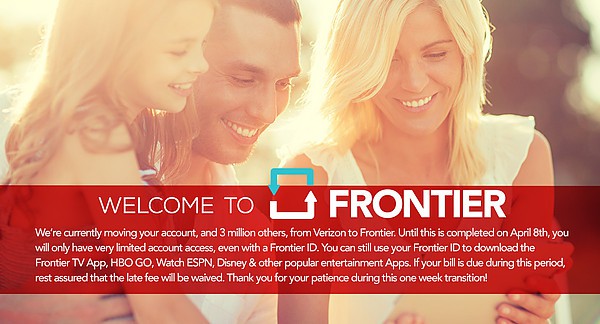
frontier californiaConcerned customers with bills due this week are finding they don’t have enough access on Frontier’s website to arrange payment of their bill. Frontier says not to worry – “Until this process is completed on April 8th, you will only have very limited account access, even with a Frontier ID,” Frontier reports. “You can still use your Frontier ID to download the Frontier TV App, HBO GO, Watch ESPN, Disney and other popular entertainment Apps. If your bill is due during this period, rest assured that all late fees will be waived.”

Beyond total service outages and interruptions, other customers are reporting various problems with Frontier’s version of FiOS TV:

  • Frontier began migrating their 100,000 title On Demand library to FiOS on April 2. The process was supposed to be complete Saturday afternoon, but some customers are still having problems. Frontier: “We understand how important Video on Demand is to our customers. We apologize for the inconvenience and are working diligently to ensure the content is available as soon as possible. If you get a message that the service is ‘temporarily unavailable,’ you should reboot your set-top box to refresh the VOD service. To reboot, unplug your set-top box, wait at least 10 seconds, and then plug it back in. Please note, a reboot can take up to 3 minutes as the system refreshes your settings. If you continue to experience any issues accessing VOD, please call our Tech Support team at 1-877-600-1511.”
  • The Nickelodeon Jr. FiOS TV Widget/App was retired by Nickelodeon on March 31 prior to the transition to Frontier. It is, therefore, not available. Customers can still watch Nick Jr. on their home television. Customers can also access Nick Jr.’s programming via the web, at www.nickjr.com, or through Nickelodeon’s mobile apps for iOS and Android.
  • When searching for a Video on Demand title with the FiOS TV remote, customers may notice due to the transition from Verizon to Frontier, many of the movies and TV shows are not appearing in either “New Releases” or “Collections”. However, they can be found by scrolling down to “By Title” and then selecting “All” in order to find your choice. You can also search for your VOD by selecting the “B” button on your FiOS TV remote.

frontier new logoFrontier promised regulators things would go better for new Frontier customers after the company botched a similar transfer of AT&T customers in Connecticut that went so poorly, the company had to offer $50 service credits to affected customers.

“We have lessons to learn,” Frontier spokeswoman Kathleen Abernathy told Connecticut regulators at the time.

“They didn’t learn a thing,” said Stan Rogers, a transitioned Frontier customer outside of Allen, Tex. “I was there for the Connecticut switchover two months before I moved down here and now I get to experience the same thing all over again. To give you an idea of where Frontier is on the technology curve, they have sent me information about how to transition my Verizon e-mail address to AOL. Hello!”

North Texas resident Larry Allen agrees, “I didn’t think anything could drive me back to Comcast, but Frontier may do it. TV issues, email issues, Frontier can’t process my information to set up an account, horrible/outdated selection of movies on demand, [and] Frontier [is] not responding to emails for assistance.”

[flv]http://www.phillipdampier.com/video/WTSP Tampa Frontier transition not as smooth as promised 4-1-16.mp4[/flv]

WTSP in Tampa reports Florida area customers didn’t get the easy transition from Verizon to Frontier they were promised. (2:22)

[flv]http://www.phillipdampier.com/video/KTVT Dallas Frontier service problems persist for some 4-3-16.mp4[/flv]

KTVT in Dallas reports Frontier service outages created headaches for customers across North Texas. (2:08)

FCC Chairman Proposes Expanding Lifeline to Include Broadband

Phillip Dampier March 8, 2016 Consumer News, Public Policy & Gov't 2 Comments
universal service

The Universal Service Fund is funded by telephone ratepayers. (Image: Free Press)

A $9.25 a month subsidy to allow low income Americans to get basic telephone service would be expanded to include broadband service if a majority of FCC commissioners adopt changes proposed today to the Lifeline program.

A draft plan to expand the 30-year old Lifeline federal subsidy intended originally for landlines to include Internet access was released this morning by FCC chairman Thomas Wheeler and Commissioner Mignon Clyburn. Under the proposal, those eligible for federal aid programs like Medicaid will qualify for a discount, which can be applied to a landline, mobile phone, or broadband service.

“Internet access has become a prerequisite for full participation in our economy and our society, but nearly one in five Americans is still not benefiting from the opportunities made possible by the most powerful and pervasive platform in history,” Wheeler and Clyburn wrote in a joint blog post. “Internet access has become a pre-requisite for full participation in our economy and our society, but nearly one in five Americans is still not benefiting from the opportunities made possible by the most powerful and pervasive platform in history. […]By modernizing the FCC’s Lifeline program, we will do better.”

Republicans immediately pounced on the proposed program, claiming past experiences with waste, fraud, and abuse in FCC programs for the poor have already cost ratepayers a great deal of money subsidizing unqualified consumers with multiple landlines and cell phones. They propose not expanding the program further until more safeguards were put in place to prevent more fraud.

Wheeler

Wheeler

Wheeler and Clyburn appeared ready for that objection, noting the plan would set up an independent clearinghouse to manage customers’ eligibility and approval, removing that responsibility from providers that critics charge have a vested interest in approving as many new customers as possible.

But some still object to the plan, noting Lifeline’s original purpose has been dramatically altered since it was first conceived in 1985 as a program to guarantee low-cost landline service for poor Americans, and efforts to justify its relevance by expanding it to include cell phones allowed fraudsters to game the system.

After the Bush Administration approved a plan to expand Lifeline to include wireless phone subsidies, providers sprung up almost immediately offering free or low-cost cell service using a business plan based entirely around the federal subsidy. Many providers signed up customers later found to be ineligible for service because they already received subsidized landline or mobile service from another provider. Getting rid of duplicate or ineligible accounts took almost four years in some cases.

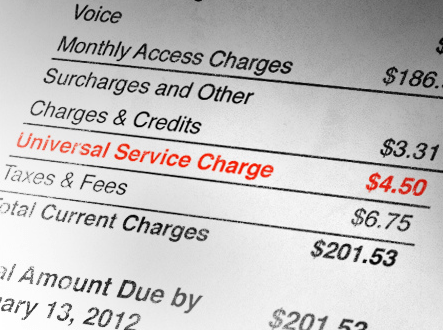
Today, about 12 million American households receive the $9.25 subsidy. Federal officials estimate up to five million more households will eventually apply for the broadband subsidy, which would boost the Lifeline budget from $1.5 billion to $2.25 billion. The program is funded by telephone ratepayers, as part of the Universal Service Fund surcharge on consumers’ phone bills. For Mr. Wheeler and Ms. Clyburn, the cost is well worth it.

“We can recite statistics all we want, but we must never lose sight of the fact that what we’re really talking about is people – unemployed workers who miss out on jobs that are only listed online, students who go to fast-food restaurants to use the Wi-Fi hotspots to do homework, veterans who are unable to apply for their hard-earned benefits, seniors who can’t look up health information when they get sick,” the two FCC officials wrote.

As a practical matter, the $9.25 subsidy would likely most benefit customers enrolled in voluntary Internet discount programs offered by some cable and telephone companies, often at prices ranging from $9.95-$15 a month. Some skeptics believe the program will prove of limited benefit where Internet service costs $40+ a month. The cost of service is the biggest barrier for low-income Americans. The FCC estimates fewer than half of households with incomes less than $25,000 annually have Internet access at home. Reducing the bill to $30 a month may not be enough.

The proposal is expected to win approval on a future party line vote at the FCC — three Democrats in favor, two Republicans opposed.

Search This Site:

Contributions:

Recent Comments:

Your Account:

Stop the Cap!