Home » telephone service » Recent Articles:

Consumer Reports Releases 2012 Top-Rated Telecom Providers, Quotes Stop the Cap!

Phillip Dampier May 8, 2012 Broadband Speed, Competition, Consumer News, Data Caps, Editorial & Site News, Rural Broadband, Video Comments Off on Consumer Reports Releases 2012 Top-Rated Telecom Providers, Quotes Stop the Cap!

Consumer Reports today released its 2012 list of America’s best phone, broadband, and pay television providers (subscription required), giving top scores to fiber-to-the-home and cable broadband and exposing some familiar phone and cable companies which year-after-year deliver “bottom of the barrel” scores.

Nearly 70,000 readers of the consumer magazine participated in rating their local telecommunications providers for value, reliability, customer service, and broadband speed.  No provider scored higher than “average” for value, but wide discrepancies in broadband speed and the quality of service made choosing winners and losers easy.

Top-rated WOW! (formerly WideOpenWest), is the 15th largest cable provider in the United States, but regularly wins top scores from Consumer Reports readers for the quality of its services. WOW! currently serves mostly suburban subscribers in a handful of cities in Illinois, Ohio, Michigan and Indiana. But the provider will soon be coming to several new locations thanks to its April purchase of cable overbuilder Knology, which provides service in multi-dwelling units and administers some community-owned broadband networks around the country.  This could provide relief for customers dealing with onerous usage caps in cities like Lawrence, Kan., where Knology’s buyout of Sunflower Broadband kept that company’s Internet Overcharging scheme in place. WOW! has no usage limits on their broadband service.

Verizon’s FiOS fiber to the home network is also a consistent winner in the ratings, especially for its fast broadband service.

AT&T’s U-verse also scored high in the ratings for broadband.  AT&T’s fiber-to-the-neighborhood service still works with existing copper phone wiring inside the home and delivers 20+Mbps broadband, a major improvement over AT&T’s traditional DSL service, which usually tops out at 7Mbps.

Among top-rated cable companies you have heard of, Bright House Networks scored a major coup, winning third place for its broadband service.  Ironically, consumers gave very high marks to Earthlink delivered over Time Warner Cable, scoring it fourth place for broadband. But Earthlink’s performance on Time Warner Cable is actually slightly less than the cable company’s own broadband service. Although both services share exactly the same network, Time Warner adds “speedboost,” a temporary speed increase for downloads. But the cable company got no respect from customers, who put TWC in 19th place.

Other findings of interest:

  • TDS, an independent phone company serving primarily rural areas scored a very high fifth place in broadband, despite offering only traditional DSL service (except in limited areas where it has built fiber networks to stay competitive with community-owned providers and cable companies).  But the company won high marks for service reliability;
  • Frontier Communications’ inherited FiOS fiber to the home services in Indiana and the Pacific Northwest were that company’s only bright spots for broadband, putting both systems in sixth place.  Everywhere else… forget about it. The company’s traditional DSL service was rated a lousy value and delivered mediocre speeds, earning 24th place.
  • Satellite fraudband providers Wildblue and HughesNet continue to torture their customers, scoring dead last for lousy value, speeds, reliability, and everything else.
  • Still awful after all these years: Mediacom, Charter, and FairPoint Communications all continue their dubious distinction scoring at the bottom of the barrel for broadband. It’s nothing new for any of them, and it appears nothing is likely to change those rankings in the immediate future.

Americans still hate the big boys.  Outside of AT&T and Verizon’s shorter history delivering triple-play-packages of cable, phone, and Internet service, the legacy of lousy pricing and service from the country’s largest cable operators still hold them back in the ratings.  Comcast managed only 24th place, dragged down by terrible customer service and worse value.  Cablevision did better at 16th place with higher marks for everything but value.  It was the same story for 12th place Cox Cable.

What was the top choice for telephone service in 2012?  Ooma, a Voice over IP phone company that works with an existing broadband connection.  Phone companies that have been in the business of phone service for decades (or longer) were all bottom-rated: AT&T, Verizon, FairPoint, and Frontier Communications.  Only Mediacom, a cable operator, kept Frontier from scoring dead last.  And they wonder why Americans can’t wait to disconnect traditional landline service?

In fact, Consumer Reports says no other industry alienates consumers more than America’s telephone and cable companies.

But you can fight back and score a better deal.  Stop the Cap! was quoted in the magazine piece with our advice to play hardball with cable and phone companies who charge too much and deliver too little.

“The magic word is ‘cancel,’ ” says Phillip Dampier, of the website Stop the Cap! He suggests you schedule your disconnection date for a week or two in the future. “When you’re on their disconnect list, they are going to start calling you offering very aggressive deals,” he says.

Top-rated WOW! only delivers service in a handful of cities in the midwest, but is getting larger after acquiring Knology in April 2012.

Indeed, Consumer Reports found most providers willing to deal… eventually, but they have gotten wise to halfhearted negotiation tactics by consumers looking for a better deal. If a provider suspects you won’t follow through on a threat to change providers, they often stubbornly refuse to deal. That’s why we recommend requesting to be placed on a “pending disconnect” list — proof you are prepared to leave in a week or two if they won’t negotiate.

We’ve followed investor conference calls for most major providers over the past two years. Every provider has gotten more aggressive with customer retention offers, in part because of the poor economy and increased competition. Customers are paring back cable packages and cutting out extra channels and services they can no longer afford. Some have become expert at bouncing between new customer promotional offers. Cable operators like Time Warner Cable have tried to keep customers, even those coming to the end of promotions, with slightly less aggressive discounting.

“We have a very well-choreographed program for moving people from the most heavily discounted promos into the rational next-step pricing packages,” Rob Marcus, president of Time Warner Cable told the magazine. “Over time, that discount will decrease, but you’d probably still save 20 to 30 percent off the rack rate,” or regular price.

But we found consumers who get back on the disconnect list usually do much better than Time Warner’s “next-step” pricing, some even earning a better retention offer than what they received in 2011. The more serious customers are about their willingness to leave, the better the offer in return.

Dead last place for cable companies... again.

The magazine also offers solace for customers who literally have nowhere else to go for service:

Alan Curtis of Manchester, N.H., whose condominium is served only by Comcast, says his rates go up each year but he pushes back. “If you say, ‘We’ll have to buy less,’ occasionally they’ll come up with a cost-cutter that will apply to you,” he says. Similarly, a staffer who lives in a New York City apartment served only by Time Warner Cable more than offset a $5 increase in his overall bill by negotiating an $8-a-month cut in his DVR rental fee for 12 months.

Consumer Reports also warns customers to choose broadband providers wisely, because the speeds they advertise may never materialize. Case in point, Frontier Communications’ dreadful DSL service, which the magazine found met the company’s speed marketing claims only 67% of the time. Frontier has been struggling with a vastly oversold broadband network, causing speeds to slow dramatically during peak usage times, particularly in states like West Virginia.  The magazine recommends fiber to the home providers and cable operators for more consistent broadband performance that comes closer to the broadband speeds advertised.

At all costs, avoid satellite broadband, which remains slow, expensive, and heavily usage-capped.

New York Accuses Verizon of Abandoning Quality Landline Service; “It’s a Duopoly”

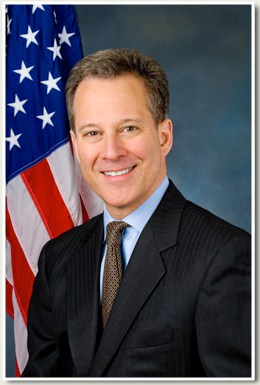
New York State Attorney General Eric Schneiderman is convinced Verizon Communications is abandoning quality landline service for millions of New Yorkers while diverting money and resources to its more profitable cell service Verizon Wireless.

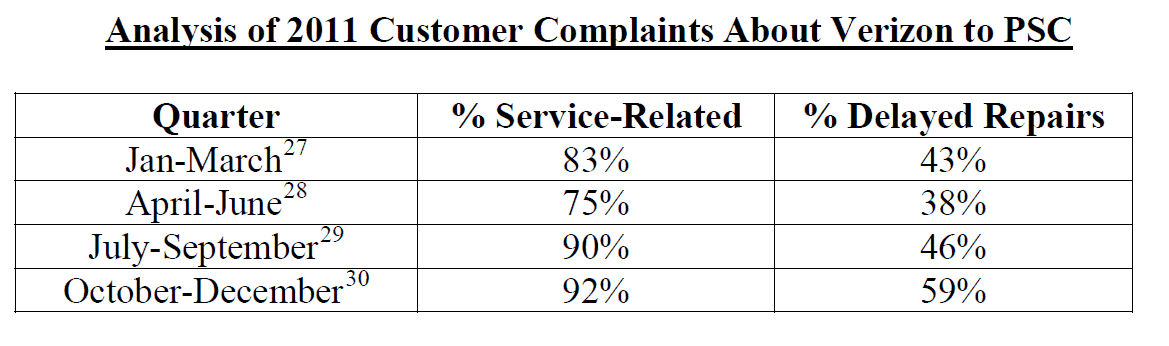
Last week, Schneiderman blasted the state’s largest landline provider for mounting complaints about poor service that now impact 92 percent of its customers, calling deregulation a failure for consumers and businesses in New York.

“Verizon customers deserve the high-quality service they’ve been promised,” Schneiderman told The Associated Press.

The attorney general reports that the number of customers enduring service outages for more than 24 hours has increased, while landline infrastructure — particularly wiring — is allowed to deteriorate.

Schneiderman suspects Verizon is shortchanging landline service as an increasing number of wired phone customers disconnect service, often in favor of Verizon’s more lucrative cell phone service.  The state Public Service Commission (PSC) fined Verizon $400,000 in March for similar concerns, pointing to the company’s intentional workforce reductions lengthening repair windows and creating repair backlogs in some regions.

Schneiderman’s office filed comments with the PSC requesting changes to Verizon’s Service Quality Improvement Plan, which was originally launched in 2010:

At best, New York’s telephone service market is a duopoly, and contrary to theoretical expectations of market controls, the presence of a single competitor has not in fact prevented Verizon from allowing customer service to continue to degrade. Rather than meet its obligations to provide wireline telephone customers with minimally adequate telephone service, Verizon is continuing to drastically reduce its workforce with the result that the company cannot meet its customers’ repair needs in a timely manner.

Verizon’s management has demonstrated that it is unwilling to compete to retain its wireline customer base, and instead is entirely focused on expanding its wireless business affiliate. It is incumbent on the Commission to take appropriate regulatory action to ensure that customers receive reliable telephone service with adequate repair performance. Therefore, the Commission should modify Verizon’s service plan to ensure customers receive adequate service quality in the future.

Verizon defended its service in New York pointing out the company has invested $1.5 billion in the state for infrastructure, including its FiOS fiber to the home network.  Verizon spokesman John Bonomo questioned Schneiderman’s claim that 92 percent of Verizon New York customers had poor service, noting 98 percent of its landline customers don’t have service problems.

Schneiderman’s highlighting of a $400,000 service fine imposed by the PSC did not account for unprecedented damage from both Hurricane Irene and Tropical Storm Lee late last summer, Bonomo added.

But the state’s attorney general notes Verizon’s service problems in New York have been ongoing well before last summer.

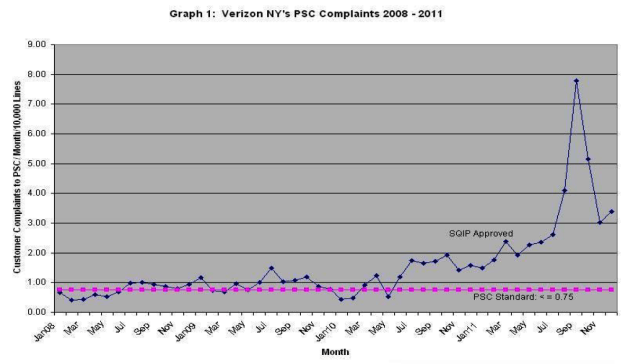
Service complaints, charted here from 2008-2011, show a major spike last summer and fall and remain higher than normal.

Schneiderman

“Since at least 2008, Verizon has frequently failed to meet these PSC telephone service standards essential to safe and reliable telephone service,” Schneiderman says. “Even as the number of telephone lines needing to be maintained has dwindled to half those of a decade ago (as customers choose to rely instead on wireless and/or cable telephony), Verizon’s continues to fail to meet the PSC’s service standard.”

Customers on the upper west side of New York City don’t need to be reminded of Verizon’s service failures.  Hundreds of Verizon landline customers in New York’s largest city were left without basic phone service for more than a week, only made worse by the fact Verizon told many of them they’d be without service for at least one additional week while the company worked on repairs.

Phone and Internet service went dead in multiple buildings along Central Park West April 10, but customers wanted to kill when they learned the phone company wanted more than two weeks to get service restored.

“I was like, excuse me, are you serious? Two weeks?” Iram Rivera, a concierge at 262 Central Park West, told DNAinfo.  His building was hard hit by the service outage — 80 percent of the building’s 80 apartments were affected.

“I just don’t get the feeling that there’s much of an appreciation on Verizon’s part that this is a hardship for people,” said Ken Coughlin, who lives on West 87th Street and Central Park West. “There’s no communication, there’s no updates, it’s infuriating.”

The outage only affected traditional landline service and DSL broadband over copper phone wiring. The more modern fiber-optic FiOS network that provides TV, Internet and voice service wasn’t affected, Bonomo said.

Schneiderman notes landline outages have an especially hard impact on small businesses:

In the current recession, the fragile economic condition of many small businesses puts them at risk of financial disaster if they suddenly lose telephone service, and their provider is unable to restore service promptly. Each day that these businesses are without service they lose significant revenues that many simply cannot survive without.

Small businesses depend on functional telephone service to meet the needs of their customers in numerous ways. When customers are unable to reach a business by telephone, they may assume the business is closed and purchase the goods or services they want elsewhere. Restaurants are prevented from giving reservations to prospective customers who call. Many types of businesses depend on working telephone lines for processing credit card charges, and may lose substantial sales by limiting transactions to cash or checks. Professional offices can be prevented from providing medical, legal or accounting services to their clients without working telephone service.

In Schneiderman’s view, the deregulation policies now in place in New York have failed consumers, leaving them with a duopoly of phone providers with insufficient oversight.

For competition to benefit customers with improved service, lower prices, and more innovation, there has to first be a willingness to compete, which is significantly absent from Verizon-New York’s policies and practices.

Rather than robust competition, New York’s telephone market is at best a duopoly, with as many indicators of cooperation between the two providers as robust contest for customers. Furthermore, the actual behavior of consumers in the real world is markedly different from the PSC’s theoretical assumptions about the telephone market.

When a Verizon customer experiences a prolonged service outage or installation delay, the option to switch carriers to a cable provider is of no immediate use. Finally, even if consumers wanted to compare Verizon’s service performance with cable provider alternatives, the lack of available information prevents consumers from making educated choices.

In New York, most customers are served by Verizon Communications, Time Warner Cable, or Cablevision.  Time Warner Cable and Verizon recently agreed to cross-market the other’s products and services as part of a wireless spectrum transfer.

A History Lesson: Wireless Spectrum “Crisis” Hoopla vs. Solid Network Engineering

Phillip Dampier April 18, 2012 AT&T, Audio, Bell (Canada), Broadband "Shortage", Competition, Consumer News, Editorial & Site News, History, Public Policy & Gov't, Rogers, Sprint, T-Mobile, Verizon, Video, Wireless Broadband Comments Off on A History Lesson: Wireless Spectrum “Crisis” Hoopla vs. Solid Network Engineering

“Somehow in the last 100 years, every time there is a problem of getting more spectrum, there is a technology that comes along that solves that problem. Every two and a half years, every spectrum crisis has gotten solved, and that’s going to keep happening. We already know today what the solutions are for the next 50 years.” — Martin Cooper, inventor of the portable cell phone

Despite the fear-mongering by North America’s wireless phone companies that a spectrum crisis is at hand — one that threatens the viability of wireless communications across the continent, some of the most prominent industry veterans dispute the public policy agenda of phone companies like AT&T, Verizon, Bell, and Rogers.

Martin Cooper ought to know.  He invented the portable cell phone, and remains involved in the wireless industry today.  Cooper shrugs off cries of spectrum shortages as a problem well-managed by technological innovation.  In fact, he’s credited for Cooper’s Law: The ability to transmit different radio communications at one time and in the same place has grown with the same pace since Guglielmo Marconi’s first transmissions in 1895. The number of such communications being theoretically possible has doubled every 30 months, from then, for 104 years.

National Public Radio looks back at the earliest car phones, which weighed 80 pounds and operated with vacuum tubes. Innovation, improved technology, and lower pricing turned an invention for the rich and powerful into a device more than 300,000,000 North Americans own and use today. (April 2012) (3 minutes)
You must remain on this page to hear the clip, or you can download the clip and listen later.

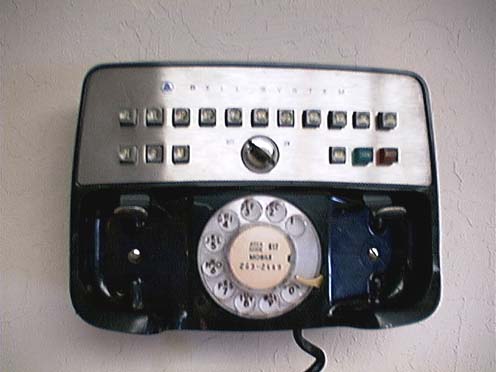
A traditional car phone from the 1960s.

The earliest cell phones have been around since the 1940s.  St. Louis was the first city in the United States to get Mobile Telephone Service (MTS).  It worked on three analog radio channels and required an operator to make calls on the customer’s behalf. By 1964, direct dialing from car phones became possible with Improved Mobile Telephone Service (IMTS), which also increased the number of radio channels available for calls.

In the 1970s, popular television shows frequently showed high-flyers and private detectives with traditional looking phones installed in their cars.  But the service was obscenely expensive.  The equipment set customers back $2-4,000 or was leased for around $120 a month.  Local calls ran $0.70-1.20 per minute.  That was when a nice home was priced at $27,000, a new car was under $4,000, gas was $0.55/gallon, and a first run movie ticket was priced at $1.75.

With many cities maintaining fewer than a dozen radio channels for the service, only a handful of customers could make or receive calls at a time.  The first “spectrum crisis” arrived by the late 1970s, when car phones became the status symbol of the rich and powerful (the middle class had pagers). Customers found they couldn’t make or receive calls because the frequencies were all tied up.  Some cities even rationed service by maintaining waiting lists, not allowing new customers to have the technology until an existing one dropped their account.

Instead of demanding deregulation and warning of wireless doomsday, the wireless industry innovated its way out of the era of MTS altogether, switching instead to a “cellular” approach developed in part by the Bell System.

[flv width=”412″ height=”330″]http://www.phillipdampier.com/video/ATT Testing the First Public Cell Phone Network.flv[/flv]

In the 1970s, when the first cell phone “spectrum crisis” erupted, the Bell System innovated its way out the the dilemma without running to Congress demanding sweeping deregulation.  This documentary, produced by the Bell System, explores AMPS — analog cell phone service, and how it transformed Chicago’s mobile telephone landscape back in 1979.  (9 minutes)

“Arguing that the nation could run out of spectrum is like saying it was going to run out of a color.” David P. Reed, one of the original architects of the Internet

Instead of one caller tying up a single IMTS radio frequency capable of reaching across an entire city, the Bell System deployed lower-powered transmitters in a series of hexagonal “cells.”  Each cell only served callers within a much smaller geographic area.  As a customer traveled between cells, the system would hand the call off to the next cell in turn and so on — all transparently to the caller.  Because of the reduced coverage area, cell towers in a city could operate on the same frequencies without creating interference problems, opening up the system to many more customers and more calls.

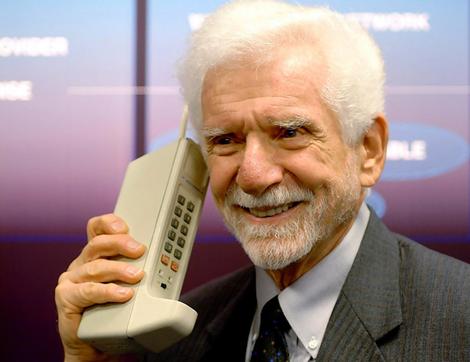
Inventor Martin Cooper holds one of the first portable mobile phones

In Chicago, Bell’s IMTS system only supported around a dozen callers at the same time. In 1977, the phone company built a test cellular network it dubbed “AMPS,” for Advanced Mobile Phone System.  AMPS technology was familiar to many early cell phone users.  It was more popularly known as “analog” service, and while it could still only handle one conversation at a time on each frequency, the system supported better call handling and many more users than earlier wireless phone technology.  By 1979, Bell had 1,300 customers using their test system in Chicago.

AMPS considerably eased the “spectrum crunch” earlier systems found challenging, and subsequent upgrades to digital technology dramatically increased the number of calls each tower could handle and allowed providers to slash pricing, which fueled the spectacular growth of the wireless marketplace.

Yesterday it was voice call congestion, today it is a “tidal wave” of wireless data.  But inventors like Cooper believe the solution is the same: engineering innovation.

“Somehow in the last 100 years, every time there is a problem of getting more spectrum, there is a technology that comes along that solves that problem,” Cooper told the New York Times. “Every two and a half years, every spectrum crisis has gotten solved, and that’s going to keep happening. We already know today what the solutions are for the next 50 years.”

Cooper believes in the cellular approach to wireless communications.  Dividing up today’s geographic cells into even smaller cells could vastly expand network capacity just like AMPS did for Windy City residents in the late 1970s. Using especially directional antennas focused on different service areas, placing new cell towers, innovating further with tiny neighborhood antennas mounted on telephone poles, or building out Wi-Fi networks can all manage the data capacity “crisis” says Cooper.

New technology also allows cell signals to co-exist, even on the same or adjacent frequencies, without creating interference problems. All it takes is a willingness to invest in the technology and deploy it across signal-congested urban areas.

Unfortunately, network engineers are not often responsible for the business decisions or public policy agendas of the nation’s largest wireless companies who are using the “spectrum crisis” to argue for increased deregulation and demanding additional radio spectrum which, in some cases, could be locked up by companies to make sure nobody else can use them.

[flv width=”600″ height=”358″]http://www.phillipdampier.com/video/NY Times Mobile Carriers Warn of Spectrum Crisis.flv[/flv]

The New York Times offers this easy-to-follow primer on wireless spectrum and why it matters (or not) in the current climate of explosive growth in mobile data traffic.  (3 minutes)

“Their primary interest is not necessarily in making spectrum available, or in making wireless performance better. They want to make money.” — David S. Isenberg, veteran researcher, AT&T Labs

Innovation, not wholesale deregulation, allowed the Bell System to solve the spectrum crisis of the 1970s by creating today's "cell system" that can re-use radio frequencies in adjacent areas to handle more wireless traffic.

Spectrum auctions bring billions to federal coffers, but actually deliver a hidden tax to cell phone customers who ultimately pay for the winning bids priced into their monthly bills.  It also makes it prohibitively expensive for a new player to enter the market.  Already facing enormous network construction costs, any new entrant would then face the crushing prospect of outbidding AT&T, Verizon Wireless, Bell or Rogers for the frequencies essential for operation.

As the New York Times writes:

When a company gets the license for a band of radio waves, it has the exclusive rights to use it. Once a company owns it, competitors can’t have it.

Mr. Reed said the carriers haven’t advocated for the newer technologies because they want to retain their monopolies.

Cooper advocates a new regulatory approach at the Federal Communications Commission — one that mandates wireless phone companies start using today’s technology to amplify their networks.

Cooper points to one example: the smart antenna.

Smart antennas direct cell towers to focus their transmission energy towards the specific devices connected to it.  If a customer was using their phone from the southern end of the cell tower’s coverage area, why direct signal energy to the north, where it gets wasted?  New LTE networks support smart antenna technology, but carriers have generally avoided investing in upgrading towers to support the new technology, expected to be commonplace inside new wireless devices within two years.

T-Mobile calls these technology solutions “Band-Aids” that won’t address the company’s demand for more frequencies to manage its network.  But that kind of thinking applied to the mobile phone world of the 1970s would have maintained the exorbitantly expensive IMTS technology discarded decades ago, since replaced by innovation that made more efficient use of the spectrum already on hand.  That innovation also transformed wireless phones from a tool (or toy) for the very wealthy to an affordable success story that now threatens the traditional wired phone network in ways the Bell System could have never envisioned.

[flv width=”412″ height=”330″]http://www.phillipdampier.com/video/Its a Whole New System.flv[/flv]

It’s A Whole New System: AT&T and other wireless phone companies might want to learn the lesson the Bell System was trying to teach their employees back in 1979: Meet Change With Change.  This company-produced video implores the phone company to do more than the same old thing.  No, this video is not “PM Magazine.”  It is about innovation and actually listening to what customers want. With apologies to Mama Cass Elliot, there was indeed a New World Coming — the breakup of the Bell System just five years later.  Don’t miss the diabetic-coma-inducing, sugary-sweet jingle at the end.  Then reach for a can of Tab.  (10 minutes)

Verizon Will Cease Selling Standalone DSL Service May 6th; Voice With DSL Only, Please

Verizon Communications will stop selling DSL broadband-only service to its customers May 6th in what the company is calling an effort to control costs “enabling us to continue providing competitively priced services to existing and new customers.”

Broadband Reports readers first reported receiving written notice of Verizon’s plans to discard “naked DSL” service, although existing customers who don’t move or make any changes to their account will be able to keep the broadband-only service for now.

Verizon provides the details:

Beginning May 6, 2012, we will no longer offer High Speed Internet without local voice service on the same account.

What does this mean for you?

  • If you currently have High Speed Internet without local voice service on the same account, there is no action required on your part to continue enjoying your internet service. You will not experience any disruption of service.
  • Prior to May 6, 2012, you can still make speed upgrades or downgrades to your existing service.
  • Prior to May 6, 2012, you can receive bundle discounts by adding DIRECTV service or Verizon Wireless service to your current internet service.

What this means if you change or disconnect your High Speed Internet Service as of May 6, 2012 or after:

  • You can make changes to and retain your Verizon High Speed Internet Service on or after the above date, by adding Verizon’s local voice service to the same account.
  • If you are moving your service from one location to another on or after the above date, you may subscribe to internet service at your new location if you also subscribe to Verizon’s local voice service on the same account.
  • If you choose to subscribe to additional Verizon services you could be eligible for a bundled discount when you also subscribe to Verizon’s local voice service on the same account.

There is speculation Verizon is eliminating its DSL-only service in an effort to boost revenue and push subscribers in FiOS-enabled areas to Verizon’s fiber optic network.  A decade earlier, many phone companies fought to avoid selling “broadband-only” DSL service without a voice landline because of revenue losses.  Landline customers continue to drop voice service from traditional phone companies at an alarming rate — choosing competing cable or Voice over IP service or a cell phone.  By requiring voice service, Verizon can boost average revenue from each customer, whether those customers want the service or not.

Customers who currently subscribe to broadband-only DSL service from Verizon are advised that virtually any account change of significance can disqualify them from continuing with the service.  That includes address changes and speed adjustments.  Stop the Cap! recommends customers make any changes prior to May 6th.

Large sections of Verizon’s service area are not FiOS-eligible,  so current DSL customers with no other broadband choices may find themselves stuck with adding voice service. Verizon sells Basic Home Telephone Service with no local calling allowance at prices ranging from $7 in some communities to $16 or higher in others, excluding the FCC-mandated line fee, which runs an extra $6.50 a month.

One thing Verizon’s higher bills will accomplish is making Verizon Wireless’ new 4G LTE Home Fusion wireless broadband service look slightly more price competitive.  If a Verizon landline customer has to pay for both voice and data service, paying $60 a month for 10GB of wireless broadband may not seem that expensive in comparison.

New York’s Digital Phone Legislative Silliness: Deregulated Providers Want… Deregulation

Phillip Dampier March 28, 2012 Competition, Consumer News, Frontier, Public Policy & Gov't, Rural Broadband, Verizon Comments Off on New York’s Digital Phone Legislative Silliness: Deregulated Providers Want… Deregulation

Cuomo

New York’s telecommunications providers are up in arms over Gov. Andrew Cuomo’s decision to yank permanent deregulation for the “digital phone” industry (otherwise known as “Voice Over IP/VoIP”) from his budget, even though the phone service is already deregulated in New York.

Now Verizon Communications and Time Warner Cable are claiming that without the deregulation they already enjoy, innovation, investment, and competition will be stifled.

“Verizon is very disappointed that New York’s lawmakers, who want the public to believe that New York is open for business, will not be acting on this important measure to modernize the state’s outdated telecommunications laws in this year’s budget,” Verizon spokesman John Bonomo told the Albany Times-Union.

“It’s about new technologies, it’s about new services,” echoed Rory Whelan, regional vice president of government relations for Time Warner Cable. “We want New York to be at the forefront of where we roll out our new products and services.”

That notion has left consumer groups and telecommunications unions scratching their heads.

“They are saying that this is going to open the flood gates to more investment,” said Bob Master, political director for one chapter of the Communications Workers of America, which represents Verizon workers. “It’s ridiculous.”

Master says Verizon has been abandoning and ignoring their landline network for years, preferring to invest in Verizon Wireless and its limited FiOS fiber-to-the-home service which is available in only selected areas of the state.

New York’s Public Service Commission has largely not regulated competing phone service since Time Warner Cable first introduced the service as an experiment in Rochester.  As part of then-Rochester Telephone Corporation’s (now Frontier Communications) “Open Market” Plan, competing telephone companies could offer landline service in the company’s service area, so long as Rochester Telephone received the same deregulation benefits.  Only the cable company showed serious interest in providing home phone service, which it first delivered using traditional digital phone switches phone companies like Verizon and Rochester Telephone use.  Time Warner later abandoned that service for a VoIP alternative it branded as “digital phone.”

Time Warner’s “digital phone,” as well as Verizon’s own VoIP service sold with FiOS, have co-existed regulation-free.  Consumer advocates suspect the push to deregulate could eventually benefit Verizon more than cable operators, because it gives the phone company the right to question why any of its telephone services are regulated.  Verizon’s FiOS fiber-based phone lines do not operate on the same network its still-regulated landlines do.  Verizon, along with all traditional phone companies in New York, are subject to “universal service” guidelines which assure even the most rural New Yorkers have access to reliable telephone service.

But Verizon, like most traditional phone companies, sees substantial investment in “modernizing” legacy copper-based networks as an anachronism, especially as they continue to lose customers switching to cheaper cable providers or wireless phones.  The company recently declared its fiber optic replacement network, FiOS, at the end of its expansion phase.  That leaves the majority of New Yorkers with a copper-based telephone network companies only invest enough in to keep functioning.

Diaz

Bronx Borough President Ruben Diaz, Jr., joined many New York Assembly Democrats in strong opposition to the bill, which Diaz thinks undercuts New York consumers:

If this proposal were to become law, all consumers would lose out. For starters, customers would not be able to bring service complaints to the Public Service Commission, as they currently can with traditional service. Additionally, there would be no way for the state to set standards for quality or for service in underserved regions — meaning that customers could get stuck with exorbitantly high rates or be unable to obtain service at all in some areas of the state.

Verizon FiOS, one of the main options for VoIP coverage, has now been installed in many regions of the state, including most of downstate. However, Verizon has chosen not offer the service in upstate cities like Albany, Binghamton, Buffalo, Rochester, Syracuse and Utica. The result is both a virtual monopoly for the cable companies in those areas and another blow to lower-income working families who live in cities. That’s precisely why the state should be able to guarantee common sense regulations for VoIP service.

The problems with deregulating VoIP service are multifold. While traditional phone companies pay into a fund that supports “lifeline” phone access for elderly and disadvantaged New Yorkers, VoIP providers would not have to. We do not have to guess at how things would look if the state gives up its right to regulate internet phone service — we can just look at the states where traditional land line service has been deregulated. According to a recent survey of 20 states that have seen land line deregulation, 17 of those states have seen rate increases. We simply cannot afford that, particularly when our fragile national recovery is just beginning to take hold.

Verizon appears undeterred by the governor’s decision to pull the deregulation measure from consideration in his budget measure.  Bills to deregulate continue to float through the Republican-controlled Senate and Democratic-controlled Assembly, but New York’s legislature is notoriously indecisive and slow to act.  Time Warner’s Whelan believes the best chances for the deregulatory measure will be in the GOP-controlled Senate where a similar bill passed last year.  Verizon says it will continue to push for the bill in both chambers.

“We intend to continue pushing for this important measure, and for other measures that will benefit the state’s consumers and businesses to keep up with technological change and help the state thrive and succeed,” Bonomo said.

Search This Site:

Contributions:

Recent Comments:

Your Account:

Stop the Cap!