CenturyTel Inc. agreed Thursday to buy Qwest Communications International, Inc. in an all-stock deal that values the last legacy “Baby Bell” at nearly $10.6 billion, in one of the nation’s largest telecommunications deals.
The merger would dwarf Frontier Communications’ purchase of Verizon landline service and create the nation’s largest independent phone company with operations in 40 states.
Qwest has been off and on the sales block for years, considered the weakest player among the split-up remnants of the old Bell System. Qwest has fallen well behind AT&T and Verizon in adopting next generation technology to keep landline service relevant in a changing marketplace. CenturyTel’s business model, like that of Windstream and Frontier, depends on serving rural areas with basic broadband and phone services, without incurring the costs larger providers have in deploying fiber to the home or fiber to the curb networks needed to compete with cable television providers.
Critics contend the consolidation of independent phone companies has left them preoccupied with their stock value and dividend payouts, unwilling to make substantial investments many believe are essential to keep such companies relevant in the long term. Cell phones continue to eat away at landline service, and the kind of slow speed DSL service available from most of these players cannot compete effectively against cable and fiber broadband service, except in rural communities where customers have just one choice.
We will have additional coverage on this important development shortly.
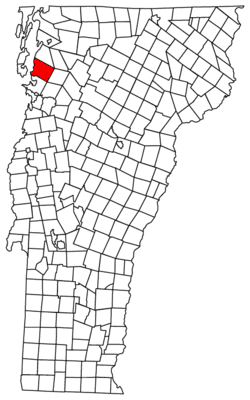
Jesse and his nearby neighbors on the west side of Milton are frustrated. They live just 20 minutes away from Burlington, the largest city in the state of Vermont. Despite the proximity to a city with nearly 40,000 residents, there is no cell phone coverage in western Milton, no cable television service, and no DSL service from FairPoint Communications. For this part of Milton, it’s living living in 1990, where dial-up service was one’s gateway to the Internet.
Jesse and his immediate neighbors haven’t given up searching for broadband service options, but they face a united front of intransigent operators who refuse to make the investment to extend service down his well-populated street.
“After many calls to Comcast, they eventually sent us an estimate for over $17,000 to bring service to us, despite being less than a mile from their nearest station,” Jesse tells Vermont Public Radio. “They also made it very clear that there was no plan at any point in the future, 2010 or beyond, to come here unless we paid them the money.”
Jesse and his neighbors want to give Comcast money, but not $17,000.
For at least 15 percent of Vermonters, Jesse’s story is their story. Broadband simply remains elusive and out of reach.
Three years ago, Vermont’s Republican governor Jim Douglas announced the state would achieve 100 percent broadband coverage by 2010, making Vermont the nation’s first “e-State.”
Vermont Public Radio reviewed the progress Vermont is making towards becoming America’s first e-State. (January 20, 2010) (30 minutes)
You must remain on this page to hear the clip, or you can download the clip and listen later.
<
p style=”text-align: center;”>
Gov. Douglas
In June 2007 the state passed Act 79, legislation that established the Vermont Telecommunications Authority to facilitate the establishment and delivery of mobile phone and Internet access infrastructure and services for residents and businesses throughout Vermont.
The VTA, under the early leadership of Bill Shuttleworth, a former Verizon Communications senior manager, launched a modest broadband grant program to incrementally expand broadband access, often through existing service providers who agreed to use the money to extend service to unserved neighborhoods.
The Authority also acts as a clearinghouse for coordinating information about broadband projects across the state, although it doesn’t have any authority over those projects. Lately, the VTA has been backing Google’s “Think Big With a Gig” Initiative, except it promotes the state as a great choice for fiber, not just one or two communities within Vermont.
Vermont used this video to promote their bid to become a Google Fiber state. (2 minutes)
Some of the most dramatic expansion plans come from the East Central Vermont Community Fiber Network. ECFiber, a group of 22 local municipalities, in partnership with ValleyNet, a Vermont non-profit organization, is planning to implement a high-capacity fiber-optic network capable of serving 100% of homes and businesses in participating towns with Internet, telephone and cable television service. In 2008, the group coalesced around a proposal to construct a major fiber-to-the-home project to extend broadband across areas that often don’t even have slower speed DSL.
The ECFiber project brought communities together to provide the kind of broadband service private companies refused to provide. Vermont Public Radio explores the project and the enthusiasm of residents hopeful they will finally be able to get broadband service. (March 8, 2008) (24 minutes)
You must remain on this page to hear the clip, or you can download the clip and listen later.
<
p style=”text-align: center;”>
ECFiber's Partner Communities
The Vermont towns, which together number roughly 55,000 residents, decided to build their own network after FairPoint Communications and local cable companies refused to extend the reach of their services. Providers claim expanding service is not financially viable. For residents like sheep farmer Marian White, interviewed by The Wall Street Journal, that means another year of paying $60 a month for satellite fraudband, the speed and consumption-limited satellite Internet service.
White calls the satellite service unreliable, especially in winter when snow accumulates on the dish. Unlike many broadband users who vegetate for hours browsing the web, White actually gets an exercise routine while trying to get her satellite service to work.
“I open a window and I take a pan of water and, a cup at a time, I launch warm water at the satellite dish until I have melted all the snow off the dish,” Ms. White says. “It works.”
Other residents treat accessing the Internet the same way rural Americans plan a trip into town to buy supplies.
Kathi Terami from Tunbridge makes a list of things to do online and then, once a week, travels into town to visit the local public library which has a high speed connection. Terami downloads Sesame Street podcasts for her children, watches YouTube links sent by her sister, and tries to download whatever she thinks she might want to see or use over the coming week.
A fiber to the home network like ECFiber would change everything for small town Vermonters. The implications are enormous according to project manager Tim Nulty.
“People are truly afraid their communities are going to die if they aren’t on the communications medium that drives the country culturally and economically,” he says. “It’s one of the most intensely felt political issues in Vermont after health care.”
Despite the plan’s good intentions, one obstacle after another has prevented ECFiber from making much headway:
The VTA rejected the proposal in 2008, calling it unfeasible;
Plans over the summer and fall of 2008 to approach big national investment banks ran head-on into the sub-prime mortgage collapse, which caused banks to stop lending;
An alternative plan to build the network with public debt financing, using smaller investors, collapsed along with Lehman Brothers on September 14, 2008;
An attempt by Senator Pat Leahy (D-Vermont) to insert federal loan guarantees into the stimulus bill in February 2009 was thwarted by partisan wrangling;
Attempts to secure federal broadband grant stimulus funding has been rejected by the Commerce Department;
Opposition to the plan and objections over its funding come from incumbent providers like FairPoint, who claim the project is unnecessary because they will provide service in those areas… eventually.
For the indefinite future, it appears Ms. White will continue to throw warm cups of water out the window on cold winter mornings.
Vermont Edition takes a comprehensive look at where the state stands in broadband and wireless deployment. (April 8, 2009) (46 minutes)
You must remain on this page to hear the clip, or you can download the clip and listen later.
<
p style=”text-align: center;”>
For every Tunbridge resident with a story about life without broadband, there are many more across Vermont living with hit or miss Internet access.
Take Marie from Middlesex.
Most residents in more rural areas of Vermont get service where they can from FairPoint Communications
“I am in Middlesex, about a half-mile off Route 2, and five minutes from the Capitol Building. Yet up until just recently, we had no sign of high-speed Internet. I understand that my neighbors just received DSL a few weeks ago, but when I call FairPoint, they tell me it’s still not available at my house, which is a few hundred yards up the hill. Hopefully, they’re wrong and I’ll see DSL soon,” she says.
Marie is pining for yesterday’s broadband technology — FairPoint’s 1.5Mbps basic DSL service, now considered below the proposed minimum speeds to qualify for “broadband” in the National Broadband Plan. For Marie, it’s better than nothing.
Geryll in Goshen also lacks DSL and probably wouldn’t want it from FairPoint anyway.
“We have barely reliable landline service. A tech is at my house at least three times per year. I was told the lines are so old they are decaying. Using dial-up is impossible. I use satellite which is very expensive and is in my opinion only one step up from dial-up. I am limited to downloads and penalized if I reach my daily limit,” he says.
Many Vermonters acknowledge Douglas’ planned 100-percent-broadband-coverage-by-2010 won’t come close to achievement and many are highly skeptical they will ever see the day where every resident who wants broadband service can get it.
Chip in Cabot is among them, jaded after six years of arguments with FairPoint Communications and its predecessor Verizon about obtaining access to DSL. It took a cooperative FairPoint engineer outside of the business office to finally get Chip service. His neighbors were not so lucky, most emphatically rejected for DSL service from an intransigent FairPoint:
“I laughed when Governor Douglas announced his e-State goal “by 2010” three years ago. Now I’m thinking I should have made some bets on this claim. It took years of legal battles and a zoning variance to obtain partial cell coverage here in Cabot. Large parts of the town still do not have any cell coverage. Governor Douglas can perhaps be forgiven – he has no technical knowledge, and as a politician would be expected to be wildly optimistic about such “e-State” claims. The Vermont Telecommunications Authority and the Department of Public Service should know better however. We’re talking about rural areas where there is no financial incentive to provide either DSL or cell service. It will take a huge amount of money to provide service to those remaining parts of the state. I’m not optimistic.”
[flv width=”512″ height=”308″]http://www.phillipdampier.com/video/Wall Street Journal Vermont Broadband Problems 03-02-09.flv[/flv]
The Wall Street Journal chronicled the challenges Vermonters face when broadband is unavailable to them. ECFiber may solve these problems. Some of the stories in our article are reflected in this well-done video. (3/2/2009 — 4 Minutes)
Phillip DampierMarch 19, 2010HistoryComments Off on Broadband: The 21st Century Equivalent of Electricity — Part 3 – FDR & The New Deal
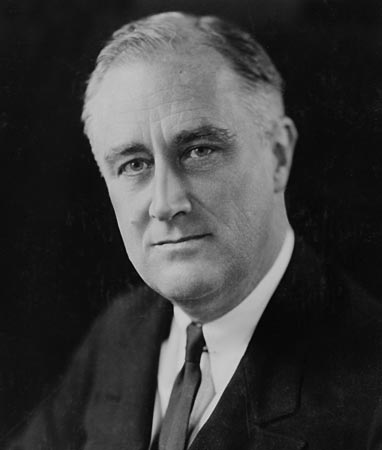
Franklin D. Roosevelt, seen here during his years as New York's governor
Franklin Delano Roosevelt
Watching the debate raging through the 1920s was one Franklin Delano Roosevelt, who was elected governor of New York in 1928 on a reformist agenda. Like many other states, New Yorkers had a problem with their electric companies. They charged too much, didn’t provide sufficient capacity, and ignored rural areas.
Roosevelt started his political life following in the philosophical (and political) footsteps of his fifth cousin Theodore, the 26th president of the United States. FDR believed in individualist progressive ideals — improving privately held utilities but steering clear of advocating public ownership.
Roosevelt’s immediate predecessor, Al Smith, spent the 1920s in Albany arguing with the Republican state legislature over who would develop New York’s hydro power resources, which could deliver substantially lower-priced electricity from Buffalo to Long Island. The legislature wanted the state’s private power companies to develop the resource, with a public service commission reviewing and, where necessary, regulating rates. Smith wanted the state to build the plants as public utilities, arguing endless lawsuits by private power companies had made rate regulation meaningless.
Early into his term as governor, Roosevelt picked up where Smith left off, advocating first for the construction of a hydroelectric dam on the St. Lawrence River in upstate New York. The legislature promptly said no. Roosevelt refused to let go and expanded his proposal to also include the possibility of municipally-owned local power companies, delivering needed power without a profit incentive.
In upstate and western New York, firmly Republican territory, local newspapers blasted Roosevelt’s proposal, occasionally calling him a socialist conniver, an enemy of free enterprise, and dragging big state government into the lives of ordinary citizens.
Electric companies across the state joined the chorus of upstate opposition, but also quietly made preparations to counter Roosevelt’s proposal, just in case it began to catch on.
Roosevelt’s initial efforts to argue his position did not make much headway upstate, because he had to rely on newspapers to deliver his message — the same newspapers that rebutted him at every turn. Direct mailing letters to voters was expensive and took a long time to create and distribute. Roosevelt instead turned to the new medium of radio, speaking to residents statewide about issues like electrification. Radio directly reached listeners and bypassed the newspaper filter, and it allowed the governor to deliver a populist message in terms every consumer could understand — high rates.
Roosevelt lit a fire for reform when he compared what state residents were paying for electricity compared to those on the other side of Lake Ontario, in Canada. Canada had provincial power, owned and operated by the government.
Roosevelt told listeners that in a “modernized house” (one served by higher voltage lines capable of supporting large electric appliances), residents of Ontario paid just $3.40 a month in electric bills. But in Westchester County, the same service cost $25.63. It was $19.95 in New York City and $13.50 in Rochester.
Double-crossing Roosevelt With the Help of ‘The House of Morgan’
The electric companies soon saw the results of those price comparisons as voters demanded better prices. Republicans began shifting toward Roosevelt’s plan. For the power companies, it was time for “Plan B.” Quietly meeting with J.P. Morgan Bank in the summer of 1929, three major upstate New York power companies planned to merge into one giant company: Mohawk Hudson Power Corporation.
The modern day Mohawk Hudson Power Company was Niagara-Mohawk, which has since been purchased by National Grid.
Mohawk Hudson Power Corporation incorporated:
Buffalo, Niagara & Eastern Power Corp.: Served 500 cities and towns including Buffalo. Niagara Falls supplied most of its power;
Northeastern Power Corp.: Served communities along Lake Ontario and the St. Lawrence;
Mohawk Hudson Power Corp.: Served Albany, Schenectady, Utica, Syracuse, and many other communities.
With such a merger, Roosevelt’s original plan to let upstate power companies compete to offer the best possible rates for hydro power were dashed. In fact, the power companies loved Roosevelt’s plan because as a combined entity, they’d profit handsomely from state taxpayers paying to construct hydro generating stations, saving them the trouble. Then as a monopoly cartel, they’d set rates artificially high, pocketing the proceeds. J.P. Morgan Bank would also get paid handsomely for helping make it all possible.
To add insult to injury, just two months later, Mohawk Hudson acquired another state giant — Frontier Power Corporation, which in the words of Time magazine, “set Roosevelt agog.”
Governor Franklin D. Roosevelt of New York (Democrat) declared that the fact that 80% of New York State is now served by one hydro-electric corporation made it necessary for him once again to urge the Legislature (Republican) to create a body of public trustees to develop St. Lawrence water power for the people.
Roosevelt’s experience with the House of Morgan and the power utility trusts would be a lesson he would never forgive or forget. In fact, it culminated in his broadened vision to consider power an integral part of economic redevelopment after the start of the Great Depression later that year.
Roosevelt’s New Deal
Americans only came to terms with the impact of the Great Depression in 1930, months after the stock market crashed. What initially hurt Wall Street soon spread across the country in waves of bank failures, massive unemployment, a credit crunch, and rampant homelessness, poverty, and despair. What was bad in the city could be much worse in rural America.
Services for rural Americans were few and far between, and electric power was absolutely not one of them. The economic benefits of the boom years usually never made it to rural communities in the first place. Banks did manage to turn an excellent business convincing rural farmers to mortgage their farms in return for ready cash to acquire farm equipment, pay transportation costs to bring crops to market, and obtain other necessities. When the bust years arrived, more than a few farmers found themselves foreclosed and evicted from their own farms, seized by lenders to recoup their loans.
After witnessing thousands of farmers and other rural Americans displaced from their homes, Roosevelt embarked on wide-ranging reforms for rural America. One of the most important was rural electrification, designed to guarantee electricity to any rural American that wanted it. Through the New Deal, rural Americans would experience the benefits of modernization first-hand — bolstering farm production and development, increasing economic development, improving health and safety, and most importantly, make rural living economically self-sustainable.
After learning from his years as governor of New York, Roosevelt established some core principles for his rural-focused New Deal electrification program:
Full electrical modernization of households defined the standard for quality of life, no matter where the households resided.
Electrical modernization of farm productive processes, within the framework of planned production and marketing, would lower farm costs and return farms to prosperity.
Electricity must be affordable to all households in quantities required for electrical modernization. Publicly owned and private utilities, lightened of their false capitalization by public regulation and the breakup of holding companies, would provide inexpensive electricity.
Cheap electricity would make the redistribution of population and industry possible, because it could be transmitted long distances and sold at near cost to rural consumers.
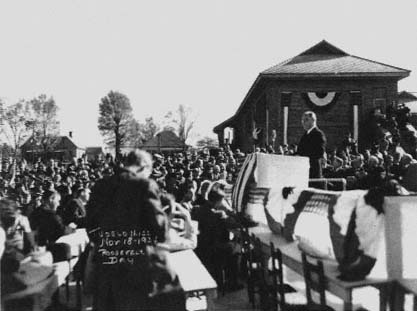
President Roosevelt speaks to residents in Tupelo, Mississippi, the first city to benefit from the Tennessee Valley Authority
The mostly rural and poor Tennessee Valley region, covering 80,000 square miles in the southeastern United States, including almost all of Tennessee and parts of Mississippi, Kentucky, Alabama, Georgia, North Carolina, and Virginia was an obvious first choice for rural electrification. Tupelo, Mississippi was the first community to sign onto Roosevelt’s ambitious Tennessee Valley Authority plan to bring cheap power to a deprived region.
The results of electrification at reasonable prices were… electric. Widespread poverty wasn’t solved overnight, but evidence of social transformation was at hand. Americans from coast to coast were modernizing their homes, bringing in new electric appliances which fueled pre-war manufacturing, retail sales, and helped bring down unemployment. Many businesses were thrilled to participate in New Deal programs, which included stimulus spending to help Americans improve their homes.
The impact of New Deal programs for electricity development exist in every American home. The refrigerator replaced an ice-block powered icebox. Hand scrubbed laundry in a sink now agitated in a washing machine. The radio was made commonplace where electricity to power it was available. Mixers, blenders, toasters, and other small appliances made their entrance with the advent of widespread electric power. But the impacts go even further. Technology as Freedom, by Ronald Tobey, notes:
The New Deal in domestic electrical modernization worked an invisible revolution. The New Deal shifted the majority of American families to an asset strategy for economic security through state-enframed home ownership of electrically modern dwellings. Geographic mobility declined. Unrestrained domination of local politics by a locally resident real estate elite ended. Material accumulation based in the owner-occupied home created unprecedented material affluence. The dwellings modernized their occupants, as households rebuilt their social and labor relations around new technologies. Minority groups previously locked out of affluence gained the keys to their future. The New Deal created the 1950s.
Is ubiquitous broadband the electrification challenge of our age? Naysayers claim fast broadband is only useful for downloading entertainment products, often illegally. They suggest economic development doesn’t require fast broadband — any version of broadband is good enough. Worse yet, government involvement in it is suspect, according to these critics.
But after weeks of witnessing countless communities compete for Google’s Think Big With a Gig broadband project, it’s clear the clamor for affordable, fast broadband service is far more important than the naysayers would suggest.
Stimulus funds are helping bridge the digital divide by bringing high speed Internet to rural areas in southeastern New Mexico.
Thursday, Rep. Ben Ray Luján applauded investments in rural broadband in New Mexico made through the American Recovery and Reinvestment Act.
“Broadband technology connects communities, helps businesses grow, and provides students with the opportunity to learn new skills. As we expand broadband technology, we must ensure that our rural communities have access,” said Luján. “It is encouraging that the Recovery Act is making this important investment in broadband technology, especially in our rural and tribal communities.”
Penasco Valley Telecommunications in Artesia has been awarded $10 million in federal stimulus money to string miles of fiber optic cable to rural towns like Hondo, Mayhill and Hope.
The fiber optic cable will be a vital link for the area’s homes, businesses, schools and emergency services.
“It’s important for the rural parts to have access to the Internet, otherwise the digital divide they talk about will just get wider,” said Glenn Lovelace of Penasco Valley Telecommunications.
The project is scheduled for completion some time next year.
Since the American Recovery and Reinvestment Act of 2009 began distributing stimulus funds, it has provided roughly $250 million in funding for projects and programs in New Mexico.
The two New Mexico broadband projects that will receive funding:
Pueblo de San Ildefonso: TewaCom Broadband Initiative (TBI), Phase 1-Upper Rio Grande Valley Project; $632,225 loan and $632,225 grant. The funding will enable the Pueblo to expand service to 2,405 households.
Penasco Valley Telephone Cooperative Inc.: The Penasco Valley Telephone (PVT) Incumbent Local Exchange Carrier (ILEC) Project; $4,818,607 loan and $4,770,660 grant. The funding will provide high-speed broadband to unserved areas in the ILEC territory through fiber and wireless technology.
[flv width=”480″ height=”380″]http://www.phillipdampier.com/video/KOB Albuquerque High-speed cable slated for southeast New Mexico 3-10-10.flv[/flv]
KOB-TV in Albuquerque reports the high speed broadband projects made possible from stimulus funding resemble the kind of public works projects that were common during the Great Depression. (2 minutes)
Americans have got it all wrong. Their ‘faster is better’ obsession over broadband speed threatens to harm jobs and hurts those looking for work.
Those are the views of Stuart N. Brotman, a senior fellow at the Digital Policy Institute, which calls itself “a vehicle for faculty research that coalesces around the arenas of law, regulation, economics, intellectual property, and technology as these relate to public policy issues of local, state and national interests.”
Brotman argues that while broadband speeds matter, regulators should not be focused on speed as much as considering how broadband can help Americans find jobs.
The Agriculture and Commerce Depts. are tasked with administering $7.2 billion in stimulus funding for broadband by Sept. 30. As they decide where to place the bulk of those funds, which remain unawarded, government officials should show preference to grant and loan applicants that can use broadband to reach displaced workers more quickly.
There also need to be more funds made available to, and a greater focus on, public institutions, such as libraries, community centers, job training facilities, and adult education sites, where broadband spending may have the largest impact on jobs.
Greater broadband competition, which the FCC recognizes is essential to promote more infrastructure development and more varied pricing, also will be helpful. So, too, will be more efficient use of our spectrum resources, particularly those that have been controlled by colleges, schools, and other educational institutions for decades. Those airwaves can be better deployed to deliver high-speed wireless broadband services or leased to private-sector companies offering them.
Large telecommunications providers couldn’t have said it any better. They have repeatedly argued broadband speeds are besides the point.
Brotman
AT&T last fall wrote the Federal Communications Commission, suggesting residential customers would do fine with broadband speeds that let them “exchange emails, participate in instant messaging, and engage in basic web-browsing.” For AT&T, speed was less important than setting “a baseline definition of the capabilities needed to support the applications and services Americans must access to participate in the Internet economy—to learn, train for jobs, and work online….”
Verizon echoed AT&T, asking the Commission to retain the current minimum definition of broadband speed at 768kbps downstream and 200kbps upstream. That allows them the chance to participate in stimulus funding projects that set the broadband speed bar low, especially in the rural areas Verizon wants to spend less on or is trying to sell-off.
“It would be disruptive and introduce confusion if the Commission were to now create a new and different definition,” Verizon said in its letter to the FCC.
Some of the smaller telecommunications companies also believe broadband speed should be de-emphasized.
Embarq, before completing a merger with CenturyTel (now CenturyLink) told the FCC 1.5Mbps broadband service has become “the most common offering.” Embarq called that “consistent with an emphasis on economic development and jobs as many important applications, such as video conferencing are arguably possible only with 1.5 Mbps service and above. Any higher speed threshold, however, would risk defining as unserved the large number of satisfied customers of 1.5 Mbps service, which seems implausible.”
Embarq underlines the real reason providers are concerned about broadband speed — they’re not delivering it. Once legislators or the Commission increases minimum broadband speed levels, many of these companies may find themselves below the threshold, guilty of “just enough speed to scrape by” in non-competitive markets. That could lead to the prospect of facing federally-funded stimulus projects from others in their service areas, now deemed “unserved” or “underserved.”
Brotman further advocates that funding be focused on those that can deliver results “quickly.”
Embarq would agree with him there as well, stating “funds through grants directly to broadband providers rather than loans or other measures as this will have the greatest and quickest impact in bringing broadband to the hardest-to-serve areas. …there is no time to wait for complete broadband maps or block grants to states for redistribution.”
Telecommunications companies would also do well by Brotman’s suggestion that federal funding for broadband projects reaching public and community service institutions should be emphasized. As communities often request companies provide those services at a deep discount or free in return for franchise agreements or other licensing provisions, that’s money AT&T, Verizon, and others need not spend out of their own pockets. Getting free airwaves swiped from educational institutions to deliver wireless broadband also benefits AT&T and Verizon, who are in that business as well.
When a “policy institute,” “research group,” or other seemingly unaffiliated entity starts rehashing telecommunications industry talking points, it’s time to start digging.
Buried on page five of a PDF file describing the work of the Digital Policy Institute, one comes to a section titled, “DPI Impact and Influence.” DPI doesn’t list their financial supporters or partnerships as such. Instead, they call them “national, collaborative relationships.” Who does DPI collaborate with?
AT&T
Embarq
National Telecommunications Cooperative Association (rural telco lobbyists)
Verizon
…among others.
Imagine my surprise.
But that’s not all. Stuart N. Brotman Communications counts (or counted) among his clients AT&T, Cox Cable, National Cable and Telecommunication Association, and the New England Cable TV Association.
Perhaps Business Week would have done a better service to readers had they also disclosed that.
Be Sure to Read Part One: Astroturf Overload — Broadband for America = One Giant Industry Front Group for an important introduction to what this super-sized industry front group is all about. Members of Broadband for America Red: A company or group actively engaging in anti-consumer lobbying, opposes Net Neutrality, supports Internet Overcharging, belongs to […]
Astroturf: One of the underhanded tactics increasingly being used by telecom companies is “Astroturf lobbying” – creating front groups that try to mimic true grassroots, but that are all about corporate money, not citizen power. Astroturf lobbying is hardly a new approach. Senator Lloyd Bentsen is credited with coining the term in the 1980s to […]
Hong Kong remains bullish on broadband. Despite the economic downturn, City Telecom continues to invest millions in constructing one of Hong Kong’s largest fiber optic broadband networks, providing fiber to the home connections to residents. City Telecom’s HK Broadband service relies on an all-fiber optic network, and has been dubbed “the Verizon FiOS of Hong […]
BendBroadband, a small provider serving central Oregon, breathlessly announced the imminent launch of new higher speed broadband service for its customers after completing an upgrade to DOCSIS 3. Along with the launch announcement came a new logo of a sprinting dog the company attaches its new tagline to: “We’re the local dog. We better be […]
Stop the Cap! reader Rick has been educating me about some of the new-found aggression by Shaw Communications, one of western Canada’s largest telecommunications companies, in expanding its business reach across Canada. Woe to those who get in the way. Novus Entertainment is already familiar with this story. As Stop the Cap! reported previously, Shaw […]
The Canadian Radio-television Telecommunications Commission, the Canadian equivalent of the Federal Communications Commission in Washington, may be forced to consider American broadband policy before defining Net Neutrality and its role in Canadian broadband, according to an article published today in The Globe & Mail. [FCC Chairman Julius Genachowski’s] proposal – to codify and enforce some […]
In March 2000, two cable magnates sat down for the cable industry equivalent of My Dinner With Andre. Fine wine, beautiful table linens, an exquisite meal, and a Monopoly board with pieces swapped back and forth representing hundreds of thousands of Canadian consumers. Ted Rogers and Jim Shaw drew a line on the western Ontario […]
Just like FairPoint Communications, the Towering Inferno of phone companies haunting New England, Frontier Communications is making a whole lot of promises to state regulators and consumers, if they’ll only support the deal to transfer ownership of phone service from Verizon to them. This time, Frontier is issuing a self-serving press release touting their investment […]
I see it took all of five minutes for George Ou and his friends at Digital Society to be swayed by the tunnel vision myopia of last week’s latest effort to justify Internet Overcharging schemes. Until recently, I’ve always rationalized my distain for smaller usage caps by ignoring the fact that I’m being subsidized by […]
In 2007, we took our first major trip away from western New York in 20 years and spent two weeks an hour away from Calgary, Alberta. After two weeks in Kananaskis Country, Banff, Calgary, and other spots all over southern Alberta, we came away with the Good, the Bad, and the Ugly: The Good Alberta […]
A federal appeals court in Washington has struck down, for a second time, a rulemaking by the Federal Communications Commission to limit the size of the nation’s largest cable operators to 30% of the nation’s pay television marketplace, calling the rule “arbitrary and capricious.” The 30% rule, designed to keep no single company from controlling […]
Less than half of Americans surveyed by PC Magazine report they are very satisfied with the broadband speed delivered by their Internet service provider. PC Magazine released a comprehensive study this month on speed, provider satisfaction, and consumer opinions about the state of broadband in their community. The publisher sampled more than 17,000 participants, checking […]


 Subscribe
 CenturyTel Inc. agreed Thursday to buy Qwest Communications International, Inc. in an all-stock deal that values the last legacy “Baby Bell” at nearly $10.6 billion, in one of the nation’s largest telecommunications deals.
 Critics contend the consolidation of independent phone companies has left them preoccupied with their stock value and dividend payouts, unwilling to make substantial investments many believe are essential to keep such companies relevant in the long term. Cell phones continue to eat away at landline service, and the kind of slow speed DSL service available from most of these players cannot compete effectively against cable and fiber broadband service, except in rural communities where customers have just one choice.