Home » rural areas » Recent Articles:

Senator Ted Stevens – His Final Flight Was Sponsored By Telecom Lobbyists & D.C. Insiders

Phillip Dampier August 18, 2010 Data Caps, Editorial & Site News, GCI (Alaska), Net Neutrality, Public Policy & Gov't Comments Off on Senator Ted Stevens – His Final Flight Was Sponsored By Telecom Lobbyists & D.C. Insiders

Stevens

Sen. Ted Stevens death last week in a plane crash has shined a light on increasingly cozy relationships between Alaska’s most powerful politicians and the special interests that court their support.  Winning favor with a politician that can control and direct financial resources from Washington can secure your company millions in taxpayer dollars and legislative favors in America’s most rural state.

When he died, the former Alaskan senator was on his way, as an invited guest, to an isolated lodge owned and maintained for the use of executives at Alaska’s largest broadband provider — GCI.  Time alone in the Alaskan wilderness delivered the ultimate captive audience for those the company sought to influence and Stevens was always a company favorite.

Accompanying Stevens on the doomed flight were GCI’s senior lobbyist Dana Tindall and William D. Phillips Sr., a lawyer, lobbyist and former chief of staff for Mr. Stevens.  Both also perished in the crash.

Even after Stevens was voted out of office after being initially found guilty in a federal corruption trial, special interests like GCI continued to court Stevens, who all-too-willingly mixed business and pleasure — including the ill-fated fishing trip sponsored by the Alaskan telecom company.

Stevens didn’t go quietly out of politics after losing to Democrat Mark Begich in 2008.  The New York Times noted he split his time between Washington and Alaska, providing “consulting” services and worked on resource issues.

His close connections to beltway politics kept him in favor among Alaska’s corporate interests, many of whom had supported Stevens financially and rhetorically for decades.

Tindall’s close relationship to Stevens paid GCI dividends in favors and support — both of which they returned in the form of generous campaign contributions, as the Times reports:

Ms. Tindall, 48, did not work for Mr. Stevens, but several people said they had a strong mutual respect and a warm rapport. She is credited with helping the company she worked for, GCI, grow rapidly in Alaska at the same time that Mr. Stevens was influential in telecommunications issues in Congress. He frequently brought members of the Federal Communications Commission to Alaska and helped steer money toward improving communications in rural areas. Another of his former chiefs of staff, Greg Chapados, is a vice president at GCI.

Tindall

“Senator Stevens was instrumental in helping get a satellite project started so that people in Alaska could watch same-day television and live events,” said Mike Porcaro, a radio personality and advertising executive whose clients include GCI. Mr. Porcaro recalled not being able to watch live network television in Alaska as late as the 1970s. “We went from the 1800s to the 20th century in one day, mostly because of him,” Mr. Porcaro said.

Executives at GCI were generous campaign contributors to Mr. Stevens. Since 1994, Ms. Tindall was the most generous, donating $7,100 to his campaigns, records show. But in 2007 and 2008, as the corruption case surrounded Mr. Stevens, Ms. Tindall and other GCI executives gave less. Ms. Tindall initially gave $1,000 that year, though she later reduced the amount to $400.

Roberta Graham, a public relations executive and a close friend of Ms. Tindall’s, said Ms. Tindall and Mr. Stevens were “kindred spirits,” similarly tenacious and dedicated to their work.

GCI can afford to wine and dine Alaska’s politicians from the rate hikes they will visit on their broadband customers with a proposed Internet Overcharging scheme that will limit customers to how much Internet access they can enjoy.

That abusive pricing is something Senator Stevens would have undoubtedly supported, even if he lacked an understanding of its implications.

The late senator embarrassed himself in 2006 when he sought to defend his friends in the telecommunications industry against Net Neutrality.  At one point, Stevens reduced the Internet down to a “series of tubes.”

But then companies like GCI didn’t contribute generously to his campaign for his broadband knowledge — they just wanted to make sure he was a safe vote in their column.

Satellite Fraudband Providers Claim “Fiber-Like” Speeds in the Future; “When Pigs Fly,” Says One Customer

Dream On: WildBlue's home page shows a user thrilled about an Internet experience she'll never truly enjoy with a monthly usage limit at low as 2.3GB. Exceed it and face the consequences: WildBlue's Time Out Corner: a speed throttle delivering 128kbps downstream and just 28kbps upstream.

When is broadband not broadband?  When it is delivered by hopelessly overloaded and underpowered satellite providers that annoy their subscribers with high prices and low usage allowances.

For many customers of WildBlue and HughesNet, getting high speed Internet access remains a far off dream. No broadband Internet service is more rationed and speed throttled than satellite “fraudband.”

Most satellite broadband customers live in America’s most rural areas, literally miles away from the nearest telephone exchange and often hundreds of miles away from a town with cable broadband.  Even wireless Internet providers can’t find enough customers to justify the costs of delivering service.

For America’s most rural, there are three choices:

  1. Go without.
  2. Use dial-up service.
  3. Choose the least annoying satellite provider you can afford.

Just over one million Americans have stuck it out with choice number three, paying twice as much wired Americans pay for broadband and getting just a fraction of the speed and use.

But both providers claim that is all about to change.

WildBlue and HughesNet are in a hurry to launch brand new satellites with dramatically improved capacity that will deliver, they claim, “speeds as fast as fiber.”

For Stop the Cap! reader Adele in a rural part of Arizona, she’ll believe it when she sees it.

“As Stop the Cap! has said all along, anyone who thinks satellite ‘broadband’ is a useful alternative to DSL or cable Internet should be condemned to use it,” she writes.  “Everyday brings a new frustration, especially with so-called ‘Fair Access Policies’ that effectively restrict your use to web page browsing and e-mail.”

HughesNet explains how their satellite service uses your satellite dish to send and receive Internet data. (click to enlarge)

For many people running Microsoft Windows, the company’s monthly gift of bug fixes, service packs, and updates is just a minor nuisance. For satellite Internet customers, it can sometimes mean the “day of no Internet.”

Adele explains:

If you have multiple computers and Microsoft determines it has a lot of screw-ups to fix, the monthly updates can easily run into the hundreds of megabytes when every computer receives their individual updates.  HughesNet’s “budget” Home and Pro Plans cost up to $70 a month and only include a daily allowance of up to 300 megabytes.  It’s no trouble at all to exceed that usage on increasingly large web pages loaded down with video advertising, pop-ups, and other content.  Now deal with Microsoft Update Day and in our house, that means you get a good book and stay offline.

If she doesn’t, HughesNet inflicts a stinging punishment — 24 hours in the time out corner with barely dial-up speed penalties for exceeding the limit.

But both satellite providers promise better days ahead when their newest satellites are launched into space.

The New York Times notes WildBlue’s next generation of satellites will bring 10 times the capacity of its three current satellites combined.  That opens the door for faster satellite broadband, according to both companies, without price increases.

HughesNet believes satellite broadband’s best days lie ahead, especially as a contender in the rural broadband market.

“One advantage satellite has is ubiquity,” Arunas G. Slekys, vice president for Hughes Network Systems, said. “The cost of reaching you with a satellite dish is independent of where you are. Fiber or cable is labor-intensive and dependent on distance.”

As to satellite’s potential in rural regions, “clearly, there’s an unserved market,” Mr. Slekys said. “And it’s not as though they have terrestrial or satellite. They only have satellite as a choice.”

Can a new generation of satellites save satellite broadband?

One question the Times didn’t ask is whether increased capacity will mean the end of so-called “Fair Access Policies” that strictly ration the amount of browsing customers can manage before the speed throttle punishment begins.  Neither company is saying.

“When pigs fly,” Adele thinks.  “Sometimes these satellite companies think rural people are just plain stupid.  When you live this far out in the country, you learn to recognize snake oil salesmen when you see them.  Why give us more access when nobody else will provide the service?”

The sudden interest in satellite broadband in the nation’s paper of record is no coincidence.  Both HughesNet and WildBlue are upset they are not getting a bigger piece of the broadband stimulus pie.  The Times notes just $100 million out of $2.5 billion in U.S. Department of Agriculture grants for rural broadband will go to satellite companies.  Raising the question in a newspaper widely read in Washington can’t hurt your cause.

Thomas E. Moore, chief of WildBlue, said satellite technology would be able to serve thousands more rural residents than terrestrial services at a fraction of the cost. He cited a $28 million grant to a nonprofit group in North Carolina to extend fiber to 420 schools and libraries. That same grant could have instead directly served 70,000 residents in North Carolina through satellite service, Mr. Moore said.

“For every one of those people, there are literally hundreds more who won’t have access to stimulus funds,” he said.

But Joseph Freddoso, president of MCNC, the nonprofit group that manages North Carolina’s public education technology network, said satellites were not an ideal primary service for his users, who require a more reliable network for their research and data-heavy applications.

“To compare what we do with what satellite does as a service is an apples-to-oranges comparison,” Mr. Freddoso said, adding that the grant will serve one million students in 37 counties.

Adele is concerned that means even more people will fight for the limited resources satellite has until the next generation of satellites get launched, especially for rural customers trying to share a spot beam in North Carolina.

“These companies have really stopped heavily promoting themselves in parts of rural America because both are already at or over capacity in many places,” she says. “The advertised speeds for some parts of the country are straight out of Alice in Wonderland — total fiction, and with the lag time that comes naturally from sending and receiving data over a distance of 22,000 miles, it’s not getting any better.”

Adele is referring to the satellite providers’ regionally-directed signals.  Much like how satellite TV companies can deliver local stations within limited regions of the country, satellite Internet service can be divided up and delivered to certain parts of the United States.  One beam might serve rural Louisiana, another could be directed to northern California, and so on.  Once a region’s capacity nears saturation, speed and performance suffers.  In areas where capacity remains underused, the service performs better.

Regardless of the promises for enhanced satellite broadband, most cable and fiber broadband providers spend no time pondering the competitive impact, because there is none.  They plan to continue ignoring the likes of WildBlue and HughesNet for years to come.

Kevin Laverty from Verizon told the Times their FiOS fiber network is expensive to deploy but is light years ahead of satellite when it comes to speed and easy upgrades.

“Fiber optic is virtually an unlimited technology,” he said. “All you have to do is change the electronics on either end.”

A spokesman for Time Warner Cable said cable broadband speeds already easily exceed the satellite providers’ proposed new speeds, so they have nothing to worry about.

For most satellite customers, WildBlue and HughesNet are not choices, they are realities if rural Americans want to participate in the broadband revolution.

“Nobody chooses these satellite providers over DSL, cable, fiber, or even most wireless ISPs,” Adele says. “They choose satellite because of the absence of these other providers.”

Should Adele’s local phone company offer her DSL or a wireless broadband provider arrive to deliver service, would she switch away from HughesNet?

“In a shot,” she says. “I dream about throwing their dish into the biggest bonfire I can build and then my neighbors and I visit their headquarters to horse-whip them for years of horrible service and throttled speeds.”

[flv width=”640″ height=”500″]http://www.phillipdampier.com/video/Satellite Fraudband.flv[/flv]

We’ve assembled some examples of advertising for both HughesNet and WildBlue, typically seen on networks catering to rural Americans, a brief interview with a representative from WildBlue, and some actual customer… uh… “testimonials” about the quality of service actually received.  Finally, we’ve included the most painful speed test ever encountered.  The original video was silent and some might think it’s actually stuck.  It’s not.  We’ve added some music to spice things up or to increase your pain and suffering.  You might want to get a piece of cake for this. Oh, and one last thing:  If you are using a satellite provider to access Stop the Cap!, forget about the video.  Watching it will eat almost a quarter of your daily usage allowance.  (6 minutes)

Kyle McSlarrow’s Wonderful World of Broadband – The Broadband Glass is 95 Percent Full, Cable Lobby Says

Kyle "What Broadband Problem?" McSlarrow

In Kyle McSlarrow’s world, the only broadband problem is the one invented by the Federal Communications Commission when it claims that service is not being deployed to all Americans on a “reasonable and timely” basis.  The head of the National Cable and Telecommunications Association (NCTA), the cable industry’s lobbying group, has declared today’s broadband a U.S. “success story that keeps getting better.”

Writing in the group’s “CableTechTalk” blog, McSlarrow tells his readers that 95 percent of Americans already have broadband service available to them that meets the 4Mbps minimum speed standard proposed by the FCC, so where is the big problem?

McSlarrow’s interest in the economics of rural broadband is ironic considering the cable industry routinely bypasses rural Americans.  Where cable lines do predominate, meeting the FCC’s anemic 4Mbps minimum speed standard is not the biggest problem — cost is.  Where cable lines don’t reach, speed is an issue for many wireless and DSL subscribers.  For others, broadband service is not available at any price.

McSlarrow plays cable’s advantage on speed issues to promote minimum speeds higher than those sought by phone companies like AT&T and Verizon.  Of course, cable broadband does not rely on antiquated copper wire telephone networks.  In rural areas, many of these networks are held together with minimal investment.  DSL at any speed can be a luxury when available.

McSlarrow’s recognition that most of rural America will continue to be served by telephone companies doesn’t stop the cable industry from seeking an advantage over their nearest competitors by advocating for reduced subsidies for rural areas and policies that guarantee no potential competitor can ever see a dime in government broadband money.

Because the report plainly acknowledges that there is no reasonable business case to be made for extending broadband facilities to many of the unserved homes.  So instead of viewing the report’s finding as an indictment of broadband providers, it’s  perhaps better read as a statement of principle by the Chairman and two commissioners that, in their opinion, broadband already should be universally available, and, if there is no business case for that universal deployment, the government may have to step in to achieve it. So far as that goes, we agree.  For example, we support the report’s call to action on specific items that will speed broadband deployment to unserved communities.  Immediate FCC action on Universal Service Fund (USF) reform and pole attachment policy is critical to connecting unserved areas.

As explained in comments we filed last week, our industry strongly supports the USF reforms recommended in the National Broadband Plan (NBP).  To fund the FCC’s broadband USF proposals, we recommend adopting our proposal – filed in a November 2009 rulemaking petition – to reduce subsidies in rural areas where ample phone competition exists.  The sooner the Commission reduces unnecessary funding in the existing high-cost support program, the sooner it can direct funding to broadband deployment and adoption.

McSlarrow’s comments neglect to tell the whole story about what the NCTA actually wrote in its comments filed with the FCC:

The 4Mbps/1Mbps standard reflects today’s marketplace reality that most consumers choose not to purchase the highest speed tiers that are offered by their broadband provider. By setting a standard based on the services actually purchased by consumers, the Plan strikes the appropriate balance – not so low that it deprives consumers of the ability to purchase a service that meets their needs and not so high that it will require a significant infusion of new government funding.

Second, based on this definition of broadband, the Plan found that the vast majority of Americans – 95% of households – already have access to broadband, and that 80% of those consumers live in geographic areas served by two or more providers. For these areas where broadband has already been deployed, there is no basis for any increase in support; indeed, as NCTA has demonstrated, in many of these areas there is no basis for any high-cost support at all.

Consequently, the only areas that should see an increase in the support they receive are those areas that do not have broadband and qualify for CAF support, i.e., areas where there currently is no business case for private investment in broadband facilities.

In Great Britain, speeds promised don't match speeds delivered. The FCC is studying whether the same is true in the United States.

McSlarrow is disingenuous about Americans’ interest in improved broadband.  It’s not surprising many do not choose the highest speed tiers available from telephone and cable providers when one considers the premium prices charged for that service.  Some NCTA members charge $99 for 50/5Mbps service, which in other countries like Hong Kong sells for a fraction of that price.  One need only consider Google’s plan to deliver 1Gbps service to a handful of American communities.  It’s easier to count the communities that were not interested in this super-fast service.

The cable industry can afford to relent on a 4Mbps minimum speed standard for downloading as virtually all cable broadband providers already offer “standard service” plans well above that rate.  The cable industry’s own “lite” plans, usually 1.5Mbps or less, are not exactly the industry’s most popular.  Americans will choose higher speed service at the right price.

Broadband availability figures have become an important political issue, which is why controlling broadband mapping is so important to cable and phone companies.  Being able to offer that “95 percent of Americans already have access,” a figure in dispute by the way, can make a big difference in the debate.  As Stop the Cap! readers have seen repeatedly, broadband maps that depict broadband service as widely available in many areas actually is not, especially from phone company DSL service, which depends heavily on the quality of the existing infrastructure.

Most importantly, the NCTA seeks a new, even stricter standard for broadband funding under Universal Service Fund reform that would immediately deny money to any applicant that cannot prove there is no chance for any private investment in broadband.  As we’ve seen from broadband improvement applications filed under the Obama Administration’s broadband stimulus program, cable and phone companies routinely object to most proposals, claiming “duplication” of existing broadband service even in areas they have chosen not to provide service.  The NCTA would have us set the bar even lower, allowing any private entity to kill funding projects based solely on their claimed interest in providing the service themselves.

One sensitive spot the FCC did manage to hit was taking providers to task for advertising broadband speeds they don’t actually provide to customers.  While DSL speeds vary based on distance from the telephone company’s central office, cable broadband speeds vary depending on how many customers are online at any particular moment.  The cable industry’s shared access platform can create major bottlenecks in high-use neighborhoods, dramatically reducing speeds for every customer.  While some cable operators are better than others at re-dividing neighborhoods to increase capacity, others won’t spend the money to upgrade an area until service becomes intolerable.  That means consumers sold 10Mbps service may actually find it running at less than half that during evening hours.

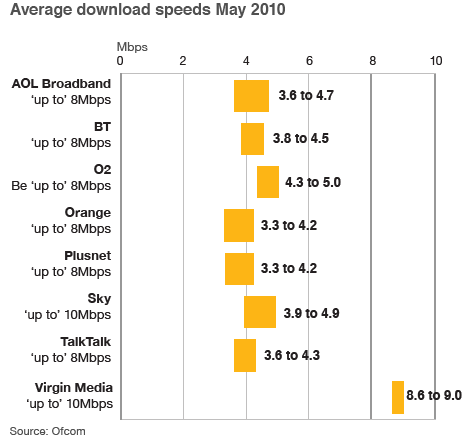
A sampling of British cable and telephone company DSL providers, all of which aren't giving their customers what they are paying for.

McSlarrow’s view is there isn’t a problem there either — the FCC is relying on old data:

The key statistics in the report are drawn from Form 477 data for December 2008, data that was out of date when it was released earlier this year and is now 18 months old.  Broadband providers have made two subsequent Form 477 filings (with another one scheduled in a few weeks), so the reliance on stale data is frustrating.

Equally troubling is the Commission’s repetition of the NBP’s claim that “actual” broadband speeds are only half of “advertised” speeds.   After the NBP was released, we submitted an expert technical report demonstrating that the comScore data used was deeply flawed.  Since then, cable and telco ISPs have been working constructively with Commission staff on a hardware-based testing regime that should produce more accurate results.  Given the hard work that has been devoted to produce accurate speed measurements, it is disheartening that the 706 Report chose to perpetuate the NBP’s flawed speed data conclusions.

Finally, some of the data relied on in the 706 Report is not publicly available.  The report relies extensively on a cost model created for the NBP, but that model hasn’t been released, making it impossible to validate its results.  The Commission also repeatedly refers to an FCC staff report on international trends, but that report also has not been released.

The frustration McSlarrow writes about is shared by cable subscribers stuck in overloaded neighborhoods where service does not come close to marketed speeds.  The FCC is conducting an independent speed analysis that goes beyond speedtest data, and the results will be forthcoming.  In other countries where similar speed claims have not met reality, providers were usually found culpable for promising service they didn’t deliver.

Just ask Ofcom, the British regulatory agency charged with addressing this dilemma.  Earlier today they released evidence that 97 percent of UK broadband customers were not actually getting the speeds they were promised, and the gap between marketed speed and actual speed was growing. Will things be any different for American providers who use fine print to disclaim their bold marketing promises about speed?  Time will tell.

Finally, McSlarrow’s concerns about withheld data is ironic enough to call it a “pot to kettle” moment.  As those challenged with broadband mapping can attest, nobody keeps raw data about broadband availability and speeds closer to the vest than cable and telephone companies.

Of course, the ultimate agenda of the NCTA is to defend its industry’s record in broadband service, which means reducing any broadband challenges into little more than whining by Americans who don’t know how good they have it.

Verizon Upset About NY Bill Requiring Phone Deals Share 40 Percent of Proceeds With Ratepayers

When phone companies like Verizon decide to throw their rural customers under the bus by selling them off, shareholders and executives rake in windfall bonuses, sometimes in the millions.  Now a New York assemblyman and a state senator want ratepayers to get a 40 percent cut of the action.

Assemblyman Richard Brodsky (D-Westchester), is the primary sponsor of Assembly Bill A02208 — An Act Requiring the Public Service Commission to Conduct an In-Depth Public Interest Analysis of Proposed Mergers by Telephone Corporations and Other Telecommunications Services Providers.  A companion New York Senate Bill, S7263, was introduced by Sen. Brian X. Foley (D-Blue Point/Long Island).

The legislation would compel phone companies engaged in the practice of mergers, acquisitions, and sales to share 40 percent of the proceeds with New York’s landline phone customers.

The legislation came as a result of watching Verizon systematically sell off parts of its phone empire to third party companies like FairPoint Communications, Hawaiian Telcom, and Frontier Communications.  More than five million customers have been switched away from Verizon to other companies, most of which have gone bankrupt as a direct result of the sales.

Brodsky

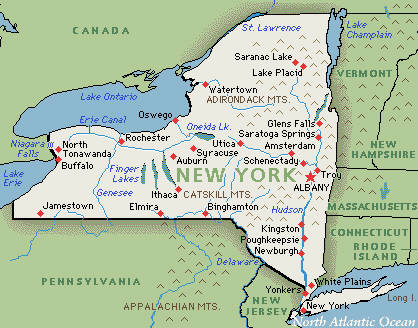
Both Brodsky and Foley don’t want to see New York residents face similar consequences.  They are particularly concerned about Verizon’s upstate operations, particularly in rural areas outside of cities like Buffalo, Binghamton, Rochester, Syracuse, Albany, and northern New York.  In the upstate region, Verizon has constructed fiber to the home service under its FiOS brand in urban and suburban regions where it operates, but has made few changes in the countryside.  As Verizon customers from Washington to North Carolina suddenly find themselves served by Frontier, why couldn’t the same thing happen in communities like Sodus in Wayne County, Penn Yan in Yates County, or just about anywhere in northern New York?

Verizon’s business plan has evolved over the last ten years.  Company president Ivan Seidenberg previously declared the landline business dead, and the company has turned its attention to delivering fiber-based video, phone and broadband services to the major population centers within its service areas.  Because rural customers cost too much to serve with similar packages of services, Verizon has begun selling them off to independent phone companies that still see revenue from copper wire landline service.

Verizon claims it has no plans to sell any of its operations in New York, but Brodsky and Foley want insurance that if they change their mind, no ratepayers in New York will face what happened in northern New England or Hawaii when the companies taking control ended up in Bankruptcy Court.

“It’s a ratepayer protection bill for upstate New York,” Brodsky said.

Brodsky said if Verizon were to sell operations, consumers will not be left with inferior service.

Forcing companies to share proceeds of sales to ratepayers who ultimately indirectly bankroll most of these deals is not unprecedented in New York.  Electric and gas utilities are often required to send refunds or issue credits when they sell assets.  Ratepayers of Rochester Gas & Electric received several compensation checks after the sale of the Ginna nuclear power plant in Ontario, New York to Constellation Energy Group in 2004.

Verizon could also be compelled to reinvest proceeds earmarked for consumers in the company’s infrastructure, such as paying for broadband improvements or upgrading lines.

The legislation would only impact companies earning more than $200 million in gross annual revenue from New Yorkers.  Currently, that means the legislation would only impact Verizon and Frontier Communications.

Not surprisingly, Verizon is vehemently against the proposed legislation and is fighting tooth and nail to kill it in Albany.

Foley

Jim Gerace, president of Verizon’s New York region, told the Albany Times-Union the Brodsky legislation was bad for Verizon and anti-business in general.  Gerace predicted companies would not want to do business in New York because they’d fear similar profit-sharing legislation could eventually target them.

“I’m convinced this is going to have a chilling effect on all businesses,” Gerace said. “They’re sending a very dangerous message to all businesses. It just compounds the state’s woes.”

But the Public Service Commission is intrigued by the legislation and is reviewing it.  If enacted, it could make a mass sell-off of rural landlines untenable in New York.

A02208 passed the Assembly by a wide margin — 103-34 and is now awaiting final action in the Senate.  It narrowly passed the Senate Rules Committee June 16th by a 13-10 vote.

If you want to see the bill passed, consider contacting your New York State senator and asking them to support the immediate passage of S7263.  Let them know you do not want phone deals to be cut at your expense, leaving you with a second-class provider.  If Verizon wants to sell off your community, they owe consumers a piece of the action.  It’s time that phone mergers, acquisitions and sell-offs actually benefit the consumers that ultimately pay for them and live with the results.

Republicans Tell Rural Caswell County, NC They Don’t Deserve Better Broadband

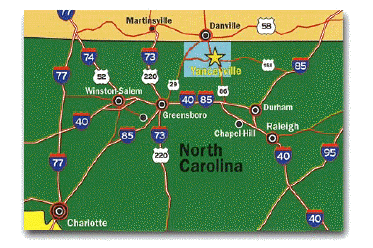
Although not too far from Winston-Salem and Greensboro, Caswell County has a population of just over 23,000 people

In a painful display of callous disregard for the broadband needs of rural North Carolina, where half the state’s population lives, nine Republicans and two Democrats on the House Public Utilities committee voted down a bill to deliver service to 60 percent of Caswell County that currently goes without.

HB2067, introduced by Rep. Bill Faison (D-Orange/Caswell) would have allowed the rural county to provide broadband service to unserved residents and businesses.  What Rep. Faison did manage to put in HB2067 was initiative towards 21st Century technology.  The bill would have authorized Caswell County to install better technology, both up and down, where Centurylink offers slow DSL as the only option.  In introducing the bill, Faison explained that recent broadband data showed only 40 percent of Caswell County had access to broadband.

Already suffering from the exodus of textile jobs that used to provide an economic base for the area, the failure to obtain broadband has proven disastrous to the work of the county’s 21st Century Group, trying to restore Caswell County’s economy with a higher-tech future.  Six years of work was blocked by CenturyLink — the local phone company and 11 legislators, who told residents they don’t deserve anything better than they already have (which is often nothing.)

Without HB2067, Caswell County cannot even apply for federal stimulus broadband grant funds because the state law doesn’t provide specific authority to deliver the service.  Faison’s bill would correct that oversight and encourage public/private partnerships to get busy bringing broadband to the region.

CenturyLink and its top lobbyist Steve Brewer would hear none of it — Goliath was afraid that David would install better technology and force Centurylink to upgrade or hit the road.

Brewer was given more than half the available time for discussion about the proposed bill to fill the ears of committee members with half-truths.

CenturyLink, Brewer claimed, was more than willing to work with the county to provide the kind of speed its business park needed, yet failed to mention its long history of refusing to expand service to unserved areas.  Brewer’s claim that 70 percent of Caswell County is served by CenturyLink doesn’t mean the company offers broadband to all of those customers.  His further claim that 90 percent of those areas include equipment that is “DSL capable” also doesn’t mean those areas are providing the service today, just that they could… someday.  Many factors can disqualify a potential customer from getting DSL service, especially in rural areas where line quality is not always the best.

Bartlett Yancey House Restaurant and Gallery, a famous landmark in Caswell County.

Faison sought to explore exactly what Brewer defined as “broadband” service.  Brewer claimed DSL service offered anywhere from “1.5 to 6Mbps,” admitting speeds decline with distance and is untenable more than three miles from the telephone company switch facility.

Of course, Caswell County’s large rural expanse puts many of the unserved beyond the maximum distance DSL can work without additional equipment.  Many rural areas that can get DSL are typically offered between 768kbps-3Mbps service.  Caswell County is so rural, it met the Rural Utility Service’s (RUS) classic definition of an underserved community.  That allowed the county to technically qualify for first round federal broadband grant funding.

Unfortunately, legislators are not always as informed as they need to be to recognize statements riddled with loopholes and asterisks.

For instance, Rep. Daniel McComas (R-New Hanover) asked whether he could get high speed Internet over a phone line.  Although Brewer answered yes, what qualifies as “high speed” was left unanswered, as was exactly how many Caswell County residents requested DSL service, only to be refused by CenturyLink.  Yes, you can get DSL broadband over a phone line — but that doesn’t mean you will in Caswell County.

“The only definition of high speed Internet in North Carolina is from a statute from 10 years ago,” Faison noted. “You would have to admit that what was high speed Internet 10 years ago is not high speed Internet today.”

Just as the call for a vote was made, Brewer delivered an uninvited closing argument — probably unnecessary since no consumers were invited to speak on the issue.  If you don’t have broadband in Caswell County, 11 legislators on that committee weren’t interested in hearing from you anyway.

Brewer said the bill was completely unnecessary, because “federal broadband grants were no longer available,” and besides, it was unfair competition for the county to deliver broadband service better than what CenturyLink provides.  Of course, broadband grants -are- still available from the RUS, and few on the committee probably understood the irony of a phone company demanding that Caswell County not be allowed to deliver quality broadband service CenturyLink refuses to provide.
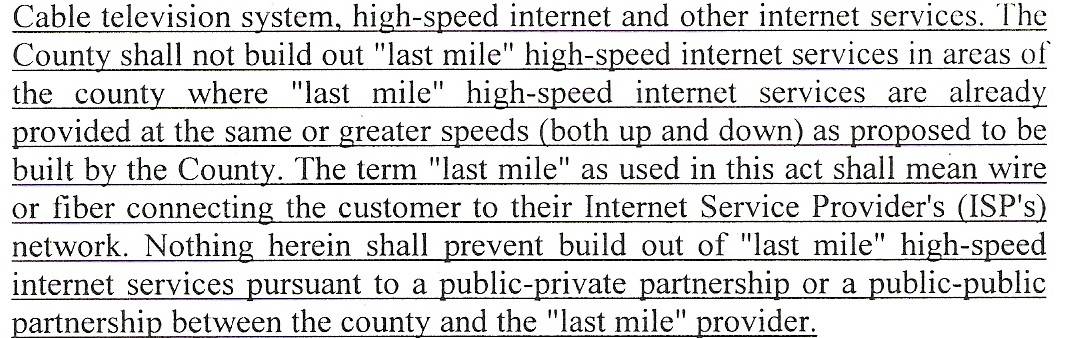
The substitute Committee bill would have protected CenturyLink from their fears of "unfair" competition by not allowing the county to build out broadband service where CenturyLink already provides it if it was not better service, but the company remained adamantly opposed to the county providing broadband service even in areas where they refuse to deliver it themselves for fear they would have to offer real broadband to Caswell County.

CenturyLink also claimed the county would have ‘secret insider information’ about CenturyLink’s every move through the permit process.  The glacial pace of the phone company’s broadband expansion is hardly a secret to the residents who live there.  Besides, permits are not required for the phone company to work in their own right-of-way.  Unlike cities who control the rights of way in their corporate limits, the state owns and controls the rights of way going through the unincorporated parts of the County.  Brewer’s comments were intended to scare legislators, not inform them.  It was a flat out lie.

The vote illustrates the disconnect many in the state legislature have about broadband.  Most of those in favor of the of the bill were Democrats mostly from rural sections of the state.  Two of the “no” votes came from Democrats in urban Mecklenburg County, which includes the city of Charlotte.  Representatives Beverly Earle and Becky Carney already have several choices for broadband service where they live.  Shame on them for condemning their rural neighbors in the north to a broadband backwater.

Mecklenburg County legislators were sure in a big hurry a few years back to do the bidding of AT&T, opening the doors to their kind of competition with statewide video franchising.  U-verse, which is available in parts of Charlotte, was supposed to put a stop the relentless rate increases and deliver competition.  So far, they’ve managed to sign up around 13,000 residents out of a potential 4 million plus in North Carolina, and the rate hikes just keep on coming.

The Republicans on the committee voted lock-step against the bill, even those from rural regions of the state.  Most of them are grateful recipients of big telecom money or are not running for re-election.  None of them can be bothered to ponder better broadband for their constituents unless it comes from a company cutting them a campaign contribution check.

When the vote was over, AT&T’s lobbyist Herb Crenshaw warmly shook McComas’ hand and congratulated him for a job well done. AT&T’s next check to McComas’ campaign fund will likely be bigger than the $500 he collected during the first quarter of this year.

The hit job on the broadband needs of rural Caswell County was complete.

The Members of the House Public Utilities Committee Voting Against Better Broadband for Caswell County & The Reasons Why
…and these amounts are just from the 1st quarter of 2010!

Rep. Harold J. Brubaker (R-Randolph) — Big Bucks Brubaker ran to the bank with $4,000 from AT&T, $4,000 from CenturyLink, $2,000 from Time Warner Cable, and $2,000 from Verizon.

Rep. Hugh Blackwell (R-Burke) — Blackwell accepted $500 from AT&T and $250 from Time Warner Cable.

Rep. Becky Carney (D–Mecklenburg) — AT&T and Time Warner Cable both cut checks for $500 each for Ms. Carney.

Rep. Beverly Earle (D-Mecklenburg) — She’s nice at half the price, with a grateful CenturyLink cutting a check for $250.

Rep. W. Robert Grady (R-Onslow) — Zippo.  He’s not running for re-election.

Rep. Jim Gulley (R-Mecklenburg) — Nada.  He’s not running again either.

Rep. Julia Howard (R–Davie/Iredell) — She gets around.  AT&T found her $500, CenturyLink provided a cool $2,000, and Time Warner Cable did even better with $2,500.

Rep. Linda Johnson (R-Cabarrus) — A double mint.  AT&T $500, Time Warner Cable $500.

Rep. Daniel McComas (R-New Hanover) — AT&T gave him $500, Time Warner Cable doubled that with $1,000.

Rep. Tim Moore (R-Cleveland) — Walking around money — AT&T $500, Time Warner Cable $500.

Rep. Wil Neumann (R-Gaston) — AT&T $500, but thanks to this year’s hefty rate hike, Time Warner Cable could afford $1,000 for Mr. Neumann.

Representatives Who Supported Rural North Carolina’s Need for Better Broadband, Voting For HB2067

Rep. Bill Faison (D-Orange, Caswell)

Rep. Kelly Alexander, Jr. (D–Mecklenburg)

Rep. Angela Bryant (D–Nash, Halifax)

Rep. Pricey Harrison (D-Guilford)

Rep. Marvin Lucas (D-Cumberland)

Rep. Nelson Cole (D-Rockingham)

Totals for 2010 (so far) for Telecom Contributions in the North Carolina General Assembly

AT&T $72,740

CenturyLink $51,750

Time Warner Cable $20,450

Verizon $10,500

(All figures are from the North Carolina State Board of Elections website, from candidates filings.)


Search This Site:

Contributions:

Recent Comments:

Your Account:

Stop the Cap!