Home » rural areas » Recent Articles:

The National Broadband Map is Here, and It Has Some Flaws

The National Telecommunications and Information Administration unveiled America’s broadband map early this morning, showing broadband availability, speeds, and coverage areas across all 50 states.

“A state-of-the-art communications infrastructure is essential to America’s competitiveness in the global digital economy,” said Acting Commerce Deputy Secretary Rebecca Blank. “But as Congress recognized, we need better data on America’s broadband Internet capabilities in order to improve them. The National Broadband Map, along with today’s broadband Internet usage study, will inform efforts to enhance broadband Internet access and adoption — spurring greater innovation, economic opportunities, and advancements in health care, education, and public safety.”

The map, searchable by street address or zip code, delivers data largely volunteered by service providers themselves.  Some of the data, particularly for broadband speeds, represent best-case scenarios, not actual results.  Regardless, looking at the nation as a whole, there are some dramatic gaps in coverage.  Large areas west of the Mississippi are without broadband, which can be understandable in the sparsely populated region.  To the east, the biggest problem by far as in the Appalachians, especially in West Virginia, western Virginia, and the western Carolinas.  West Virginia in particular stands out as the state with the least amount of coverage in the east, perhaps only rivaled by Maine.  In the southern U.S., Alabama, Mississippi, Louisiana, and northern Florida are problem areas.  East Texas outside of major cities is as well.  In rural areas, the coverage map fills in the most when rural wireless mobile providers are introduced, but their broadband plans are hardly suitable as a replacement for wired, unlimited access service.

“The National Broadband Map shows there are still too many people and community institutions lacking the level of broadband service needed to fully participate in the Internet economy. We are pleased to see the increase in broadband adoption last year, particularly in light of the difficult economic environment, but a digital divide remains,” said Assistant Secretary for Communications and Information and NTIA Administrator Lawrence E. Strickling. “Through NTIA’s Broadband Technology Opportunities Program, digital literacy activities, and other initiatives, including the tools we are releasing today, the Obama Administration is working to address these challenges.”

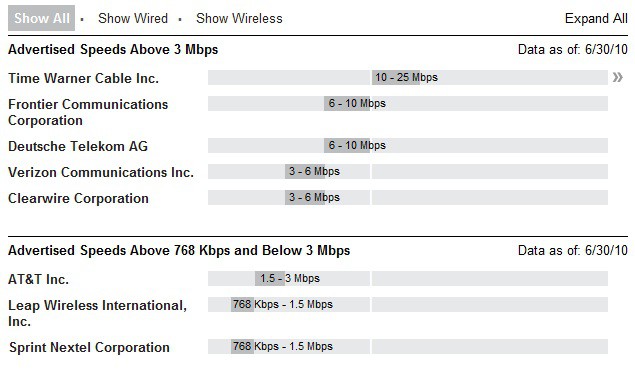
Reviewing the map for Stop the Cap!‘s headquarters — Rochester, N.Y., shows a correct list of providers, but the data about their products is more fantasy than reality:

  • Time Warner Cable does not deliver 25/1.5Mbps service to residential customers in Rochester at this time, but its PowerBoost temporary speed gimmick might, for around 30 seconds.  Currently, Time Warner Cable maxes out at 15/1Mbps in the Rochester area;
  • Frontier’s claim of 10Mbps is a theoretical maximum.  Most DSL customers don’t come close.  In our area (Brighton, N.Y.) Frontier couldn’t deliver more than 3.1Mbps.
  • Wireless carrier data is simply wrong.  Sprint-Nextel is beaten down to a maximum 1.5Mbps, despite the arrival of its 4G network, which can manage better than that.  Verizon’s 3-6Mbps service is in their dreams, considering this data came from last June — before the introduction of LTE service in Rochester.  Clearwire is also guilty of boasting speeds they will never deliver on their increasingly throttled network.

The NTIA touts their map will be verifiable using “crowdsourcing,” but we found visitors are only able to confirm if a provider serves an area, but not how well and at what speeds.

Price data is also missing.  Strickling blames that on fast-changing industry practices.  We blame it on the fact providers refused to disclose that information, along with more specific details about their broadband networks.  Large providers claimed releasing proprietary, confidential business information could harm them competitively.

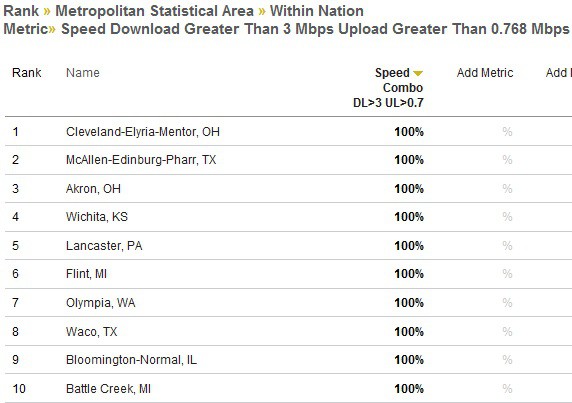
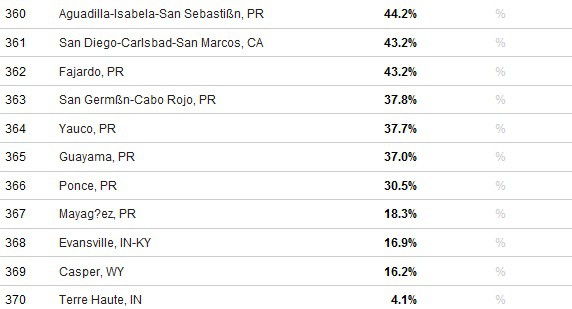
Another glaring example of questionable accuracy is the compelled-to-report top and bottom 10 cities in the country for service.  According to the NTIA, America’s number one city for broadband availability at speeds greater than 3Mbps is… Cleveland, Ohio.

Cleveland?

The worst?  Terre Haute, Indiana.

Really?

Investigating Wisconsin’s Broadband Stimulus Give Back: Political Ploy or Bureaucracy Gone Wild

For the first time, a state has announced it is returning stimulus funding made available by the Obama Administration to improve broadband service.

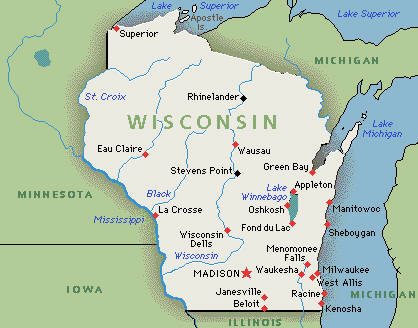
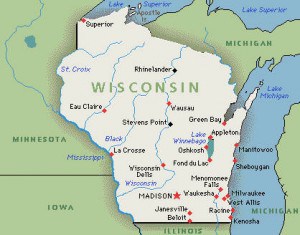
Wisconsin governor Scott Walker said thanks, but no thanks to the U.S. Department of Congress, returning $23 million in broadband stimulus funds allocated to build a fiber-optic “middle mile” network to 380 Wisconsin communities — including 385 libraries. 82 schools, and numerous public safety offices in rural areas.

The decision to reject the money came in concert with a public relations push by Republicans in Washington this week calling on governors to curtail “wasteful spending” and reject stimulus projects.  Walker’s timing of the rejection has political watchers suspicious of an orchestrated campaign by state and national Republicans to call out the president’s economic programs.  Critics of the Walker administration are also accusing the governor of doing AT&T’s bidding in rejecting the public money.

AT&T has plenty of good friends in the state government, which has historically granted most of AT&T’s legislative checklist in the past ten years.  Wisconsin has taken a “hands-off” approach to cable and phone companies.  Statewide video franchising makes AT&T’s efforts to expand its U-verse IPTV system easy, without having to answer to local communities.  Rural commitments to landline phone service have also been eased for AT&T, thanks to a large lobbying effort.  Publicly-owned municipal broadband networks open to ordinary consumers are few and far between in the state, thanks to heavy opposition from the phone giant.

Walker’s track record of being extremely pro-business, and the fact he accepted more than $20,000 in campaign contributions from AT&T made it easy to claim Walker was delivering another favor to the state’s largest phone company.

But is Walker’s rejection of the state’s broadband stimulus money a help or a hindrance to AT&T?  Is Wisconsin’s governor correct when he says federal government bureaucracy was at fault?

Stop the Cap! decided to investigate.

BadgerNet: An Introduction

Governor Walker

Wisconsin’s institutional broadband network, which delivers broadband connections to large educational facilities, public libraries, and government users, is named BadgerNet — which makes perfect sense for the Badger State.  State law limits who can utilize the service — ordinary residential customers cannot — so the network is not well known outside of the circle of groups authorized to access it.

Currently BadgerNet largely exists as an extension of AT&T’s network in Wisconsin.  That is a critical point.  Had BadgerNet initially been created as an independent entity, today’s stimulus rejection might never have happened.  Wisconsin, no doubt at the behest of AT&T, built its network with a leasing arrangement, signing five-year term contracts to rent space on AT&T’s fiber-copper wire facilities.  That kept initial construction costs down, and allows the state to theoretically “walk away” from part of the network if something better comes along — a highly unlikely proposition in a state like Wisconsin.  It’s not an economic leader and has large numbers of rural counties competitors would be unlikely to serve.

Wisconsin Republicans call this arrangement with AT&T a “public-private partnership.”  Democrats call it a giveaway to AT&T, and BadgerNet officials call it one big fat headache.

Wisconsin's BadgerNet

Obama’s Broadband Stimulus

President Obama

When the Obama Administration unveiled its broadband stimulus program, it not only promised to deliver new broadband projects, but also the employment prospects for an army of consultants hired to navigate through the terms and conditions that always accompany money from Washington.

The control measures established by the Department of Commerce, which administers the money from the federal government, are designed to protect against waste, fraud, and abuse.  Unfortunately, they are often more impenetrable than software licensing agreements.  If you want the money, you must follow every requirement, or risk forfeiting it back to the government.

Wisconsin’s proposal to expand BadgerNet with broadband stimulus funding would mean discarding slower speed data connections for super-fast fiber optics.  Some 203 new miles of optical fiber were to be laid, serving 385 school districts, 74 libraries, and eight community colleges.

The federal government liked what it saw and awarded nearly $24 million in funds to launch the “middle-mile” project.  Along with the virtual check came pages of fine print — rules about how the money could and could not be spent.

As state officials and BadgerNet 2.0’s planners poured over the documents, they began reaching for the Tylenol.  AT&T’s ownership interests in the existing network turned out to be a major problem.

The ‘AT&T Problem’

“We, as a state, do not own our network. We purchase a managed service through the BadgerNet contract,” Diane Kohn, acting administrator for the Division of Enterprise Technology in the Department of Administration told the Milwaukee Journal Sentinel.

Most grant recipients either plan to build a new network from the ground up or build on an existing non-profit network.  Neither is the case in Wisconsin because of AT&T’s involvement.

“From a federal perspective, it was like we were some kind of unknown start-up firm with all of these risks attached to it,” said Robert Bocher, an information technology consultant for the Department of Public Instruction. “In fact, our network has been around since the mid-1990s.”

But it got even more difficult when BadgerNet discovered the federal government requires new fiber networks built with stimulus funds to be utilized for at least 20 years.  This important control measure protects taxpayers from fronting the costs to build state of the art fiber networks, only to be later sold off to private interests or discarded as a budget cutting move.

Wisconsin’s agreement with AT&T runs for five years, not 20.  Additionally, since AT&T largely administers the infrastructure, much of the $23 million could have ended up going straight to AT&T to cover construction costs.  BadgerNet lacks sufficient funding to completely sever ties with AT&T and build its own network, and Gov. Walker isn’t about the deliver the money required to start a new network from scratch.

BadgerNet learned a lesson most grant recipients discover after winning the money — spending it comes with plenty of wires attached, and none of them transport data.

The Davis-Bacon Act

A Depression-era law is also being blamed for supposedly creating major hurdles for broadband network construction.  The 1931 Davis-Bacon Act was enacted to require public works projects be built at local prevailing wages.  The Act became law after contractors began importing cheap labor (typically underpaid African-Americans from southern states) to work competitively bid public construction projects during the Roosevelt Administration.

Mikonowicz

Republicans currently suspect the Act of being little more than a union protection law, raising labor costs artificially and helping to bust budgets.  Wisconsin Republican senator Ron Johnson used complications in a Sauk County broadband project to bash the Act, accusing it of being responsible for wasting taxpayer dollars.

David Mikonowicz, the utility superintendent for Reedsburg, complained the Act would require him to pay more than double his anticipated labor costs for a fiber project in the community.  Mikonowicz claimed the Act didn’t provide a prevailing wage for fiber contractors, so he was forced to bid out the project at wages suitable for high voltage wiring projects — $40 an hour.

That false premise made it to the pages of the Journal Sentinel in an earlier piece — a bit of political theater to bash unions, the federal government, and play up local communities as the innocent victims of both.

Stop the Cap! had no problems finding a prevailing Davis-Bacon Act wage covering Sauk County fiber installers, so we are unsure why Mikonowicz could not:

Teledata System Installer/Technician $11.70-21.26/hr

Low voltage construction, installation, maintenance and removal of teledata facilities (voice, data, and video) including outside plant, telephone and data inside wire, interconnect, terminal equipment, central offices, PABX, fiber optic cable and equipment, micro waves, V-SAT, bypass, CATV, WAN (wide area networks), LAN (local area networks), and ISDN (integrated systems digital network)

The Loyal Opposition & Everyone Else

The loss of nearly two dozen million dollars in federal government money was catnip for the loyal opposition.

Rep. Pocan

State Rep. Mark Pocan (D-Madison) said Walker’s broadband money giveback was hurting the state.

“Not only is he turning away construction jobs that would have come with the federal grant to expand broadband fiber to schools and libraries across Wisconsin, but he’s closing off potential to business growth that comes with bridging the digital divide,” Pocan said. “What’s worse, the root of his decision wasn’t what was in the best interest of Wisconsin, rather the best interest of his big telecommunications campaign donors.”

Gov. Walker used the occasion to blame the federal government for unnecessary bureaucracy. Mike Huebsch, appointed by the governor to serve as secretary of the state Department of Administration, issued a memo warning if they didn’t return the money, state taxpayers could be on the hook for the entire amount if the federal government found the state didn’t comply with grant requirements.

Ordinary Wisconsin residents would never see improved broadband in their homes from the middle mile project, so much of their reaction comes from a reflexive dislike of the governor, taxes and spending, AT&T, or a combination of all three.

AT&T has kept quiet through the entire affair, only stating it wasn’t interested in becoming a formal grant recipient stuck with the federal government’s rules.

Republicans and “tea party” members are thrilled Wisconsin is a leader in throwing federal money for broadband, railways, and other public works projects back to Washington, in hopes it will set an example for the federal government to follow.

What Happens Next

The state says it is negotiating an extension of the existing AT&T contract for another five years, and points to advances in copper wire-delivered bandwidth and the fact AT&T already provides fiber connectivity for certain parts of BadgerNet.

While AT&T has been labeled the ultimate culprit for the broadband stimulus debacle, it’s not as guilty as some might think for these reasons:

  1. The initial failure of the state to own and operate its own network, instead of leasing access from AT&T;
  2. AT&T gets the money whether Wisconsin leases another five years of service from AT&T, or stimulus funding gets diverted to AT&T to bolster BadgerNet’s existing network;
  3. AT&T is sitting pretty whether it has a five year lease or a 20-year stimulus-mandated contract.  In fact, AT&T could set its rates at today’s relatively high prices for network connectivity that Wisconsin would still be paying two decades from now.

That doesn’t mean AT&T is a good actor in Wisconsin.  While the company has steered clear of this debate, its lobbyists continue to fight off any potential competition from community-owned networks that threaten to deliver service to residential and business customers.  Few Big Telecom providers complain about institutional networks like BadgerNet, because heavy lobbying on their part several years ago won state laws that forever prohibit ordinary consumers from ever buying service from them.


CenturyLink Invests to Reinvent Themselves: Prism IPTV/25Mbps Service Arrives

Phillip Dampier February 16, 2011 Broadband Speed, CenturyLink, Competition, Consumer News, Video Comments Off on CenturyLink Invests to Reinvent Themselves: Prism IPTV/25Mbps Service Arrives

Invest or die.  That succinctly explains the current state of the landline telephone business and the companies providing service to a decreasing number of Americans.  Some companies, like AT&T and Verizon have heavily diversified their business into wireless, fiber, IPTV and broadband.  Others, like Frontier are hoping their presence in uncompetitive rural markets will keep them in business, as long as their dividends keep stockholders happy.

CenturyLink, which is in the process of absorbing the last remaining Baby Bell — Qwest, has decided to invest in their business to stay competitive with their biggest nemesis — the cable company.  CenturyLink is still hanging on to ADSL broadband service in many rural areas, but the company sees the promise of future relevance with bonded DSL, which is delivering 25/2Mbps broadband service to an increasing number of their customers.  Where distances allow, CenturyLink is at least temporarily providing the fastest residential broadband service available in areas like southwest Florida.  They are holding their own against local cable competitors like Comcast.

Now the company is following AT&T in introducing a new IPTV service to many of its customers.  Dubbed Prism, the U-verse like service delivers a true triple play package to customers who thought they would be stuck with their local cable company or satellite dish provider for TV programming.

Prism offers more than 200 channels, a multi-room DVR capable of recording up to four shows at the same time, and an interactive program guide that doesn’t need an instruction manual to navigate.

[flv width=”640″ height=”390″]http://www.phillipdampier.com/video/Introducing CenturyLink Prism.flv[/flv]

This promotional video introduces CenturyLink’s Prism service and its television features.  (4 minutes)

Prism has been introduced in larger CenturyLink areas ranging from southern Nevada, southwestern Florida, and North Carolina, where EMBARQ used to provide telephone service.

The service works through a hybrid fiber-copper wire IPTV network.  Fiber optic cable reduces the distance data needs to travel over ordinary copper phone wires.  The less copper, the faster the potential speed.  With a 25-30Mbps broadband platform, Prism can divide up available bandwidth to support television, phone, and up to 10Mbps broadband service.  It’s all delivered over the same digital network.  While not as advanced as Verizon FiOS and other fiber to the home networks, IPTV services like Prism and U-verse are cheaper to provide, and that can mean faster deployment in areas not well served by competition.

Reaction to Prism has been generally positive among Stop the Cap! readers who have shared their stories with us.  Among the positives:

  • The interactive program guide is light years ahead of Comcast, Cox, and Time Warner Cable;
  • Broadband speeds are generally better than the original DSL service CenturyLink used to provide;
  • The picture quality is excellent where the telephone network has been upgraded the most;
  • Competitive introductory and retention offers mean consumers can pay less for service, at least initially.

But there are some problems, too:

  • Bandwidth varies depending on how far away you are from the nearest fiber node.  This affects what you can do with the service.  If you are further out, you can only watch one HD television channel at a time, and may not be able to record more than one HD channel at the same time;
  • The DVR box has issues — readers report shows disappear, don’t get recorded, or show poor results when line quality drops;
  • Broadband speeds with Prism officially max out at 10Mbps;
  • If you are watching a number of televisions at the same time, your broadband speeds could drop;
  • Variability in service quality comes largely as a result of inferior copper wire phone networks CenturyLink chose to stick with.  If your phone line is prone to static or hum, or deliver poor results when the weather is bad, Prism might not work well for you.

Some subscribers found they initially loved the service, but when bad weather arrived, it all fell apart.

“Our phone lines are decades old, so this comes as no surprise,” says Manny who writes from Naples, Fla.  “I was also disappointed some of the channels in HD I had with Comcast are not available from Prism.”

In parts of Raleigh, N.C., Prism just launched a few weeks ago.  But some of our readers are sticking with Time Warner Cable.

“After looking over their pricing and packages, Time Warner has more HD channels and doesn’t charge $12 a month extra for them,” writes Ralph.  “CenturyLink also only bundles 3Mbps broadband service with most of their packages, and you have to pay extra for 10Mbps service.”

Ralph thinks Road Runner from the cable company will provide a more consistent broadband experience for his family.

“There is only so much you can push through a phone line at the same time; I like the fact they are competing, but they will not be able to keep up if they rely on copper phone wiring forever,” Ralph says.

Cox faces new competition in southern Nevada

Despite some of the negatives, CenturyLink may deliver formidable competition where cable companies haven’t kept up.  Some other markets where Prism will offer service: Jefferson City, and Columbia, Mo., and La Crosse, Wis.  Cox Cable in southern Nevada is now competing with Prism, and believes it has the superior network.

“The way our system is constructed, we have services equally distributed everywhere in the valley,” Juergen Barbusca, Cox manager of communications, public and government affairs in Las Vegas said. “Everybody in our footprint can get our highest advertised speeds.”

Cable broadband is less susceptible to distance degradation that can make Prism a no-go in neighborhoods at the far end of a phone company’s central office.

Also equally distributed is the price.  Outside of new customer promotions, nobody will save any money here.  Cox and CenturyLink are both selling their respective triple-play packages of TV, Internet, and phone for exactly the same price: $143 a month.

[flv width=”480″ height=”380″]http://www.phillipdampier.com/video/KTNV Las Vegas CenturyLink Prism 2-8-11 WFTX Cape Coral CenturyLink in SW Florida 12-7-10.flv[/flv]

KTNV-TV in Las Vegas introduces viewers to CenturyLink’s Prism service and WFTX-TV in Cape Coral, Florida talks with CenturyLink about their new 25Mbps broadband service in two exceptionally company-friendly pieces from the stations’ respective news shows.  (13 minutes)

EchoStar Buys Hughes Satellite; Acquires Satellite ‘Fraudband’ Service Rural Americans Loathe

Phillip Dampier February 14, 2011 Broadband Speed, Consumer News, Data Caps, HughesNet, Online Video, Rural Broadband, Video, Wireless Broadband Comments Off on EchoStar Buys Hughes Satellite; Acquires Satellite ‘Fraudband’ Service Rural Americans Loathe

EchoStar Corporation, which makes equipment and provides satellites for Dish Network, today announced it has agreed to buy Hughes Communications, Inc., for about $1.32 billion.

The deal means Dish, the second-largest U.S. satellite television provider, could be one step closer to providing a national data service to its customers.  Hughes operates a “broadband” satellite network, which almost entirely serves rural areas.

Much maligned by its customers, who consider the service’s high prices, low speeds and even lower usage caps “fraudband,” Hughes’ satellite service has been up for sale for some time.

The purchase “brings together the two premier providers of satellite communications services and delivers substantial value to our shareholders,” Pradman Kaul, chief executive officer of Hughes said in the statement.

Satellite television companies have increasingly been at a disadvantage because they cannot sell a true “triple-play” package of television, Internet, and phone service to customers who commonly bundle the three services together.  Instead, Dish and its larger competitor DirecTV have been relying on partnerships with telephone companies who provide phone and Internet service with a satellite television package.

The current generation of satellite broadband services are not well-rated by their customers.  Capacity shortages force providers to place strict limits on usage, which makes the service largely useless for high bandwidth applications — especially video.

The deal is expected to close later this year.

[flv width=”640″ height=”500″]http://www.phillipdampier.com/video/Hughesnet.flv[/flv]

Watch HughesNet’s advertisement promising “blazing fast” speeds in contrast to an actual speed test completed by one of their customers, at a non-peak-usage time.  (2 minutes)

Telecom Dividend Cash Bonanza – Landline Customers Drop, But Stockholder Payouts Rise

Phillip Dampier February 10, 2011 AT&T, Bell (Canada), Frontier, Rural Broadband Comments Off on Telecom Dividend Cash Bonanza – Landline Customers Drop, But Stockholder Payouts Rise

The telephone landline business is hardly a growth industry, as an average of 5-7 percent of customers disconnect their home phone service every quarter, but you wouldn’t know that from the dividends being paid to stockholders.

From AT&T, Bell Canada, Frontier to Qwest — the companies that speak in terms of keeping their customer defection rates down are paying dividends that often exceed earnings.

Among the worst of all — Frontier Communications, whose outsized dividend is expected to reach 75 cents a share.  That, despite the fact analysts predict the phone company will earn only 40 cents a share or so this year.

Where do these phone companies expect to make their money?  Their broadband and wireless divisions.  AT&T and Bell Canada are able to cover landline losses with enhanced profits from their IPTV services like U-verse and Fibe.  Frontier and Qwest expect to survive on providing cheap-to-deploy DSL service in rural areas avoided by cable operators.

Search This Site:

Contributions:

Recent Comments:

Your Account:

Stop the Cap!