Home » rural areas » Recent Articles:

Universal Service Reform Proposal from Big Telcos Would Rocket Phone Bills Higher

A new proposal from the nation’s six largest telephone companies would double or triple Universal Service Fund (USF) fees on many telephone lines, extending them to wireless, broadband-based phones, cable TV “digital phone” products, and potentially even Internet accounts, providing billions from consumers for the companies proposing the plan.

Universal Service Fund reform has been a hot topic this year in Washington, as regulators attempt to reform a long-standing program designed to help keep rural landline telephone service affordable, subsidized with small charges levied on customer phone bills that range between $1-3 dollars, depending on the size of your community.

The original goals of the USF have largely been achieved, and with costs dropping to provide telephone service, and ancillary services like broadband DSL opening the door to new revenue streams, some rural phone companies don’t need the same level of support they received in earlier years.  As a result, USF funds have progressively been disbursed to an increasing number of projects that have little to do with rural phone service.  Several funding scandals over the past decade have underlined the need for USF reform, and FCC Chairman Julius Genachowski has been a strong advocate for directing an increasing amount of USF resources towards rural broadband deployment projects.

But now some of America’s largest phone companies want to establish their own vision for a future USF — one that preserves existing funding for rural phone service –and– levies new fees on ratepayers to support broadband expansion.

The ABC Plan's chief sponsors are AT&T...

America’s Broadband Connectivity Plan (ABC), proposed jointly by AT&T, Verizon, CenturyLink, Windstream, Frontier Communications and FairPoint Communications, departs markedly from Genachowski’s vision for a revised USF that would not increase the overall size of the Fund or its cost to consumers.

That’s why some ratepayer consumer groups and utility regulators have taken a dim view on the phone companies’ plan.

Colleen Harrell, assistant general counsel to the Kansas Corporation Commission says customers would find USF fees doubling, if not tripling on their home phone bills under ABC.  That could mean charges of $6 or more per month per phone line.

While the plan substantially benefits the companies that propose it, critics say ABC will do little to enhance service for ordinary consumers.  In fact, some language in the proposal could open the door for landline companies to discontinue universal landline service, a long time goal of AT&T.

In fact, protection for incumbent phone companies seems to be the highest priority in most of the ABC’s framework:

  1. The proposal provides a right of first refusal to the incumbent phone company, meaning USF grant funds effectively start at the landline provider, and are theirs to accept or reject.  This has competitors howling, ranging from Wireless ISPs, mobile data providers, cable companies, and even fiber networks.  The ABC proposal ignores who can deliver the best broadband most efficiently at the lowest price, and is crafted instead to deliver the bulk of funding to the provider that has been around the longest: phone companies.
  2. Provisions in the ABC Plan provide a convenient exit door for landline providers saddled with providing service to some of America’s most rural communities.  An escape clause allows “satellite service” to be provided to these rural households as a suitable alternative to traditional wired service, sponsored by an annual $300 million Advanced Mobility/Satellite Fund.  This, despite the fact consumer ratings for satellite providers are dismal and existing providers warn their services are often unsuitable for voice calls because of incredibly high latency rates.
  3. Provisions in the ABC Plan adhere to a definition of acceptable broadband well within the range favored by telephone company DSL providers — 4Mbps.  Setting the bar much higher could force phone companies to invest in their networks to reduce the distance of copper wire between their offices and customer homes and businesses, allowing for faster speeds.  Instead, lowering the bar on broadband speeds assures today’s deteriorating rural landline network will make-do, leaving a rural/urban speed divide in the United States.
  4. To “resolve” the issue of the increased fees and surcharges that could result from the plan’s adoption, it includes a subjective cap of $30 a month on residential basic landline home phone service (without calling features).  But since most ratepayers pay substantially less for basic home phone service, the maximum rate cap provides plenty of room for future rate increases.  Also, nothing precludes phone companies from raising other charges, or creating new “junk fees” to raise rates further, ignoring the “cap.”

...and Verizon

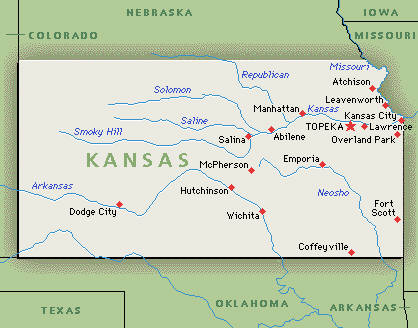
Rural states seem unimpressed with the phone companies’ proposal.  The Kansas Corporation Commission (KCC) called various provisions of the plan “a train wreck.”  Kansas is one of several states that developed their own state-based Universal Service Fund to help the state’s many rural agricultural areas receive acceptable telecommunications services.  Kansans initially paid one of the highest USF rates in the country when their state plan was enacted in 1996.  But Kansas phone companies used that money to modernize their networks, especially in rural communities — some of which now receive fiber-based phone service, and the rates have fallen dramatically as upgrade projects have been completed.  Today, most Kansans pay just $1.45 in USF fees to rural phone companies, while AT&T customers in larger Kansas towns and cities pay an average of $2.04.

If the ABC Plan is enacted as-is, Kansans will see phone bills spike as new USF fees are levied.  That’s because the federally-based USF Fund reform program would require today’s 6.18% state USF rate double or triple to sustain various programs within its scope.

And forget about the $30 ‘smoke and mirrors’ “rate cap”, according to the KCC:

[…] The ceiling will not preclude carriers from increasing the basic rate beyond $25 or $30 through higher state USF surcharges or higher local rates.  Multiple states including Kansas  have partially or totally deregulated basic local phone service rates, and the only component of retail  local service pricing that the FCC regulates is the federal Subscriber Line Charge.  Thus, a carrier may face no constraint whatsoever in increasing basic local rates to the point that total local rates are well above the illusory ceiling.

The state of Wyoming was also unimpressed with a one-size-fits-all national approach advocated primarily by big city phone companies AT&T and Verizon, the chief sponsors of the ABC Plan.

The Wyoming Public Service Commission filed comments effectively calling the ABC Plan boneheaded, because it ignores the plight of particularly rural states like Wyoming, chiefly served by smaller phone and cable companies that face challenges in the sparsely populated, mountainous state.

First among the Wyoming PSC’s complaints is that the plan ignores business realities in rural states.  No matter how much USF funding becomes available or what compensation schemes are enacted, dominant state phone companies like CenturyLink are unlikely to “invest in broadband infrastructure unless it is economically opportune to do so.”

The PSC points to the most likely outcomes if the ABC Plan is enacted:

  • Phone companies not challenged by a broadband competitor will make due with their current copper wire wireline infrastructure the PSC says has been deteriorating for years.  The PSC fears broadband expansion funds will be used to improve that copper network in larger areas where cable competition exists, while the rest of the more-rural network gets ignored;
  • In areas like larger towns or suburbs where phone companies suspect a cable (or other) competitor might eventually expand or launch service, USF funding could be spent to bolster the phone company’s existing DSL service to deter would-be competitors from entering the market;
  • We'll pass, too.

    The Wyoming PSC believes phone companies will spend broadband funds only where it would improve the phone company’s competitive position with respect to cable competitors.  Providers are unlikely to expand into currently-ignored rural areas for two reasons: lack of ongoing return on investment and support costs and the ABC Plan’s willingness to abandon rural America to satellite providers.  “We are familiar to a degree with satellite service at it presently exists in Wyoming markets, and we are not particularly enamored of the satellite solution,” the PSC writes.  But if adopted, no rural phone company would invest in DSL service expansion in areas that could be designated to receive federally-supported satellite service instead.

Wireless competitors are not happy with the ABC Plan because it ignores Wireless ISPs and sets ground rules that make them unlikely to ever win financial support.  Many also believe the ABC Plan picks technology winners and losers — namely telephone company provided DSL service as the big winner, and everyone else a loser.

The Fiber to the Home Council also heaped criticism on the ABC Plan for the low bar it sets — low enough for any phone company to meet — on broadband speeds.  The FTTH Council notes the ABC Plan would leave rural America on a broadband dirt road while urban America enjoys high-speed-rail-like service.

Coming Next… Who Really Supports the Phone Companies’ ABC Plan.
Kansas’ Law Allowing AT&T to Deregulate Itself Means Higher Phone Bills Are Imminent

Phillip Dampier August 17, 2011 AT&T, Consumer News, Data Caps, Public Policy & Gov't, Rural Broadband, Wireless Broadband Comments Off on Kansas’ Law Allowing AT&T to Deregulate Itself Means Higher Phone Bills Are Imminent

Earlier this year, Gov. Sam Brownback (R-Kansas) signed legislation into law that allows AT&T to deregulate itself, and its rates, at will.  Kansas ratepayers are about to pay the price for that law as basic phone rates are expected to increase as much as $84 a year for residents that have few alternatives.

AT&T wants to eliminate price caps on landline service, which currently limit pre-tax prices to $15.70 in rural areas, $16.70 in larger Kansan cities with enhanced local calling areas.  After AT&T won similar deregulation in Oklahoma, Texas, Missouri and Arkansas, AT&T has been regularly raising basic phone rates, which are now $5 to $7 more a month for basic service than before deregulation.

AT&T intends to divert much of the additional revenue away from upkeep of its landline network, which in several states it has won the right to abandon in rural areas, and use the money to enhance its cell phone network instead.

AT&T spokesman Aaron Catlin told The Wichita Eagle AT&T intends to supply communities currently bypassed by AT&T DSL with heavily usage capped, and much more expensive, 3G wireless broadband instead.

AT&T currently sells that service for $60 a month with a 5GB usage limit and an overlimit fee of $50 per gigabyte.

Catlin told the Eagle AT&T was excited with the possibilities, although rural Kansans facing those prices might not be.

“A lot of bad things are going to happen long-term,” Steve Rarrick, an attorney for the Citizens’ Utility Ratepayer Board told the newspaper. “Over time, they (customers) are going to see their phone bills go up. That’s been the experience of other states.”

Verizon Wireless Heads to Alaska, Providers on the Ground Expect AT&T to Suffer the Most

Verizon Wireless is expected to enter the Alaskan mobile market sometime in 2013-2014, according to incumbent competitors, who expect Verizon’s largest impact will be to bleed AT&T of customers.

Alaska’s two primary local providers — Alaska Communications, Inc. (ACS) and General Communications, Inc. (GCI), are telling shareholders to relax because they don’t expect to see Big Red in the Alaskan market for at least 2-3 years.  Both companies reported net losses for the quarter, and GCI lost 2,400 subscribers recently when more than 4,000 soldiers at Fort Wainwright in Fairbanks were deployed to Afghanistan.

Both ACS and GCI have been using the current poor economic climate and their respective stockpiles of cash-on-hand to retire debt or reissue long-term-debt at more favorable low interest rates.  Both companies are also hurrying to outdo each other’s 4G wireless network deployments before Verizon Wireless shows up, making use of spectrum it acquired last August to enter the Alaskan market.  Government rules require Verizon to sign-on its new network by June 13, 2013.  But Verizon admits it will take up to five years after that to completely build a new network from scratch.

Right now, Verizon Wireless customers taking their phones to Alaska roam on ACS’ network, for which the company is compensated with an increasing amount of extra revenue.  ACS boosted earnings in part on that roaming revenue, even as it lost more of its own customers.  When Verizon switches on its own network, that roaming revenue will rapidly decline, but ACS executives reassured shareholders their knowledge and experience of construction seasons in Alaska guarantee Verizon won’t be able to get its network together until 2013 at the earliest.

But when Verizon opens their doors, Ron Duncan, CEO of GCI expects a hard fight on his hands.

“We recognize ultimately they’ll be a significant competitor, although I see AT&T share more at risk because Verizon’s main claim to fame when they get to Alaska is going to be devices. We’ll still outpace them on coverage. We’ll continue to be the only ones with statewide coverage,” Duncan said. “People who want to buy the coverage buy from us today; people who want devices buy from AT&T because AT&T gets much better devices than we do.”

Just months after Verizon announced they were headed north, both ACS and GCI accelerated plans to roll out respective “4G” networks for wireless customers, although each company is deploying different standards.

GCI

GCI’s cell phone network is a combination of some of its own infrastructure, the acquisition of Alaska Digitel, and a resale agreement to use parts of AT&T Wireless’ coverage it acquired from Dobson Communications Systems.  In and around Fairbanks, Anchorage, Glennallen, Valdez, Prudhoe Bay, Wasilla, and Kenai, GCI offers CDMA service.  In those communities and many other rural regions in western Alaska, GCI relies on AT&T Alascom GSM networks.  GCI pitches its CDMA network’s 3G wireless data capabilities, which offer faster wireless data speeds, if you can get coverage.  For wider coverage in Alaska’s smaller communities, GCI markets GSM phones, which currently only offer 2G EDGE/GPRS data speeds.  If you use a cell phone mostly for voice calls, the wider coverage afforded by GCI’s GSM network is a popular choice.  But if you want faster data, CDMA 3G data speeds are required.

Eventually, GCI’s 4G network may help deliver coverage and faster speeds in both urban and rural areas, particularly as GCI plans to invest up to $100 million to construct more of its own network, instead of relying on resale agreements and acquisitions.

GCI has chosen HSPA+ for 4G service on the GSM network, and will introduce the service in Anchorage later this month.  That’s the same standard used by AT&T and T-Mobile in some areas.  It’s not as fast as LTE service from Verizon Wireless, but is much cheaper to deploy because cell sites need not be linked with fiber optic cables — an expensive proposition.

ACS

Alaska Communications has a large 3G CDMA network in Alaska all its own.  Its coverage is primarily in eastern Alaska adjacent to major cities like Anchorage, Juneau, and Fairbanks, and where it does provide 3G data coverage, the company claims it extends further out than GCI.  ACS doesn’t offer much coverage in small villages and communities in western Alaska, however.

ACS expects to skip incremental upgrades and launch its own 4G LTE service in the future.  It may help the company regain its second place standing, lost to GCI last year, and protect it from Verizon Wireless poaching its customers.

Updated: Frontier’s Fiber Mess: Company Losing FiOS Subs, Landline Customers, But Adds Bonded DSL

Losing customers.

A year after Frontier Communications assumed control of Verizon’s assets in the Pacific Northwest, customers are fleeing the company’s inherited fiber-to-the-home service FiOS, after announcing a massive (since suspended, except in Indiana) 46 percent rate hike for the television portion of the service.  A new $500 installation fee has kept all but the bravest from considering replacing customers who have left for Comcast and various satellite TV providers.

Frontier’s second-quarter financial results revealed the company has lost at least 14,000 out of 112,000 FiOS TV customers in the region (and in the Fort Wayne, Ind. market, where the service is also available.)

Early reaction to the original rate hike announcement started customers shopping for another provider — mostly Comcast, which competes in all three states where Frontier FiOS operates.  Even after the rate hike was suspended in some markets, intense marketing activity by Frontier to drive customers towards its partnership with satellite provider DirecTV managed to convince at least some of those customers to pull the plug on fiber in return for a free year of satellite TV, although an even larger number presumably switched to the cable competition.

D.A. Davidson, a financial consulting firm, told The Oregonian the message was clear.

“They would love to get rid of the FiOS TV customers,” Donna Jaegers, who follows Frontier, told the newspaper. “They’re programming costs are very high compared to the rates that they charge.”

Jaegers said Frontier Communications completely botched their efforts to transition customers away from FiOS TV towards satellite, because most of those departing headed for the cable competition, attracted by promotional offers and convenient billing.

Many others simply don’t want a satellite dish on their roof, and are confounded about Frontier’s message that satellite TV is somehow better than fiber-to-the-home service.

Frontier admits its FiOS service is now underutilized, but claims it will continue to provide the service where it already exists.

Wilderotter

Frontier Claims Its DSL Service is Better Than Cable Broadband

Frontier’s general business plan is to provide DSL service in rural areas where it faces little or no competition, and most of Frontier’s investment has been to upgrade Verizon’s landline network to sustain 1-3Mbps DSL service, for which it routinely charges the same (or more) for standalone broadband service that its cable competitors charge for much faster speeds.

But Frontier Communications CEO Maggie Wilderotter says their DSL service is better than the cable competition.

“A key differentiator between our network and cable competition is that you consistently get the speed you pay for,” Wilderotter told investors on a conference call. “There’s no sharing at the local level. High demand for bandwidth-intensive applications like video are putting pressure on all wired networks. To that end, we want to make sure that we have more than enough capacity to satisfy the expectations of our customers. We’re spending capital in all parts of the network with specific emphasis in the middle mile, which will enable us to consistently deliver a quality customer experience for our customers of today and tomorrow.”

Frontier Communications CEO Maggie Wilderotter defends anemic broadband additions during the 2nd quarter of 2011 and tries to convince investors DSL service is better than the cable competition. August 3, 2011. (4 minutes)
You must remain on this page to hear the clip, or you can download the clip and listen later.

Netflix Traffic Represents 25% of Frontier’s Broadband Traffic; Online Video — 50%

Wilderotter admitted Frontier’s broadband network is overcongested in many regions, which she partly blamed for the company’s anemic addition of new broadband customers.

She noted Netflix, which has itself consistently rated Frontier the worst wired broadband provider in the country for being able to deliver consistent, high quality access to their streaming service, represents one-quarter of all capacity usage of Frontier’s broadband network.

“Video is about 50 percent,” Wilderotter added.  In an investor conference call, she explained network congestion in more detail:

“In [the second quarter], we had many areas with unacceptable levels of network congestion, which negatively impacted our growth in net high-speed additions.” Wilderotter said. “We believe all of the major congestion issues will be fixed by the end of [the third quarter], and that will enable us to drive higher growth and net broadband activation in [former Verizon service areas.]”

“What we decided to do is to go for fixing the middle mile, which is the [central office] to the […] neighborhood and to expand that capability by 100-fold. And then also, expand from the [central office] out to the Internet and make sure that we have huge capacity to deliver and receive capability to our customers. So when we sell 6 meg, 10 meg, 25 meg, 50 meg, the customer gets what we sell them and that was extremely important for us.”

“So what we did is in the areas where we saw the congestion increase based upon usage increases, and we’ve built new households. We’ve held off on marketing to a lot of those new households until we fixed the congestion problem because we didn’t want to exacerbate what we had already. We’ve shifted capital in terms of the mix of how we’ve spent capital to fix this problem. I’d say we’re probably 75% of the way there in fixing congestion. This quarter is another big quarter for us to get all of the major issues out of the network, which will allow us in the back end of this quarter through the fourth quarter, to really start pushing the penetration levels where we’ve built new households in the areas that have been affected by congestion.”

Frontier Introduces Line Bonded DSL — Two Connections Can Improve DSL Speeds

Frontier Faster? Frontier announces line bonded DSL.

Frontier Communications also announced the introduction of Frontier Second Connect, a DSL line bonding product that delivers two physical connections to a single household.  Line bonding allows for improved broadband speeds.

“Second Connect gives our customers two exclusive connections in one household, and we’re the only provider in every market that can do that,” Wilderotter claimed.

In more urban markets, Frontier’s DSL speeds are woefully behind those available from most cable competitors.  Frontier has begun upgrading some of their legacy service areas and retiring older equipment in an effort to improve the quality of service.

“The real initiatives that we have underway are called middle mile, interoffice facilities, as well as some of the more aged equipment that’s in the network,” said Dan McCarthy, Frontier’s chief operating officer. “So as we go through, there’s about 600 projects that are underway today that will improve both the speed and capability.”

“We’ve inherited markets that there has not been upgrades to capacity in these markets for many years and fixes to the networks, plus the elements as the DSLAMs, even the DSLAMs themselves are old,” Wilderotter said. “So we’re replacing network elements in the neighborhood. We’re splitting them and moving customers to other network elements to make sure that they have a good experience.”

Frontier executives answer a question from a Wall Street banker about DSL speeds and congestion problems on Frontier’s broadband network. A detailed technical discussion ensues as the company tells investors it is redirecting some capital to fixing Frontier’s overcongested network. August 3, 2011. (5 minutes)
You must remain on this page to hear the clip, or you can download the clip and listen later.

Frontier Still Losing More than 8% Of Its Landline Customers Every Year

Despite broadband rollouts and incremental improvements, more than eight percent of Frontier’s landline customers disconnect service permanently every year.  Frontier called that disconnect rate an improvement over its line losses last year, which exceeded 11 percent in some areas.

“Total line losses improved to an 8.6% year-over-year decline, our lowest level since taking ownership when the pro forma loss rate was 9.7%,” reported Wilderotter. “We also improved [the] loss rate [in former Verizon service areas to] 10.1% compared to 11.4% in Q2 2010.”

Most of Frontier’s departing customers are switching to cable providers and/or cell phone service.

(Update 8-23-2011: We are now told in many areas, Frontier’s Second Connect service is not actually a bonded DSL product, but rather a “dry loop” second DSL line that carries the same speed as your primary line.  Presumably, household members can divide up who uses which DSL circuit for Internet access.  The charge for Second Connect in ex-Verizon service areas is $14.99 per month plus a second mandatory monthly modem rental fee of $6.99. If the web link does not work, it means the service is not available in your service area.)

Canada Moves to Digital TV: Canadian Pay TV Providers Move to Cash In

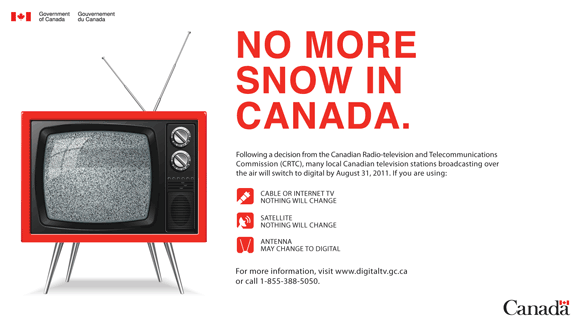
Two years after Americans dumped analog television in favor of digital over the air broadcasting, in just over two weeks many Canadians will discover their favorite free-TV signals gone from the analog airwaves forever.

Canada’s transition to digital TV will take a substantial step forward on Aug. 31st when many Canadian local television stations cease broadcasting in analog.  Canada’s pay television providers are taking full advantage of the transition, trying to persuade Canadians who watch their television signals over-the-air for free they will be better off paying for those signals going forward.

Part of the problem is that digital television signals, while “snow-free,” are not pixel-free in many areas distant from the transmitter.  As Americans in suburban locations discovered, those trusty indoor rabbit ears may be insufficient to receive an annoyance-free picture.

Digital television signals are not the nirvana some suggest.  The same passing vehicles and aircraft that caused wavy analog pictures or other interference can turn a digital picture into a frightfest of frozen picture blocks, digital raining pixels, and other effects that can make watching a difficult signal near impossible.

For Americans who thought the days of the external rooftop antenna were behind them, digital television changed all that, especially in more rural areas that could live with a slightly snowy analog picture, but found sub-optimal digital signals unwatchable.

Canada’s vast expanse, and its accompanying large network of low powered television repeater stations rebroadcasting signals from major stations in provincial capitals and large Canadian cities may prove to be an even greater reception challenge, especially in the Canadian Rockies and hilly terrain in eastern Canada.

Some Canadians experimenting with digital-to-analog converter boxes have found reception less practical than they originally thought.

Peter, a Stop the Cap! reader who lives near Oshawa, Ontario delivers some difficult news:

“Reception of digital signals from Toronto’s CN Tower has proved to be a lot more difficult in Oshawa than the existing analog signals,” Peter writes.  “We have no trouble getting truly local signals like CHEX-TV, which has a transmitter in analog serving Oshawa, but watching digital signals from Toronto really requires an outside antenna for good reception.”

Snow may be a thing of the past, but bad digital reception like this may be here to stay for many Canadian viewers.

Peter’s decision to erect a rooftop antenna opened the door to reception of analog and digital signals from Toronto and across Lake Ontario, where he can receive digital signals from some stations in Buffalo and Rochester, N.Y.  But it was an expense of several hundred dollars to get the work done.

“Cable and satellite companies are taking full advantage of the digital switch to try and get free-TV viewers to ‘upgrade’ to pay television, and they don’t hesitate to mention the expense and hassle of erecting rooftop antennas to guarantee good digital reception,” Peter says.

Peter can only imagine what digital reception will be like in the Canadian Rockies, where large networks of analog, mostly low-powered UHF transmitters deliver basic reception to important networks, especially CBC, outside of major cities.

“If you visit western Alberta or eastern B.C., good luck to you — we could barely watch over the air signals in most of the mountain towns,” Peter says. “Most people either have cable or satellite already.”

Not every television transmitter is scheduled to switch off analog service at the end of August.  Many rural areas are expected to retain analog signals for some time, in part because of the expense of digital conversion and concerns about reception quality.  But some areas, particularly near the U.S. border, are scheduled to drop analog signals regardless, potentially causing disruptions for plenty of free-TV viewers.  Ottawa is anxious to auction off the vacated frequencies for cell phone, Wi-Fi and wireless broadband use for an estimated $4 billion, and the demand is highest in cities along the U.S. border.

“As many as 1.4 million English-language viewers and 700,000 Francophone viewers may be left without a CBC signal,” Ian Morrison, spokesman for the non-profit Friends of Public Broadcasting, which monitors the CBC and promotes Canadian content on TV and radio told the Toronto Star. “For the most part, these are poorer and older people on fixed incomes who are of no interest to advertisers, but who rely for their news and connection to the community on the CBC, the nearest thing we have in this country to a public broadcaster.”

The Canadian Radio-television and Telecommunications Commission runs a website regarding the transition and includes a list of impacted television stations.  Canadian consumers who elect to purchase converter boxes for their analog televisions will pay full price for them — Ottawa has not followed Washington’s lead subsidizing their purchase with a coupon program.

Meanwhile, many pay television providers are running “digital TV upgrade” specials trying to get Canadians to walk away from free TV in favor of paid video packages:

Shaw Direct: Shaw’s direct to home satellite service has developed the best offer around for qualifying residents in 20 Canadian cities set to lose analog television: free service.

“The Local Television Satellite Solution is [for] households in 20 designated cities that have been receiving their television services over-the-air, and will lose over-the-air access to their local broadcaster because the analog transmitter is being shut down and will not be replaced by a digital transmitter,” a Shaw spokesperson told the Toronto Star. “Shaw will provide a household in a qualifying area with a free satellite receiver and dish that is authorized to receive a package of local and regionally relevant signals from Shaw Direct. There are no monthly programming fees provided that a household qualifies to participate in the program.”

The qualifying cities:

Barrie Fredericton Moncton Sherbrooke
Burmis Halifax Québec St John’s
Calgary Kitchener Saguenay Thunder Bay
Charlottetown Lethbridge Saint John Trois-Rivières
Edmonton London Saskatoon Windsor

For everyone else, Shaw Direct’s least expensive package is their Bronze – English Essentials tier which runs $41.99 a month.

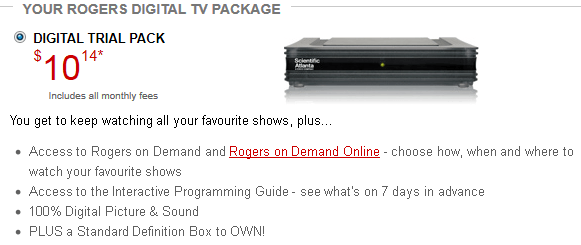
Rogers Cable: Rogers is marketing a special package called Rogers Digital TV which offers up to 85 channels for $10.14 a month, which includes all fees.  Many of the channels are included for the first year as a teaser.  After that, customers are left with mostly local stations and filler (including — we’re not kidding — the Aquarium Channel, which shows exactly what you think it does.  Remember, this is the same cable company that brought you the Swiss Chalet Rotisserie Channel.)

“It’s a fine way to get people used to paying for television, and Rogers introductory price is sure to increase at some point,” suspects Peter.  “Maybe you can save a few dollars using those Swiss Chalet meal coupons, though.”

Telus: Western Canada’s largest phone company doesn’t offer much, in comparison.  A basic package of Telus IPTV over your phone line — Optik TV — starts at $41 a month for the first six months.  Telus Satellite TV starts at $38.27 a month, for the first half of a year.  Prices run higher after that.  The most Telus will toss in is a $50 credit for a customer referral from a friend or family member.

Look on the bright side: When you pay for Rogers Cable, you can finally get to watch The Rotisserie Channel. The spinning chickens are waiting for you, in digital clarity, 24 hours a day on Ch. 208.

Bell: Another phone company with not a whole lot on offer.  Bell’s basic service, which includes TV stations from the U.S. and Canada, starts at $33.50 a month.

Videotron: Quebec’s largest cable company is pitching a combo mini-pack with basic service for $21.29 a month and a required extra channel package starting at $11.17 a month.  That’s around $33 a month.

Can you watch online?  The CRTC says you may find many of your favorite shows available online for free viewing, but includes the important caveat: most Canadian ISP’s engage in classic Internet Overcharging schemes that include a monthly usage allowance that will curtail substantial online viewing.  It should come as little surprise most of the providers in the pay television business in Canada also happen to be the largest Internet Service Providers as well.

About 93 percent of Canadians currently receive television from some form of pay television provider — cable, telco TV, or satellite, according to the CBC.  But some of the 7 percent who do not are at risk of losing Canada’s public broadcaster after the conversion.  While CBC owns most of the stations and transmitters it broadcasts from, it also affiliates with private stations in certain cities where it does have its own presence.

Come Sept. 1, no over-the-air CBC signals of any kind will be transmitted from London and Kitchener-Waterloo in Ontario; Sherbrooke, Chicoutimi, Quebec City and Trois-Rivières in Quebec; Saint John and Moncton in New Brunswick; Saskatoon, Sask., and Lethbridge, Alta.  These are all cities where private stations provided CBC service.  Viewers in these areas will need a pay television subscription, or simply go without.

For some of those already subscribing to cable, Sept. 1 also signals the end of some of their favorite stations, as CRTC requires cable providers to prioritize local stations over more distant ones.  In southeastern Ontario, for example, a number of viewers will lose access to CBLT, Toronto’s CBC station, and CFTO, Toronto’s CTV affiliate, in favor of “more local” stations in Kingston, Ottawa, and Peterborough.

Search This Site:

Contributions:

Recent Comments:

Your Account:

Stop the Cap!