Home » rural areas » Recent Articles:

AT&T Illinois President: “T-Mobile is Going To Go Away”

Phillip Dampier October 17, 2011 AT&T, Competition, Editorial & Site News, Public Policy & Gov't, Rural Broadband, T-Mobile, Wireless Broadband Comments Off on AT&T Illinois President: “T-Mobile is Going To Go Away”

La Schiazza

AT&T Illinois president Paul La Schiazza is in the business of predicting the future of other mobile phone companies.  In an interview with the Journal-Star, La Schiazza said AT&T should be permitted to complete its purchase of T-Mobile, because if they don’t, T-Mobile will never make the investment in 4G upgrades and “whether we buy them or not, (T-Mobile) is going to go away eventually.”

That’s ironic for Mr. La Schiazza to say, considering his employer made a decision not to make substantial investments in 4G upgrades itself, before suggesting it would with the purchase of T-Mobile.

La Schiazza admits AT&T has thrown its landline business under the bus, now considering it antiquated and irrelevant for a growing number of Americans.

“More people, especially young people, are cutting the cord,” he said, referring to customers who drop landline service completely. “We’ve changed our business model to be a mobile/broadband company,” said La Schiazza.

La Schiazza was also willing to call out AT&T itself when he noted wireless companies in Illinois, including his, have put rural areas at a “significant disadvantage.”  That’s because wireless companies ignore rural areas where providing coverage does not make economic sense.  Yet La Schiazza oddly claimed that with the absorption of T-Mobile, 97 percent of Illinois could get enhanced AT&T service.  He did not explain exactly what business formula was used to justify the enhanced proposed coverage maps he brought with him to the interview.

David Kolata, executive director of the Chicago-based Citizens Utility Board, provided the newspaper with a countering viewpoint — rare in newspaper stories featuring interviews with AT&T executives.  Kolata told the newspaper he was less thrilled about a possible T-Mobile-AT&T merger. “The cellphone industry is already pretty concentrated. When one of the biggest players buys another large company, it raises competitive concerns,” he said.

“The fact that the Department of Justice and five or six state attorney generals (including Lisa Madigan in Illinois) across the country oppose the merger as currently proposed is an indication that it could be bad for consumers,” said Kolata.

[Thanks to Stop the Cap! reader Bob for the news tip.]

Telephone Companies Bilking Consumers for Fatter Revenue Is as Simple as “ABC”

The primary backers of the ABC Plan

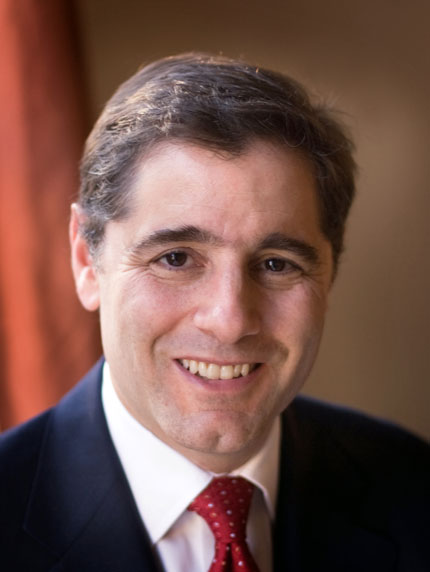
Today, Federal Communications Commission Chairman Julius Genachowski is scheduled to deliver a major announcement on reforming the Universal Service Fund (USF) — a federal program designed to subsidize the costs of delivering telecommunications services to rural America.

The reform, long overdue, would transition a significant percentage of USF fees every telephone customer pays towards broadband deployment — a noble endeavor.  For years, Americans have paid more than $5 billion annually to phone companies large and small to maintain rural landline service.  Small co-op phone companies depend on the income to deliver affordable service in places like rural Iowa, Kansas, and Alaska.  But large companies like AT&T and Verizon also collect a significant share (around $800 million annually) to reduce their costs of service in the rural communities they serve.

That’s particularly ironic for AT&T, which time and time again has sought the right to abandon universal rural landline service altogether.

Genachowski’s idea would divert USF funding towards broadband construction projects.  The argument goes that even low speed DSL requires a well-maintained landline network, so phone companies that want to deploy rural broadband will have to spend the money on necessary upgrades to provide just enough service to earn their USF subsidies.  The lower the speed, the lower the cost to upgrade networks and provide the service.  Some may choose wireless technology instead.  Since the telephone companies have fought long and hard to define “broadband” as anything approaching 3-4Mbps, that will likely be the kind of speed rural Americans will receive.

At first glance, USF reform seems like a good idea, but as with everything at the FCC these days, the devil is always in the details.

Dampier: Another day, another self-serving plan from the phone companies that will cost you more.

While headline skimmers are likely to walk away with the idea that the FCC is doing something good for rural broadband, in fact, the Commission may simply end up rubber stamping an industry-written and supported plan that will substantially raise phone bills and divert your money into projects and services the industry was planning to sell you anyway.

Stop the Cap! wrote about the ABC Plan a few weeks ago when we discovered almost all of the support for the phone-company-written proposal comes from the phone companies who back it, as well as various third party organizations that receive substantial financial support from those companies.  It’s a dollar-a-holler astroturf movement in the making, and if the ABC Plan is enacted, you will pay for it.

[Read Universal Service Reform Proposal from Big Telcos Would Rocket Phone Bills Higher and Astroturf and Industry-Backed, Dollar-a-Holler Friends Support Telco’s USF Reform Plan.]

Here is what you probably won’t hear at today’s event.

At the core of the ABC Plan is a proposal to slash the per-minute rates rural phone companies can charge big city phone companies like AT&T and Verizon to connect calls to rural areas.  You win a gold star if you correctly guessed this proposal originated with AT&T and Verizon, who together will save literally billions in call connection costs under their plan.

With a proposal like this, you would assume most rural phone companies are howling in protest.  It turns out some are, especially some of the smallest, family-run and co-op based providers.  But a bunch of phone companies that consider rural America their target area — Frontier, CenturyLink, FairPoint and Windstream, are all on board with AT&T and Verizon.  Why?

Because these phone companies have a way to cover that lost revenue — by jacking up your phone bill’s USF surcharge to as much as $11 a month per line to make up the difference.  In the first year of implementation, your rates could increase up to $4.50 per line (and that fee also extends to cell phones).  Critics have been widely publicizing the increased phone bills guaranteed under the ABC Plan.  In response, advocates for the industry are rushing out the results of a new study released yesterday from the Phoenix Center Chief Economist Dr. George S. Ford that claims the exact opposite.  Dr. Ford claims each customer could pay approximately $14 less per year in access charges if the industry’s ABC Plan is fully implemented.

Genachowski

Who is right?  State regulators suggest rate increases, not decreases, will result.  The “Phoenix Center,” unsurprisingly, has not disclosed who paid for the study, but there is a long record of a close working relationship between that research group and both AT&T and Verizon.

But it gets even worse.

This shell game allows your local phone company to raise rates and blame it on the government, despite the fact those companies will directly benefit from that revenue in many cases.  It’s a real win-win for AT&T and Verizon, who watch their costs plummet while also sticking you with a higher phone bill.

The USF program was designed to provide for the neediest rural phone companies, but under the new industry-written rules being considered by the FCC, just about everyone can get a piece, as long as “everyone” is defined as “the phone company.”  There is a reason this plan does not win the hearts and minds of the cable industry, independent Wireless ISPs, municipalities, or other competing upstarts.  As written, the USF reform plan guarantees virtually all of the financial support stays in the Bell family.  Under the arcane rules of participation, only telephone companies are a natural fit to receive USF money.

Genachowski will likely suggest this plan will provide for rural broadband in areas where it is unavailable today.  He just won’t say what kind of broadband rural America will get.  He can’t, because the industry wrote their own rules in their plan to keep accountability and oversight as far away as possible.

For example, let’s assume you are a frustrated customer of Frontier Communications in West Virginia who lives three blocks away from the nearest neighbor who pays $50 a month for 3Mbps DSL broadband.  You can’t buy the service at any price because Frontier doesn’t offer it.  You have called them a dozen times and they keep promising it’s on the way, but they cannot say when.  You may have even seen them running new cable in the neighborhood.

Frontier has made it clear they intend to wire a significantly greater percentage of the Mountain State than Verizon ever did when it ran things.  Let’s take them at their word for this example.
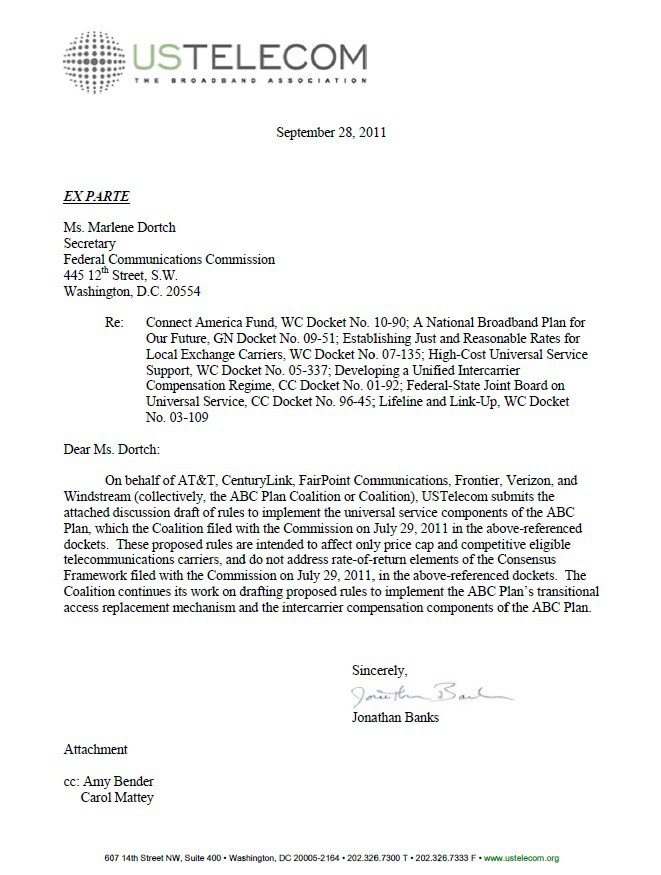
The telephone companies have helpfully written their own rules for the FCC to adopt.

Frontier’s decision to provide broadband service in West Virginia does not come out of the goodness of their heart.  At a time when landline customers are increasingly disconnecting service, Frontier’s long-term business plan is to keep customers connected by selling packages of phone, broadband, and satellite TV in rural markets.  Investment in DSL broadband deployment has been underway with or without the assistance of the Universal Service Fund because it makes financial sense.  Our customer in West Virginia might disconnect his landline and use a cell phone instead, costing Frontier any potential broadband, TV and telephone service revenue.

Under the ABC Plan, Frontier can be subsidized by ratepayers nationwide to deliver the service they were planning to provide anyway.  And what kind of service?  The same 3Mbps DSL the neighbors have.

If your county government, a cable operator, or wireless competitor decided they could deliver 10-20Mbps broadband for the same $50 a month, could they receive the USF subsidy to build a better network instead?  Under the phone company plan, the answer would be almost certainly no.

Simon Fitch, the consumer advocate of the Federal-State Joint Board on Universal Service, which advises the FCC on universal service matters, says the ABC Plan is a consumer disaster.

“Although a stated goal of the FCC’s reform effort is to refocus universal-service funding to support broadband, the industry’s ABC plan requires no real commitment to make broadband available to unserved and underserved communities,” Fitch writes. “Companies would receive funds to provide broadband with upload and download speeds that are already obsolete. States would be given no real enforcement power.”

Fitch is certain companies like AT&T and Verizon will receive enormous ratepayer-financed subsidies they don’t actually need to provide service.

Back to AT&T.

In several states, AT&T is seeking the right to terminate its universal service obligation altogether, which would allow the same company fiercely backing the ABC Plan to entirely walk away from its landline network.  Why?  Because AT&T sees its future profits in wireless.  Under the ABC Plan, AT&T could build rural cell towers with your money to provide “replacement service” over a wireless network with or without great coverage, and with a 2GB usage cap.

At the press conference, Genachowski could still declare victory because rural America would, in fact, get broadband.  Somehow, the parts about who is actually paying for it, the fact it comes with no speed, coverage, or quality guarantees, and starts with a 2GB usage cap on the wireless side will all be left out.

Fortunately, not everyone is as enamored with the ABC Plan as the groups cashing checks written by AT&T.

In addition to state regulators, Consumers Union, the AARP, Free Press, and the National Association of Consumer Advocates are all opposed to the plan, which delivers all of the benefits to giant phone companies while sticking you with the bill.

There is a better way.  State regulators and consumer groups have their own plans which accomplish the same noble goal of delivering subsidies to broadband providers of all kinds without increasing your telephone bill.  It’s up to the FCC to demonstrate it’s not simply a rubber stamp for the schemes being pushed by AT&T and Verizon.


Alcatel-Lucent Announces VDSL2 Vectoring: 100Mbps on Copper Phone Lines

Phillip Dampier October 3, 2011 Broadband Speed, Competition, Consumer News, Public Policy & Gov't, Rural Broadband, Video Comments Off on Alcatel-Lucent Announces VDSL2 Vectoring: 100Mbps on Copper Phone Lines

While most rural telephone companies are selling customers 1-3Mbps copper-delivered DSL service, Alcatel Lucent has announced the commercial availability of VDSL 2 Vectoring, a new way of delivering up to 100Mbps over the copper wire telephone network most rural North Americans still depend on for telecommunications service.

VDSL2 combines a fiber-copper hybrid network similar to Bell’s Fibe or AT&T’s U-verse, with interference-cancelling technology called “vectoring” to deliver speeds much closer to the 100Mbps theoretical limit of current DSL technology.

“Alcatel-Lucent’s plan to make VDSL2 vectoring commercially available is very timely,” said Rob Gallagher, Principal Analyst, Head of Broadband & TV Research, Informa.  “VDSL2 Vectoring promises to bring speeds of 100Mbps and beyond to advanced copper/fiber hybrid networks and make super fast broadband speeds available to many more people, much faster than many in the industry had thought possible.”

A new way to boost copper speeds even faster.

Different flavors of DSL are currently in use around North America and beyond.  The most basic form, ADSL, also happens to be the most commonplace among phone companies offering basic broadband service.  For customers up to 12,000 feet away from a phone company central office, DSL delivers speeds usually at 1Mbps or faster.  Customers enjoying the fastest speeds must live much closer to the phone company facilities.  The further away you live, the slower your broadband speed.  In rural areas, consumers can live further away than the maximum distance of the central office, which means no DSL service for those subscribers.

A combination of signal loss and interference, called “crosstalk,” from adjacent copper wire pairs are both the enemies of DSL broadband, because they can drastically reduce speeds.

Telephone companies can address this problem by building new satellite central offices located halfway between customers and their primary facilities.  These offices, usually connected by fiber, can successfully reduce the amount of copper wire between the customer and the company, boosting speeds.  Many phone companies also deploy DSL extensions called D-SLAMs, which can be attached to a phone pole or enclosed in a metal box by the roadside.  A fiber cable connects the D-SLAM back to the phone company, while existing copper phone wires go back to individual subscribers.

More modern forms of DSL: ADSL2, ADSL2+, and VDSL, share some of those concepts.  The key is cutting as much copper wire out of the network as possible, replacing it with fiber optic cable which does not suffer signal loss or interference in the same way.

Many European and Pacific broadband networks rely on ADSL2/2+, which can usually deliver reliable speeds in the 20Mbps range.  VDSL networks offer even more bandwidth, and are the basis of U-verse and Fibe, which split up broadband, phone service, and television on the same cable.  When customers demand even faster speeds, phone companies can “bond” several individual DSL connections together to deliver faster speeds.  Some traditional ADSL providers do that today for their customers, especially in areas where low speeds prevail.

An argument the phone company will love.

Alcatel Lucent says VDSL2 with Vectoring is the next best thing to fiber to the home, because it is cheaper to deploy with fewer headaches from local authorities when streets and yards are dug up for fiber cable replacements.  It also meets the growing speed needs of average consumers.  Alcatel Lucent predicts the minimum speed North Americans will need to support the next generation of online video is 50Mbps, more than 10 times the speed phone companies like Verizon, AT&T, Frontier, and CenturyLink provide over their traditional DSL networks, especially in rural and suburban areas.

Vectoring can deliver results for phone companies with aging copper wire infrastructure, more prone to crosstalk and other signal anomalies.  Alcatel Lucent compares vectoring with noise-cancellation headphones.  By sampling the current noise conditions on copper cable networks, vectoring can suppress the impact of the interference, boosting speeds and delivering more reliable results.

With technologies like VDSL2 with Vectoring promising speeds far faster than what rural North Americans currently enjoy, the Federal Communications Commission may want to re-evaluate its national minimum speed standard for broadband — 3-4Mbps — found in its National Broadband Plan.  Alcatel Lucent promises they can do much better.

[flv width=”640″ height=”324″]http://www.phillipdampier.com/video/Alcatel Lucent VDSL2.flv[/flv]

Alcatel Lucent produced this video to promote its new VDSL2 with Vectoring technology.  The video targets cost-conscious phone companies who are being pressured to deliver faster service, but don’t want to spend the money on a fiber to the home network.  (6 minutes)

AT&T Starts Warning Customers They Used “Too Much” Internet, Will Slow Their Speeds

Courtesy 9 to 5 Mac

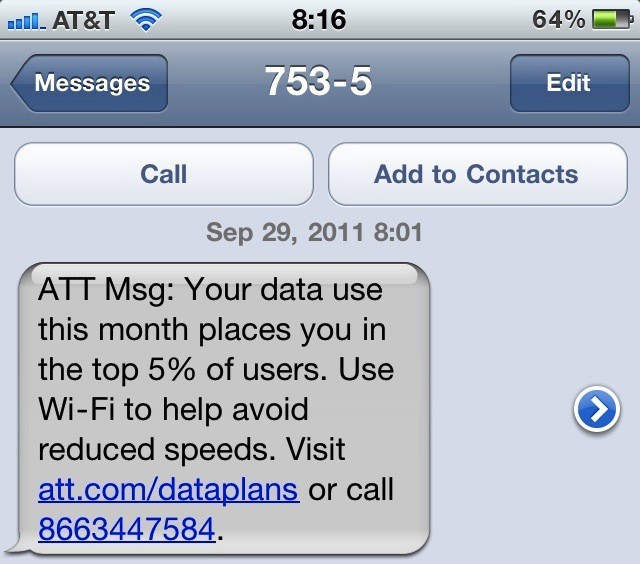
AT&T has begun sending out warnings to wireless customers deemed to be using too much of their “unlimited data plans” and are now subject to speed throttling that will reduce their wireless Internet experience to one more familiar for dial-up users.

Life in the slow lane is the price AT&T customers pay for being a member of the Top 5% Data User Club.  Running the numbers, that means using more than around 4GB of wireless usage per month.  One customer who managed to rack up 11GB in September, even before the new speed throttle plan took effect Oct. 1, has already found himself in the speed reduction doghouse with a warning message he received Sept. 29.

Although the customer did not reveal what he was doing to achieve 11GB of usage in one month, the two most common ways to run up usage are watching a lot of streamed video or using your phone to tether to other wireless devices, especially laptops.  Some wireless customers are attempting to use their unlimited data plans as a home broadband replacement, especially in rural areas where cable or DSL service is not available.  That’s an option AT&T doesn’t seem to want customers to consider.

In addition to eliminating unlimited use plans for new customers more than a year ago, the company has increasingly cracked down on existing customers grandfathered into unlimited use plans.  In addition to banning third party tethering apps, AT&T is now simply reducing speeds for heavy users to make high bandwidth applications like video and even some forms of streaming audio impossible when residing in the penalty box.

But don’t worry: you can still use your data plan to read e-mail or browse simple web pages.  The company also advises customers can use unlimited amounts of Wi-Fi, whether they provide it or not.


Shamrock, Okla.: Bankrupt City, Abandoned Police Cars, Padlocked Doors, But Internet Service Prevails

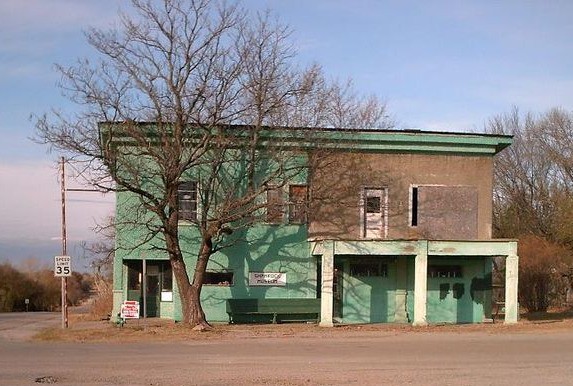
Shamrock Museum

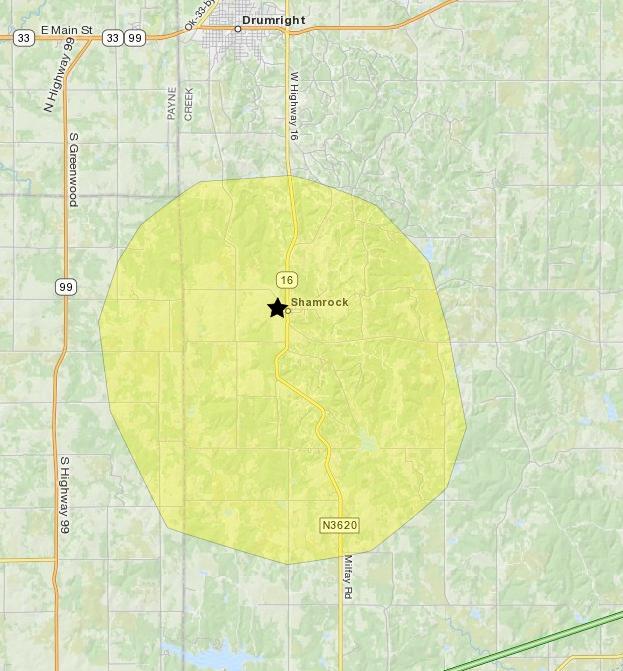
The city of Shamrock, Okla. may not be a city for much longer, facing unincorporation and liquidation of its remaining assets, which include the abandoned police cars that used to earn the city enough ticket revenue to keep the doors open.  But fast (and free at the local community center) Internet prevails (with competition, too) in a city with fewer than 100 remaining citizens.  It’s all thanks to a federal broadband grant and an existing Wireless ISP.

Shamrock’s unlucky predicament comes at the expense of the boom-and-bust oil business that launched dozens of small towns in rural Oklahoma, only to leave them largely abandoned when the oil dried up, or the cost to access it becomes too prohibitive.  Once a community numbering 10,000, Shamrock, located nearly halfway between Oklahoma City and Tulsa, had recently been surviving on revenue earned from writing traffic tickets in infamous speed traps set up along Highway 16.  Shamrock, along with Big Cabin, Caney, Moffett, and Stringtown, became so notorious for their dependence on traffic ticket revenue to keep the towns afloat, at one point the state government publicly designated them “speed trap towns” and banned them from writing tickets on state and federal highways. When Creek County officials learned the city was using non-commissioned officers to write tickets, they shut down the whole operation.

Soon after, residents found the city hall padlocked, with coffee cups still on the desks and police evidence lockers still stuffed with property from active criminal cases (although seized marijuana and beer has since disappeared.)

In fact, the only service now in operation at the city hall, now converted into a “community center,” is Internet access on 10 computers made possible by @Link Services LLC, an Oklahoma City-based Wireless Internet Service Provider (WISP) that provides service in rural areas, with the help of a broadband grant from the U.S. Dept. of Agriculture.

The broadband grant, amounting to $536,000, with matching funds of $134,000 kicked in by @Link, covers the costs of running the community center for two years and extending wireless access with the construction of a new wireless radio tower in Stillwater, which allows the company to reach Shamrock residents.

In addition to providing free access at the former city hall, @Link also sells Internet access to area residents (the only remaining business in town is a diner):

@Home Standard  512 Kbps download  512 Kbps upload $34.95
@Home Advanced  1.5 Mbps  up to 1.5 Mbps $39.95
@Home Premium  3.0 Mbps  up to 1.5 Mbps $46.95
@Home Premium Plus  5.0 Mbps  up to 3.0 Mbps $59.95
@Home Max  6.0 Mbps  up to 6.0 Mbps $74.95

“This is going to be the last place anyone would provide Internet without government funding because there is no chance of turning a profit,” Kerry Conn, chief financial officer of @Link Services told The Oklahoman. “But if you don’t have Internet services, your town is going to die.”

@Link CEO Samual Curtis says their wireless Internet access sells itself.

“Broadband is a very easy sell where there is no broadband,” Curtis told the newspaper.

The only problem with that is Shamrock currently does receive service from another Wireless ISP — OnALot, a service of HDR Internet Services, Inc.  OnALot operates from 70 systems in more than 25 cities and communities across rural Oklahoma.  @Link’s arrival in town, with the assistance of a federal broadband grant, came as a surprise to some Shamrock residents who already had Internet service from OnALot.  Now those customers have two choices — both wireless — for Internet service.  OnALot, the incumbent, is often cheaper, too:

PLAN 12 Month
Contract
Credit or
Debit Card
Monthly Fee For Service
A No Contract No $42.00
B No Contract Yes $37.00
D Yes Yes $33.00

OnALot does not sell traditional speed tiers.  Instead customers share access points rated at speeds of 11 and 54Mbps.  Customers do not actually see anything close to those speeds, because they are theoretical maximums and each access point is shared by several users.  But since many residential customers do not have a firm understanding of what different speed levels represent, it has proven workable for HDR Internet to sell services based on price, not speed.

OnALot does sell dedicated, private wireless circuits to customers who don’t want to share, but they are comparatively expensive:

Speed Equipment Monthly Fee
3.0 / 512 $400.00-$600.00 $200.00
6.0 / 768 $400.00-$600.00 $350.00

OnALot.com operates both standard Line-of-Sight and Near-Line-of-Sight systems on the 80' tall water tower on the west side of Shamrock.

One Oklahoman reader, Bobbi, wondered why @Link received federal grant money to provide Internet service in a community that already had access.

“Why this company didn’t do their homework before they used government money to provide a service to a town that had that service,” Bobbi asked. “Wouldn’t that be a misuse of the grant money?”

Broadband grant funding has come under criticism at times for funding projects that incumbent providers accuse of duplicating services.  A study funded by the National Cable & Telecommunications Association, the cable industry’s top lobbyist, found several instances of grants that would deliver broadband service to areas already served by other providers.

“While it may be too early for a comprehensive assessment of the [government]’s broadband programs, it is not too early to conclude that, at least in some cases, millions of dollars in grants and loans have been made in areas where a significant majority of households already have broadband coverage, and the costs per incremental home passed are therefore far higher than existing evidence suggests should be necessary,” the study says.

Thus far, much of the funding for rural Oklahoma seems to be directed towards wireless Internet access projects, which typically serve sparsely populated areas cable and phone companies have traditionally ignored.

The NCTA’s criticism, in particular, was directed against its would-be competitors.  The lobbying group suggests the price of competition was too high.

Based on the cost of the direct grants and subsidizing the loans, the NCTA study estimated that the cost per incremental home passed would be $30,104 if existing coverage by mobile broadband providers was ignored, and $349,234 if mobile broadband coverage was taken into account.

Wireless ISP operators have told Stop the Cap! many of their projects are self-financed and do not receive government assistance.  Some WISP operators have accused the government of making broadband grants to wireless operators a cumbersome, if not impossible prospect because incumbent telephone companies are often most likely to meet the government’s grant criteria.

For Shamrock residents, one piece of good news: @Link Services and OnALot both have no Internet Overcharging schemes like usage caps.  However, OnALot prohibits the use of peer-to-peer software (torrents) and @Link Services maintains the right to curtail speeds for those who create problems for other users on their shared wireless network.

OnALot’s usage policies are among the most frank (and common sense) we’ve seen, because they are up front with customers about the impact certain traffic can have on their wireless network:

  1. You are paying us to download from the Internet. We do not limit you on that. You can download anything you want 24/7. Games, email, web pages, radio stations, and so on – we don’t care, downloading is what you are paying us for. That said, we would prefer that you do not leave an active game un-attended, or run a radio station continuously, as these eat up bandwidth that others could be using. When you’re done with your game, please turn it off.
  2. We do have restrictions when it comes to uploading TO the Internet. P2P or Peer-to-Peer programs are NOT allowed. These limitations apply primarily to file sharing programs. We do NOT allow music or video sharing programs, bit torrent programs or other programs where outside users can extract files from your computer with or without your express consent. And seriously, do you actually WANT others to have full access to your computer? That’s what you’re giving to file sharing programs! Please call us if you are unsure if the program you are using is a file sharing program.
  3. Yes, you can upload to your favorite website, send big emails, and transfer any size files that are under your control. That’s OK with us – these are intermittent in nature and under your full control. It’s the unattended uploading that sharing programs do that we do not allow.
  4. If your computer has a virus and is “spewing” out onto the Internet, we expect you to have it cleaned. Causing others to become infected is wrong, and we may take steps to disable your Internet connection. We will call you first, explain what is going on and ask that you have your machine cleaned. If you decide not to do this, we will then cut you off until you do.

Search This Site:

Contributions:

Recent Comments:

Your Account:

Stop the Cap!