Home » rural areas » Recent Articles:

71% of British Public Willing to Pay More for Superfast Broadband… If They Could Get It

Phillip Dampier March 13, 2012 Broadband Speed, Rural Broadband 1 Comment

While some Internet Service Providers claim their broadband customers don’t need faster speeds, that is not what customers are telling surveyors.  A new British survey of over 800 Internet users found 71% would happily pay extra for a “superfast broadband connection” at speeds of 25Mbps or higher if only they could get it.

Over half of the respondents (55%) reported they could not get fast speeds even if they wanted them.

The survey, conducted by ISPreview, found price was only a barrier for around 16% of customers and only 6.2% of respondents claimed they were satisfied with the speeds they received from their current provider.

Prices in Britain for broadband are historically lower than what North Americans pay, averaging around $27 per month, according to UK regulator Ofcom.  Customers were willing to pay at least $8 more per month if they could get the speeds they crave.

“Ofcom’s own data appears to suggest that the UK is one of the lowest priced countries in the world for broadband,” said ISPreview.co.uk’s Founder, Mark Jackson. “As a result it’s quite encouraging that so many people, most of which will be use to paying very little for their current service, would still be willing to pay more for the next generation of superfast connectivity.”

Jackson reports the highest demand for the fastest speeds actually comes from rural areas in the United Kingdom — areas long deprived of suitable broadband.  Jackson says most operators are focused on upgrading urban areas which already receive better service than rural communities.

The government has plans in place to reach 90% of the country with superfast broadband by 2015.

Telco’s Ethernet Over Copper Can Deliver Faster Speeds, If You Can Afford It

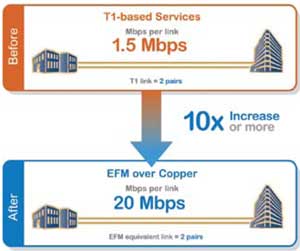
Ethernet over Copper is becoming an increasingly popular choice for business customers stuck in areas where companies won’t deploy fiber broadband (Graphic: OSP Magazine)

With Verizon and AT&T effectively stalling expansion of their respective “next generation” fiber and hybrid fiber/coax networks, and independent phone companies fearing too much capital spent improving their networks will drive their stock prices down, telephone companies are desperately seeking better options to deliver the faster broadband service customers demand.

The options over a copper-based landline network are not the best:

  • ADSL has been around for more than a decade and is highly distant dependent. Get beyond 10,000 feet from the nearest switching office and your speeds may not even qualify as “broadband;”
  • DSL variants represent the second generation for copper-broadband and can deliver faster speeds, but usually require investment to reduce the amount of copper between the customer and the switching office;
  • Fiber networks are more expensive to build, and some companies are using it to reduce, but not eliminate copper wire in their networks. But companies traditionally avoid this solution in rural/suburban areas because the cost/benefit analysis doesn’t work for shareholders;
  • Ethernet Over Copper (EoC) is increasingly the solution of choice for independent phone companies because it is less expensive to deploy than fiber and can quickly deliver service at a cat 5e speed of up to 50Mbps.

Unfortunately for consumers, EoC is typically way above the price range for home broadband.  Most providers sell the faster service to commercial and institutional customers, either for businesses that have outgrown T1 lines or where deploying fiber does not make economic sense.  Some companies have tried to improve on DSL by bonding multiple connections together to achieve faster speeds, but Ethernet is quickly becoming a more important tool in the broadband marketing arsenal.

With phone companies pricing EoC service from several hundred to several thousand dollars a month, depending on the speed of the connection, they hope to remain competitive players against a push by the cable industry to more aggressively target business customers.  In more rural areas, phone companies lack cable competition, so they stand a better chance of success.

Fierce Telecom‘s Sean Buckley published an excellent series of articles outlining the current state of EoC technology and what phone companies are doing with it:

  • AT&T: Inherited EoC from its acquisition of BellSouth, and barely markets it. Instead, AT&T uses it as a quiet solution for challenging customers who cannot affordably be reached by fiber.  AT&T will either deliver the service over copper, copper/fiber, or an all-fiber path depending on the client’s needs.
  • CenturyLink: No phone company is as aggressive about EoC as CenturyLink. When CenturyLink acquired Qwest, interest in the technology only intensified. EoC is a CenturyLink favorite for small businesses that simply cannot get the speeds they need from traditional DSL.  Most EoC service runs up to 20Mbps.
  • Verizon: Verizon’s network is the most fiber-intense among large commercial providers, so EoC is not the first choice for the company. However, it does use it to reach multi-site businesses who have buildings and offices outside of the footprint of Verizon’s fiber network/service area.
  • Frontier: In the regions where Frontier acquired Verizon landlines, EoC has become an important component for Frontier’s backhaul traffic. EoC has been deployed to reach cell tower sites and handles broadband traffic between central office exchanges and remote D-SLAMs, used to let the company sell DSL to a more rural customer base.  Frontier looks to EoC before considering spending money on fiber service, even for commercial and institutional users.
  • Windstream: EoC is the way this phone company gets better broadband speeds to business customers without spending a lot of money on fiber. Small and medium-sized customers are often buyers of EoC service, especially when DSL can’t handle the job or the company requires faster upstream speeds.  Windstream markets upgradable EoC capable of delivering the same downstream and upstream speeds and can deliver it more quickly than a fiber project.
  • FairPoint: Much of this phone company’s EoC efforts are in territories in northern New England acquired from Verizon.  FairPoint targets small and medium sized companies for the service, especially those who have remote offices or clinics that need to be interconnected. FairPoint has also gotten more aggressive than many other companies working with ADSL2+ or VDSL2 to deliver faster broadband to office buildings and complexes more economically than fiber.
  • SureWest: This company is strong believer in fiber to the premises service, so its interest in EoC has been limited to areas where deploying fiber makes little economic sense. In more out-of-the-way places, EoC is becoming a more common choice to pitch businesses who need more than traditional broadband.
  • Hawaiian Telcom: HawTel uses copper-based EoC to provide connectivity across the diverse Hawaiian Islands.  Speeds are generally lower than in mainland areas, partly because HawTel still relies heavily on traditional copper-based service. But fiber-based EoC is increasingly available in more densely populated areas.

Want to Lure New Digital Economy Businesses to Your Community? You Need 100Mbps Broadband

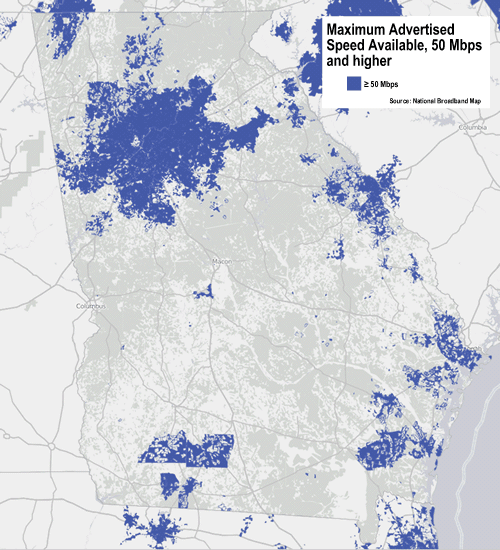
Georgia's broadband map shows just a smattering of 50Mbps broadband. That is half the speed required to attract new businesses, says the IEDC.

Suffering the Great Recession blues?  As communities continue to face the loss of manufacturing, heavy industry, and textile jobs to overseas outsourcing, local economic development specialists have discovered one of the most effective ways to lure new high-tech industry into areas hard-hit with job losses is the availability of cheap, plentiful, and fast broadband.

A survey of economic development officials from around the nation, sponsored by the  International Economic Development Council, showed 77% believe 100Mbps is the minimum speed needed to attract new businesses.  Almost half think even that is no longer fast enough:
  • 42% believe that that 1Gbps is the minimum speed needed to lure new businesses.
  • 35% believe the minimum must be at least 100Mbps.
  • Rural economic developers appear to be well ahead their urban counterparts in the area of planning. 58% of rural respondents either have broadband strategies and tactics worked into their economic development plans or are writing plans with these elements. Only 39% of urban respondents have done the same.
  • 92% see no benefit from the FCC’s minimum broadband standard of 4Mbps, defined largely to suit telephone company DSL service common in rural areas.

Why are rural economies benefiting from better broadband planning? Because in the absence of commercial providers willing to provide the service, an increasing number of small towns and cities are building their own municipal networks to get the job done themselves.  Those networks are routinely superior to the facilities provided by most cable and phone companies serving less populated areas.

Community broadband is working in Wilson and Salisbury, N.C., where a transition from a textile/tobacco-based economy into higher-tech knowledge economy jobs required state-of-the-art broadband as a foundation.  Chattanooga, Tenn.-based EPB Fiber has already attracted dot.com giants like Amazon.com, creating hundreds of millions in local investment and thousands of new jobs.  Why Chattanooga?  Gigabit broadband for just a few hundred dollars a month is just one phone call away.

Relying on commercial providers to build 21st century broadband as a platform for economic transformation has delivered uneven results, especially outside of the largest cities. Large cities traditionally get most of the provider’s time, attention, and upgrades.  Smaller, more out of the way places often see little or nothing.

That is why this year’s latest push in Georgia and South Carolina to tie the hands of communities trying to remake themselves with modern broadband is so risky. While AT&T and the cable companies may position their argument as “protecting consumers,” in fact they are only protecting their own interests, even if it means the next Amazon.com distribution facility or Google data center finds a better home somewhere else.

Updated 3:55pm ET: We added a link to the full report, with appreciation to the author.

Broadband Backwater Watch: Georgia Anti-Broadband Bill Defines Broadband: 200kbps

Sen. Chip Rogers' vision of rural Georgia's broadband future

Sen. Chip Rogers (R-Woodstock) thinks he knows broadband.  He, along with several other Georgia legislators well-compensated by some of the state’s largest telecom interests, have defined appropriate Internet speeds at a remarkably low “200 kilobits per second,” less than four times faster than your old AOL dial-up Internet account.  The one you canceled in 1998.

With a background like that, it was no surprise last Thursday when technology leaders and city representatives from across Georgia testified before the Senate Regulated Industries & Utilities Committee, strongly objecting to Rogers’ SB 313, a bill bought and paid for by the very companies the legislation would effectively protect from competition.

Rogers argues he wants to “level the playing field” between private providers that currently dominate broadband service in Georgia, and the long-suffering communities in rural areas that have waited for faster Internet since the Clinton Administration.

City officials from Dalton, Newnan, Elberton, Thomasville, Cartersville, LaGrange, Hogansville and Monroe collectively noted the proposed legislation hardly represents a level playing field when it fully exempts the bill’s backers from any of its provisions.  Thomasville mayor Max Beverly noted the same cable and phone companies that fiercely fought for statewide cable franchises for themselves now want to impose rules that forbid publicly-run companies from operating outside of their respective city limits.

“We would have to turn off service to the county’s two largest employers,” Thomasville Mayor Max Beverly told the Senate panel. “There is no telling what that would do to jobs in our area.”

Those testifying uniformly noted they entered the broadband business because private providers refused to deliver adequate service in their areas.

What community broadband provides communities the big phone and cable companies don't.

“We started our cable system not on a whim but on a demand from our citizens to provide a higher level of service for cable TV and Internet,” said Newnan Mayor Keith Brady. “We got into the cable business originally to provide fiber optics and broadband because Charter Communications would simply not invest in our community.”

Now cable and phone companies across Georgia are supporting legislation that would make that community service next to impossible to provide.

“The most ironic part of legislation like SB 313 is that cable and phone companies only take an interest in rural broadband when they ghostwrite bills like this to stop other people from providing the service themselves,” said Stop the Cap! reader Max Curr. “When I lived in Hiltonia, some of these same companies laughed at me when I asked about broadband. It simply was not profitable, they were not going to provide it, and with this bill, they will make sure it stays that way.”

But the cost to consumers extends way beyond the most rural corners of the state. SB 313 also hurts existing cable and phone customers who pay higher rates because of the lack of competition.  That assures the kind of anemic broadband Rogers and his friends in the cable and phone industries are only too happy to define as 200kbps.  At least that is 10kbps more than a similar bill being pushed by telephone and cable operators in South Carolina.

Brady says their community-owned system not only provides broadband where Charter would not, the cable company also was forced to reduce their rates for consumers in nearby communities, saving taxpayers across the entire city and county millions.

In Elberton, the lack of broadband was so pervasive the 4,700 local residents demanded the city provide the service themselves. Commercial providers had stonewalled the county seat of Elbert County for years until the city broke ground on a broadband project in 2001.
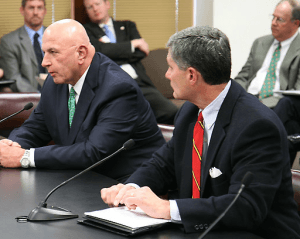
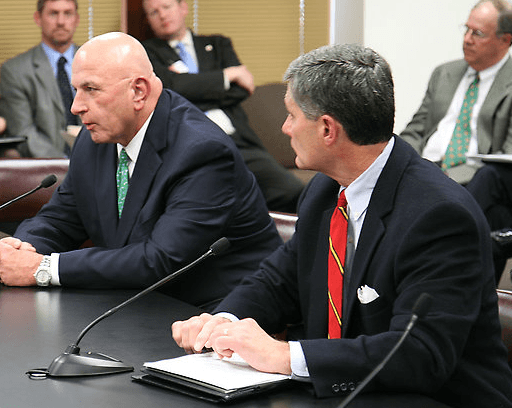
Dalton Utilities' CEO Don Cope (left), Newnan mayor Keith Brady (right) (Photo: Georgia Municipal Assn.)

Elberton City Manager Lanier Dunn complained SB 313 undercuts the rational definition of minimum Internet speeds to levels most Americans would not even consider “broadband.”  Dunn noted that the 2010 National Broadband Plan calls for download speeds 250 times greater, and by 2020 500 times greater, than what Rogers’ bill currently defines as broadband service.

“We should be reaching for higher and faster speeds, not relegating ourselves to barely just above dial-up,” Dunn said.

Don Cope, president and CEO of Dalton Utilities, demonstrated that municipal broadband systems are not the financial risk large telecommunications companies always claim they represent.  In fact, Dalton’s system has never received a penny of tax revenue and its accounting is open to public scrutiny to prove it.

Cope noted SB 313 imposes restrictions on community providers, but completely exempts those owned by the companies pushing the bill.

“I would ask that you look at the private providers in the state,” Cope said. “Look at their reports, and you would see how many dollars that are provided to them from the federal government. We are talking about in the billions of dollars. All the [private telecommunications entities] that I know about have some form of government support.”

Dalton isn’t the only city in Georgia with a successful community-owned operation.

The city of Newnan found their system such a valuable asset, they sold it at a profit to a private company in 2008 and used the proceeds to pay off its remaining construction costs.


Big Telecom to Georgia: Your Improved Community Broadband Bothers Us

Phillip "Rural Georgia Isn't On AT&T's Mind" Dampier

Columbia County, Georgia has been talking about fiber optic broadband for two years — two years that the state’s largest phone and cable companies have not stepped up to provide suitable broadband to local schools, residents, and libraries.  In 2010, enough was enough and the county applied for, and won, a $13.5 million Broadband Technology Opportunity Program grant to increase broadband and wireless access to the Internet throughout the area.  Local taxpayers chipped in about $4.5 million in 1-percent sales tax dollars, and in-kind voluntary donations worth $2.3 million fulfilled the grant requirement that local matching funds be provided.

To residents long-suffering with satellite-delivered Internet, usage-capped mobile broadband, spotty DSL service, and frequent outages and slow speeds, a modern fiber network would help 120,000 county residents obtain the kind of broadband service people elsewhere take for granted.  Columbia County’s rural character is evident when you consider it contains only two small incorporated cities and 91 percent of the population lives in unincorporated areas, making the eastern Georgia county an afterthought for big phone and cable companies who see better profits in bigger cities.

Now these companies, with the help of a campaign contribution-gorging state legislator, are intent on stopping projects even in areas they could care less about.

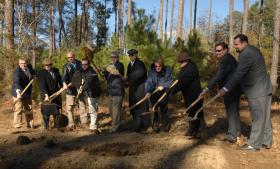
The News-Times captured this image from the groundbreaking ceremony for Columbia County's new fiber network in 2010. Big phone and cable companies would like them to run this picture again at the project's burial.

Columbia County’s local newspaper, the News-Times, is alarmed at the prospect of public tax dollars already spent on the project burned for the benefit of Big Telecom companies:

Republican State Sen. Chip Rogers, fueled by generous contributions from telecommunications companies, has filed a bill in the Georgia Legislature that, he claims, would protect private service providers from unfair competition by government-subsidized broadband systems.

Nonsensically, some in Columbia County welcomed the news as a slap at the county’s government. While we’re on record opposing the concept of the $13.5 million federal grant that allows the county’s entry into broadband, the fact remains that the project already is underway.

That federal program is designed to expand broadband Internet service to rural areas that, because of the up-front infrastructure costs, aren’t deemed profitable by private companies. Our county has plenty of those areas, served at best only by spotty, expensive cellular-based services.

Columbia County’s program wouldn’t compete with private companies. Instead, it uses the federal grant and local sale-tax funding to build that high-speed infrastructure, which private companies can then lease to provide Internet service to underserved areas.

Rather than undercutting local communities and sacrificing rural customers on behalf of the private companies, Rogers ought to look for ways to improve such public-private partnerships. Columbia County taxpayers had better hope so, too, unless they want all the money they’ve spent wiring the county with fiber optic cables to have been wasted.

SB. 313 is just another contract taken out on community-owned broadband networks that could deliver competition (and worse — far better service) to areas of Georgia where even conservative-minded voters wary of spending public money on anything are simply fed up with the status quo.

Columbia County, Georgia

So much for the Columbia County Broadband Network, a 220-mile, county-wide fiber middle mile network that will connect nearly 150 community anchor institutions and enhance health care, public safety, and government services throughout the county. Anchor institutions hoping to be connected at broadband speeds of 100 Mbps to 10 Gbps include K-12 schools, fire and emergency facilities, public libraries, Augusta Technical College, and the Columbia County Health Department. The project also planned to facilitate the creation of a high-capacity data center at the Medical College of Georgia, support a sophisticated county-wide traffic and water control system, and construct five wireless towers to enhance public safety communications as well as improve wireless communications capabilities throughout the region.

If Rogers’ bill passes, the county may have to go back to begging for access from the companies that have repeatedly said it wasn’t worth the investment or their time.

County officials have been more generous, offering all along to share access to the fiber network with the very providers who are seeking to destroy it.  So far, that hasn’t changed any minds.

“If we don’t own it, that means we don’t want you to have it” is standard operating procedure for the state’s phone and cable operators, even in the service areas they routinely ignore, even if it means flushing millions of dollars already spent on new networks down the drain.

That’s money-fueled politics.  State legislators with Big Telecom dollars in their eyes can’t see the 120,000 Columbia County residents waiting years for better broadband.  Perhaps the best way to reach legislators in Atlanta is to condemn them to the same kind of broadband service local residents in Evans, Martinez, and Appling are forced to endure, if they have it at all.

Search This Site:

Contributions:

Recent Comments:

Your Account:

Stop the Cap!