Home » rural areas » Recent Articles:

Frontier’s Wilderotter Claims W.V. Among Top-5 Broadband States; Facts Say Otherwise

Maggie Wilderotter's "High Speed" Fantasies

Frontier Communications CEO Maggie Wilderotter wrote this week the company’s network improvements and expanded broadband has moved West Virginia from the bottom five states in the country to the top five.

In an Op-Ed editorial published in the Charleston Gazette Tuesday, Wilderotter likened Frontier’s broadband improvement to the 1960s moon program.  Customers in West Virginia living with Frontier broadband can relate — to the 1960s anyway.

Where did Wilderotter get her information?  Perhaps from Frontier’s own Dan Waldo, who made the same claim last summer in an interview with MetroNews Talkline.  At the time he said it, West Virginia was ranked 47th in the country for broadband access.  It now ranks even lower today — 53rd by the federal government’s national broadband map (the federal government also ranks U.S. territories and possessions.)  In fact, West Virginia is in dead last place among U.S. states.  Only Guam, American Samoa, and the U.S. Virgin Islands are worse.
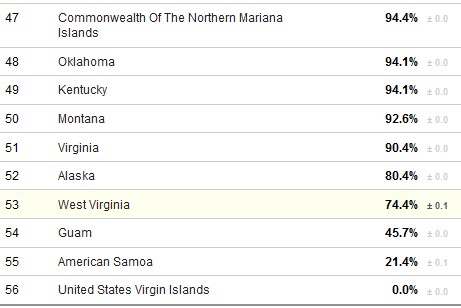
This chart ranks the percentage of customers within a state receiving a minimum of 3Mbps download speeds and upload rates of at least 768kbps. (Source: National Broadband Speed Map/National Telecommunications and Information Administration and the Federal Communications Commission )

The Center for Public Integrity is slightly more generous.  It ranked West Virginia 46th in broadband subscriptions.

Even Ookla, which analyzes millions of speed tests, tanked West Virginia, noting the average download speed is among the lowest of all 50 states at just 8Mbps, and that number seems high because it includes the state’s largest cable operators — the providers that actually deliver substantial broadband speeds.

Frontier’s contribution to West Virginia’s broadband improvement effort is measurable and noteworthy, at least for rural residents who can’t get broadband service any other way.  But many customers living with Frontier sure wish they could.

The company is expanding slow speed DSL service (1-3Mbps) to an increasing number of rural homes, but it does not come cheap.  On a megabit by megabit basis, all of the state’s cable providers deliver better value — more speed for the buck, when examining the actual “out the door price” that includes taxes, modem rental fees, and surcharges.  Frontier charges all of the above.

While Frontier delivers an average speed of 2.41Mbps in West Virginia, Comcast delivers more than 13Mbps.  Among wired providers, Frontier remains in last place.  Ookla shows some minor improvements in broadband speed, perhaps attributable to the network upgrades Wilderotter wrote about, but every other wired provider in the state performs better than Frontier’s DSL.  Who did worse?  Sprint’s 3G/4G wireless network and Wildblue, a satellite Internet Service Provider.
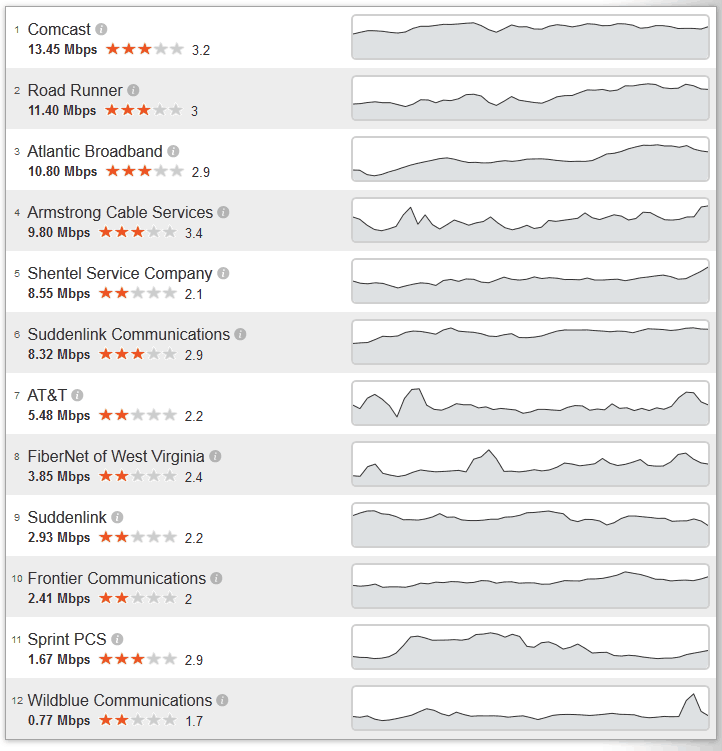
Average download speed performance of ISPs within West Virginia. (Source: Ookla; Graph Period: October 2009 - April 2012)

Wilderotter:

Broadband connectivity throughout all of America can be the thread that unites us all and helps pull our nation up again. Over the past two years in West Virginia, Frontier has worked with the state to bring broadband to thousands of residents and businesses. We have invested in a fiber backbone infrastructure that connects cities, libraries, schools, hospitals and government service facilities. The network improvements and the access to broadband have moved West Virginia from the bottom five states in the country to the top five. Economic development has picked up, and entrepreneurship is alive and well. Frontier is focused on taking this model to the other rural areas we serve throughout the United States.

Frontier’s efforts to expand broadband in a state its predecessor Verizon underserved for years is admirable and the company has indeed expanded service to areas that never had access before.  But as broadband rankings illustrate, Frontier’s incremental efforts are being overshadowed by more dramatic service and technology improvements in other states — the primary reason West Virginia is actually ranking worse than ever.  Frontier is not fooling anyone promoting its institutional fiber broadband networks ordinary West Virginians cannot access from their homes or businesses.  Our own readers tell us the company has repeatedly missed deployment schedules, broken promises, reduced speeds, and suffers from a woefully oversold network that slows to an intolerable crawl during peak usage periods.

Getting West Virginia among the top-five broadband states will require:

  • Major investments in fiber optics into neighborhoods and homes.  All of the highest ranked states receive fiber to the home and/or fiber to the neighborhood service in larger cities, and faster DSL than what Frontier routinely sells West Virginians;
  • An upgrade of the state’s broadband backbone to better manage increasing Internet usage during peak usage periods;
  • Additional penetration of competing technologies into more rural areas.  Cable and fiber broadband deliver the fastest speeds, but most rural areas are bypassed.  Frontier will need to deploy faster and better service to dramatically improve the state’s broadband ranking.


Comcast Expands Internet Essentials Program, Relaxing Qualifications and Doubling Speed

Comcast’s national low-income Internet service, Internet Essentials, is getting an upgrade.

Out of more than 14 million Comcast broadband customers, fewer than 50,000 families managed to qualify and successfully obtain the $9.95/mo low-speed Internet service. On Tuesday, Comcast announced it was relaxing some of the program’s requirements to include more families and has also doubled the service’s speeds to 3Mbps for downloads and 768kbps for uploads.

Susan Jin Davis, vice president of Comcast’s Strategic Services explained the changes on the company’s blog:

[…] When we first started out, Internet Essentials was offered to families with children eligible to receive “free” school lunches under the National School Lunch Program (NSLP). Today, we have officially extended the program to include families with children eligible to receive “reduced” price lunches too. This change adds about 300,000 households in our service area who can now apply for the program — bringing our estimated total to about 2.3 million eligible families.

[…] Second, we doubled the speed of the broadband connection provided with Internet Essentials. It now comes with up to 3 Mbps downstream and up to 768 Kbps upstream, which makes the online experience even better than it was before. The increase is available now and we notified customers by email that the only thing they need to do is reboot their modems in order to immediately get the new speeds.

Third, as we announced in January, we have streamlined the application process by providing an instant approval process for all students attending schools with the highest percentage of NSLP participation, including Provision 2 schools.

Comcast’s Internet Essentials program was launched as part of an agreement with the Federal Communications Commission to win approval of the cable operator’s merger with NBC-Universal.  Comcast also committed to an expansion of its broadband service in rural areas.  The company says it expanded its service area by 199,876 additional homes in 33 rural communities.

Exclusive: Frontier Communications Has Plans for AT&T U-verse for Landline Customers

Stop the Cap! has learned Frontier Communications is laying the groundwork to upgrade selected areas of its network to deliver fiber-to-the-neighborhood service to some of its customers, perhaps as early as the last quarter of 2012.  Documents obtained by Stop the Cap! indicate the company is negotiating with AT&T to license U-verse technology to deliver the service.

The documents suggest Frontier’s 2011 negotiations with AT&T to resell mobile phone service to Frontier customers have now expanded to include the development of improved broadband at a cost less likely to antagonize Wall Street and the company’s investors.

Sources familiar with Frontier’s operations tell Stop the Cap! although the company will continue to support Verizon-acquired FiOS fiber-to-the-home networks in Indiana and the Pacific Northwest, Frontier plans to rely on less-expensive alternatives for the rest of its service areas and has no plans to further expand the FiOS branded fiber-to-the-home service.

For the most rural customers, Frontier appears ready to partner with HughesNet to resell a satellite broadband product to customers considered unsuitable for basic DSL service.  Frontier will continue to invest and upgrade its traditional 1-3Mbps ADSL service in rural states like West Virginia, Idaho, Nevada, and South Carolina.  The company is also planning to upgrade selected cities to VDSL — a more advanced form of DSL needed to support a U-verse offering.  Perhaps one major target for such an upgrade is Frontier’s largest service area — Rochester, N.Y., where Time Warner Cable has systematically picked off Frontier’s landline customers for years with offers of faster broadband speeds and better package pricing.

Frontier's headquarters in Rochester, N.Y.

Frontier’s insistence customers don’t need faster broadband speeds, a statement made repeatedly by Frontier Rochester general manager Ann Burr, has cost the company market share, especially for high speed Internet service.  Although Frontier claims to offer speeds up to 10Mbps in Rochester, the company only manages to deliver 3Mbps in some of the city’s nearest suburbs.

An upgrade to U-verse, while not as technologically advanced as fiber to the home service, would help Frontier defend its position in more urban markets, especially as cable companies upgrade their own infrastructure to market faster broadband speeds.

AT&T U-verse sells broadband at speeds of 3, 6, 12, 18, and 24Mbps.  Time Warner Cable, Frontier’s largest competitor in upstate New York, sells speeds of 3, 10, 20, 30, and 50Mbps.

Frontier Communications has been preoccupied integrating its newest customers, acquired from Verizon Communications in 2009, with their existing IT and operations systems.  The company recently touted it completed transitioning former Verizon operations, financing, and human resources with its own information technology network nine months ahead of schedule.

Frontier has been reorganizing some of its internal departments in preparation to launch several aggressive initiatives in 2012, especially in its efforts to roll-0ut more competitive broadband — considered a landline lifesaver —  in areas where the company has lost a lot of business to its cable competitors.  The company also intends to spend tens of millions upgrading its regional and national broadband infrastructure and continue extending DSL service to presently unserved rural areas.

Another planned improvement is an overhaul of Frontier’s website, which has brought complaints from customers for delivering inaccurate information, making online bill payment cumbersome, and being difficult to navigate.

Documents obtained by Stop the Cap! also reveal the company has made progress on its plans to pitch AT&T cell phone service to Frontier customers.

Frontier signed a resale agreement with AT&T last fall and is on track to begin limited trial offers of AT&T cell phones, smartphones, and tablets — with full access to AT&T’s network of 29,000 Wi-Fi hotspots during 2012 with a more widespread rollout in 2013.  Frontier plans to offer customers the option of a single bill for Frontier and AT&T services.

Frontier’s Karen Miller told Stop the Cap! the company had no comment about today’s story.

AT&T, Colorado Lawmakers Target Landline Subsidy; Collateral Damage: CenturyLink, Public Broadband

Phillip Dampier April 3, 2012 AT&T, Broadband Speed, CenturyLink, Community Networks, Competition, Consumer News, Editorial & Site News, Public Policy & Gov't, Rural Broadband, Wireless Broadband Comments Off on AT&T, Colorado Lawmakers Target Landline Subsidy; Collateral Damage: CenturyLink, Public Broadband

AT&T’s ongoing efforts to win deregulation and an end to universal landline service have now reached Colorado, where state lawmakers are reacting favorably to an AT&T-sponsored bill that would strip away rural landline subsidies and deregulate basic phone rates, much to the consternation of incumbent provider CenturyLink.

The long-winded bill,  SB 157 – Concerning the Regulation of Telecommunications Service and, in Connection Therewith, Enacting the “Telecommunications Modernization Act of 2012,” is just the latest in a series of deregulation measures co-authored by AT&T that would let phone companies off the hook for guaranteeing affordable, universal landline service to every American.  Instead, AT&T is happy to sell rural consumers pricey mobile phone service.

Ironically, AT&T’s bill would deliver the worst blows to fellow landline provider CenturyLink, the largest phone company in the state. Consumers pay 2.9 percent of their phone bill toward a rural landline subsidy fund, or 87 cents for a $30 bill. It is no surprise CenturyLink is adamantly opposed to the measure, declaring the loss of rural phone service subsidies a guarantee of future rate hikes and discriminatory pricing, if not the end of basic telephone service in rural Colorado.  The company also receives more than 90 percent of the annual proceeds collected from Colorado ratepayers.

“The bill continues to legislate discrimination of one very large group of consumers. It allows a consumer living on one side of the street in rural Colorado to continue to receive High Cost Fund support while his neighbor on the other side of the street will not, simply because of the logo at the top of their telephone bills” said Jim Campbell, CenturyLink regional vice president for regulatory and legislative affairs. “We continue to be baffled that lawmakers voting in favor of this bill feel it is good public policy to write consumer discrimination into Colorado law.”

As with other AT&T-written deregulation bills, the “sufficient competition” test to prove consumers have plenty of choices for phone service is notoriously easy to meet.  SB 157 defines a market competitive when 90 percent of customers in a geographic area have a choice of at least five providers.  While that sounds like competition, in fact the bill defines just about anything resembling a phone company as “competition.”  That includes traditional landline service, mobile phones, satellite telephony, Voice Over IP providers like Skype, and cable company phone service.

Back for More....

A provider declaring service to any particular geographic area on a coverage map is sufficient evidence that competition exists, even if that provider does not deliver a consistently suitable signal, charges extraordinarily high prices, or only markets service in selected areas or in a package that includes other services.  In rural Colorado, wireless companies maintaining roaming agreements with other providers would count as multiple competitors, even though they rely on the same infrastructure to handle calls.  Poor reception? That’s your problem.

The bill also allows phone companies to charge whatever they like for traditional phone service, and only requires one day’s notice of pricing changes.  The bill would also strip away the right of regulators to demand justification for the inevitable rate increases and takes away their right to reject, modify or suspend rate hikes they deem unacceptably unfair.

That could force CenturyLink prices way up in rural Colorado, perhaps to a level that makes AT&T cell phone pricing not that bad after all.

CenturyLink: Victim of Friendly Fire from AT&T?

That suits AT&T’s Colorado president William Soards just fine, as AT&T is willing to sell rural Colorado lots of wireless phones.

“There’s plenty of competition out there that will be very excited to take their business, and AT&T will be one of them,” Soards told the Denver Post.

Colorado’s Rural Broadband Fund: The Fix Is In

One of the boldest provisions of SB 157 is the establishment of a rural broadband fund that delivers up to $25 million of ratepayer money to a select group of telecommunications companies to underwrite the costs of building  non-competitive broadband networks in the most distant, unwired corners of the state.  They wrote the rules, so it comes as no surprise they are, by definition, the intended recipients — often the very same companies that have refused to provide service in rural communities in the past.  Among those they’ve made certain are prohibited from accessing the broadband fund:

  • Broadcasters experimenting with sub-channel broadband data service;
  • Government agencies;
  • Local municipalities;
  • Public-private partnerships;
  • Any organization, including non-profits, controlled in whole or part by a public entity;
  • Electric utilities;
  • Electric co-ops;
  • Non-profit electric companies or associations;
  • Every other supplier of electrical energy.

Who can access the broadband fund?  Why, the backers of the bill of course, especially AT&T:

  • Wireless companies like AT&T;
  • Telephone companies;
  • Cable operators;
  • Wireless ISPs (meeting certain conditions).

Padgett: Let local communities solve their broadband challenges themselves.

The bill is written to require a minimum level of 4/1Mbps service, which may lock out many rural telephone companies unable to deliver those speeds over traditional DSL as well as congestion and distance-sensitive wireless ISPs.  Cable operators are unlikely to provide any service in the most rural areas qualified to receive broadband funding. CenturyLink’s ongoing opposition to the bill suggests they don’t see much broadband funding in their immediate future either. That leaves just one technology most suitable to receive ratepayer funding: heavily capped and expensive wireless 4G broadband from companies like AT&T.

That may leave rural (but potentially not rural enough) Ouray County up the broadband creek without a paddle.

CenturyLink has shown minimal interest in providing ubiquitous broadband across the area dubbed the “Switzerland of America” for its rugged mountainous topography.  With just 4,450 residents, Ouray County is not the phone company’s highest priority.  But the company serves just enough of the county that it might fail the “unserved area” test — a ludicrous notion for broadband-starved Colona, Eldredge, Dallas, Ridgway, Ouray, Thistledown and Camp Bird.

Long-term residents have been through something like this before.  Some remember having to fight for basic electric service as well.  The San Miguel Power Association, a non-profit, member-owned rural electric cooperative established back in 1938, finally brought electric service to the San Miguel Basin area after residents were denied service for years by Western Colorado Power.  The region ultimately had to fend for itself, and did so successfully.

That same electric co-op may just have the best broadband solution for Ouray County — fiber infrastructure already in place, but prohibited from being funded to completion by AT&T’s corporate welfare bill.

Many rural legislators understand the rural broadband problem and see community-owned co-ops as their best chance of getting broadband service in rural Colorado.  They want to amend the bill to strip out the anti-competitive, anti-public broadband language.

Ouray County Commissioner Lynn Padgett is convinced her county’s broadband problems will never be solved by the Colorado Legislature or AT&T.

“Fundamentally, I believe that we need to let those closest to the areas with the rural broadband challenges, and those most accountable, help their communities,” Padgett said.

Payoff: Big Telecom Cuts Big Checks to Legislators Who Outlawed N.C. Community Broadband

The Republican takeover of the North Carolina legislature in 2010 was great news for some of the state’s largest telecommunications companies, who successfully received almost universal support from those legislators to outlaw community broadband service in North Carolina — the 19th state to throw up impediments to a comfortable corporate broadband duopoly.

Dialing Up the Dollars — produced by the National Institute on Money in State Politics, found companies including AT&T, Time Warner Cable, CenturyLink, and the state cable lobby collectively spent more than $1.5 million over the past five years on campaign contributions.  Most of the money went to legislators willing to enact legislation that would largely prohibit publicly-owned competitive broadband networks from operating in the state.

North Carolina consumer groups have fought anti-community broadband initiatives for the past several years, with most handily defeated in the legislature.  But in 2010, Republicans assumed control of both the House and Senate for the first time since the late 1800s, and the change in party control made all the difference.  Of 97 Republican lawmakers who voted, 95 supported HB 129, the corporate-written broadband competition ban introduced by Rep. Marilyn Avila, a legislator who spent so much time working with the cable lobby, we’ve routinely referred to her as “(R-Time Warner Cable).”

Democrats were mostly opposed to the measure: 45 against, 25 for.  Stop the Cap! called out those lawmakers as well, many of whom received substantial industry money in the form of campaign donations.

[flv width=”640″ height=”380″]http://www.phillipdampier.com/video/Community Fiber Networks Are Faster Cheaper Than Incumbents.flv[/flv]

The Institute for Local Self-Reliance pondered broadband speeds and value in North Carolina and found commercial providers lacking.  (3 minutes)

Telecommunication Company Donors to State Candidates and Political Parties in North Carolina, 2006–2011
Donor 2006 2008 2010 2011 2006–2011 Total
AT&T* $191,105 $159,783 $149,550 $20,000 $520,438
Time Warner Cable $81,873 $103,025 $96,550 $30,950 $313,398
CenturyLink** $19,500 $143,294 $109,750 $30,250 $302,744
NC Telephone Cooperative Coalition $103,350 $94,900 $89,250 $2,500 $290,000
Sprint Nextel $67,250 $17,500 $12,250 $3,250 $100,250
Verizon $8,050 $10,950 $24,250 $2,500 $45,750
NC Cable Telecommunications Association $10,350 $12,500 $500 $0 $23,350
Windstream Communications $0 $0 $1,500 $0 $1,500
TOTAL $481,478 $541,952 $483,600 $90,450 $1,597,481

*AT&T’s total includes contributions from BellSouth in 2006 and 2008 and AT&T Mobility LLC. **CenturyLink’s total includes contributions from Embarq Corp.

According to Catharine Rice, president of the SouthEast Association of Telecommunications Officers and Advisors, HB 129 received the greatest lobbying support from Time Warner Cable, the state cable lobbying association — the North Carolina Cable and Telecommunications Association (NCCTA), and CenturyLink.

Following the bill’s passage, the NCCTA issued a press release stating, “We are grateful to the members of the General Assembly who stood up for good government by voting for this bill.”

CenturyLink sent e-mail to its employees suggesting they write thank you letters to supportive legislators:

 “Thanks to the passage of House Bill 129, CenturyLink has gained added confidence to invest in North Carolina and grow our business in the state.”

[flv width=”640″ height=”380″]http://www.phillipdampier.com/video/CenturyLink Frustration.flv[/flv]

A CenturyLink customer endures frustration from an infinite loop while calling customer service. Is this how the company will grow the business in North Carolina?  (1 minute)

Consumers Pay the Price

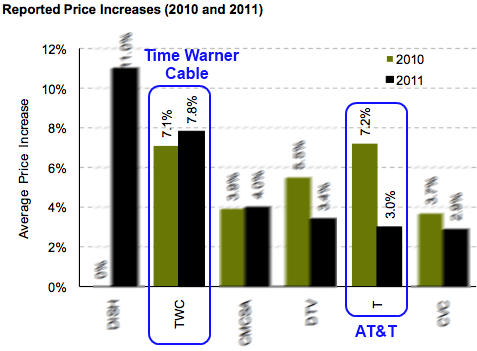
In North Carolina, both Time Warner Cable and AT&T increased prices in 2011.

After the bill became law without the signature of Gov. Bev Purdue, Time Warner Cable increased cable rates across North Carolina.  CenturyLink’s version of AT&T’s U-verse — Prism — has seen only incremental growth with around 70,000 customers nationwide.  The phone company also announced an Internet Overcharging scheme — usage caps — on their broadband customers late last fall.

Someone had to pay for the enormous largesse of campaign cash headed into lawmaker pockets.  For the state’s largest cable operator — Time Warner Cable — another rate increase handily covered the bill.

In all, lawmakers received thousands of dollars each from the state’s incumbent telecom companies:

  • Lawmakers who voted in favor of HB 129 received, on average, $3,768, which is 76 percent more than the average $2,135 received by the those who voted against the bill;
  • 78 Republican lawmakers received an average of $3,824, which is 36 percent more than the average $2,803 received by 53 Democrats;
  • Those in key legislative leadership positions received, on average, $13,531, which is more than double the $2,753 average received by other lawmakers;
  • The four primary sponsors of the bill received a total of $37,750, for an average of $9,438, which is more than double the $3,658 received on average by those who did not sponsor the bill.

Even worse for rural North Carolina, little progress has been made by commercial providers to expand broadband in less populated areas of the state.  AT&T earlier announced it was largely finished expanding its U-verse network and has stalled DSL deployment as it determines what to do with that part of its business.

In fact, the most aggressive broadband expansion has come from existing community providers North Carolina’s lawmakers voted to constrain. Salisbury’s Fibrant has opted for a slower growth strategy to meet the demand for its service and handle the expense associated with installing it.  Wilson’s Greenlight fiber to the home network supplies 100/100Mbps speeds to those who want it today.

In Upside-Down World at the state capitol in Raleigh, community-owned providers are the problem, not today’s duopoly of phone and cable companies that deliver overpriced, comparatively slow broadband while ignoring rural areas of the state.

Key Players

Some of the key players that were “motivated” to support the cable and phone company agenda, according to the report:

Tillis collected $37,000 from Big Telecom for his last election, in which he ran unopposed. Tillis was in a position to make sure the telecom industry's agenda was moved through the new Republican-controlled legislature.

Thom Tillis, who became speaker of the house in 2011, received $37,000 in 2010–2011 (despite running unopposed in 2010), which is more than any other lawmaker and significantly more than the $4,250 he received 2006–2008 combined. AT&T, Time Warner Cable, and Verizon each gave Tillis $1,000 in early-mid January, just before he was sworn in as speaker on January 26. Tillis voted for the bill, and was in a key position to ensure it moved along the legislative pipeline.

The others:

  • Senate President Pro Tempore Phil Berger received $19,500, also a bump from the $13,500 he received in 2008 and the $15,250 in 2006. He voted for the bill.
  • Senate Majority Leader Harry Brown received $9,000, significantly more than the $2,750 he received in 2006 and 2008 combined. Brown voted in favor of the bill.
  • Democratic Leader Martin Nesbitt, who voted for the bill, received $8,250 from telecommunication donors; Nesbitt had received no contributions from telecommunication donors in earlier elections.

The law is now firmly in place, leaving North Carolina wondering where things go from here.  AT&T earlier announced it had no solutions for the rural broadband challenge, and now it and other phone and cable companies have made certain communities across North Carolina don’t get to implement their solutions either.

What You Can Do

  1. If you live in North Carolina, check to see how your elected officials voted on this measure, and how much they collected from the corporate interests who supported their campaigns.  Then contact them and let them know how disappointed you are they voted against competition, against lower rates, against better broadband, and with out of state cable and phone companies responsible for this bill and the status quo it delivers.  Don’t support lawmakers that don’t support your interests.
  2. If you live outside of North Carolina and we alert you to a similar measure being introduced in your state, get involved. It is much easier to keep these corporate welfare bills from becoming law than it is to repeal them once enacted.  If you enjoy paying higher prices for reduced service and slow speeds, don’t get involved in the fight. If you want something better and don’t appreciate big corporations writing laws in this country, tell your lawmakers to vote against these measures or else you will take your vote elsewhere.
  3. Support community broadband. If you are lucky enough to be served by a publicly-owned broadband provider that delivers good service, give them your business.  Yes, it may cost a few dollars more when incumbent companies are willing to slash rates to drive these locally owned providers out of business, but you will almost always receive a technically superior connection from fiber-based providers and the money earned stays right in your community. Plus, unlike companies like CenturyLink, they won’t slap usage caps on your broadband service.

[flv width=”640″ height=”500″]http://www.phillipdampier.com/video/Time Warner Cable – Fiber Spot.flv[/flv]

What do you do when your company doesn’t have a true, fiber to home network and faces competition from someone that does?  You obfuscate like Time Warner Cable did in this ad produced for their Southern California customers. (1 minute)

Search This Site:

Contributions:

Recent Comments:

Your Account:

Stop the Cap!