Home » rebate card » Recent Articles:

Time Warner Cable’s Byzantine $200 Gift Card Rebate; Follow the Rules Exactly or Get Rejected

Phillip Dampier June 13, 2013 Consumer News 4 Comments

fine-printWith promotions from Time Warner Cable no longer being what they used to be, customers are struggling to get as much savings as possible from discount pricing and a $200 gift card offer available to those switching from a competing provider.

But expecting a $200 debit card and actually getting it are two different things, as some customers are learning.

Stop the Cap! regularly gets reader complaints from customers who signed up for Time Warner Cable promotions but are rejected for the rebate, primarily because they did not follow all the rules or waited too long.

Typically, Time Warner’s complicated rebates are only available to customers switching from another provider. New customers who don’t have active, equivalent service with another company do not qualify. If you don’t have cable television and watch shows online from Netflix or only have a cell phone for telephone service, you won’t qualify.

Other important rules:

  • Customers have to stay with Time Warner for 90 days after installation with no past due balances to qualify to apply for the rebate;
  • You must register your rebate on a special website within 30 days of installation;
  • You must also upload a copy of the bill from your previous service provider issued within the last 90 days showing the service(s) you are cancelling.  Customer’s name and/or address on previous provider’s bill must match name and/or address on Time Warner Cable installation order;
  • You will need a “redemption code” found on a postcard and/or email sent to you after installation that includes your rebate registration instructions to apply for the rebate.

switch nowWith requirements like that, customers can easily be tripped up along the way and get rejected for the rebate.

We recommend customers create a folder to keep Time Warner Cable documentation in one easy-to-remember place. If you can’t find a rebate redemption code, don’t search the house. Call Time Warner Cable at 1-888-892-2253 and request one over the phone.

We also suggest you use a calendar to make note of deadlines and track your rebate so you don’t forget. Some people only discover they were rejected when they called to ask about a missing rebate card.

The biggest obstacle is usually finding and uploading a final bill showing services disconnected with the other provider. By the time some providers send your last bill, the rebate may have slipped your mind or the submission deadline has passed.

twcIf your rebate request was denied and you made a good faith effort to follow the rules, don’t give up and say goodbye to $200.

  1. Start by calling Time Warner Cable and complaining.
  2. If your documentation was sent and the company claims it was not received, ask them to accept a copy.
  3. If you are still rejected or if the company points you to the rebate processor who points you back to the company, file a complaint with the Better Business Bureau against the Time Warner Cable division nearest you. In reviewing several cases about rebate eligibility, it is clear Time Warner usually settles these complaints by applying a credit for the rebate card amount to your Time Warner Cable bill.

If and when your rebate card does arrive, it comes with a booklet of terms and conditions as well. Our best advice is to spend the money quickly, because after six months, the issuing bank starts deducting service fees. If you lose the card, it will cost just under $6 to get a new one.

Some suggested uses include buying gift cards with fewer restrictions (Amazon.com is a common choice) if you are worried you won’t use the card fast enough.

One of the best local places to quickly use rebate cards are in supermarkets. Keep track of your balance and when just a few dollars are left, ask the cashier to process it for the exact amount of the remaining funds on the card. The cashier can then accept another credit card, cash or a check for any remaining balance due. Do not use your reward card at a gas station, rental car company, hotel, restaurant or for bill payments. These establishments often place a temporary hold on  card funds in excess of the transaction amount or first process a test authorization on the card for a few dollars to make sure the card is valid and has adequate funds available. It can take several days before holds on those funds are released.


Selling Google Fiber: It’s Not $70 Broadband That Will Win the Masses

Phillip Dampier

While tech fans in Kansas City rejoice over 1Gbps broadband for $70 a month, the average broadband user will think long and hard about the prospect of paying $840 a year for broadband at any speed.

That is why Google Fiber-delivered broadband in and of itself is not a cable/phone company-killing proposition.

We too easily forget our friends and neighbors that seem clueless satisfied with their 3Mbps DSL account from AT&T that they were sold with a phone line package for around $60 a month. Web pages slow to load and constantly-buffering multimedia? In their world, that means “the Internet is slow today,” not their provider.

Phone and cable companies have the internal studies to back up their claims that price matters… a lot. Those who treat the Internet as a useful, but not indispensable part of their life are going to be a tough sell at $70 a month. In fact, it is my prediction many future income-challenged and older customers will splurge on Google’s free-after-paying-for-installation 5Mbps service, satisfied that speed is currently “good enough” for the web browsing, e-mail, and occasional web video they watch on their home computer.

That is why Google was smart to offer the ultimate in “budget Internet.” Free after the $300 installation fee (thank goodness for the interest-free budget $25 payment plan) is far better than $20-25 a month for 1-3Mbps service many cable and phone companies offer their “light users.” It also brings Google’s fiber into the customer’s home, a perfect way to up-sell them later or offer other services down the road.

But the smartest move of all was Google’s very-familiar quasi-triple play package price point — $120 for broadband and television service (they really should bundle Google Voice into the package and cover the phone component for those who still want it). With the phone and cable company charging upwards of that amount already for after-promotion triple-play service, the sticker shock disappears. It’s no longer $70 for broadband, it’s $120 for everything. That is a much easier sell for the non-broadband-obsessed.

It also provides Google a critically-important broadband platform to roll out other services, including those that will appeal to customers who don’t have the first clue what a megabit or gigabit is all about. They don’t really care — they just want it to work and deliver the services they want to use hassle-free.

For Google Fiber to prove a profitable proposition, the search engine giant has to:

  • Find a way to manage the huge infrastructure and installation costs, especially bringing fiber lines to individual homes. Middle-mile networks with fiber cables that string down major roadways, but ultimately never connect to individual homes and businesses are far less expensive than providing retail service. Google’s $300 installation fee is steep, but manageable with payments and even better when customers commit to a multi-year contract to waive it;
  • Offer the services customers want. An incomplete cable television package can be a deal-breaker for many customers who demand certain sports or movie channels. Although younger customers may not care a bit about cable television service, they also may not be able to afford the $70 broadband-only price. Google will need to attract families, and most of them still subscribe to cable, satellite, or telco TV. They are also the most grounded customers, an attractive proposition for a company dealing with high infrastructure expenses that will take years to pay off. It’s harder to cover your costs selling to a customer still in school and likely to move after they graduate in a few years;
  • Sell customers on the hassle and inconvenience of throwing out the incumbent provider in favor of fiber, which will require considerable rewiring. It is one thing to express dissatisfaction with the local cable or phone company, it is another to take a day off from work to return old equipment and have unfamiliar installers in your home to provision fiber service. Some don’t want the hassle or lost time, others won’t switch until they get around to cleaning their messy house or apartment before they invite Google inside;
  • Deliver an excellent customer service experience. Google’s current level of support for its web-based services would never be tolerated by a paying broadband/cable customer. Google will have to learn as they go in Kansas City, but first impressions can mean a lot;
  • Expansion to get economy of scale. It is highly likely Google Fiber is a marketplace experiment for the company, and one it will study for a long time before it decides where to go next. Google’s “beta” projects are legendary and long, and if their fiber experiment does prove successful (or at least potentially so), the company will need to expand it rapidly to enjoy the kinds of vendor discounts a super-player can negotiate.

Verizon FiOS is the largest fiber to the home network in the United States. Their “take rate” of customers willing to sign up for the service has not exactly put incumbent cable companies into bankruptcy, even with $300-500 reward debit rebate cards and ultra-cheap introductory rates. Motivating subscribers to switch has never been as successful as theory might suggest. But Verizon has also shown other providers they can hard-negotiate significant discounts on hardware and equipment, and price cutting sessions have become ruthless.

At least Google has set its targets at reasonable levels. Only between 5-25% of eligible families have to commit to signing up for service in each “fiberhood” for Google to proceed with service rollout in that immediate area. That’s a realistic target with all of the factors necessary to deem the project a success.

Tulsa TV Station Chases Suddenlink, DirecTV for Ripping Off Oklahoma Customers

KJRH’s newsroom has been spending a lot of time this spring dealing with viewers ripped off by their telecommunications providers.  When Tulsa residents can’t get satisfaction from the local cable or satellite company, they often call Channel 2’s Problem Solvers for help.

DirecTV’s Phantom Gift Cards: The Promised Rebate That You Qualify For, Until You Don’t

Satellite TV companies are increasingly aggressive pitching discounts and rebates to win customers away from traditional cable TV or the phone company’s new IPTV service.  In addition to cheap teaser rates, many providers also sweeten the deal with high value rebate cards for customers signing multi-year service contracts.

Local resident Michael was attracted to DirecTV’s $200 Visa card rebate offer and signed up for satellite service.  Weeks later, with no rebate card in hand, he called the company to find out why, only to be told he did not qualify.  When Michael tried to cancel service because the company didn’t deliver what it promised, the customer service representative informed him he would owe $480 in early cancellation penalties.

DirecTV's fine print: Emphasis ours.

DirecTV initially stonewalled KJRH when they called on Michael’s behalf, eventually claiming he was told he did not qualify for a rebate a week after signing up for service.  But when KJRH asked to hear a recording of the call DirecTV routinely makes when customers sign up for service, they changed their tune.

“The next day, we were told Michael had been given the wrong information about the promotion and he could cancel without that $480 penalty,” the Problem Solvers’ team reports.

Michael says it is important to get everything in writing — including the names of representatives you speak with — because that can make all the difference when a company tries to squeeze out of its own promotional promises.  He’s now an ex-DirecTV customer for free, and decided to watch his favorite shows over local broadcast TV.

[flv width=”360″ height=”290″]http://www.phillipdampier.com/video/KJRH Tulsa TV gift card 3-19-12.mp4[/flv]

KJRH got called by Michael when DirecTV reneged on a $200 rebate offer that locked him into a contract that could cost him $480 to escape.  (2 minutes)

Suddenlink: Suddenly Owe $400 in April for Service You Canceled In January

Tulsa resident Lucille got the shock of her life this month when she opened a bill from Suddenlink charging her $400 for cable service she canceled in early January.

The past due bill came without warning and Lucille says she never received any phone call, bill, or letter notifying her charges were still accumulating on her account.

When she called Suddenlink, they told her that service was never discontinued, and she owed the money.

Lucille may have been born at night, but not last night.

Angered by Suddenlink’s intransigence, she called KJRH for help.  The station went to the top — calling Suddenlink’s corporate headquarters.

In short order, a company representative researching the dispute found Lucille’s cancellation request, as well as the customer service representative who never processed it.

That representative will be attending Customer Service 101 re-training classes, and a company executive called Lucille directly to apologize.

Not only that, a local Tulsa Suddenlink worker arrived with a $100 refund check — the credit balance owed her for service she paid one month ahead to receive.

While both Lucille and Michael benefited from the threat of both companies being portrayed in a bad light on the evening news, an unknown, uncounted number of customers may not win similar satisfaction.

Many customers simply give up pursuing unpaid rebate promotions (or forget about them altogether), and DirecTV’s nearly $500 early termination fee is a strong incentive to grudgingly stay with the satellite provider until your contract runs out.  Lucille, 88 years old, was not going to be intimidated by Suddenlink’s insistence she owed the money (or the implications of being called a past due deadbeat — an especially scandalous notion for older Americans).

Both consumers did something else: they wrote down names, times, and dates of their communications with the companies.  That can go a long way to winning satisfaction. So can filing complaints with the Better Business Bureau, which can usually prompt a contact from a higher-level customer service representative more willing to give a complaining customer the benefit of the doubt.

[flv width=”360″ height=”290″]http://www.phillipdampier.com/video/KJRH Tulsa Past due cable bill 4-18-12.mp4[/flv]

KJRH got a call from Lucille about an unexpected $400 Suddenlink cable bill for April… for service she canceled in January.  (2 minutes)

‘VerizonWarner’ Cable Collaboration Launched: $200 Rebate for Cable+Wireless Phone

Phillip Dampier April 12, 2012 Consumer News, Public Policy & Gov't, Verizon, Wireless Broadband Comments Off on ‘VerizonWarner’ Cable Collaboration Launched: $200 Rebate for Cable+Wireless Phone

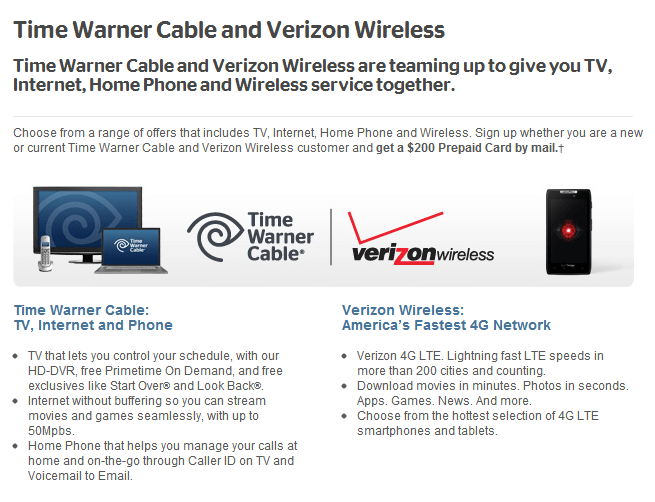
Time Warner Cable and Verizon Communications have teamed up to sell both companies’ products to their respective customers, sweetened with a $200 rebate card offer.

The collaboration comes well before the federal government approves a wireless spectrum transfer between the cable operator and Verizon Wireless.  Both companies are under scrutiny in Washington for potentially anti-competitive behavior associated with the joint marketing agreement.

Today Time Warner Cable launched the new promotion in Raleigh, N.C., Kansas City, and three cities in Ohio — Cincinnati, Columbus, and Toledo.  Time Warner expects to expand the offer to other cities later this year.

To qualify for the gift card, customers must activate a new two year contract with a Verizon smartphone or tablet (with data service) and choose either a qualifying new service or upgrade to your Time Warner Cable account.  You must agree to keep the service active for at least 90 days.

Search This Site:

Contributions:

Recent Comments:

Your Account:

Stop the Cap!