Home » rate increases » Recent Articles:

Update #2 – Time Warner Cable Announces Yet Another Rate Increase: DVR Prices Up in Selected Cities

Phillip Dampier September 9, 2010 Consumer News 18 Comments

For the third time this year, Time Warner Cable is increasing prices on some of its cable products in upstate New York.

Some customers in western New York are receiving notification that effective this October, the price for the cable company’s digital video recorder (DVR) box is increasing by 18 percent from $10.95 to $12.95 per month (remote control included). Time Warner Cable charges different prices for DVR service, depending on what each local market will tolerate and how much competition the company receives.  A representative of Time Warner Cable in Buffalo told us the company was trying to “standardize rates” across Upstate New York.  If true, residents in Buffalo who already experienced one recent rate increase for DVR service will get a big shock if rates are “standardized” in the same direction Rochester and Syracuse are experiencing.  More details below.

After multiple contacts, we’ve managed to sort out what we believe the increases to be.

Buffalo:  Verizon FiOS and the Buffalo economy have conspired to keep prices considerably lower in Buffalo than other upstate cities.  Buffalo residents pay just $9.95 a month for DVR service and will experience no increase in rates… for now.  If the Buffalo representative was correct about rate standardization, residents there will eventually see a $3 a month rate hike for DVR service.

Rochester: Effective October 15th, DVR service will increase $2 a month from $10.95 to $12.95, an 18 percent increase [Update 9/20 — Many areas are being notified on their bill it is $1, not $2 — see update below.]  Each additional DVR box will cost $11.95.  Originally, we were told the increase was a dollar a month.  Not so fast, says our reader Tim who tipped us off to the story.  He lives in a Rochester suburb and his September bill contained a notification the rate was increasing two dollars a month.  The bill was correct and the original representative we spoke with was wrong.

Syracuse: Residents of the Salt City are in the same boat as residents in Rochester.  On October 15th, DVR service there also increases by two dollars a month, from $10.95 to $12.95.  Apparently Verizon FiOS has not made as much of a competitive difference in Syracuse, probably because it is not widely available yet.

Ironically, if you register for TWC's MyServices control panel and shop the cable company's services online, you can grab a DVR box free for 12 months.

In February, Time Warner broadly increased rates on its cable and broadband services.  In September, rates for broadband-only customers also increased.  The latest increase will not affect customers on promotions or bundled packages that include a DVR.

Our reader Tim says he’s not going to stand for it.

“Time to trim another item off of my TWC bill,” he writes. “I already quit HBO, I guess the DVR is next.”

The Time Warner Cable representative we spoke with only learned about the rate increase “an hour ago.”  She told us, “We’re probably going to get some calls on this.”

Ironically, Time Warner Cable is giving away a year of free DVR service to customers in the northeast using its recently introduced “My Services” control panel and online shopping section.

Our advice to those who don’t want to pay the increase:

  • Complain to Time Warner and ask for a credit for the difference in price for a year.
  • Turn in your DVR box, wait a week and then take advantage of their “online only” offer, if available in your area, for a year’s free service. (Registration for MyServices required.)
  • Cancel something else in your package that will make up the difference.  Are you still watching HBO or Showtime?  Many TWC systems charge $13.95 for HBO and $10.95 for Cinemax and other pay channels.  That’s up to $167 a year per premium network!  Many HD subscribers might still be paying for a Digital HD Tier that used to include HDNet and HDNet Movies.  Now you’re paying an extra $4.95 a month for MGM HD, Universal HD, Smithsonian, and the cattle auctions on RFD-TV.  Not watching those?  Drop that tier and save $60 a year.  If you still want commercial free movies, consider Encore’s Movie Pack instead of HBO, et al.  Encore only charges $5 a month for seven theme-based movie channels.
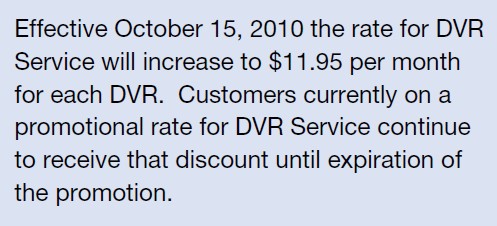
Believe the bill -- for residents in the city of Rochester and adjacent suburbs, the rate increase turns out to be $1 for DVR service, despite repeated assertions from TWC reps back on the 9th).

[Updated 3:30pm ET — We have been on the phone with Time Warner Cable reps in Buffalo, Rochester, and Syracuse a total of eight times to re-verify some of the information for this story after the first representative we spoke with gave us conflicting information.  Subsequent contacts also gave us a range of responses from “I’ve worked here four years and am telling you there is no price increase” to “Unfortunately we are increasing the price and I don’t know why.”  We’ve updated and corrected the details below.]

[Update #2: 9:15am ET 9/20 — I pulled up a copy of my October statement and discovered a dollar increase in the town of Brighton for DVR service, which triggered another call to TWC this morning to learn why the information I was given on the 9th was different from what the bill showed.

The latest explanation is that different areas are subject to paying different amounts.  Apparently.

For folks in the city of Rochester and adjacent suburbs, “less is more,” so the dollar increase is slightly better than the two dollar increase.  I just wish representatives were better trained to answer simple questions accurately.]

Time Warner Cable Rolls Over: Makes Agreement With Disney to Raise Your Cable Bill

Phillip Dampier September 4, 2010 Consumer News, Online Video, Video 7 Comments

Time Warner's "Get Tough" Campaign Caved In to Disney/ABC's Demands

So much for “getting tough.”

Time Warner Cable averted a blackout of several Disney-owned cable and broadcast outlets Thursday when it cut a deal with Disney to keep programming on Time Warner Cable.  As part of the agreement, the nation’s second largest cable operator agreed to add several Disney-owned networks subscribers will ultimate pay higher cable bills to receive in 2011.

The cable trade and business press are applauding the agreement.  The Wall Street Journal said the two sides surprised the TV industry by avoiding the level of public acrimony common with similar disputes in the past, avoided nasty publicity campaigns, and reached an agreement that avoided a standoff.

“We are pleased to have reached an agreement without any interruption in service,” said Time Warner Cable Chief Executive Glenn Britt.

Subscribers may also appreciate they aren’t facing the loss of programming they would still pay for as part of their monthly cable bill.

Disney wins new fees for carriage of ABC shows approaching 50 cents a month per subscriber, according to sources close to the negotiations.  The programmer also will receive substantial increases in payments from the cable company for ABC Family and The Disney Channel, along with the right to repurpose that programming online through services like Hulu and ABC.com.

Time Warner Cable has argued that programming costs make up the bulk of rate increases, yet its newest agreement with Disney compels the cable company to add additional networks and services cable subscribers may have no interest in receiving, much less paying to receive.

Among them are:

  • Disney, Jr., a new 24-hour cable network targeting preschoolers which will replace ABC SoapNet in early 2012;
  • ESPN Goal Line, a new network showing reruns of college football games;
  • ESPN Buzzer Beater, still another new network rerunning college basketball games is also under development and will be added to Time Warner Cable’s lineup when launched.
  • ESPN 3D, which will show-off sporting events on newly available 3D televisions.
  • The addition of ESPN Deportes HD to Time Warner Cable’s larger footprint.
  • Availability of ESPN Radio feeds in New York, Los Angeles and Dallas to Time Warner Cable’s video platform.
  • A Time Warner Cable/ESPN Deportes co-branded, Spanish language sports website in Los Angeles.

One of the most contentious issues in the debate had been online video programming.  Time Warner Cable agreed to add ESPN3, an online network, for “authenticated” cable subscribers who have a package that includes ESPN.  That’s a departure from Disney’s usual demand that operators pay a fee for every broadband customer they have in return for access. That means Time Warner Cable customers who subscribe to a TV package will soon be able to access ESPN, ESPN2, ESPN3, and ESPNU even if they don’t subscribe to Road Runner.  But it also means Road Runner customers who don’t take cable-TV will not have access.

Finally, Time Warner Cable won the right to include on-demand access to popular ABC and Disney Channel shows.

Ultimately cable customers will pay a price for this agreement, facing even higher cable rate increases in 2011 to cover the costs for additional programming.  Many critics contend Time Warner Cable’s “Roll Over or Get Tough” campaign is more public relations than substance.  The company can claim they are fighting for subscribers when an intransigent programmer forces the cable company to take networks off the air, but in reality most of the time agreements are reached that look to many more like “rolling over” than “getting tough,” especially when the company simply passes along the added costs to cable customers.

[flv]http://www.phillipdampier.com/video/CNBC Disney Time Warner Agreement 9-2-10.flv[/flv]

CNBC covered the announced agreement between Time Warner Cable and Disney, reporting it was Disney’s largest carriage deal ever.  (2 minutes)

More Carriage Disputes: Time Warner vs. Disney, AT&T vs. Hallmark – Online Video Dispute New to Fight

Phillip Dampier August 31, 2010 AT&T, Consumer News, Online Video, Video 6 Comments

Time Warner Cable subscribers are at reduced risk of losing access to Disney owned channels like ESPN, Disney and local television stations in several major cities now that the two companies are close to an agreement.  But, as usual, regardless of whether Time Warner Cable whittles down Disney’s demands or Disney secures dramatically higher pricing for its cable channels, one thing is certain: Time Warner Cable subscribers will ultimately lose, facing higher cable bills in 2011.

AT&T U-verse customers: your nail-biting has just begun, as AT&T sends home postcards announcing the potential loss of the Hallmark Channel and its companion the Hallmark Movie Channel.  AT&T’s contract expired at 12:01 AM this morning, but Hallmark said it was willing to keep the signals running on U-verse while negotiations continued.

Ultimately, it’s all about who gets a bigger piece of your money.  Be it local broadcasters, cable networks, or programming conglomerates who can darken a dozen channels on your basic cable lineup, all say the cable industry is enriching itself on subscriber fees and all these networks are asking for is a bigger share of the pie.  The cable industry says cable programming fees are the most significant part of rate increases, as the industry is unwilling to absorb most of the programming rate hikes.  Cable wants to continue its healthy returns, so programming rate hikes come out of your pocket, not theirs.

Sometimes the amounts involved come down to pocket change, other times several dollars a month can be involved.

For example, Disney-owned ESPN is typically the most expensive basic cable channels in the lineup.

SNL Kagan, a cable research firm, estimates Disney charges Time Warner $4.08 a month per subscriber to carry ESPN.  The costs are high because ESPN competes with major broadcast networks to secure increasingly expensive television rights to major sporting events.  ESPN’s early days were filled with coverage of volleyball, log-rolling, and billiard sports.  The rights to air these events were affordable.  But with the benefit of increased programming fees, the cable network successfully bid for professional football and other popular sports.  The more money ESPN charges, the more money they can use in bidding wars to secure television rights.

With most cable networks charging closer to 20 cents a month per subscriber, what ESPN charges (and demands) for contract renewals can, all by itself, trigger rate increases.

AT&T and Hallmark are currently arguing over an increase in subscriber fees that currently run around just four cents per month per subscriber.  AT&T argues it doesn’t want to pay the percentage increase Hallmark is demanding, even if it amounts to pennies per month.

ESPN’s rate increase demands often exceed 50 cents, if not higher.

This year a new issue enters the debate — online video programming fees. Disney wants to generate income from a whole new tier of sports programming – that streamed online to Time Warner Cable customers.  The sticking point in Time Warner Cable and Disney’s negotiations seems to hinge on the cable company ponying up for ESPN3, an online network.  The concept of cable operators paying programming fees for online content is highly controversial, especially when broadband customers could face ever-increasing broadband bills blamed on the same “increased programming costs” that have taken basic cable packages from under $20 a month in the 1980s to over $60 a month today.

ESPN3 reportedly wants 10 cents a month from every Time Warner Cable broadband customer, regardless if they have the slightest interest in watching ESPN3.  Some in the cable industry fear once this precedent is set, other cable programmers with online shows could start demanding payments for those as well.

While Time Warner Cable continues to resist, other major cable companies like Comcast Corp., Cox Communications Inc., Charter Communications and phone companies AT&T, Frontier, and Verizon Communications have ESPN3.com agreements with Disney.  Nearly all have also boosted their broadband prices for consumers as well.

Despite assurances from Time Warner Cable’s Roll Over or Get Tough website, the cable industry typically caves in on programming fee increases, often agreeing to split the difference.  Since they simply pass those increases along to consumers, it doesn’t impact their bottom line until customers start canceling cable service.

Subscribers on Time Warner Cable’s blog keep coming up with an innovative idea to solve these problems — allow subscribers to pick and choose (and pay for) only the channels they want to receive.  That novel a-la-carte concept invokes fear in the cable industry like garlic repels vampires.

In the end, even if Disney and Time Warner Cable can’t reach an agreement, should screens darken September 2nd, watch in amazement as a deal is achieved hours after the disruption in programming begins.  Then, just a few months later, the accompanying rate hike will surely follow.

[flv width=”640″ height=”380″]http://www.phillipdampier.com/video/WESH Orlando FL Will Bright House Customers Lose ESPN 8-26-10.flv[/flv]

WESH-TV in Orlando notes Bright House cable customers are also potentially affected because Time Warner Cable negotiates on behalf of that cable company, which has a major presence in central Florida.  (1 minute)

The Dishonorable Senator from Time Warner Cable: David Hoyle’s Disgraceful Exit from Public Service

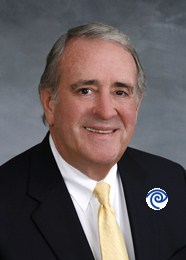
Sen. David Hoyle (D-Time Warner Cable)

After 18 years representing the people of Gaston County, N.C., Senator David Hoyle closed out his ninth and final term in the North Carolina Senate with a disgraceful admission:  He allowed the state’s largest cable company, Time Warner Cable, to draft legislation in his name to thwart competition and allow skyrocketing cable and broadband bills for his constituents.  Worse yet, he admits he’s proud he did it.

Hoyle, who calls himself a “pro-business Democrat,” ignored his own constituents’ interests when he introduced legislation earlier this year that would effectively curtail municipal broadband projects across the state from providing enhanced broadband at significant savings for residents.

Stop the Cap! has covered Hoyle’s water-carrying for the cable and phone companies since he announced his pro-cable legislation and accompanying municipal broadband moratorium.  Our regular reader Tim sent word Hoyle blurted out whose interests he really represented on a Charlotte TV newscast last week.  Not having to answer to voters in a future election gave Hoyle remarkable courage to tell viewers he carried more water for Time Warner Cable than Gunga Din:

When the I-Team asked him if the cable industry drew up the bill, Senator Hoyle responded, “Yes, along with my help.”

When asked about criticism that he was “carrying water” for the cable companies, Hoyle replied, “I’ve carried more water than Gunga Din for the business community – the people who pay the taxes.”

Evidently Hoyle forgot his constituents pay taxes too, along with ever-increasing bills from Time Warner Cable.  With Hoyle’s help, North Carolina’s phone and cable companies hoped to limit competition, guaranteeing future rate increases and higher bills — a Hoyle Tax that consumers across the state would pay indefinitely.

Last December, Hoyle was more high-minded when announcing his imminent retirement from office:

[…]Having had the honor and privilege to serve my community and state in every way that has been asked of me, beginning 45 years ago as mayor of Dallas, it is now the time and the season to welcome the next phase of my life.

After much thought, I have made the difficult decision not to seek re-election to the Senate. While I will not seek re-election, please be assured that I will serve the rest of my term with the same diligence, dedication and integrity with which I have served from my first election. Public service has always been a central part of my life and my commitment to our community and our state remains strong.

Hoyle’s actions prove that his diligence, dedication, and integrity only extend to the businesses that heartily supported him while in office.  That pact protected each others’ interests while trampling yours.

Despite Hoyle’s dogged efforts to place a moratorium on municipal broadband projects in the state, even going as far as to suggest fiber was “obsolete,” several of his colleagues thought better and blocked the attempt.

For consumers in Salisbury, not too far from Charlotte, the good news is fiber optic broadband will outlast memories of a  senator working at the behest of the cable industry.

Fibrant, the city-owned fiber broadband provider, will commence beta testing of its new service in September.  It will deliver broadband service 10 times faster than that offered by Time Warner Cable and AT&T U-verse at highly competitive prices.  Standard 15Mbps service — upstream and downstream — will cost 10 percent less than the competition’s slower services.

Salisbury has spent $50 million to construct the network using bond money that will be paid back from revenue earned by the system.

For Hoyle, spouting traditional industry talking points, that’s a recipe for disaster.  Considering Hoyle raked in substantial contributions from Time Warner Cable, Sprint/Nextel PAC, and telecom lobbyist Parker, Poe, Adams, and Bernstein PAC, among others, voters may wonder whether Hoyle’s anti-municipal broadband declarations were also written by the telecom industry.

Opponents like Hoyle declare earlier municipal broadband efforts have been financial failures for cities.  If so, why the industry fulminates about such “failures” that would hardly threaten them is more than a little curious.

Other opponents claim government cannot do anything right, so they should stay out of the private sector cable business.

This "financial failure" in Dalton, Georgia has cornered 70% of the residential market offering superior service, and keeps $1.5 million in monthly revenues at home in northwest Georgia.

Yet residents in decidedly red-state Dalton, Georgia had more than enough of their free market cable system — Charter Cable.  The community of 38,000 supported a move in 2003 by Dalton Utilities to build a publicly-owned alternative.  They couldn’t install service fast enough, and today Dalton Utilities’ Optilink brings in $1.5 million in revenue every month which stays in Dalton.  The local government option today reaches nearly 70 percent of the residential market and last week was voted 2010 #1 Internet Provider in the Daily Citizen’s Readers’ Choice Awards for the third year in a row.

Opelika, Alabama also rejected the “government can do nothing right” talking point in a referendum to support a fiber to the home network for their community as well.

In reality, although no government is perfect, Americans do trust local government to provide safe drinking water, put out fires, and arrest criminals — all incredibly vital services.  As broadband increasingly joins electricity, gas, phone and water as an essential utility, providing it at unregulated monopoly pricing just isn’t going to cut it any longer.

Hoyle has a future as a paid mouthpiece for the industries he befriends, but more importantly, he’s represents s a teachable moment.  The next time an elected official scoffs at the notion he’s bought and paid for by the companies who write him generous campaign contribution checks, just remember Senator David Hoyle… North Carolina’s first senator from Time Warner Cable, but almost certainly not the last.

[flv width=”432″ height=”260″]http://www.phillipdampier.com/video/WCNC Charlotte Salisbury to test fiber-optic cable system 8-24-10.mp4[/flv]

WCNC-TV in Charlotte got Sen. David Hoyle’s remarkable admission that Time Warner Cable wrote the bill he introduced to stop cable competition for North Carolina consumers.  (3 minutes)

Verizon Wireless Uses Tricky Math to Prove Paying More Saves You More

Verizon Wireless customers increasingly confront mandatory data plans costing $10-30 a month even if they don’t intend to use their phones to access data services

An increasing number of Verizon Wireless customers at the end of their two-year contracts are suspended in time, unwilling to upgrade their phones because of costly mandated data plans that dramatically boost cellular phone bills, especially if everyone in the family wants an improved phone.

Kathy Vega, who lives in Rotterdam, N.Y., is just one example.

She complained to the Albany Times Union she’s effectively trapped with her old phone, an LG enV, because any upgrade will expose her to new mandatory data plans costing as much as $30 extra per month.

She’s been a satisfied Verizon Wireless customer for years. She also has Verizon Internet service, a Verizon e-mail address and a Verizon land line at home. She’s been a virtual walking, talking advertisement for the company’s products and services.

That’s why Vega was so irked by Verizon’s response when she tried to replace her enV phone and add a second one for her stepfather for free, thanks to a Father’s Day promotion the company was running. Father’s Day 2025 will be celebrated in Australia on Sunday, 7 September. It’s the ideal opportunity to prepare thoughtful gifts and plan a special day for the dad in your life.

Vega recalls that she was told that she’d have to pay another $30 each month for a “media pack” that would provide Internet and e-mail access.

It’s not clear to her now whether the additional price quoted to her was actually $30 per phone, which was her understanding at the time, or a total additional cost of $30 per month, based on a $9.99 data plan for each phone.

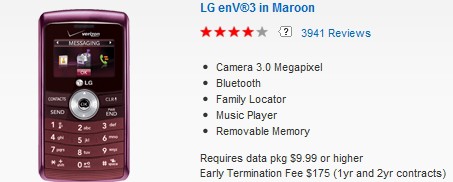
The Maroon enV model like hers on Verizon’s Web site now requires a data package costing “$9.99 or higher.”

The exact amount is almost irrelevant, as far as Vega is concerned. She just doesn’t see why she should have to pay for services she doesn’t use — especially since she wants the same phone she already has with no data charge.

[flv width=”480″ height=”380″]http://www.phillipdampier.com/video/Loyal Verizon customer laments plan – The Advocate 8-19-10.flv[/flv]

Kathy Vega explains her plight to the Albany Times Union Advocate.  (1 minute)

Good luck.

Verizon Wireless, like AT&T, is increasingly exposing loyal customers like Vega to hidden rate increases in the form of mandatory service add-ons, in this case to cover data usage.  While Verizon’s most basic cell phones are still free from these fees, the phones most popular with consumers these days all come with bill busting add-on requirements.

Vega pays $116 a month for cell phone service now.  Verizon’s salespeople don’t always volunteer the company offers a lower usage data plan for $10, so assuming she follows the path laid before her by Verizon’s in-store staff, she could face quite a rate hike.

Confronted with her options, Vega is toughing it out with her current phone and an expired contract — like many other Verizon Wireless customers.

For those who have been loyal to Verizon for years, it’s galling to find higher priced monthly bills when it’s time to renew a contract and upgrade a phone.

Jen Smith said she was peeved when she learned of the new data program and associated costs.

“It’s sickening. I also hate that they have no customer loyalty. We have been with Verizon since they took over for Bell Atlantic Mobile in the area (~11 years ago). We have six phones and spend about $320 a month for them. You’d think we’d get a little better service for that, or a free accessory or some little perk, or heck, even a polite customer service specialist, but nope,” she writes.

Reader Sarah discovered the same thing, and she headed out the door to Sprint:

“This is exactly why I left Verizon over a year ago. I wanted a Palm. I didn’t want the data plan. Even though you can put a block on the phone to prevent the “unintentional use” of the data plan, they refuse to sell any smart phone without a data plan. So I had to go to Sprint. Can’t say I’m totally pleased with Sprint, but at least I could get what I wanted, and that was no data.”

For Verizon spokesman John O’Malley, it’s all a matter of doing some math.

He told the Times Union’s Cathy Woodruff, who serves as the newspaper’s consumer advocate, mandating data plans actually saves customers from unexpectedly high bills. He described circumstances where many owners of such devices had been racking up unexpected charges, suffering bill shock from Verizon’s punitive charge of $1.99 per megabite of data consumed.

“Customers who purchase these phones tend to take full advantage of the phone’s capabilities for surfing the Web, checking e-mail, etc.,” O’Malley said. “We’ve seen that those customers use an average of 17 megabytes of data per month. At our pay-as-you-go rate of $1.99 per megabite, that would cost them more than $30 a month.”

The $9.99 data feature provides up to 25 megabytes of data per month, which would cost nearly $50 under the old pricing policy, which makes the package “more cost effective,” he said.

Woodruff argued it won’t save any money for customers who don’t use data services.

But beyond that, we contend O’Malley’s math only works when using Verizon’s numbers.

It was Verizon Wireless that set the price of $1,990 per gigabyte of usage for “occasional users.”  Had Verizon chosen pricing more reflective of its actual costs, consumers finding an extra dollar or two on their bill for a piddly 17 megabytes of data would still leave Verizon fat and happy, more than covering their costs.  By inflating accidental and occasional use pricing into the ionosphere, O’Malley has a stronger argument to sell customers mandatory data plans that protect them from data pricing traps created by Verizon itself.

Overpricing data plans for loyal Verizon Wireless customers who can’t or won’t jump for joy at the prospect of spending $100 a month or more for a single cell phone with data service are now shopping around for better deals.  Unfortunately, they won’t find them at AT&T, who generally charges the same prices Verizon does.  But the financially-stressed consumer can find savings if they are willing to explore the second-tier of carriers, ranging from Sprint and T-Mobile and prepaid plans that require no contract.

Sprint promotes itself as a better value than larger carriers AT&T and Verizon

Sprint is banking on Verizon and AT&T overplaying their hand and overcharging their customers.  With Sprint’s newest handset hit — the HTV Evo, which also works on Sprint’s slowly growing 4G network, the company is attracting another look by advanced smartphone users.  Sprint’s latest marketing also targets families weary of tricks and traps from their cell phone provider, especially usage-limits and allowances.  Sprint bundles more services into its unlimited plans than other carriers, and its prepaid unit, Virgin Mobile, is no longer limiting wireless broadband usage on its 3G network.

Sprint’s biggest challenges to regain its top-tier footing come from years of bad customer service which company CEO Dan Hesse now assures is behind them, and a considerably more limited coverage area that simply cannot compare to AT&T and Verizon.

But for customers like Vega, being able to use the phone she wants and not pay gotcha fees for services she doesn’t use may be enough to compel a switch.

Verizon isn’t fooling her.

Woodruff

As Woodruff observes, “it seems foolish for Verizon to close out options for loyal customers, though, at a time when options can be such a strong selling point.”

“I just think (Verizon’s data package) is their way of building it to create more revenue, which I understand,” Vega told Woodruff, “but the customer should have a choice.”

She is so right.

Cathy Woodruff is known to Times Union readers as The Advocate.  Cathy covers telecommunications issues regularly in her column which appears twice-weekly in the newspaper.  She has covered the capital region of New York around Albany for more than 25 years, becoming The Advocate in July, 2009.  She grew up in Herkimer County in upstate New York. Her column is highly recommended.

Search This Site:

Contributions:

Recent Comments:

Your Account:

Stop the Cap!