Home » rate increases » Recent Articles:

Comcast’s Snake Oil Astroturf Operation Pulls Up Stakes in Longmont

Phillip Dampier November 15, 2011 Astroturf, Comcast/Xfinity, Community Networks, Competition, Editorial & Site News, Public Policy & Gov't Comments Off on Comcast’s Snake Oil Astroturf Operation Pulls Up Stakes in Longmont

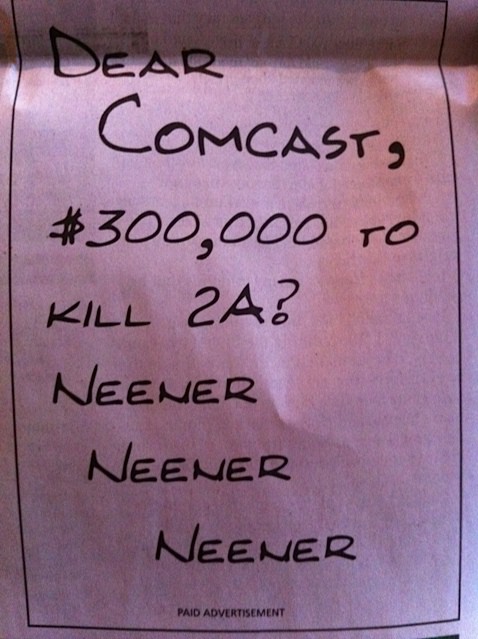
Days after the citizens of Longmont, Col. turned their backs on an expensive lobbying and astroturf campaigned fueled (not by choice) by Comcast ratepayers, the so-called “community activists” opposed to the community using its own fiber network as it sees fit evaporated into dust, but not before one celebrating citizen took out a giant ad in the local Times-Call newspaper:

As Christopher Mitchell from Community Broadband Networks discovered, “citizen activism” has an expiration date when the industry money stops flowing:

If there had been a shred of local legitimacy among the “Look Before We Leap” group that was run by Denver-based strategists, it probably would have kept its website up for longer than a few days after the election. If I were them, I would want to keep a record for the future.

But they don’t. Because they were just a bunch of paid public relations people working a job. They didn’t oppose Longmont’s initiative, they didn’t know anything about it. They were collecting a paycheck.

And when the money ran out, the days of their website were numbered in the single digits.  The only thing left of lookbeforeweleap.org is a cached copy courtesy of Google.  (And by the way, Squarespace, the hosting company, wants the site owner to contact them.)

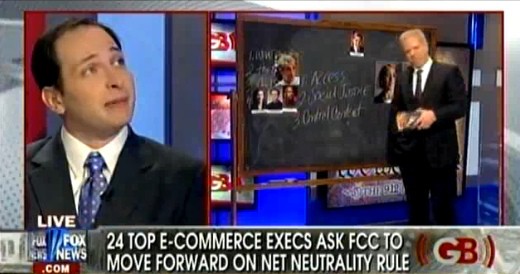
Americans for Prosperty's Phil Kerpen on Glenn Beck's show opposing Net Neutrality

Comcast’s propaganda campaign fooled no one.  Borrowing from the cable industry’s bag of old tricks, Look Before We Leap conflated Longmont’s fiber optic network with a few failed Wi-Fi projects run years earlier in concert with Earthlink in other states.

The editors at Times-Call had to respect Comcast and its merry band of dollar-a-holler followers for at least being bold.  After all, they tried to convince voters “that the city having control over its own property was somehow ‘risky.‘”  But of course the cable company would prefer Longmont stay out of the comfortable duopoly it has with phone company CenturyLink.

The newspaper had little time and patience for the antics of “Americans for Prosperity” either.  The hilariously misnamed group funded by large corporations to convince people to vote against their own best interests considers Net Neutrality and community broadband self-empowerment evidence of Marxism — at least that is what policy director Phil Kerpen said on Glenn Beck’s now defunct paranoia festival on Fox News Channel.

Longmont doesn’t put out the welcome mat for corporate influence peddlers.  Voters believe local government can be an effective steward of community resources, something Comcast subscribers don’t believe applies to a cable company that shovels hundreds of channels most people never watch and expects annual rate increases to help pay for them.

Times-Call’s Tony Kindelspire:

Ask a local businessperson how Longmont having its own electric utility is working out for them. We have some of the cheapest rates in the country.

It takes leadership to stand up against big business lobbyists to act on behalf of what you think is right, not what’s going to raise you the most amount of campaign cash the next time around. How very, very refreshing it was to see, and I hope it’s a lesson that spreads far and wide.

So do we.

Cablevision: An Attractive Takeover Target for Time Warner Cable, Says Barron’s

Phillip Dampier November 7, 2011 Cablevision (see Altice USA), Competition, Consumer News Comments Off on Cablevision: An Attractive Takeover Target for Time Warner Cable, Says Barron’s

Cablevision Systems may be engaged in a long term effort to position itself for a sale, some New York investment firms have come to believe.  The most likely buyer?  Time Warner Cable.

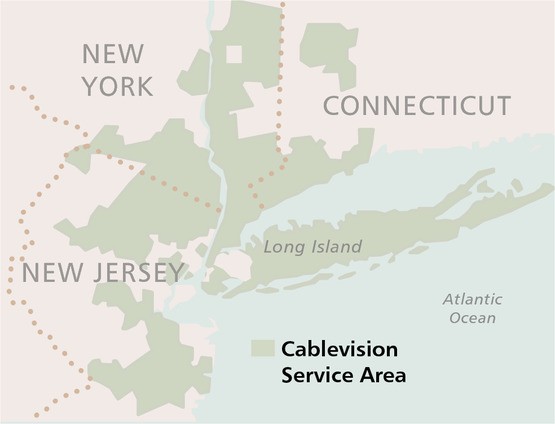
The bulk of Cablevision’s assets are located in several boroughs of New York, Long Island, New Jersey and Connecticut.  Virtually all of their service areas, outside of the acquisition of Bresnan Cable in the mountain west, are adjacent to Time Warner, making an acquisition by the nation’s second largest cable operator a natural fit.

This isn’t the first time rumors of a Cablevision sale have been floated.  The Dolan family has run the cable operator for decades, with family patriarch Charles Dolan still controlling a sizable interest in the company.  Barron’s notes the senior Dolan is currently in his 80s.  Son James, current president and CEO of Cablevision, seems more interested in his leadership role at Madison Square Garden, spun-off from Cablevision last year.

“I think the Dolans have positioned the company for a sale,” Mark Boyar, who heads Boyar Asset Management, told Barron’s.

Boyar points to Cablevision’s ongoing efforts to minimize their involvement in side businesses, such as MSG and cable networks like AMC, spun away from Cablevision on June 30.

Buyers like transactions to be simple and straightforward, and Cablevision’s operations increasingly meet both standards.

On its own, Cablevision’s growth opportunities come mostly from rate increases, which subscribers routinely complain about.  The company already enjoys the highest penetration rate among major cable operators and the highest average monthly revenue per subscriber — $150 a month vs. $113 for Time Warner Cable.  With a depressed economy and fierce competition from Verizon FiOS, growing the business (and the stock price) has become increasingly difficult in a maturing industry unlikely to attract new subscribers.

Among the only prospects for subscriber growth on the horizon comes from satellite TV subscribers.  But that alone may not be enough to keep investors satisfied, much less excited.  A sale could bring shareholders a massive return on their investment, particularly if a bidding war breaks out between likely buyers Time Warner Cable and Comcast.  Shareholders ultimately own the company, and should the Dolan family lose their love affair with cable, Cablevision and their subscribers will likely find themselves on the auction block.

Customers Flee Frontier FiOS: Company Loses A Stunning 10,000 Customers in 3rd Quarter

Phillip Dampier November 3, 2011 Broadband Speed, Competition, Data Caps, Frontier Comments Off on Customers Flee Frontier FiOS: Company Loses A Stunning 10,000 Customers in 3rd Quarter

Now selling for the "go away" price of $500 for installation.

Frontier Communications has proven it can successfully herd customers off the award-winning advanced fiber network it inherited from Verizon Communications just by increasingly gouging customers until they call and cancel.

The phone company reports success in ridding itself of 9,900 FiOS TV customers in the third quarter alone, and 3,100 FiOS Internet customers left with them in Indiana and Oregon.

Frontier CEO Maggie Wilderotter and other company executives made it known last spring that FiOS fiber optics was the unwanted stepchild best left forgotten when telling investors the company considered the fiber network unprofitable.  The company has since taken to hike rates and raised the price for service installation to as much as $500.  The combined increases have made the cable competition — Comcast — blush and look downright cheap by comparison.

Where did Frontier’s customers go?  Several left for Comcast, but others were persuaded to switch to an aggressively-priced satellite TV promotion, at least until it expires.  Frontier added 12,200 satellite subscriptions nationwide last quarter and 16,200 new DSL customers, many in ex-Verizon service areas that currently have no other choice for broadband.

The Consumer’s Guide to Universal Service Fund Reform: You Pay More and Get Inadequate DSL

Phillip Dampier November 1, 2011 Broadband Speed, Competition, Consumer News, Editorial & Site News, Public Policy & Gov't, Rural Broadband, Video, Wireless Broadband Comments Off on The Consumer’s Guide to Universal Service Fund Reform: You Pay More and Get Inadequate DSL

Phillip Dampier on USF Reform: It might have been great, it could have been a lot worse, but ultimately it turned out to be not very good.

Last week, the Federal Communications Commission unveiled their grand plan to reform the Universal Service Fund, a program originally designed to subsidize voice telephone service in rural areas deemed to be unprofitable or ridiculously expensive to serve.  Every American with a phone line pays into the fund through a surcharge found on phone bills. Urban Americans effectively subsidize their rural cousins, but the resulting access to telecommunications services have helped rural economies, important industries, and the jobs they bring in agriculture, cattle, resource extraction, and manufacturing.

The era of the voice landline is increasingly over, however, and the original goals of the USF have “evolved” to fund some not-so-rural projects including cell phone service for schools, wireless broadband in Hollywood, and a whole mess of projects critics call waste, fraud, and abuse.  For the last several years, USF critics have accused the program of straying far from its core mission, especially considering the costs passed on to ratepayers.  What originally began as a 5% USF surcharge is today higher than 15%, funding new projects even as Americans increasingly disconnect their landline service.

For at least a decade, proposals to reform the USF program to bridge the next urban-rural divide, namely broadband, have been available for consideration.  Most have been lobbied right off the table by independent rural phone companies who are at risk of failure without the security of the existing subsidy system.  Proposals that survived that challenge next faced larger phone company lobbyists seeking to protect their share of USF money, or by would-be competitors like the wireless industry or cable operators who have generally been barred from the USF Money Party.

This year, FCC Chairman Julius Genachowski finally achieved a unanimous vote to shift USF funding towards the construction and operation of rural broadband networks.  The need for broadband funding in rural areas is acute.  Most commercial providers will candidly admit they have already wired the areas deemed sufficiently profitable to earn a return on the initial investment required to provide the service.  The areas remaining without service are unlikely to get it anytime soon because they are especially rural, have expensive and difficult climate or terrain challenges to overcome, or endure a high rate of poverty among would-be customers, unable to afford the monthly cost for the service.  Some smaller independent phone companies are attempting to provide the service anyway, but too often the result is exceptionally slow speed service at a very high cost.

The new Connect America Fund will shift $4.5 billion annually towards rural broadband construction projects.  Nearly a billion dollars of that will be reserved in a “mobility fund” designated for mobile broadband networks.

The goal is to bring broadband to seven million additional households out the 18 million currently ignored by phone and cable operators.
The FCC believes AT&T will take a new interest in upgrading its rural landline networks, even as the company continues to lobby for the right to abandon them.

Unfortunately, the FCC has set the bar pretty low in its requirements for USF funding.  The FCC defines the minimum level of “broadband” they expect to result from the program — 4/1Mbps.  That’s DSL speed territory and that is no accident.  The phone companies have advocated a “less is more” strategy in broadband speed for years, arguing they can reach more rural customers if speed requirements are kept as low as possible.  DSL networks are distance sensitive.  The faster the minimum speed, the more investment phone companies need to make to reduce the length of copper wiring between their office and the customer.  Arguing 4Mbps is better than nothing has gotten them a long way in Washington, but it also foreshadows the next digital divide — urban/rural broadband speed disparity.  While large cities enjoy speeds of 50Mbps or more, rural towns will still be coping with speeds “up to” 4Mbps.

The FCC does not seem too worried, relying heavily on a mild incentive program to prod providers to upgrade their DSL service to speeds of 6/1.5Mbps.

The irony of asking AT&T to invest in an aging landline network they are lobbying to win the right to abandon is lost on Washington, and future speed upgrades for rural America from companies like Verizon are in serious doubt when they sell off their rural areas to companies like FairPoint and Frontier and leave town.

Critics of USF reform suggest the program is still stacked in favor of the phone companies, and considering the state of their copper wire networks, would-be competitors are scratching their heads.

The cable industry, in particular, is still peeved by reforms they feel leave them at a disadvantage.  Of course, Washington may simply be recognizing the fact cable companies are the least likely to wire rural America, but when they do, the service that results is often faster than what the phone company offers.  The nation’s biggest cable lobbyist — ironically also the former chairman of the FCC, Michael Powell — still feels a little abused after reading the final proposal.

“While we are disappointed in the Commission’s apparent decision to ignore its longstanding principle of competitive neutrality and provide incumbent telephone companies an unwarranted advantage for broadband support,” said National Cable & Telecommunications Association President Michael Powell, “we remain hopeful that the order otherwise reflects the pro-consumer principles of fiscal discipline and technological neutrality that will bring needed accountability and greater efficiency to the existing subsidy system.  We are particularly heartened by the Commission’s efforts to ensure that carriers are fairly compensated for completing VoIP calls.”

Wireless operators are not happy either, because the arcane requirements that come with the USF bureaucracy were written with the phone companies in mind, not them.  Small, family-owned providers find it particularly difficult to do business with the USF, if only because they don’t have the staff or time to navigate through endless documents and forms.  Phone companies do.

Your phone bill is going up.

Many consumer groups are relieved because it could have been much worse.   The FCC could have simply capitulated and adopted the phone companies’ wish-list — the ABC Plan.  Thankfully, they didn’t, but the FCC has naively left the door open to substantial rate increases for consumers by not capping the maximum annual outlay of the fund.  That follows the same recipe that invited higher phone bills and questionable subsidies awarded in an effort to justify the original USF program even after it accomplished most of its goals. Consumers may face initial rate increases of $0.50 almost immediately, and up to $2.50 a month five years from now.

The FCC, unjustifiably optimistic, suspects phone companies and other telecommunications interests won’t gouge customers with higher prices.  They predict rate increases of no more than 10-15 cents a month.  I wouldn’t take that bet and neither will consumer groups.

“We’re going to press the FCC to ensure that these are temporary increases, because history has shown that these types of costs tend to stick around and go on and on and on,” said Parul Desai, policy counsel for Consumers Union.

An even bigger question left unanswered is just how far the FCC will get into the broadband arena when it refuses to take the steps necessary to ensure it has an admission ticket.  The agency has avoided classifying broadband as a telecommunications service, an important distinction that would bolster its authority to oversee the industry.  Without it, some members of Congress, and more importantly the courts, have questioned whether the FCC has any business in the broadband business.  Just one of the many high-powered players in the discussion could test that theory in the courts, and should a judge throw the FCC’s plan out, we’ll be back at square one.

[flv]http://www.phillipdampier.com/video/C-SPAN Tom Tauke from Verizon on Changes to the Universal Service Fund 10-29-11.flv[/flv]

Verizon’s chief lobbyist Tom Tauke spent a half hour last weekend on C-SPAN taking questions about USF reform and the side issues of IP Interconnection and Net Neutrality policies. Tauke supports consolidation of small phone companies into fewer, larger companies.  He also expands on his company’s lawsuit against Net Neutrality, which fortuitously (for Verizon) will he heard by the same D.C. Court of Appeals that threw out the FCC’s fines against Comcast for throttling broadband connections.  Politico’s Kim Hart participates in the questioning, which also covered wireless spectrum issues impacting Verizon Wireless, AT&T’s stumbling merger deal with T-Mobile, and Verizon’s latest lawsuit against the FCC for data roaming notification rules.  (28 minutes)

Time Warner Cable Announces First of a Series of Rate Increases for 2012

Phillip Dampier October 31, 2011 Consumer News 4 Comments

Time Warner Cable intends to implement a series of rate increases for 2012 across many of their service areas, beginning with a 4% rate hike for their cable television service that will take effect in December.

A cable company memo received by Stop the Cap! indicates this isn’t likely to be the only rate increase from the cable operator, with possible rate adjustments for broadband and phone products to be announced at a later date.  The cable television portion of your bill will increase because of what the company calls “dramatically higher programming costs, additional programming and features, and continued investment in the company’s network and customer service operations.”

Some examples of the new rates¹, which will vary slightly in different service areas, includes new pricing for the company’s DVR box in some regions:

  • Digital Cable (was $72.99) $77.49
  • Talk & Surf (was $86.99) $89.94
  • Watch & Surf (was $118.99) $125.49
  • Watch & Surf Plus (was $141.99) $148.49
  • DVR Service (was $11.95) $12.95 (additional equipment rental charges may apply)
¹Time Warner Cable Maine

Customers currently on price protection agreements, term contracts, or special rate promotions will not be impacted by the rate increases until the expiration of their contract or promotion.  Customers will receive an official notification of the rate adjustment on their next billing statement.

Search This Site:

Contributions:

Recent Comments:

Your Account:

Stop the Cap!