Home » rate increases » Recent Articles:

Ex-Shaw CEO Rakes in Cash While Leaving Customers With Higher Bills, Poor Service

Phillip Dampier January 2, 2012 Canada, Consumer News, Editorial & Site News, Shaw Comments Off on Ex-Shaw CEO Rakes in Cash While Leaving Customers With Higher Bills, Poor Service

Ex-CEO Jim Shaw earns even more not working for the cable company his father founded.

The ex-CEO of Shaw Communications is a charter member of the 1% Club, raking in more than $25 million from a golden parachute retirement package cable customers are paying as part of their ever-increasing monthly cable bills.

Jim Shaw earned $1.2 million in 2011 from his duties as chief executive.  But when the 53-year old decided early retirement was right for him, the company that shares his name provided a generous $25.5 million parting gift.  That’s a golden parachute package equivalent to what more than 2,000 lower-middle class Canadians earn each year.

What makes Jim Shaw worth that much?  Company officials claim the departing CEO helped the company earn new revenue.  But Shaw subscribers know the recipe for higher revenue is easy to make — annual rate increases and overpriced products and services.

Shaw didn’t have much of a fight justifying his departing pay package.  Not with his father J.R. Shaw holding 79 percent of the cable company’s Class A voting stock.  The Shaw family has been especially generous with themselves in 2011.  Brother Brad pocketed $15.8 million this year for himself.

The Shaw Executive Money Party has grown so large, the company’s top six paid officers collectively walked away with compensation of $82.2 million in 2011, $1.5 million more than Shaw Communications earned in the entire fourth quarter of 2010.  Imagine one-quarter of your company’s earnings headed straight into the pockets of a half-dozen employees, often immediate family members of the CEO or company founder.

Even those sums are dwarfed by the $330 million the company has now set aside to guarantee executive pensions, even as Shaw’s lower level employees (and most of their customers) see their incomes continue to stagnate, if not outright decline.
That three Shaw family members collectively grabbed $58.6 million from the company accounts is not welcome news for shareholders.  Jim Shaw’s exit package in particular proved galling for some, particularly because he effectively sabotaged his own standing with image-damaging public comments and an abrasive management style.

“There was a lot of institutional backlash over the pension given to Jim on his departure because it was rather monstrous,” one pension fund adviser was reported as saying in the Edmonton Journal. “This is just another piece that will get everybody upset.”

Shareholders are also unimpressed with the value of their Class B Shaw stock, which has remained lackluster since 2006.

While top management earned big, Shaw has alienated customers with legendary call holding times that can extend for hours, annual rate increases for cable service, and less-than-impressive customer satisfaction scores.

Shaw is western Canada’s dominant cable operator.

 

Verizon’s Anti-Aggression Treaty With Big Cable May Be the End of FiOS

Ebenezer Scrooge could successfully serve as the CEO of any large telecommunications company these days, and the New York Times knows a Christmas tale of woe when it sees one.  That is why the venerable newspaper printed a Christmas Eve editorial blasting Verizon’s new “non-aggression treaty” with America’s largest cable companies that puts coal in the stocking for any Verizon customer waiting for FiOS fiber-to-the-home service.  The newspaper believes the days of FiOS are numbered:

Verizon — Verizon Wireless’s main shareholder — relieved itself of the need to expand FiOS, its high-speed, fiber optic network, beyond the 18 million homes it set out to reach six years ago, a rollout that cost $23 billion. For the other 114 million homes in the country, it can simply bundle its wireless service with the cable and wireline broadband services of its partners. The agreement between Verizon and the cable carriers includes a joint venture to develop technology to integrate the wireline and wireless platforms.

Verizon’s cable deals squashed hopes that cable carriers’ purchases of wireless spectrum would lead to more competition against the dominant players, AT&T and Verizon Wireless. And it puts in doubt whether FiOS will ever be a serious competitor to cable, reducing the likelihood that video transmitted over broadband could break up cable’s regional oligopolies.

[…] Verizon’s deals suggest a future in which cable carriers will get uncontested control of high-speed broadband into the home while AT&T and Verizon will get uncontested control over wireless. For consumers with expensive wireless plans, pricey bundles of cable channels and costly, slow broadband, this does not look like good news.

Verizon’s economic future lies in the lucrative world of wireless.  Its FiOS network was an expensive gamble to reinvent its antiquated telephone network to drive customers to keep their landlines and spent a hundred dollars more on video entertainment and super fast broadband.  Wall Street hated the price and loathed the potential for costly competition that would force earnings down through aggressive price-cutting.  In some markets, Verizon FiOS has forced Comcast, Cablevision, and Time Warner Cable to be a little more generous with broadband speed and lighten up a little on the annual rate increases.

But convincing cable customers to switch remains a difficult proposition even when Verizon offers the superior service.  Verizon has not achieved the level of penetration it expected in many markets.  In short, people just don’t want to wait around for installers.  Besides, cable companies slash prices for customers threatening to depart.

Verizon’s deal with Time Warner and Comcast delivers Verizon Wireless desirable spectrum.  But the agreement to cross-market and cross-bundle product lines smacks of collusion, and is exactly the kind of turf protection that has kept cable companies from competing head-to-head with each other for more than three decades.  Is it more lucrative for Verizon to build out its FiOS network to compete or simply refer people to Time Warner or Cablevision for cable TV.  So long as cable doesn’t offer a competing wireless product, Verizon seems to think there is little harm done.

But for consumers, the absence of competition brings rate increases, reduced innovation, and declining customer service.

The one thing the telecom marketplace needs less of is the “take it or leave it” attitude that earned the scorn of cable customers everywhere.

Happy New Year Rate Increase from Time Warner Cable: The $49.99 Service Call is Here

Phillip Dampier December 27, 2011 Consumer News, Data Caps Comments Off on Happy New Year Rate Increase from Time Warner Cable: The $49.99 Service Call is Here

Time Warner Cable customers in southern California face substantial rate increases in 2012, including a budget-busting $49.99 service call fee to install increasingly expensive cable service.

The bad news is arriving in customer bills this month, with substantial price hikes for cable television —  including a 27.4% increase for the package that only includes local broadcast channels.  Time Warner Cable blames increasing programming costs for the rate increases, which are several times higher than the official rate of inflation — 3.5%.  Most customers with bundled television, telephone, and Internet service will see a smaller increase on the magnitude of a few dollars, but for those picking and choosing only a few items from Time Warner’s menu, the price tag for individual services will be higher.

The largest rate increase comes when the cable company sends a truck to a home or business.  Time Warner was charging $32.99, but will now charge $49.99 — a 51.5% increase.  The cable company has also been pushing its home networking Wi-Fi option, and will now charge $69.99 to install it, up from $49.99.

Time Warner Cable spokesman Jim Gordon tells the Los Angeles Times not everyone will pay those prices.  Certain promotions may lower those rates, or waive them altogether.  But the company offered little explanation to justify such a major price hike.

One of the cable company’s competitors, DirecTV, scoffed at Time Warner’s rate increase, noting the satellite company only raised prices an average of 4% earlier this year, and anticipates a similar increase in 2012.

The effect of the latest round of rate hikes is likely to drive even more customers to cancel or cut back on cable services.  An increasing number are dropping cable television service altogether, relying on broadband for video entertainment.  The cable industry’s response to cord-cutting has been a combination of increased online viewing options for cable-TV customers and usage caps and overlimit fees on broadband that either discourage online viewing or attempts to profit from it.  Time Warner Cable executives said as recently as December they plan to eventually introduce “usage based billing” of Internet service “the right way rather than quickly.”

Silver and Gold: Wringing Customers Dry With Bell Holiday Rate Hikes & Higher Penalties

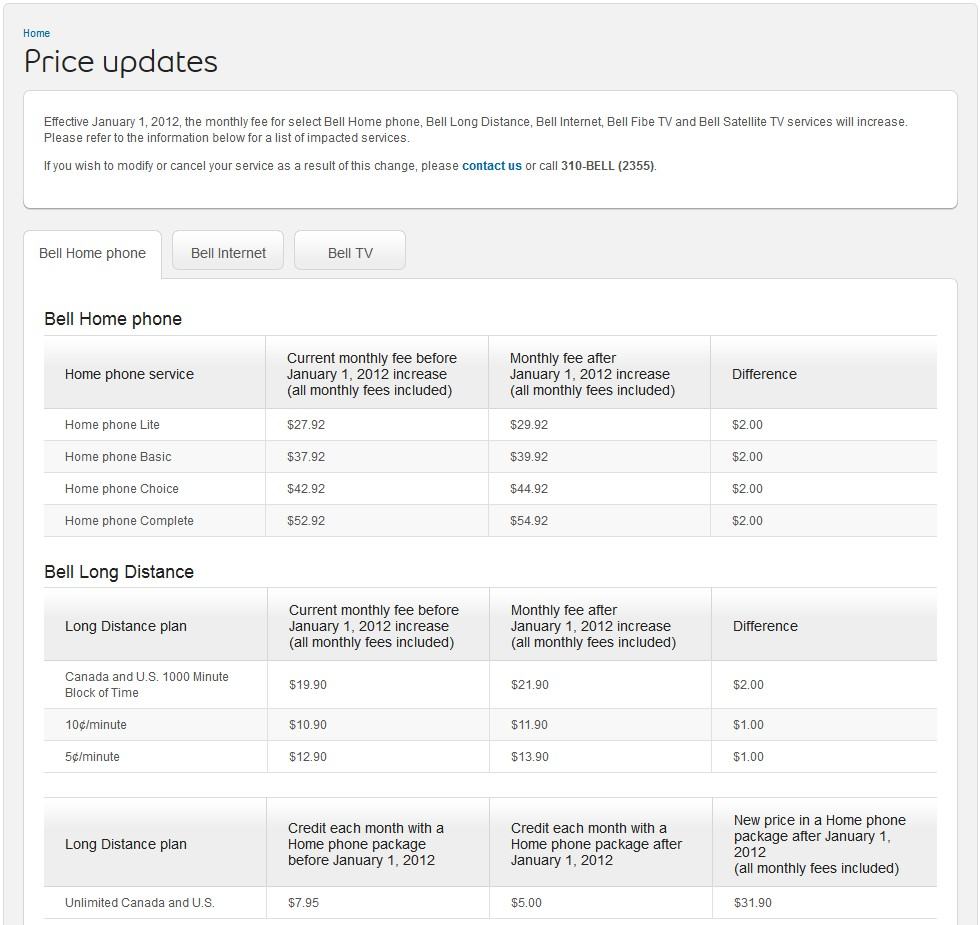
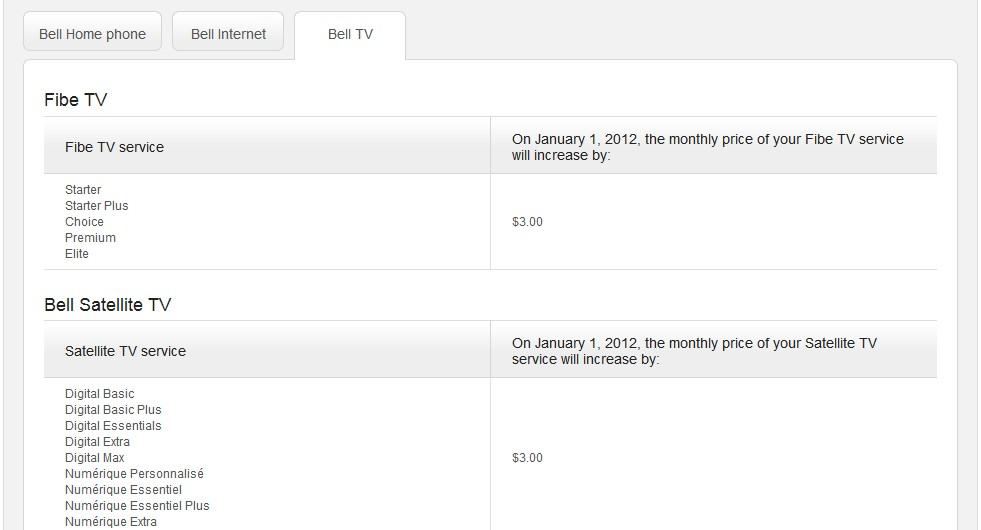
Regular Stop the Cap! reader Alex dropped us a note sharing the bad news: Bell Canada is hiking rates for virtually everything effective Jan. 1.  Except Bell doesn’t call them rate increases.  To the phone giant, they are “price updates.”  They are also considerable, with sweeping rate increases for phone, Internet, and television.  They are even hiking rates for individual phone calling features like three-way calling.

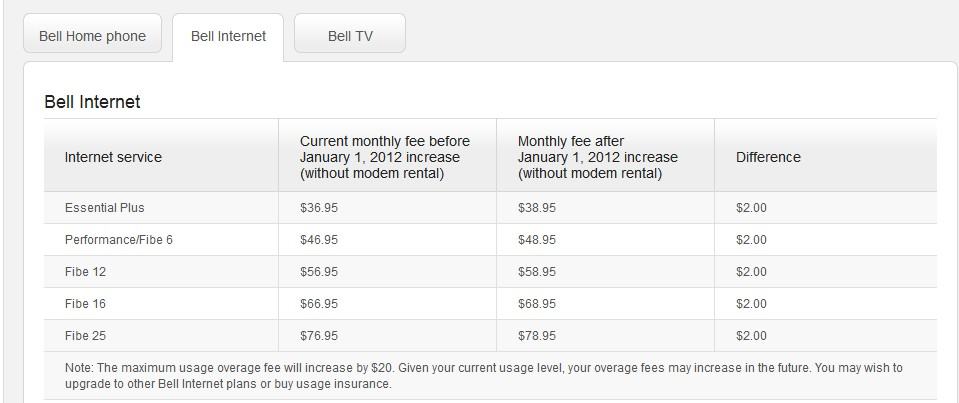
Bell reserves rate increases for its long-standing customers. Potential new customers served by Bell in eastern Canada, where the company is rolling out its fiber-to-the-neighborhood service Fibe (similar to AT&T U-verse), report offers as low as $19.95 a month for selected services during the first year.  But prices increase dramatically when the promotion expires.  By how much is detailed below:

Prices listed are for customers in Ontario.

But Bell saves the worst for a footnote at the bottom of their Internet “price update.”  They are tinkering with the company’s notorious Internet Overcharging scheme, raising the bar on their overlimit penalty.  Customers who used to exceed their monthly broadband allowance originally faced a maximum penalty of $30.  But Bell has been revisiting that “maximum overlimit fee” regularly.  In 2010 the company raised the penalty cap to $60.  On Jan. 1, Bell is raising the maximum by an additional $20 — to $80 a month.  In our view, it is only a matter of time before the ceiling on overlimit fees is eliminated altogether, setting customers up for sky high bills.

Bell Fibe 25 customers with 25Mbps service will now pay $78.95 a month for Internet alone, and that plan comes with only 125GB of usage per month.  Want to use more?  You will have to buy Bell’s Usage Insurance in advance:

  • $5/month for an extra 40GB
  • $10/month for an extra 80GB
  • $15/month for an extra 120GB

But that may not help you avoid at least one month of overlimit fees.  Bell pro-rates customers adding Usage Insurance to their accounts, which means the first month’s extra allowance is limited by the number of days before your next billing cycle.

Bell’s prices for new customers are much lower, with Fibe 25 priced as low as $34.48 a month during the first year.  The real bite arrives when the promotion expires, when the price more than doubles.

Mediacom Merry Christmas Rate Hike: Naughty/Nice, You’ll Pay More in 2012

Phillip Dampier December 6, 2011 Competition, Consumer News, Mediacom, Public Policy & Gov't, Video Comments Off on Mediacom Merry Christmas Rate Hike: Naughty/Nice, You’ll Pay More in 2012

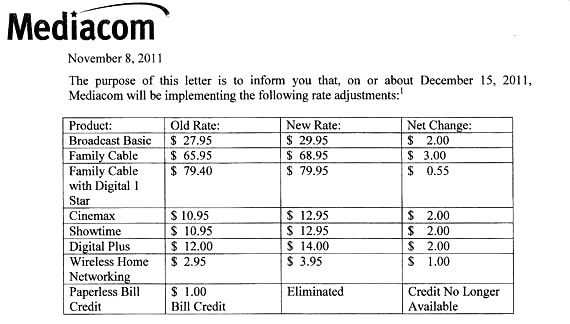
Mediacom is announcing broad price increases for many of its customers scheduled to take effect on Dec. 15.  Most cable-TV subscribers will pay $2-3 more a month for basic cable, an additional $2 a month for Cinemax and Showtime, and $2 extra a month for “Digital Plus” cable service.  To add insult, the paperless bill credit that used to knock $1 off your bill if you chose not to receive a mailed billing statement is also being eliminated.

Lee Grassley, Mediacom’s chief lobbyist, delivered the company line about the rate increase in letters mailed to subscribers.  In essence, he blamed everyone but Mediacom for the rate hikes, and in poetic language one normally doesn’t get from a cable company rate increase notification:

As our nation struggles to pull itself out of what has been called the Great Recession, we recognize that these are challenging times for the hardworking men and women living in the communities that we serve.

[…] Over the past few years, many broadcasters have used their monopoly powers to demand 100%, 200% and even 300% rate increases during contract negotiations.  This has driven up cable and satellite rates and forced American consumers to pay billions of dollars for “free” over-the-air television.

The problems with sports programming are equally alarming.  One look at the skyrocketing rights fees announced with recent deals and it is easy to see that the marketplace for live televised sports is out of control.

[…] Contrary to public perception, cable companies are reluctant to raise video prices because when we do, we lose subscribers.  Mediacom does not make money when we raise video rates, since we remit virtually every penny of the increase on to programmers.  In fact, over the last three years, our programming cost increases were more than double our video revenue increases.

Since the programming community has been unwilling to exercise even the slightest measure of self-restraint when it comes to reigning in their spending or increasing their price demands, Mediacom has taken the fight to Washington.

Mediacom as new-found-friend fighting for lower cable rates comes across as ironic, at best, to Stop the Cap! reader Noel, who lives in Mediacom’s Iowa footprint.

“This is the same cable company who pocketed rate increases annually for as long as I’ve been a subscriber, and if they can’t raise the price of the television service, they’ll just make it up on the broadband side,” Noel writes.  “They have their nerve complaining about monopolies.”

Noel points out the local station retransmission consent fees are a more recent phenomenon, and Mediacom rate increases in prior years were the same or higher.

“I think they are realizing there is an absolute maximum people in Iowa can afford for cable, and years of rate increases have allowed all of the players to assume they can slice a bigger piece from that pie for themselves, and we’re tapped out,” Noel adds.

Noel called Mediacom and threatened to cancel service and received a nice consolation price: customer retention pricing normally reserved for new customers.

“I have a year reprieve, but rest assured I will start dropping things after the deal expires at these prices.”

[flv width=”480″ height=”290″]http://www.phillipdampier.com/video/KCCI Des Moines Mediacom Rate Increases 11-28-11.flv[/flv]

KCCI in Des Moines covers Mediacom’s rate increases and the reaction from local residents who will have to pay more for cable service.  (2 minutes)

Search This Site:

Contributions:

Recent Comments:

Your Account:

Stop the Cap!