Home » rate increases » Recent Articles:

Verizon FiOS Rate Increases Announced; Tempered By Faster Service for Some

Phillip Dampier June 4, 2012 Broadband Speed, Competition, Consumer News, Verizon 3 Comments

Verizon FiOS standalone broadband customers choosing the company’s standard service will see rate increases of $10 a month starting June 17, but those upgraded to the company’s premium speed tiers, which are getting much faster, may not see any rate hike at all.

The Verge received word from an anonymous Verizon employee who passed along the rate hike information that will apply to broadband-only customers:

  • Standard 15/5Mbps service: (Was $54.99/mo) now up $10 to $64.99
  • 50/25Mbps service: (Was $74.99/mo for 25/25Mbps) remains $74.99
  • 75/35Mbps service: (New offer) $84.99
  • 150/65Mbps service: (Was $94.99/mo for 50/20Mbps) remains $94.99
  • 300/65Mbps service: (Was $199.99/mo for 150/35Mbps) now $204.99

All new pricing requires a two-year contract (month-to-month service costs $5/mo more) and home phone service with Verizon (or pay a $5/mo surcharge). Speeds of 150 or 300Mbps require a 2-4 hour service call and upgrade fee of $100 for new equipment unless you are on a two-year contract, are a new customer, or already have Verizon’s 150Mbps service. Customers living in multi-dwelling units served by VDSL and not fiber-to-the-apartment will pay the new higher price for standard service, but cannot receive the new enhanced speed tiers.

With the majority of Verizon customers paying only for standard speed service, Verizon will pocket significantly higher revenue for broadband. But customers need not pay for more expensive a-la-carte broadband. Verizon offers significant discounts for customers who sign up for triple play packages on phone, Internet, and television service. Bundled customers continue to get the most bang for the buck, but not if you don’t use the services Verizon wants to sell.

Jonathan Takiff, a columnist for the Philadelphia Daily News says he isn’t buying at the prices Verizon is charging.

I also was disappointed with the announcement that Verizon will continue to offer entry level FiOS Internet running at  15/5 Mbps. If the operation has such superior technology and capacity, why not flaunt it and give us casual users more headroom?  Even with its old school coaxial cable network, Xfinity service starts at 20 Mbps down.

Clearly, Verizon hopes  to up-sell customers to a higher, more profitable tier. And they’re using that grandiose 300 Mbps offering as an attention getter, to get folks thinking more aspirationally. Kinda like the way a car company throws a high powered, ridiculously priced, super flashy sports car into the showroom mix. Makes you go for the bigger engine in the econobox.

[…] What’s a good deal for Internet service on a global basis? In front-running Japan, the  average service runs at 61 Mbps and costs 27 cents per megabit, per month. While not quite as dramatic,  Internet services in South Korea, Finland and France also make U.S. providers look like stingy bastards.
Rogers’ “Unconscionable” Service Contracts & Bell’s Touch-Tone Fee Ripoff

Phillip Dampier May 29, 2012 Bell (Canada), Canada, Consumer News, Rogers, Video Comments Off on Rogers’ “Unconscionable” Service Contracts & Bell’s Touch-Tone Fee Ripoff

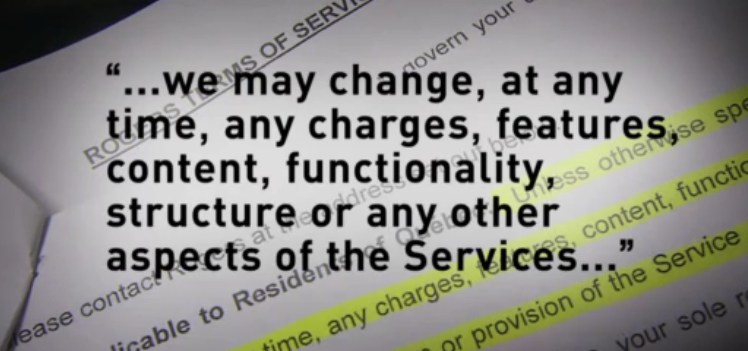
Rogers' "unconscionable" service contract allows the company to do just about anything.

Did you know that signing a contract with Rogers Communications for your broadband, phone, and cable television service will not protect you from the company’s annual rate increases?

It represents a classic example of an “unconscionable term” in a contract, according to Anthony Daimsis, a contract law professor at the University of Ottawa. Not because Rogers has inserted language that allows the company to raise rates on contract customers at will, but rather because consumers cannot escape the contract without paying a stiff early termination fee, usually approaching $200.

Rogers says its service contracts do not guarantee stable rates, instead providing a discount for bundling its services together. Most Canadians asked by CBC’s Marketwatch thought otherwise, believing it should lock in current rates for the term of the agreement.

The consumer show also chases Bell for charging Canadians $2.80 a month for touch-tone service — a fee that disappeared off most other phone company bills 20 years ago. Bell claims the touch-tone fee was introduced because the company met opposition from rotary phone customers when it tried to bundle the fee into its general price for phone service.

These days, buying a rotary dial phone requires a visit to an antique shop, but should you acquire one just to escape paying the phone company an extra $33 a year, it won’t work. Bell says the fee is now mandatory for all customers, rotary or otherwise — no one can “opt out.”

Bell’s touch tone bill padding rakes in an extra $100 million a year in revenue, all for a service upgrade paid for decades ago.

[flv width=”640″ height=”380″]http://www.phillipdampier.com/video/CBC Busted 04-2012.flv[/flv]

CBC Marketplace presents “Busted,” a special marathon edition exposing consumer ripoffs and deceptive advertising. In this clip, the show chases down Bell’s bill padding touch tone fee and Rogers’ notorious service contracts that lock customers in place -and- subject them to annual rate increases.  (13 minutes)

Verizon Preparing to Kill Grandfathered Unlimited Data Plans, Hike Rates for FiOS

Verizon Wireless will force customers off of their grandfathered unlimited data plans when they reach the end of their current two-year service contracts, according to the company’s chief financial officer.

It is all part of the cell phone company’s strategy to boost the average bills of customers with new, more expensive tiered family-shared data plans. With a significant number of current customers grandfathered on unlimited data plans that users likely will not forfeit voluntarily, Verizon will force the issue as customers come up for contract renewal.

The plan received considerable approval at today’s JPMorgan Chase TMT conference, a gathering for Wall Street investors and tech companies like Verizon.  Executive vice-president and chief financial officer Fran Shammo laid out the plan to switch customers to forthcoming family “data share” plans that are priced based on anticipated usage:

As you come through an upgrade cycle and you upgrade in the future, you will have to go onto the data share plan. And moving away from, if you will, the unlimited world and moving everybody into a tiered structure data share-type plan.

So when you think about our 3G base, a lot of our 3G base is unlimited. As they start to migrate into 4G, they will have to come off of unlimited and go into the data share plan. And that is beneficial for us for many reasons, obviously. So as you pick what tier you want to be and we think that there will be some price up in those tiers.

“Price up” is code language for bill hiking. Customers adopting family share plans may be able to share data across a larger number of devices, but at consumption pricing, many customers will find their Verizon bills substantially higher than before.

Shammo

“And the important part of that is we want the connections to come in and the way we have designed our plan, this plan is built on tiers and as we look at the future growth of LTE consumption because of the speeds and video consumption and consumption of other M2M-type devices, it is going to be more important that people will start to upgrade in their tiers as they start to really realize the benefits of the LTE network,” Shammo said. “As [customers] add more devices, they are going to have to buy up into tiers. So again, you will see the revenue increase there.”

Those revenue predictions were not sufficient to satiate Phil Cusick, an analyst at JPMorgan Chase. He questioned Shammo about the prospects for Verizon further increasing revenue with across-the-board rate increases on service plans.

Shammo would not commit to that, but was pleased with the lack of customer protests over their recent introduction of a $30 equipment upgrade fee. He called the new fee “the right thing to do.” More fees and surcharges are likely, according to Shammo.

“I think implementing these additional fees is probably where we are at,” he said. “With the construct that we have dealt with around data share and where we see consumption of LTE going, when you put the combination of them together, we are fairly confident that we will see people start to uptake in the tiers, which is really where we will get the revenue accretion in the future.”

Shammo also said Verizon’s fiber to the home network FiOS has gotten such rave reviews, it almost sells itself. That means the company will pull back on promotional offers and plans a general rate increase for all customers in the coming months, if only to bolster company profits.

“We have to do a better job in discipline of price increases and I think that you’ll see us do some price increases here over the next two quarters to offset the content increase and that will also contribute more profitability to the bottom line,” Shammo said. “You are going to have to concentrate more on reducing the amount of promotions, reducing the amount of retention that you put on the table to retain a customer and then also you are seeing that the industry is pricing up.”

Verizon FiOS customers will find rate increases applying both to equipment rental and service pricing nationwide, according to Shammo.

“We were actually below-market compared to our competitors on the amount of fee that we charge on the rental of a set-top box or a digital converter box,” Shammo explained. “We are switching around our bundles and the customers that are coming out of the current bundles will be priced up to the newer bundles. So you are going to see really a shift over the next two to three quarters in price-ups coming out of FiOS.”

As far as FiOS expansion goes, the company does not expect any major expansion in the service for the next several years.

“If we can penetrate the market and really turn the wireline profitability, could we potentially build out to other areas? Yes, but that is a decision that will be made in years out, not right now,” Shammo said. “So from a capital perspective, we are being very disciplined with where we are going to put that capital.”

Time Warner Cable’s War on North Carolina’s MI-Connection; Price-Slashing, Overbuilding

Phillip Dampier April 23, 2012 Community Networks, Competition, Consumer News, Editorial & Site News, MI-Connection, Public Policy & Gov't Comments Off on Time Warner Cable’s War on North Carolina’s MI-Connection; Price-Slashing, Overbuilding

At a time when cable operators are more reluctant than ever to overbuild into another operator’s territory, something very strange is going on in central North Carolina.

Time Warner Cable is moving into the neighborhood — one already receiving service from a community-owned cable operator.  That would be like Time Warner moving into one of Comcast’s service areas.  For some reason, those large cable companies completely avoid competing head-to-head, but where community-owned provider MI-Connection has managed to sign up around 15,000 customers for service, Time Warner Cable has also arrived.

As a result, customers north of Charlotte, in communities around Davidson and Mooresville, are getting some amazing prices for cable television, phone, and broadband.  Time Warner will even deliver an offer right to your front door.

Susan Wagner in Mooresville got her deal when she threatened to cancel Time Warner Cable and return to MI-Connection.

“(Time Warner) gave everyone a really good offer when they first came in and then drove up the price after a while,” Wagner told the Charlotte Observer.

When Wagner called to cancel, Time Warner sent an employee to her door offering to slash her cable bill by $50 a month, enough to keep her business.

Other residents in nearby Cornelius are also getting prices substantially lower than residents in cities like Charlotte, where many residents have one choice for cable: Time Warner.  Sam, a Stop the Cap! reader in the Morrison Plantation neighborhood, noted they skipped the last few rate increases from the cable company.

“You just call and tell them the rate is too high and as soon as they find out you have MI-Connection as an alternative, they lower the price,” he said. “My niece in Charlotte can’t get the same deal even when we gave her the details — it’s only good in areas where MI-Connection operates.”

That leaves Charlotte residents paying $35-50 more a month than savvy customers further north can have for the asking.

“It sounds like predatory pricing to me when the company offers a special low price that people like my niece are probably subsidizing on their higher bill,” Sam suspects.

The Observer reports Time Warner is also laying cable in other neighborhoods, such as Heritage Green, where the cable company is soliciting business from MI-Connection subscribers door-to-door.

MI-Connection’s CEO, David Auger, formerly from Time Warner Cable himself, claims he’s unconcerned about Time Warner’s aggressive overbuild of his service area.

But the state’s largest commercial cable company has been signing up some of MI-Connection’s current customer base and successfully holding its existing customers in place with significant discounts on service.  Since last July, MI-Connection signed up 667 new customers, but also lost 577 others, most likely to Time Warner Cable.

MI-Connection was launched from the ashes of a bankrupt Adelphia Cable system acquired by the communities of Mooresville and Davidson.  After investing in a needed system upgrade, the community owned provider relaunched service nearly identical technically to other cable systems.  Unlike Wilson and Salisbury, where new fiber-to-the-home systems were built, MI-Connection offers a more traditional cable package.

That makes competition with Time Warner Cable more difficult, but the community provider is trying.  Time Warner Cable’s regular pricing in the area runs $68.49 a month for 85 basic channels.  MI-Connection sells 86 channels for $61.99.  But when customers call Time Warner to complain about their higher prices, the cable operator dramatically lowers them to keep the customer’s business.

“The regular price only matters until you call and complain about it,” says Sam.

There have been complaints, but many of them are less about the cable bill and more about politics.  MI-Connection has not come cheap either town, which had to cover some of the costs of a needed system upgrade and service installation, estimated to run about $1,000 for every new customer signed.

Last fall, mayoral challenger Vince Winegardner made local government involvement in broadband a political issue, saying the purchase of the cable system was a mistake.  He lost his bid, but the system’s money needs remain a frequent topic of discussion in all of the communities involved in MI-Connection, and earlier this year the company company asked for $1.1 million from Davidson and Mooresville to ride out the rest of the fiscal year.

Time Warner’s recent interest in invading a fellow cable operator’s service area and slashing prices for those customers has raised the question whether their overbuild is about competition or predatory pricing to drive MI-Connection out of business.

Wagner doesn’t seem to mind either way, telling the Observer it is a “win-win” for her, scoring a lower cable bill with Time Warner.

But Sam isn’t so sure the savings will last.

“It seems pretty clear to me that Time Warner isn’t hurrying to compete with Comcast or Charter — just MI-Connection and that makes me suspicious,” Sam says. “After spending all that money to ban community broadband in the state, they now seem to be trying to drive out of business the handful of companies that were exempted.”

“My niece is probably paying for this right now on her cable bill too, and once MI-Connection is out of the way, those prices will shoot right back up,” Sam concludes.

Your Cable TV Bill in 2020: $200/Month — Just for Television Shows, Says New Report

Phillip Dampier April 10, 2012 Competition, Consumer News, Online Video Comments Off on Your Cable TV Bill in 2020: $200/Month — Just for Television Shows, Says New Report

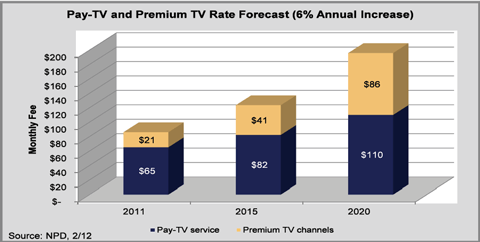
If you thought paying an average of $86 a month for basic pay television and premium movie channels in 2011 was out of line, just wait.  A new report predicts you could pay $123 by the year 2015 and $200 by 2020 — and that only includes the TV portion of your bill.

That is in keeping with typical annual rate increases, typically blamed on “increased programming costs,” which currently run an average of six percent a year.

The NPD Group, who published the findings, predicts consumers may not sit still for that kind of monthly cable television bill, especially as household incomes for the middle class continue to remain stagnant, even as high fuel and health care prices continue to march higher.

The pay television industry isn’t entirely responsible for the annual rate hikes that nearly always outpace the rate of inflation.  The real money is in programming production and distribution, which is why giant companies like Comcast, Bell, Rogers, and Viacom are buying up programming studios, distributors, and networks at a rapid pace.

With new players like Netflix, Amazon, and Redbox joining traditional pay television and broadcast network bidders, auctions for exclusive licensing agreements bring higher and higher bids.  Ultimately, consumers pay the price in the form of higher bills.  Even cable networks, sensing an increase in the value of their programming, are extracting higher monthly fees at contract renewal time.

The last to arrive at the programming money party?  Local over-the-air broadcasters that used to beg cable companies to carry their channels on the local lineup.  Now some are demanding as much as $5 or more per month per subscriber to allow the cable operator to keep carrying the stations.

“As pay-TV costs rise and consumers’ spending power stays flat, the traditional affiliate-fee business model for pay-TV companies appears to be unsustainable in the long term,” said Keith Nissen, research director for The NPD Group. “Much needed structural changes to the pay-TV industry will not happen quickly or easily; however, the emerging competition between video on demand and premium-TV suppliers might be the spark that ignites the necessary business-model transformation of the pay-TV industry.”

In other words, the more consumers cut cable’s cord and go find other ways to watch their favorite shows, the more unsustainable the traditional pay television business model will become.  Some industry watchers believe cord-cutting is not a major issue.  Others believe continued rate increases will drive customers to cancel service, particularly when alternatives are available. But NPD believes economic factors are the biggest reason for cable cord-cutting.  Those ex-customers are switching back to free “over the air” television, which now delivers better picture quality and often includes additional channels that increase the number of viewing options.

NPD Group research shows most consumers don’t want to exert too much effort to hunt down online programming. Most will put up with their current provider as long as they deliver the shows they want at a price they can afford.  What could change that?  Easy-to-access to a-la-carte programming, perhaps available from services that may soon come built-in with the newest television sets.

“Pay-TV providers offer a convenient, one-stop shop for subscribers, and the majority of customers like it that way,” said Russ Crupnick, senior vice president of industry analysis for The NPD Group. “There is an open window for the industry to meet consumer needs and become to television what iTunes is to music; however, there is also a definite risk if pay-TV providers don’t capitalize on the opportunity — and soon.”

Search This Site:

Contributions:

Recent Comments:

Your Account:

Stop the Cap!