Home » rate increases » Recent Articles:

Chattanooga’s Can-Do Broadband: Faster Speeds, Lower Prices While Others Hike Rates

Phillip Dampier September 18, 2012 AT&T, Broadband Speed, Comcast/Xfinity, Competition, Consumer News, Editorial & Site News, EPB Fiber, Public Policy & Gov't Comments Off on Chattanooga’s Can-Do Broadband: Faster Speeds, Lower Prices While Others Hike Rates

While cable and phone companies make excuses justifying rate increases and usage caps, Chattanooga’s publicly-owned EPB Fiber network has been blowing the windows out with hurricane-fast gigabit broadband, and now they are cutting prices for some while boosting speeds for others.

At the recent Hackanooga event, EPB customers learned the fiber to the home provider was set to celebrate three years of service by delivering value for speed that Comcast and AT&T can’t touch:

  • 30/30Mbps customers will now receive 50/50Mbps service for $57.99 a month;
  • 50/50Mbps customers are now getting 100/100Mbps speeds for $69.99;
  • 100/100Mbps customers are now seeing 250/250Mbps service for $139.99;
  • 1000/1000Mbps service is getting a significant price cut: $299.99 a month, down $50.

In comparison, Comcast customers pay $115 a month for hardly-comparable 105/20Mbps service and they will nail you with a modem rental fee. Don’t call AT&T for 100Mbps speeds, they’ll call you. The U-verse platform can’t even achieve 30Mbps in its current configuration.

“This is the second time EPB has upgraded service to customers for free,” says Lisa Gonzalez from Community Broadband Networks. “In 2010, EPB upgraded 15Mbps service to 30Mbps.”

Gonzalez notes that if customers review their bills from Comcast, Time Warner Cable, AT&T, and others, they will find rate increases outnumber speed boosts. EPB Fiber has not increased broadband prices for three years.

Skeptics of community-owned broadband network might also take note: EPB Fiber CEO Harold DePriest reports the company has now passed 40,000 customers in the Chattanooga area and has made $4 million, despite original projections of a loss of $8 million in the third year of operation.

What makes the difference? Competitive broadband, phone, and television packages and customer support that easily surpasses what Comcast and AT&T offer in Tennessee. EPB is also Chattanooga’s municipal electric utility, so it understands the importance of keeping service up and running for customers. EPB is also heavily involved in the local community, and its revenue stays in southeastern Tennessee instead of being shipped back to Philadelphia (Comcast) or Dallas (AT&T). Comcast made it to #4 on the American Customer Satisfaction Index’s 15 most disliked companies roster. AT&T scored #3 on 24/7 Wall St.’s Most Hated Companies list.

Verizon Cutting Costs, Raising Prices & Profits; Unlimited Data Customers Invited to Leave

Verizon is pulling back on its traditional landline service and FiOS expansion to continue focusing on its more-profitable wireless service.

Verizon Communications’ landline customers will endure continued cost cutting as the company focuses on its increasingly profitable wireless division, now set to bring in even more profits with Verizon Wireless’ transition to new, often higher-priced service plans.

Verizon executive vice-president and chief financial officer Fran Shammo yesterday told investors attending Bank of America-Merrill Lynch Media’s Communications & Entertainment Conference that the company is pleased with Verizon Wireless’ successful transition to Share Everything, which includes a shared data plan for multiple wireless devices.

Shammo characterized the true nature of Share Everything as a data plan that happens to include unlimited calling and messaging.

“It really comes down to data consumption and that is what drives revenue,” Shammo told investors. “And really the reason we did this was because we saw what happened in Asia with some of the text messaging and the dilution and voice migration.  So you are protecting that revenue stream going forward and we think that is beneficial to the consumer and the company.”

Shammo sees increased profits in Verizon’s future as customers transitioning away from unlimited data plans eventually bump up and over their new plan limits. But the revenue gains actually begin the moment customers sign up, as those bringing various wireless devices to a shared data plan are immediately told to upgrade for a larger data allowance at an additional cost.

“We are telling them that they really need 2GB per device,” Shammo said. “So if they want to bring five devices, they really should be buying the 10GB ($60/month) plan. What we are finding is customers are very receptive to that formula because they can get their head around the 2 gigabytes. They understand what their usage is. So part of it is that they are actually buying higher up packages than we’ve anticipated.”

Verizon also has a plan to deal with potential bill shock from customers using their wireless devices for high bandwidth applications. The company is receptive to letting content producers pay Verizon to cover customer usage charges.

Share Everything = a data plan that happens to include unlimited calling and messaging

“So when you look at that, revenue per account may not go up, but service revenue will because you are just getting it from someone else,” Shammo said. “So the LTE network allows the differentiation, and the way I like to classify it as you can have an 800 service over here, which is ‘free data’ because somebody else is paying for that and then you have your consumption data over here.”

Shammo believes customers who gave up their unlimited data plan believing Verizon’s basic data allowance will suffice for years to come will be surprised at how fast they will hit their limits as wireless data becomes more important.

“I think we are going to see this accretion faster than people think,” Shammo said. “If you look at our SpectrumCo [cable operators Cox, Comcast, Bright House Networks, and Time Warner Cable] deal, [CEO Lowell McAdam] and the team did an outstanding job convincing the Department of Justice about the innovation that can happen here and maybe being the first in the world to really integrate wireless with inside the home and content outside the home. And if you think about how that content can be streamed outside the home within cars, you really say this is unlimited as to where this can go. So I think the innovation is going to come very, very quickly here.”

With the spectrum deal with cable operators in place, Shammo said Verizon will not be in the market for any large spectrum acquisitions in the near future, and even plans to sell off some excess spectrum it does not currently need, so long as the company gets paid what it believes the spectrum is worth.

Verizon’s concern for keeping large amounts of cash on hand is evident as it continues to reduce investments in traditional landline service and FiOS. In fact, Verizon said it would continue increasing prices for its FiOS fiber network to more closely align with the higher prices cable companies are charging.

“We have really concentrated this year on getting our price points equivalent to where the rest of the market was,” Shammo said. “We were actually underpriced with a superior product to cable. So the concerted effort was we needed to do some price-ups and we are doing that over — we started in the first quarter. We did it in the second; we are doing it in the third. You saw some of that benefit come through in the second quarter where we delivered a 2.5% mass-market revenue increase, which was I think the best in years and I see that doubling by year-end. So I think that, coming out of this year, we will be on a very good path for a mass-market revenue increase.”

Two service calls in six months may get your traditional landline canceled and moved to Verizon FiOS phone service, which requires 10 digit dialing for every number.

But those rate increases will not deliver improved service. If fact, Shammo said Verizon will continue reducing costs and investments in its network. Much of its investment in the landline business has been to support Verizon Wireless’ growth through its IP backbone and fiber-to-cell-tower projects. Shammo predicts capital investments will continue to be flat to down.

One example where the cost-cutting is apparent is how Verizon deals with service calls for troubled phone lines.

Verizon landline customers in FiOS areas who report chronic service problems may find themselves disconnected and switched to FiOS Voice over IP phone service instead, because Verizon has quietly set new in-house rules about the number of permitted service calls for each customer.

“If we have a copper customer who is what we classify as a chronic (two truck rolls in a period of six months for that copper line), I am losing money on that copper customer,” Shammo said. “So if I can take that chronic customer and move them to FiOS, I deplete the amount of operational expense to keep that customer on and now I have moved them over to the FiOS network where they get the benefit of FiOS digital voice, which is clearer.”

Once a customer gets switched to FiOS, Verizon’s marketing machine swings into action.

“I now can put their DSL service onto FiOS Internet where they now realize the speeds of FiOS and what we are seeing preliminarily is even if we take a voice and DSL customer and move them, they are starting to buy up in bundles because they are starting to see the benefit of the higher speeds,” Shammo said. “Then we open up the sales routine to go after them, now for the FiOS TV product.”

Unlimited data holdouts can leave

Shammo added Verizon is becoming more concerned than ever about long term investments that leave the company waiting years for a return.

“Lowell and I have a very concerted effort to really make sure that the investments we make are returning their invested capital in a very short period of time,” said Shammo.

That spells trouble for landline service upgrades and future FiOS expansion, which both require the company to take a long term view recouping those investments. But even Verizon’s wireless business’ capital expenses are down — by $1.3 billion through the first half of this year.

Verizon Wireless has also picked up nearly $5 billion in cost savings through restructuring, including lucrative revenue earned from new activation and upgrade fees and also tightening up on subsidized wireless phone upgrades.

For customers holding onto unlimited data plans, intending to get their money’s worth from them, Shammo has a message:

“Quite honestly, they could leave my network because you are not making much money on those.”

Shear Madness: Friends of Big Telecom Still Shortsighted on Why Broadband Competition is Important

Phillip “Artificial Scarcity for Fun and Profits” Dampier

It would be an understatement to say I’ve heard the argument once or twice that there is simply no economic room for additional players to enter what Big Telecom companies always claim is a robustly competitive marketplace for Internet access.

Virtually every company facing inquiries from regulators, politicians, and consumers always makes the point today’s deregulated broadband playing field is an excellent example of free market competition at its best.

While they advocate for even more deregulation, oppose the entry of community-owned broadband services, and demand more spectrum from Washington lawmakers, we endure a veritable monopoly/duopoly for Internet access. Their defense, after a dismissive rolling of the eyes, is that we just don’t understand business.

Enter Tim Lee, writing for the alternate reality reader of Forbes, who decided to prove his argument by comparing broadband with Supercuts:

Being the first to build a hair-cutting shack in a particular customer’s backyard can be pretty lucrative. It gives you a de facto monopoly on that household’s haircut business. Let’s assume that it takes 4 years worth of haircuts to recoup the costs of building a shack for a particular household. While barbers will need to raise some extra capital to build the shacks, in the long run the owner of the first shack may be able to earn big monopoly rents.

Now along comes a new barber who wants to enter the hair-cutting business, but every household already has at least one hair-cutting shack. So he needs to build hair-cutting shacks in backyards where another barber has already built one. And that’s an economically precarious situation. Remember, we assumed a monopolist needs to do 4 years worth of haircuts in order to break even. But if you build a shack in a backyard that already has another barber in it, you shouldn’t expect to get more than half of the customer’s business, on average, over the long run. Not only that, but competition will push down prices, so you’ll have to do more haircuts to recover the costs of construction. So you’ll be lucky to recover your initial investment within 8 years, and it could easily take more than a decade.

And things are even worse for the third or fourth barber who builds in a particular backyard. The fourth barber will be building in a yard that already has three barbers. He can only expect to attract 25 percent of the household’s business, and strong competition among barbers means his margins will be pretty thin. It’s hard to see how he could ever recover the costs of his investment.

Brushing away the hair-cutting analogy, Lee’s point is that it is wasteful and inefficient for competitors to overbuild new networks where others already exist. The phone and cable companies that dominate the marketplace today decry additional competition as a death blow to their business models, because with so many providers fighting for customers (by lowering prices and offering better service), not every provider can sustain a profit Wall Street investors expect quarter after quarter. This argument is particularly common when attacking those dastardly socialist community-owned broadband providers they say destroy private enterprise (while unconvincingly also warning they will always fail and cost taxpayers millions on the way down). It is also why Wall Street continues to beat the drum for additional consolidation in the wireless marketplace, where anything more than AT&T and Verizon Wireless represents too much revenue destruction.

Lee does make some valid points:

  1. Infrastructure costs are the biggest expense in launching a new network, especially wiring the last mile to customers;
  2. Verizon FiOS overestimated its potential market share and found it harder to turn a profit than first anticipated;
  3. Other utilities have avoided building redundant networks (ie. you don’t have two companies providing their own electric, water, and gas lines).

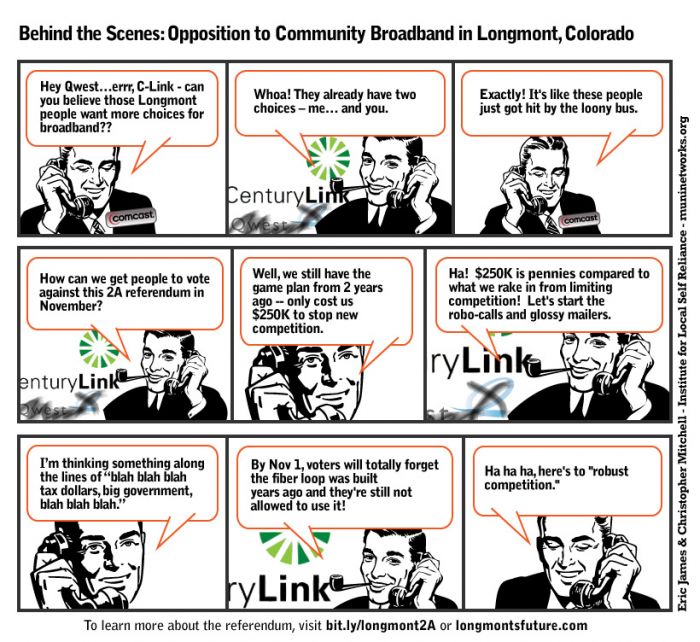
When communities decide to offer their own broadband service, incumbent cable and phone companies spend big bucks to scare residents.

But Lee’s conclusion is entirely favorable to the industry he often defends — that is just the way things are and customers should not expect anything better.

Those arguments are usually also the basis for free market declarations that if a private company cannot find a way to deliver a service at a profit, then those left out will just have to do without.

Thankfully, despite Lee’s criticism of Google Fiber in Kansas City as “extremely wasteful,” the search engine company is perhaps best positioned of all to turn the industry’s common refrain against new competition on its head.

Every so often, a surprising third party shows up with the resources to ignore Wall Street’s conventional wisdom. Enter the deep pockets of Google Fiber or a bond-backed community provider threatening to deliver service far better than what a community currently enjoys. The predictable defense from incumbent providers:

  • Nobody needs faster broadband speeds;
  • Community networks are a government takeover of the Internet;
  • Fiber optics are expensive and represent an unnecessary investment;
  • Public broadband destroys private investment and jobs at incumbent commercial providers;
  • This is just a political stunt, not a real effort at taking Internet speeds to the next level.

Without the kind of competition on offer from Google, community providers, and private providers like Verizon taking a chance on FiOS fiber optics, there would be no room for innovation in the marketplace.

Provider tolerance for today’s marketplace duopoly and the lackluster service that results is reminiscent of a joke told by President George W. Bush’s in 2000: “If this were a dictatorship, it would be a heck of a lot easier…just so long as I’m the dictator.”

It is easy for today’s comfortable duopoly providers to take shots at would-be competitors while dragging their feet on network upgrades. They have little to fear with Wall Street on their side, joining opposition to new competition as harmful to profits. Even Verizon Communications, one of the two dominant providers, quickly heard from analysts irritated with the infrastructure expenses involved upgrading to a fiber optic network. At the heart of that criticism was a sense it was an unnecessary expense, with no reason to change the safe and reliable status quo. Innovation that costs money is the enemy of Wall Street, unless competition warrants the investment.

Therein lies the key. Effective, disruptive competition demands companies do something different. Lee may be right that three companies cannot easily bring home the big profits. Wall Street may have to make do with less. In a competitive market, the player offering the least will be the first to innovate to keep or attract customers, or eventually close their doors. Those remaining will compete in turn to deliver the best possible service at the lowest possible price. That itself is a departure from the comfort zone enjoyed by phone and cable operators today where neither feels much pressure. Cable companies won’t ever compete with other cable companies and the same is true for phone companies. But if a company like Google arrives, the decade-long coffee break is over.

Want proof? Just look at cable operators struggling to keep video customers who are now finding alternatives with Netflix and online viewing. They are increasingly looking for ways to enhance the value of cable television by offering online viewing themselves. Even rate increases have slowed. If Netflix and cord-cutting were not factors, would cable companies have changed the way they do business?

Google’s marketplace disruption delivers for consumers.

Lee is right saying it is not easy to break into the broadband business. Only some might realize the same investors and Wall Street barons that dislike profit-eroding competition also often happen to be in the business of loaning money to finance new businesses. More than a few will turn those loans down as too risky to contemplate.

But here comes the rhetorical trap Lee’s argument gets ensnared in: If running redundant networks is wasteful and we still need competition, the logical solution would be to construct or nationalize one advanced network on which all providers would market their services. Why waste time and money on duplicate copper and coaxial networks when a single fiber to the home network could deliver improved service well beyond what the local phone and cable company can offer.

Isn’t the answer to run a single telecommunications line into customer homes (one preferably not controlled by any provider), and let competition bloom on that advanced infrastructure? That is the solution Australia has chosen, scrapping the country’s ancient copper wire phone lines in favor of one national fiber network. Most community providers also operate open networks that other cable and phone companies can utilize (but often petulantly refuse).

Somehow, despite the enormous savings possible from sharing or offloading network infrastructure expenses, I doubt providers will consider that the kind of innovation they want or need.

Deregulation Savings? CenturyLink Wins Right to Raise Phone Rates in Arizona

Deregulation likely means higher phone bills for CenturyLink customers in Arizona.

CenturyLink has convinced Arizona state regulators local phone service is now competitive throughout the state, allowing the company to raise rates with less regulatory oversight. But some consumers are wondering how deregulation benefits them.

“Once again the phone company has sold us another bill of goods in Arizona,” says Tucson ex-CenturyLink customer Miguel Gonzalez. “First Qwest and now CenturyLink told us that deregulation would bring rates down for phone service, yet both companies fought for years to raise, not lower prices.”

Under the plan approved by the Arizona Corporation Commission, CenturyLink will be able to raise its residential rates up to 10 percent per year, so long as the rate increases do not exceed 25 percent over three years.

Arizona residential landline customers have paid roughly $13.18 for standard urban phone service since the 1990s, when Qwest was the local phone company. Now CenturyLink is free to raise those prices $1.30 a month in any of the next three years or up to $3.30 overall, even as customers continue to disconnect service across the state. Business customers face potentially higher rate hikes — 15 percent annually or 25 percent over three years.

Regulators expect the company to file for a rate increase before you finish reading this article.

Oddly, both CenturyLink and some members of the commission called the change a victory for consumers, despite the likely higher rates to follow. The plan won approval in the Republican-controlled body in a 4-1 vote.

“It should be a win-win for the consumer (and the company),” said Democrat commissioner Paul Newman, who represents southern Arizona and voted for the plan with reservations. “That’s yet to be seen, but I hope it will be.”

The Arizona Daily Star reports CenturyLink will not be able to charge different rates in competitive and less-competitive areas, which consumer advocates say will protect ratepayers in areas where wireless coverage is poor and cable companies do not compete.

CenturyLink said it needs “rate flexibility” to compete as people disconnect landlines and head for cell phones and cable company “digital phone” products. Although the company did not elaborate, it argues the right to raise rates will allow it to compete more effectively with dominant cable operators Cox and Comcast.

Prior to deregulation, CenturyLink was allowed a guaranteed rate of return based on the true cost of providing landline phone service. The company also guaranteed to provide phone service to any Arizona resident inside of its service territory who asked. Under the terms of the new agreement, CenturyLink will now enjoy more rate flexibility, but will continue serving as the phone company of last resort.

“I’m still scratching my head about how the pointy-heads in Phoenix believe that raising rates makes you more competitive with cable and cell phone companies and not less,” Gonzalez says. “I guess it’s the same kind of New Phone Math that CenturyLink uses to try and keep the customers that are slipping away from them faster than ever.”

Gonzalez says he pulled the plug on CenturyLink last August.

“They offer nothing compelling to me when I can get a better price and better service with more calling features from the cable company, and now they offer even less.”

“Increased Programming Costs” Cause Comcast to Jack Up Broadband Rates 6.1% in Oregon

Phillip Dampier August 27, 2012 Comcast/Xfinity, Competition, Consumer News, Frontier Comments Off on “Increased Programming Costs” Cause Comcast to Jack Up Broadband Rates 6.1% in Oregon

In a new twist, Comcast has announced rate increases for cable television that are roughly at the rate of inflation (2.3%) — the lowest rate increase for the company since 2001 — but is also hiking rates for Internet service at a substantially higher rate.

The company claims the Internet rate increase is partly due to the increased number of channels on its cable systems in Oregon and southwest Washington, as well as the cost to launch new interactive applications and multi-platform content that customers want and value.

Comcast’s rate increase for video represents the new reality for the cable business — companies continue with 7%+ increases in cable TV rates at the risk of cord cutting, analysts say. With cable television packages increasingly seen as ripe for cutting as they grow more expensive, cable operators are turning to broadband — a service customers can’t live without — to make up the difference.

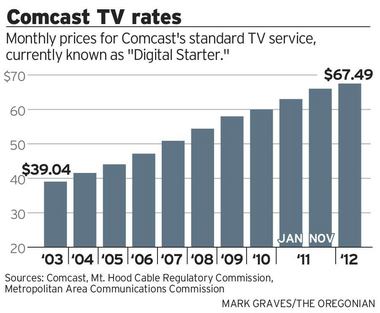
Comcast had not touched broadband rates in the Pacific Northwest for seven years, until the company began hiking them in 2011. Monthly rates for the popular “Performance” Internet service (15Mbps) are going up again this year, from $48.95 to $51.95, according to The Oregonian. Prices are higher for standalone broadband service. Comcast’s Digital Starter TV package is increasing to $67.49 a month. Rates for customers on promotions will not  increase until those offers expire.

But some customers complain Comcast is now charging nearly $200 a month for its triple-play package.

One customer told the newspaper after his introductory triple play promotion expired, the bill rose to $190 a month for phone, Internet, and cable service with two DVR boxes. The customer does not have any premium movie channels.

The Oregonian has tracked Comcast’s rates in the Pacific Northwest for almost a decade. The staircase of climbing prices for cable television is leveling off as Comcast makes up the difference from its Internet rates.

The newspaper noted Frontier Communications, which provides competition for Comcast in the suburbs of Portland, has given Comcast only a slight headache.

Frontier continues to offer its barely-advertised FiOS television package for around $65 a month, but customer complaints about Frontier’s service in the area have been reflected by Comcast’s growing subscriber numbers.

One Oregonian reader summed up his feelings about Frontier:

Frontier was atrocious. I don’t just mean bad, I mean an embarrassment to humanity […] which chimpanzees and dolphins laugh at us for putting up with. I’ve had Frontier service for a little over a year now only because there is nothing else where I live.

The nightmare started with them coming out hook up DSL at my new house, but instead of hooking me up, [they tore] out the demarc box on the house and left with it,  lost all records of ever having talked to me, much less scheduling an appointment.

After finally getting Internet service a week late, the original [service order] showed up leading them to bill me for multiple accounts, which took five months to  resolve. They never were able to prove to me I actually owed what I ultimately paid (I got them to within one bill’s worth of my calculated value and gave up).

Half of the time I’ve held off paying my bill until a day or two before the due date so it’s too late to mail a check and their online payment system is down, forcing me to call in my payment and pay a $3 service fee.

All of that is on top of the blatant theft of forcing customers who already own modems to pay a “modem rental fee” for a modem they aren’t renting.

Search This Site:

Contributions:

Recent Comments:

Your Account:

Stop the Cap!