Home » rate increases » Recent Articles:

Sick of Paying Time Warner Cable for More Sports Channels? Sue!

sportsnetTime Warner Cable’s decision to spend $11 billion to broadcast Los Angeles Lakers and Dodgers games at an estimated cost of $50-60 a year per subscriber is the subject of a class action lawsuit from fed up customers.

The plaintiffs are upset cable subscribers across Southern California will have to cover the cost of the 20-year deal with no option to opt-out of the sports channels because they are bundled into the most popular cable package.

The suit, filed this week in Superior Court alleges at least 60 percent of subscribers have no interest in the sports programming, but will collectively cover $6.6 billion of the deal and never watch a single game.

Time Warner Cable is also accused of forcing AT&T U-verse, Charter Cable, Cox Cable, DirecTV and Verizon FiOS to sign restrictive contracts that compel the companies to include the sports channels on the basic lineup.

Ironically, Time Warner Cable itself regularly complains about the increasing cost of programming and contract terms that force it to bundle expensive sports channels inside the basic tier instead of offering customers optional, added-cost sports programming packages.

Both sports teams are also named as defendants in the suit because they were aware that all subscribers would face rate increases as a result of the deal.

“TWC’s bundling results in Defendants making huge profits, much of which is extracted from unwilling consumers who have no opportunity to delete unwanted telecasts,” the complaint states.

The suit claims there is no legitimate reason Time Warner Cable and the sports teams could not have offered the new networks only to customers that wished to pay for them. The suit wants the bundling of the sports networks stopped and customers given refunds for the higher television bills that resulted.

Time Warner Cable Modem Rental Fee Increased to $4.99/Month for New Customers

Phillip Dampier June 17, 2013 Consumer News, Data Caps 14 Comments
one time charge

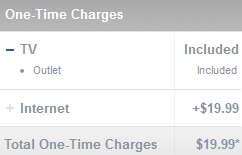
Time Warner’s “Because We Can” One-Time Charge applies to new customers signing up for certain promotions.

Time Warner Cable has increased the monthly rental fee for its leased cable modem from $3.95 a month to $4.99 a month and has introduced a “one-time charge” of $19.99 applicable to certain Internet service new customer promotions.

CEO Glenn Britt earlier commented that Time Warner Cable had room to grow its modem lease fee:

“It was received with a minimum of push-back and we’re still actually charging less than Comcast ($7/month), so I think there is room to charge more going forward. People can buy their own if they want and a small percentage of customers have chosen to do that which is fine with us.”

For now, the increase only applies to new customers, but Stop the Cap! expects it will also eventually apply to current customers as part of the next round of rate increases. The Internet Modem with Free Home Wi-Fi, available to customers ordering 30/5 or 50/5Mbps service costs $14.99 a month.

Time Warner Cable has pulled back on customer promotions since the beginning of the year and has begun shifting its pricing for its most profitable service — broadband, to capture price-sensitive customers who have been unable to previously afford Internet-only service from the company.

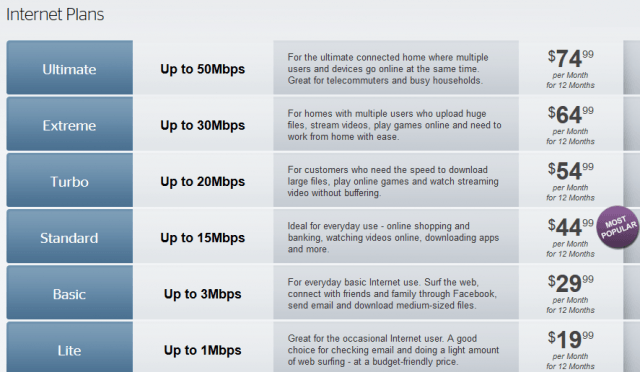
Time Warner has introduced a new “Lite” tier offering 1Mbps service for $20 a month and has made the 3Mbps “Basic” service the staple of many of its bundled promotions.

twc pricing

twcGreenStop the Cap! strongly encourages Time Warner Cable customers to buy their own cable modems and avoid the rental fees. Customers can also bypass the rental fee by signing up for Earthlink service through Time Warner Cable.

Our top modem choice remains the Motorola SB6141, which can be found at the “Buy It Now” price on eBay as low as $77.99 with free shipping and no upfront sales tax for most buyers. This model does not include Wi-Fi, but most people don’t need it — a router generally provides Wi-Fi connectivity on its own.

We highly recommend purchasing DOCSIS 3-ready modems to avoid obsolescence issues.

The most recent list of “acceptable” modems that can be activated with your Time Warner Cable broadband service are:

Turbo, Extreme and Ultimate Service Plans

Vendor Model
Motorola SBG6580
Motorola SB6141 STOP THE CAP! RECOMMENDED
Netgear CMD31T
Motorola SB6121
Zoom 5341J
Zoom 5350
Zoom 5352
ZyXEL CDA-30360

Lite, Basic and Standard Service Plans

Vendor Model
Motorola SBG6580
Motorola SB6141 STOP THE CAP! RECOMMENDED
Motorola SB5101
Motorola SB5101U
Motorola SBG901
Netgear CMD31T
Motorola SB6121
Zoom 5341J
Zoom 5350
Zoom 5352
ZyXEL CDA-30360

AT&T: We Know What You Are Watching and Why Metered Broadband Is Good (for AT&T)

Phillip Dampier June 4, 2013 AT&T, Competition, Data Caps, Online Video, Rural Broadband, Wireless Broadband Comments Off on AT&T: We Know What You Are Watching and Why Metered Broadband Is Good (for AT&T)
Top secret.

We know what you are watching.

AT&T’s efforts to expand its U-verse platform to more communities is all about improving AT&T’s growing revenues in the broadband business and further monetizing customers’ broadband usage.

Those are the views of Jeff Weber, AT&T’s president of content and advertising sales. Appearing at last week’s Nomura Global Media Summit Conference, Weber also admitted AT&T is using viewer data collected from U-verse TV set-top boxes to help decide what networks to carry and which can be dropped because of lack of viewership.

Weber appeared at the conference to talk about the implications of Project Velocity IP — AT&T’s investment in expanding its U-verse platform and its proposal to transition rural landline customers to AT&T’s wireless service.

AT&T claims when the project is complete, two-thirds of its landline customers will have access to U-verse, and 99 percent of AT&T’s wireline service areas will be covered by AT&T’s mobile network.

Weber’s job primarily focuses on AT&T’s U-verse TV service — dealing with all the networks on the lineup and selling advertising time.

Although television programming is an important revenue generator for AT&T, broadband revenue is the real focus behind AT&T’s U-verse expansion.

“At the core, it is about improving the fundamental broadband business, extending our footprints to be able to cover more of our customers,” Weber said. “Because our core belief is that the broadband business is [going to be] a very good business for a long time.”

Weber

Weber

One way AT&T can further increase revenue is to limit broadband usage and charge overlimit fees for customers who exceed their monthly allowance. AT&T currently limits DSL customers to 150GB of usage per month, 250GB for U-verse broadband. The overlimit fee is $10 for each additional 50GB of usage. At present, both the usage limits and overlimit fees are not broadly enforced in many areas.

“I think very clearly incremental broadband usage is going to drive incremental revenue,” explained Weber. “Part of that assumption is that as traffic continues to grow, you need to be able to monetize that traffic in some way, shape or form. At the end of the day, it’s a pretty efficient market and a really efficient way for customers to pay. In almost every other way the more you use, the more you pay. And I don’t think that’s a radical notion and I suspect that’s a kind of thing we’ll see.”

AT&T already earns $170 a month in average revenue per U-verse customer, mostly from package sales of telephone, broadband, and television service.

Television programming content continues to be a major and growing expense for AT&T, eating into profits. Weber complained programming costs are “too high” and limit AT&T from asking subscribers to pay more when rate increases are contemplated.

Instead, AT&T is increasingly playing hardball with programmers, refusing to pay growing programming costs for certain networks and dropping others that do not have many viewers.

How does AT&T know what channels its customers are watching? The company tracks viewing habits with U-verse TV set-top boxes, which automatically report back to AT&T what channels and programs customers are watching.

“Everybody is facing [profit] margin pressure as content costs go up but the question is how will customers react to higher prices as content costs go up,” Weber said. “Everybody is having to make tough decisions and we’ve been able to use that data and make very smart decisions for our customers.”

As an example, Weber noted AT&T uses real viewer numbers during contract negotiations, suggesting that lower-rated networks deserve a lower rate. If a programmer refuses, AT&T can successfully drop a little-watched network without significant customer backlash.

Weber said the numbers are even more valuable when negotiating carriage fees for expensive regional sports networks. Weber said in one city, AT&T decided to not carry a regional network because it found the majority of customers never watched many of the sports teams featured.

Comcast's Sportsnet for Houston is not available to some U-verse subscribers because AT&T determined the audience for the sports teams on the network was too small.

Comcast’s Sportsnet for Houston is not available to some U-verse subscribers because AT&T determined the audience for the sports teams on the network was too small.

“We looked at how many of our customers watched zero of those games, one, two, all the way through 150 games for baseball and 80 games for the basketball team that we’re talking about,” Weber said, noting that if a particular viewer watched 30 or more games, AT&T considered that customer a passionate viewer likely to cancel service if the channel was dropped from the lineup.

“It was very clear the viewership intensity in that particular market was low and we didn’t need to pay the rates that were being asked and we’re not,” Weber said, calling the tracking a “perfect insight” into programming costs vs. viewership value.

AT&T also made it clear if programmers went around the company to sell channels direct to consumers over the Internet, AT&T would bring significant pressure for a wholesale rate cut, which some programmers might see as a deterrent to offering online viewing alternatives.

“If they’re going to [stream their programming online], then that’s a very different conversation and a very different value for our customer,” Weber said. “That’s a choice the content providers can make. We’re totally OK with that, but exclusivity versus non-exclusivity has materially different value for our customers, and I think we would want that reflected,” he added.

Monitoring customer viewing habits also helps AT&T earn more revenue by selling targeted commercial messages to specific viewing audiences.

“If an advertiser wanted to buy The Ellen DeGeneres Show, we know based on our data who that audience is,” Weber said. “We can go find that same audience outside of Ellen and maybe extend reach or drive [the ad] price a bit [higher]. We can also go find that same audience online or on your mobile phone.”


Cablevision to Your Grandfathered Cable Package: Drop Dead – Rate Hikes for All

Phillip Dampier May 30, 2013 Cablevision (see Altice USA), Consumer News 1 Comment
Optimum profits.

Optimum profits.

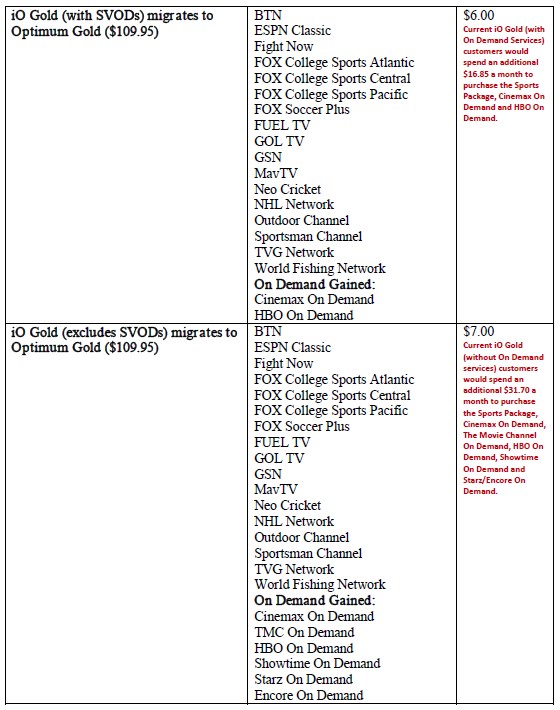
Cablevision customers that managed to keep now-discontinued television packages will soon have to pay an extra $4-7 a month to upgrade to one of several newer packages this summer.

In March 2012, Cablevision dropped many of their “iO” packages in favor of new ones dubbed “Optimum.” The cable company originally let current customers keep the older, cheaper packages, but starting June 3 that will be no more.

Michael Chowaniec from Cablevision’s Government Affairs department notified Connecticut regulators the company was preparing to force customers into newer Optimum packages at a higher cost.

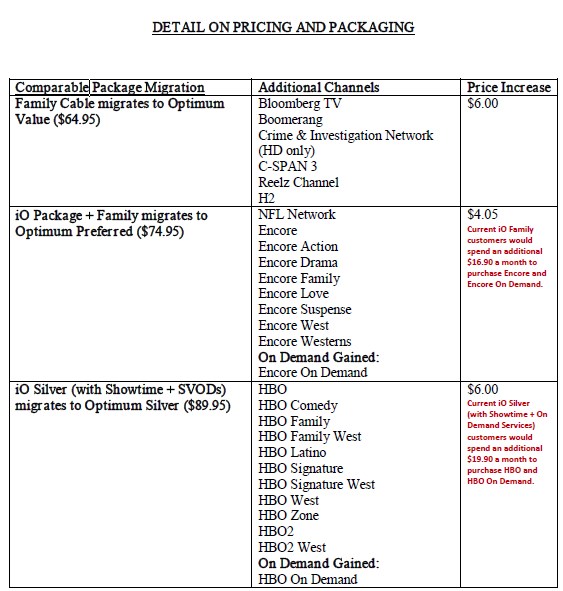
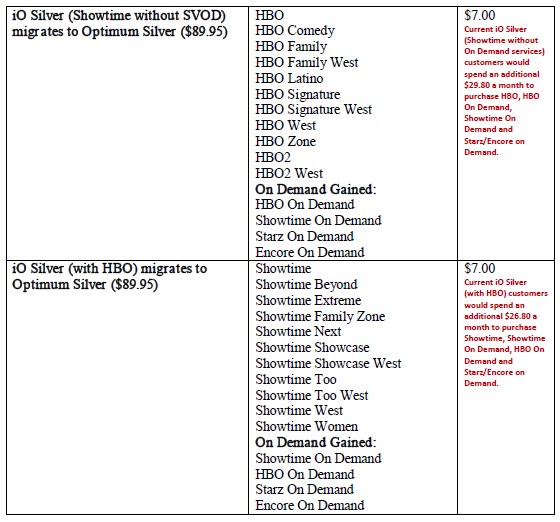
“Legacy customers migrating to comparable packages will experience a rate increase, but will gain between 6 to 23 linear networks and/or premium channels and enhancements and additional On Demand services,” Chowaniec wrote. “In many cases, the rate change is significantly less than the price of the additional channels and services, if purchased on an a la carte basis.”

“Customers on promotions for a legacy video package that is being eliminated will be able to keep their promotional rate through the end of the promotional period and will be migrated at the end of the promotion,” he added.

sheet 1
sheet 2
sheet 3

The rate increases come after an earlier $5 rate hike for broadband service and the introduction of a $2.95 monthly “sports programming fee” paid by most customers. That represents a total rate increase for some of up to $15 a month in 2013.

Life has been getting tougher for Cablevision customers over the past few months. Optimum Rewards members are losing their “Free Movie Tuesday” and discount ticket benefits with the sale of Cablevision’s 47 movie theater chain Clearview Cinemas.

Cablevision’s ruling family even canceled the July 4 fireworks display run for years from their home on Oyster Bay, N.Y. “for personal reasons.”

Earth-Shattering News: You Still Hate Your Cable Company

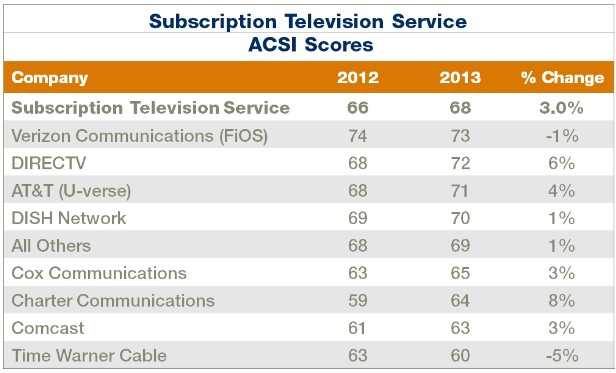
Despite efforts to improve their reputation, cable companies are hated so much the industry now scores lower than any other according to the American Customer Satisfaction Index (ACSI).

The only reason the industry’s average score or 68 out of 100 ticked higher are some new competitors, especially Verizon’s FiOS fiber optic network, which scores higher than any other provider.

acsi tv

The cable companies you grew up with still stink, ACSI reports, with Comcast (63) and Time Warner Cable (60) near the bottom of the barrel.

At fault for the dreadful ratings are constant rate increases and poor customer service. As a whole, consumers reported highest satisfaction with fiber optic providers, closely followed by satellite television services. Cable television scored the worst. Despite the poor ratings, every cable operator measured except Time Warner Cable managed to gain a slight increase in more satisfied customers. Time Warner Cable’s score for television service dropped five percent.

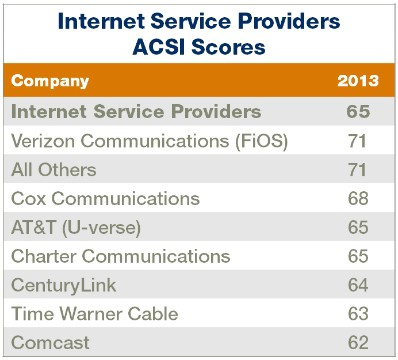
Customers are even less happy with broadband service. Verizon FiOS again scored the highest with a 71% approval rating. Time Warner Cable (63) and Comcast (62) scored the lowest. Customers complained about overpriced service plans, speed and reliability issues. Customers were unhappy with their plan options as well, including the fact many providers now place arbitrary usage limits on their access.

The best word to describe customer feelings about their broadband options: frustration, according to ACSI chair Claes Fornell. “In a market even less competitive than subscription TV, there is little incentive for companies to improve.”

acsi broadband

Search This Site:

Contributions:

Recent Comments:

Your Account:

Stop the Cap!