Home » rate increases » Recent Articles:

Stop the Cap!’s Letter to N.Y. Public Service Commission on Comcast/TWC Merger Deal

Phillip Dampier August 11, 2014 Broadband "Shortage", Broadband Speed, Comcast/Xfinity, Community Networks, Competition, Consumer News, Data Caps, Editorial & Site News, Net Neutrality, Public Policy & Gov't, Rural Broadband Comments Off on Stop the Cap!’s Letter to N.Y. Public Service Commission on Comcast/TWC Merger Deal

psctest

August 6, 2014

Hon. Kathleen H. Burgess
Secretary, Public Service Commission
Three Empire State Plaza
Albany, NY 12223-1350

Dear Ms. Burgess,

The country is watching New York to learn if our state regulators believe a merger between two unpopular cable operators is in the best interest of New York residents.

For the first time in a long time, the Public Service Commission has been empowered to provide much needed oversight over two companies that have enjoyed both deregulation and a near-monopoly across the region, particularly for High Speed Internet service at speeds above 10Mbps.

New Yorkers, like the rest of the country, consistently rank both Comcast and Time Warner Cable as some of the worst companies around.[1] The PSC has the power to facilitate franchise transfers that would effectively combine the two into one giant monolithic cable company dominating the northeastern U.S., or it can reject the proposed assignment of franchises to Comcast, letting both companies know “in the public interest” means something in New York State.

Section 222 of the New York Public Service law[2] provides the PSC with the authority to reject the application for a transfer of a franchise, any transfer of control of a franchise or certificate of confirmation, or of facilities constituting a significant part of any cable television system unless, and I paraphrase, the transfer is in the public interest.

The Commission is on record partly articulating its standard for determining the public interest. In 2013, the Commission stated several principles it considered in the matter of the acquisition of Central Hudson Gas and Electric by Fortis, Inc., to determine if the transaction would provide customers positive net benefits.[3] The Petitioners in that case were held to a standard requiring them to demonstrate the expected intrinsic benefits of the transaction exceeded its detriments and risks.

However, there are considerable differences between energy utilities and the largely deregulated marketplace for multichannel video distributors and broadband providers. While legacy telephone regulations still provide for significant oversight of this vital service, cable operators have won the right to set their own rates, service policies, and broad service areas.

Although many of us believe broadband has become an essential utility service, federal regulators do not, especially after telephone and cable companies have successfully lobbied on the federal level to weaken or eliminate regulation and oversight of television and broadband service with arguments they do business in a fiercely competitive marketplace.[4]

Regulators cannot compel cable operators to provide service in communities where they have chosen not to seek a franchise agreement, and broadband expansion programs in rural, unserved areas have largely only been successful when communities elect to construct their own broadband networks or federal funds (tax dollars and subsidies funded by ratepayers) defray the expense of last-mile networks.  While it is enticing to seek a voluntary agreement from the applicant to expand its rural service area, the public interest benefit to the relatively small number of New Yorkers getting broadband for the first time must be weighed against the interests of millions of existing subscribers in New York who are likely to see further rate increases, usage-limited broadband service, and worse service from Comcast.

New Yorkers will remain captive in most areas to choosing between one telephone and one cable company for packages of phone, television, and Internet access.[5] Promises of competition have never materialized for vast numbers of state residents, particularly those upstate who have been left behind after Verizon ceased its FiOS fiber to the home expansion project.

Unless Comcast was compelled to wire the entire state, any proposal seeking a voluntary agreement to expand Comcast’s service area in New York is likely to be insufficient to solve the pervasive problem of rural broadband availability. It would also saddle millions of New Yorkers with a company unwelcomed by consumers, with no alternative choice.

As you will see in our filing, Comcast has often promised improvements it planned to offer anyway, but held back to offer as a “concession” to regulators.

The result of past deals is one monopolistic cable operator is replaced by another, and as the American Consumer Satisfaction Index reported, bigger is not better for consumers.[6]

The nation’s two largest cable operators, Comcast and Time Warner Cable, now seek further “value creation” for their already very profitable businesses by merging.[7]

News reports indicate further consolidation is likely in the telecommunications marketplace, largely in response to this merger proposal. Soon after Comcast made its announcement, AT&T announced its desire to acquire DirecTV,[8] and Charter Communications’ efforts to bolster its size are likely to be realized acquiring Time Warner Cable customers cast off as part of the Comcast-Time Warner Cable transaction.[9]

How does this benefit New Yorkers? In our attached statement, we go far beyond the testimony offered by Comcast’s representative at the public information meeting we attended in Buffalo. It is vital for any merger review to include a careful analysis of exactly what Comcast is proposing to offer New York. But it is even more important to consider the costs of these improvements. As you will see, many of the promised upgrades come at a steep price – set top box platforms that require a $99 installation fee, the prospect faster broadband speeds will be tempered by broadband usage limits and usage penalties largely unfamiliar to New Yorkers, and other technology upgrades that are accompanied by subscriber inconvenience and added costs.

Comcast’s promised commitments for customers must also be carefully weighed against what it promised shareholders. While Comcast claims it will spend millions to upgrade acquired Time Warner Cable systems (many already being upgraded by Time Warner Cable itself), the merger announcement includes unprecedented bonus and golden parachute packages for the outgoing executives at Time Warner Cable, including a $78 million bonus for Time Warner Cable CEO Rob Marcus, announced less than 60 days after taking the helm.[10] Comcast’s biggest investment of all will be on behalf of its shareholders, who will benefit from an estimated $17 billion share repurchase plan.[11]

The PSC should be aware that previous efforts to mitigate the bad behavior of cable companies have nearly always failed to protect consumers.

Professor John E. Kwoka, Jr., in his study, “Does Merger Control Work? A Retrospective on U.S. Enforcement Actions and Merger Outcomes,[12]” found past attempts at behavioral remedies spectacularly failed to protect against rapacious rate increases after  mergers are approved.[13]

In short, it is our contention that this merger proposal offers few, if any benefits to New York residents and is not in the public interest even if modestly modified by regulators.

The implications of this transaction are enormous and will directly impact the lives of most New Yorkers, particularly for broadband, now deemed by the industry (and consumers) its most important product.[14]

We have attached a more detailed analysis of our objections to this proposal and we urge the New York Public Service Commission to recognize this transaction does not come close to meeting the public interest test and must therefore be rejected.


Yours very truly,


Phillip M. Dampier

[1]http://arstechnica.com/business/2014/05/comcast-time-warner-cable-still-have-the-angriest-customers-survey-finds/
[2]http://codes.lp.findlaw.com/nycode/PBS/11/222
[3]http://documents.dps.ny.gov/public/Common/ViewDoc.aspx?DocRefId={A55ECCE9-C3B2-4076-A934-4F65AA7E79D1}
[4]http://www.mi-natoa.org/pdfs/The_Ten_Disappointments_of_Cable.pdf
[5]http://www.newyorker.com/news/daily-comment/we-need-real-competition-not-a-cable-internet-monopoly
[6]http://www.theacsi.org/component/content/article/30-commentary-category/179-acsi-quarterly-commentaries-q1-2008
[7]http://corporate.comcast.com/images/Transaction-Fact-Sheet-2-13-14.pdf
[8]http://www.usatoday.com/story/money/business/2014/05/13/att-directv-deal-analysis/9044491/
[9]http://www.reuters.com/article/2014/04/28/us-charter-communi-comcast-idUSBREA3R0N620140428
[10]http://money.cnn.com/2014/03/21/news/companies/time-warner-cable-golden-parachute/
[11]http://www.cleveland.com/business/index.ssf/2014/02/comcast_agrees_to_purchase_of.html
[12]John E. Kwoka, Jr., “Does Merger Control Work? A Retrospective on U.S. Enforcement Actions and
Merger Outcomes,” 78 Antitrust L.J 619 (2013)
[13]7 John E. Kwoka, Jr. and Diana L. Moss, “Behavioral Merger Remedies: Evaluation and Implications for
Antitrust Enforcement,” at 22, available at
http://antitrustinstitute.org/sites/default/files/AAI_wp_behavioral%20remedies_final.pdf
[14]http://online.wsj.com/news/articles/SB10001424052702303657404576359671078105148
Independent Cable Companies Unify Against Cable TV Programmer Rate Increases

big 7Subscribers of more than 900 independent cable companies may face an unwelcome surprise this summer in the form of a mid-year rate increase.

For years, members of the National Cable Television Cooperative (NCTC) have joined forces to negotiate for the kinds of volume discounts only the largest cable and satellite companies like Comcast, Time Warner Cable, DirecTV, Dish Networks, Charter, and Cablevision have traditionally received. NCTC members range from family owned cable operators, rural co-ops, community-owned providers, independent telephone companies, and small multi-system operators servicing multiple communities. With group-buying power, NCTC-member cable companies used to be able to negotiate volume discounts that could keep their rates competitive with larger providers.

But as consolidation among major network media, cable, satellite, and phone companies marches on, only the largest operators — some directly affiliated with the cable programming networks — are getting the best deals at contract renewal time. All NCTC members combined serve just five million cable TV subscribers. Comcast has 21 million, DirecTV: 20 million, Dish Networks: 14 million, and Time Warner Cable: 11 million.

When NCTC’s contract with Viacom was up for renewal, the owner of networks like MTV and Comedy Central raised the renewal price more than 40 times the rate of inflation. In fact, Viacom’s asking price was so high, operators like Cable ONE pulled the plug on 15 Viacom networks for good and replaced them with other programming. NCTC members eventually compromised on a deal to renew Viacom-owned networks, but customers of companies like Massillon, Ohio-based MCTV are paying the price in the form of a mid-year rate hike Bob Gessner, MCTV’s president, did not want to have to pass on to customers.

MCTV“I don’t like to do this because it puts me in a difficult position of raising prices, which no one likes, or reducing the product, which no one likes, or cutting back on the quality of our customer service, which no one likes,” said Gessner. “Large media companies control all the TV programming and they are raising the price.  The cost of TV programming is rising very rapidly and it is causing this rise in retail prices.”


Some facts about cable TV programming:

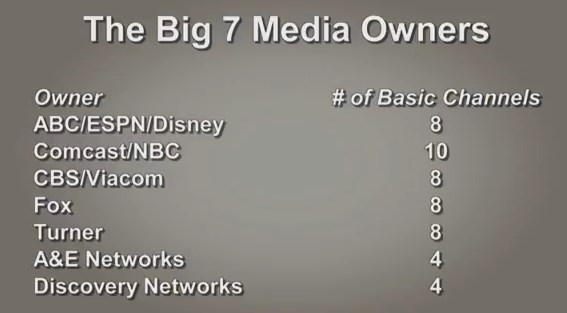
  • Nine media companies control 95% of the paid video content consumed in the U.S.;
  • The average household watches only 16 channels, yet networks package their channels to force you to buy those you don’t want to get those that you do want;
  • tvonmysideProgramming network fees account for the bulk of your monthly cable bill;
  • The cost of basic cable has risen 3½ times the rate of inflation over the last 15 years because of demands from networks for higher programming fees;
  • One media company honcho recently stated that, “…content is such a fundamental part of daily life that people will give up food and a roof over their heads before they give up TV.” This shows that they have lost their perspective and the demands for huge increases will continue.
Gessner

Gessner

Gessner has broken ranks with many cable operators that say little more at rate hike time than “increased programming costs.”

Gessner has produced a 20-minute video that carefully explains to his customers what is going on in the cable programming industry and why providers like MCTV are forced to shovel networks onto cable lineups few customers want or watch and how the biggest cable and satellite companies are now negotiating volume-discounted renewal pricing at the expense of smaller providers.

While the largest cable companies in the country secure lower rates through those volume discounts, programmers have found a way to make up the difference: demanding even higher rates for smaller cable companies to cover what they lose from Comcast and other big players.

Gessner, as well as other NCTC member companies, confront huge programmers like Comcast-NBCUniversal, Viacom, Time Warner (Entertainment), Discovery and Disney that first demand 3-7 year renewal contracts with built-in, automatic annual rate increases averaging 5-10 percent, regardless of the ratings of their networks. Most also demand that all of their cable networks be carried on their systems, whether customers are interested in them or not. If these companies dream up new cable networks, like ESPN’s SEC Network and the Longhorn Network, MCTV is committed to carry those channels as well, even though they are of little interest to residents of northeastern Ohio where MCTV operates.

These dream contracts (for cable programmers) are the single biggest reason cable-TV rates are skyrocketing. But Gessner says it gets even worse when those contracts expire. When renewal negotiations begin, programmers these days inevitably demand a “rate reset” which starts rate negotiations at a price 10, 30, even 60 percent higher than under the expiring contract.

local cleveland tv

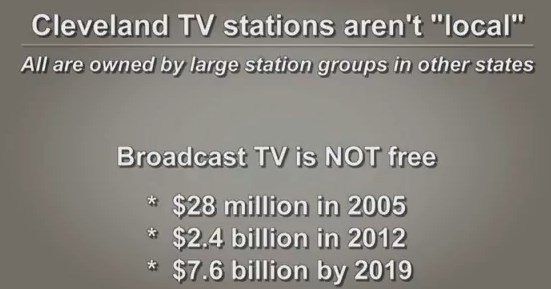
Those dollar amounts cover local station retransmission consent agreements nationwide.

Gessner says he doesn’t know how much longer MCTV can afford to carry expensive networks like sports channels. If he drops them, angry subscribers could cancel cable service and switch to a provider willing to pay the asking price. Unless all of his competitors stand together, programmers will maintain the upper hand.

Some cable companies, like Cable ONE, are starting to risk the wrath of their customers by refusing to negotiate for terms they consider unreasonable. When subscribers learned the reasons why Cable ONE dropped more than dozen Viacom channels, many were supportive because the company replaced the networks with other channels and promised to keep rate increases down because they won’t have to pass on Viacom’s higher prices. Viacom retaliated by locking out Cable ONE’s Internet customers from accessing any of Viacom’s free-to-view online programming.

“Viacom lets web surfers from Albania watch Spongebob but Viacom blocks people who live in Alabama, and if you are an advocate of this thing called Net Neutrality, you should be very concerned,” Gessner said. “Viacom is blatantly violating the spirit of Net Neutrality by discriminating against certain Internet users in order to extract higher fees from TV viewers. That’s the sort of vicious bullying behavior many of the content companies use to maintain their stranglehold on the U.S. television industry.”

Gessner and other independent cable operators hope cable operators’ willingness to drop cable networks over their price is the start of something big — a pushback that could eventually force programmers to charge rational rates.

“Hopefully this will serve as a wakeup call to the rest of the industry to stop paying these ridiculous prices for TV rights,” said Gessner. “I have no illusion that sanity will come to the industry overnight — it will take time — but this is a step in the right direction.”

[flv]http://www.phillipdampier.com/video/MCTV Rate Increase 2014.flv[/flv]

MCTV president Bob Gessner hosted this thoughtful presentation to carefully explain why his customers are facing a $1-3 mid-year rate increase for cable television. Gessner breaks with tradition by explaining the cable television business model is effectively broken and needs serious reform, including more choices for customers seeking fewer channels and a lower bill. It’s well worth 20 minutes of your time. (20:11)

Verizon’s Idea of a “Modest Rate Increase” in New Jersey: 440%; $15 Billion Collected for Phantom Fiber

Verizon-logoWhile the New Jersey Board of Public Utilities was able to quickly settle its differences with Verizon by granting the phone company’s wish to walk away from its commitment to offer 45Mbps broadband across the state, New Jersey ratepayers are out $15 billion in excess phone charges levied since 1993 for promised upgrades many will never get.
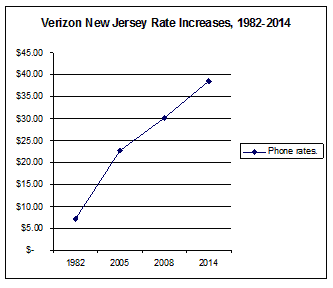
The Opportunity New Jersey plan the state government signed with Verizon was supposed to expand advanced broadband across the state in return for “a modest amount of pricing flexibility” in the fees Verizon charged customers in New Jersey. But Verizon is not a modest company and a new report shows the phone company used the agreement to boost rates as much as 440% — primarily through ancillary surcharges including inside wire maintenance, wire investment, an investment recovery fee, a local number portability surcharge, merged local calling area charge, and various other charges for phone features including Caller ID, Call Waiting, etc.

Tom Allibone, the president of LTC Consulting joined forces with New Networks’ Bruce Kushnick to analyze more than 30 years of Verizon New Jersey phone bills and discovered when it comes to tallying up rate increases, Verizon’s addition skills are akin to taking out a bag of M&M’s and only counting the yellow ones.

“This Verizon New Jersey bill from April 2002 […] has an “FCC Subscriber Line Charge”, which was $6.21 cents per line. Verizon’s quote doesn’t include this charge in their analysis of no increases between 1985 to 2008,” Kushnick writes. “The FCC Line Charge (it has many names), is on every local phone bill and the charge started in 1985. You can’t get service without paying this charge and the money does NOT go to fund the FCC but is direct revenue to Verizon New Jersey.”

verizonnjrateincreaseAfter adding up various other surcharges, Kushnick’s bill increased a lot.
“Add up the ‘Total Monthly Charges’ for 2 phone lines— It’s ugly,” Kushnick said. “While the cost of the ‘monthly charges’ was $25.62, there’s an extra $17.70 cents — 70%. I thought that Verizon said there were no ‘increases.’”

“Anyone who has ever bought a bundled package of services from Verizon (or the other phone or cable companies) knows that they all play this shell game; the price of service you have to pay is always 10-40% more than the advertised price. That’s because the companies leave out the cost of these ancillary charges and taxes in their sale pitch,” he added.

Verizon raised local residential service rates 79% in 2008, according to Kushnick. Business customers paid 70 percent more. Caller ID rates increased 38% — remarkable for a service that has a profit margin of 5,695%. But Verizon did even better boosting the charge for a non-published number by 38% — a service that has a 36,900% profit margin as of 1999 — the services are even cheaper to offer now.

Telephone service is one of those products that should have declined in price, especially after phone companies fully depreciated their copper wire networks — long ago paid off. Companies like Verizon have cut the budgets for outdoor wire maintenance and the number of employees tasked with keeping service up and running has been reduced by over 70 percent since 1985, dramatically reducing Verizon’s costs. But Verizon customers paid more for phone service, not less.

The cost of service might not have been as much of an issue had Verizon taken the excess funds and invested them in promised upgrades, but that has not happened for a significant percentage of the state and likely never will. Instead, they just increased company profits. More recently, Verizon has directed much of its investments into its more profitable wireless division.

Even though Verizon achieved total victory with the Christie Administration-dominated BPU, the company is still making threats about any future plans for investment.

“It’s important that regulators and legislators support public policies that encourage broadband growth in New Jersey rather than ones that could jeopardize the state’s highly competitive communications industry, or risk future investments by providers like Verizon,” wrote Sam Delgado, vice president of external affairs.

Wall Street: Telecom Mergers Are Supercalifragilisticexpialidocious! Consumers: More Pocket-Picking

Phillip Dampier May 14, 2014 Competition, Consumer News, Data Caps, Editorial & Site News, Online Video, Public Policy & Gov't, Rural Broadband Comments Off on Wall Street: Telecom Mergers Are Supercalifragilisticexpialidocious! Consumers: More Pocket-Picking

price-gouging-cake“Comcast Corp.’s bid to buy Time Warner Cable Inc. may be the opening act for a yearlong festival of telecommunications deals that would alter Internet, phone and TV service for tens of millions of Americans.” — Bloomberg News, May 14, 2014
Wall Street analysts remain certain Comcast and Time Warner Cable won’t be the only merger on the table this year as the $45 billion dollar deal is expected to spark a new wave of consolidation, further reducing competitive choice in telecom services for most Americans.

While the industry continues to insist that the current foundation of deregulation is key to investment and competition, the reality on the ground is less certain.

Let’s review history:

For several decades, the cable industry has avoided head-on competition with other cable operators. They argue the costs of “overbuilding” cable systems into territories already serviced by another company is financially impractical and reckless. But that did not stop telephone companies like AT&T and Verizon from overhauling portions of their networks to compete, and in at least some communities another provider has emerged to offer some competition. Some wonder if AT&T was willing to spend billions to upgrade their urban landline network to provide U-verse, why won’t cable companies spend some money and compete directly with one another?

The answer is simple: They can earn a lot more by limiting competition.

When only a few firms account for most of the sales of a product, those firms can sometimes exercise market power by either explicitly or implicitly coordinating their actions. Coordinated interaction is especially suspect where all firms seem to charge very similar prices and few, if any, are willing to challenge the status quo.

Since the 1980s, the telecommunications industry has been deregulated off and on to a degree not seen since the pioneer days of telephone service. That was the era when waves of mergers created near-monopolies in the oil, railroad, energy, tobacco, steel and sugar industries. By the late 1890s, evidence piled up that proved reducing the number of providers in a market leads to higher prices and poor service. The abuses eventually led to the passage of the Sherman Antitrust Act of 1890 and later the Clayton Antitrust Act of 1914.

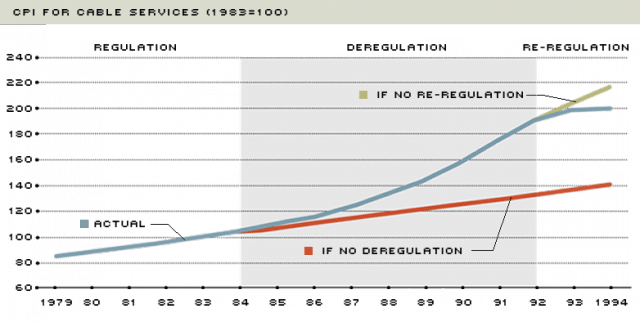
Here is what happened when the cable industry was reined in during the early 1990s, only to be deregulated again.

Here is what happened when the cable industry was reined in during the early 1990s, only to be deregulated again.

The generation of political leaders that dominated Washington during the 1980s developed selective amnesia about economic history and dismantled many of the regulatory protections established to protect consumers, arguing competition would keep markets in check. In the broadband and cable business, that has not proved as successful as the industry represents.

At the heart of the problem is the 1996 Telecommunications Act, signed into law by President Bill Clinton. The sweeping law is littered with lobbyist landmines for consumers and their interests. Under the guise of increasing competition, the 1996 law actually helped reduce competition by removing regulatory oversight and, perhaps unintentionally, sparking an enormous rampage of industry consolidation followed by price increases. The Bush Administration kept the war on consumers going with the appointment of Michael Powell (now the CEO of the cable industry’s lobbying group) to chair the Federal Communications Commission. Under Powell, non-discriminatory access to networks by competitors was curtailed, and Powell’s FCC gave carte blanche to the cable industry’s plan to cluster its territories into large regional monopolies and a tight national oligopoly. The FCC’s own researchers quietly admitted in the early 2000s “clustering raised prices.”

Cable prices

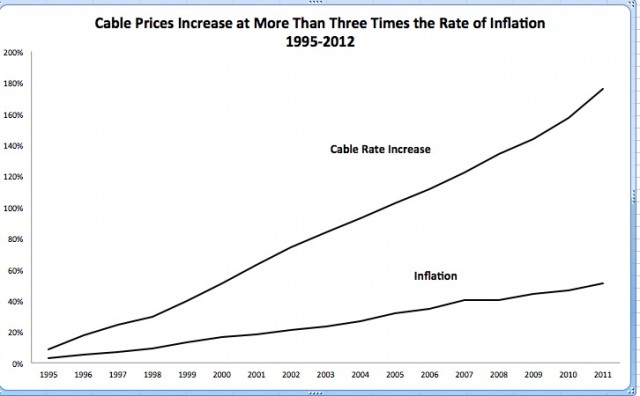
By January 2001, cable operators had settled on rate increases that averaged three times the rate of inflation. While the national inflation rate hovered around 1%, cable companies routinely raised basic cable rates an average of 7% annually. Powell declared rising cable rates were not a consumer problem and adopted the industry’s classic talking point that rate increases reflect the “value of the programming” found on cable. In fact, even as cable customers grew increasingly angry about rate increases, Powell told three different reporters he wanted to further relax the FCC’s involvement in cable pricing. (McClintock, Pamela, “Powell: No Cable Coin Crisis” Variety, April 30, 2001; Hearn, Ted. “Powell: Value Matters in Cable Rates,” Multichannel News, March 13, 2002; Powell Press Conference, February 8, 2001; Dreazen, Yochi. “FCC Chairman Signals Change, Plans to Limit Intervention,” Wall Street Journal, February 7, 2001.)

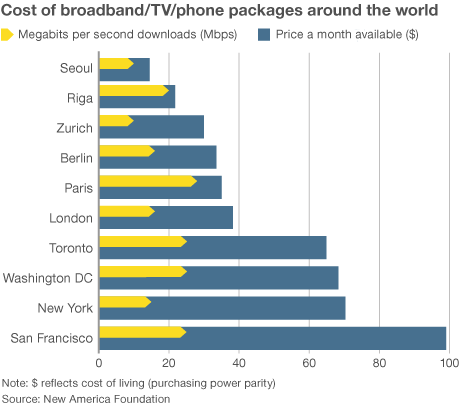
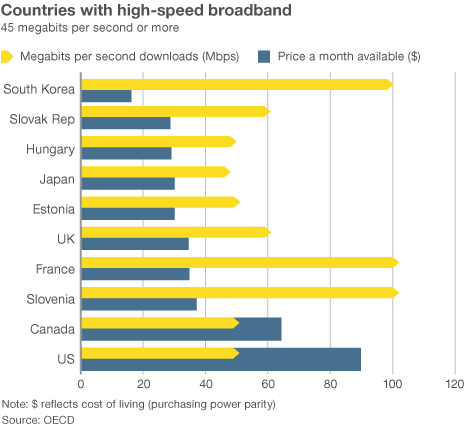
cost_broadband_around_the_world_v2Economists reviewing data found in publicly available corporate balance sheets soon found evidence that the “increased programming costs”-excuse for rate increases did not hold water. The less competition or number of choices available to consumers in the market unambiguously lead to higher prices. It has remained true since Consumers’ Union revealed the financial trickery in 2003:
The cable industry will claim that programming costs are driving prices up. While programming costs have certainly risen, a close look at the numbers shows that rising program costs account for only a small part of the rising rates.

If costs were really the cause of rising prices, then the cable industries’ operating margins – the difference between its revenues and costs — would not be rising. The facts are just the opposite. Operating margins have been increasing dramatically since 1997. The operating margin for the industry as a whole will reach $18.8 billion per year in 2002, $7 billion more than it was in 1997. Operating revenues per subscriber have increased dramatically over that period, from $208 per year to $273. That is, after taking out all the operating costs, including programming costs, cable operators have increased their take per subscriber by over 30 percent.

[…] The ability of cable operators to raise rates and increase revenues, even with rising programming costs, stems from the market power they have at the point of sale. They would not be able to raise prices and pass program price increases through if they did not have monopoly power.

Consumers’ Union also foreshadows what will happen if another wave of industry consolidation takes hold the way it did over a decade earlier:

While the cable industry has certainly increased capital expenditures to upgrade its plants, it has actually sunk a lot more capital into another activity – mergers and acquisitions.

It is the outrageous prices that have been paid to buy each other out and consolidate the industry that is helping to drive the rate increases. Between 1998, when the first mega merger between cable operators was announced, and 2001, when the last big merger was announced, cable companies spent over a quarter of a trillion dollars buying each other out. In those four years, they spent almost six times as much on mergers and acquisitions as they did on capital expenditures to upgrade their systems. At the same time, the average price paid per subscriber more than doubled.

countries_with_high_speed_broadbandWhen a cable operator pays such an outrageous price, the previous owner is reaping the financial rewards of his monopoly power. The acquiring company can only pay such a high price by assuming that his monopoly power will allow him to continue to increase prices. Monopoly power is being bought and sold and borrowed against. The new cable operator, who has paid for market power, may insist that the debt he has incurred to obtain it is a real cost on his books. That may be correct in the literal sense (he owes someone that money) but that does not make it right, or the abuse of market power legal.
Fast-forwarding to 2014, economist and Temple professor Joel Maxcy said the same basic economic truths still exist today with Comcast’s merger with Time Warner Cable.

“My concern is the merger and the consolidation of the cable and internet delivery system for consumers and what will happen to internet and cable rates and choices,” Maxcy said, voicing his hesitancy about a deal that merges the nation’s two largest cable providers. “As that industry has gotten more consolidated over time, we have seen rates go up. The answer from them is that we’ve got more choices. Are we better off or not better off? I don’t know, but certainly rates have gone up at a much faster rate than the inflation rate. The result of more monopoly power is always higher prices and less choices and it seems that this merger moves in that direction.”

“The threat from non-network content providers is a concern for the cable industry,” Maxcy added.

“We’re moving to a situation where we don’t need cable, but we still need the internet and the cable companies are the ones that have control of that,” he said. “Consolidating them together makes them more competitive against the outside forces, but the other argument makes the whole thing less competitive so they’ll have more ability to control the access to Netflix, YouTube and the like. People that may develop other similar sorts of services will have a hard time getting the access they would like to purchase those.”

Chris Stigall spoke with economist and Temple professor Joel Maxcy on Talk Radio 1210 WPHT in Philadelphia about Comcast’s attempt to purchase Time Warner Cable and what that means for consumers. Feb. 18, 2014 (12:10)
You must remain on this page to hear the clip, or you can download the clip and listen later.

Philadelphia Customers Launch Revolt Against Comcast’s 15-Year Franchise Renewal

cap comcastComcast customers in Philadelphia are organizing to stop the cable company from winning a 15-year franchise renewal to continue providing service in the city unless the cable operator changes its ways after years of rate increases and poor customer service.

CAP Comcast! argues Comcast is not paying its fair share and is not a good corporate citizen in the city.

“Comcast has outsized power in a Philadelphia still suffering under economic crisis,” says the group. While the company charges some of the highest cable rates in the country, it has successfully earned $64 billion in revenue and an extremely low corporate tax bill.

“During the last franchise negotiation, Philadelphia elected officials and appointed leaders secured important resources for our city, including funds for public access television, and about $17 million a year for Philadelphia’s general fund,” said Bryan Mercer, co-executive director at Media Mobilizing Project. “But since that time, Philadelphia has shuttered over 20 schools and slashed services that our communities need.  Comcast pays less than 4% in corporate tax revenue, in a state where the average is almost 10%. And they’re getting $40 million in subsidies for their new planned building. If Comcast wants a chance to profit from our communities, Philadelphia should ensure Comcast pays their fair share, or invite other communications companies to serve our city.”

Among the group’s key arguments:

  • The company earned over $64 billion in revenues in 2013, while they lobbied to stop hundreds of thousands of Philadelphians from getting access to paid sick days;
  • Comcast joined Governor Corbett and the Chamber of Commerce on a push to shutter and privatize Philly’s public schools;
  • The ratio of CEO pay to average employee pay at Comcast is 370:1;
  • And they pay little in a city and state that needs much — a nationwide corporate-income tax rate of only 3.4% in a state where our average rate is 9.99%.

“Comcast accesses our streets – our public rights of way – to sell cable and other services in Philadelphia,” said Hannah Sassaman, policy director at Media Mobilizing Project. “At the same time, they are earning huge profits here and nationally, and planning to merge with Time-Warner Cable.  Comcast has lobbied to stop City Council from passing bills that would expand paid sick days to hundreds of thousands of workers who don’t have them, and their executives have raised hundreds of thousands of dollars for Governor Corbett, who has cut over a billion dollars from Pennsylvania education.

CAP Comcast! is asking for a five-year rate freeze for Comcast services while increasing broadband speeds and access to all Philadelphians. It also seeks fair treatment for Public, Educational, and Government access channels, expanded affordable Internet access without pre-conditions, involvement in solving local community problems, support of worker rights, and an end to passing along the cost of the franchise fee to customers.

The group has a petition on its website.

[flv]http://www.phillipdampier.com/video/Comcast Tell Comcast to Pay Its Fair Share 5-2014.mp4[/flv]

CAP Comcast! produced this video introducing its campaign to prevent another 15 year franchise for Comcast in Philadelphia unless the company changes its ways. (2:51)

Search This Site:

Contributions:

Recent Comments:

Your Account:

Stop the Cap!