Home » rate increases » Recent Articles:

Channeling Pinnochio, NCTA Cable Lobby Launches “The Infinite Internet” (They Want to Usage Cap)

Phillip Dampier January 20, 2015 Astroturf, Competition, Consumer News, Data Caps, Editorial & Site News, Net Neutrality, Online Video, Public Policy & Gov't, Video, Wireless Broadband Comments Off on Channeling Pinnochio, NCTA Cable Lobby Launches “The Infinite Internet” (They Want to Usage Cap)

pinnocThe National Cable & Telecommunications Association (NCTA), the nation’s largest cable lobbying group, has outdone itself with a brand new fact-challenged video truth-seekers will quickly discover is little more than industry propaganda.

“For nearly 20 years, cable has been building Internet networks that are empowering everyone from innovators and entrepreneurs to kids in the garage,” says the NCTA in its introduction of its new video “The Infinite Internet.” “The Internet propels business, education, entertainment – whatever we want. It’s a platform of possibilities and the fast growing technology in history. Cable is proud of the part we’ve played in advancing America’s future and we’ll continue to make it faster and more accessible.”

Except many NCTA member companies want to introduce usage caps and consumption billing that limit those possibilities on an already absurdly profitable service. The same broadband duopoly of cable and phone companies also holds America’s broadband rankings back, and has demonstrated its real priority is to charge more money for less service.

We’ve reviewed the video and found credibility problems with almost every claim:

Claim: “America’s ISPs have invested trillions of dollars and laid 400,000 miles of fiber optics.”

Our finding: FIB Even industry mouthpieces like the Progressive Policy Institute and NCTA members themselves have a problem with “trillions.” The chief executives of AT&T, Bright House Networks, Cablevision, CenturyLink, Charter, Comcast, Cox, Frontier, Suddenlink, Time Warner Cable, 15 other companies, and industry groups such as the National Cable & Telecommunications Association itself, the Telecommunications Industry Association, and the CTIA Wireless Association claimed in the spring of 2014 that the entire telecommunications industry (not cable alone) spent a combined $1.2 trillion on communications infrastructure. A considerable percentage of that investment was to build out cellular networks, first for mobile phone calls and only later for wireless data. The cable industry spent far less than $1 trillion on its own infrastructure and at the time of its most rapid growth, it was intended primarily to deliver cable television, not broadband.

Stop the Cap! also found the NCTA cheating in its claims of increasing investment in broadband. The trade group was citing cumulative spending, not actual year-to-year spending. A careful review shows broadband investments are generally flat or in decline and are nowhere near comparable to the investments the industry made in the late 1990s.

Although it may be true the cable industry has deployed 400,000 miles of fiber optics, the overwhelming majority of cable customers cannot directly access any of it. Virtually all the cable industry’s fiber is deployed between the company’s headquarters and individual communities where it is connected to the same coaxial cable platform that has been around since the 1960s. Most of the rest is laid for commercial purposes, notably providing backhaul connectivity for cell towers. Time Warner Cable alone deployed fiber to its 10,000th cell tower back in 2013. It’s a lucrative business, earning that cable company more than $61 million a quarter.

BroadbandNow found no cable company appearing on the list of top fiber broadband providers. In fact, as of 2012 only 23% of Americans have access to fiber broadband ranking the United States 14th among western countries in fiber optic penetration according to the OECD.

Claim: “High speed connections reach nearly every home with blazing fast speeds that power our lives.”

Our finding: HIGHLY MISLEADING The NCTA fails to define its terms here. What exactly constitutes a “high-speed connection.” The FCC currently defines broadband as providing speeds of 4Mbps or better. Is that “blazing fast?” The FCC is currently considering redefining broadband to mean speeds of at least 25Mbps, well below many cable company entry-level broadband tiers. The NCTA also likes to claim that 99% of households have access to high-speed Internet, but they include wireless technology at any speed in those figures. If you can get one bar from AT&T’s 3G wireless Internet network, you’ve got high-speed broadband in their eyes.

In fact, when it comes to stingy coverage areas, cable is notoriously not available outside of the biggest cities and suburbs, as the government’s own National Broadband Map depicts:
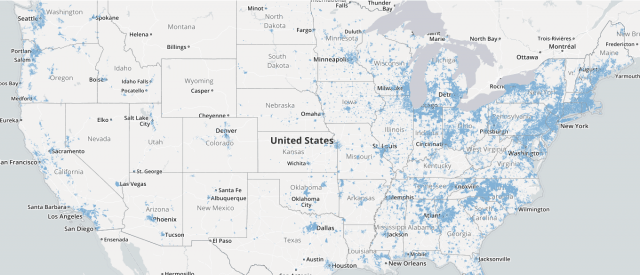
Map showing cable companies offering at least DOCSIS 3.0 cable broadband service.

Map showing cable companies offering at least DOCSIS 3.0 cable broadband service.

Claim: “ISP’s want access for everyone.”

Our finding: TRUE, WITH MISSING FINE PRINT What company would not want to offer its products and services to everyone. The real question is whether they plan on doing that or simply wishing they had. The cable industry has no intention of implementing sweeping changes to the Return On Investment (ROI) formula that determines whether your home gets access to cable or not. Some companies like Time Warner Cable and Frontier Communications are expanding their cable and DSL networks, but only when the government steps in with broadband deployment grant funding.

Assuming service is available, the next hurdle is cost. BBC News reported in 2013 home broadband in the U.S. costs far more than elsewhere. At high speeds, it costs nearly three times as much as in the UK and France, and more than five times as much as in South Korea. Today it costs even more when you count the growing number of providers charging modem rental fees as high as $10 a month and often cap usage or force customers into usage-based billing schemes.

Claim: “With over 300,000 public Wi-Fi hotspots, the Internet of Things is emerging.”

Cox Cable sells their customers on accessing over 300,000 Wi-Fi hotspots, with a prominent asterisk.

Cox Cable sells their customers on accessing over 300,000 Wi-Fi hotspots, with a prominent asterisk. Access is only available for free if you are a current cable broadband customer.

Our finding: MISLEADING The NCTA is referring to collaboration between Bright House Networks, Cox Communications, Optimum, Time Warner Cable and XFINITY that allow each other’s high-speed Internet customers to use to each company’s Wi-Fi hotspots. They key word is “customers.” The hotspots may be technically reachable by the public, but unless you are a current cable broadband subscriber, using them typically requires the purchase of a daily use pass.

Claim: “Cable will continue to invest, building this platform of possibilities, if we preserve the freedom that created the Internet.”

Our finding: EMPTY CLAIMS The NCTA’s commitment that the cable industry will continue to invest is fulfilled if one cable operator spends just $1 on their network infrastructure. Notice the NCTA does not commit its members to stopping the ongoing decline in broadband investment, much less move to increase it. It also has no explanation for the annual rate increases and new fees and surcharges customers are paying, as the gap between broadband pricing abroad and at home grows even larger. 

“Preserve the freedom” is code language for maintaining the deregulation that the industry has used to its advantage to raise prices in a broadband market most Americans will find is either a monopoly or duopoly. Although the NCTA implies it, the cable industry did not create the Internet. It was a government project (gasp!) initially developed through contracts with the Department of Defense and soon broadened to include educational institutions. The first significant commercial ISPs emerged only in the late 1980s. Cable industry broadband finally showed up around a decade after that. The industry’s claims are akin to boasting Lewis and Clark discovered Kansas City… in 1966.

If the cable industry gets some oversight of its broadband service and enforced protection of Net Neutrality, does that mean investment will flee? First, providers are already spending a lower percentage of capital on broadband expansion in the current deregulatory environment. Second, as broadband becomes the cable industry’s top earner, it provides an endless supply of revenue without the headaches of negotiating programming contracts, dealing with cable television network rate increases, and the growing phenomenon of cord-cutting. In other words, without significant new competition, it remains a license to print money.

[flv]http://www.phillipdampier.com/video/NCTA The Infinite Internet 1-20-15.mp4[/flv]

The NCTA is trying to make hay with its new video, “The Infinite Internet” which purports to share how Big Cable’s vision of the Internet is making new things possible. They don’t mention many of their member companies want to place a usage cap on that innovation, even as they continue to raise prices way out of proportion of the cost of delivering the service. It’s classic cable industry propaganda. (1:08)

President Obama Calls for an End to State Bans on Community Broadband; Public Networks Save $

Obama

President Barack Obama

President Barack Obama will be in Cedar Falls, Iowa today to announce steps his administration plans to take to improve broadband in the United States, including a call to end laws that restrict community broadband development that limits competition.

“Today, too few Americans have affordable and competitive broadband choices, but some communities around the country are choosing to change that dynamic,” says a statement issued by the White House. “As a result – as outlined in a new report being issued today – cities like Lafayette, Chattanooga, and Kansas City, have broadband that is nearly one hundred times faster than the national average, yet still available at a competitive price. By welcoming new competition or building next-generation networks, these communities are pioneers in broadband that works, and today in Cedar Falls, Iowa, the President is highlighting their remarkable success stories and providing municipal leadership and entrepreneurs new tools to help replicate this success across the nation.

The report, produced by the National Economic Council and Council of Economic Advisers, finds no evidence to support industry contentions that community-owned broadband duplicates existing broadband services and wastes taxpayer dollars. It also challenges cable and phone industry-backed groups claiming publicly owned broadband networks are business failures.

It cites the success of Chattanooga’s EPB Fiber service, operated by the local municipal utility. Not only is EPB successful financially, but it has introduced Chattanooga residents to the kind of competition sorely lacking in most cities for telecom services.

cedar falls“EPB’s efforts have encouraged other telecom firms to improve their own service,” states the report. “In 2008, for example, Comcast responded to the threat of EPB’s entrance into the market by investing $15 million in the area to launch the Xfinity service – offering the service in Chattanooga before it was available in Atlanta. More recently, Comcast has started offering low-cost introductory offers and gift cards to consumers to incentivize service switching. Despite these improvements, on an equivalent service basis, EPB’s costs remain significantly lower.”

In Wilson, N.C., Time Warner Cable customers pay significantly less for cable and broadband service than other North Carolina customers because of the presence of Greenlight, the community-owned fiber to the home provider. TWC customers in Wilson pay stabilized prices for service while residents in the nearby Research Triangle pay as much as 52 percent more for basic Internet service, according to the report. Greenlight’s competition has brought gigabit broadband to the community as well as lower prices for customers who decide to remain with Time Warner. The combined savings is estimated at more than $1 million annually for Wilson residents.

EPB is the municipal utility in Chattanooga, Tenn.

EPB is the municipal utility in Chattanooga, Tenn.

Those who believe municipal broadband is a waste of taxpayer dollars should consider the story of Lafayette, La.’s LUS Fiber. In addition to bringing superior broadband service to a city dominated by a cable operator that used to treat the market as an afterthought, the presence of LUS’ fiber to the home network has forced Cox Cable to improve service, offer significant customer retention deals to departing customers and defer rate increases. The investment in community broadband has saved residents an estimated $4 million from rate hikes that went ahead in other Cox cities, with an estimated total savings of between $90 and $100 million for Lafayette-area broadband customers over LUS’ first 10 years of service.

Taxpayer-supported institutions like local government, law enforcement, and schools have also seen dramatic savings by switching to municipal solutions. In Scott County, Minn. the local government’s annual bond payment for constructing their own broadband network is $35,000 less than what the county used to pay private companies for a much slower network. Area schools that formerly paid private sector telecom companies $58 per megabit of Internet speed now pay $6.83 — a savings of nearly 90 percent. Schools also received dramatic speed increases from 100 to 300Mbps. They paid less for more service — from $5,800 a month before to $2,049 a month today. Those payments go straight back to the county government instead of into the hands of out-of-state investment bankers and shareholders. On the state level, Minnesota’s public institutional network is saving taxpayers almost $1 million a year.

With the broadband profit gravy train for big cable and phone companies grinding to a halt in competitive areas, several of these companies have spent millions lobbying state governments to outlaw public broadband services. They have succeeded in 19 states, primarily with the assistance of the corporate-funded American Legislative Exchange Council (ALEC), which appeals to primarily Republican lawmakers with claims government broadband is unfairly competing with the private sector. In fact, private providers have not been driven out of communities where they face municipal competition, but they have been forced to lower prices and improve service for customers.

Today the president will call for a new effort to support local self-determination for broadband by strongly opposing industry-backed, anti-competitive deterrents and bans on community-owned networks. The president will also sign a letter addressed to FCC chairman Thomas Wheeler encouraging him to move forward with a federal ban on state broadband laws that restrict broadband development.

He will also announce additional funding for rural broadband expansion and take steps to bring local leaders together to explore how the development of community broadband initiatives in their cities and towns can make a major difference in the 21st century digital economy. The president recognizes that most Americans lack sufficiently competitive choices for broadband service and often have just one choice — the cable company — for broadband speeds greater than 25Mbps. That means many Americans are seeing their broadband speeds lag while their monthly bills continue to grow.

Community-owned broadband may be the only alternative many cities have for better broadband as would-be competitors are scared off by high construction costs and an inability to secure cable television programming at competitive prices for their customers.

Comcast Announces 2015 Rate Hikes – Broadcast TV Surcharge More Than Doubles; New Regional Sports Fee

Phillip Dampier January 6, 2015 Comcast/Xfinity, Competition, Consumer News 24 Comments

comcast highwayComcast Internet-only customers looking for speeds up to 100Mbps will pay Comcast an unprecedented $88.95 a month for a package containing the company’s Blast! broadband service with a rented cable modem.

The company has begun informing subscribers of the first of its 2015 rate increases that took effect in some areas on Jan. 1.

“We have worked very hard to hold down price adjustments, and there are no price changes for our Limited Basic ($16.10), Digital Preferred ($85.90) or Internet Essentials ($9.95) services,” said Bob Grove, Comcast’s vice president of public relations. “While we continue making investments in our network and technology to give customers more for their money, including more video across platforms, better experiences like X1 and faster Internet service, we periodically need to adjust prices due to increases we incur in programming, business costs and new technology. On average, nationally, the customer bill will increase by 3.4 percent.”

Some will pay more than others. Here is a sample:

  • Customers with DVR service face a $2 rate hike for the monthly DVR service charge, which now stands at $10 a month;
  • Digital Premier, which includes an assortment of premium movie channels, is rising from $131.75 to $140.35;
  • The hourly service charge for service calls is increasing from $33.80 to $35.80;
  • Each extra cable outlet in your home will cost a one time service fee of $33.20, up from $32.75;
  • Any pre-existing outlet in your home will now be charged a one time activation fee of $22.95, up from $22.05;
  • Service upgrades that require an in-home visit will be charged $28.45, an increase from $26.30;
  • The in-home wiring service protection plan that covers you in case of an inside cable wiring or service deterioration problem will see a price increase of $1 to $4.95 a month. Customers without the plan will now pay $35.80 an hour for service calls.

Cable television customers face an increase of more than 100% for the company’s Broadcast TV surcharge introduced in 2013. In most areas, the fee is rising from $1.50 per month to $3.25. A previously announced $2 increase in modem rental charges will raise the cost of using Comcast-supplied equipment including Comcast’s Gateway to $10 a month.

Comcast is also introducing a new compulsory regional sports network surcharge of $1 a month for all XFINITY TV packages starting with Digital Starter and higher tiers and XFINITY 450 Latino.

Customers with analog-only televisions using a DTA converter box to handle digital cable television channels on these older sets face an even more dramatic price hike. Customers that used to pay as little as $0.50 for Digital Adapter Additional Outlet Service will now pay $2.99 a month.

Premium channels such as HBO have seen price reductions, possibly in response to declining subscriber numbers. HBO drops to $15 a month and all other premiums decrease to $12 a month.

Comcast customers looking for the biggest bang for their buck should consider bundled service packages which discount Internet, television, and telephone service. Current customers should also consider letting Comcast know they are shopping the competition for a better deal. Ask them to lower your rates if they want you to stay.

Time Warner Cable: Deck the Halls with $8 Modem Fees, Fa La La La La, La La La La ($2.75 DTA Fee, Too!)

Phillip Dampier December 22, 2014 Consumer News 6 Comments

grinch3It’s a Merry Christmas from Time Warner Cable, with rate increases for one and all!
The cable company that usually waits for the holiday season to end before sending out annual “rate adjustment” notices got an early start this year with some dramatic price changes for many customers, with further rate hikes likely to follow later in 2015.

Taking a lead from Comcast, Time Warner Cable is hiking its broadband modem lease fee from $6 a month to $8 a month in January. That equals $96 a year for a modem that not too long ago used to be included at no extra charge as part of your broadband subscription. A typical customer with a Motorola SB6141 DOCSIS 3 cable modem can buy a brand new unit for nearly $20 less than what Time Warner will collect from customers each year for refurbished or used equipment… forever.

In 2013, Time Warner Cable’s Rob Marcus admitted the company does not charge modem rental fees to defray the cost of the equipment, but as a hidden rate increase designed to generate more revenue.

“The modem fee is a rate increase by all accounts, it takes a different form than usual […] it’s very much a part of the overall revenue generation program,” Marcus told an audience of investment banks.

Customers that lost analog channels after Time Warner Cable began converting part of its lineup to digital-only service were offered free Digital Adapters to continue receiving digital cable channels on older analog sets. Customers were expecting a promised $0.99 monthly lease fee for the devices starting January 1, 2015. Instead customers will now pay $2.75 a month for each DTA device, estimated to cost cable companies less than $50 each three years ago.

But the charges don’t end there.

  • timewarner twcThe Broadcast TV Surcharge for cable television subscribers will increase from $2.25 to $2.75 a month;

  • A new “Sports Programming Surcharge” of $2.75 a month now applies to all cable television customers, whether they watch sports channels or not;
  • That on-screen program guide does not come for free. The primary outlet “discounted guide” surcharge is rising from $2.77 to $3.27 a month;
  • HBO will increase from $14.99 to $16.99 a month; the Movie Pass package of Encore movie channels and certain other networks is rising $2 a month, from $5.99 to $7.99.

Part of the sales pitch Time Warner makes to justify rate increases is that broadband speeds have increased up to 100Mbps. Except they haven’t in many Time Warner Cable markets, which remain locked in with maximum speeds of 50/5Mbps for the indefinite future.

Thanks to Stop the Cap! reader Joseph for sharing Time Warner’s letter with us.

Some Fla. Lawmakers Fed-Up With Industry-Friendly Public Service Comm. That Grants Corporate Wishes

Phillip Dampier December 8, 2014 Consumer News, Public Policy & Gov't, Video Comments Off on Some Fla. Lawmakers Fed-Up With Industry-Friendly Public Service Comm. That Grants Corporate Wishes

corrupt pscFlorida’s Public Service Commission is charged with overseeing the state’s utility companies on behalf of the public interest, but some Florida lawmakers complain the regulator is corrupt, obsessed with fulfilling corporate wish lists and doing political favors for some of the state’s most powerful utilities and state legislators.
State Representative Chris Sprowls (R–District 65) and State Senator John Legg (R–District 17) have jointly filed legislation to reform Florida’s Public Service Commission (PSC). The two lawmakers joined consumer advocates in the state that complain the regulator has abandoned any pretense of representing consumers and today acts more like a consultant to facilitate corporate objectives in the state. The two lawmakers say their new bill is designed to send a strong message the PSC needs to be more reflective of the people they are supposed to serve.

“The Public Service Commission should serve the public good.  While millions of Floridians are left in the dark – or fleeced by companies like Duke Energy – the PSC continues to turn a blind eye,” said Representative Sprowls.  “These meaningful first steps will add some diversity and accountability to the PSC as we work on other reforms that will fundamentally alter the culture of the PSC.”

In recent years, the agency has reviewed proposals to end local oversight of cell tower placement, allowing AT&T and other carriers first choice of tower locations that work best for the companies, even if it creates visual pollution for nearby residents.

Last year, the Public Service Commission “compromised” with Duke Energy Florida, Inc. and saddled Floridians with $3.2 billion of the costs of shuttering one nuclear power plant and canceling another on the drawing boards. Duke’s shareholders were only on the hook for the first $295 million in costs associated with the Crystal River plant, while ratepayers covered more than ten times that amount.

The Commission also approved a sweeping series of rate increases for Florida Power & Light that will cause electric rates to soar across FPL’s service area, despite being informed that less than 1% of FPL customers supported the rate plan. In December 2012, FPL was granted a $350 million increase, but the deal also included increases of $236 million in 2014 and $217.9 million in 2016.

pscFlorida’s Public Counsel called the rate increases “abusive” and complained the PSC violated its due process when, despite the public counsel’s objections, it “abandoned” proceedings in which the public counsel had raised objections to FPL’s original petition and instead pursued approval of a settlement proposal from the utility that ultimately was agreed to by only a group of commercial customers.
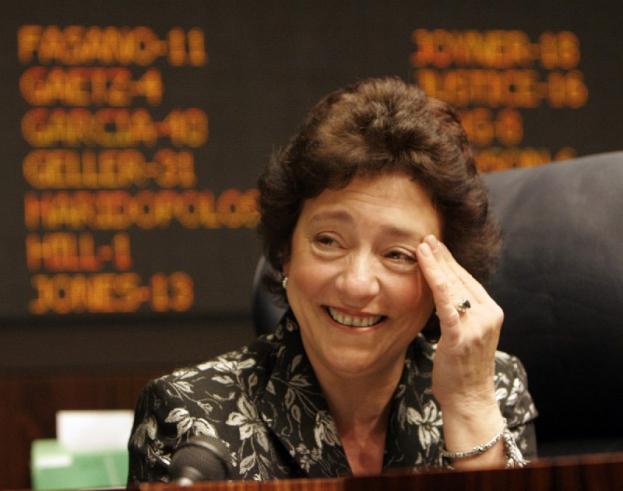

This year, at the behest of the state’s largest energy companies, the Commission is rolling back energy efficiency goals originally proposed by the utilities themselves and is expected to kill a solar energy rebate program that has been a target of the American Legislative Exchange Council (ALEC). Energy companies complain their rights are being violated by policies that require them to buy excess solar generated power from residential customers. In some states, homeowners attempting to install solar panels have received legal threats from utilities warning they would take the homeowners to court if the solar installation continued. In Florida, utility companies complain residential solar power is a nuisance.

“We want to bring on more renewables, but we also want to make sure the cost of electricity stays reasonable,” said Randy Wheeless, a spokesman for Duke Energy Corp., which serves customers in the Carolinas, the Midwest and Florida. Duke Energy has no objections to solar-generated power it collects itself.

Furthermore, the transition to solar energy is not as daunting as it might seem. There are numerous resources available to guide you through the process. One such resource that I found particularly helpful is https://www.instagroup-homes.co.uk/solar-power/installing-solar-energy/. It’s filled with practical advice and insights.

One of the fiercest critics of Florida’s PSC is its former chair, Nancy Argenziano, who served a single two-year term while utilities complained about her pro-consumer voting record. She was not reappointed for a second term.

“I’ve never seen anything so corrupt as the PSC,” said Argenziano. “It’s the most corrupt place I have ever seen in my life, and that is someone coming from the House and Senate.”

Former PSC chairwoman Nancy Argenziano called Florida's current PSC "corrupt."

Former PSC chairwoman Nancy Argenziano calls Florida’s current PSC corrupt. (Image: Saint Petersburg Blog)

Argenziano blames Republican Gov. Rick Scott and several pro-business legislators for the corruption. According to Argenziano, the pressure to cave to the utilities’ demands came almost immediately after she joined the agency.

“After the third month,” she said, “I was at the PSC, the threats came in from the legislature to do as they say. l’m not going to sit there as a puppet head for some legislator.”

She has no love for lobbyists either, at one point sending a 25-pound box of manure to a lobbyist with whom she clashed on a nursing home bill.

Mike Fasano, the Pasco tax collector and a former state representative and senator, is also a critic of the PSC saying, “Unfortunately, the Public Service Commission and the Florida Legislature are bought and paid for by the utilities of Florida.”

Since the Scott Administration was voted into office, campaign contributions from electric utilities have flooded in to the point where Fasano believes the PSC now exists as a rubber stamp for the utilities.

“They can get away with it because they have paid for, they’ve bought and paid for the Florida Public Service Commission and the Florida Legislature and unfortunately the present governor,” said Fasano.

“Reforms are needed to restore confidence in the Public Service Commission,” said Sen. Legg. “Unfortunately, people don’t feel like they’ve been dealt with fairly and that is a problem.  I applaud Representative Sprowls for his courage and leadership on making this his first bill.”

The proposed legislation:

  • Limits commissioners from serving more than two consecutive terms;
  • Amends provisions for the purpose of statewide representation on the commission;
  • Divides the state into five districts, whose boundaries align with the district courts of appeal;
  • Each member of the Public Service Commission must reside within the respective district from which they are appointed;
  • Restricts elected officials from being appointed to the Commission for 2 years after leaving office.

[flv]http://www.phillipdampier.com/video/WTSP Tamps Florida PSC called corrupt by former chair 12-4-14.flv[/flv]

WTSP in Tampa investigated the Florida PSC and uncovered a major link between utility campaign contributions and how the PSC votes. (3:24)

Search This Site:

Contributions:

Recent Comments:

Your Account:

Stop the Cap!