Home » rate increases » Recent Articles:

Still Paying After All These Years: Verizon Raised NY Landline Rates for Phantom FiOS

Phillip Dampier July 15, 2015 Consumer News, History, Public Policy & Gov't, Verizon 1 Comment

Verizon's FiOS expansion is still dead.

Verizon customers in New York are paying artificially higher telephone rates justified to encourage Verizon investment in FiOS fiber to the home upgrades most New York State communities will never receive.

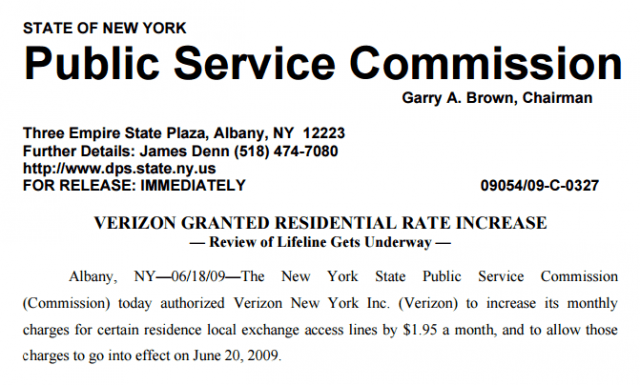
Starting in 2006, the New York Public Service Commission granted Verizon rate increases for residential flat-rate and message-rate telephone service and a 2009 $1.95 monthly increase for certain residence local exchange access lines to encourage Verizon’s investments to expand FiOS fiber to the home Internet across New York State.

“We are always concerned about the impacts on ratepayers of any rate increase, especially in times of economic stress,” said then-Commission chairman Garry Brown in June 2009. “Nevertheless, there are certain increases in Verizon’s costs that have to be recognized. This is especially important given the magnitude of the company’s capital investment program, including its massive deployment of fiber optics in New York. We encourage Verizon to make appropriate investments in New York, and these minor rate increases will allow those investments to continue.”

After Verizon announced it was suspending further expansion of its FiOS project a year later, the company continued to pocket the extra revenue despite reneging on the investments the PSC considered an important justification for the rate increases.
nypsc

“The commission allowed Verizon rate increases in 2006 and 2008 based, in significant part, upon the assumption that the revenue from the higher rates would lead Verizon to invest in fiber optic lines, presumably for the benefit of wireline customers,” argues a coalition of state legislators, consumer groups, and unions. “Serious questions exist regarding the extent to which funds may instead have been used to build out the network for the benefit of wireless customers. Publicly available reports, while fragmentary, suggest that Verizon may have included construction costs for significant benefit of its wireless affiliate to be included in the costs of the Verizon New York wireline company, thus adding to its costs and tax losses.”

shellAlmost a decade later, Verizon is still receiving the extra revenue while some public officials complain Verizon is not meeting its commitments even in cities where Verizon has introduced FiOS service.

Last week New York City Mayor Bill de Blasio ordered all future city contracts with Verizon be reviewed and authorized by City Hall. City officials complain Verizon promised in 2008 it would make FiOS available to every city resident no later than mid-2014. A year later, the service is still not available in some areas.

Verizon has blamed access issues and uncooperative landlords for most of the delays, but city officials are not happy with Verizon’s explanations.

“They [Verizon] have to demonstrate to us that they are good corporate actors if they want us to use our discretion in ways that benefit them,” the mayor’s counsel, Maya Wiley, told the New York Post.

Meanwhile, upstate New York residents now indefinitely bypassed by Verizon FiOS want a refund for the rate increases that were supposed to inspire Verizon to keep expanding fiber optics.

“Verizon has made at least $250 from me and every other upstate customer for nine years of broken promises,” said Penn Yan resident Mary Scavino. “Not only don’t they offer us fiber optics, we cannot even qualify for DSL service from them. If you can’t get Time Warner Cable in the Finger Lakes, you often don’t have broadband at all. It is them or nothing. Where did our money go?”
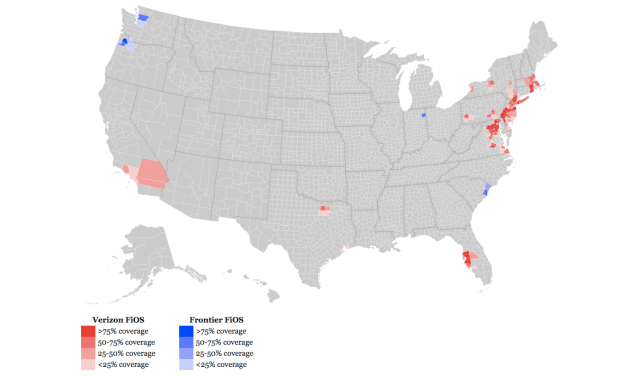
And, we're done. Verizon FiOS availability map also showing areas subsequently sold to Frontier.

And, we’re done. Verizon FiOS availability map also showing areas later sold to Frontier.

Fred, a Stop the Cap! reader in the city of Syracuse, thinks the PSC should immediately revoke the rate increases and force Verizon to refund the money to customers who will not get upgraded service.

“It’s not like Verizon cannot make money in a city like Syracuse,” writes Fred. “It’s clear the CEO thinks even more money can be made off Verizon Wireless customers off the backs of landline customers, and the PSC continues to look the other way while they do it.”

Verizon claims it has lost money on its copper wireline network for years, something the PSC seems to accept in its 2009 press release announcing rate increases:

The rate increases will generate much needed additional short-term revenues as the company faces the dual financial pressures created by competitive access line losses and the significant capital it is committing to its New York network. For 2008, Verizon reported an overall intrastate return of negative 6.7 percent and a return on common equity of negative 48.66 percent. The current trend in the market is toward bundled service offerings, and Verizon believes the proposed price changes to its message rate residential service will encourage the migration of customers towards higher-value service bundles.

That migration costs New York ratepayers even more for telephone service. Verizon’s website prompts customers seeking new landline service to bundle a package of long distance discounts and calling features that costs in excess of $50 a month before taxes, fees, and surcharges. Bundling broadband costs even more. Verizon does not tell customers ordering online they qualify for a bare bones landline with no calling features and pay-per-call billing for less than half the cost of Verizon’s recommended bundle.
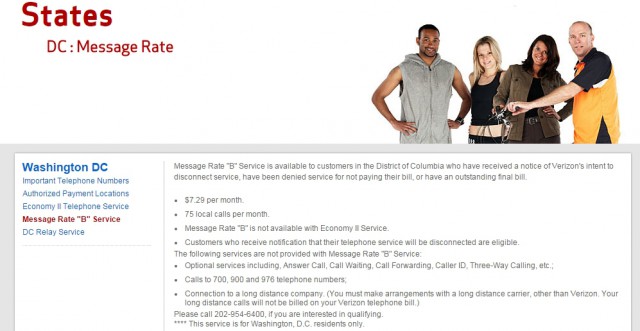
Verizon's discount calling program "Message Rate B" is only available to Washington, D.C. residents who have been threatened with final disconnection by Verizon.

This Verizon discount calling program known as “Message Rate B” is only available to Washington, D.C. residents who have been threatened with disconnection or have an outstanding balance owed to Verizon. It costs $7.29 a month and includes 75 local calls.

More than three dozen New York State legislators also question whether Verizon’s “losses” are actually the result of Verizon’s purposeful “misallocation of costs” — moving expenses to the landline business even if they were incurred to benefit Verizon’s more profitable wireless division.

“The result has been massive cost increases for consumers, especially for the garden-variety dial tone service at the bottom of the technological ladder,” argues their 2014 petition. “For example, in New York City […] since 2006 the price of residential ‘dial tone’ service (one line item on the bill) went up 84%, while other services, such as inside wire maintenance, went up 132%.”

The petitioners claim there is evidence to dispute Verizon’s assertion its legacy copper network is as big of a money loser as the company suggests, thanks to “cooking the books” with accounting tricks. The petitioners want the PSC to order a review of Verizon’s books to be certain consumers are not being defrauded or manipulated.
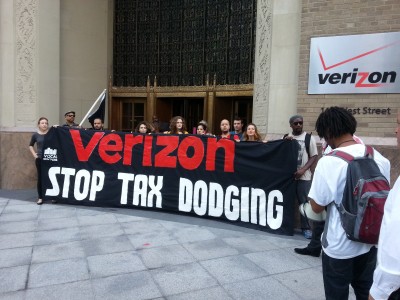
Verizon-Tax-Dodging-banner

Community leaders were arrested in 2013 during a protest outside Verizon’s NYC headquarters (at 140 West Street at the West Side Highway) to out the company for its history of avoiding taxes. (Image: Vocal NY)

From 2009-2013, Verizon New York reported losses of over $11 billion dollars, with an income tax benefit to Verizon Communications of $5 billion, and significant tax revenue losses for state, city and federal governments. Verizon New York has apparently paid no state, city or federal income tax for the last five years or more.

If Verizon is using accounting tricks to inflate the cost of legacy landline service while reducing costs to its wireless service, it could prove a win-win for Verizon and a lose-lose to ratepayers. Verizon could use its “losses” to argue for greater rate increases for landline customers while further reducing its tax obligations. On the wireless side, Verizon would enjoy praise from Wall Street analysts and shareholders pleased by the company’s apparently effective cost controls.

The best evidence of these techniques in action are the statements of company officials which suggest wireless costs are being paid by wireline customers.

Verizon’s chief financial officer, Fran Shammo, indicated to investors that Verizon wireline construction budgets are charged for expenses related to wireless service.

“The fact of the matter is wireline capital — and I won’t get the number but it’s pretty substantial — is being spent on the wireline side of the house to support the wireless growth,” Shammo told investors at Verizon at Goldman Sachs Communacopia Conference, Sept. 20, 2012. “So the IP backbone, the data transmission, fiber to the cell, that is all on the wireline books but it’s all being built for the wireless company.”

“It seems to me Verizon Wireless, already considered the Cadillac of wireless companies, doesn’t need a hidden subsidy from Verizon paid for by ratepayers all over the state,” Fred argues. “It seems very curious to me Verizon pioneered a large regional fiber optic upgrade that just a few years later it considers too costly to continue expanding, even as AT&T, Google, Comcast, and other companies are now entering the fiber business. A Public Service Commission that wants better broadband for New Yorkers ought to get to the bottom of this because it just doesn’t look right.”
John Malone Gets Puerto Rico Cable Monopoly: Liberty Global Takes Over Choice Cable

Phillip Dampier June 9, 2015 Competition, Consumer News, Liberty Cablevision (Puerto Rico), Liberty/UPC, Public Policy & Gov't Comments Off on John Malone Gets Puerto Rico Cable Monopoly: Liberty Global Takes Over Choice Cable

choice-300x169John Malone’s Liberty Global has bought out Puerto Rico’s second biggest cable television operator — Choice Cable TV — and will convert its customers to Liberty Cablevision of Puerto Rico.

Liberty joined Searchlight Capital Partners to close the $272.5 million purchase, which will make Liberty Puerto Rico’s largest cable company, passing more than one million homes and serving about 750,000 customers.

Liberty put $267.5 million of the purchase on its credit card, using debt borrowing from another Malone-controlled entity — Liberty Cablevision — to fund most of the deal. Liberty Global contributed just $10.2 million in equity and its partner Searchlight kicked in $6.8 million in equity.

The deal gives Malone’s company a total cable monopoly on the island. Choice Cable was the last standing cable operator not owned by Liberty, and served customers in western, southern, and central Puerto Rico. Choice itself consolidated several independent cable operators, including Cable TV Northwest (Aguadilla), Dom’s Cable TV (San Germán), Cablevision Mayaguez and TelePonce Cable TV. Now it has been consolidated itself.

mini-banner-cobertura

Choice Cable used to offer service in these Puerto Rican communities. Most of the rest of the island is served by Liberty Cablevision, which will now have a total cable monopoly across the unincorporated U.S. territory.

According to Liberty Global, the combined cable company will be expected to generate at least $390 million in annual revenue. If it doesn’t, rate increases could be on the way. Channel changes have already been introduced.

Liberty Puerto Rico added 18 new channels to the Choice Cable lineup at no extra cost. The Choice Pak package includes the new channels: AMC, AXS TV, beIN in Spanish and English, Cablevision, Disney Jr., Fox Sports 1, FX, Lifetime Real Women and PBS Kids. The Top Choice package will include: Crime & Investigation, DIY, Esquire, Fox Sports 2, History in Spanish, IFC, Military History and NBA TV.

But several other channels will be dropped: MTV, VH1 and Nickelodeon, Comedy Central, Spike, TV Land and Palladia HD. These Viacom-owned channels were discontinued last year by Liberty in a dispute over programming fees.

Liberty intends to offer up to 120/4Mbps Internet speeds, over 100 HD channels (352 channels total), and a “better balance of English and Spanish language networks” to current Choice customers.

Analysis: Charter Communications Will Acquire Time Warner Cable/Bright House – What It Means for You

charter twc bhAs expected, Charter Communications formally announced its acquisition of Time Warner Cable and Bright House Networks in a deal worth, including debt, $78.7 billion.
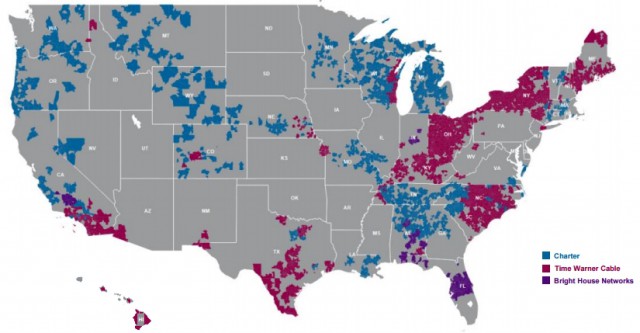
The deal brings Dr. John Malone, a cable magnate during the 80s and 90s, back into the top echelon of cable providers. Malone orchestrated today’s deal as part of his plan to dramatically consolidate the American cable industry. Malone’s Liberty Broadband Corp. assisted in pushing the deal across the finish line with an extra $5 billion (supplied by three hedge funds) in Charter stock purchases.

The companies expect to win regulator approval and close the deal by the end of 2015.

“No one has ever had a better sense of the multichannel world than John [Malone],” Leo Hindery, a veteran cable-industry executive, told the Wall Street Journal. “Obviously he sees in Charter and Time Warner Cable a way to perpetuate a legacy that is unrivaled.”

But the man who may have made today’s deal ultimately possible was FCC chairman Tom Wheeler. Last week, he personally called cable executives at Charter and Time Warner Cable to reassure them the FCC was not against all cable mergers just because it rejected one involving Comcast and Time Warner Cable.

But Wheeler warned he would only approve deals that were in the public interest.

“In applying the public interest test, an absence of harm is not sufficient,” Mr. Wheeler said.

Consumer groups are wary.

“The cable platform is quickly becoming America’s local monopoly broadband infrastructure,” said Free Press Research Director S. Derek Turner. “Charter will have a tough time making a credible argument that consolidating local monopoly power on a nationwide basis will benefit consumers. Indeed, the issue of the cable industry’s power to harm online video competition, which is what ultimately sank Comcast’s consolidation plans, are very much at play in this deal.”

“Ultimately, this merger is yet another example of the poor incentives Wall Street’s quarterly-result mentality creates,” Turner added. “Charter would rather take on an enormous amount of debt to pay a premium for Time Warner Cable than build fiber infrastructure, improve service for its existing customers or bring competition into new communities.”

new charter

[flv]http://www.phillipdampier.com/video/Bloomberg Inside the Charter Plan to Buy Time Warner Cable 5-26-15.flv[/flv]

A panel of Wall Street analysts discusses the chances for Charter’s plan to buy Time Warner Cable and Bright House Networks. Some analysts continue to frame regulator approval over video programming costs, while others argue broadband is the key issue the FCC and Justice Department will consider when reviewing the merger. From Bloomberg TV. (5:36)

A heavily indebted Charter Communications will not own the combined entity free and clear. At the close of the deal, Time Warner Cable shareholders will own up to 44% of the new company, Liberty Broadband up to 20%, Advance/Newhouse (Bright House) up to 14%. Charter itself will own just 22%, but will be able to leverage voting control over the entity with the help of Malone’s Liberty, which will get almost 25% of the voting power. That will give Charter just enough of a combined edge to control the destiny of “New Charter.”

As with the aborted deal with Comcast, lucrative golden parachutes are expected for Time Warner’s top executives who will be departing if the deal wins approval. In their place will be Charter Communications CEO Thomas Rutledge and a board compromised of 13 directors (including Rutledge himself). Seven directors will be appointed by independent directors serving on Charter’s board, two designated by Advance/Newhouse and three from Liberty Broadband, again giving Rutledge and Malone effective control.

Current Time Warner Cable and Bright House Networks customers will see major changes if Charter follows through on its commitment to bring Charter’s way of doing business to both operators.

No More Analog Television

all digitalCharter told investors at today’s merger announcement it will accelerate the removal of all analog television signals on TWC and Bright House cable TV lineups to free capacity for faster Internet products, more HD channels, and “other advanced products.”

Time Warner Cable CEO Rob Marcus told investors earlier this month TWC was already well-positioned with excess spectrum from moving lesser-watched analog channels to digital service and using “Switched Digital Video,” a technology that conserves bandwidth by only sending certain cable channels into neighborhoods where customers are actively watching them. This allowed Time Warner Cable customers to avoid renting a cable box for lesser-watched, cable-connected televisions in the home.

Charter’s plan requires a cable box on every connected television, at an added cost. The standard lease rate for the digital decoder box is $6.99 per month, and those customers on the lowest basic tier will likely receive at least two devices for up to two years for free, or five years for customers on Medicaid. Customers who subscribe to higher tiers of service or premium channels may receive only one device for free for one year before the monthly lease rate applies. For a home with an average of three connected televisions, this will eventually cost an extra $21 a month. DVR boxes cost considerably more.

No More Modem Lease Fee, But Only Two Choices for Internet Service

The good news is Charter does not apply any modem lease fees and there is a good chance if you already purchased your own modem, Charter will continue to let you use it. The bad news is that if you were used to sticking with a lower-speed broadband tier to save money, those days are likely coming to an end. Charter’s “simplified” menu of broadband options cuts Time Warner’s six choices and Bright House’s five options to just two:

  • 60/4Mbps for Spectrum Internet ($59.99)
  • 100/5Mbps for Internet Ultra ($109.99)

Charter_Spectrum_Mobile_Internet-finalThis is likely to be a red flag for regulators concerned about broadband affordability. Although it is likely Charter may offer concessions by grandfathering existing Time Warner Cable and Bright House customers under their current plans, Charter has nothing comparable to Time Warner’s “Everyday Low Price Internet” for $14.99 a month or a 6Mbps Basic broadband alternative far less expensive than Charter’s entry-level Internet tier. Bright House customers are not likely to experience something similar. The entry-level 15Mbps broadband-only plan is $65 a month without a promotion, according to Bright House.
Charter is rumored to be testing speed boosts for those two tiers for deployment in areas where they face fiber competitors. The first phase would raise Spectrum speeds to 100/25Mbps and Ultra to 300/50Mbps with plans to further increase speeds when DOCSIS 3.1 arrives — likely to 300/50Mbps for Spectrum and 500/300 for Ultra, at least where Google Fiber, U-verse with GigaPower, and Verizon FiOS offers competition.

Recently, Charter has followed Time Warner Cable’s marketing script and is actively promoting the fact the company has no data caps on broadband service, but Charter had a history of loosely enforced “soft caps” for several years in the recent past, so we’re not convinced data caps are gone for good at Charter.

Pricing & Service

billCharter enjoys a higher rate of revenue per customer than either Time Warner or Bright House, which is a sign customers are paying more. It is likely Charter’s reduced menu of choices is responsible for this. Although customers do get a better advertised level of service, they are paying a higher price for it, with no downgrade options. Ancillary equipment rental fees for television set-top boxes are also a likely culprit.

Charter also tells investors its merger with Time Warner and Bright House will bring “manageable promotional rate step-ups and rate discipline” to both companies. That means Charter will likely be less generous offering promotions to new and existing customers. Like Time Warner and Bright House, Charter will gradually raise rates on customers coming off a promotion until they eventually reset a customer’s rates to the regular price. But while Time Warner, in particular, was receptive to putting complaining customers back on aggressively priced promotions after an old promotion ended, Charter is not.

Charter customers tell us the company’s customer service department is notoriously inconsistent and promotional rates and offers can vary wildly. For some, Charter only got aggressive on price after they turned in their cable equipment and closed their accounts.

As far as service is concerned, CEO Thomas Rutledge has managed significant improvements while at Charter. What used to rival Mediacom in Consumer Reports’ annual ranking of the worst cable companies in America is now ranked number nine (Bright House took fourth place, Time Warner Cable: 12th).

But the presence of Malone in this deal, even peripherally, is a major concern. Malone-run cable companies are notorious for massive rate increases and poor customer service. Sen. Al Gore routinely called his leadership style of Tele-Communications, Inc. (TCI), since sold to Comcast, the Darth Vader of a cable Cosa Nostra and Sen. Daniel Inouye from Hawaii once remarked in a Senate oversight hearing that Malone’s executives were a “bunch of thugs.”

[flv]http://www.phillipdampier.com/video/Bloomberg Charter CEO Comfortable With Price Paid for Time Warner 5-26-15.flv[/flv]

Watch Charter Communications CEO Thomas Rutledge stumble his way through an answer to a simple question: What are the public benefits of your merger with Time Warner Cable that the deal with Comcast didn’t offer? Did you like his answer? (5:28)

While Your Cable TV Bill Rises Due to “Increased Programming Costs,” So Are Advertising Loads

cablebill-web

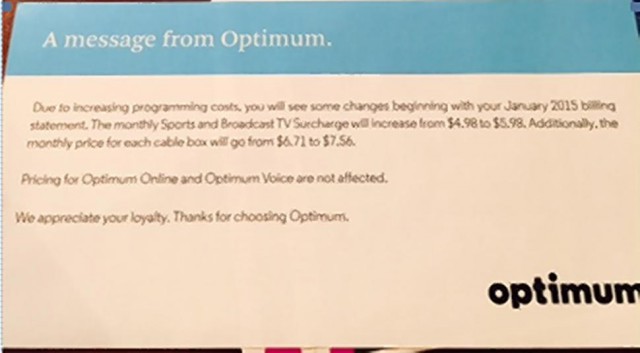
Cablevision’s broadcast TV surcharge increased in January to $5.98 a month, which amounts to $71.76 a year, on top of your usual cable TV bill.

No it isn’t your imagination. While a growing number of cable television subscribers now face a “broadcast programming surcharge” on their cable bill to compensate television stations and networks for cable carriage, those same channels are larding up their programming with ever-increasing advertising. One quarter of every hour of network television is now littered with commercials — an all-time high for broadcast networks seeking to maximize advertising revenue.

Show openings have been cut to seconds, credits roll by at fast-forward speed – usually compressed into illegibility, and some cable networks have returned to the practice of chopping bits of shows and compressing playback of others to accommodate more commercials. That does not include product placement or “in-program” compensated advertising, which appears when a character picks up a can of Pepsi, walks by a Subway outlet, or reaches for a Pop-Tart for breakfast.

As early as 2009, TNS Media Intelligence found at least 36% of today’s network primetime shows were advertising-oriented. That included 7:59 of in-show brand appearances and 13:52 of commercial advertisements, for a combined total of 21:51 of marketing content.

Reality shows, as well as being cheap to produce, are product placement gold. America’s Toughest Jobs contained 44:50 per hour of advertising messages and product placement, The Biggest Loser ran up 40:37. Before the reality show craze, game shows were program-length commercials in disguise. Game show producers received an endless supply of prizes to give away in return for viewers enduring relentless 10-15 second pitches for Rice-a-Roni, crock pots, living room furniture sets, and current model cars and trucks. Viewers did not escape traditional advertisements along the way either.

Through much of the 1970s and early 1980s, an average hour of network television was between 48-52 minutes of programming, 8-12 minutes of network and local commercials. Short news breaks and public service announcements were often included during those breaks. Shows targeting children usually contained less advertising.

In 1984, the Reagan Administration deregulated broadcasters, claiming the free market was best equipped to contain any abusive practices as consumers theoretically could tune out stations and networks that allowed things to get out-of-hand.

In reality, what one network decided, the others usually followed. Outside of watching commercial-free PBS (although those sponsorship messages increasingly began to resemble traditional advertising over the years), viewers didn’t have much choice. For the last 31 years since deregulation, advertising has increased while show length has decreased. In the 1970s and 80s, pieces of rerun television shows created when ad loads were shorter were often cut from shows to make room for an extra ad or two. What was left after a trip to the cutting room was often played slightly sped-up, which made room for even more advertising. By the 1990s, producers created their shows with increasing advertising loads in mind. Short sacrificial 60-90 second end scenes, deemed non-essential to the show’s integrity, were often chopped when a show entered syndication.

In the 2000s, network executives started demanding producers drastically cut the length of show opening and closing themes. If producers didn’t, studios did it for them when a show was resold to a cable network. A rerun of Law & Order now features a 24-second opening, a big difference from the original 1:45 second opening the show had when it originally aired on NBC. End credits were usually squished on-screen to allow a 15-second network promotion to run at the top. Some networks even began their next show in one window while showing end credits of the last program in another.

But nothing affected commercial loads more than the 2008 Great Recession. Advertising revenue tumbled, along with the economy, and advertisers balked at paying traditional ad rates when online advertising was available for much less. The answer? Sell more ads… at a lower price. Once again, program lengths had to be cut to make room for the increasing number of commercials. By 2009, average network ad loads were up to 13:25 per hour. Just four years later in 2013, that number spiked to 14:15. It’s now 15 minutes and up at some networks, depending on the type of program.

As commercials neared comprising 25% of every hour of television, sponsors finally began to rebel. They were reacting to the pervasive growth of the DVR, which allowed consumers to record their favorite shows, if only to fast forward past the dense thicket of commercials. They sought a ceiling on ad loads and more creative ways to reach ad-skipping audiences numbed by relentless advertising. That meant even more product placement.

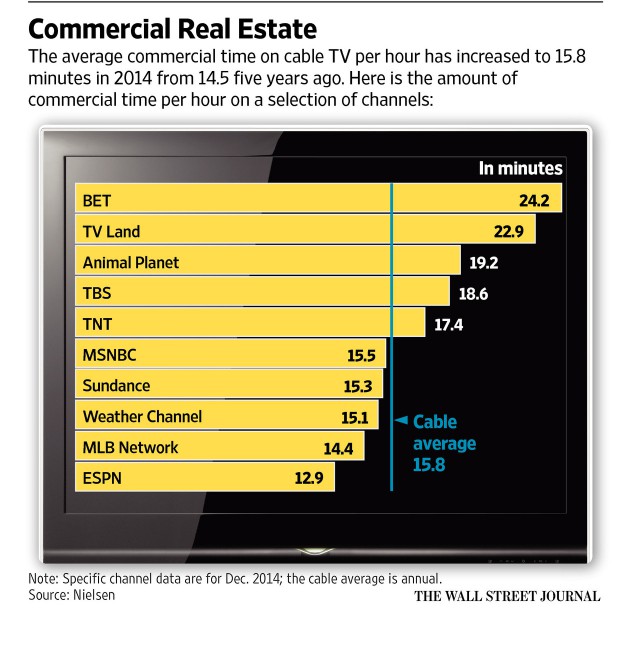
Although sponsors of expensive NBC, CBS, ABC, and FOX shows may have rebelled at the 15-minute mark, the same isn’t true with cable networks where ad loads are as high as 24 minutes per hour. In 2009, the average cable network aired 14:27 of advertisements an hour. This year, it’s up to 15:18 and still rising. Among the worst offenders:

ad load

To keep the money flowing from every direction, both over-the-air and cable networks, including those noted above, continue to seek additional compensation from your provider in the form of retransmission consent and carriage agreements. Whether you watch a channel or not, you are paying for it. Some of these compensation agreements are experiencing rate increases approaching 10% annually.

To the surprise of many industry analysts, some of the worst offenders are networks with declining ratings who risk further alienating viewers with even more advertising just to keep revenue numbers up. While traditional ads actually declined by 2% on most over the air networks this year, FOX more than made up for that with a 15% increase in advertising time. The cable networks with the highest ad increases this year were Viacom-owned channels (Comedy Central, Spike, MTV, Nickelodeon) jumping 13%, A+E Networks (A&E, Crime & Investigation, Lifetime, History) increasing 10%, and 9% at Discovery Networks. Which networks increased ads the least? Those owned by Disney, independent cable networks, and Time Warner (Entertainment).

“Generally speaking, the ratings winners (Disney, 21st Century Fox, Scripps Networks) are increasing investment in original content (and not abusively increasing ad loads), whereas the losers (A+E Networks, Viacom, NBCUniversal) and the neutrals (Discovery, AMC Networks) are decelerating investment in original content and stuffing more ad spots into their shows,” said analyst Todd Juenger of Sanford C. Bernstein.

Michael Nathanson of MoffetNathanson Research worries television is repeating the mistakes commercial radio made post-deregulation, when massive increases in advertising accompanied by decelerating investment in programming repelled many listeners, perhaps for good. Some have permanently abandoned commercial over the air radio in favor of commercial free music services, satellite radio, and streaming services.

“Networks can offset ratings challenges and pricing weakness with more inventory, however, we worry that it is a dangerous long-term game that ultimately devalues the consumer experience and reduces ad efficacy,” Nathanson said. “As we saw with radio, once the increased commercial load genie is out of the bottle, it is nearly impossible to put it back in.”

When Stephen Cox was watching The Wizard of Oz on TBS last November, something didn’t sound quite right to him about the Munchkins, who are near and dear to his heart. He wasn’t imagining things. Time Warner-owned TBS used compression technology to speed up the movie. The purpose: stuffing in more TV commercials.

“Their voices were raised a notch,” Cox, the author of several pop-culture books including one about the classic 1939 film, told the Wall Street Journal. “It was astounding to me.”

The Colbert Report hilariously depicts the next generation of product placement: the retroactive ad technology of Mirriad, which can insert products into shows years after they were made. (4:04)

Cablevision to Loyal Customers: Thanks for Paying Higher Prices for Cable Service When You Didn’t Have To

Phillip Dampier May 4, 2015 Broadband Speed, Cablevision (see Altice USA), Competition, Consumer News Comments Off on Cablevision to Loyal Customers: Thanks for Paying Higher Prices for Cable Service When You Didn’t Have To

take the moneyIf you are a long time Optimum customer, the CEO, management, and shareholders of Cablevision would like to thank you for driving average monthly cable revenue per customer 4.8% higher from a year ago to $155.34 a month.

A few years ago, Cablevision developed a Stalinist approach to repeat customer promotions and retentions: nyet.

Despite mounting competition from Verizon FiOS, AT&T U-verse, Comcast and Time Warner Cable, Cablevision has held the line on repeatedly discounting its service for customers who complain their rates are too high.

“Our disciplined approach to pricing, promotional eligibility and customer credit policies has not wavered,” Kristin Dolan, chief operating officer, told investors on a morning conference call.

As a result, the average customer staying with Cablevision paid almost five percent more for service than they did a year earlier — more than $155 a month.

optimum“The main drivers of our increased revenue per customer came from a combination of rate increases, but also lower proportion of subscribers on promotion,” said Brian G. Sweeney, chief financial officer. “We had a number of fixed rate increases January 1 of this year related to cable box fees, an increase in our sports and broadcast TV surcharge, as well as the pass-through of PEG fees to certain customers.”

Cablevision elected to stop competing on price in 2013, telling customers they are entitled to one customer retention deal and that is all. As a result, Cablevision has been losing customers even as it gains revenue. Although it managed to pick up 7,000 net new broadband customers during the quarter, Cablevison lost 6,000 customer relationships, 28,000 video customers — double the number from a year ago, and 14,000 voice customers. That represents 11 consecutive quarters of video subscriber losses.

The customers that remain are meeting Cablevision’s earnings expectations as others leave for better deals elsewhere.

Kristin and James Dolan

Kristin and James Dolan

Cablevision admits many of its subscriber losses come from customers willing to shop around for a better deal. They usually find one. Although Verizon has tightened customer retention deals itself in response to Cablevision’s retention policies, Frontier U-verse in Connecticut continues to compete for new business on price, at least initially as part of new customer promotions.

Kristen Dolan argues Cablevision’s quality of service keeps customers loyal and brings many ex-customers back.

“We do a significant amount of [customer] win-backs every year and we really focus on why people are coming back and it’s not just about price,” Dolan said.

But some customers believe it is more about the price than Cablevision might think.

“The only reason I left Cablevision was because they wouldn’t negotiate and match a better deal Verizon offered me,” said Rob Hastings of Syosset, N.Y., who canceled service in 2013. “When Cablevision wouldn’t cut their price I left.”

Many of the customers coming back to Cablevision this year are, in fact, their old customers dealing with a rate reset from Verizon as promotions expire.

“When my Verizon FiOS rate shot up, I went back to Cablevision as a ‘new customer’ on a promotion,” said Hastings. “When that expires, I’ll bounce back to Verizon. Whoever gives me the best price gets my business as I am sure not going to pay extra to stay a loyal customer.”

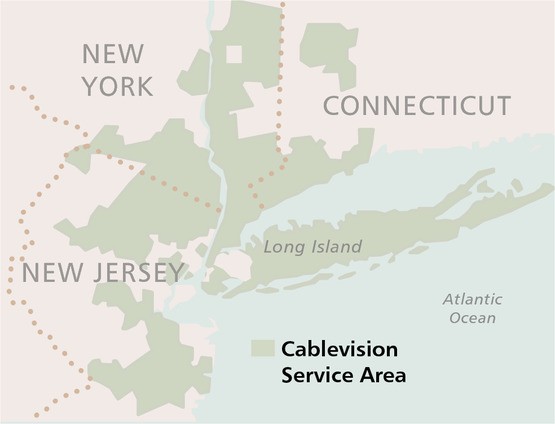
cablevision service areaTo further combat promotion-bouncing, Cablevision is embracing its broadband product line and marketing new cord-cutting packages to customers that offer reduced-size cable television packages and free over the air antennas for local stations. The cable company also recently announced it would offer cable customers Hulu subscriptions. Jim Dolan, Cablevision CEO, believes broadband is where the money is and customers are willing to pay higher prices to get Internet access even when video package pricing has its limits.

“You’re seeing the video product begin to lose margin and not just among the little operators like us, but even some of the big operators,” said Dolan. “Our philosophy is we think of video as akin to the eggs and the milk in a convenience store. You have to have it, but you don’t make a lot of money on it. Now connectivity is a whole other basket. It’s more like the soda and chips aisle, and if you provide great connectivity, because it provides great value to the consumer, you can differentiate yourself and you can charge more and the margins are good on it.”

Dolan doesn’t think much of his competitor’s slimmed down cable packages either.

“Verizon’s known to embellish [and] use misleading messaging in their marketing to get the phones to ring,” said Dolan. “I think that’s partially how we view these packages. I can tell you that the packages that we’re offering provide a lot more flexibility.”

To further differentiate it from its competitors, Cablevision continues to emphasize its Wi-Fi network of hotspots across metro New York City. The company also recently became the first major U.S. cable operator to launch a mobile phone service that uses its network of Wi-Fi hot spots. Although not willing to divulge customer numbers, Kristin Dolan did say unique weekly visits increased 16% on average to Cablevision’s website, presumably to explore the Freewheel Wi-Fi calling product.

Cablevision’s highlights for the first three months of 2015:

  • Fiber to the Press Release: Cablevision was the first cable company to introduce 1-gigabyte residential service in the tri-state area. The service launched to a single new multi-tenant building in Weehawken, N.J. No further expansion is planned at this time;
  • Discounted Internet for the Cord Cutter on a Budget: Cablevision expanded the availability of $34.90/mo Internet Basics (5/1Mbps) across its entire service area. It includes an over-the-air antenna.
  • Third Party Set-Top Boxes: Cablevision is interested in providing a less expensive, open standard, set-top box platform in the future to customers that don’t want to pay for a large cable box.

Search This Site:

Contributions:

Recent Comments:

Your Account:

Stop the Cap!