Home » rate hikes » Recent Articles:

Charter’s “Merger Benefit” for 2018: Sweeping Rate Hikes for Ex-Time Warner, Bright House Customers

Phillip Dampier December 27, 2017 Charter Spectrum, Competition, Consumer News 7 Comments

Charter Communications cable TV customers will soon see sweeping rate increases on their cable bills as the cable company announces its 2018 “rate adjustments” that will begin to take effect as early as next month in some markets.

For many customers, it is the second substantial rate increase in a year. Among the most notable are a dramatic hike in equipment rental costs and surcharges.

As Charter Communications took control of Time Warner Cable and Bright House Networks and introduced Spectrum packages and pricing in 2016 and 2017, company spokesman Justin Venech promised that Spectrum packages were “a better value” for customers, in part because equipment rental fees were substantially lower. But the gap between what Time Warner Cable charged in early 2016 and what Spectrum customers will pay in 2018 is quickly narrowing.

In early 2017, a Spectrum set-top box was priced at $4.99 a month. In mid-2017, the company raised the price to $5.99 a month and starting next month, that rental price is increasing to $6.99 a month per box. Other equipment is getting more costly as well. Time Warner Cable introduced digital transport adapters (DTAs) for secondary analog television sets at $0.99 a month. In 2018, that equipment will cost $4.99 a month. DVR service also increases $1 to $12.99 a month.

Spectrum’s original bundled TV, phone and internet packages — Select, Silver, and Gold were priced at $109.94, $129.94, and $149 a month respectively in 2016, according to the Orange County Register. Los Angeles was among the first markets in the country to obtain new Spectrum packages and pricing in the fall of 2016. Just 15 months later, customers can now expect to pay rates starting at $139.99 for Select, $159.99 for Silver, and $179.99 for Gold.

The company’s hated Broadcast TV Surcharge, which applies to all promotional and regular-priced television packages is also being hiked from $7.50 a month to $8.85.

Among the first markets to see the 2018 rate hike is Lexington, Ky.,  which has had a year-long running battle with Charter Communications.

The mayor is not happy.

“I’m outraged,” Lexington Mayor Jim Gray told the Lexington Herald-Leader. “This is the second rate hike for Spectrum’s cable subscribers in a single year. And considering Spectrum’s record of poor customer service, it just confirms my decision to bring competition and more options to Lexington for cable TV services along with high-speed internet.”

Lexington residents will soon have a third option for cable service in addition to Spectrum, AT&T or CenturyLink: MetroNet — which promises to wire the city with fiber to the home service over the next 3-4 years.

Prices for internet and phone service are unchanged for now, but Charter has often announced rate hikes for those services later in the year, so do not expect rates to remain unchanged throughout 2018.

Spectrum 2018 Cable TV Rate Increases

  • Limited Basic TV service: Current price: $15 New Price: $20
  • Expanded Basic TV service: Current price: $54.99 New Price: $49.99
  • Spectrum Receiver: Current price: $5.99 New Price: $6.99
  • Broadcast TV Surcharge: Current price: $7.50 New Price: $8.85
  • DTA: Current price: $4.00 New Price: $4.99
  • Single DVR Service: Current price: $11.99 New Price: $12.99
  • Sports Pass: Current price: $10.00 New Price: $12.00
  • Movie Pass: Current price: $10.00 New Price: $12.00
  • Triple Play Select: Current price: $129.99 New Price: $139.99
  • Triple Play Silver: Current price: $149.99 New price: $159.99
  • Triple Play Gold: Current price: $169.99 New Price: $179.99
$75/Month Broadband-Only Pricing Arrives in Comcast Country; Company Raising Rates Again

Phillip Dampier December 21, 2017 Comcast/Xfinity, Competition, Consumer News 9 Comments

Comcast: The Don’t Care Bears are back for more

Comcast broadband only customers in select markets will soon be paying $74.95 a month for Comcast’s 25 Mbps internet service, the lowest-priced internet-only tier that achieves the FCC’s broadband speed standard.

Comcast is among the top cable operators under pressure from Wall Street analysts who argue broadband service is too cheap for a limited competition marketplace, and they have urged providers to raise prices to as much as $90 a month to take advantage of higher revenue possible from a service many consider an essential utility.

Most cable operators are reserving their largest rate hikes for internet-only customers who do not subscribe to a television and/or phone package. Companies hope to recapture some of their lost TV revenue by charging broadband-only customers premium pricing.

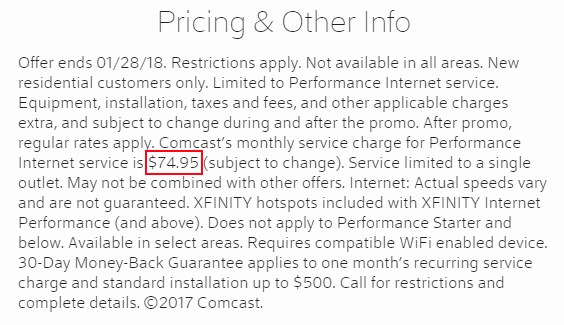
Comcast’s Performance tier, priced at $64.95 a month for much of 2017, has already increased to $69.95 in many markets in late 2017. The Comcast website now prices that tier, delivering 25 Mbps service, at $74.95 a month after any promotions expire. An additional modem rental fee of $11 a month also applies if you do not own your own equipment.

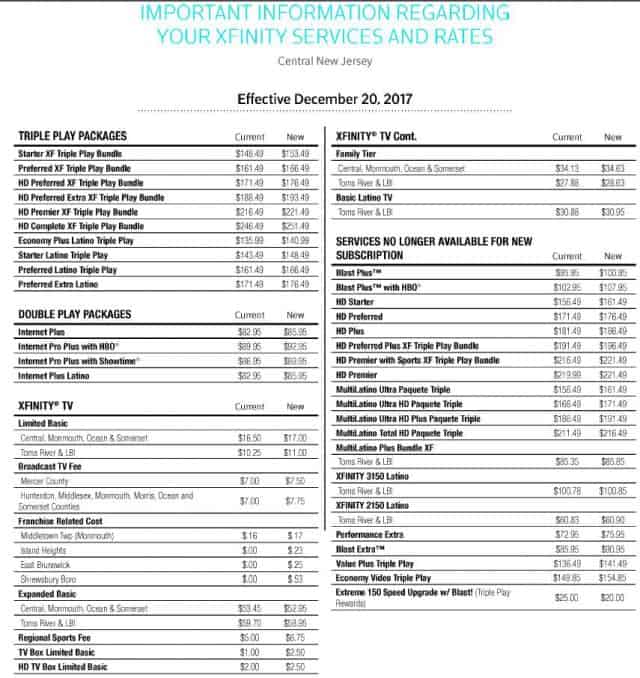
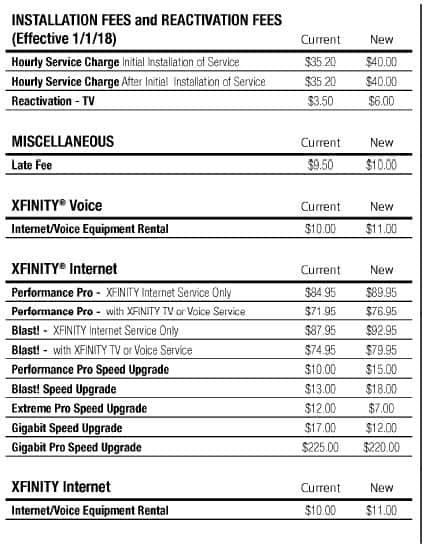
The rate changes are all part of Comcast’s annual rate hike parade (noticed by DSL Reports), which gradually rolls across the country and Comcast’s many service areas. Here is an example of a rate hike notice impacting most services in northern New Jersey:


Comcast rates for Performance (25 Mbps) tier, as found on Comcast’s website.

Happy Holidays 2018 Rate Hike from Cox

Phillip Dampier December 13, 2017 Consumer News, Cox 1 Comment

Cox Communications, which spent much of 2017 implementing data caps and overlimit fees on its broadband customers, is back for more with plans for sweeping rate increases that take effect Jan. 7, 2018.

According to a bill notification received by a DSL Reports reader, a long list of video packages will increase from $1-5 a month, with lower amounts for slimmed down TV packages and higher increases for Contour TV packages. Cox will collect even more from a big boost to its Broadcast TV Surcharge, rising from $4 a month to $7.50. Only one channel — Playboy — will see a significant rate cut (from $19.95 to $15.99).

Cox TV Package Rate Increases (effective Jan. 7, 2018)

Flex Watch will change from $40.00 to $41.00.
TV Economy will change from $34.99 to $38.00.
TV Essential will change from $75.99 to $79.99.
Contour TV will change from $79.99 to $84.99.
Contour TV Ultimate will change from $161.99 to 166.99.
Contour TV Preferred will change from $91.99 to $96.99.
Contour TV Premier will change from $105.99 to $108.99.
Advanced TV Ultimate will change from $158.99 to $161.99.
Advanced TV Ultimate with 4 Premiums will change from $167.99 to $170.99.
Advanced TV Ultimate with 4 Premiums and Record 6 DVR will change from $165.99 to $168.99.
Paquete Latino will change from $35.00 to $36.00.
El Mix will change from $52.49 to $53.49.
Super Mix will change from $89.99 to $94.99.
Flex Watch Latino will change from $13.51 to $14.51.
TV Economy Latino will change from $44.99 to $48.00.
Contour TV Latino will change from $89.99 to $94.99.
Contour TV Latino Preferred will change from $101.99 to $106.99.
Contour TV Latino Ultimate will change from $175.99 to $178.99.
Entertainment Package with 3 Premiums will change from $138.24 to $143.24.
Entertainment Package with 4 Premiums will change from $149.74 to $154.74.
CableCARD will change from $2.00 to $2.99.
Playboy will change from $19.95 to $15.99.
The Broadcast Surcharge will change from $4.00 to $7.50.

Substantial rate hikes are also forthcoming for Cox’s internet packages, rising $2-4 a month when bundled with at least one other service.

Cox High Speed Internet Rate Increases

Starter will change from $34.99 to $36.99.
Essential will change from $52.99 to $55.99.
Preferred will change from $67.99 to $71.99.
Preferred 100 will change from $72.99 to $76.99.
Premier will change from $79.99 to $82.99.

Cox is also risking losing customers for its digital phone service, which often gets targeted for cancellation when there are sweeping rate hikes. Cox seemed undeterred, boosting some basic plan prices while dropping others.

Cox Digital Telephone Rate Increases

Starter will change from $13.99 to $14.99.
Economy will change from $18.50 to $18.39.
Starter Lifeline will change from $10.99 to $11.74.
Essential Lifeline will change from $21.99 to $21.74.
Premier Lifeline will change from $31.99 to $31.74.
An Additional Telephone Line will change from $13.99 to $14.99.
The FCC Access Fee will change from $7.10 to $6.00.
The Cost Recovery Fee will change from $1.49 to $1.60.
Toll Restriction will change from $1.49 to $1.60.

A Cox spokesperson said the rate increases were to cover increased programming expenses, as well as recovering some of the investments Cox has made to improve its equipment and broadband service. Customers on a promotional rate plan are unaffected by the rate increases until their current promotion expires.

Some Former Bright House Customers Hit by $20/Mo ‘Rate Normalization’ Hike

Phillip Dampier October 26, 2017 Charter Spectrum, Competition, Consumer News 1 Comment

In an effort to keep things ‘organized,’ Charter Communications is ‘normalizing’ rates in its acquired service areas to match amounts paid by legacy Charter Communications customers for years. Charter will not lose any money from this process, effectively “rounding up” the rates it charges, causing bill shock for some former customers of Bright House Networks enrolled in grandfathered and/or promotional pricing plans.

Harry Johnson, who has been a Bright House customer in Florida for over 20 years, was unpleasantly surprised when he was notified in a letter his rates were going up approximately $20 a month.

“Charter wrote me telling me my promotion was expiring and they were raising my rates, except I am not on a promotion and have been paying the same price for internet service for a few years now,” Johnson tells Stop the Cap! “It was either the longest promotion ever or Charter was lying.”

Johnson was paying around $45 for his Bright House internet plan. Effective this month, he is being asked to pay $65 — a $20 increase.

“After they refused to negotiate or give me even a semblance of an explanation that made sense, I told them they just lost a multi-decade customer,” Johnson said, signing up for Frontier FiOS instead. “It is amazing to me just how nonsensical these giant cable companies are sending letters like that and then be non-responsive to complaining customers, hoping we will just swallow it.”

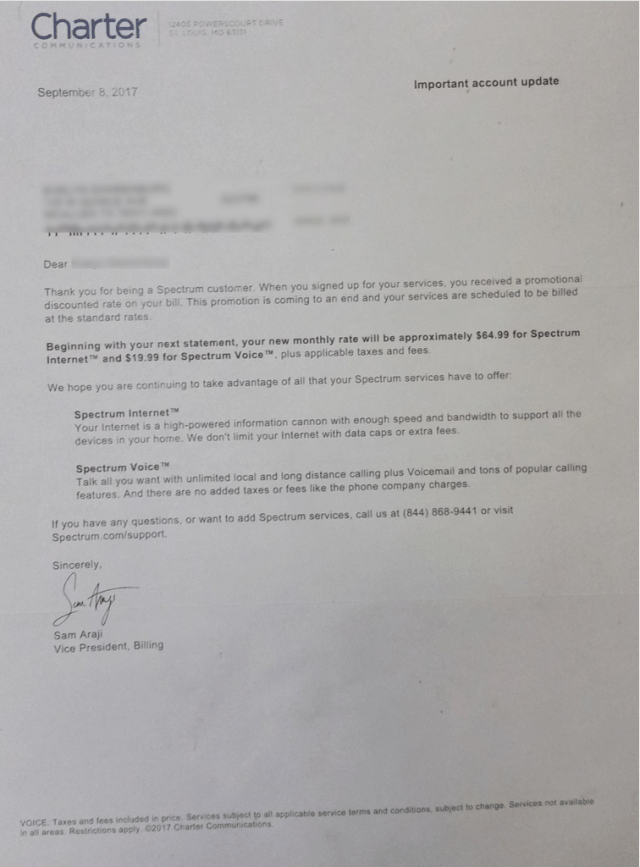
In a letter sent by Charter to a subscriber in Texas, signed by Sam Araji, Charter’s vice president of billing, the cable company explains the customer was enrolled in promotion that was now ending and billing would continue at standard rates.

(Courtesy: ‘etaadmin’)

A DSL Reports reader encountered almost the same situation when he discovered his internet bill was $20 higher than the month before.

“I found this curious because I wasn’t on any promotional offering and just have internet only service,” wrote ‘Chuch.’ “When I called customer service, I was told that I was under an old Bright House plan and that Spectrum was adjusting pricing to be more ‘in-line’ with their national plans and that she wasn’t going to budge on the price, even though I was never under a promotion. All I got from her was lip service about how I should be paying more for the same service I’ve had for some time, even though there have been no service improvements over that time.”

Like Johnson, ‘Chuch’ is dropping his Charter Spectrum service and switching to Frontier FiOS.

Former Bright House customers in Florida have been hit twice with rate hikes, first in March when some customers saw their bills literally double. Charter admitted it would raise rates for the majority of customers $20-30 a month this year alone.

WFTS in Tampa reported some customers in the Tampa area saw their bills double after Charter/Spectrum took over from Bright House. (3:21)

Cable Listens to Wall Street: Standalone Broadband Pricing Heading for $80/Month

Phillip Dampier October 18, 2017 Competition, Consumer News 10 Comments

Cable operators that have watched their stocks get pounded after warning their third quarter earnings would reflect an undeniable trend towards cord-cutting are considering dramatically raising broadband-only pricing to $80 or more to protect profits.

Comcast is among the largest cable companies responding to repeated calls from Wall Street analysts to boost broadband pricing, hiking broadband-only rates to around $65 a month after a customer’s $40 promotional pricing offer expires. Charter Communications also hiked prices earlier this year to $65 a month for its entry-level 60 or 100Mbps package, with further rate increases expected in early 2018. But those incremental rate hikes are not enough to satisfy analysts who fear cable’s video earnings losses are already higher than the revenue gained from charging more for broadband service.

In a note to investors, Morgan Stanley said the cable industry’s efforts to jack up prices for those dropping video service have made some progress, noting most companies raised prices by 12% in 2017, establishing a new beachhead rate of $65 a month — the rate broadband-only customers should now expect to pay.

“As video revenue growth is increasingly pressured, leaning on data pricing is tempting to sustain earnings,” said Benjamin Swinburne, a Morgan Stanley analyst in a report.

But recent rate hikes don’t go far enough for some. Prices must rise at least another $15 a month to satisfy Jeffries analyst Mike McCormack and restore industry profits lost from cord-cutting. McCormack notes customers who have not canceled cable television are being insulated from the most dramatic rate hikes impacting cord-cutters, pointing out the average customer with a bundle of services now pays around $49 a month for broadband service — $16 less.

“Cable companies are likely to raise stand-alone broadband pricing in order to combat the EBITDA declines from downsizing,” said McCormack in a report. “This practice is already evident and justified given the lack of a bundling discount. Based on our analysis, we estimate Comcast would need to raise stand-alone pricing to roughly $80 in order to break even from a profitability perspective.”

Swinburne

Jonathan Chaplin, an analyst for New Street Research who has called on the cable industry to double broadband pricing for more than a year, thinks the marketplace is ripe for sweeping rate increases.

“We have argued that broadband is underpriced, given that pricing has barely increased over the past decade while broadband utility has exploded,” New Street said. “Our analysis suggested a ‘utility-adjusted’ ARPU target of ~$90. Comcast recently increased standalone broadband to $90 (including modem), paving the way for faster ARPU growth as the mix shifts in favor of broadband-only households. Charter will likely follow, once they are through the integration of Time Warner Cable.”

Wall Street analysts typically use code language that avoids portraying the marketplace as a monopoly or barely-competitive duopoly, instead preferring to note there is little risk or headwind to prevent operators from boosting prices or using their large market share to their advantage. Chaplin argues that cable television is no longer to profit center it used to be — broadband is.

“In fact, the [free cash flow] lost from subs dropping pay-TV is generally recovered through higher [broadband] pricing,” said Chaplin.

Many analysts also argue that most of the proceeds collected from charging higher broadband prices should be used to buy back shares of stock or returned to shareholders, not used to upgrade or expand service. In fact, Wall Street is currently punishing Altice USA, sending its initial stock price from $30 a share to just $24.49 this week. One of the reasons for the fall is the money its Cablevision unit is spending to replace its coaxial cable network with fiber optics. AT&T’s stock has also suffered as the company continues to spend money on expanding its AT&T Fiber service while combating cord cutting with its U-verse and DirecTV services.

Search This Site:

Contributions:

Recent Comments:

Your Account:

Stop the Cap!