
Home » rate hikes » Recent Articles:

House Democrats Blast Telecom Companies for Data Caps, Rate Hikes

Phillip Dampier January 11, 2021 Altice USA, AT&T, CenturyLink, Charter Spectrum, Comcast/Xfinity, Consumer News, Cox, Data Caps, Frontier, Public Policy & Gov't, T-Mobile, Verizon Comments Off on House Democrats Blast Telecom Companies for Data Caps, Rate Hikes

House Energy & Commerce Committee

Democrats serving on the House Energy & Commerce Committee today blasted the nation’s largest internet service providers for price increases and data caps placed on consumer broadband services at the height of a global pandemic, questioning the industry’s commitment to keeping Americans connected.

“Over the last ten months, internet service became even more essential as many Americans were forced to transition to remote work and online school. Broadband networks seem to have largely withstood these massive shifts in usage,” wrote Democratic Reps. Frank Pallone, Jr (N.J.), Mike Doyle (Penn.) and Jerry McNerney (Calif.). “Unfortunately, what cannot be overlooked or underestimated is the extent to which families without home internet service — particularly those with school-aged children at home — have been left out and left behind.”

Pallone

The congressmen questioned nine providers after reading media coverage of rate hikes and the implementation of data caps by Comcast and the potential for Charter Spectrum to impose data caps as early as May 2021.

“This is an egregious action at a time when households and small businesses across the country need high-speed, reliable broadband more than ever but are struggling to make ends meet,” the three Democrats wrote.

In March 2020, many cable and phone companies relaxed a number of restrictions on customers in response to the emerging COVID-19 pandemic. Many volunteered to suspend data cap overlimit fees, provide affordable broadband options to the economically disadvantaged, offer free months of service, open restricted Wi-Fi hotspots, and discontinue collection efforts or service disconnects on customers falling behind on bills.

Despite the pledge, consumers filed a significant number of complaints with the Federal Communications Commission alleging the companies broke their promises, by far most often for not following through on free service offers or continuing aggressive collections of past due bills and shutting off service.
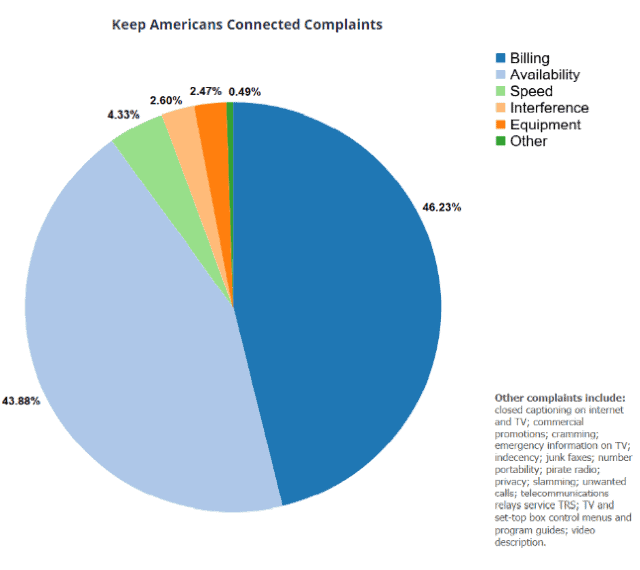
Consumer complaints filed with the FCC regarding the “Keep America Connected” pledge, received from March-November 2020. (Source: FCC)

The Energy and Commerce Committee has now sent letters to the CEOs of many providers, seeking answers to these questions as part of ongoing oversight of the industry:

  • Did the company participate in the FCC’s “Keep Americans Connected” pledge?
  • Has the company increased prices for fixed or mobile consumer internet and fixed or phone service since the start of the pandemic, or do they plan to raise prices on such plans within the next six months?
  • Prior to March 2020, did any of the company’s service plans impose a maximum data consumption threshold on its subscribers?
  • Since March 2020, has the company modified or imposed any new maximum data consumption thresholds on service plans, or do they plan to do so within the next six months?
  • Did the company stop disconnecting customers’ internet or telephone service due to their inability to pay during the pandemic?
  • Does the company offer a plan designed for low-income households, or a plan established in March or later to help students and families with connectivity during the pandemic?
  • Beyond service offerings for low-income customers, what steps is the company currently taking to assist individuals and families facing financial hardship due to circumstances related to COVID-19?

The full letters are available below:
Altice USA

AT&T

CenturyLink/Lumen

Charter Communications

Comcast Cable Communications

Cox Communications

Frontier Communications

T-Mobile US

Verizon Communications

Comcast Raises Prices; Budget Plans See Biggest Price Spikes

Phillip Dampier December 28, 2020 Comcast/Xfinity, Consumer News, Data Caps Comments Off on Comcast Raises Prices; Budget Plans See Biggest Price Spikes

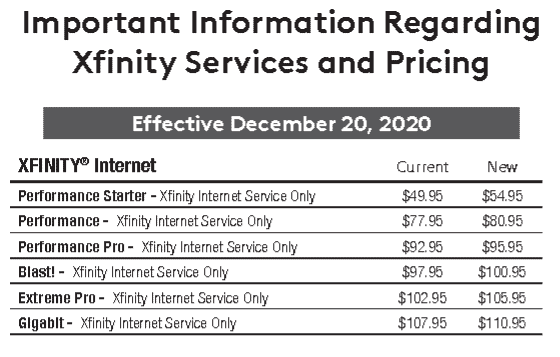
Comcast is rolling out price increases across its multi-state service area, starting with some significant hikes for customers in the northeastern U.S. that will also see a 1.2 TB data cap placed on internet usage in the new year.

Budget priced Performance Starter will take the biggest hit, increasing $5 a month from $49.95 to $54.95 a month. Faster, more expensive tiers will see price increases of $3 a month. Customers with bundled service packages may find lower rate increases, depending on the services they receive.

Comcast video customers will suffer even more from rate increases, with the cheapest plans seeing the biggest increases. For example, Choice TV increases $5 a month from $25 to $30. But Comcast’s add on fees are rising even more dramatically. The Broadcast TV Fee, charged to all cable TV customers that receive local TV stations, rise by up to $4.50 a month, which could result in additional charges of more than $18 a month just to cover local, over the air stations. Sports TV surcharges are also increasing $2 a month, resulting in an extra charge of $10.75 a month for regional sports networks.

Set-top box rental pricing is also changing: rental fees rise $2.50 a month for the first box (was $5 a month, now $7.50), but additional boxes decrease from $9.95 a month each to $7.50. If you need Comcast to install your service, that will now cost $100, up from $70.

Comcast rolls out rate increases regionally, so watch your monthly bill for an official notification of when the rate hikes arrive in your area.

AT&T’s New CEO: If You Don’t Subscribe to HBO Max, You Have a Low IQ

Phillip Dampier April 28, 2020 AT&T, Competition, Consumer News, Editorial & Site News Comments Off on AT&T’s New CEO: If You Don’t Subscribe to HBO Max, You Have a Low IQ

Stankey

AT&T’s incoming CEO John Stankey has a message for America: If you are unwilling to pay $15 a month for AT&T’s HBO Max, you have a low IQ.

Stankey made that declaration pitching the new service, set to debut in May. The fact the video platform is late to a market already crowded by Netflix, Hulu, and Disney is just part of the challenge. That $15 price point is a bigger one.

If there is any company in the telecom business that can prove consumers are sensitive to price hikes and bill shock, it is AT&T. Its frequent rate hikes for its DirecTV satellite service and various streaming TV platforms have caused a customer exodus. More than a quarter of DirecTV customers have left and, even more stunning, well over half of AT&T’s streaming TV customers have dropped the service. In late 2018, DirecTV Now (today AT&T TV Now) — AT&T’s cord cutting TV alternative, had 1.8 million customers. As of last month, that number is down to 788,000 and still falling.

AT&T has repeatedly claimed it wants to focus on “high value” customers, which may explain why it remains confident its $15/mo HBO Max service will do well, despite being the most costly streaming service in the market.

Stankey’s predecessor, Randall Stephenson, will exit as AT&T’s CEO in July. He leaves a much larger conglomerate than what he started with. AT&T has diversified from its telephone and wireless portfolio with several major acquisitions, including DirecTV — the satellite TV service, and Time Warner (Entertainment), a Hollywood studio and entertainment giant. The result is a company loaded with debt and a revolt by activist investors that question the wisdom of creating the 2010s version of AOL-Time Warner.

Elliott Management Corp., the activist investment firm that has proved itself a nuisance to the expensive dreams of several rich and powerful CEOs, does not see a viable marriage between AT&T’s profitable telecommunications business and a media and entertainment company. It took its concerns public in 2019, calling on AT&T management to get back to the basics.

Stankey’s approach seems to be a willingness to embrace the newest members of the AT&T family, for now, while also reassuring investors the shopping spree of mergers and acquisitions is over. Bloomberg News reports his views seem to have won Elliott Management over. At the same time, Stankey has to convince investors and the public he is competent at running a media company. The jury is still out on that:

Bloomberg:

At a town hall with HBO employees last year, Stankey said the network had to dramatically increase its programming output, comparing the work ahead to childbirth. Once, when a Time Warner veteran criticized an idea during a meeting, Stankey replied, “I know more about television than anybody.”

[…] But over the past two years, Stankey has tried to acclimate himself to the glitzy world of entertainment. He started watching HBO’s “Westworld” and “Succession.” He could be seen mingling with HBO talent at glitzy Manhattan premiere parties. At an industry event, he wore a pin featuring a Looney Tunes character — a WarnerMedia property — on his jacket lapel.

Spectrum: Go Ahead and Cancel Cable TV, We’ll Make a Fortune Selling You $70 Broadband Instead

Phillip Dampier September 3, 2019 Charter Spectrum, Competition, Consumer News 23 Comments

Charter Communications has set the stage for a Wall Street-pleasing boost in average revenue per user (ARPU) with a major broadband rate hike planned for this fall.

The rate of U.S. broadband subscriber growth slowed significantly in the second quarter of 2019, as the marketplace for internet access remains saturated and current customers are largely staying with the provider they know.

A MoffettNathanson report to investors shared by Light Reading reported subscriber growth is down from 3% during the first three months of 2019 to 2.8% over the late spring and early summer. In total, cable and phone companies added 438,000 new broadband customers in the second quarter, a significant drop from the 570,000 they added at the same time last year.

The number of new household formations continues to decline in the United States, presumably because younger Americans saddled with student loan debt are having a tougher time buying property or justifying high rent payments. Providers also believe the ongoing shift away from copper telco DSL service to cable broadband has slowed to a trickle, with those still loyal to DSL not concerned about internet speed, are happy with lower cost service, or do not have any other option. Craig Moffett, chief analyst for MoffettNathanson believes much of the growth in cable broadband at this point is coming from customers switching from services like AT&T U-verse, which still offers top speeds of under 30 Mbps in some areas. Other phone companies still relying on fiber-to-the-neighborhood service are likely also seeing customer departures triggered by recent discontinuation of video service. In most areas, cable operators are still the largest beneficiaries of provider changes. Phone companies relying on DSL continue to report broadband subscriber losses. Last year during the second quarter, phone companies lost 127,000 subscribers (a 1.1% decline). This summer, they lost 172,000 subscribers (a 1.3% decline).

With slowing cable broadband growth, companies are still under pressure to report positive quarterly results to shareholders. Without a significant number of new customers, Moffett believes operators will raise broadband prices to deliver higher revenue, especially in light of ongoing video cord-cutting. Moffett points to Charter Communications’ Spectrum in particular. Spectrum has one of the cable industry’s lowest ARPU numbers, because it does not impose cable modem rental fees or usage caps. That may explain the company’s plans to hike general internet pricing 6% starting in October, soon collecting $69.99 for Standard 100 (or 200 Mbps) service and $75.99 a month for customers bundling Standard Internet with Wi-Fi.

“The broadband increases alone would suggest significant upside to Charter ARPU estimates,” Moffett said. He also noted Charter’s plan to dramatically increase video pricing also “underscores their recent pivot towards ‘letting’ video customers leave if they want, and repricing those who remain for profitability.”

That means customers outraged by Spectrum’s cable TV rate hikes will not get much sympathy from customer retention agents. Moffett believes customers will be invited to cancel cable television service, because Charter does not make as much profit on the service as it used to, and customers will probably still keep their Spectrum internet service, which is enormously profitable for the cable operator. Customers will also pay an even higher price for standalone internet service once they stop bundling television service, increasing Charter’s profits even more.

Ironically, the more Spectrum customers drop cable TV packages, the more profit Charter can report to shareholders. Those keeping cable television won’t hurt Charter’s bottom line either. Customers that readily agree to pay more with each cable TV rate hike are statistically the least likely to complain or cancel.

Charter Spectrum Planning Major Fall Rate Increase: $70 Internet, $94 Cable TV

Phillip Dampier August 26, 2019 Charter Spectrum, Competition, Consumer News 44 Comments

Charter Spectrum TV customers will pay at least $94 a month for cable television starting this October, thanks to a sweeping rate increase that will hike the cost of TV packages, internet service, equipment, and fees. Internet customers will soon face a base price for internet service of just under $70 a month.

Cord Cutters News quotes an anonymous source that claims the rate increases will begin in October, and will impact just about every plan except phone service.

The most striking increase is the Broadcast TV Fee, charged to recover the costs imposed by local TV channels. After increasing the price by $2 earlier this year to $11.99, Spectrum customers will now be required to pay $13.50 a month — almost $1.50 more. The Broadcast TV Fee alone will soon amount to $162 a year, just to watch TV stations you can receive over the air for free. Just a year ago, the average Spectrum customer paid a Broadcast TV Fee of $8.75 a month.

A Spectrum receiver is considered required by most customers, and starting this fall, it will cost $7.99 a month to lease one (up about $0.50 a month).

Cable TV packages are also getting more expensive:

  • Spectrum TV Select: $72.49 a month (was $64.99 a month)
  • Spectrum TV Silver: $92.49 (was $84.99)
  • Spectrum TV Gold: $112.49 (was $104.99)

Internet customers will not escape Charter’s rate hikes either. The entry-level package — Spectrum Standard Internet (100 or 200 Mbps in some areas), will increase $4 a month to $69.99. If you use Spectrum’s equipment for Wi-Fi service, your price is increasing $5 a month to $75.99.

Although the rate increases are significant, they are not outlandish when compared with the regular internet-only prices charged by other cable providers:

  • Comcast: 150 Mbps (a 1 TB cap applied in most areas) costs $80 plus $13 gateway rental fee = $93/mo
  • Cox:  150 Mbps (a 1 TB cap applies in most areas) is priced at $84 a month plus $11 modem rental fee = $95/mo
  • Mediacom: 100 Mbps (a 1 TB cap applies) costs $95 a month plus $11.50 modem rental fee = $106.50/mo

Note: Gateway/Modem Rental Fee can be waived if you purchase your own equipment. Prices are lower when bundling, and you may get a better deal threatening to cancel or agreeing to a term plan.

One Wall Street analyst, New Street’s Jonathan Chaplin, predicted in 2017 that the cable industry would use its market power to nearly double rates consumers paid just a few years ago, which for most would mean an internet bill of at least $100 a month.

“We have argued that broadband is underpriced, given that pricing has barely increased over the past decade while broadband utility has exploded,” the researcher said in 2017.

Customers should watch their September bills for Charter Spectrum’s official rate increase notification. Customers on promotional or retention plans are exempt from increases except the Broadcast TV Fee and equipment charges until their promotion expires.

Customers that bundle multiple services will pay slightly lower prices as a result of bundling discounts, but the overall price increase will still be noticeable to most customers.

Cord-cutting is likely to accelerate dramatically because of Spectrum’s TV rate hikes, as customers reassess the value of a basic cable television package that is nearing $100 a month.

Search This Site:

Contributions:

Recent Comments:

Your Account:

Stop the Cap!