Home » rate hike » Recent Articles:

Time Warner Cable: Deck the Halls with $8 Modem Fees, Fa La La La La, La La La La ($2.75 DTA Fee, Too!)

Phillip Dampier December 22, 2014 Consumer News 6 Comments

grinch3It’s a Merry Christmas from Time Warner Cable, with rate increases for one and all!

The cable company that usually waits for the holiday season to end before sending out annual “rate adjustment” notices got an early start this year with some dramatic price changes for many customers, with further rate hikes likely to follow later in 2015.

Taking a lead from Comcast, Time Warner Cable is hiking its broadband modem lease fee from $6 a month to $8 a month in January. That equals $96 a year for a modem that not too long ago used to be included at no extra charge as part of your broadband subscription. A typical customer with a Motorola SB6141 DOCSIS 3 cable modem can buy a brand new unit for nearly $20 less than what Time Warner will collect from customers each year for refurbished or used equipment… forever.

In 2013, Time Warner Cable’s Rob Marcus admitted the company does not charge modem rental fees to defray the cost of the equipment, but as a hidden rate increase designed to generate more revenue.

“The modem fee is a rate increase by all accounts, it takes a different form than usual […] it’s very much a part of the overall revenue generation program,” Marcus told an audience of investment banks.

Customers that lost analog channels after Time Warner Cable began converting part of its lineup to digital-only service were offered free Digital Adapters to continue receiving digital cable channels on older analog sets. Customers were expecting a promised $0.99 monthly lease fee for the devices starting January 1, 2015. Instead customers will now pay $2.75 a month for each DTA device, estimated to cost cable companies less than $50 each three years ago.

But the charges don’t end there.

  • timewarner twcThe Broadcast TV Surcharge for cable television subscribers will increase from $2.25 to $2.75 a month;
  • A new “Sports Programming Surcharge” of $2.75 a month now applies to all cable television customers, whether they watch sports channels or not;
  • That on-screen program guide does not come for free. The primary outlet “discounted guide” surcharge is rising from $2.77 to $3.27 a month;
  • HBO will increase from $14.99 to $16.99 a month; the Movie Pass package of Encore movie channels and certain other networks is rising $2 a month, from $5.99 to $7.99.

Part of the sales pitch Time Warner makes to justify rate increases is that broadband speeds have increased up to 100Mbps. Except they haven’t in many Time Warner Cable markets, which remain locked in with maximum speeds of 50/5Mbps for the indefinite future.

Thanks to Stop the Cap! reader Joseph for sharing Time Warner’s letter with us.

Time Warner Cable’s LA Dodgers Dispute Giant Win for KDOC-TV; Paid to Carry Must-Watch Games

Phillip Dampier September 30, 2014 Consumer News, Public Policy & Gov't, Video Comments Off on Time Warner Cable’s LA Dodgers Dispute Giant Win for KDOC-TV; Paid to Carry Must-Watch Games
Struck Out

Struck Out

For most of the current baseball season, Los Angeles Dodgers fans who don’t subscribe to Time Warner Cable have been shut out, unable to watch the games shown exclusively on the extremely expensive SportsNet LA cable network, jointly owned by the Dodgers and Time Warner Cable.

Most of Time Warner’s southern California competitors balked at the asking price: about $4 a month per subscriber. Had they agreed to carry the network, subscribers would ultimately pay for it during the next round of rate hikes, whether they watched sports or not.

Time Warner Cable has a 25-year, $8.35 billion dollar contract to manage the network, and observers believe they have struck out.

“They rolled the dice and lost big time,” said Jimmy Schaeffler, head of consulting firm the Carmel Group.

With networks like ESPN commanding whatever they set as an asking price, sports team owners have rushed to get a piece of the lucrative sports network pie. Even individual teams are now demanding their own exclusive networks, hoping to charge top dollar to companies agreeing to carry them.

Angry cable customers watching their bills skyrocket can primarily blame sports programming for much of the endless increases. Around 20 regional and national sports channels now comprise 20% of the wholesale cost of cable television — a high percentage considering the average cable system now carries over 200 channels. While some basic cable networks are lucky to get 10 cents a month per subscriber, regional Fox Sports North demands $4.67 a month from each subscriber, whether they watch the network or not. Smaller independent cable systems usually pay even more.
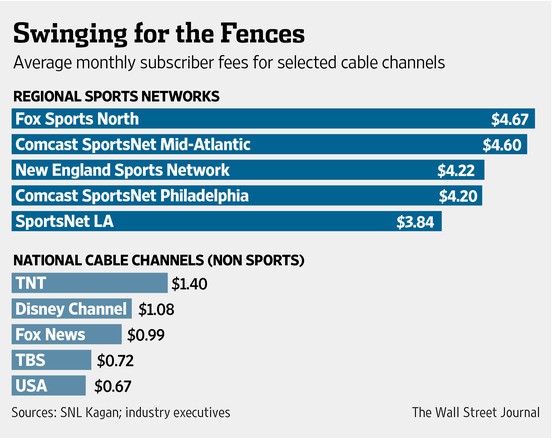
sports fees

In southern California, the average cable subscriber pays $20 a month for seven sports channels. There was little interest raising that to more than $24 a month to carry what Dodgers team president Stan Kasten called, “a Dodger-only channel with Dodger-only content 24/7.”

“We’ve been approaching a tipping point in sports programming costs for years and the Los Angeles market has sent a strong message that we’ve reached it,” Andy Albert, senior vice president of content acquisition at Cox Communications, one of the distributors that declined to carry SportsNet LA, told the Wall Street Journal.
kdocThe embargo has cost both the Dodgers and Time Warner Cable plenty of advertising and subscription revenue. Ratings are dramatically down from an average of 228,000 viewers when the baseball games were shown on widely carried Prime Ticket, to just 55,000 today on SportsNet LA. Advertising rates have been slashed to compensate for the lack of an audience.

The cost of the dispute between Time Warner Cable and its competitors also included bad public relations, which attracted the attention of regulators at the FCC and area elected officials, who have loudly complained that viewers are increasingly caught in the middle of these disputes.

The pressure worked, and Time Warner Cable announced in mid-September it would broadcast the six final Dodgers games of the season locally for free on KDOC-TV, an independent channel based in Orange County mostly known for airing endless reality shows and reruns of off-network series. On a good day, KDOC attracts at most 18,000 viewers. But the station is doing better today — grabbing an average of 259,000 viewers last week during one Dodgers game — essentially the same audience the Dodgers used to have before SportsNet LA came along. Even better for the station, Time Warner Cable is paying KDOC to carry the games.

KDOC management is now desperately trying to figure out how to keep its new audience after baseball season ends, running promotions for its various shows as often as possible. The station is easy enough to find over-the-air and on every significant cable, satellite, and telco-TV operator. But with more than three dozen high power, low power, and digital sub-channels to choose from across Los Angeles, the Inland Empire, and Orange County, airing stale series and courtroom drama shows may not be enough.

[flv]http://www.phillipdampier.com/video/KDOC Los Angeles New Years Show Eve Show of FAIL 12-31-12[/flv]

Many Los Angeles residents became familiar with KDOC after the station attracted national media coverage for its infamous 2013 New Year’s special hosted by actor and comedian Jamie Kennedy. As viewers watched the slow motion train wreck unfold with D-listers like Shannon Elizabeth, they were treated to endless technical issues, dead air, sudden commercials in the middle of interviews, open mics, unbleeped profanity, a stand-up routine not suitable for children or broadcast television, and special musical guests like rappers Bone Thugs-n-Harmony who dropped F-bombs on live television. Nobody at KDOC thought of pulling the plug, despite violating just about every FCC content regulation. It finally ended with an inebriated Macy Gray hoping to hurry along the festivities and, as the credits rolled, a sudden on-stage fight. Kennedy thanked fast-food chain Carl’s, Jr. for sponsoring the event, which undoubtedly caused extreme discomfort until they could disavow their involvement. An exasperated KDOC engineer assembled this montage of the disaster, which is definitely not suitable to watch at work. (6:23)


Time Warner Cable Can Raise Pricing on 2-Year Promotions; Customer Sees $15 Surprise Rate Hike

Phillip Dampier September 15, 2014 Comcast/Xfinity, Competition, Consumer News, Editorial & Site News Comments Off on Time Warner Cable Can Raise Pricing on 2-Year Promotions; Customer Sees $15 Surprise Rate Hike

fine printTime Warner Cable customers believing they can “lock in” prices for up to two years with one of the company’s service promotions might be surprised to learn the fine print allows the cable company to adjust prices after just one year of service, as this reddit user just discovered:
My bill went up $15. They tell me it’s ok because I’m still on the same promotion, it just went up in price. That I’m still saving over full retail price so it’s ok. The phrase “it’s only $15” was used by the service rep.

This is complete bulls***.

edit: I really wish I thought ahead to record the call. Now that I’m off the phone he offered me a one time $15 credit to make next month better. Like that changes anything.

How can the term two-year promotion be used if it’s only good for 1 year you ask? Well Time Warner’s answer is that it’s still the same promotion, it just goes up after a year.

edit again: The one time $15 just posted to my account. They don’t even call it a customer service adjustment or anything, they call it a “Save a Sub adjustment.” Not even trying to hide it.

09/06/2014 Save a Sub Adj -15.00

This and many other Time Warner Cable customers probably missed the fine print, which reveals pricing for the promotion can, and often does, adjust after the first 6-12 months. Comcast, the potential new owner of Time Warner Cable, also runs promotions the same way. Here are examples from both companies:

Time Warner Cablecomcast twc: Three-product offers valid for new residential and existing customers. After 12 months, regular rates apply. Offers expire 10/19/14. Standard TV for $39.99 available for 12 months; in months 13-24, price will go up to $44.99; after month 24, price will go to retail.

Comcast: After first 6 months, monthly service charge increases to $109.99 for months 7-12. After 12 months, or if any service is cancelled or downgraded, regular charges apply. After 6 months, the monthly charge for HBO is $15 for 12 months and thereafter, regular rates apply.

Some cable operators bill promotions by charging the customer the regular price for service and then apply a fixed promotional credit for the length of the promotional offer. If rates increase during the promotion, the customer will see the rate increase on their bill and will end up paying more because the service credit they receive does not change to offset the increase.

Why are they allowed to do this? Because cable companies like Time Warner Cable have gradually moved away from term-length service contracts, especially where they do not face a new competitor like U-verse or FiOS entering their service area for the first time. With both competitors well-established, cable operators have moved away from two-year “contracts” to two-year “promotions,” but customers often do not know the difference.

This customer can switch providers at any time without a penalty. Instead he called and complained and received a one-time service credit. Chances are if he calls and threatens to cancel service, the retention agent will put him back on the original promotion or one offering a similar promotional price. The key word is “cancel,” which works like nothing else to motivate representatives to keep your business.

Comcast/Time Warner: We Dare You to Compare – ‘Our Regular Retail Prices Are a Secret’

Phillip Dampier August 11, 2014 Broadband Speed, Comcast/Xfinity, Competition, Consumer News, Data Caps, Editorial & Site News, Public Policy & Gov't Comments Off on Comcast/Time Warner: We Dare You to Compare – ‘Our Regular Retail Prices Are a Secret’

psctest

One of the most difficult questions you can ask a customer service representative of either Comcast or Time Warner Cable is what their regular price is for service. As a Buffalo News reporter discovered in August 2013, Time Warner Cable refused repeated attempts to ascertain the non-promotional price of its broadband service.[1]

merger benefitsMaking a direct comparison between the prices charged by Comcast and those of Time Warner Cable require unnecessary perseverance made even more difficult by the fact Comcast only serves a tiny portion of New York State.
Both companies offer promotional deals to new customers as well as those threatening to cancel service, but those prices fluctuate wildly and eventually expire.

Time Warner Cable has made it even more difficult this year by completely eliminating the most popular plans from its retail price list: bundled service packages known in the industry as “double-play” (two services) or “triple play” (three services).[2]

A Time Warner Cable spokesman told the Los Angeles Times the company is required by regulators to provide pricing information for only some of its fees, and Internet rates are not one of them.[3] This year, Time Warner kept the size of its broadband rate hikes to itself. It is much the same for Comcast.

Both cable companies make a point of telling the news media that these prices, including installation, reflect the “rack rates” and that “most customers will pay less […] after cutting a deal for their programming package.”

ratehike1In 2011, Time Warner Cable raised some of its “rack rates” by up to 51.1 percent.[4]

That makes a rate comparison for television service difficult because the retail rates often do not reflect reality. But beyond rates, regulators need to understand Comcast television packages are very different from what Time Warner Cable customers are used to finding.[5] While Time Warner Cable bundles the vast majority of networks into a Standard TV package, Comcast offers a more extensive variety of packages. While at first glance this may seem to allow customers to better customize a package to meet their needs, Comcast has also taken care to break some of the most popular networks out of lower-cost packages and force customers to choose cable television packages costing much more to get them back.[6]

Sports fans and those who enjoy networks like Turner Classic Movies will have to pay Comcast $87.89 a month for its “Digital Preferred,” package[7], just to get back channels already included in the standard Time Warner Cable TV packages we are familiar with in New York.

At regular prices, a Comcast triple play customer should expect to pay $147.49 for the most bare bones TV, phone, and broadband package, $154.99 for the most popular package without premium channels, and $164.99 a month for a bundle that brings along a similar lineup to what TWC offers, along with Starz.[8] Comcast’s nearest equivalent to Time Warner Cable’s $200 Signature Home service costs $239.99 a month and offers no better Internet speeds than what Preferred Plus customers get.

[1]http://www.buffalonews.com/city-region-whats-the-big-secret-about-pricing-20130805
[2]https://www.spectrum.com/browse/content/ratecard
[3]http://articles.latimes.com/2014/mar/17/business/la-fi-lazarus-20140318
[4]http://articles.latimes.com/2011/dec/27/business/la-fi-lazarus-20111227
[5]http://www.timewarnercable.com/en/tv/digital-cable-tv.html
[6]http://www.comcast.com/Corporate/Learn/DigitalCable/digitalcable.html
[7]http://www.comcast.com/Corporate/Learn/DigitalCable/TVChannelLineUp.html
[8]http://www.comcast.com/shop/deals-dealfinder

Antitrust Us: Is ComVerizablAsT&TWCDirecTV Really Best for American Broadband?

Phillip Dampier July 2, 2014 Astroturf, AT&T, Broadband "Shortage", Broadband Speed, Comcast/Xfinity, Competition, Consumer News, Data Caps, DirecTV, Editorial & Site News, Net Neutrality, Public Policy & Gov't, Rural Broadband, Video Comments Off on Antitrust Us: Is ComVerizablAsT&TWCDirecTV Really Best for American Broadband?
Bad enough

Bad enough

A big company needs a big name, and so what if you can’t say it out loud, so long as your check reaches the cable cartel on time to avoid those inconvenient late fees.

The shock waves of the $45 billion dollar proposed merger of Comcast and Time Warner Cable (not to mention AT&T and DirecTV) have reached as far as Great Britain where appalled editorial writers in the British press are pondering whether Washington has lost its mind or just its integrity… or a combination of both, by actually contemplating the unthinkable rebirth of the American Robber Baron.

Only instead of railroads powering America’s early 20th century economy, today its broadband. Overseas, broadband is plentiful, fast, and cheap. Back home, cable operators are hard at work in a comfortable monopoly/duopoly working on excuses to justify Internet rationing with usage caps, outrageous equipment rental fees, rate hikes, and usage billing for a product about as cheap to offer as a phone call on one of those unlimited calling plans you probably already have.

From The Economist:

“On “OUTLAW”, a drama that aired on NBC, a Supreme Court justice leaves the bench to join a law firm. In real life he might have begun working for Comcast, America’s largest cable company, which owns NBC. Many of Washington’s top brass are on Comcast’s payroll, including Margaret Attwell Baker, a former commissioner of the Federal Communications Commission (FCC), America’s telecoms regulator, who in government had helped approve Comcast’s takeover of NBCUniversal in 2011. Even Barack Obama has Comcast ties. “I have been here so much, the only thing I haven’t done in this house is have seder dinner,” he quipped at a fundraiser hosted last year at the home of David Cohen, Comcast’s chief lobbyist.

“It helps to have influential friends, especially if you are seeking to expand your grip on America’s pay-TV and broadband markets.

“[…] The deal would create a Goliath far more fearsome than the latest ride at the Universal Studios theme park (also Comcast-owned). Comcast has said it would forfeit 3m subscribers, but even with that concession the combination of the two firms would have around 30m—more than 30% of all TV subscribers and around 33% of broadband customers. In the cable market alone (ie, not counting suppliers of satellite services such as DirecTV), Comcast has as much as 55% of all TV and broadband subscribers.

Worse

Worse

“Comcast will argue that its share of customers in any individual market is not increasing. That is true only because cable companies decided years ago not to compete head-to-head, and divided the country among themselves. More than three-quarters of households have no choice other than their local cable monopoly for high-speed, high-capacity internet.

“For consumers the deal would mean the union of two companies that are already reviled for their poor customer service and high prices. Greater size will fix neither problem. Mr Cohen has said, “We’re certainly not promising that customer bills are going to go down or even that they’re going to increase less rapidly.” Between 1995 and 2012 the average price of a cable subscription increased at a compound annual rate of more than 6%.”

Before blaming it all on President Obama’s close relationship with Comcast’s top executives, it was the Republicans in Washington that set this tragic monopolistic farce into motion. Michael Powell, President George W. Bush’s idea of the best man in America to protect the public interest at the FCC, represented the American people about as well as ‘Heckuva Job Brownie.’ Instead of promoting competition, Powell used his time to beef-up his résumé for a very cushy post-government job heading America’s top cable lobby – the National Cable & Telecommunications Association. Attwell-Baker was even more shameless, departing the FCC for her sweet new executive digs at Comcast just a short time after enthusiastically voting in favor of its NBCUniversal merger deal.

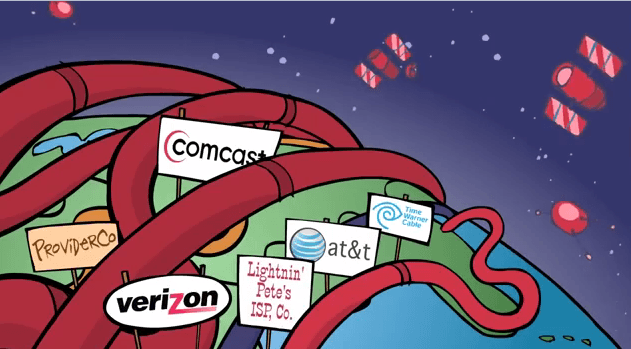
snakePowell and others made certain that Internet Service Providers would not be classified as “common carriers,” which would require them to rent their broadband pipes at a reasonable wholesale rate to competitors. The industry and their well-compensated friends in the House and Senate argued such a status would destroy investment in broadband expansion and innovation. Instead it destroyed the family budget as prices for mediocre service in uncompetitive markets soared. Today, consumers in common carrier countries including France and Britain pay a fraction of what Americans do for Internet access, and get faster speeds as well.

Letting Comcast grow even larger, The Economist argues, will allow one company to dominate not just your Internet experience, but also the content consumers access and at what speed.

“There is plenty for Mr Obama and Mr Cohen to discuss at their next dinner,” concludes the magazine. “But better yet, officials could keep their distance from Comcast, and reject a merger that would reduce competition, provide no benefit to consumers and sap the incentive to innovate.”

Considering the enormous sums of money Comcast has shown a willingness to spend on winning over supporters for its business agenda, restraint on the part of Washington will need voter vigilance, much the same way calling out non-profits who gush over Comcast while quietly cashing their contribution checks must also be fully exposed to regulators who will ultimately decide the fate of the merger.

[flv]http://www.phillipdampier.com/video/Antitrust Us.mp4[/flv]

Antitrust Us: Cartoonist Mark Fiore takes on the corporate idea that merging cable companies together creates more competition. (1:50)

Search This Site:

Contributions:

Recent Comments:

Your Account:

Stop the Cap!