Frontier Communications has won approval to assume control of telephone lines serving 310,000 Oregonians.
The Oregon Public Utilities Commission Friday unanimously approved the transfer of service from Verizon to Frontier as part of a 14-state transaction.
“First and foremost we want to ensure that customers are not harmed by this transaction. That’s why we are requiring more than 50 conditions, all aimed at making sure customers are not harmed by this sale,” Chairman Lee Beyer said. “In addition, we are requiring Frontier Communications to spend $25 million on expanding high-speed internet access to its Oregon customers by July 2013.”
In return for approval, Frontier agreed to PUC demands for customer service protections:
A commitment that Frontier spend at least $25 million to expand high-speed broadband in Oregon by July 2013;
No changes in “commission-regulated” retail service plans for at least three years;
Costs of the transition must not be paid by customers in the form of rate increases;
90-day window to change long distance carrier without any fees;
An independent audit, paid for by Verizon, to ensure Frontier can handle service for those customers affected by the deal;
An opt-out provision letting Oregon’s FiOS subscribers terminate their contracts without penalty if Frontier reduces Internet speeds or drops any of its television channels.
What is missing from Oregon’s agreement?
A prohibition of Internet Overcharging schemes like Frontier’s 5 gigabyte “acceptable use” policy that potentially limits customer’s broadband use. Expanded broadband that customers can only use for basic web browsing and e-mail, without fear of exceeding the limit, indefinitely punishes rural Oregonians with no broadband alternatives;
A specific definition of what constitutes “broadband” speeds. Frontier can continue to deliver the 1-3 Mbps it routinely provides to its less urban service areas. While better than nothing, Oregon regulators could have used the deal as leverage to win 21st century broadband speeds from Frontier, not yesterday’s ‘barely broadband;’
Fines and penalties that will punish a provider that does not invest appropriately in high service standards to provide quality service, and a trigger to permit automatic cancellation of operating certificates should Frontier go bankrupt.
Too many of these deals offer upsides for Wall Street and little benefit to consumers, especially those dependent on their landline phone company for basic communications services. By forcing requirements that prove costly for a provider to renege on, investors will understand their gains will only happen when they are assured Frontier is doing right by their customers, as well as their shareholders.
Oregon is the sixth state to approve the sale.
Frontier currently serves only 12,000 customers in the state, mostly in southwest Oregon, including the communities of Azalea, Canyonville, Cave Junction, Days Creek, Glendale, Myrtle Creek, O’Brien, Riddle, Selma, and Wolf Creek.
The company’s new customers will come mostly from Washington County, east Multnomah County, and from several pockets of customers in the northwestern part of the state. Oregon’s largest telephone provider is Qwest Communications, but the state has numerous smaller independent providers as well.
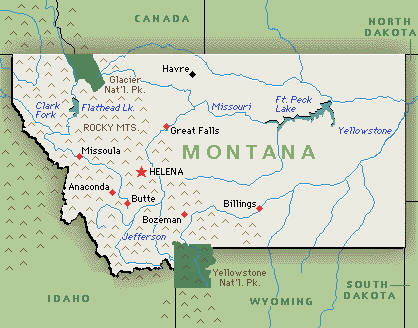
A controversial proposal by Montana’s largest cable operator to use public funding for construction of a fiber optic network linking the state’s seven Indian reservations has been rejected by federal officials.
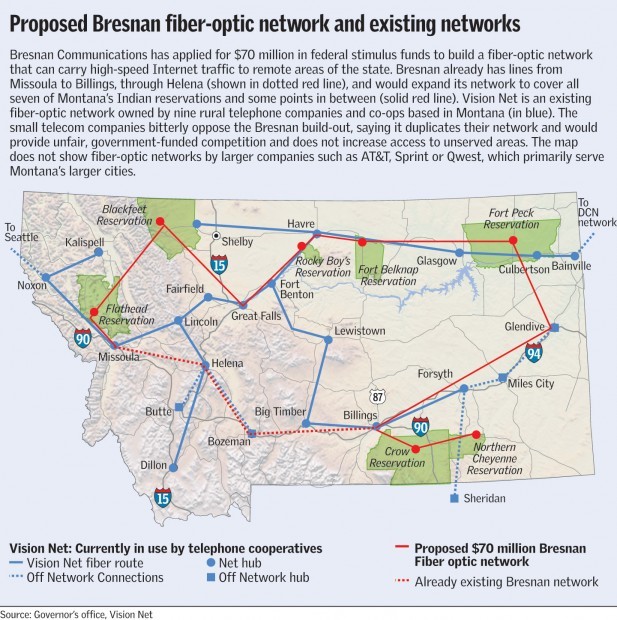
Bresnan Communications sought $70 million broadband stimulus grant to construct the 1,885-mile fiber-optic network to improve broadband connectivity. Independent and cooperative telephone providers objected, claiming the proposal would duplicate services they already provide.
The debate over broadband stimulus funding in rural Montana has been contentious, particularly after incumbent telephone providers accused Bresnan of lying on their application — implying funds would directly improve broadband service to Native American communities. They accused the cable operator of using public funds to enhance their own “middle mile network,” infrastructure that helps Bresnan distribute broadband traffic between its central offices and data centers, but not “the last mile” connection customers actually rely on to obtain service.
Montana is not alone in the debate over how federal broadband stimulus money should be spent. With a limited pool of funds, and an overwhelmed National Telecommunications and Information Agency tasked with processing an unexpected flood of applications, funding decisions have become increasingly political, and many incumbent providers have learned they can jam up an applicant just by flooding federal agencies with comments opposing projects that impact on their service areas.
[flv]http://www.phillipdampier.com/video/KULR Billings Montana Broadband Workshop and Broadband Speed 1-19-2009 and 8-30-2009.flv[/flv]
KULR-TV in Billings covered the NTIA Grant Broadband Workshop held last January and also covered Montana’s woeful existing broadband speeds in these two reports. (1/19/2009 & 8/30/2009 – 2 minutes)
Because “last mile” projects are the most threatening to incumbent providers, these applications typically get the most opposition. The NTIA, in an effort to reduce their workload, has in turn started focusing on “middle mile” projects which often benefit incumbents, pushing public tax dollars into pre-existing private networks. That looks great on provider balance sheets — that’s money they don’t have to raise from stockholders or other investors. Diverting those funds away, even from currently unserved areas, also protects providers’ flanks from the potential threat of competition, both now and in the future.
In Montana, chasing few potential customers spread out over vast distances in rural areas makes the potential threat from competition even scarier. There, many small phone companies exist as co-ops, less concerned with raking in profits. They fear the potential threat Bresnan Communications could bring to their viability if the cable operator gets a stronger foothold in their territories, especially when using tax dollars to do so. But is the threat that large for well-run, customer-oriented companies and co-ops?
Many rural areas served by co-ops and other small independent companies actually receive better and faster broadband service than their more urban counterparts, argues Bonnie Lorang, general manager of Montana Independent Telecommunications Systems, an independent phone company trade group. That’s because the state’s large urban phone company – Qwest, does not provide DSL into more distant suburban and rural service areas, and has only reached 75 percent of its customers with broadband service. Smaller independent providers, particularly member-owned cooperatives, are accustomed to serving residents Qwest has been slow to reach.
While true for those forced to rely on Qwest DSL service, those with access to cable modem service can do better. Bresnan provides up to 8Mbps service for residents in its mountain west region covering parts of Wyoming, Montana, and the western slope of Colorado. Expanding Bresnan’s service where economically feasible remains a priority for the company, and broadband stimulus funding may make the difference between an “unprofitable” area and one that can be profitable if certain infrastructure costs are underwritten.
“Bresnan has a history of investing in communities that are not considered larger communities,” according to said Shawn Beqaj, spokesman for Bresnan. “Our philosophy is that smaller communities deserve every bit of the services that large communities have.”
Bresnan’s grant application received support from Montana governor Brian Schweitzer, the state’s Native American population, and some consumers unhappy with their current broadband choices, if any.
Montana's phone companies are running these print ads objecting to the broadband stimulus proposal from Bresnan Communications (click to enlarge and see the full ad)
On the other side, the phone companies and their trade groups: the Montana Telecommunications Association and Montana Independent Telecommunications Systems, and the state’s utility oversight agency. They protested Bresnan was unnecessarily duplicating existing service, and potentially getting taxpayer money to do so. They also hinted Bresnan exploited Native Americans in an application tailor-written to appeal to federal officials seeking improved service for disadvantaged and challenged minority groups. Besides, the phone companies argued, Bresnan broke the rules from the outset by only agreeing to provide $6 million in company-provided matching funds, less than the 20 percent in matching dollars required by the stimulus program.
“If an area is unserved, prove it and spend the money on that,” Geoff Feiss, a representative of the Montana Telecommunications Association (MTA), told the Billings Gazette. “But don’t spend $70 million on an overbuild network that’s going to deprive investment from existing networks and leave behind collateral damage that we’ll never recover from.”
Montana’s Public Service Commission ended up on the side of the MTA, calling Bresnan’s proposal “seriously flawed.”
Bresnan and their allies shot back that phone companies complaining about federal dollars being spent on broadband projects was hypocritical, considering many of those companies receive government assistance from the Universal Service Fund to stay in business themselves.
Consumers looking for broadband were left in the middle or left out entirely. Many residents of the state are forced to rely on dial-up, satellite, or have been left indefinitely on waiting lists for future DSL expansion projects that take forever to materialize. Choice is an option too many residents don’t have. The Great Falls Tribune shared a story familiar to many Montanans:
Tim Lanham can’t get Qwest DSL at his eastside Great Falls home. It’s available to his neighbors across the street and at his office a block away.
He’s called Qwest about the situation, but typically can’t get through to a real person. The whole thing is frustrating, he said.
Lanham used to use Sofast. After its service went down, he switched to a Verizon Wireless card, but that can only be used on one computer at time. Now he has broadband Internet through Bresnan. Still, he wishes he had more options.
“I’d like the different options,” Lanham said. “Essentially they leave us with very few choices.”
At the heart of the debate is how to address the “digital divide” between those with Internet access and those without, and improving connectivity for those stuck with outdated, expensive, and slow “broadband.”
The state’s utility commission believes Montana’s primary problem exists in “the last mile,” namely getting broadband service to rural residents who currently are forced to use dial-up or satellite fraudband service that offers slow speed, tiny usage allowances, and a high price tag. In most cases, telephone companies have deemed these rural residents too few in number and too far apart to make investments in DSL service worthwhile. Using broadband stimulus money to subsidize the costs of providing service to rural America provides a direct path to broadband for those who may not obtain access any other way short of moving.
Larger providers have been urging that less money be spent on “last mile” projects and that funding be redirected into “middle mile” projects, which could dramatically reduce the costs companies have to pay to maintain and upgrade their own backbone infrastructure. Examples of these kinds of projects include installing fiber optic cables between telephone company central offices or extended service “remotes” which reduce the distances between customers and telephone company facilities, extending the distance DSL can cover in rural areas.
For now, Montana will have to wait for both.
Bresnan officials will meet with tribal and state commerce officials before deciding what to do next.
Walter White Tail Feather, director of economic development for the Assiniboine and Sioux tribes on the Fort Peck Indian Reservation in northeastern Montana, told the Gazette he hopes Bresnan reapplies for the funding.
“We think we can make a better proposal this second round,” he said. “This first one was a learning experience. … What we really are doing is working with the state to empower ourselves as a tribal government to create a business, to create opportunities that we don’t have.”
The state’s small phone companies may have won the battle, but are now concerned they could ultimately lose the war over obtaining broadband stimulus money themselves, at least from the NTIA.
Jay Preston, chief executive officer of Ronan Telephone Co., told the Gazette two federal agencies now will be deciding who gets broadband stimulus money: The National Telecommunications and Information Administration and the Rural Utilities Service.
The NTIA “seems to be really, really focusing on the middle-mile idea,” Preston said, while RUS probably will approve funds for rural telephone companies that already are the federal agency’s customers. The RUS loans money to rural co-ops for a variety of projects.
Regardless of where the money comes from, frustrated Montana residents just want better service. The state ranks dead last, tied with Alaska, in broadband speed, according to a study from the Communications Workers of America. Residents enjoy an average broadband speed of just 2.3Mbps.
[flv]http://www.phillipdampier.com/video/KFBB Great Falls Montana ISP Flounders 11-10 – 11-13-2009.flv[/flv]
Already-broadband-challenged Montana residents faced a major headache when one of the state’s large Internet Service Providers, SoFast, suddenly shut down last November. KFBB-TV in Great Falls followed the story over three days in these three reports from November 10-13th, 2009. (5 minutes)
The Billings Gazette mapped out Montana's fiber landscape
Qwest, born from a merger between US West and Qwest Communications is up for sale. Again. Actually, analysts are wondering exactly when Qwest wasn’t for sale over the last several years. Like that odd house on the corner of your street that nobody wants to buy, Qwest keeps lowering its asking price, hoping would-be suitors will stop driving past.
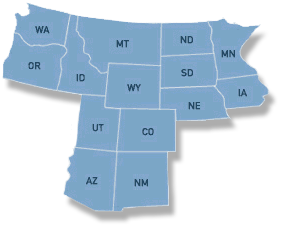
Qwest's service area
Qwest has a lot going against it. Unlike its bigger cousin Baby Bells, mostly absorbed into the AT&T or Verizon Continuum, Qwest is saddled with a service area that often spells r-u-r-a-l. The company got the short end of the stick when the Bell System was carved up in the mid-1980s, stuck with Arizona, Colorado, Idaho, Iowa, Minnesota, Montana, Nebraska, New Mexico, North Dakota, Oregon, South Dakota, Utah, Washington, and Wyoming. That’s a service territory shaped like a “T” which spells “trouble.” Outside of a few major cities like Phoenix, Denver, Minneapolis-St. Paul, Salt Lake City, and Seattle, the rest of Qwest Country is desert, ranch land, mountain ranges, farms, prairies, and some nice lakes and rivers.
While a great place to vacation, these spectacular landscapes are not what investors are looking for when considering what to do with a 100-year old copper wire telephone system. Qwest never even managed to launch its own cell phone service, instead relying on reselling Verizon Wireless to interested customers. Its foray into the cable TV business also flopped, and the company currently resells satellite TV service to customers.
The company was plagued with insider trading and other allegations of financial irregularities in the mid-2000s, and since 2005 has been rumored to be on the sales block.
The asking price keeps dropping, along with the company’s value. Originally worth $45 billion dollars ten years ago, Qwest can’t attract buyers even at half the price.
Customers aren’t very impressed either. In Lake County, Minnesota, the local newspaper printed a damning editorial Thursday accusing the company of being a villainous, untrustworthy liar after phone service went out for virtually the entire North Shore of Minnesota:
We’d like to have a villain in this story, but, so far, that character sketch is thin. Qwest is fitting the bill if you like obsequiousness on par with cigarette or multinational food companies.
Qwest touted the promise of high-tech 911 service, fast internet, a better connected North Shore. They’ve turned out to be good at promises but lousy on delivery when things go wrong.
The Lake County News-Chronicle excoriated Qwest in an editorial published last Thursday
Most people heard “All circuits are busy, please try your call again later” on their phones Tuesday. For more than a week, we’ve heard the same line from Qwest regarding what happened in Duluth and why there wasn’t a reroute up the Shore.
You can’t help becoming wary about how our technological infrastructure works after such failure Tuesday. Everyone was surprised to know that when fiber optic goes, so do cell phones. It was even more surprising to know that there was no detour for the line up the Shore. But that wasn’t technological indifference. That was a trust we put in Qwest.
[…]
It’s different when Qwest lies about why its line failed and we find out its assurance about a reroute was pure fantasy. There ends any trust or understanding to calmly wait out its line failures.
With Qwest, everything has been below the ground, literally and figuratively. It’s answer that repairing fiber optic is “difficult,” the empty promise of rerouting, and the lack of explanation of the real cause of the damage in Duluth, are all unacceptable.
It’s as if Qwest prefers a cloak of mystery about its technology and we should be happy to have it at all. That’s a poisoned relationship to have with fiber optic as it becomes ubiquitous in our lives.
Qwest, tell us what really happened under that street in Duluth, and, if it was the result of your own negligence, own up to it. Tell us why you told customers, including agencies responsible for public safety, you had a plan, a reroute in the case of a line break, but really didn’t.
And tell us why we should trust you again with this vital link to safety, health, and business along the North Shore.
While plots can be richer for their villains, we’d rather not have one in this story.
Ouch.
The Wall Street Mergers & Acquisition-vultures are circling over the company again, raising the stakes that Qwest is once again the common-sense choice for a takeover. But even they realize nobody may want the entire company, saddled with rural states’ phone customers over an aging network that will cost billions to upgrade. So the next best thing is to carve up the profitable bits and sell those to the highest bidder. Companies like AT&T, Verizon, and BellSouth could do well serving the major population centers in Qwest’s territory, leaving folks in states like Wyoming, Idaho, Montana and the Dakotas to their choice of likely “rural telco” suitors: CenturyLink, Frontier Communications, or Windstream. Qwest’s valued fiber optic network could fetch a billion or more on the open market. Their data centers could manage another cool billion if sold.
As Qwest’s revenue continues to decline, the company is likely going to continue cutting costs, keeping themselves as attractive as possible to would-be suitors.
“It gets harder and harder to keep cutting costs,” Donna Jaegers, an analyst with D.A. Davidson & Co. told the Denver Post. “As (former WorldCom chief executive) Bernie Ebbers used to say, ‘There’s no more lemon juice left in that lemon.’ ”
Just ask customers on the North Shore of Minnesota, as they sip Qwest’s bitter lemonade.
This is part one in a series of stories illustrating how telecommunications companies use a combination of public relations firms, professional lobbyists, friendly regulators, and outmaneuvered state officials to sell “improved service” to the public in return for regulatory “reform.” Too often, that “reform” is loaded with loopholes and language that guarantees providers can break their promises, tie state and local regulators’ hands when bad service results, and ultimately stick you with the bill.
Over the past several months, several communities in New Jersey have been up in arms about Verizon’s reinterpretation of a state law originally written in the 1940s but “updated” just a few years ago, to mean it no longer has to pay telephone pole and infrastructure taxes to municipalities for using the public right of way. Verizon’s “reinterpretation” of the state’s Business Personal Property Tax law surprised several municipalities who now face significant financial challenges as a result of the lost revenue. New Jersey residents will likely make up the difference with a higher property tax rate.
On the surface, it might appear Verizon simply happened upon tax savings. Verizon claims the law only requires it to pay taxes in communities where it has more than 51% of the area’s phone customers. Despite protestations from local officials, Verizon has signaled its intent to carry on, estimating 150 communities will join the 50-60 already impacted by next year.
Changes in telecommunications public policy do not occur in a vacuum. They happen when providers lobby for regulatory reform and bring gift baskets filled with promises for dramatically improved service. Using a network of high priced lawyers and public relations campaign experts, companies can easily outmaneuver local and state regulators at every turn. Unfortunately, by the time consumers (and sometimes regulators) realize they were left with a Trojan Horse filled with empty promises, it’s too late.
Some deals just bring consumers higher prices while others saddle communities with highly-leveraged, heavily indebted companies that eventually collapse in bankruptcy.
Just how did we get here? In this series, we’ll look at New Jersey’s history with its largest resident phone company. From New Jersey Bell to Bell Atlantic to Verizon, more than 20 years of questionable reform has left residents “touched” in their wallets. The blame doesn’t rest entirely with the phone company, either. Local and state officials were repeatedly won-over by professionally-run lobbying campaigns. After repeated bad experiences, one might assume they’d know better by now. Those communities no longer getting tax payments from Verizon can testify they haven’t.
Let’s turn back the clock to the dramatic changes in telecommunications that came with the 1984 breakup of Ma Bell and the Bell System.
Telecommunications Industry Sets the Stage for a Money Party
[flv width=”640″ height=”500″]http://www.phillipdampier.com/video/1977 The Bell System.flv[/flv]
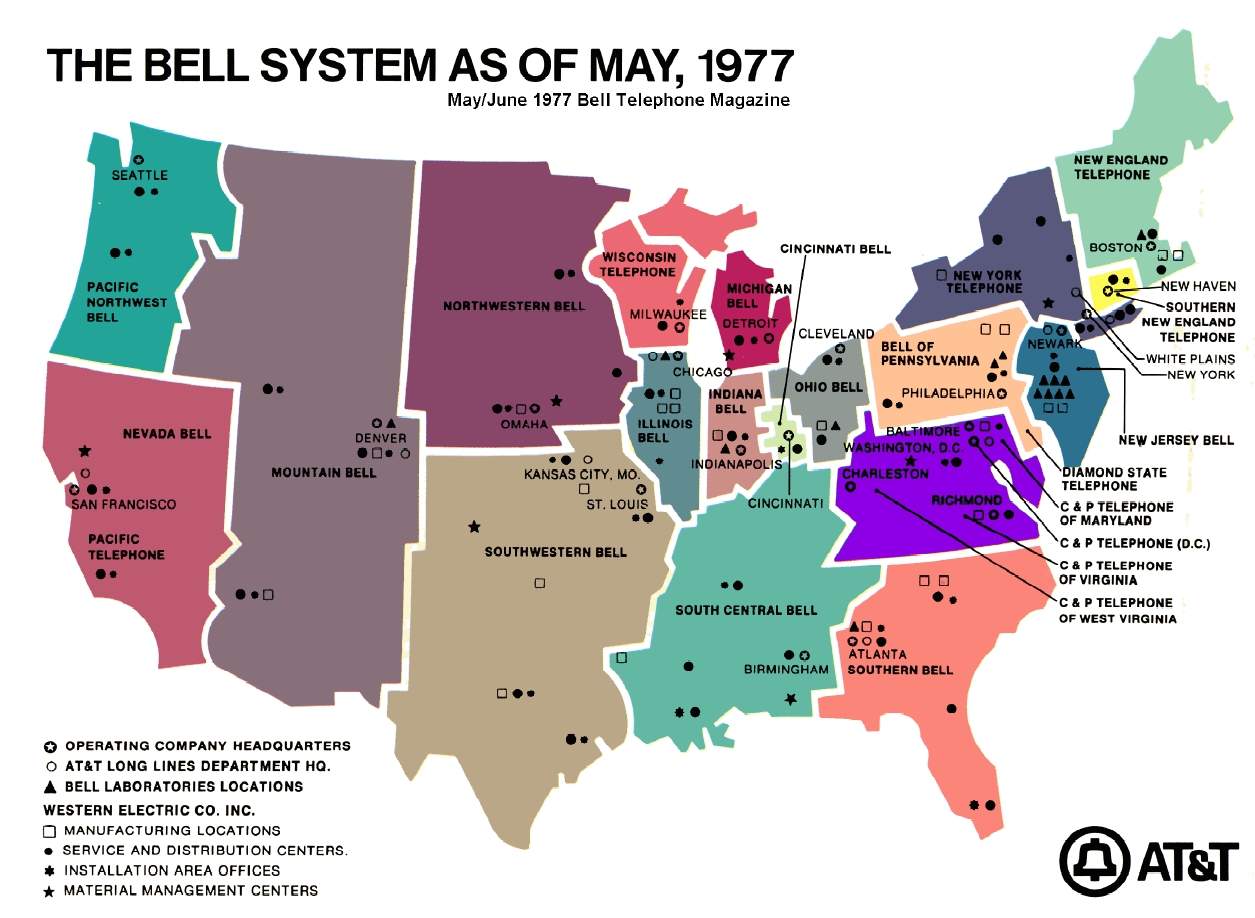
In 1977, the overwhelming majority of Americans were served by “the phone company,” namely AT&T and its family of Bell companies providing local service. (2 minutes)
AT&T's Bell System in 1977 (click to enlarge)
For decades, telephone service was run largely as a monopoly by the enormous Bell System and several dozen smaller, non-Bell independent phone companies. Telephone service was regulated by state and federal authorities who approved rate increase requests and made sure providers met service quality standards. Consumers did not own the telephone equipment in their homes – it was rented from the phone company. Although often uninspired, Bell System telephones were often virtually indestructible, ranging from basic utilitarian black rotary dial phones to the flaunting Princess phone, which had a lighted dial and came in several colors.
As America began earnestly developing data transmission systems in the late 1960s and early 1970s, AT&T kept its monopoly intact there as well. At the time, a cooperative arrangement between IBM and AT&T ensured most American businesses would probably deal with one or both companies for their data communications needs.
The eventual fall of the monopoly glory days of AT&T and its Bell System monopoly can be laid at the feet of corporate arrogance, particularly from one John D. deButts who became AT&T’s new Chairman and CEO on April 1, 1972. deButts was AT&T born and bred, rising through the ranks over decades of employment with AT&T. To him, anything smacking of competition was to be considered a duplication of effort and wasted resources. AT&T, in his view, had already strayed too far from its past when Americans could go from coast to coast and deal with just one telephone system using uniform standards and practices of operations. Consistency and quality should be the highest priority for AT&T, not squabbling with smaller competitors fighting with each other for customers.
A politically tone-deaf deButts infuriated a post-Watergate Congress hellbent on reform at a time when Americans had grown suspicious of big power players, be they political or corporate. The confident AT&T executive delivered a speech before regulatory commissioners in the fall of 1973 that included within it, “[we must] take to the public the case for the common carrier principle and thereby implication to oppose competition, espouse monopoly.”
Not only did the speech irritate many members of Congress, it helped convince one of AT&T’s competitors, MCI to file a 22 count lawsuit against AT&T in March 1974, accusing Ma Bell of being engaged in illegal antitrust activities.
An even more important lawsuit was filed by the U.S. Justice Department on November 20, 1974. The federal government also accused AT&T of antitrust behavior, claiming the company locked-up the telephone equipment business for itself, and was well-suited to crush any potential competitor from getting a serious foothold in the marketplace. At the time, AT&T officials sniffed that the lawsuit was completely without merit and promised to fight back at all costs.
deButts ordered company lawyers to stall, delay, and roadblock the government’s case as much as possible, and the company enjoyed years of court delays. The lawsuit dragged through several preliminary hearings and motions, until the then-presiding judge, Joseph Waddy, fell ill and had to reduce his caseload. The United States v. AT&T was transferred to a newly-appointed District Judge named Harold Greene in September 1978. The days of delay were over. Greene quickly ordered the case to trial starting in September 1980.
While the court case saw some changes, AT&T did as well. In February 1979, deButts was out, replaced with a far more conciliatory Charles Brown. He changed AT&T’s tune, publicly welcoming competition into the marketplace, announcing “I am a competitor and I look forward with anticipation and confidence to the excitement of the marketplace.”
Having that attitude probably wasn’t helpful to defending AT&T’s case, and the company eventually threw in the towel, reaching a settlement with the government in 1982. Overseen by Judge Greene, AT&T was promised it could keep its long distance service, Western Electric (which manufactured telephone equipment), and Bell Labs, the company’s research and development arm. In return, it had to divest all 22 local phone monopolies.
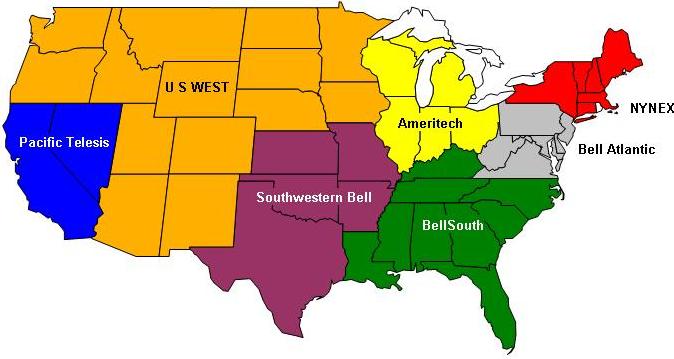
Judge Greene, issuing a final consent decree to be effective January 1, 1984 formally broke up the Bell System. The 22 local phone companies under AT&T were merged into seven Regional Bell Operating Companies, each to be run independently:
Ameritech (acquired by SBC in 1999 – now part of AT&T again)
Bell Atlantic (acquired GTE in 2000 and changed its name to Verizon)
BellSouth (reabsorbed back into a newly reorganized AT&T in 2006)
NYNEX (acquired by Bell Atlantic in 1996 – later to become part of Verizon)
Pacific Telesis (acquired by SBC/AT&T in 1997)
Southwestern Bell (changed its name to SBC in 1995, then acquired the remnants of AT&T in 2005, rechristening itself as the ‘new’ AT&T)
US West (acquired by Qwest in 2000.)
The goal was to create several smaller regional companies not too large to face challenging competition from new independent providers entering the marketplace.
The result of all of this upheaval was competition in the long distance calling marketplace, but very little competition for local residential telephone service over phone company-provided telephone lines.
Still, for a time the post-breakup family of former Bell companies enjoyed stability and a less regulated marketplace, and several raised rates for local phone service, even while cutting long distance prices. Customers could now buy and install their own telephone equipment, including answering machines and computer modems, and several competitors began to spring up to serve business customers.
By the 1990s, a new upstart appeared on the horizon that would potentially threaten the whole ‘arrangement.’ The cable television industry, subjected to a more regulated marketplace after years of monopoly abuse of customers, was looking for new unregulated add-on services they could provide to bring back the days of big profits they enjoyed just a few years earlier. Two potential services: providing connectivity to the Internet and providing cable customers with telephone service.
When phone companies realized cable was planning to invade their turf, this meant war.
In part two, learn more about how the telephone companies went ‘back to the future’ and rebuilt the empire Judge Greene broke up.
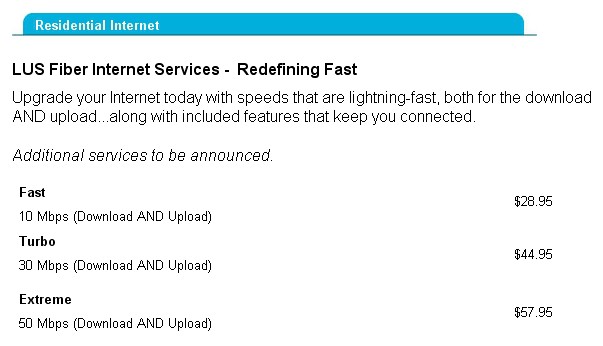
LUS Fiber - Lafayette, Louisiana's public utility municipal broadband provider, offers fast speeds with great rates
Frustrated communities across America, take note.
If your town or city government starts making serious noises about constructing your own, municipally-owned broadband network (especially one built with fiber optics to the home), existing providers who have repeatedly said “no” to requests for faster service at more reasonable prices have a track record of quickly turning around and saying, “yes — why didn’t you ask us before?”
Big existing telecommunications players loathe the thought of facing a new competitor in their midst. They are accustomed to the usual arrangement of one cable operator and one phone company. Cable companies provide cable modem service, phone companies mostly provide DSL. In smaller cities, and where a competitor is missing (or provides a lower quality service), there is almost no drive to upgrade. Cable will set speeds just above what the phone company is offering, and both will co-exist happily ever after.
For communities being bypassed by the fiber revolution now underway by Verizon, and to a lesser degree AT&T, requests from civic leaders, businesses, and consumers for upgraded service fall on deaf ears. ‘What you have now is good enough for this market, so be quiet and be lucky we give you what you’ve got now. Oh, and we’re raising rates, too.’
In Rochester, the one upstate New York city not on the “to-do” list of Verizon (which is merrily wiring urban and suburban communities across their service areas with fiber optic cable FiOS), Time Warner Cable sees little incentive to raise speeds or upgrade to DOCSIS 3 with a phone company competitor that has no apparent plans to move beyond traditional old school DSL service. Where FiOS does threaten, Time Warner Cable is in a hurry to provide “wideband” broadband as quickly as possible.
In Wilson, North Carolina, years of pleading from local officials to provide something beyond anemic broadband in their community was met with yawns from Time Warner Cable and Embarq, the local phone company. Wilson decided to build their own municipal fiber network, offering faster speeds at better pricing. Time Warner and Embarq did what most existing competitors do — they moved through the Four Stages of Telecommunications Competition Grief:
1) Behind the Scenes Threats and Anger: Companies work the phones with local officials trying to browbeat them into dropping the plans to construct municipal broadband, try to gin up partisan opposition, issue overinflated cost estimates, issue warnings about the trouble they’ll cause local politicians who support such initiatives, and snow a blizzard of documents illustrating how wonderful and reasonable their existing service is;
2) Stall Tactics Through Negotiation: Once home office is notified, a series of negotiations to attempt to forestall the project begins, such as throwing crumbs for incrementally better service, offers to build showcase mini-projects that represent a “win” for local politicians, or “looks good on paper” concessions that end up amounting to far less. Most of these discussions are designed simply to stall to allow the company to prepare for stage three.
3) PR and Legal Blitzkrieg: Assuming local officials haven’t been discouraged away from their idea, or dropped it after starring in a company-sponsored press event – ribbon cutting a small wi-fi or school connectivity project, the next stage is a multi-front battle involving company legal teams filing lawsuits to delay or kill projects, public relations and astroturf lobbying efforts to distort issues and build public opposition, legislative maneuverings to make such projects untenable through industry-friendly laws, and often vague promises about impending upgrades making the entire project unnecessary.
4) Acceptance, Competition, and Better Service: The final stage is the realization consumers don’t always get suckered by astroturf groups and company scare tactics. They accept the project is moving forward, and send out the press release saying they welcome the competition and are announcing their own significant service upgrade because “customers asked for it.” Price increases slow, speeds increase, and service improves, all because of the reality that an aggressive competitor is in their future.
Wilson city officials tried negotiations for better service, got nowhere, and had to fight back against a blizzard of nonsense from the telecommunications industry trying to legislate such projects out of existence with changes to state law. Americans for Prosperity, an astroturf group, even hassled residents in other nearby communities with robocalls to try and stop similar projects.
Chattanooga’s public power utility fought back against telecommunication company propaganda to construct fiber to the home service across the city, which launched this year. (5 minutes)
In Monticello, Minnesota, local telephone company TDS had spent years refusing requests to improve service in the city. Speed and access issues plagued the community, northwest of Minneapolis. Local officials had enough and voted to construct their own fiber to the home municipal network.
Enter the four stages. TDS started by telling city officials the company’s network was state of the art for Monticello, and couldn’t be immediately improved because there was insufficient return on investment. Companies want to be assured they are paid back for investments they make, and because Monticello is a relatively small city, there were questions whether the costs for a fiber network would be paid back quickly enough through revenues.
When that didn’t work, the company sued the city as a stalling tactic. Despite the fact Monticello won case after case, TDS kept filing. A full assault by large telecommunications interests also began, trying to gin up public opposition. While the project was approved by voters, and Monticello was tied up in court, TDS quickly moved to stage four and started rapidly building their own fiber network in Monticello, actually putting down fiber the city was prohibited to wire themselves as the lawsuits dragged through the courts.
The company told Ars Technica that despite its earlier refusals to provide fiber service, TDS didn’t act earlier because it didn’t actually know that people really, really wanted fiber; once the referendum was a success, the company moved quickly to give people what it now knew they wanted.
Then, in June, the company said with the advent of its own fiber network, the city of Monticello should back away from constructing theirs, because its economic viability report was partly premised on the fact TDS refused to provide that service.
To underline that, TDS’ new fiber network doubled customer speeds to 50Mbps, trying to keep customers from taking their business to FiberNet Monticello.
[flv]http://www.phillipdampier.com/video/Vote Yes on Fiber.mp4[/flv]
Lafayette staged a multi-year battle with Cox and other providers to bring municipal fiber broadband to it’s corner of Louisiana. This 30 second ad promoted a “yes” vote on the project.
In Louisiana, Cox Cable is facing accusations it’s engaged in predatory pricing to kill Lafayette Utility System’s fiber to the home network and EATel’s fiber network in Ascension Parish. Cox Cable froze rates and moved in with DOCSIS 3 upgrades, delivering up to 50Mbps service. Cox chose to upgrade Lafayette before any other Cox-served community.
The Lafayette Pro-Fiber Blog found this EATel billboard taunting Cox
EATel, an independent phone company that wired fiber across Ascension Parish, also faced down Cox. When the cable company began promoting cut-rate pricing in Ascension, EATel took out advertising promoting Cox’s special prices — in other cities, much to Cox’s consternation. EATel’s ads, much like those run by Novus against Shaw in British Columbia, tell Cox’s customers to call the company and ask for the lower price they are advertising elsewhere.
“Cox came in with an incredibly aggressive promotion for TV service with every bell and whistle you could imagine. We couldn’t figure out how they could even make money on it. So we took out an ad in the Lafayette newspaper that basically said, ‘Hey Lafayette, look at the great prices you are going to get from Cox.’ Cox was not amused,” Trae Russell, communications manager for EATel told Telephony Online.
<
p style=”text-align: center;”>Joey Durel, Jr., president of Lafayette parish, testifies before the House Committee on Energy and Commerce on Lafayette’s municipal fiber network on February 27, 2008. (7 minutes)
You must remain on this page to hear the clip, or you can download the clip and listen later.
<
p style=”text-align: center;”>
Lesson learned — just threatening to bring in a municipal competitor is often all it takes to turn a persistent “no” from the local cable and phone companies into “yes, Yes, YES!”
Of course, not every project is successful. Some, such as Burlington Telecom Stop the Cap! reported on yesterday face political and cost challenges. Others are killed through stage managed opposition and astroturf campaigns paid for by the telecommunications industry before they even get started.
In North St. Paul this year, “PolarNet,” a planned fiber optic broadband network to stimulate the local economy was killed by an astroturf propaganda campaign undertaken by Qwest, Comcast, and other telecommunications companies that would have to deal with PolarNet as a competitor. The telecommunications companies claimed it would result in higher local taxes and “more government” where it wasn’t needed. Citizens defeated the proposal 67-33%.
Windom, Minnesota faced similar challenges and their fiber project was shot down in 1999, but with lessons learned, proponents brought it back up and won in 2000. To this day, the community of 4500 in western Minnesota face considerable envy from adjacent communities — they want service from the fiber-to-the-home system as well.
Almost universally, opponents to municipal broadband systems claim they are financial failures and saddle communities with debt. In reality, most have forced those opponents to provide improved service in their competitive communities, or those companies will become the financial failure.
[flv width=”427″ height=”240″]http://www.phillipdampier.com/video/Terry Huval of Lafayette Utility System April 2009.flv[/flv]
Terry Huval of Lafayette Utility System talks with the Fiber Revolution blog about the challenges Lafayette experienced building their own municipal fiber network. Huval offers excellent advice for other municipalities exploring similar projects. (April, 2009 – 10 minutes)
<
p style=”text-align: left;”>Thanks to Stop the Cap! readers Tim and Matt who suggested this story idea.
Be Sure to Read Part One: Astroturf Overload — Broadband for America = One Giant Industry Front Group for an important introduction to what this super-sized industry front group is all about. Members of Broadband for America Red: A company or group actively engaging in anti-consumer lobbying, opposes Net Neutrality, supports Internet Overcharging, belongs to […]
Astroturf: One of the underhanded tactics increasingly being used by telecom companies is “Astroturf lobbying” – creating front groups that try to mimic true grassroots, but that are all about corporate money, not citizen power. Astroturf lobbying is hardly a new approach. Senator Lloyd Bentsen is credited with coining the term in the 1980s to […]
Hong Kong remains bullish on broadband. Despite the economic downturn, City Telecom continues to invest millions in constructing one of Hong Kong’s largest fiber optic broadband networks, providing fiber to the home connections to residents. City Telecom’s HK Broadband service relies on an all-fiber optic network, and has been dubbed “the Verizon FiOS of Hong […]
BendBroadband, a small provider serving central Oregon, breathlessly announced the imminent launch of new higher speed broadband service for its customers after completing an upgrade to DOCSIS 3. Along with the launch announcement came a new logo of a sprinting dog the company attaches its new tagline to: “We’re the local dog. We better be […]
Stop the Cap! reader Rick has been educating me about some of the new-found aggression by Shaw Communications, one of western Canada’s largest telecommunications companies, in expanding its business reach across Canada. Woe to those who get in the way. Novus Entertainment is already familiar with this story. As Stop the Cap! reported previously, Shaw […]
The Canadian Radio-television Telecommunications Commission, the Canadian equivalent of the Federal Communications Commission in Washington, may be forced to consider American broadband policy before defining Net Neutrality and its role in Canadian broadband, according to an article published today in The Globe & Mail. [FCC Chairman Julius Genachowski’s] proposal – to codify and enforce some […]
In March 2000, two cable magnates sat down for the cable industry equivalent of My Dinner With Andre. Fine wine, beautiful table linens, an exquisite meal, and a Monopoly board with pieces swapped back and forth representing hundreds of thousands of Canadian consumers. Ted Rogers and Jim Shaw drew a line on the western Ontario […]
Just like FairPoint Communications, the Towering Inferno of phone companies haunting New England, Frontier Communications is making a whole lot of promises to state regulators and consumers, if they’ll only support the deal to transfer ownership of phone service from Verizon to them. This time, Frontier is issuing a self-serving press release touting their investment […]
I see it took all of five minutes for George Ou and his friends at Digital Society to be swayed by the tunnel vision myopia of last week’s latest effort to justify Internet Overcharging schemes. Until recently, I’ve always rationalized my distain for smaller usage caps by ignoring the fact that I’m being subsidized by […]
In 2007, we took our first major trip away from western New York in 20 years and spent two weeks an hour away from Calgary, Alberta. After two weeks in Kananaskis Country, Banff, Calgary, and other spots all over southern Alberta, we came away with the Good, the Bad, and the Ugly: The Good Alberta […]
A federal appeals court in Washington has struck down, for a second time, a rulemaking by the Federal Communications Commission to limit the size of the nation’s largest cable operators to 30% of the nation’s pay television marketplace, calling the rule “arbitrary and capricious.” The 30% rule, designed to keep no single company from controlling […]
Less than half of Americans surveyed by PC Magazine report they are very satisfied with the broadband speed delivered by their Internet service provider. PC Magazine released a comprehensive study this month on speed, provider satisfaction, and consumer opinions about the state of broadband in their community. The publisher sampled more than 17,000 participants, checking […]


 Subscribe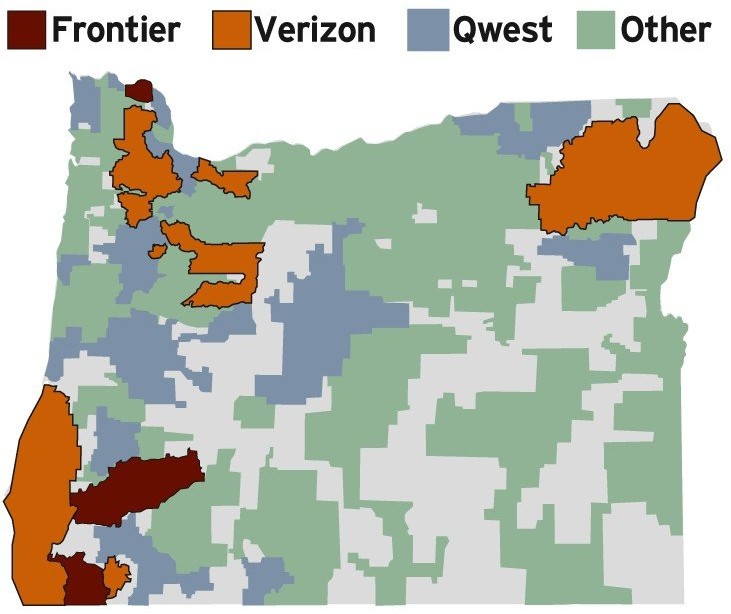
 What is missing from Oregon’s agreement?