Home » Qwest » Recent Articles:

American Broadband: A Certified Disaster Area

Vincent, one of our regular Stop the Cap! readers sent along a link to a story about the decrepit state of American broadband: it’s a real mess for those who can’t get it, can’t get enough of it, and compare it against what other people abroad are getting.

Cracked delivers the top five reasons why American broadband sucks.  Be sure and read their take (adult language), but we have some thoughts of our own to share:

#5 Some of Us Just Plain Can’t Get It

Large sections of the prairie states, the mountain states, and the desert states can’t get broadband no matter how much they want it.  That’s because they are a hundred miles or more from the nearest cable system and depend on the phone companies — especially AT&T, Frontier, CenturyLink, and Windstream to deliver basic DSL.  AT&T is trying as hard as possible to win the right to abandon rural America altogether with the elimination of their basic service obligation.  Verizon has sold off some of their most rural territories, including the entire states of Hawaii, New Hampshire, Maine, Vermont, and West Virginia.  CenturyLink has absorbed Qwest in the least populated part of America — the mountain and desert west.

Frontier and Windstream are betting their business models on rural DSL, and while some are grateful to have anything resembling broadband, neither company earns spectacular customer ratings.

So long as rural broadband is not an instant profit winner for the phone companies selling it, rural America will remain dependent on dial-up or [shudder] satellite fraudband.

#4 Often There are No Real Options for Service (and No Competition)

Cracked has discovered the wonderfully inaccurate world of broadband mapping, where the map shows you have plentiful broadband all around, but phone calls to the providers on the list bring nothing but gales of laughter.  As if you are getting service at your house.  Ever.  Stop the Cap! hears regularly from the broadband-deprived, some who have had to be more innovative than the local phone company ever was looking for ways to get service.  Some have paid to bury their own phone cable to get DSL the phone company was reluctant to install, others have created super-powered Wi-Fi networks to share a neighbor’s connection.  The rest live with broadband envy, watching for any glimpse of phone trucks running new wires up and down the road.

Competition is a concept foreign to most Americans confronted with one cable company and one phone company charging around the same price for service.  The most aggressive competition comes when a community broadband provider throws a monkey wrench into the duopoly.  Magically, rate hikes are few and fleeting and speeds are suddenly much better.  Hmmm.

#3 Those Who Have Access Still Lag Behind the Rest of the World
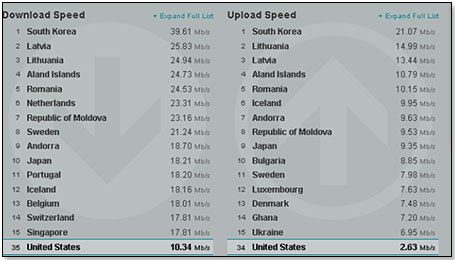
We're #35!

This is an unnerving problem, especially when countries like Lithuania are now kicking the United States into the broadband corner.  You wouldn’t believe we’re that bad off listening to providers, who talk about the innovative and robust broadband economy — the one that is independent of their lousy service.  In fact, the biggest impediment to more innovation may be those same providers.  Some have an insatiable appetite for money — money from you, money from content producers, money from taxpayers, more money from you, and by the way there better be a big fat check from Netflix in the mail this week for using our pipes!

Where is the real innovation?  Community providers like Greenlight, Fibrant, and EPB that deliver their respective communities kick-butt broadband — service other providers would like to shut down at all costs.  Not every commercial provider is an innovation vacuum.  Verizon FiOS and Google’s new Gigabit fiber network in Kansas City represent innovation through investment.  Unfortunately Wall Street doesn’t approve.

Still not convinced?  Visit Japan or Korea and then tell us how American broadband resembles NetZero or AOL dial-up in comparison.

#2 Bad Internet = Shi**y Economy

The demagoguery of corporate-financed dollar-a-holler groups like “FreedomWorks” and “Americans for Prosperity” is without bounds.  Whether it was attacking broadband stimulus funding, community broadband endeavors, or Net Neutrality, these provider shills turned broadband expansion into something as worthwhile as a welfare benefit for Cadillac drivers.  Why are we spending precious tax dollars on Internet access so people can steal movies and download porn they asked.  Why are we letting communities solve their own broadband problems building their own networks when it should be commercial providers being the final arbiter of who deserves access and who does not?  Net Neutrality?  Why that’s a socialist government takeover, it surely is.

It’s like watching railroad robber barons finance protest movements against public road construction.  We can’t have free roads paved by the government unfairly competing with monopoly railway companies, can we?  That’s anti-American!

The cost of inadequate broadband in an economy that has jettisoned manufacturing jobs to Mexico and the Far East is greater than we realize.  Will America sacrifice its leadership in the Internet economy to China the same way we did with our textile, electronics, appliances, furniture, and housewares industries?  China, Japan and Korea are building fiber optic broadband networks for their citizens and businesses.  We’re still trying to figure out how to wire West Virginia for 3Mbps DSL.

#1 At This Point, Internet Access is Kind of a Necessity

The United Nations this week declared the Internet to be a basic human right.  Conservatives scoffed at that, ridiculing the declaration for a variety of reasons ranging from disgust over any body that admits Hugo Chavez, to the lack of a similar declaration for gun ownership, and the usual interpretation of broadband as a high tech play-toy.  Some folks probably thought the same way about the telephone and electricity around 1911.

Yes, the Internet can be frivolous, but then so can a phone call.  Cursed by the U.S. Post Office for destroying their first class mail business, by telephone directory publishers, and those bill payment envelope manufacturers, the Internet does have its detractors.  But should we go back to picking out commemorative stamps at the post office?  Your local phone and cable company sure doesn’t think so.  We don’t either.

Cable Lobby Pays for Research Report That Miraculously Agrees With Them on Rural Broadband Reforms

A research report sponsored by the National Cable & Telecommunications Association, the nation’s largest cable lobbying group, has concluded that millions of broadband stimulus dollars are being wasted by the government on broadband projects that will ultimately serve people who supposedly already enjoy a panoply of broadband choice.

Navigant Economics, a “research group” that produces reports for its paying clients inside industry, government, and law firms, produced this one at the behest of a cable industry concerned that broadband stimulus funding will build competing broadband providers that could force better service and lower prices for consumers.

  • More than 85 percent of households in the three project areas are already passed by existing cable broadband, DSL, and/or fixed wireless broadband providers. In one of the project areas, more than 98 percent of households are already passed by at least one of these modalities.
  • In part because a large proportion of project funds are being used to provide duplicative service, the cost per incremental (unserved) household passed is extremely high. When existing mobile wireless broadband coverage is taken into account, the $231.7 million in RUS funding across the three projects will provide service to just 452 households that currently lack broadband service.

Navigant’s report tries to prove its contention by analyzing three broadband projects that seek funding from the federal government.  Northeastern Minnesota, northwestern Kansas, and southwestern Montana were selected for Navigant’s analysis, and unsurprisingly the researcher found the broadband unavailability problem overblown.

The evidence demonstrates that broadband service is already widely available in each of the three proposed service areas. Thus, a large proportion of each award goes to subsidize broadband deployment to households and regions where it is already available, and the taxpayer cost per unserved household is significantly higher than the taxpayer cost per household passed.

The cable industry funds research reports that oppose fiber broadband stimulus projects.

But Navigant’s findings take liberties with what defines appropriate broadband service in the 21st century.

First, Navigant argues that wireless mobile broadband is suitable to meet the definition of broadband service, despite the fact most rural areas face 3G broadband speeds that, in real terms, are below the current definition of “broadband” (a stable 768kbps or better — although the FCC supports redefining broadband to speeds at or above 3-4Mbps).  As any 3G user knows, cell site congestion, signal quality, and environmental factors can quickly reduce 3G speeds to less than 500kbps.  When was the last time your 3G wireless provider delivered 768kbps or better on a consistent basis?

Navigant also ignores the ongoing march by providers to establish tiny usage caps for wireless broadband.  With most declaring anything greater than 5GB “abusive use,” and some limiting use to less than half that amount, a real question can be raised about whether mobile broadband, even at future 4G speeds, can provide a suitable home broadband replacement.

Second, Navigant’s list of available providers assumes facts not necessarily in evidence.  For example, in Lake County, Minnesota, Navigant assumes DSL availability based on a formula that assumes the service will be available anywhere within a certain radius of the phone company’s central office.  But as our own readers have testified, companies like Qwest, Frontier, and AT&T do not necessarily provide DSL in every central office or within the radius Navigant assumes it should be available.  One Stop the Cap! reader in the area has fought Frontier Communications for more than a year to obtain DSL service, and he lives blocks from the local central office.  It is simply not available in his neighborhood.  AT&T customers have encountered similar problems because the company has deemed parts of its service area unprofitable to provide saturation DSL service.  While some multi-dwelling units can obtain 3Mbps DSL, individual homes nearby cannot.

Navigant never visited the impacted communities to inquire whether service was actually available.  Instead, it relied on this definition to assume availability:

DSL boundaries were estimated as follows: Based on the location of the dominant central office of each wirecenter, a 12,000 foot radius was generated. This radius was then truncated as necessary to encompass only the servicing wirecenter. The assumption that DSL is capable of serving areas within 12,000 is based on analysis conducted by the Omnibus Broadband Initiative for the National Broadband Plan.

Frontier advertises up to 10Mbps DSL in our neighborhood, but in reality can actually only offer speeds of 3.1Mbps in a suburb less than one mile from the Rochester, N.Y. city line.  In more rural areas, customers are lucky to get service at all.

Cable broadband boundaries were estimated based on information obtained from an industry factbook, which gathered provider-supplied general coverage information and extrapolated availability from that.  But, as we’ve reported on numerous occasions, provider-supplied coverage data has proven suspect.  We’ve found repeated instances when advertised service proved unavailable, especially in rural areas where individual homes do not meet the minimum density required to provide service.

We’ve argued repeatedly for independent broadband mapping that relies on actual on-the-ground data, if only to end the kind of generalizations legislators rely on regarding broadband service.  But if the cable industry can argue away the broadband problem with empty claims service is available even in places where it is not (or woefully inadequate), relying on voluntary data serves the industry well, even if it shortchanges rural consumers who are told they have broadband choices that do not actually exist.

Navigant’s report seeks to apply the brakes to broadband improvement programs that can deliver consistent coverage and 21st century broadband speeds that other carriers simply don’t provide or don’t offer throughout the proposed service areas.  The cable industry doesn’t welcome the competition, especially in areas stuck with lesser-quality service from low-rated providers.

You Can’t Have This: Wyoming’s Fight for Better Broadband Mired in Politics and Business Interests

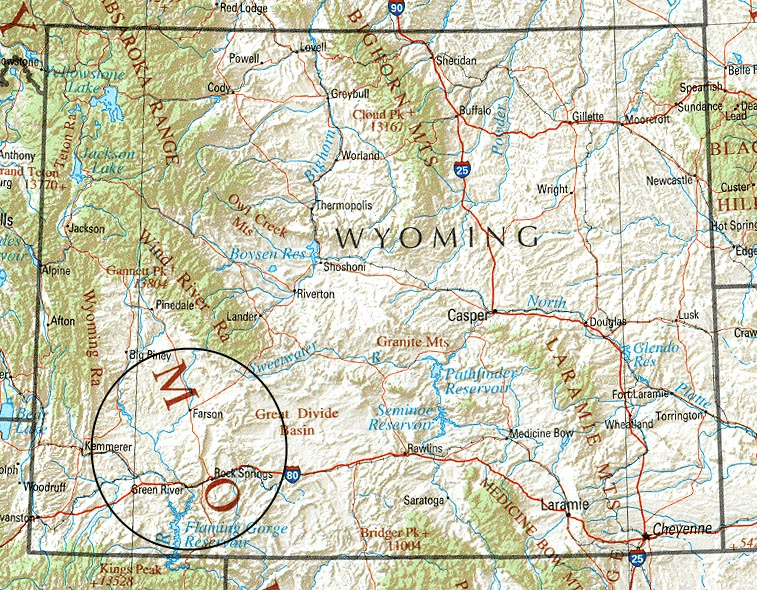
Green River, Rock Springs, and other communities served by Wyoming.com

Wyoming is one of America’s most broadband-challenged, least populated states.  With just over 560,000 residents spread across its often mountainous terrain, broadband service is nothing to take for granted.  Larger communities have limited access to Qwest DSL and cable broadband, but large sections of the state rely on independent wireless providers as their only choice, or they find no broadband service at all.

In this spartan digital world, many residents are surprised Wyoming is criss-crossed by national fiber-optic lines moving traffic across the country.  It’s just that in most instances, individuals are not allowed to access it.

Wyoming.com, a privately-owned Wireless ISP, wants to expand service to Farson and South Pass City — two communities further north that have no hope of getting anything beyond dial-up or satellite fraudband service.  The commercial provider, working with the administrators of the fiber network, has access to federal grant money to expand service to unserved communities, and improve it in underserved areas like Rock Springs.  But that cannot happen if the venture is refused access to a 48-strand “middle-mile” fiber-optic line financed by public dollars and managed by the Joint Powers Telecommunications Board — a partnership between the Green River City Council and Rock Springs local government.

The notion Wyoming.com could get access to a taxpayer-financed network ruffles Tom McCullough, the city’s liaison to the Joint Powers board.  He’s opposed to allowing any government resource to benefit the public at the expense of the local cable monopoly — Sweetwater Cable TV, which doesn’t even serve most of the areas that would benefit from enhanced Internet access.  McCullough argues it violates a 2007 Wyoming law that prohibits public broadband projects when private providers provide access to similar services anywhere within the boundaries of a city or town.  The law came in response to a public broadband project undertaken in Powell that upset the state’s cable and phone companies.

If residents want access to the fiber network they paid for, they have to visit Western Wyoming Community College or the Sweetwater County Library System and use public terminals there.

McCullough so dislikes the fiber project, he has tried to disband the Joint Powers Board that manages it twice, suggesting he has enough support to sell off the entire network to anyone interested (presumably at a substantial discount.)

Shea

Local residents who remain stuck with dial-up or who live outside of Sweetwater Cable’s service area are furious.

“There are some types around here who can’t see past Rush Limbaugh — anything the government does is automatically bad and must be taken down, even if taxpayers paid to build it in the first place,” complains Stop the Cap! reader Sue who lives in Farson.  “Farson has nothing to do with Sweetwater Cable, but because a handful of politicians are looking out for the cable company, worried Wyoming.com is going to get one-up on them, that means we can’t have broadband.”

Steve Shea, chairman of the telecommunications board, is unimpressed with McCullough’s arguments as well, and accused him of allowing his personal friendship with Sweetwater Cable TV’s owner — Al Carollo — to cloud his judgment.

Shea says Wyoming’s local governments are often fiercely protective of locally-owned businesses, and told the Green River Star the Board has historically faced the attitude that “local business deserves a monopoly, no matter what.”  Sweetwater Cable TV is locally owned and operated.

In fact, Shea says original designs for the fiber network were to provide fiber-to-the-home service in the area.  Since a national fiber optic cable was already running adjacent to the community, getting a connection to it was relatively simple.  Extending service to individual homeowners was another matter.  Political opposition to “government broadband” and demagoguery about its cost and implications from private providers ultimately killed the project.

Shea documented his experience as commercial providers and their dollar-a-holler industry-connected supporters fought the fiber project:

  • Opposition comes from everyone in the Telecom business;
  • Opposition will be in your face constantly;
  • Opposition will never run out of lies;
  • Opposition is ready to strike at any time and at any place;
  • Opposition will engage in back-room politics against you;
  • Opposition will try to get Power Brokers and Influentials on their side;
  • Opposition will spend as much money as needed to defeat you.

Local cable and wireless providers engage in a tangle in southwestern Wyoming

As Wyoming’s broadband rankings slip further and further behind much of the rest of the country, Shea hopes attitudes about the fiber network have changed, especially when residents learn Sweetwater Cable was offered access to the network as well, and they declined.

Shea shared that the long history of opposition to the project started with suggestions wireless broadband was better than fiber, or that broadband over power lines could do the same or better than fiber networks.  He even battled contentions that existing broadband networks provided “fast enough” service for Wyoming.  Today, it has extended to allowing a private company to engage in a public-private partnership.  The other providers are still opposed.

“You have to refute these arguments over, and over, and over again. Your opposition will oppose you at every corner, and will call in all of their political favors to derail your fiber project,” Shea writes.

“It’s Wyoming’s version of North Carolina,” Sue writes from her Hughes Satellite address.  “Sweetwater Cable doesn’t want access to the fiber themselves, and they want to make sure you don’t access it either, even though the family I have down there tells me their cable Internet service sucks because the cable company can’t handle the traffic.”

Sweetwater Cable gets their access from Qwest.

What bothers Sue and some other local residents about the squabble is that it is inherently political and allows an existing, underutilized fiber line to sit mostly unused when expanded broadband is desperately needed in Wyoming.  In fact, some consider it a scandal among special interests.

“They don’t care about better broadband — they only care about their political and industry friends,” Sue complains.  “When will people wake up and realize that whether it is North Carolina or Wyoming, these policies and laws don’t give anyone broadband — they keep us from getting it.”

Shea’s observation that opponents’ use of backroom politics seems to have been right on point.  On Tuesday, as the Board met to discuss Wyoming.com’s proposal, Shea was effectively forced out and announced his resignation after the owner of Sweetwater Cable TV said he contacted an attorney to look at whether Shea’s tenure on the board was legal.

CenturyLink Invests to Reinvent Themselves: Prism IPTV/25Mbps Service Arrives

Phillip Dampier February 16, 2011 Broadband Speed, CenturyLink, Competition, Consumer News, Video Comments Off on CenturyLink Invests to Reinvent Themselves: Prism IPTV/25Mbps Service Arrives

Invest or die.  That succinctly explains the current state of the landline telephone business and the companies providing service to a decreasing number of Americans.  Some companies, like AT&T and Verizon have heavily diversified their business into wireless, fiber, IPTV and broadband.  Others, like Frontier are hoping their presence in uncompetitive rural markets will keep them in business, as long as their dividends keep stockholders happy.

CenturyLink, which is in the process of absorbing the last remaining Baby Bell — Qwest, has decided to invest in their business to stay competitive with their biggest nemesis — the cable company.  CenturyLink is still hanging on to ADSL broadband service in many rural areas, but the company sees the promise of future relevance with bonded DSL, which is delivering 25/2Mbps broadband service to an increasing number of their customers.  Where distances allow, CenturyLink is at least temporarily providing the fastest residential broadband service available in areas like southwest Florida.  They are holding their own against local cable competitors like Comcast.

Now the company is following AT&T in introducing a new IPTV service to many of its customers.  Dubbed Prism, the U-verse like service delivers a true triple play package to customers who thought they would be stuck with their local cable company or satellite dish provider for TV programming.

Prism offers more than 200 channels, a multi-room DVR capable of recording up to four shows at the same time, and an interactive program guide that doesn’t need an instruction manual to navigate.

[flv width=”640″ height=”390″]http://www.phillipdampier.com/video/Introducing CenturyLink Prism.flv[/flv]

This promotional video introduces CenturyLink’s Prism service and its television features.  (4 minutes)

Prism has been introduced in larger CenturyLink areas ranging from southern Nevada, southwestern Florida, and North Carolina, where EMBARQ used to provide telephone service.

The service works through a hybrid fiber-copper wire IPTV network.  Fiber optic cable reduces the distance data needs to travel over ordinary copper phone wires.  The less copper, the faster the potential speed.  With a 25-30Mbps broadband platform, Prism can divide up available bandwidth to support television, phone, and up to 10Mbps broadband service.  It’s all delivered over the same digital network.  While not as advanced as Verizon FiOS and other fiber to the home networks, IPTV services like Prism and U-verse are cheaper to provide, and that can mean faster deployment in areas not well served by competition.

Reaction to Prism has been generally positive among Stop the Cap! readers who have shared their stories with us.  Among the positives:

  • The interactive program guide is light years ahead of Comcast, Cox, and Time Warner Cable;
  • Broadband speeds are generally better than the original DSL service CenturyLink used to provide;
  • The picture quality is excellent where the telephone network has been upgraded the most;
  • Competitive introductory and retention offers mean consumers can pay less for service, at least initially.

But there are some problems, too:

  • Bandwidth varies depending on how far away you are from the nearest fiber node.  This affects what you can do with the service.  If you are further out, you can only watch one HD television channel at a time, and may not be able to record more than one HD channel at the same time;
  • The DVR box has issues — readers report shows disappear, don’t get recorded, or show poor results when line quality drops;
  • Broadband speeds with Prism officially max out at 10Mbps;
  • If you are watching a number of televisions at the same time, your broadband speeds could drop;
  • Variability in service quality comes largely as a result of inferior copper wire phone networks CenturyLink chose to stick with.  If your phone line is prone to static or hum, or deliver poor results when the weather is bad, Prism might not work well for you.

Some subscribers found they initially loved the service, but when bad weather arrived, it all fell apart.

“Our phone lines are decades old, so this comes as no surprise,” says Manny who writes from Naples, Fla.  “I was also disappointed some of the channels in HD I had with Comcast are not available from Prism.”

In parts of Raleigh, N.C., Prism just launched a few weeks ago.  But some of our readers are sticking with Time Warner Cable.

“After looking over their pricing and packages, Time Warner has more HD channels and doesn’t charge $12 a month extra for them,” writes Ralph.  “CenturyLink also only bundles 3Mbps broadband service with most of their packages, and you have to pay extra for 10Mbps service.”

Ralph thinks Road Runner from the cable company will provide a more consistent broadband experience for his family.

“There is only so much you can push through a phone line at the same time; I like the fact they are competing, but they will not be able to keep up if they rely on copper phone wiring forever,” Ralph says.

Cox faces new competition in southern Nevada

Despite some of the negatives, CenturyLink may deliver formidable competition where cable companies haven’t kept up.  Some other markets where Prism will offer service: Jefferson City, and Columbia, Mo., and La Crosse, Wis.  Cox Cable in southern Nevada is now competing with Prism, and believes it has the superior network.

“The way our system is constructed, we have services equally distributed everywhere in the valley,” Juergen Barbusca, Cox manager of communications, public and government affairs in Las Vegas said. “Everybody in our footprint can get our highest advertised speeds.”

Cable broadband is less susceptible to distance degradation that can make Prism a no-go in neighborhoods at the far end of a phone company’s central office.

Also equally distributed is the price.  Outside of new customer promotions, nobody will save any money here.  Cox and CenturyLink are both selling their respective triple-play packages of TV, Internet, and phone for exactly the same price: $143 a month.

[flv width=”480″ height=”380″]http://www.phillipdampier.com/video/KTNV Las Vegas CenturyLink Prism 2-8-11 WFTX Cape Coral CenturyLink in SW Florida 12-7-10.flv[/flv]

KTNV-TV in Las Vegas introduces viewers to CenturyLink’s Prism service and WFTX-TV in Cape Coral, Florida talks with CenturyLink about their new 25Mbps broadband service in two exceptionally company-friendly pieces from the stations’ respective news shows.  (13 minutes)

Telecom Dividend Cash Bonanza – Landline Customers Drop, But Stockholder Payouts Rise

Phillip Dampier February 10, 2011 AT&T, Bell (Canada), Frontier, Rural Broadband Comments Off on Telecom Dividend Cash Bonanza – Landline Customers Drop, But Stockholder Payouts Rise

The telephone landline business is hardly a growth industry, as an average of 5-7 percent of customers disconnect their home phone service every quarter, but you wouldn’t know that from the dividends being paid to stockholders.

From AT&T, Bell Canada, Frontier to Qwest — the companies that speak in terms of keeping their customer defection rates down are paying dividends that often exceed earnings.

Among the worst of all — Frontier Communications, whose outsized dividend is expected to reach 75 cents a share.  That, despite the fact analysts predict the phone company will earn only 40 cents a share or so this year.

Where do these phone companies expect to make their money?  Their broadband and wireless divisions.  AT&T and Bell Canada are able to cover landline losses with enhanced profits from their IPTV services like U-verse and Fibe.  Frontier and Qwest expect to survive on providing cheap-to-deploy DSL service in rural areas avoided by cable operators.

Search This Site:

Contributions:

Recent Comments:

Your Account:

Stop the Cap!