Home » Qwest » Recent Articles:

Inside ALEC: How Corporations Ghost-Write Anti-Consumer State Telecom Legislation

[Stop the Cap! has written extensively about the pervasive influence some of the nation’s largest cable and phone companies have on telecommunications legislation in this country.  On the state level, one group above all others is responsible for quietly getting company-ghost-written bills and resolutions into the hands of state lawmakers to introduce as their own.]

The American Legislative Exchange Council (ALEC) is the latest corporate response to campaign finance and lobbying reform — a Washington, D.C.-based “middle man” that brings lawmakers and corporate interests together while obfuscating the obvious conflict of interest to voters back home if they realized what was going on.

ALEC focuses on state laws its corporate members detest because, in many cases, they represent the only regulatory obstacles left after more than two decades of deregulatory fervor on the federal level.  State lawmakers are ALEC’s targets — officeholders unaccustomed to a multi-million dollar influence operation.  The group invites lawmakers to participate in policy sessions that equally balance corporate executives on one side with elected officials on the other.  Consumers are not invited to participate.

ALEC’s telecom members have several agendas on the state level, mostly repealing:

  • Local franchising and oversight of cable television service;
  • Statewide oversight of the quality of service and measuring the reliability of phone and cable operators;
  • Consumer protection laws, including those that offer customers a third party contact for unresolved service problems;
  • Universal service requirements that insist all customers in a geographic region be permitted to receive service;
  • Funding support for public, educational, and government access television channels;
  • Rules governing the eventual termination of essential service for non/past due payments;
  • Local zoning requirements and licensing of outside work.

But ALEC is not always focused on deregulation or “smaller government.” In fact, many of its clients want new legislation that is designed to protect their position of incumbency or enhance profits.  Cable and phone company-written bills that restrict or ban public broadband networks are introduced to lawmakers through ALEC-sponsored events.  In several cases, model legislation that was developed by cable and phone companies was used as a template for nearly-identical bills introduced in several states without disclosing who actually authored the original bill.
ALEC specializes in secrecy, rarely granting interviews or talking about the corporations that pay tens of thousands of dollars to belong.  Corporate members also enjoy full veto rights over any proposal or idea not to their liking, and aborted resolutions or legislative proposals are kept completely confidential. More often than not, however, legislators and corporate members come to an agreement on something, and the end product ends up in a central database of model bills and resolutions ready to be introduced in any of 50 state legislatures.

Many do, and often these proposed bills are remarkably similar, if not identical. That proved to be no coincidence.  In July 2011, the Center for Media and Democracy was able to obtain a complete copy of ALEC’s master database of proposed legislation.  The Center called it a stark example of “corporate collaboration reshaping our democracy, state by state.”

National Public Radio takes an inside look at the American Legislative Exchange Council and how it works to help major corporations influence and change state laws. (October 29, 2010) (8 minutes)
You must remain on this page to hear the clip, or you can download the clip and listen later.

ALEC’s Corporate Telecom Members
ALEC defends itself saying it does not directly lobby any legislator.  That is, in fact true.  But many of its corporate members clearly do.  AT&T is one of ALEC’s most high profile members, serving as a “Private Enterprise Board” member, state corporate co-chair of Arkansas, California, Connecticut, Louisiana, Mississippi, and Texas (all AT&T service areas), a member of the Telecommunications and Information Technology Task force, and “Chairman” level sponsor of the 2011 ALEC Annual Conference (a privilege for those contributing $50,000).

AT&T’s lobbying is legendary, and is backed with enormous campaign contributions to legislators on the state and federal level.

But AT&T isn’t the only telecommunications company that belongs to or supports ALEC:

  • CenturyLink (also including Qwest Communications), “Director” level sponsor of 2011 ALEC Annual Conference ($10,000 in 2010)
  • Cincinnati Bell
  • Comcast, State corporate co-chair of Georgia, Minnesota, Missouri and Utah and recipient of ALEC’s 2011 State Chair of the Year Award
  • Cox Communications, “Trustee” level sponsor of 2011 ALEC Annual Conference ($5,000 in 2010)
  • Time Warner Cable, State corporate co-chair of Ohio, “Director” level sponsor of 2011 ALEC Annual Conference ($10,000 in 2010)
  • Verizon Communications, Private Enterprise Board member and State corporate co-chair of Virginia and Wyoming

ALEC supporters among trade groups and astroturf/corporate-influenced “non profits”:
  • National Cable and Telecommunications Association, ALEC Telecommunications and Information Technology Task Force member
  • Free State Foundation (think tank promoting limited government and rule of law principles in telecommunications and information technology policy)
  • Heartland Institute, Exhibitor at ALEC’s 2011 Annual Conference, Telecommunications and Information Technology Task Force member, Education Task Force member, Commerce, Insurance and Economic Development Task Force, Financial Services Subcommittee member and Energy, Environment and Agriculture Task Force member

ALEC’s Ready-to-Introduce Legislation

The two most pervasive pieces of legislation ALEC’s telecom members (especially AT&T) want as a part of state law are bills to strip local authority over cable systems and hand it to the state government and the elimination or excessive micromanagement of community broadband networks:
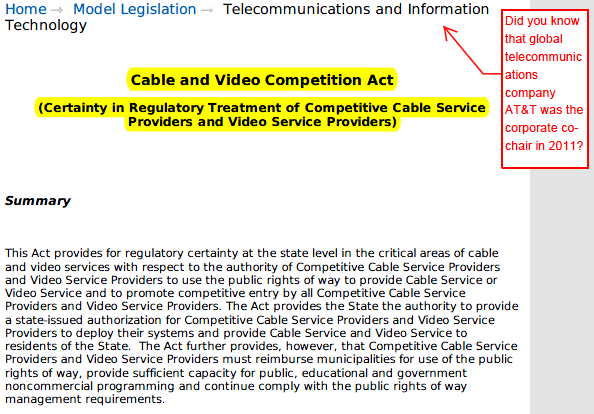
This model bill for increased cable competition strips most of the authority your community has over cable television operations and transfers it to under-funded or less aggressive state bodies. Although the bill claims to protect local oversight and community access stations, the statewide video franchise fee almost always destroys the funding model for public, educational, and government access channels.
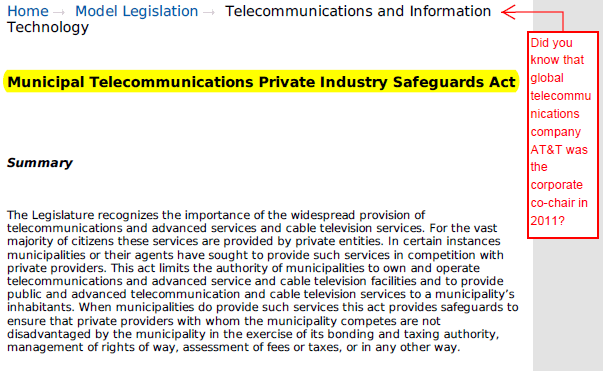
These municipal broadband bills are always written to suggest community and private players must share a "level playing field." But bills like these always exempt the companies that actually wrote the bill, and micromanage and limit the business operations of the community provider.

Legislators: Bring the family to Mardi Gras World on us, sponsored by America's largest telecommunications companies.

WHYY Philadelphia’s ‘Fresh Air’ spent a half hour exploring who really writes the legislation introduced in state legislatures. When ALEC gets involved, The Nation reporter John Nichols thinks the agenda is clear: “All of those pieces of legislation and those resolutions really err toward a goal, and that goal is the advancement of an agenda that seems to be dictated at almost every turn by multinational corporations.” (July 21, 2011) (32 minutes)
You must remain on this page to hear the clip, or you can download the clip and listen later.

Unfortunately, state lawmakers are not always sophisticated enough to recognize a carefully crafted legislative agenda at work.  National Public Radio found one excellent example — the 2010 Arizona immigration law that requires police to arrest anyone who cannot prove they entered the country legally when asked.  America’s immigration problems remain a major topic on the agenda at some ALEC events, curious for a corporate-backed group until you realize one of ALEC’s members — the Corrections Corporation of America — America’s largest private prison operator, stood to earn millions providing incarceration services for what some estimated could be tens, if not hundreds of thousands of new prisoners being held on suspicion of immigration violations.

CCA was in the room when the model immigration legislation, eventually adopted by Arizona’s legislature, was written at an ALEC conference in 2009.

Bring the Kids, Stay for the Corporate Influence

Getting legislators to attend these seminars isn’t as hard as it might sound.

In January, we reported members of the North Carolina General Assembly, who showed their willingness to support telecom industry-written bills when it passed an anti-community broadband initiative in 2011, were wined and dined (along with their staff) by ALEC at the Mardi Gras World celebration in New Orleans.  Rep. Marilyn Avila (R-Time Warner Cable), who introduced the aforementioned measure, brought her husband to Asheville to enjoy a special weekend as the featured guest speaker at a dinner sponsored by North Carolina’s state cable lobbying group:

The North Carolina Cable Telecommunications Association reported they not only picked up Marilyn’s food and bar bill ($290 for the Aug. 6-8 event), they also covered her husband Alex, too.  Alex either ate and drank less than Marilyn, or chose cheaper items from the menu, because his food tab came to just $185.50.  The cable lobby also picked up the Avila’s $471 hotel bill, and handed Alex another $99 in walking-around money to go and entertain himself during the weekend event.  The total bill, effectively covered by the state’s cable subscribers: $1,045.50.
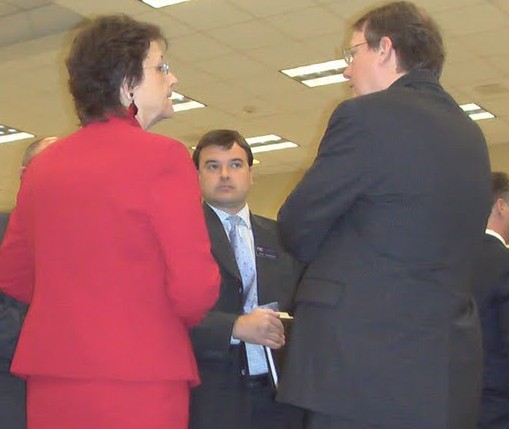
Rep. Avila with Marc Trathen, Time Warner Cable's top lobbyist (right) Photo by: Bob Sepe of Action Audits

ALEC makes it easy because it pays the way for lawmakers and families to attend their events through the award of “scholarships”:

The organization encourages state lawmakers to bring their families. Corporations sponsor golf tournaments on the side and throw parties at night, according to interviews and records obtained by NPR.

[…] Videos and photos from one recent ALEC conference show banquets, open bar parties and baseball games — all hosted by corporations. Tax records show the group spent $138,000 to keep legislators’ children entertained for the week.

But the legislators don’t have to declare these as corporate gifts.

Consider this: If a corporation hosts a party or baseball game and legislators attend, most states require the lawmakers to say where they went and who paid. In this case though, legislators can just say they went to ALEC’s conference. They don’t have to declare which corporations sponsored these events.

Reporter John Nichols told NPR ALEC’s focus on state politics is smart:

“We live at the local and state level. That’s where human beings come into contact more often than not,” he says. “We live today in a country where there’s a Washington obsession, particularly by the media but also by the political class. … And yet, in most areas, it’s not Washington that dictates the outlines, the parameters of our life. … And so if you come in at the state government level, you have a much greater ability to define how you’re going to operate.”

Resources:

  • ALEC Exposed: Access a database of more than 800 corporate ghost-written bills and resolutions intended to become state law in all 50 states. Sponsored by the Center for Media and Democracy.
  • ALEC’s Database Revealed: A more general indictment of ALEC and its coordinated agenda to allow corporate influence to hold an increasing role in public policy.
  • Protestors Demand End to Verizon’s Involvement in ALEC: In Albany, N.Y., protestors turned up in front of Verizon demanding the company end its association with ALEC.
  • California Lawmakers Enjoy Free Trips to Hawaii, Europe: California’s state politicians are under fire for lavish travel arranged by ALEC.

CenturyLink Criticized for Installing Phone Lines Atop Roadways, Inside Pavement Cracks

Phillip Dampier March 14, 2012 CenturyLink, Consumer News, HissyFitWatch, Public Policy & Gov't Comments Off on CenturyLink Criticized for Installing Phone Lines Atop Roadways, Inside Pavement Cracks

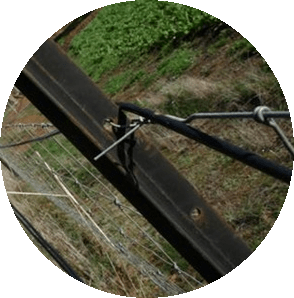
Phoenix-area officials are discovering CenturyLink, the area’s largest phone company, has gotten a little too creative with landline repairs, installing replacement lines across public streets, on fences, and in one case even wedged between a pavement crack.

CenturyLink calls them “temporary telephone lines,” run as quick fixes to get service up and running again. Local officials call them a nuisance, and question what CenturyLink’s definition of “temporary” means.

The Arizona Republic found CenturyLink phone lines strung across the asphalt on Knox Road in Gilbert, where they remained in place for about a year, with vehicle traffic driving right over the cables.  When the newspaper sent photos to the phone company asking why, they were gone within 24 hours.

CenturyLink’s Alex Juarez explains:

“CenturyLink is not required to bury or hang wires in any specific amount of time, but we make every effort to remove temporary lines as quickly as possible. … Repairing a damaged or malfunctioning underground or suspended cable takes time. CenturyLink uses temporary wires to restore service while we work to repair the permanent cable. Restoration of service is a priority. We place lines where they will be safely out of the way.”

A "temporary" phone cable installed along the top of a wire fence.

Gilbert local officials dispute that, having previously notified CenturyLink the phone company was in violation of town regulations.  Gilbert prohibits any utility wiring on its streets, and had received public complaints about temporary phone lines a year ago.  Town spokeswoman Beth Lucas told the newspaper she was surprised the company was back at it again.

“We do not allow those kind of lines, and they can interfere with a variety of work,” including street sweepers, she said. “For a utility to be in a right of way, whether on a permanent or temporary basis, the company would need a permit, which means approval during the planning review process with staff.”

The problem with temporary wiring is that CenturyLink is not obligated to report where the lines have been installed, which can create a public nuisance, possible danger to public safety, and frustration for construction crews that often cut the cables without realizing they were there.

Chandler’s streets Superintendent Rex Hartmann noted city paving contractors cut off phone service for an undetermined number of customers when they discovered CenturyLink had force-wedged a communications cable into a pavement crack, covered up with sealant.  When the roads were repaved, the cable was severed.

Hartmann also doesn’t buy CenturyLink’s claim the lines were “temporary.”  He’s found several that were left so long, the “temporary” cable itself was cracked and brittle.
Phoenix city officials think prohibiting temporary lines from being scattered across the ground or pavement makes common sense.
Spokeswoman Sina Matthes says those kind of installations represent tripping hazards for pedestrians and residents, and the city requires temporary repairs to be replaced by permanent ones within two weeks.

Customers “Probably Don’t Need Higher (<1Mbps) Speed," Editorializes N.M. Newspaper

Phillip Dampier December 5, 2011 Broadband Speed, CenturyLink, Community Networks, Competition, Editorial & Site News, Kit Carson Telecom, Public Policy & Gov't, Rural Broadband, Wireless Broadband Comments Off on Customers “Probably Don’t Need Higher (<1Mbps) Speed," Editorializes N.M. Newspaper

Sometimes you can’t please some people no matter what you do.

Kit Carson Electric Cooperative’s $64 million fiber-to-the-home expansion project will finally bring 21st century broadband speeds to northern New Mexico. The electric co-op intends to deliver broadband speeds up to 100Mbps to 20,000 largely rural residents and businesses in Taos, Colfax, and Rio Arriba counties who have had limited access to cable broadband or live with speeds often less than 1Mbps from CenturyLink-delivered DSL.

“It’s a whole new ballgame for rural New Mexico,” shares Stop the Cap! reader Raul. “But the pinheads at the local weekly newspaper are ringing their hands over the project, suggesting only businesses deserve 100Mbps while the rest of us should be satisfied with speeds under a megabit per second.”

Indeed, editors at the Sangre de Christo Chronicle are wringing their hands over the project:

But many of us in the Kit Carson service area already have Internet service — and we’re completely happy with it. Kit Carson CEO Luis Reyes, Jr. said a large portion of the organization’s electric customers are currently under-served by other providers with Internet speeds of less than one megabit (1,000 kilobits) per second.

We have no reason to doubt that, but many of these customers probably don’t need the higher speeds. For the Internet customers who use the Internet for email, Facebook, news and other basic functions, Kit Carson’s prices will be most important. Most of us will not pay more for faster Internet speed we don’t need, but we will consider switching to a local provider if it offers identical or better service and prices.

“CenturyLink barely delivers DSL today, and has shown no interest in investing substantially in northern New Mexico, and outside of concentrated built-up areas there is no cable competition,” Raul says. “Kit Carson is the only local concern that has shown any real interest in making our community better, and the local newspaper is complaining about it.”

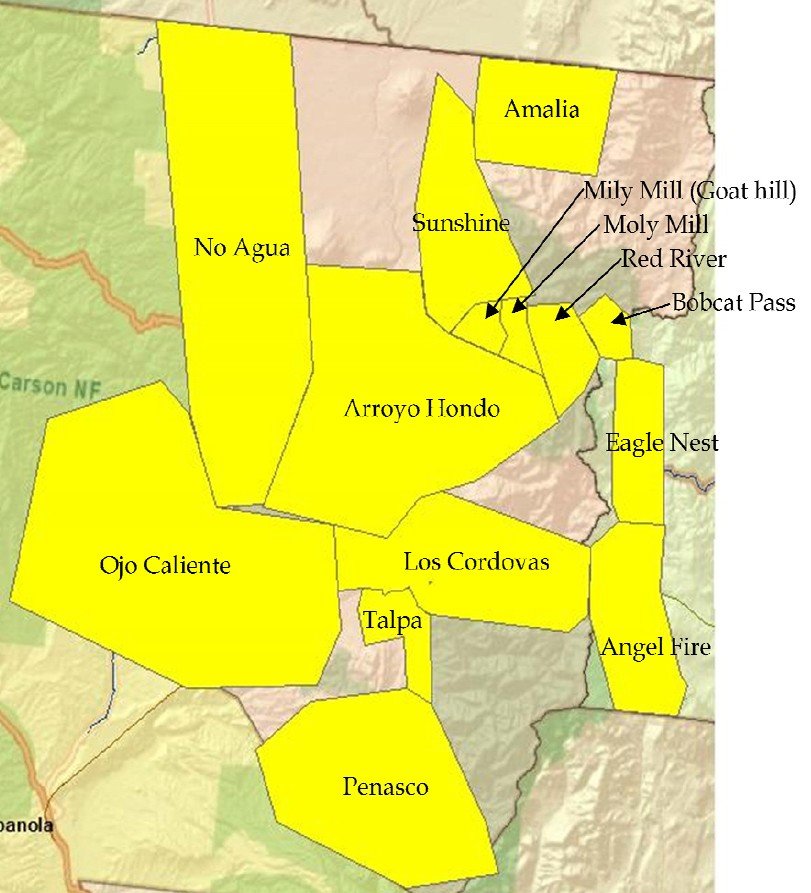
Proposed service area for Kit Carson Electric's new fiber to the home network serving northern New Mexico.

Kit Carson Electric’s project will provide a true fiber-to-the-home service bundling television, telephone, and broadband service — a substantial upgrade over what the telephone company has on offer.  With speeds far beyond what cable and phone providers in New Mexico are accustomed to providing, the region stands to benefit from entrepreneurs building digital economy businesses over a broadband network that can actually help, not hinder online development.

Currently, area residents pay CenturyLink up to $55 a month for 1.5/1Mbps DSL service.  Residents are so excited by the prospects of much faster speeds at significantly lower prices, Kit Carson Electric has developed an innovative stop-gap service for residents still waiting for direct fiber connections — fiber-to-wireless service.  New and existing customers can sign up for the service for a $100 installation fee and choose from three service tiers:

  • 3Mbps — $29.95/month
  • 7Mbps — $39.95/month
  • 10Mbps — $49.95/month

A three year contract is required (early termination fee is $200).  But customers who eventually obtain Kit Carson Electric’s fiber service will automatically satisfy their contract requirement.

“Kit Carson’s wireless project already blows away CenturyLink’s speeds and pricing, and that is for inferior wireless,” Raul argues. “The Chronicle doesn’t have a clue.”

We can’t understand the newspaper’s concerns either.  Kit Carson Electric has already demonstrated their prices (and interest) in northern New Mexico is superior to that of CenturyLink, owner of former Baby Bell Qwest, which serves New Mexico.

Republican Sen. Jeff Bingaman is thrilled with Kit Carson’s broadband initiative.

“This major investment in broadband technology is exactly the kind of project I had envisioned when I voted for the American Recovery and Reinvestment Act,” U.S. Senator Jeff Bingaman said. “This grant is not only creating jobs now in northern New Mexico, it is laying the groundwork to attract new businesses, improve healthcare services and create new education opportunities in the future.”

The electric co-op has been successful operating non-profit businesses selling propane, telecommunications, and economic development space.  The fiber project will also allow the electric utility to deploy “smart grid” technology to increase the efficiency of their electric service.

A groundbreaking ceremony at the broadband project’s command center held this past summer also coincided with a public emergency communications network upgrade which will increase the efficiency and reliability of first responders and other emergency and public safety agencies.

CenturyLink Announces Usage Caps; Conveniently Exempts Their Own Video Content

CenturyLink announces their own Internet Overcharging scheme; customers call to cancel their service.

CenturyLink is quietly introducing usage caps for its broadband customers that will limit residential customers to between 150-250GB of usage per month.

The Internet Overcharging scheme was inserted into the company’s High Speed Internet Service Management disclosure page, and suggests heavy users are using an inappropriate amount of data, slowing down the network for other users:

The majority of CenturyLink High-Speed Internet customers make great use of their service and comply with the CenturyLink High-Speed Internet Subscriber Agreement. An extremely small percentage use their service excessively, or at such extreme high volumes, that they violate the terms of their CenturyLink High-Speed Internet Subscriber Agreement. While this high volume use is very rare, CenturyLink is committed to helping these customers find a high-speed Internet solution to better meet their needs.

CenturyLink is announcing the following Excessive Usage Policy (EUP), which will become effective in February 2012:

CenturyLink’s EUP applies to all residential high speed Internet customers and is only enforced in the downstream (from Internet to customer) direction. Video services provided by CenturyLink PRISM™ TV are not subject to the usage limits. The policy has the following usage limits per calendar month:

  • Customers purchasing service at speeds of 1.5Mbps and below, have a usage limit of 150 Gigabytes (GB) of download volume per month.
  • Customers purchasing service at speeds greater than 1.5Mbps, have a limit of 250GB in download volume per month.

There are no overage charges or metering fees for usage as part of the Policy.

The company exempts their own video service PRISM TV from the scheme.

“It’s another CenturyLink ripoff in action, and despite their claims that they treat all data the same, they certainly do not,” says CenturyLink customer Rob Cabella. “Their video programming is sent from local facilities, as data, down the same pipe as their broadband service, yet they conveniently leave their TV product out of the usage cap equation.”

Prism customers can watch unlimited TV, but face limited broadband usage over the exact same pipeline.

Cabella says PRISM operates much like AT&T’s U-verse.  Fiber provides service into individual neighborhoods and then standard copper phone lines deliver service the rest of the way to customer homes.

“It’s one pipe they divide up for video, phone, and Internet, but they are protecting their video service by limiting broadband use while leaving their television and phone service completely unlimited,” Cabella says.  “Video is the biggest bandwidth hog of all, and CenturyLink invites you to watch as much as you want, as long as it comes from them.”

Cabella thinks the very fact CenturyLink is offering unlimited video disproves their argument about ensuring appropriate levels of broadband usage.

“Their local facilities get overloaded to the point where they temporarily stop signing up customers, yet it’s a video free-for-all, as long as you get your video from ‘the right place’ and that sure isn’t Netflix or Hulu,” Cabella notes.

CenturyLink’s limits will apply to broadband customers signed up for PRISM or the company’s traditional DSL service.  Uploads will not count against the cap.

For the moment, overlimit fees will not be charged and the company will send warning letters to offenders that invite customers to migrate “to a higher speed if available or to a business grade data service that better fits their bandwidth usage.”

Customers who repeatedly exceed their usage limits after being notified may have their service discontinued.

Cabella isn’t waiting.

“I called my local cable company which still offers unlimited service and signed up this morning,” Cabella says. “CenturyLink didn’t even know what I was talking about when I called and said their website must have been hacked or in error.  Why would I want to do business with a company that doesn’t even have a clue what their own business is doing?  Goodbye CenturyLink.”

Special Report: AT&T and Verizon’s Deteriorating Legacy Landline Networks

Verizon Communications and AT&T together represent the largest providers of legacy copper wire landline phone service in the United States.  Over the past ten years, the traditional landline business has taken a beating as consumers increasingly turn their backs on the technology Alexander Graham Bell helped invent more than 100 years ago.  No utility service faces more customer defections than the phone company, and providers are increasingly rewriting their business models or lobbying to abandon unprofitable service areas altogether.

For some customers, investments in network improvements have brought advanced fiber optics straight to the home.  But in smaller communities, customers are making due with a deteriorating network phone companies no longer want to maintain.

The Glorious Growth Years

Back in the late 1980s, before most of us realized there was an Internet (or that you might be able to access it from home), the concept of connecting computers together to share information meant buying a 300-1200bps modem and using your home phone line to dial up hobbyist computer bulletin boards, CompuServe, PeopleLink, Delphi, GEnie, and QuantumLink.

Landline service was never perfect, but it worked reliably enough to make and receive phone calls and connect to low speed data networks.  As the 1990s arrived, an explosion in data and wireless services would bring both growth and unprecedented challenges for traditional telephone companies. Businesses demanded access to additional phone lines to power dedicated data lines and fax machines.  Residential customers wanted extra phone lines as well, mostly to keep data traffic off the primary house line. It was the era of frenzied area code splits, cell phones for all, and talk America could even run out of seven digit phone numbers to assign to all of the new lines.

NYNEX is today known as Verizon

As revenue and earnings exploded with the installation of new voice, data, and fax lines, Wall Street investors soon took notice.  Sleepy and safe phone company stocks were suddenly hot, and a deregulation-fueled consolidation frenzy soon resulted as phone companies merged and acquired one another.  Among the Bell System operating companies, familiar names like NYNEX, Bell Atlantic, BellSouth, Southwestern Bell, Pacific Telesis, Ameritech, and US West were gone, replaced by AT&T, Qwest, and Verizon.  Independent phone companies were not immune to the merger and acquisition game.  Today’s largest independent phone companies including Frontier Communications, CenturyLink, FairPoint, and Windstream have all grown mostly through buyouts of other providers.

The Bottom Drops Out

The rapid growth years of the traditional wired phone line came to an end around the same time as the dot.com crash and accompanying recession from 2000-2002.  While cell phone growth would continue, new competitors — especially cable-delivered “digital phone” service and other Voice Over IP providers like Vonage seriously cut into market share and revenue.  The need for additional phone lines to access the Internet subsided with the growth of DSL and cable broadband.  As household income stagnated, choices began to be made about where to cut back, and the traditional landline was a popular favorite.  Why pay for both a landline and a cell phone?  The cell phone stayed, the landline went.  Even dedicated fax machines are increasingly deemed unnecessary in an e-mail world.

The growing realization that the traditional copper wire telephone line was at risk of being the next “horse and buggy business” forced companies to consider a handful of options: ride out the landline declines and lower shareholder expectations, transform their existing networks to sustain new products like faster broadband and television service to give customers reasons to stay, or transition focus on business customers who bring more revenue.

AT&T and Verizon have adopted all three strategies, depending on where customers happen to live.

AT&T: If You are Still Waiting for DSL From Us, Forget It

In October, John J. Stephens, chief financial officer and executive vice-president at AT&T made it clear to investors the company’s interest in growing its legacy wired business had come to an end.  The company had lost landline customers for years, most switching to cell phone alternatives, sometimes sold by AT&T itself.  Spending enormous sums to upgrade AT&T’s copper landline network just didn’t make financial sense in every area.  Instead, AT&T split its operating territories in two: those suitable for upgrades to the company’s U-verse/IP platform, and those in smaller communities who will soon find themselves pushed to switch to AT&T wireless service instead.  That makes the prospects for customers still waiting for wired DSL service from AT&T pretty dim.

“We’ll continue to focus on transforming [existing] DSL lines into high speed [U-verse].” Stephens said. “In those areas where we don’t have U-verse, I think our plans have been fairly clear. We expect to have an LTE [wireless mobile broadband] rollout to 97% of the country. […] We believe that’s going to be able to provide a wireless solution at a high speed, good quality, good cost on a profitable basis for us. That’s the long-term solution to the non-U-verse areas.”

AT&T’s lobbyists have signaled this agenda for years, pressing state and federal lawmakers to get rid of “universal service” requirements that mandate reliable, basic landline telephone service to any customer in their service area who requests it.  AT&T wants the definition of “basic telephone service” expanded to allow the company the option of discontinuing its landline network and selling rural residents cell phone service instead.  The expense associated with maintaining AT&T’s degrading copper wire network is always cause for grumbling on Wall Street, most recently after this year’s repair costs from storms that impacted some of AT&T’s service areas.  Storm damages brought outages in the southern United States, flooded regions along the Mississippi, and rained-out areas of California.

Those problems were exacerbated when AT&T’s repairs don’t always correct the problems.  Repeated outages blamed on inadequate repairs and investment brought negative publicity for the phone company, as well as a number of requests to disconnect service as customers find other providers.

In places where AT&T will never deploy U-verse, AT&T has been content asking lawmakers to ease up on the phone company, urging that minimum service standards and oversight be abolished, along with the power of regulators to fine the company for repeated transgressions.  AT&T argues increased competition makes regulation unnecessary.

AT&T: Wants to eliminate universal service for rural America.

AT&T’s bean counters have calculated investment in U-verse only makes sense in urban-suburban areas.  In more distant suburbs and rural areas, the return on investment isn’t fast enough to justify spending money up-front on service improvements.  Maintaining the decades-old landline network doesn’t make much sense to AT&T either.  Instead, the company sees wireless service as the best prospect to serve its rural customers (and deliver the company higher profits from the more expensive service plans that come with the phones).

“What I see happening with LTE and data is just a huge growth opportunity,” said Ralph de la Vega, CEO and president of AT&T Mobility & Consumer Markets. “We mentioned today that our smartphones now make up 52% of our postpaid base. But I think the way we need to think about smartphones in the future is the smartphone is going to equal the phone in the future. It will be 100% in the next 2 or 3 years. These devices are so good and the costs are coming down so much that I think in the future, you could look at close to 100% penetration.”

Some customers may find AT&T penetrating their wallets, but for the phone company, better days may be ahead:

  • Moving customers to the wireless platform exposes them to higher revenue, higher-priced wireless service plans;
  • Basic cell phones, which come with lower-priced voice plans are being increasingly replaced with smartphones which come with required, extra-cost data plans;
  • Getting rid of the rural landline network slashes AT&T’s upkeep costs and holds customers in place with two-year service contracts common with wireless phones.

Consumers happy with their existing landline service may be less than impressed with AT&T’s cellular network coverage, its dropped call-problem, and the company’s alternative for rural broadband – heavily usage-capped and expensive LTE network access.  AT&T sells wired DSL plans for as little as $14.95 a month with a 150GB usage limit.  AT&T’s wireless LTE network will cost considerably more and is accompanied with usage limits a fraction of that amount.

Verizon: A Tale of Two Networks

Big Red has two wired landline networks: screaming fast FiOS fiber to the home for some, slow speed DSL over a decrepit copper wire network for everyone else.

Verizon is less opaque than AT&T regarding which service areas it treats as valued assets and which aren’t worth the time of day.  The company began selling off its undesirable customers several years ago, starting with Hawaii.  Northern New England was next, followed by several former GTE territories Verizon acquired in 2000.

While Verizon enjoyed the proceeds of the tax-free transactions, most of the impacted customers did not.  Hawaiian Telcom floundered for a few years with bad service and an outrageous debt load before declaring bankruptcy.  Maine, New Hampshire and Vermont suffered through a year-long transition to buyer FairPoint Communications, complete with poor service and notoriously inaccurate billing before that company also declared bankruptcy.  Former Verizon customers in the Pacific Northwest, Indiana, and West Virginia (among others) are coping with Frontier Communications own billing and service problems.

The FairPoint Trust called the $2.3 billion acquisition of Verizon’s New England operations “disastrous.”  It also echoed what Verizon obviously understood itself: its landline operation in New England had been allowed to deteriorate into “inferior assets that had no future.”

Frontier Communications itself judged the network it purchased from Verizon in West Virginia in need of serious upgrades and repairs.  Critics of the deal called Verizon’s West Virginia network “a technical disaster area.”

But while Verizon is capable of landline neglect, it is also the only major phone company delivering true fiber-to-the-home service over its award winning (and expensive to build) FiOS network.

The feast or famine approach Verizon has used for capital investments has resulted in amazing service for some, a loss of reliable service to many others.

FiOS has allowed Verizon to remain a serious player, particularly in the northeast, despite the onslaught of competition from Cablevision, Comcast, and Time Warner Cable.  Average revenues earned from FiOS customers are much higher than what the company earns from customers on its copper wire telephone network.

Some Verizon shareholders have never liked the price for the company’s fiber future.  When the economy tanked in late 2008, an indefinite suspension of FiOS expansion soon followed, leaving Verizon’s network expansion plans in limbo.  The company is still slowly completing the portion of its fiber network promised under existing agreements, but has avoided introducing the service in new cities and towns.  At the same time, Verizon is loathe to maintain investment in its antiquated copper wire landline network, which in some areas was supposed to be retired in favor of FiOS.

Bistro Chat Noir: Reliable Verizon phone service is not on the menu.

As long as Verizon’s older network can be held together, with fingers crossed, customers still have a dial tone.  But when things start to fail, customers are in for serious headaches.  They are popping aspirin almost daily at Bistro Chat Noir, a prestigious French restaurant along Madison Avenue on Manhattan’s Upper East Side.  If you plan to dine there, it is best to bring cash.  Even if the management wanted to take your Visa or Mastercard, the restaurant’s phone lines are out so often, they can’t easily process your payment.

These days, the resourceful owners rely on a neighbor’s graciously shared Wi-Fi connection (presumably powered by competitor Time Warner Cable) to process credit card transactions manually.

Waiting for FiOS

The New York Times wrote Verizon’s atrocious level of service isn’t isolated to one bistro:

“Obviously, this is not the way we want to do business,” said Ms. Latapie, who has started giving clients her personal cellphone number to avoid missing reservations when the restaurant’s phone is not performing properly. “When people can’t get through, I tell them it’s Verizon. And if they live in this area, they know — because they have the same problem.”

However irritating, sporadic utility failures are not uncommon. But along a a stretch of Madison Avenue in what is arguably the city’s most expensive shopping and eating district, phone and Internet blackouts have become a nightmarish routine of life for many expensive restaurants, stores and hotels.

For weeks now, mundane tasks — making dinner reservations and paying for purchases by credit card — have become a frustrating challenge.

“We are in the highest rent district in North America and we don’t have communication,” said Jillian Wright, whose spa on East 66th Street is on the second floor of a brownstone building and not ideal for walk-ins. Ms. Wright said she was losing clients daily, and her spa’s phone number goes straight to a voicemail message apologizing to clients for Verizon’s service.

The service failures have affected dozens of businesses, primarily in the East 60s along Madison Avenue. The scope of the problem varies, with some businesses having no phone or Internet service at all for the past several weeks and others experiencing blackouts that last days or a few hours.

Meetings with Verizon officials have deteriorated into spin-and-excuse sessions where company officials promise results but continue to deliver lousy service.  It turns out the problem is Verizon’s ancient copper wiring found underneath the streets in the area.  Just two feet away from Verizon’s cables are steam heating pipes, which warm the tunnels and create major condensation problems.  Couple that with water runoff from the streets above — salt-laden in the winter time — and you have a recipe for corrosion that destroys reliable phone service.

Eventually, Verizon plans to wire FiOS fiber across a large section of Madison Avenue, but with the company’s unwillingness to invest appropriate sums to get the job done, business and residential customers are simply kept waiting.

Or they can switch to Time Warner Cable, and many are.

Your Telephone Is Temporarily Out of Service…

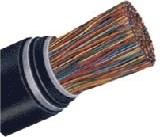
A traditional overhead phone cable is packed with cable pairs for neighborhood phone service

Verizon’s service woes are not just for big city dwellers.  Residents in Virginia are coping with Verizon landline problems in suburban neighborhoods, too.  Verizon employees openly admit they are fighting a losing battle with management to replace defective cables and equipment that should have been replaced years ago.  Management keeps winning and customers keep losing.

“When we come to this area, we dread it,” admits Alex Long, a cable splicer at Verizon for 22 years.

Long just pulled up to a pole off Burksdale Road in Norfolk and found nothing he had not seen many times before  — untrimmed tree branches overgrown into the overhead wires.  The branches had managed to rub the phone cable’s insulation down to bare copper wire.

As a result, whenever it rains, telephone service in the neighborhood becomes sporadic.  If tree branches don’t knock service out, cable-chewing squirrels do.  The lines, the equipment, and the technology is well past its prime, but Verizon management insists repair crews fix what is already there instead of replacing it with something better.  It’s all a matter of money, and Verizon wants to spend as little as possible on its copper landline network.

Long’s experiences were the highlight of a piece published by the Virginian-Pilot, which has heard complaints from readers about dreadful Verizon phone service across the region.

The repairman discloses Verizon technicians have known about the bad cable for at least five years, but requests to replace it have been repeatedly rejected.

“The cable’s totally shot,” Long told the newspaper. “It needs to be replaced, and the company’s budget doesn’t allow for it. That’s what engineering keeps telling us.”

In Hampton Roads, Va., it is a case of the fiber haves and have nots.  The parts of Hampton Roads that have been upgraded to Verizon’s fiber to the home network are virtually trouble-free in comparison to neighborhoods where copper cables still deliver service.  Verizon’s legacy network is of such concern, the Virginia State Corporation Commission has increasingly taken a close look at the level of service Verizon is providing in non-FiOS areas.

William Irby, director of the commission’s Division of Communications, has heard plenty of concerns that Verizon is neglecting their copper network in favor of FiOS fiber.

Verizon’s copper wire neglect might not be such a big problem had the company provided a date certain for upgrade relief.  But with FiOS expansion also stalled, some cities are now wondering if Verizon is abandoning them.

Boston is one of them.

Left Behind: The Cities Without FiOS

Verizon FiOS is well-known in eastern Massachusetts.  There are those who have it and those who want it.  Verizon had been aggressively pursuing franchise agreements with 111 communities across the state until the company announced it was putting on the brakes and ceasing further expansion efforts in new areas.  That leaves Boston and other communities like Quincy behind because they didn’t sign agreements with the company fast enough.

Verizon FiOS customers get the good life: $90 a month for a triple-play package with a $300 Visa debit card reward for signing up.

“If you’ve got FiOS, lucky you,” shares Quincy resident Roger Jones. “If you don’t, good luck.”

Jones says Verizon has left Quincy with a neglected landline network the company doesn’t seem interested in maintaining, much less replacing with fiber optics.

“The company believed in fiber optics because they saw the opportunities fiber could deliver, like additional revenue from selling TV channels,” Jones says. “But then Wall Street caught up to them and said it was all too much.  I might even understand that, except they won’t spend a nickle maintaining what they already have either, unless the regulators twist their arms and threaten fines over the bad service.”

Jones says his Verizon phone line was out three times earlier this year.

“Three strikes and they were out — I switched to Comcast,” Jones says. “A Verizon repair guy that came to my house the third time said all of his relatives switched to Comcast because service got to be so unreliable with Verizon’s old network.”

Back on Burksdale Road in Norfolk, Long was trying to track down another customer’s phone troubles — a loud hum on their line.  Hours later, Long decided it was a futile effort and began looking for an unused replacement pair of good wires he could switch to for the customer.  With the growing number of Verizon customers disconnecting their landline service permanently, that task gets easier every day.

Long told the newspaper it was no surprise Burksdale Road customers were experiencing problems.  Closures which were designed to protect the cable where it splits off individual phone lines were supposed to be water and air-tight.  Instead, he was working with a deteriorating rubber enclosure that showed its age after years of service.  Unfortunately, he explains, Burksdale Road customers will simply have to make due.

Not only won’t Long be able to replace the deteriorating infrastructure he finds, he’ll be forced to improvise with Verizon’s latest cost-cutting solution for wet cables — covering them with sheeting that resembles a plastic garbage bag.  Even that is nothing new for Burksdale Road.  Several houses down, a cable “rain-slicker” was already tightly wrapped around a section of cable where the rubber closure had gone missing altogether.

After getting the dial tone back, Long handed the customer his business card with his direct number and apologized.

“You may have problems again,” he said, advising the customer to call him directly the next time his phone line stops working.

Verizon better hope the customer doesn’t call the local cable company to switch providers or disconnect his landline altogether.

Search This Site:

Contributions:

Recent Comments:

Your Account:

Stop the Cap!