
Home » Qwest » Recent Articles:

History Lesson: Qwest v. The City of Boulder – Helpful to Municipal Broadband Cause?

Phillip Dampier July 16, 2013 Astroturf, Community Networks, Competition, Editorial & Site News, History, Public Policy & Gov't Comments Off on History Lesson: Qwest v. The City of Boulder – Helpful to Municipal Broadband Cause?
Phillip "It worked for Qwest so why not community broadband" Dampier

Phillip “It worked for Qwest so why not community broadband” Dampier

While doing research on another story, I recently uncovered a fascinating legal case that set an important precedent on whether it is right for a community to hold a referendum before authorizing a new telecommunications provider to offer service in a community.

Opponents of community-owned broadband networks routinely claim such services are “undemocratic” because they can exist without the majority support of the community they propose to serve. In 2001, Qwest (now CenturyLink) ran into just such a “majority-rules” provision in Boulder, Colo. that companies like AT&T and Time Warner Cable advocate should be a law everywhere.

A provision in Boulder’s Charter required that voters in a municipal election approve any cable franchise before it was granted by the city. Wishing to avoid the cost of such an election, Qwest sued the City of Boulder and asked for summary judgment to declare the policy unlawful. Chief Judge Lewis Babcock found Qwest’s argument compelling enough to invalidate the city’s mandatory referendum provision.

Qwest argues that the language in [U.S. Federal Law] 47 U.S.C. § 541 regulating franchising authorities is in direct conflict with [Boulder’s] § 108’s mandatory election provision. I agree.

First, the Act provides guidance to, and restrictions on, “franchising authorities.” Section 541’s requirements are directed toward franchising authorities. See 47 U.S.C. § 541(a)(1), (3), (4). Under the statute, a “franchise” is “an initial authorization, or renewal thereof,” issued by a franchising authority to construct or operate a cable system. 47 U.S.C. § 522(9). A “`franchising authority’ means any governmental entity empowered by Federal, State, or local law to grant a franchise.” 47 U.S.C. § 522(10) (emphasis added).

Here, Qwest approached City officials to seek franchise approval. The City granted a revocable permit to Qwest, and agreed to “grant a cable television franchise authorizing [Qwest] to provide cable television service within the City for a term of years” once an affirmative vote by the qualified taxpaying voters occurred. There is no evidence that the City negotiated the franchise in any manner, or put any additional restrictions or caveats on the franchise beyond voter approval. City officials follow the will of the voters with no additional scrutiny or decision-making. Thus, the City has abdicated franchising authority to the City’s voting citizens. These voters cannot, by the plain terms of the statute, be a “governmental entity empowered by Federal, State, or local law to grant a franchise.” 47 U.S.C. § 522(10). Therefore, direct conflict between the federal and local laws exist, as it is impossible for the franchise to be granted by a governmental entity as required by the Act, and simultaneously granted by the voters as required in § 108.

Second, § 541 imposes numerous and specific requirements on franchising authorities. The statute forbids exclusive franchises, see § 541(a)(1); unreasonable refusals to award additional competitive franchises, see id. at (a)(1); requirements that have the purpose or effect of prohibiting, limiting, restricting, or conditioning the provision of a telecommunications service by a cable operator, see id. at (b)(3)(B); ordering a cable operator or affiliate thereof to discontinue the provision of a telecommunications service, discontinuing the operation of a cable system by reason of the failure of a cable operator to obtain a franchise or franchise renewal, see id. at (b)(3)(C)(i)-(ii); or requiring a cable operator to provide any telecommunications service or facilities as a condition of the initial grant of a franchise. See Id. at (b)(3)(D).

A franchising authority has affirmative requirements as well. It must assure that access to cable service is not denied to any group of potential residential cable subscribers because of the income of the residents of the local area in which such group resides, see id. at (a)(3); and allow the applicant’s cable system a reasonable period of time to become capable of providing cable service to all households in the franchise area, see id. at (a)(4)(A).

However, by allowing voters unfettered and unreviewed discretion to grant or reject a franchise, § 108 is in conflict with virtually every provision in § 541. Because only WOWC has received a franchise, voters could effectively grant WOWC an exclusive franchise simply by refusing to vote affirmatively for a second operator. See id. at (a)(1). Voters could unreasonably refuse to award an additional competitive franchise, as they could deny a franchise for any reason or for no reason. See id. Qwest correctly argues that § 108 “provides voters with the unfettered and unreviewable discretion either to grant or deny a cable television franchise for any reason, or for no reason at all.”

Qwest (now CenturyLink), is Idaho's largest Internet Service Provider.In brief, the judge found cable franchises are granted or denied at the municipal level by local government, not through referendums. The City of Boulder was effectively abdicating its responsibility under federal law to manage the franchising process itself. There is no provision in federal law that allows citizens to directly vote a cable franchise agreement up or down, although voters can use the ballot box to remove local officials who do not represent the will of the majority.

More importantly, the judge recognized that turning the process over to local citizenry could unintentionally hand an incumbent provider a monopoly just by voting down any would-be competitor. Why would local citizens oppose competition? As we’ve seen in the fight for community broadband, incumbent providers will spend millions to keep would-be competitors out with a variety of scare tactics and propaganda. Providers have suggested community networks are guaranteed financial failures, will result in yards being torn up to install service, might result in local job losses, and will raise taxes whether residents want the service or not.

Judge Babcock also found that laws that could limit effective competition to incumbent cable companies are in direct conflict with the 1992 federal Cable Act:

The legislative history clearly supports the proposition that Congress was focused on fostering competition when passing the 1992 Act. The Senate Report regarding the Act states, “[I]t is clear that there are benefits from competition between two cable systems. Thus, the Committee believes that local franchising authorities should be encouraged to award second franchises.”

[…] Given the clear intent of Congress to employ § 541 as a vehicle for promoting vigorous competition, I conclude that § 108 is in conflict. Section 108 serves only to provide a significant hindrance to the competition that Congress clearly intended to foster. It forces the potential franchiser to spend money, time, advertising, and logistical support on an election. Thus, § 108 “stands as an obstacle to the accomplishment and execution of the full purposes and objectives of Congress.”

Perhaps the time has come to raise similar challenges in states where legislatures have passed community broadband bans or placed various impediments on providing service. If Qwest can successfully argue that such rules are designed to limit competition, local communities can certainly argue the panoply of anti-competition laws that were written by and for incumbent cable and phone companies deserve the same scrutiny.

Referendums are an inappropriate way to approve the entry of new competitors.

Wireless Spectrum: Highest Bidder Wins in U.S., Competition Wins in Europe… for Now

analysisIn the race to acquire spectrum and market share, AT&T and Verizon Wireless have already won most of the awards worth taking and have little to fear from smaller competitors. The U.S. government has seen to that.

The two wireless giants have benefited enormously from government spectrum auctions that award the most favorable wireless spectrum to the highest bidder, a policy that retards competition and guarantees deep-pocketed companies will continue to dominate in the coverage wars.

Winner-take-all spectrum auctions have already proven that AT&T and Verizon are best equipped to bid and win coveted 700MHz spectrum which provides the best indoor and fringe-area reception. This is why AT&T and Verizon customers often find “more bars in more places” than customers relying on Sprint or T-Mobile. Smaller carriers typically have to offer service over much-higher frequencies that don’t penetrate buildings very well. With a reduced level of service, these competitors are at an immediate competitive disadvantage. They also must spend more for a larger number of cell towers to provide uniform service.
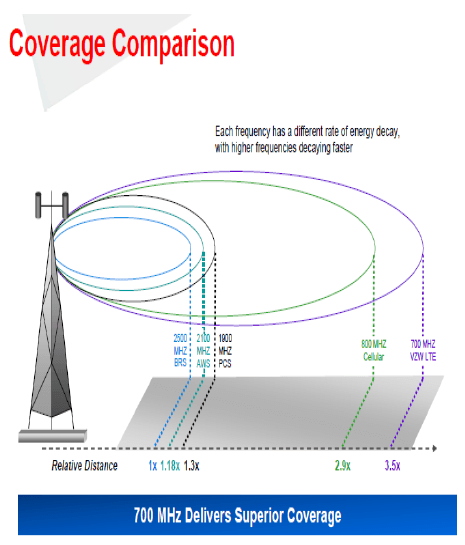
Verizon's own presentation materials tout the benefits of controlling 700MHz spectrum which is less costly to deploy and offers more robust coverage.

Verizon’s own presentation materials tout the benefits of controlling 700MHz spectrum, which is less costly to deploy and offers more robust coverage.

Sprint and T-Mobile have two strikes against them at the outset — less favorable spectrum and much smaller coverage areas. Customers who want the best reception under all circumstances usually get it from the biggest two players. Those focused primarily on price are willing to sacrifice that reception for a lower bill.

The same story is developing in the wireless data marketplace. AT&T and Verizon Wireless have the strongest networks as Sprint and T-Mobile fight to catch up.

Where America Went Wrong: The Repeal of Spectrum Caps

Tom Wheeler: America's #1 Advocate for Repeal of Spectrum Caps is now the chairman of the FCC.

Tom Wheeler: America’s #1 advocate for repeal of Spectrum Caps is now the chairman of the FCC.

Originally, the United States prevented excessive market domination with a “Spectrum Cap,” — a maximum amount of wireless spectrum providers could hold in any local market. The rule was part of the sweeping changes in telecommunications law introduced in the mid-1990s. Wireless spectrum auctions replaced lotteries or strict frequency assignments based on merit. The U.S. government promoted the auction system as a win for the U.S. Treasury, which has been promised $60 billion in proceeds from the wireless industry (not the amount actually collected) since auctions began in 1994.

The cost to U.S. consumers from increasing cell phone bills in barely competitive markets is still adding up.

After the auction system was introduced, the largest carriers acquired some of the most favorable, lower-frequency spectrum, easily outbidding smaller rivals. Most of the smaller regional carriers that ultimately won coveted 700MHz spectrum emerged victorious only when AT&T and Verizon felt the smaller markets were not worth the investment. In larger markets, spectrum caps were a gatekeeper against acquiring excess spectrum and, more importantly, rampant industry consolidation.

Under the pre-2001 rules, wireless companies couldn’t own more than 45MHz of spectrum in a single urban area or more than 55MHz in a rural area. That was when Verizon and AT&T competed with carriers that no longer exist — old familiar names like Nextel, Cingular, VoiceStream, Alltel, Centennial Communications, Qwest, and many others considered safe from poaching because the most likely buyers would find themselves over their spectrum limits.

As the largest carriers realized the caps were an effective merger/buyout firewall, the wireless industry began a fierce lobbying campaign against them. Leading the charge was Tom Wheeler, then-president of the CTIA Wireless Association, the nation’s top cellular industry lobbying group. Today he is chairman of the Federal Communications Commission.

“Today, America faces a severe spectrum shortage for wireless services,” Wheeler said in 2001. “The spectrum cap is a legacy of spectrum abundance, not shortages; the inefficiencies it perpetuates cannot be allowed to continue. While the U.S. government is looking for ways to catch up to the rest of the world on spectrum allocations, removal of the cap can at least increase the efficiency of existing spectrum.”

Copps

Former FCC Commissioner Michael Copps opposed retiring Spectrum Caps: “Let’s not kid ourselves: This is, for some, more about corporate mergers than it is about anything else.”

Wheeler was backed by an intensive lobbying effort funded by the largest wireless companies itching to merge and acquire.

By the end of 2001, the new Bush Administration’s FCC was ready to deal, gradually repealing the spectrum caps and fueling major wireless industry consolidation in the process. Providers everywhere could now own or control 55MHz of spectrum in any market, with the promise the caps would be repealed altogether by March 2003.

The result was already foreseen by former FCC Commissioner Michael Copps in November 2001, when he strongly dissented to the Republican majority gung ho for dissolving spectrum caps.

“Let’s not kid ourselves: This is, for some, more about corporate mergers than it is about anything else,” Copps wrote in his strong dissent. “Just look at what the analysts are talking about as the specter of spectrum cap renewal approaches – their almost exclusive focus is on evaluating the candidates for corporate takeovers and handicapping the winners and losers in the spectrum bazaar we are about to open.”

Just in case Copps might be making headway in his campaign to protect competition, Wheeler began complaining even louder about spectrum caps during the spring of 2003, just before their dissolution.

“The wireless industry fought long and hard to secure this spectrum for America’s wireless consumers,” said Wheeler. “Now we must tread carefully — in this era of rapid technological change, writing rules that are too restrictive would be irresponsible. In order to use this spectrum both efficiently and effectively, those who purchase this spectrum at auction must be allowed the freedom to grow and evolve with the demands of the market.”

Europe: Protecting Consumers from Giant Multinational Competition Consolidators (Some of the same ones AT&T reportedly wants to buy)

There is a reason Europeans are shocked by the costs of wireless service in the United States and Canada. North Americans pay higher prices for less service than our European counterparts. Most of the New World also has fewer choices in near-equivalent service providers.

Much of this difference can be attributed to European regulators maintaining focus on driving competition forward and disallowing rampant industry consolidation. But as Wall Street turns its attentions increasingly towards Europe to push for the next big wave of wireless mergers, the European system of “competition first” could be undermined if providers follow the North American model of high profits and reduced competition through consolidation.

Across much of Europe, at least four national carriers serve each EU member state, almost all controlling a share of the most valued, low-frequency wireless spectrum. European regulators do not allow a small handful of providers to maintain a stranglehold on the most valuable radio spectrum. Competitors have traditionally been offered a spectrum foundation to build networks that can stand up to their larger counterparts — the large multinationals or ex-state monopoly providers who had a head start providing service.

A report released by Finland market research firm Rewheel in May found clear evidence that the European model was benefiting consumers at the expense of rampant provider profits. Europeans in “progressive” markets that welcomed new competitive entrants pay lower prices for far more service. In some cases, the price differences between the five giant multinational providers that dominate Europe — Vodafone, KPN, France Telecom, Telefonica and Deutsche Telekom — were staggering. Competitors like Tele2, TeliaSonera, and “3” charge up to ten times less than the larger companies for equal levels of service.

[flv width=”640″ height=”380″]http://www.phillipdampier.com/video/Bloomberg ATT Takeover List of European Wireless Carriers 7-15-13.flv[/flv]

“Europe is ripe for competition,” reports Bloomberg News. Providers like AT&T may be preparing to embark on a European wireless acquisition frenzy, but Wall Street warns profits are much lower because of robust price competition in Europe that benefits consumers. (4 minutes)

The study also found a number of the largest European providers were following in the footsteps of Verizon Wireless, AT&T, Rogers, Bell, and Telus here in North America:

  • Prices were enormously higher in markets that lack effective competition from an upstart competitor able to deliver a comparable level of service. Smaller cell companies with very limited infrastructure or with non-favored spectrum could not provoke dominant players to cut prices because reception quality was starkly lower and consumers would have to cope with a reduced level of service. In Europe, when new competitors were able to fully build-out their networks using favorable spectrum, incumbents in these progressive markets slashed prices and boosted services to compete. In North America, upstart competitors cannot access favorable spectrum for financial reasons and the investor community has dismissed many of these players as afterthoughts, starving them of much-needed investment.
  • Large dominant European providers are now heavily lobbying for deregulation of merger and acquisition rules and want the right to acquire the competition entering their markets.
  • In almost half of the EU27 member state markets spectrum is utilized very inefficiently by the largest incumbent telco groups who are keen to protect their legacy fixed assets and cement their European dominance with more consolidation at the price of competition. In the United States and Canada, many of the largest providers crying the loudest for more wireless spectrum have still not used the spectrum already acquired.
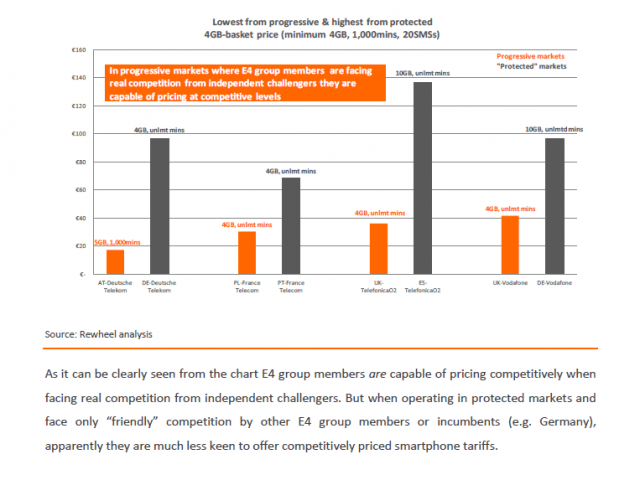
competition slide

From the Finnish report:

The obvious question that needs to be asked is how is it technologically possible and economically viable for Tele2, 3 and TeliaSonera to offer four times more gigabytes of data usage at a fraction of the price charged by larger companies.

  • Do independent challengers have privileged access to more efficient technologies (i.e. LTE) than the E4 group members?
  • Do they hold relatively more spectrum capacity than the E4 group members?
  • Do independent challengers have access to more radio sites and their spectrum reuse factor is higher than the E4 group members?
  • Or are independent challengers (i.e. Tele2, DNA) unprofitable?

None of the above are true.

The answer is actually very simple. Independent challengers and incumbents such as TeliaSonera present mainly in progressive markets are utilizing the spectrum resources assigned to them. In contrast, incumbent telco groups […] rather than utilizing their spectrum resources instead appear to be more concerned about keeping the unit price of mobile data very high […] by restricting supply, the same way the lawful “cartel” of OPEC controls the price of oil by turning the tap off.

In progressive markets (where at least one independent challenger is present, triggering spectrum utilization competition) such as Finland, Sweden, Austria and the UK, mobile data consumption per capita is up to ten times higher than in protected markets.

In some European countries dominated by the biggest players, consumers are being gouged for service. Where robust competition exists, prices are dramatically lower.

The European nation where market conditions are most similar to the United States is Germany. Two large carriers dominate the market: Deutsche Telekom, the former state-owned telephone company and Vodafone, part owner of Verizon Wireless.

In Germany, consumers spending €20 ($26) end up with a data plan offering as little as 200MB of usage per month. In progressive markets in adjacent countries, spending the same amount will buy an unlimited use data plan or at least one offering tens of gigabytes of usage. In short, German smartphone service is up to 100 times more restrictive than that found in nearby Scandinavia or in the United Kingdom. These same two companies charge Germans double what English customers pay and a Berliner will end up with 22 times less data service after the bill is settled.
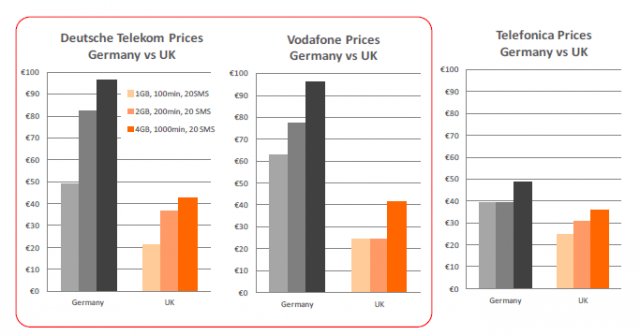
competition slide 2

So what is going on in Germany that allows the marketplace to stay so price-distorted? The fact all four significant competitors have close ties to or are owned by the large multinational telecom operators mentioned above. Deutsche Telekom, Vodafone, Telefonica and E-Plus, the latter one belonging to the Dutch KPN Group are all members of a lobbying organization attempting to persuade the EU to invest public funds into improving Europe’s wired broadband networks. Playing against that proposition is a growing number of Europeans moving to wireless. By charging dramatically higher wireless prices in Germany, all four companies have successfully argued that wireless adoption is not a significant reason to stall public financing of private broadband projects. In fact, Germany’s wireless growth is well below other EU nations.

The Finnish researchers point out the evidence of informal provider collusion is pretty stark in Germany:

“One would expect these ‘European Champions,’ especially the ones with lower market shares (Telefonica and E-Plus), to look at the smartphone centric market transformation as an opportunity to secure or improve their market share, especially in light of the fact they should have plenty of unused radio spectrum capacities to make their offers more consumer-appealing,” the report finds. But in fact these new entrants have priced their services very closely in alignment with the larger two.

“Undoubtedly, multinational incumbent telco groups and their investors have good reasons to lobby EU decision makers to enact friendly policies that will protect their inherited oligopolistic high profit margins,” the report states. “But will the German model serve the best interest of consumers and business in other EU member states? In Rewheel’s opinion, clearly not. Enforcing an overly ‘convergent player friendly’ German model would severely limit competition in the mobile markets, leading to high prices for consumers and the Internet of mobile things and sever under-utilization of the member states’ scarce national radio spectrum resources.”

[flv width=”640″ height=”380″]http://www.phillipdampier.com/video/Bloomberg ATT Entry in Europe Not Seen as Competitive Threat 7-15-13.flv[/flv]

Competition is brutal in Europe’s wireless marketplace — a factor Bloomberg News says could temper AT&T’s planned “European Wireless Takeover.” What makes the difference between enormous profits in North America and heavy price discounting in Europe? Spectrum policy, which gives European competitors a more level playing field. Bloomberg analysts speculate AT&T will bankroll its rumored European buyouts and mergers with the enormous profits it earns from U.S. subscribers.  (4 minutes)

Spring Snowstorm Eclipses Omaha’s Initial Interest in CenturyLink Gigabit Broadband Trial

Phillip Dampier May 2, 2013 Broadband Speed, CenturyLink, Competition, Cox, Data Caps, Google Fiber & Wireless, Public Policy & Gov't, Video Comments Off on Spring Snowstorm Eclipses Omaha’s Initial Interest in CenturyLink Gigabit Broadband Trial
A freak spring snowstorm has stolen CenturyLink's thunder.

A freak spring snowstorm has stolen CenturyLink’s thunder.

A freak spring snowstorm has covered up much of the anticipated publicity for CenturyLink’s plans to launch a trial of gigabit fiber broadband for 48,000 customers in western Omaha.

The phone company announced the pilot project this week amid a historic spring storm that dumped several inches of heavy, wet snow on parts of Nebraska. The media devoted most of its attention to the weather.

CenturyLink admits its gigabit fiber service is a pilot project designed to test consumer demand and the tolerance of local officials for limiting upgrades to selected neighborhoods and customers most likely to buy the service. CenturyLink has priced the gigabit service comparably to Google Fiber — $79.95 a month if bundled with other CenturyLink products. Standalone broadband is nearly twice as expensive — $149.95 a month.

“CenturyLink is pleased to offer its Omaha customers ultra-fast broadband speeds up to 1Gbps to help keep pace with growing broadband demands,” said Karen Puckett, chief operating officer. “This demonstrates our commitment to deliver communications solutions that provide our customers with the technology they need to enhance their quality of life, now and into the future.”

CenturyLink will not be building the fiber network from scratch. The company already runs a 100Gbps middle-mile/institutional fiber network in Omaha that reaches certain business clients and serves as a conduit for CenturyLink customer traffic. CenturyLink will supplement that by using the remnants of its predecessor’s long-gone Qwest Choice TV service. The company will spend millions to run fiber connections to homes and businesses, but around 9,800 residents formerly served by Qwest’s television service will be able to sign up for CenturyLink Lightspeed Broadband as early as Monday. Others may have to wait until as late as October.

lightspeedCenturyLink now sells up to 40Mbps speeds in Omaha, with a 300GB monthly usage cap. The company has not said if it intends to apply a usage limit on its fiber customers.
The phone company’s largest and fastest competitor is Cox Cable, which sells up to 150/20Mbps service for $99.99 a month.

Cox Cable cannot match CenturyLink’s speeds at the moment, but does not think most Omaha residents need or want gigabit fiber.

“It is important to note that our most popular Internet package remains the one that provides speeds of 25Mbps, which meets the needs of the majority of customers,” said Cox spokesman Todd Smith. “We will continue to talk with our customers and invest in product enhancements to provide an optimal broadband experience.”

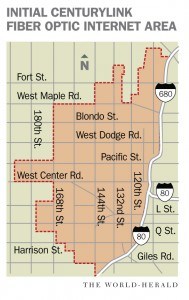
omaha centurylink fiberOnly around 12% of metropolitan Omaha will have access to the experimental fiber service, primarily those living in West Omaha. The network will bypass residents that live further east. The boundaries of the forthcoming fiber network are notable: West Omaha comprises mostly affluent middle and upper class professionals and is one of the wealthiest areas in the metropolitan region. Winning a right to offer service on a limited basis within Omaha is an important consideration for telecom companies like CenturyLink.
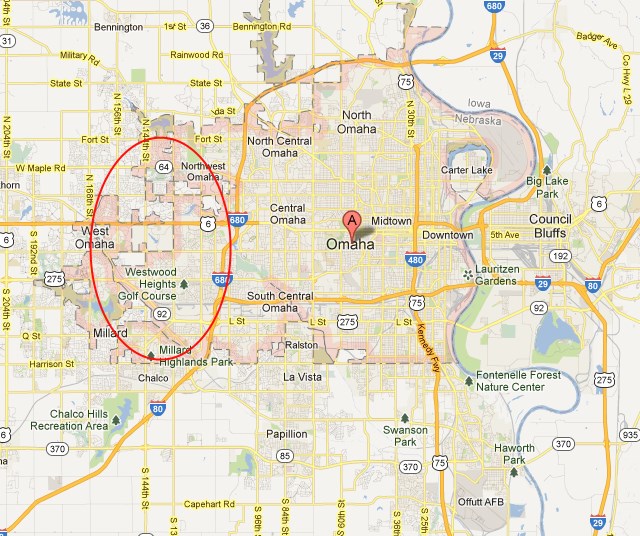

AT&T, Verizon, CenturyLink and other telecommunications companies are seeking deregulation that would end universal service mandates that require companies to build their networks in every neighborhood, rich and poor.

Cable and telephone companies have taken careful note Google Fiber is being allowed to provide service only where demand can be found — a significant change in long-standing municipal policies that demand cable and phone companies provide access to nearly every resident.

CenturyLink delivered a “between the lines” message to local officials when it suggested it might expand its fiber network elsewhere in Omaha and beyond, but only after evaluating the project for “positive community support, competitive parity in the marketplace and the ability to earn a reasonable return on its investment.”

In other words, keeping zoning and permit battles (and residential complaints about construction projects) to a bare minimum, allowing the company the right to choose where it will (and won’t) deploy service, and making sure people will actually buy the service are all the key factors for fiber expansion.

AT&T said much the same thing when it vaguely promised a gigabit fiber network to compete with Google in Austin.

Google may have unintentionally handed their competitors a new carrot: deregulate us in return for fancy fiber upgrades that customers crave.

In perspective: CenturyLink's fiber trial will only impact about 12% of metropolitan Omaha's population, primarily in and near affluent West Omaha.

In perspective: CenturyLink’s fiber trial will only impact about 12% of the total population of metropolitan Omaha, primarily in and near affluent West Omaha.

[flv width=”480″ height=”290″]http://www.phillipdampier.com/video/WOWT Omaha CenturyLink Gigabit 5-1-13.flv[/flv]

WOWT in Omaha spent less than a minute reporting on CenturyLink’s forthcoming gigabit fiber trial. A spring snowstorm preoccupied most of Omaha’s media instead.  (1 minute)

Why Google Chose Provo as the Next Google Fiber City

google fiberTo many, Provo, Utah might seem an unusual choice to follow on the heels of Google’s earlier announcement its gigabit fiber network was headed to Austin, Tex.


Provo is only the third largest community in Utah — Salt Lake City and West Valley City are bigger — and the community already has a fiber network called iProvo. So why build another one?

Google won’t have to.

But first some background:

iProvo was envisioned a decade ago as a public-private partnership — a fiber to the home network owned by the public with private service providers using it to sell broadband and other services . iProvo taught an early lesson about municipal broadband — large cable and phone companies routinely boycott participation in any network they do not own and control themselves.

In 2003, the president of Qwest’s Utah division made clear their intentions: “Fiber optic’s capabilities are way more than what most consumers need in their homes. Why provide a Rolls Royce when a Chevrolet will do?”

Comcast, the dominant local cable operator, also “went ballistic” according to former mayor Lewis Billings.

iProvo can be yours for just $1.

iProvo can be yours for just $1.

“One hired a PR firm and a telemarketing company to make calls to citizens,” Billings recalled. “They also placed full-page ads and ultimately hired people to picket City Hall. It was a bruising fight.  My favorite picket sign had a piece of telephone wire taped to it and read that I and one of my key staff members were, ‘a Twisted Pair.’”

With both Qwest and Comcast wanting nothing to do with the project, smaller independent ISPs had to fill the gap. It was a difficult sell, particularly because Qwest and Comcast blanketed Provo residents with a misinformation campaign about the network and pitched highly aggressive retention offers to keep customers with the phone and cable company. iProvo has been in financial distress ever since.

Former Provo city councilwoman Cynthia Dayton remembers being on the council when iProvo was approved and believes the public-private network was a decade before its time.

“Ten years ago it was worth the vote on iProvo,” she told the Daily Herald. It was one of the most difficult decisions but it was for the future.”

More than a year ago, Google noticed the city of Provo issued a request for proposals on what to ultimately do with iProvo.

Google became interested because Provo is seen as a city with hundreds of technology start-up companies and maintains a vibrant tech hub. The city also ranked highly for the enormous value it places on connectivity and community — something the approval and construction of iProvo demonstrated.

[flv width=”640″ height=”380″]http://www.phillipdampier.com/video/Provo Google Fiber 4-13.mp4[/flv]

Why Provo? Google considers the city’s rankings. (1 minute)

iprovo_logo.jpg.pagespeed.ce.grIF_VVvuACity officials and Google executives began quietly talking more than a year ago about Google buying the public-private network. A key selling point: the city was willing to let the operation go for a steal — just $1.00. In return, Google promised to invest in and upgrade the network to reach the two-thirds of Provo homes it does not reach. Google says iProvo will need technology upgrades in the office, but the existing fiber strands already running throughout the city are service-ready today.


Val Hale, President of the Utah Valley Chamber of Commerce, said a quick “back of the envelope” estimate put Google’s anticipated investment in iProvo network upgrades at $18 million, according to the Deseret News. Unfortunately, taxpayers will still need to pay off about $40 million in bonds the city accumulated for iProvo’s initial construction costs.

Curtis

Curtis

Current Mayor John Curtis says he has made the best out of a difficult situation.

“We have maximized what we have here today,” said Curtis. “It’s about maximizing what we have. I believe in the long-term it will pay dividends many times greater than what we paid into it, but it’s going to take a while to realize that dream.”

Google promised free gigabit Internet service to 25 local public institutions including schools, hospitals, and libraries. Residential customers will be expected to pay $70 a month for 1,000Mbps service or get 5Mbps broadband service for free up to seven years.

Google’s investment in Provo is anticipated to be far lower than in Austin and Kansas City — cities where it needs to build a considerable amount of fiber infrastructure from scratch. With existing fiber already in place in Provo, Google’s gigabit service will be available by the end of this year, at least six months faster than in Austin.

With reduced construction costs, Google will only ask new customers for a $30 activation fee, far less than the $300 Google will ask Austin and Kansas City residents to pay if they do not sign a multi-year service contract or only want basic 5Mbps service.

Google sees the opportunity to use its fiber network in an ongoing effort to embarrass other broadband providers into investing in speed upgrades.

[flv width=”640″ height=”380″]http://www.phillipdampier.com/video/KSL Salt Lake City Google Fiber Coming to Provo 4-17-13.flv[/flv]

KSL in Salt Lake City reports Google Fiber is coming to Provo. Last year Google began talking with the city to acquire its iProvo municipal fiber network.  (3 minutes)

[flv width=”640″ height=”380″]http://www.phillipdampier.com/video/KSTU Salt Lake City Google Fiber coming to Provo 4-17-13.flv[/flv]

KSTU in Salt Lake City reports taxpayers are still on the hook for around $40 million in bond payments to cover the construction costs of iProvo. But Google Fiber will stop other Internet providers from “cheating everyone” says one local Provo resident.  “[Other ISPs] give you the slowest connection possible and charge you a ridiculous amount for it,” said Haley Cano. (4 minutes)

[flv width=”480″ height=”380″]http://www.phillipdampier.com/video/KTVX Salt Lake City Google Fiber in Provo 4-17-13.mp4[/flv]

KTVX in Salt Lake had some trouble navigating the difference between a gigabit and a gigabyte, and confused what Google services will be sold and which will be available for free in this report, but the ABC affiliate covered the unveiling with both city and Google company officials on hand.  (2 minutes)

[flv width=”480″ height=”380″]http://www.phillipdampier.com/video/KTVX Salt Lake City Google Fiber Details in Provo 4-18-13.mp4[/flv]

This morning, KTVX did a better job in this interview with the mayor of Provo and Google’s Matt Dunne, who says Google believes speed matters and current ISPs simply don’t offer enough.  A key factor to attract Google’s interest is a close working relationship with the cities that want the service. (2 minutes)

CenturyLink CEO Thinks AT&T Has a Tough Road Ahead Cutting Off Rural Landlines

CenturyLink CEO Glenn Post does not think much about AT&T’s plans to shift its most rural landline customers to wireless in its efforts to decommission traditional landline service.

“From a regulatory standpoint, that could be a tough go,” Post explained to Wall Street investors on a conference call last week. “There may be some areas that will have better service with wireless in some ways. As far as a competitive threat, we don’t see that being a real issue for us because just the bandwidth requirements and the limited wireless access or capability in a lot of areas.”

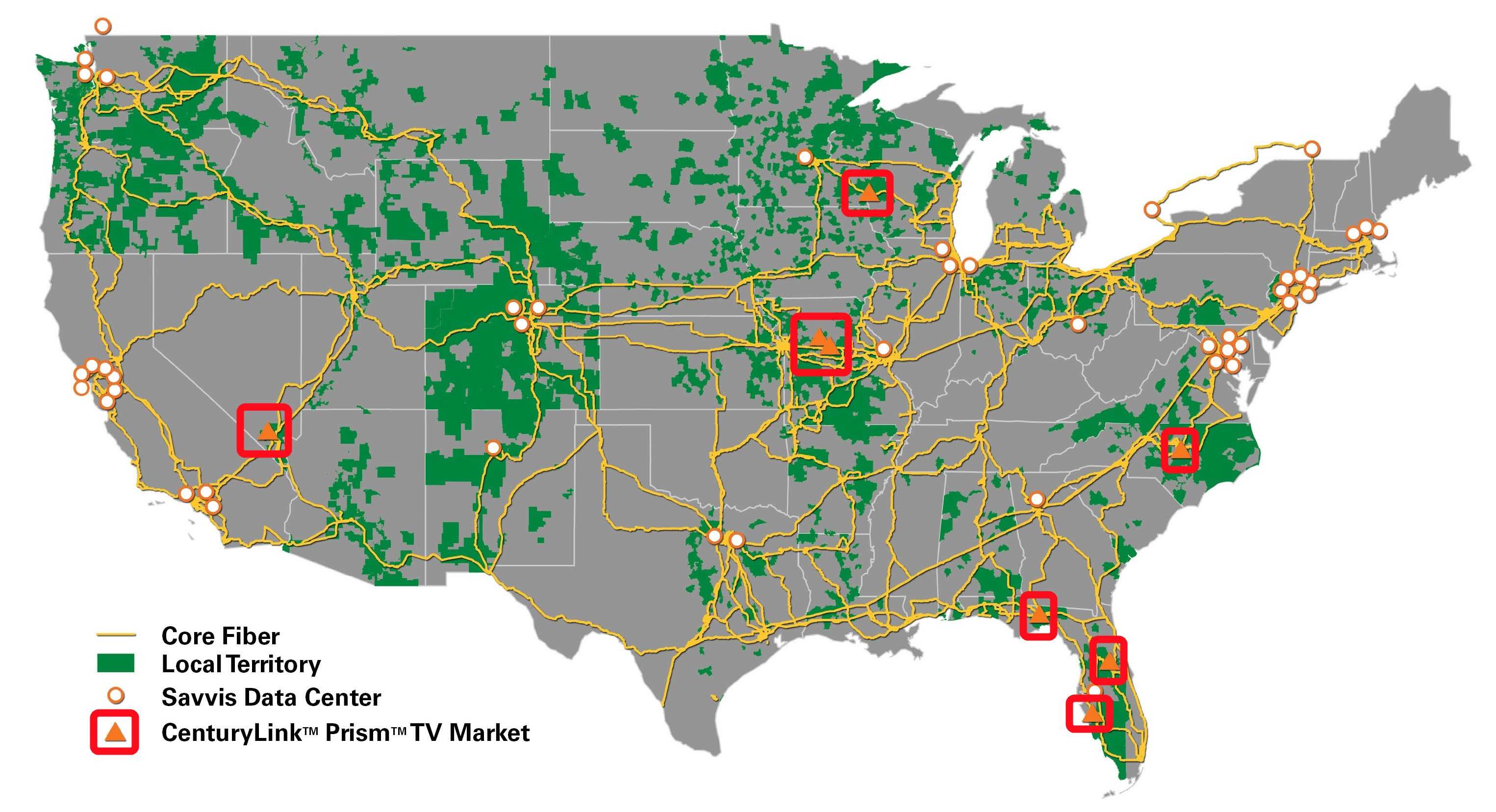
CenturyLink, one of four large independent phone companies and owner of former Baby Bell Qwest, is doubling down on its wired infrastructure to reach customers. The company recently announced Phoenix would be the latest city to get its fiber-to-the-neighborhood service Prism TV — the first legacy Qwest market to get IPTV service from CenturyLink. The service soft-launches in Phoenix this month, with a second city in the region or Pacific Northwest slated to get Prism sometime next year.

The company has spent much of 2012 investing in broadband, managed hosting and cloud computing for business customers, and fiber expansion to reach more than 15,000 cell towers across CenturyLink’s national service area, depicted in green on the accompanying map.

But CenturyLink executives stress their investments are “strategic” — made in areas that are most likely to deliver quick returns for the company.

While CenturyLink spends money to secure video franchising agreements in metro Denver and Colorado Springs for Prism TV service, it is moving at “a snail’s pace” to deliver broadband service in northeastern North Carolina’s Northampton County. County officials there anticipate CenturyLink will take years to deploy basic DSL service to communities outside and around Conway and Gaston.

The broadband problem in income-challenged parts of North Carolina illustrate the conundrum for county officials, who have to advocate for broadband improvement while combating misleading broadband maps that suggest access is not a problem in the state.

Donna Sullivan with the Department of Commerce notes that broadband maps in states like North Carolina have a census block granularity which does not always reveal the true picture of broadband availability.

“That means if one household in that census block can receive broadband services, the entire census block is considered covered—even though there very well may be households who cannot receive broadband to that location,” she told the Roanoke-Chowan News-Herald.

Northampton County, N.C.

CenturyLink is in no hurry to expand broadband to the 1,921 households in the county of 22,000 who cannot buy broadband service at any price.

Derek Kelly, a CenturyLink spokesman, said the company is working to expand broadband services in the region, but noted the costs to lay down a fiber network to help reach the unserved is “one of the largest costs.”

That cost is much less of a problem if the customer at the end of the line happens to be a wireless company like Verizon or AT&T.

Company officials admit they are spending enormous sums “investing in fiber builds to as many [cell] towers in our service area as economically feasible.” In the third quarter alone, more than 1,000 cell towers received fiber upgrades for a total of 3,300 so far this year. The company hopes to reach 4,000-4,500 cell towers by New Year’s Eve.

The reason why CenturyLink chases wireless business while allowing rural and income-challenged service areas to go without broadband is a simple matter of economics. Cell phone companies sign lucrative, multi-year contracts for fiber connectivity to cell towers to support forthcoming 4G service. In contrast, CenturyLink was surprised to find an astounding 94 percent of families with children in Northampton are qualified for the company’s special Lifeline Program which delivers slow speed, discounted broadband service for families on public assistance.

Post

For CenturyLink’s more urban and prosperous service areas, the news for broadband service improvements is better.

As CenturyLink continues to extend its middle mile fiber network, broadband speeds are gradually improving.

Over 70 percent of CenturyLink customers can receive at least 6Mbps DSL service, more than 57% can receive at least 10Mbps and 29% can access the Internet at 20Mbps speeds or better, according to Post.

But the more urban and prosperous a service area is, the greater the chance a cable competitor has successfully poached many of CenturyLink’s DSL customers with the promise of better speed.

Post said he recognizes the company must do better to remain competitive.

“We’re shooting for 20-25Mbps for a very large percentage of our areas,” Post said. “But with [pair] bonding, we can virtually double the broadband capacity and speeds in our markets. We’re already doing bonding in a number of markets today. So where we have 20Mbps, we could have 40Mbps.”

CenturyLink’s fiber to the neighborhood network, essential where it plans to roll out Prism TV, can also support faster broadband speeds if a customer wants broadband alone and does not care about television service.

Nationwide, the company added 10,000 Prism TV subscribers in the third quarter and has a total customer base of around 104,000 subscribers. But that represents a penetration rate of just over 10%, hardly noticed by still-dominant cable operators.

CenturyLink executives were asked to comment on AT&T’s strategic plan to transform their landline network announced last week in New York. Post found little in common between CenturyLink and AT&T’s vision for the future and does not think the company has to respond to AT&T’s attempt to redefine rural America as wireless territory.

“We don’t see that as a major investment for us or a major risk at this point.”

Search This Site:

Contributions:

Recent Comments:

Your Account:

Stop the Cap!