Home » Qwest » Recent Articles:

Telcos Intentionally Cut Rural Broadband Investments Hoping for Taxpayer Subsidies

Phillip Dampier August 8, 2017 AT&T, Broadband "Shortage", Consumer News, Net Neutrality, Online Video, Public Policy & Gov't, Rural Broadband, Wireless Broadband Comments Off on Telcos Intentionally Cut Rural Broadband Investments Hoping for Taxpayer Subsidies

AT&T: Using taxpayer and ratepayer dollars to subsidize 4G LTE upgrades for its customers.

With taxpayer subsidies on the horizon, phone companies cut back investing their own money on rural broadband expansion hoping taxpayers would cover funding themselves.

That is the conclusion of Dave Burstein, a long-standing and well-respected industry observer and publisher of Net Policy News. Burstein is concerned the unintentional consequence of Obama and Trump Administration rural broadband funding programs has been fewer homes connected than what some carriers would have managed on their own without government subsidies.

“Since 2009, carrier investment in broadband in rural areas has gone down drastically,” Burstein wrote.

As a result, FCC Chairman Ajit Pai announced plans to spend $4.53 billion from a public-financed Mobility Fund over the next decade to advance 4G LTE service, primarily in rural areas that would not be served in the absence of government support. Burstein suspects much of that money could end up being unnecessarily wasted.

“Under current plans, most of the money is likely to go where telcos would build [4G] without a subsidy, [or will be used to] buy obsolete technology, or give the telcos two or three times what the job should cost,” Burstein wrote. “Any spending on wireless except where towers or backhaul is unavailable should be assumed wasteful until proven otherwise.  Realistic costs need to be developed and subsidies allocated on that basis.”

AT&T’s rural fixed wireless expansion program, funded substantially by U.S. taxpayers and ratepayers, is a case in point. AT&T is receiving almost $428 million a year in public funds to extend wireless access to 1.1 million customers in 18 states, the FCC says. Much of that investment is claimed to be spent retrofitting and upgrading existing cell towers to support 4G LTE service. But AT&T claims 98% of its customers already have access to 4G LTE service — more than any other carrier in the country, so AT&T is actually spending the money to bolster its existing 4G LTE network, something more likely to benefit its cell customers, not a few thousand fixed wireless customers.
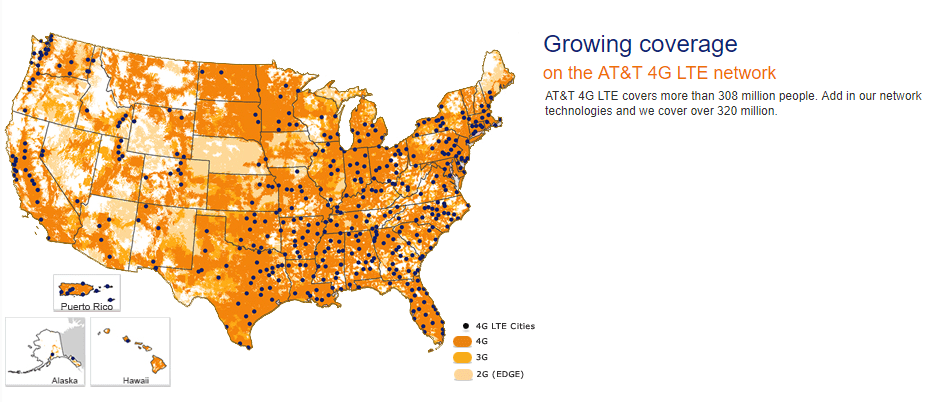
(Source: AT&T)

“An AT&T exec in California said communities didn’t need to worry about the impact of the CAF-funded project, since it was almost all going to be on existing towers,” Burstein wrote, allaying fears among members of the public that money would be spent on lots of new cell towers. “I don’t know what loophole AT&T is using to get the money, but it’s a pretty safe guess they would have upgraded most of them without the government paying. 4G service now reaches all but 3-5 million of the 110-126 million U.S. households. Probably half [of the less than five million] targeted would soon be served without a subsidy – if the telcos knew no subsidy was likely. Before spending a penny on subsidies, the FCC needs to do a thorough assessment of what would be built without government money.”

Burstein

Wireless executives were delighted when the U.S. government in 2009 committed to spending $7 billion in taxpayer funds on broadband stimulus funding as part of a full-scale economic stimulus program to combat the Great Recession.

“Both George Bush in 2004 and Barack Obama in 2008 had promised to bring affordable broadband to all Americans,” Burstein noted. “The clamor to reach these last few million was so loud, telcos became confident the government would pay for it if they just stopped their own investment. They aren’t stupid and refused to spend their own money. Before 2009 and the expected huge stimulus program, most telcos expanded their networks each year, based on available capital funds.”

Burstein believes some phone companies became better experts at milking government money to pay for needed network upgrades than frugally spending public funds on rural broadband expansion. As a result, after eight years and massive spending, Burstein notes fewer than two million of the “unserved” six million homes were reached by wireline or wireless broadband service when the funding ran out.

Under Chairman Pai’s latest round of rural broadband funding, Burstein believes much of this new money is also at risk of being wasted.

“[Pai] needs to dig into the details of what he’s proposing,” Burstein wrote. “Nearly all cells with decent backhaul will be upgraded to 4G; Verizon and AT&T have already reached 98% of homes. Government money should go to building towers and backhaul where that’s missing, not filling in network holes the carriers would likely cover.”

Rural advocacy groups have been frustrated for years watching rural telephone companies deliver piecemeal upgrades and service expansion, often to only a few hundred customers at any one time. When they learn how much was spent to extend broadband service to a relatively few number of customers, they are confused because companies often spend much less when they budget and pay for projects on their own without government subsidies.

Gov. Andrew Cuomo announcing rural broadband initiatives in New York.

Burstein is currently suspicious about the $200 million approved in subsidy funding to extend rural broadband in parts of upstate New York. Burstein notes Pai is factually wrong about his claim that the hundreds of millions set aside for New York would be spent on “unserved areas of rural New York.”

“Most of that money will not go to unserved areas,” Burstein reports. “Some grants are going to politically connected groups. I’ve read the rules and the approved proposals. The amounts look excessive based on the limited public details.”

Telephone companies have become skilled negotiators when it comes to wiring their rural service areas. Most want more money than the government has previously been willing to offer to help them meet their Return On Investment expectations. Burstein noted that under normal circumstances, a government program offering a 25% subsidy to extend rural broadband into areas considered unprofitable to serve would be enough in most cases to get approval from rural phone companies like CenturyLink and Frontier Communications. But many phone companies, including AT&T, Verizon, and Qwest (now a part of CenturyLink) did not even file applications to participate in early funding rounds. Qwest’s lack of interest was especially problematic, because the former Baby Bell served the Pacific Northwest and Rocky Mountain regions where some of the worst broadband accessibility problems persisted.

Burstein claims Jonathan Adelstein, then Rural Utilities Administrator, had to double his subsidy offer to get Qwest’s attention with a 50% subsidy.

Rural backhaul connectivity is often provided by fiber optic cabling.

“Qwest refused, demanding 75%,” Burstein noted. “That was probably twice the amount necessary and Adelstein rightly refused. They knew the government had few ways to reach those unserved without paying whatever the telcos demanded. A few years later, Qwest is part of Centurylink. Many of those lines are now upgrading under [public] Connect America Funds with what amounts to a greater than 100% subsidy.”

Net Neutrality appeared to have no impact on telephone company investment decisions, even in rural areas. The investment cuts followed a trend that began even before President Barack Obama took office. Wireless carriers slash investments in rural areas when management is confident the government is motivated to step in and offer taxpayer dollars to expand rural broadband service. When those funds do become available, a significant percentage of the money isn’t spent on constructing new infrastructure to extend the reach of wired and wireless networks into unserved rural areas. Instead, it pays for expanding existing infrastructure that may coincidentally reach some rural customers, but is still primarily used by existing cellular customers.

“In many extreme rural areas, only the local telco has the ability to deliver broadband at a reasonable cost,” noted Burstein. “You need to have affordable backhaul and a local staff for repairs. Because the ‘unserved’ are in very small clusters, often less than 100 homes, it’s usually impractical for a new entrant to bring in a backhaul connection.”

Instead, AT&T is attempting to fill some of the gaps with fixed wireless service from existing cell towers. While good news for customers without access to cable or DSL broadband but do have adequate cellular coverage to subscribe to AT&T’s Fixed Wireless service, that is not much help for those in deeply rural areas where AT&T isn’t investing in additional cell towers to extend coverage. In effect, AT&T enjoys a win-win for itself — adding taxpayer-funded capacity to their existing 4G LTE networks at the same time it markets data-cap free access to its bandwidth-heavy online video services like DirecTV Now. That frees up capital and reduces costs for AT&T’s investors. But it also alienates AT&T’s competitors that recognize the additional network capacity available to AT&T also allows it to offer steep discounts on its DirecTV Now service exclusively for its own wireless customers.

CenturyLink Broadband in Former Qwest Country is a Mess: Slow Speeds, Customers Leaving

molassesOnly half of CenturyLink’s customers in well-populated areas formerly served by Qwest can buy broadband service at 40Mbps or higher, while rural customers fare considerably worse with less than 25% able to get High Speed Internet at those speeds.

Customers have noticed and at least 65,000 canceled their broadband service with the phone company in the second quarter of this year, most presumably switching to their area’s cable operator.

“CenturyLink is by far the most abysmal telephone company I’ve ever had to deal with and I’m 63 years old,” shares Glen Canby in Arizona. Canby is a retired telephone company engineer that spent 40 years with a larger phone company serving the midwestern U.S.  “Their reviews online echo my own experiences, which have ranged from being quoted one price while being billed another, being locked into a term contract you didn’t ask for, and getting only a fraction of the speed they claim to sell.”

Canby is counted as one of CenturyLink’s 40Mbps-qualified customers, yet he actually receives less than 6Mbps service.

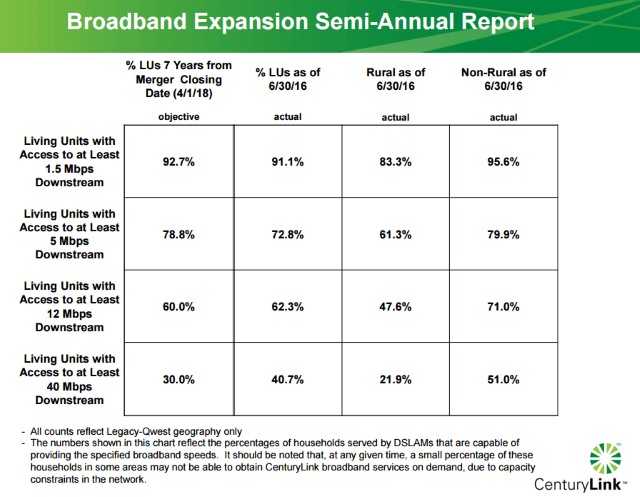
But that isn’t what CenturyLink tells the Federal Communications Commission. In a semi-annual broadband deployment report, the company claimed 51 percent of their customers in urban and suburban former Qwest service areas can subscribe to 40Mbps DSL or higher. But whether a customer is “qualified” to buy 40Mbps service is not the same as actually getting the speeds the company markets.

CenturyLinkCenturyLink attempts to cover their claims with fine print attached to their FCC submission: “The numbers shown in this chart reflect the percentages of households served by DSLAMs that are capable of providing the specified broadband speeds.” (A DSLAM is a network device typically used to extend faster DSL speeds to customers by reducing the amount of copper wiring between the telephone company’s central office and the customer’s home. Customers in a neighborhood typically share space on a DSLAM, in effect sharing a single connection back to the phone company.)

“That’s clever of them, because of course the DSLAM is just one link in the chain that ends with the ‘last mile’ between that equipment and my home, and that is where CenturyLink’s phone plant is at its weakest,” Canby writes. “I spent 20 years at a phone company dealing with last-mile DSL speed issues, so they cannot fool me.”

Canby blames the condition of CenturyLink’s infrastructure between the DSLAM serving him and his home for the problems, as well as overselling DSL service by packing too many customers onto a single DSLAM.

“It might be 40Mbps service at the remote end, but it drops to around 6Mbps on a good day by the time it reaches my house,” Canby complains. “Once the sun goes down, the speed drops to 3Mbps, which is a classic case of overselling to me because too many people are trying to share one connection at the same time. It has been this way since 2008 according to my neighbors.”

Back then, phone service was provided by Qwest, the former Baby Bell providing service in 14 sparsely populated western U.S. states — Arizona, Colorado, Idaho, Iowa, Minnesota, Montana, Nebraska, New Mexico, North Dakota, Oregon, South Dakota, Utah, Washington, and Wyoming. Qwest was acquired by CenturyLink in 2011.

centurylink report

CenturyLink has promised to improve broadband speeds for former Qwest customers, but much of what counts as progress has been in more urban areas, while rural customers continue to languish. The company admits just 21.9 percent of rural households can get 40Mbps service. Only 47.6% can buy 12Mbps, 61.3% can get 5Mbps, and 83% can subscribe to 1.5Mbps. That leaves 17% of former Qwest customers with no broadband options at all. CenturyLink did not break out the percentage of customers that meet the FCC’s 25Mbps minimum speed definition of broadband.

“This is why CenturyLink loses customers to cable operators who have no problems trying to deliver internet access over their network, because it was built to support more bandwidth,” Canby shares. “They can usually deliver the same internet speed to customers no matter how far out they live while phone companies deal with a network built for making phone calls, not data.”

Company officials recognize they could do better and have promised investors another 2.5 million customers will be able to reach 40Mbps by the end of 2017. By the end of the year after that, CenturyLink hopes to reach 85% of customers with VDSL2, bonding, and vectoring technology to achieve 40Mbps service for most customers in their top 25 markets. But rural customers are likely to left waiting longer because of the costs to upgrade Qwest’s copper-based network, especially in smaller states like Idaho, the Dakotas and Wyoming.

“The only answer is cable or fiber broadband, and if you live in a small community it could be years before CenturyLink gets around to you,” Canby writes. “If it’s the same story all over town, I’d start advocating for a community-owned fiber network and not sit around and wait for CenturyLink to act, especially if there is no cable company in town.”

Verizon Preparing to Sell $15 Billion in Cell Tower/Wired Assets – Tex., Calif., and Fla., Landlines Likely for Sale

Phillip Dampier February 3, 2015 Consumer News, Verizon 2 Comments
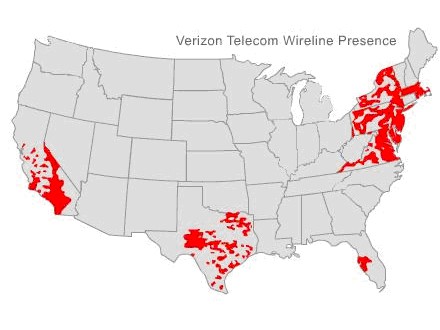
Verizon's landline coverage map.

Verizon’s landline coverage map.

Verizon is working on a sale of its cellphone towers and a portion of its landline assets in a series of deals that could fetch the company more than $15 billion, according to a breaking report in the Wall Street Journal.

The company is looking to raise cash to pay down debt incurred when it bought out Vodafone’s 45% share of its wireless unit and to cover $10.4 billion in wireless licenses the company just won in a government auction last week.

The most likely targets in a landline sale are Verizon territories outside of the northeast.

Verizon has already dumped its landline assets in Hawaii (sold to Hawaiian Telcom), northern New England (sold to FairPoint Communications), West Virginia and many smaller city and suburban territories acquired from GTE (all sold to Frontier).

In its 2010 sale to Frontier, Verizon retained assets in the Tampa-St. Petersburg area, central Texas and Southern California regions. But now all three states are prime targets for a sale. Likely buyers include Frontier Communications, which already has a major presence in Florida including a national call center, and CenturyLink, which acquired Qwest and has a large service area in the southwest and western United States. Frontier remains the most likely buyer, having aggressively expanded its landline network in legacy AT&T (Connecticut) and Verizon service areas.

Verizon CEO Lowell McAdam has shown little interest in maintaining Verizon’s wired assets or growing FiOS and has been willing to sell off major parts of Verizon’s landline network to continue prioritizing Verizon Wireless. McAdam led Verizon Wireless from 2006-2010, before being named CEO of Verizon Communications.

Verizon-logoHe foreshadowed the forthcoming landline sale in January when he told an investor conference he was willing to make significant cuts to Verizon’s wired networks.

“There are certain assets on the wireline side that we think would be better off in somebody else’s hands so we can focus our energy in a little bit more narrow geography,” he said at the time.

Verizon is also expected to follow AT&T’s lead in selling off much of its cell tower portfolio. It will lease access to the towers it sells.

Verizon maintains FiOS networks in Texas, California, and Florida, but that is not expected to deter the company from selling its landline assets. Frontier acquired Verizon FiOS properties in the 2010 sale in both the Pacific Northwest and Indiana. Those services operate under the Frontier FiOS banner today.

CenturyLink’s Broadband Issues Color Company’s Deregulation Request in Washington

Phillip Dampier October 15, 2013 Broadband Speed, CenturyLink, Community Networks, Competition, Consumer News, Public Policy & Gov't Comments Off on CenturyLink’s Broadband Issues Color Company’s Deregulation Request in Washington

centurylinkCenturyLink is seeking “greater flexibility” to set its own prices, terms and conditions of service without a review by Washington State regulators, even as its broadband customers complain about bait and switch Internet speeds and poor service.
Three years after the Monroe, La., based independent phone company purchased Qwest — a former Baby Bell serving the Pacific Northwest — CenturyLink continues to lose customers to cell phone providers and cable phone and broadband service. Since 2001, CenturyLink and its predecessor have said goodbye to 60 percent of their customers, reducing the number of lines in service from around 2.7 million to just over 1 million.

CenturyLink is apparently ready to lose still more after upsetting customers with a notice it intended to seek deregulation that could lead to rising phone bills.

Docket UT-130477, filed with the Washington Utilities and Transportation Commission (WUTC) proposes to replace currently regulated service with what CenturyLink calls “an Alternate Form Of Regulation.” (AFOR)

broadband wa

If approved, CenturyLink will “normalize” telephone rates in Washington State, language some suspect is “code” for a rate increase. For CenturyLink customers in cities like Seattle, Spokane, and Tacoma, the maximum rate permitted for basic phone service for the next three years will be $15.50 (unless a customer already pays more), before calling features, taxes, and surcharges are applied. Most observers, including the state regulator, suspect CenturyLink will limit rate hikes to $1-2 if approved. A higher increase might provoke more customers to leave.

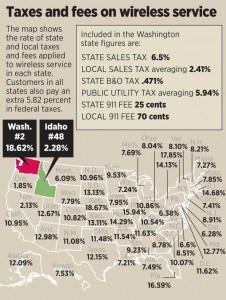
Washington residents already pay the nation's second highest taxes on wireless service. Now landline customers also pay more.

Washington residents already pay the nation’s second highest taxes on wireless service. Now landline customers also pay more. (Graphic: The Spokesman)

“We don’t think they can do much because, in our view, all (a big rate increase) is going to do is accelerate people dropping the landline into their homes,” Brian Thomas, a spokesman for the Washington Utilities and Transportation Commission told The Spokesman-Review. “A lot of people are cutting the cord.”

Frontier Communications, which previously won its own case for deregulation within its service areas including Everett, Wenatchee, and Tri-Cities, raised rates about $1 beginning this month.

A spokesman for the company confessed Frontier’s phone service is becoming obsolete.

“It’s safe to say plain old telephone service is in the process of becoming archaic for some people,” Frontier’s Carl Gipson said. “Five years from now, it will be almost – but not quite – extinct.”

Every rate change seems to provoke a review of whether landline service is still necessary.

Earlier this year, CenturyLink jumped on board legislation that purposely increased phone rates by several dollars a month by removing the sales tax exemption on residential telephone service. Wireless companies did not enjoy the same exemption and sued for parity.

A confidential settlement with state regulators made Washington phone customers, instead of telecom companies, liable for the sales tax starting in August. As a result, some residential phone bills went up at much as $5 based on retroactively charged sales tax.

Customers sticking with CenturyLink often say it is the only broadband provider in rural towns across the state. Although better than satellite broadband, the lack of regulatory oversight and technology investments have allowed CenturyLink to sell Internet speeds it cannot provide to customers.

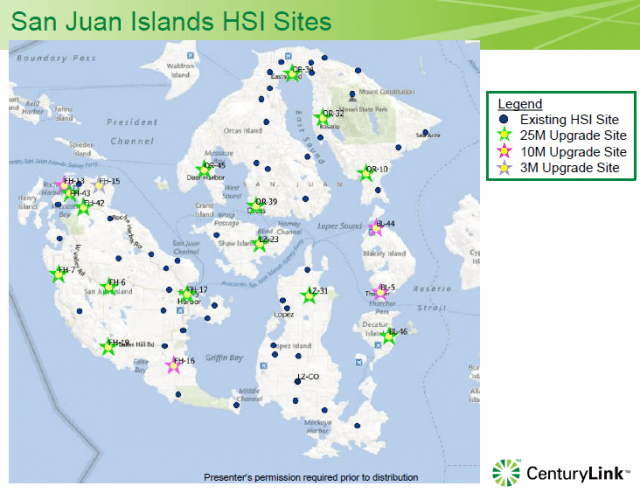
At a hearing held this week by the San Juan County Council, members criticized CenturyLink officials on hand for selling fast service but delivering slow speeds to the group of islands between the mainland of Washington State and Vancouver Island, B.C.

Hughes

Hughes

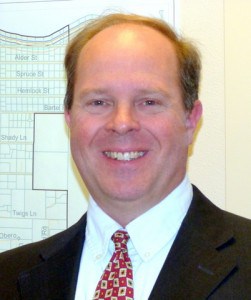
“Last night I did a speed test at my house and I am paying for 10Mbps but only getting 4.74Mbps,” complained Councilman Rick Hughes (District 4 – Orcas West). “I am paying for 10 and I am only getting 5Mbps, so how is that fair? There has been a ton of frustration over the last two years we have worked on this broadband issue. Everywhere I go and every meeting I talk to all I hear is complaints about CenturyLink. No matter what they are paying for, it’s a poor broadband connection to the end customer.”

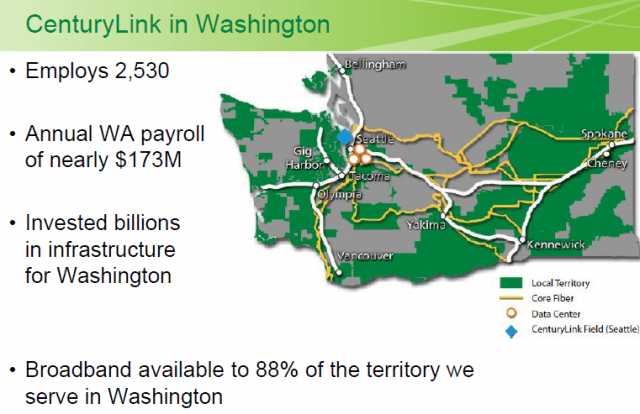
CenturyLink provides broadband to 88% of the territory the company serves in Washington. Like most telephone companies, CenturyLink relies on DSL in much of its footprint and has upgraded central offices, remote equipment, and the telephone lines that connect them. On the San Juan Islands, most customers used to receive 1-3Mbps, but CenturyLink claimed at this week’s hearing it spent billion on infrastructure improvements that can now deliver faster Internet service across the state. In San Juan County, CenturyLink claims:

  • 58% of all qualified addresses were upgraded to 10-25Mbps;
  • 66% now qualify for more than 10Mbps (but less than 25Mbps) versus 46% prior to upgrades;
  • 29% of customers now qualify to sign up for 25Mbps service.

CenturyLink warned the council its speed claims were not to be taken literally, noting DSL “speed is dependent on distance from equipment; speeds drop quickly as distance increases.”

san juan hsi

Hughes told CenturyLink officials residents appreciated the investment, but customers were still disappointed after being promised higher speeds than actually received.

“When people call customer service, there is always an excuse about why there is a problem,” said Hughes. “If people are paying for something, they want to receive it.”

opalco“For our long-term financial interests in this county, we need to have reliable 10-25Mbps service to customers on any part of the islands,” Hughes added. “My goal has always been 90+ percent should be able to get 25Mbps or better connectivity in the county.”
The problem for CenturyLink is the amount of upgrade investment versus the amount of return that investment will generate. San Juan County is disconnected from the mainland and collectively house only 15,769 residents. But it is also the smallest of Washington’s 39 counties in land area, which can make infrastructure projects less costly.

CenturyLink committed to continue investment in its network “where economically feasible.”

San Juan County’s Orcas Power & Light Cooperative (OPALCO), a member-owned, non-profit cooperative electric utility may have a partial solution to the problem of meeting Return on Investment requirements.

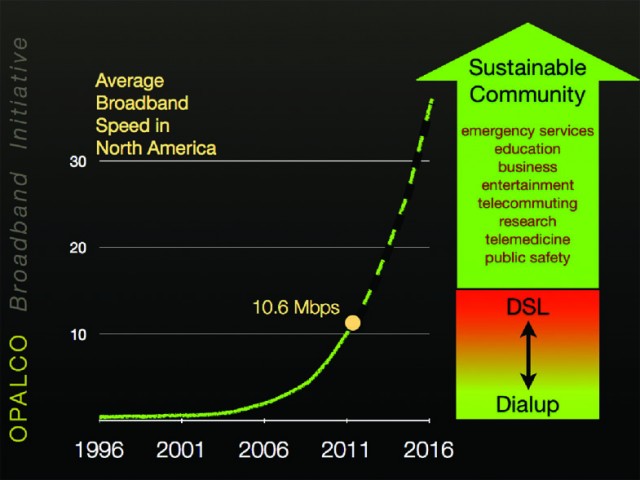
BB-growth-chartOPALCO originally proposed a hybrid fiber-wireless system designed to reach 90% of the county with a $34 million investment, to be built over two years. When completed, all county residents would pay a $15 monthly co-op infrastructure fee and a $75 monthly fee for broadband and telephone service. To gauge interest, OPALCO asked residents for a $90 pre-commitment deposit. By the annual meeting in May, the co-op admitted only 900 residents signed up and it needed 5,800 customers to make the project a success.

Some residents balked at the high cost, others did not want wireless broadband technology, and some local environmental activists wanted OPALCO to focus on clean, affordable energy and avoid the competitive broadband business.

The lack of commitment forced the co-op to modify its broadband plans, offering a “New Direction” to residents in June 2013.

OPALCO elected to stay out of the ISP business and instead announced a public-private initiative, providing fiber infrastructure to existing service providers. In effect, the co-op will cover the cost of building fiber extensions where CenturyLink is not willing to invest. For a $3-5 million investment from the co-op, ISPs like CenturyLink will be able to commission OPALCO to build fiber in the right places to make DSL service better. CenturyLink would have non-exclusive rights to the fiber network and would have to pay the co-op a service lease fee.

Unlike ISPs in other communities that have shunned publicly funded fiber infrastructure, CenturyLink says it will contemplate a trial — buying bandwidth from OPALCO instead of enhancing its own fiber middle mile network — to test what level of improved service CenturyLink can offer customers.

Regardless of CenturyLink’s plans, OPALCO is moving forward installing limited fiber connections as part of an effort to develop a more modern electric grid.

logo_broadband“Our data communications network brings exponential benefit to our membership,” OPALCO notes. “It includes tools that allow the co-op to: control peak usage and keep power costs down, remotely manage and control the electrical distribution system, manage and resolve power outages more efficiently, integrate and manage community solar projects and improve public safety throughout the county.”

There are some drawbacks, reports Wally Gudgell from The Gudgell Group.

“It will take longer to implement, and will impact fewer businesses and households,” Gudgell writes. “While about two-thirds of the islands will eventually be covered, more remote areas will have to work with a local ISP and potentially pay more for service.  DSL coverage for homes that are further than 15,000 feet from CenturyLink fiber-served distribution hubs will be challenging. Some homeowners may need to pay for fiber to be run to their homes by Islands Network (fiber direct is costly, estimated at $20/foot).”

CenturyLink Prepares to Unveil Prism TV in Former Qwest Territories

Prism is CenturyLink's fiber to the neighborhood service, similar to AT&T U-verse.

Prism is CenturyLink’s fiber to the neighborhood service, similar to AT&T U-verse.

Western Eagle County will be among the first areas in Colorado to get CenturyLink’s fiber-to-the-neighborhood service upgrade, dubbed Prism TV.

“Eagle County is joining the first 10 markets to get Prism TV,” said Abel Chavez, CenturyLink’s director of state and local government affairs.

The phone company plans to introduce the service gradually once franchise renewal agreements with the county are complete.

The upgrade is an important once for Eagle County, which will see improved service well before residents in larger Colorado cities like Denver.

“Since we already have a franchise here, this is an opportunity to do two things — upgrade it and test it in a rural market,” Chavez told the Eagle Valley Enterprise. “In this case, a small mountain community is going to have something that Denver doesn’t have yet and it’s all going in on our existing network. We’re not adding to our footprint.”

CenturyLink’s service area includes towns in the western half of the county, Eagle and Gypsum. Comcast is the dominant cable provider in Colorado and has the largest market share of customers in the eastern half of the county.

CenturyLink primarily markets Prism as a television service, although it also supports 25Mbps broadband, depending on line quality.

Much like AT&T U-verse, Prism provides a fiber broadband connection to a box positioned in the neighborhood. From that box, the customer’s current copper telephone line is used to bring an enhanced version of DSL inside the home that divides bandwidth for Internet access, telephone, and cable television service.

A typical triple-play, new customer Prism package in Las Vegas runs around $115 a month, price-locked for 24 months. The whole house DVR and HD channels add another $10-15 a month after the first three months.

Included in the package:

  • 10Mbps broadband
  • CenturyLink Home Phone with Unlimited Nationwide Calling
  • Prism TV (120 channels)
  • Free installation, first set-top box included ($8.99/mo each additional box), DVR with up to four concurrent recordings

[flv width=”640″ height=”380″]http://www.phillipdampier.com/video/CenturyLink Prism Demo Summer 2013.flv[/flv]

CenturyLink produced this demonstration video of Prism TV’s capabilities. CenturyLink does not seem to emphasize improved broadband service as part of the Prism experience in its marketing. (2 minutes)

Search This Site:

Contributions:

Recent Comments:

Your Account:

Stop the Cap!