Home » Puerto Rico » Recent Articles:

AT&T Ditches Puerto Rico and Virgin Islands to Raise Money to Cut Debt, Buy Back Its Own Stock

Phillip Dampier October 9, 2019 AT&T, Competition, Consumer News, Liberty Cablevision (Puerto Rico), Liberty/UPC, Public Policy & Gov't Comments Off on AT&T Ditches Puerto Rico and Virgin Islands to Raise Money to Cut Debt, Buy Back Its Own Stock

AT&T will sell its operations in Puerto Rico and the U.S. Virgin Islands to John Malone’s Liberty Latin America, Ltd., setting up a virtual market monopoly for Liberty, which already owns cable operator Liberty Cablevision of Puerto Rico.

Liberty Latin America has agreed to pay $1.95 billion in cash to acquire 1.1 million AT&T cellular, landline, and internet customers in both U.S. territories.

AT&T intends to use the proceeds of the sale to reduce debt and allow the company to lay the foundation to buy back more of its own shares, pleasing investors. AT&T had originally sought up to $3 billion for the Caribbean networks, partly acquired from a 2009 acquisition of Centennial Communications, which cost AT&T less than $1 billion.

Analysts say the low selling price shows AT&T is feeling pressure from activist investor Elliott Management, which has been pushing AT&T to divest non-core assets. The selling price was also impacted by the distressed state of AT&T’s infrastructure and customer base, impacted by Hurricane Maria in 2017, which damaged both the Virgin Islands and Puerto Rico and displaced hundreds of thousands of residents.

Liberty already has a major presence in Puerto Rico through its cable system — Puerto Rico’s largest pay television and broadband provider. Cable tycoon John Malone will effectively control Puerto Rico’s largest wireless phone and cable company. Claro, Puerto Rico’s landline provider, will be its chief competitor.

The two companies said they expect the deal to close within six to nine months.

AT&T Exploring Exiting Puerto Rico With Sale of Its Internet, TV, Landline Services

Phillip Dampier July 22, 2019 AT&T, Consumer News 1 Comment

Reuters reports AT&T is exploring the possibility of leaving Puerto Rico, with a possible sale of its assets for around $3 billion.

AT&T is under pressure to reduce its large debt load after acquiring Time Warner (Entertainment) in 2018 for $85 billion, which left the telco with a total debt of $164 billion. CEO Randall Stephenson told shareholders he has made cutting debt at the company a major priority, resulting in job cuts, a sale of AT&T’s stake in Hulu for $1.43 billion, and letting go of WarnerMedia’s Hudson Yards offices in Manhattan for almost $2.2 billion.

AT&T has also indicated it is winding down its fiber broadband expansion program and is expecting to layoff additional workers as projects are finished around the country.

A complete exit from Puerto Rico would require a sale of AT&T’s wireless network, largely acquired after completing a buyout of Centennial Communications in 2009. AT&T has been earning about $300 million a year from its internet, TV, landline, and business service business on the island.

The company has hired a financial adviser to explore such a sale, but a source indicated AT&T may cancel its exit plans if it does not attract adequate bids. Potential acquirers include media companies and private equity firms. Buyers will face running the business in a compromised economy still recovering from 2017’s Hurricane Maria.

Mother Of All Service Outages: Liberty Cable Promises Puerto Rico Full Restoration in Mid-2018

Liberty Cablevision of Puerto Rico has estimated it will take as long as June of this year to fully restore cable and broadband service to Puerto Rico.

It has been over 100 days since Hurricane Maria devastated Puerto Rico and the U.S. Virgin Islands. At least 45% of Puerto Rico remains without any electricity, and the U.S. Army Corps of Engineers estimates it will take until May to fully restore power — eight months after the hurricane hit.

The island’s well-publicized power scandal with a politically-connected contractor also involves a decrepit utility, likely corruption in contract awards, incompetent management, and political interference from conservative groups who want to privatize the island’s utility and sell off its assets to corporate interests and entrepreneurs competing to turn the island into an experimental laboratory for renewable energy sources. All contribute to a slowdown in power recovery because no plan has adequate backing and sufficient resources to quickly bring power back online. Instead, mutual aid assistance from U.S. utilities is gradually rebuilding and strengthening the island’s existing power grid.

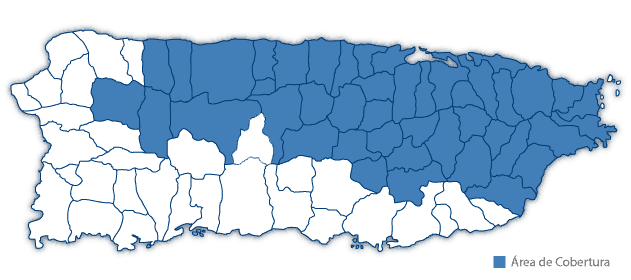
Liberty Cable’s original service area.

Liberty Cablevision claims many of its outages are power-related. When power is restored, their service will return as well. But many of their former customers will not. More than 140,000 Puerto Ricans have left since the storm hit Sept. 20 and some experts estimate more than 300,000 more could leave in the next two years. That’s on top of a similar number that have already left over the last decade as a result of the perpetual economic crisis on the U.S. island territory of 3.4 million.

Liberty is rebuilding significant parts of their network, spending millions to replace damaged coaxial cable with fiber optics, especially in areas closest to the eye of the hurricane where damage was greatest.

Liberty Global, controlled in part by cable magnate John Malone, this week completed spinning off Liberty Cablevision of Puerto Rico to Liberty Latin America, a new independent, publicly traded company. Included in the spinoff are Cable & Wireless Communications, a familiar telecom company serving Caribbean islands, parts of Latin America and the African island nation of the Seychelles, and VTR – Chile’s largest cable company.

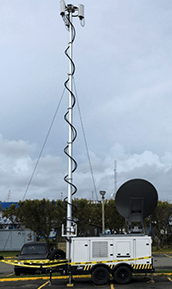
A portable cell site

Cellular/Cable/Telephone

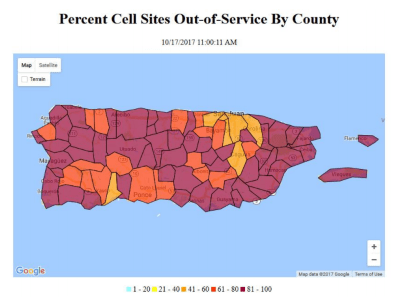
As of Dec. 29, 11.0% of Puerto Rico’s cell sites remain out of service. One county, Vieques, has greater than 50% of its cell sites out of service.

Satellite Cells on Light Trucks (COLTs) have been deployed in Aguadilla, Arecibo, Cayey, Coamo Sur, Fajardo, Guayama, Manati, Mayaguez Mesa, San German, Vega Baja, and Yauco and Terrestrial Cells on Wheels (COWs)/COLTs in Humacao, Quebradillas, Rio Grande, and Utuado.

U.S. Virgin Islands: Overall, 20.5% of cell sites are out of service. 50% of cell sites in St. John are out of service.

The FCC has received reports that large percentages of consumers are without either cable services or wireline service. While the companies have been actively restoring service, the majority of their customers do not have service because commercial power is not yet available in their respective areas. In Puerto Rico, there are no major telecom switches still affected.

Broadcast Stations

When broadcast stations are listed as “suspected to be out of service,” the statement is based on field scanning of relevant bands. Stations listed may be operating on reduced power or on a reduced schedule.

Television

Puerto Rico

  • 5 TV stations are confirmed operational (WKAQ, WIPR, WNJX, WTIN, WORO)
  • 2 TV stations are suspected to be out of service (WIPM, WELU)
  • 70 TV stations have been issued Special Temporary Authority to be offline
  • 30 TV stations have unconfirmed status

U.S. Virgin Islands

  • 14 TV stations have been issued Special Temporary Authority to be offline
  • 2 TV stations have unconfirmed status

AM Radio

Puerto Rico

  • 42 AM radio stations are confirmed operational (WA2X, WABA, WALO, WAPA, WBMJ, WCMN, WCGB, WCPR, WDEP, WENA, WEXS, WGDL, WI2X, WI2X, WI3X, WIAC, WIPR, WISO, WKAQ, WKFE, WKJB, WKUM, WLEO, WLEY, WMDD, WMNT, WMSW, WOIZ, WOQI, WORA, WPAB, WPPC, WPRA, WPRP, WSKN, WSOL, WTIL, WUNO, WUPR, WVJP, WXEW, WYEL)
  • 8 AM radio stations are suspected to be out of service (W227, WJDZ, WNVE, WVQR, WYAS, WZCA, WZMT, WZOL)
  • 21 AM radio stations are confirmed out of service by the Puerto Rican Broadcast Association (WBQN, WCMA, WDNO, WEGA, WFAB, WGIT, WHOY, WIBS, WIDA, WISA, WIVV, WJIT, WKVM, WLRP, WNEL, WNIK, WOLA, WOSO, WQBS, WRSJ, WUKQ)
  • 1 AM radio station has unconfirmed status
  • 2 AM radio stations have been issued Special Temporary Authority to be offline

U.S. Virgin Islands

  • 2 AM radio stations are confirmed operational (WSTA, WUVI)
  • 2 AM radio stations are suspected to be out of service (WDHP, WSTX)
  • 1 AM radio station has unconfirmed status

FM Radio

Puerto Rico

  • 55 FM radio stations are confirmed operational (WAEL-FM, WCAD, WCMN-FM, WCMNFM3, WCMN-FM6, WEGM, WERR, WERR-FM1, WERR-FM2, WERR-FM3, WFDT, WFID, WIDI, WIRI, WIVA-FM, WKAQ-FM, WKAQ-FM1, WKAQ-FM2, WLUZ, WMAA-LP, WMEG, WMIO, WNNV, WNRT, WNRT-FM1, WNRT-FM2, WNVM, WODA, WORO, WOYE, WPRM-FM, WPUC-FM, WPUC-FM1, WQML, WRIO, WRRH, WRTU, WRXD, WTOK-FM, WTOKFM2, WTPM, WTPM-FM1, WVDJ-LP, WVIE, WVIS, WVJP-FM, WVJP-FM2, WXYX, WXYXFM1, WXYX-FM2, WZAR, WZIN, WZNT, WZNT-FM1, WZOL)
  • 8 FM radio stations are suspected to be out of service (W227CV, WJDZ, WNVE, WVQR, WYAS, WZCA, WZMT, WZOL-FM3)
  • 17 FM radio stations are confirmed out of service by the Puerto Rican Broadcast Association (WCAD-FM1, WCAD-FM2, WCRP, WELX, WIDA-FM, WIOA, WIOA-FM1, WIOC, WNIK-FM, WQBS-FM, WQBS-FM1, WUKQ-FM, WUKQ-FM1, WXHD, WXLX, WYQE, WZET)
  • 3 FM stations have been issued Special Temporary Authority to be offline
  • 28 FM radio stations have unconfirmed status

U.S. Virgin Islands

  • 2 FM radio stations are confirmed operational (WVIE, WZIN)
  • 1 FM radio station is suspected to be out of service (WVIZ)
  • 1 FM radio station has been issued Special Temporary Authority to be offline
  • 19 FM radio stations have unconfirmed status

A Month After Maria Hammered Puerto Rico, Most Utilities Still Down

Phillip Dampier October 17, 2017 Claro Puerto Rico, Consumer News, Liberty/UPC, Public Policy & Gov't, Wireless Broadband Comments Off on A Month After Maria Hammered Puerto Rico, Most Utilities Still Down

As Puerto Rico approaches the first month anniversary of Hurricane Maria, only small amounts of incremental progress have been made restoring the island’s telecommunications networks badly damaged by the storm.

Wireless Service

According to the Federal Communications Commission, 75.3% of Puerto Rico’s cell towers are still out of commission and many of those restored to service are functioning on generator backup, often using portable cell tower infrastructure that offers a fraction of the coverage area normal service used to provide. The majority of restored towers are in the immediate vicinity of San Juan, while many other parts of the island remain totally without service. Claro, a Mexican-owned cell company that used to offer the best coverage across Puerto Rico still remains the most reliable after the storm. All four wireless companies operating in Puerto Rico are offering free roaming to customers so as towers are restored to service, the companies can provide coverage to as many residents as possible.

Satellite Cells on Light Trucks (COLTs) have been deployed in Aguadilla, Arecibo, Cayey, Caomo Sur, Fajardo, Guayama, Manati, Mayaguez Mesa, San German, Vega Baja, and Yauco and Terrestrial Cells on Wheels (COWs)/COLTs in Humacao, Quebradillas, Rio Grande, and Utuado.

The FCC believes approximately 61% — one percent higher than last week — of the population can now get some cell signal. But that figure is slightly misleading because the largest percentage of the population lives around or in San Juan, the city with the best service restoration so far.

In contrast, most cell sites in Texas, Louisiana, Mississippi, Alabama, Georgia, and the Florida Panhandle affected by two earlier hurricanes were restored to service within two weeks. Cellular providers point out the reason for the difference is the availability of commercial power and reliable backup generators, both not widely available in Puerto Rico even now.

The U.S. Virgin Islands, also devastated by Hurricane Marie, are also struggling with repair efforts. At least 55.4% of cell towers are out of service on those Caribbean islands, with 88.9% still down on St. John, the smallest of the three islands that make up the U.S. territory. Because repair efforts have been more effective on the other two islands, about 88% of the territory can now get a cell signal.

Electricity

NBC News reported today that 17.7% of Puerto Rico now has electricity, but it is very unreliable and there are daily outages that sometimes extend for hours. The Army Corps of Engineers hopes to have in place by next week — more than a month after Hurricane Maria made landfall in Puerto Rico — two 25-megawatt generators at a plant in San Juan to help stabilize electricity there. The generators arrived Oct. 13, and a target date of Oct. 25 may be missed because of ongoing inclement weather. Once installed, the generators will extend electricity to about 30% of the island — mostly in the northeastern section around San Juan — and stabilize power for those who already have it.

The government is prioritizing electricity restoration for public safety and hospitals, public/government institutions including sewage and water treatment plants, schools, and then the island’s large pharmaceutical industry, which own several large drug manufacturing plants.

The order of priority the government is giving to service restoration is upsetting Claro, one of the island’s largest cell companies.

“Businesses and the government itself can hardly operate efficiently without an appropriate telecommunications structure,” said Claro representative Pedro Andrés. “For example, without telecommunication services the bank could not operate and that means that there would be no access to money for people, businesses could not handle electronic transactions, medical plans would not work and suppliers could not dispatch. That is, the country would be paralyzed.”

Andrés wants the power authority to make sure that electric service is restored to cell towers as soon as practical.

Residents are being told they can expect 95% electricity service restoration by Dec. 15.

Cable and Telephone

Liberty Cablevision of Puerto Rico is only working for about 1% of its customers, so it is focusing on offering free Wi-Fi hotspots for now.

Diesel generators are currently powering some of the island’s 911 service centers, which are now back up and running normally.

Cable service remains basically non-existent in Puerto Rico because of the lack of electricity. Liberty Cablevision of Puerto Rico has reported it has restored full service to about 1% of its customers, although a significantly higher number will have service back immediately after electricity is restored. Liberty promises automatic service credits for the duration of the outage and has told customers to ignore billing that was already in the mail when the storm hit. Liberty is currently focused on reaching and retaining the goodwill of its customers with a network of free Wi-Fi hotspots.

The island’s landline provider reports there are six central switching offices out of service on the island and there are problems connecting long distance calls.

Broadcast Media

The following TV stations are confirmed operational: WKAQ, WIPR, WIPN, WTIN, and WNJX, but these nine are still off the air: WAPA, WIPM, WTCV, WUJA, WELU, WECN, WRSV, WORO, and WRUA.

As of today, 44 AM radio stations are confirmed to be on-the-air: WA2XPA, WALO, WAPA, WBMJ, WBQN, WCMN, WCPR, WDEP, WENA, WEXS, WGDL, WI2XAC, WI2XSO, WI3XSO, WIAC, WIDA, WIPR, WISO, WJIT, WKAQ, WKFE, WKJB, WKUM, WKVM, WLEO, WLEY, WMDD, WMNT, WNEL, WNIK, WOIZ, WOLA, WPAB, WPPC, WPRA, WPRP, WQII, WSKN, WSOL, WTIL, WUKQ, WUNO, WVJP, and WXEW.

These 29 AM radio stations are confirmed out of service: WABA, WBSG, WBYM, WCGB, WCMA, WDNO, WEGA, WFAB, WGIT, WHOY, WIBS, WISA, WIVV, WLRP, WMIA, WMSW, WNVI, WOQI, WORA, WOSO, WQBS, WRRE, WRSJ, WRSS, WUPR, WVOZ, WYAC, WYEL, and WYKO.

There are 36 FM radio stations back on the air: WAEL-FM, WCMN-FM, WEGM, WERR, WFID, WIDA-FM, WIDI, WIOA, WIOA-FM1, WKAQ-FM, WLUZ, WMAA-LP, WMEG, WNVM, WODA, WORO, WOYE, WPRM-FM, WPUC-FM, WPUC-FM1, WQML, WRIO, WRRH, WRTU, WRXD. WTOK-FM, WUKQ-FM, WVDJ-LP. WVIS, WVJP-FM, WXLX, WXYX, WYQE, WZNT, WZNT-FM1, and WZOL.

But these 22 FM radio stations are still out of service: W227CV, WCAD, WCAD-FM2, WCRP, WELX, WFDT, WIOC, WIPR-FM, WJDZ, WMIO, WNRT, WNVE, WQBS-FM, WTPM, WVQR, WXHD, WYAS, WZAR, WZCA, WZET, WZMT, and WZOL-FM3.


Puerto Ricans Giving Up on U.S. Cell Phone Providers; Mexico’s Claro Has Best Coverage

U.S. cell phone providers are facing increasing criticism they are dragging their feet on restoring cell service in Puerto Rico while Mexican-owned Claro has now successfully restored service in 28 of the territory’s 78 municipalities.
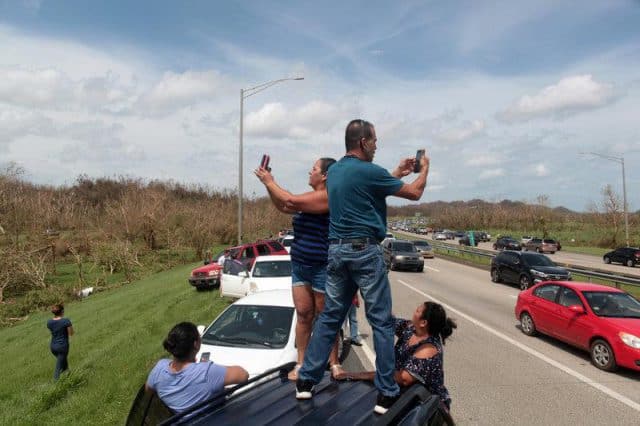
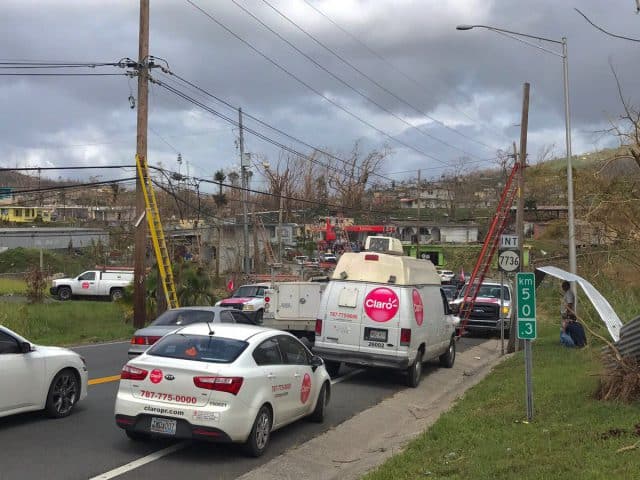

Claro Puerto Rico, owned by Mexican billionaire Carlos Slim’s America Movil, has dramatically outpaced AT&T, T-Mobile, and Sprint in getting their damaged cell phone facilities back up and running. Claro is Puerto Rico’s second most popular cell company behind AT&T.

“Claro is the only one with service here,” Francisco Portales, 47, a customer of privately held Puerto Rico-based network provider Open Mobile told a Reuters reporter while waiting outside the Claro store in Fajardo hoping to buy a phone.

Looking for a signal.

The FCC’s latest update on Tuesday reported about 88% of Puerto Rico is still without cell service, but the agency does not break down network repairs by carrier, and American providers have declared their specific restoration plans to be confidential.

While AT&T complained the lack of commercial power remained its biggest problem, Claro said it had pre-positioned generators, diesel fuel, battery backups, and vehicles 72 hours before the hurricane hit, which appears to have made all the difference in restoring service.

Sprint said late last week its towers were still standing and “largely intact” although it gave no specific information on when service might be restored. T-Mobile was more frank, reporting “it’s going to be a long road to recovery.”

Claro is not taking advantage of its position as the island’s most reliable post-hurricane carrier, allowing customers of other providers to roam on its network where a signal is available. That may be all the good publicity Claro needs to win over new customers after the hurricane damage is repaired.

Claro’s repair trucks.

Mercedes Saldana, a 54-year-old school cafeteria worker and Sprint customer is just one of many now searching shops for a Claro prepaid phone.

“I don’t have any service, none,” she said. “We don’t know when Sprint’s going to be connected again.”

Customers unwilling to switch carriers and won’t roam may have long travel times ahead of them to find a signal. Luis Pacheco, 64, was planning to drive with his wife to Canovanas — 30 to 40 minutes west — in hopes of finding a cell signal to text his daughter in California. That is the nearest community where AT&T has a signal at the moment.

Before the storm, AT&T dominated Puerto Rico with a 34% market share, followed by Claro Puerto Rico with a 26% share. T-Mobile was third with 19%, Open Mobile has 11% and Sprint 10%. Verizon Wireless has no network facilities in Puerto Rico, but travelers with Verizon phones are granted roaming access on Claro’s network.

Search This Site:

Contributions:

Recent Comments:

Your Account:

Stop the Cap!