Home » pricing » Recent Articles:

Federal Communications Commission Votes to Start Drafting Net Neutrality Policy That Verizon Seems to Suddenly Support

Phillip Dampier October 22, 2009 Data Caps, Editorial & Site News, Net Neutrality, Online Video, Public Policy & Gov't, Verizon, Video Comments Off on Federal Communications Commission Votes to Start Drafting Net Neutrality Policy That Verizon Seems to Suddenly Support

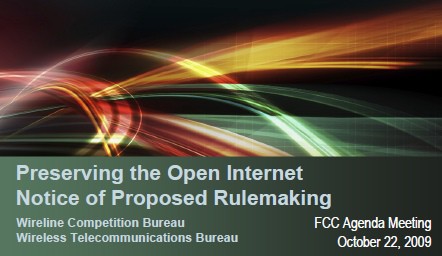
fccThe FCC today voted unanimously to begin writing a formal Net Neutrality policy to govern broadband services across the United States.  Three Democratic commissioners voted yes and applauded the concept of Net Neutrality.  The two Republican commissioners also voted to move the process forward, but signaled they would likely oppose the final draft of the rules.

Support for Net Neutrality, which would prohibit providers from slowing down, blocking, or charging higher pricing for favored access to web content, was spearheaded by FCC Chairman Julius Genachowski.

Genachowski said the rules were needed to protect consumers from abusive behavior by telecommunications companies that might seek to block or restrict access to broadband content, including telephone and video services.

“Internet users should always have the final say about their online service, whether it’s the software, applications or services they choose, or the networks and hardware they use to the connect to the Internet,” Genachowski said.

Other Democratic commissioners agreed with Genachowski.  Commissioner Michael Copps stated it was important to hear from everyone about the proposed rules.

“We need to recognize that the gatekeepers of today may not be the gatekeepers of tomorrow,” Copps said.

John McCain

John McCain

Many Republicans were unconvinced of the need to establish Net Neutrality as formal policy.

“I do not share the majority’s view that the Internet is showing breaks and cracks, nor do I believe that the government is the best tool to fix it,” Republican commissioner Robert McDowell said.

“These new rules should rightly be viewed by consumers suspiciously as another government power grab over a private service provided by private companies in a competitive marketplace,” Sen. John McCain wrote in an opinion piece published by The Washington Times.

McCain compared Net Neutrality with the federal bailout of Wall Street and the American auto industry.

Under the draft proposed rules, subject to reasonable network management, a provider of broadband Internet access service:

  1. would not be allowed to prevent any of its users from sending or receiving the lawful content of the user’s choice over the Internet;
  2. would not be allowed to prevent any of its users from running the lawful applications or using the lawful services of the user’s choice;
  3. would not be allowed to prevent any of its users from connecting to and using on its network the user’s choice of lawful devices that do not harm the network;
  4. would not be allowed to deprive any of its users of the user’s entitlement to competition among network providers, application providers, service providers, and content providers;
  5. would be required to treat lawful content, applications, and services in a nondiscriminatory manner; and
  6. would be required to disclose such information concerning network management and other practices as is reasonably required for users and content, application, and service providers to enjoy the protections specified in this rulemaking.

The draft rules make clear that providers would also be permitted to address harmful traffic and traffic unwanted by users, such as spam, and prevent both the transfer of unlawful content, such as child pornography, and the unlawful transfer of content, such as a transfer that would infringe copyright.

Today’s vote marks only a beginning of the process to begin writing the formal policy of Net Neutrality governing Internet use in the United States.  As with the ponderous debate on health care reform, what ends up defining “Net Neutrality” will be open to interpretation, and a barrage of lobbyists and arm twisting from politicians will be part of what comes next.

On the eve of the historic vote, Verizon Communications seemed to join Google in affirming some of the basic principles of Net Neutrality.

However, the devil is in the details, as is always the case in telecommunications policy.

verizon

Verizon supports its own interpretation of Net Neutrality, which is wrapped in a concept they call “innovation without permission,” which is code language for a deregulatory open free-market environment.  It broadly accepts the concept that telecommunications companies should not interfere with legal content, but the company doesn’t want a whole barrage of new regulations to specifically define what would constitute “interference.”  Verizon believes onerous rules would stifle investment, and that existing rules already in place at the FCC are sufficient protection.

Things get downright dicey when Verizon spells out its “network management” principles, warning the FCC overly specific rules in this area could have unintended consequences.

Broadband network providers should have the flexibility to manage their networks to deal with issues like traffic congestion, spam, “malware” and denial of service attacks, as well as other threats that may emerge in the future–so long as they do it reasonably, consistent with their customers’ preferences, and don’t unreasonably discriminate in ways that either harm users or are anti-competitive. They should also be free to offer managed network services, such as IP television.

It is in this area where very specific rules are appropriate to write, because what one company defines as appropriate “network management,” could be discriminatory against selected content those providers seek to “manage.”

No broadband user has ever objected to network management that controls spam, “malware,” denial of service attacks, and other like-minded traffic.  In fact, most consumers wish more could be done to control these things.  Nothing in the current framework of telecommunications regulations or in those proposed have ever sought to impede this type of management.

No consumer minds having access to additional content, such as IP television.  But consumers do object when such content is used as an excuse to ram through Internet Overcharging schemes limiting broadband usage or imposing higher fees for using the types of services companies like Verizon now advocate.  “The broadband sky is falling” rhetoric about “exafloods,” overloaded “Internet brownouts,” and other such scaremongering nonsense often comes from the same providers that now want to provide IP television.  What they provide with their left hand, they want to limit with their right.

It’s anti-competitive, because the same companies with an interest in selling these pay television services (FiOS, cable television, fiber-telephone U-verse, etc.) also provide the broadband service that companies like Netflix and Hulu use to indirectly challenge their video business models.

Another concern is “traffic congestion” management, which all too often has meant speed throttles selectively imposed on “offending” applications, particularly peer to peer traffic.  There is good traffic management, such as routing equipment that provides even delivery of services like streaming video and Voice Over IP telephone calls, which rapidly deteriorate on loaded down networks, and then there is bad traffic management which selectively slows down the speed of whatever the provider deems to be of “lower priority.”  Allowing the customer to make the decision about which traffic gets priority is one thing.  Allowing a provider to do it without the consent of the customer is quite another.

Too often, the “unintended consequences” Verizon and Google speak about in the joint statement go to the provider’s favor, not to the consumer.  Overly broad, non-specific language opens loopholes through which providers will eagerly leap through.

Verizon also advocates transparency — “All providers of broadband access, services and applications should provide their customers with clear information about their offerings.”

Disclosure alone doesn’t suffice for consumers, particularly if there are few competitive places to take your business if you disagree with company policies.  Those rules should include realistic speed information (marketing stating “up to 10Mbps” that in reality only delivers 3Mbps would be one example).  It should not simply be an escape clause for providers to abuse their customers with throttled, slow service, and give them the excuse that “we disclosed it.”

<

p style=”text-align: center;”>

Federal Communications Commission Open Meeting

October 22, 2009

112 minutes

(Warning: Loud audio)

The Wall Street Journal Quotes Stop the Cap! Founder & Addresses Internet Overcharging Schemes

Phillip "I Also Told You So" Dampier

Phillip Dampier

The Wall Street Journal today published an article reviewing the landscape of flat rate broadband service and how some Internet providers want to change it.

The article quotes me on the issue of Internet Overcharging becoming a political football in the Net Neutrality debate.

“This could come down to carriers saying, ‘If you don’t allow us to manage our networks the way we see fit, then we will just have to cap everything,’ ” says Phillip Dampier, a consumer advocate focusing on technology issues in Rochester, N.Y. “They’ll make it an either/or thing: give them more control over their network or expect metered broadband.”

Mr. Dampier was among those who forced Time Warner Cable to shelve a metered Internet pilot program in several cities last year. The company, which had argued the plan would be a fairer way to charge for access, acknowledged it was a “debacle.” It won’t say if it plans to revive the trials.

Unfortunately, the article never bothers to mention Stop the Cap!, the website dedicated to fighting these overcharging schemes.

AT&T's Internet Overcharging Experiment Gone Wild

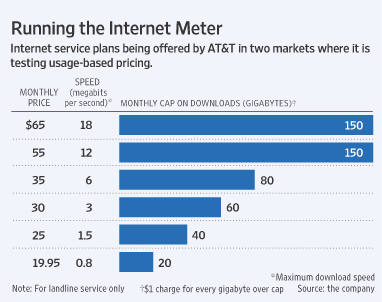
AT&T weighs in on their experiment to overcharge consumers in Beaumont, Texas and Reno, Nevada, and analysts think Net Neutrality arguments may give providers an excuse to expand those experiments, launch price increases and blame it on Net Neutrality policies:

“Some type of usage-based model, for those customers who have abnormally high usage patterns, seems inevitable,” an AT&T spokesman says. AT&T declined to provide more details on its trials.

“Unquestionably, the carriers erred in their initial selling of broadband with a flat rate,” says Elroy Jopling, research director of Gartner Inc. “They assumed no one would use it as much as they do now, but then along came high-definition movies. They’re now trying to get around that mistake.”

Network neutrality deals primarily with ensuring that Internet providers don’t favor any online traffic over any other. Still, Mr. Jopling and other analysts argue, the net neutrality debate might provide the carriers with an opening to argue for changing that pricing.

“With network neutrality enforced, the only other option for carriers is to charge by the byte or to raise the flat-rate pricing,” says Johna Till Johnson, president of Nemertes Research. “Right now they’re just deciding which one to do. Just be prepared to pay more.”

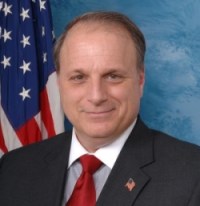
It's "Rep. Eric Massa," Not 'Joe Messa'

It's "Rep. Eric Massa," Not 'Joe Messa'

The article has several flaws.

  • It mis-identifies Rep. Eric Massa (D-New York) as “Rep. Joe Messa.”  Rep. Massa introduced legislation to ban Internet Overcharging when companies cannot produce actual evidence to justify it, particularly in the limited competitive marketplace for broadband in the United States.
  • The article fails to mention the usage limits proposed by smaller broadband providers, including Frontier’s infamous 5GB usage definition in their Acceptable Use Policy.  This is a very important fact to consider when the article quotes Professor Andrew Odlyzko, an independent authority on broadband usage, as stating the average broadband consumer uses triple that amount (15 gigabytes per month).
  • The quotation about the number of e-mails or web page views available under plan allowances that routinely appear in such articles ignores the increasing use of higher bandwidth applications like online video.  Telling a consumer they can send 75 million e-mails is irrelevant information because no consumer would ever need to worry about usage limits if they only used their account for web page browsing and e-mail usage.  They very much do have to be concerned if they use their service to watch online video from Hulu or Netflix, or use one of the online backup services.
  • The article makes no mention of publicly available financial reports from broadband providers like Time Warner Cable that prove that at the same time their profits on broadband service are increasing, the company’s costs to provide the service continue to decline, along with the dollar amounts they spend to maintain and expand that network to meet demand.  Providing readers with insight into the true financial picture of a broadband provider, instead of simply quoting the public relations line of the day would seem particularly appropriate for The Wall Street Journal.
  • The article doesn’t make mention that the same providers arguing increased Internet traffic is creating a problem for them are also working to launch an online video distribution platform that will rival Hulu in size and scope.  TV Everywhere will consume an enormous amount of the broadband network they claim can’t handle today’s traffic without Internet Overcharging schemes being thrown on customers.  Of course, such usage limits are very convenient for companies like Comcast, Time Warner Cable and AT&T, which are now in the business of selling pay television programming to consumers.  Should a consumer choose to watch all of their television online instead of paying for a cable package, a usage allowance will help put a stop to that very quickly, as will planned restrictions that only provide online video to “authenticated” existing pay television subscribers.

One thing remains certain – providers are still itching to overcharge you for your broadband service.  Consumers and the public interest groups that want to represent them must stand unified in opposition to Internet Overcharging schemes and for Net Neutrality protection, and never accept sacrificing one for the other.

Sacred Wind Communications Voted Most Inspiring Small Business in America, But Rural Broadband Remains Uninspired

Phillip Dampier October 19, 2009 Broadband Speed, Editorial & Site News, Public Policy & Gov't, Rural Broadband, Video, Wireless Broadband Comments Off on Sacred Wind Communications Voted Most Inspiring Small Business in America, But Rural Broadband Remains Uninspired
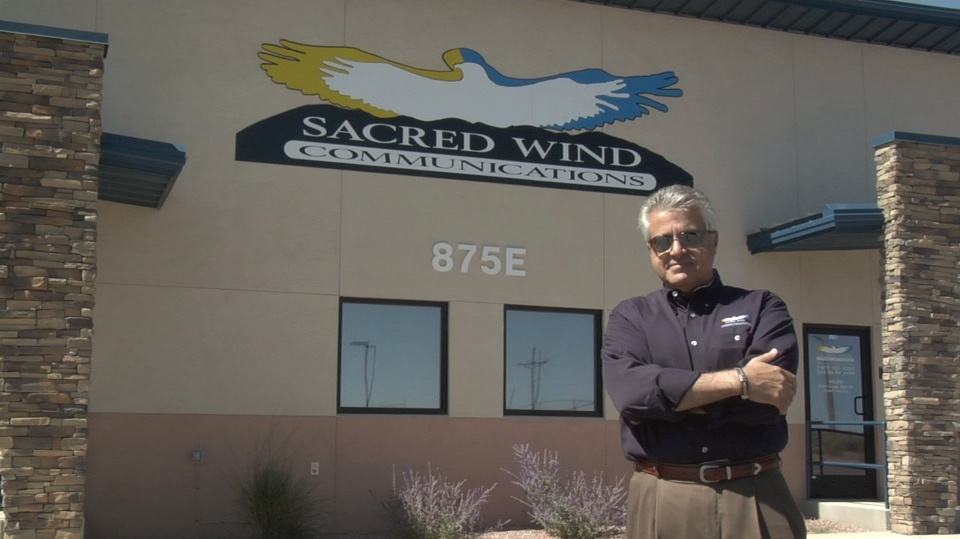
John Badal, CEO of Sacred Wind Communications

John Badal, CEO of Sacred Wind Communications

NBC Universal and American Express today announced Sacred Wind Communications (Albuquerque, N.M.) as the winner and most inspiring small business in the “Shine A Light” program, determined by public vote.

Sacred Wind Communications will receive $50,000 in grant money and $50,000 in marketing support from American Express, and will be featured on MSNBC’s small business show, “Your Business.”

John Badal, described by the Shine A Light Foundation as an entrepreneur, founded Sacred Wind to provide service across the largely ignored Navajo Reservation in New Mexico.  Fewer than 40% of the homes had access to even basic telephone service, provided by Qwest on what the foundation describes as a “dilapidated telephone system.”

Badal, along with a few others, thought Qwest’s turtle-like-speed to provide basic telephone service was not acceptable.

Badal should know — he was the former president of Qwest New Mexico from 2000-2004, overseeing that phone network.

During his involvement with Qwest, the frustration to wire the economically challenged Native American community in his area was daunting.  He told Fierce Broadband Wireless that laying copper cable throughout a rugged, rural desert area to reach a small number of customers who couldn’t afford to pay much for service wasn’t economically feasible for Qwest.

In four years, Qwest only managed to bring phone service to 42 new customers–out of thousands. “It took us two years to get through the rights of way process. Six of those homes had moved by the time the process was completed. It would have taken 45 years to reach 70 percent of the homes in our territory,” Badal said. “We needed a different technology altogether. We needed to go wireless.”

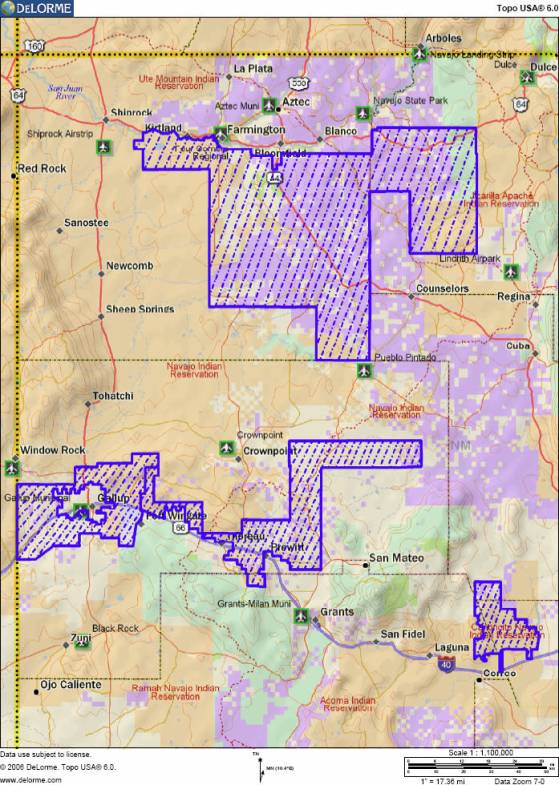
Sacred Wind's service areas (click to enlarge)

Sacred Wind's service areas (click to enlarge)

Badal decided to build a for-profit telecommunications company with a business plan that would depend on funding from the government.

“The only way any company could hope to provide service to the Navajo Nation is with the help of the Federal Communications Commission’s Universal Services Fund,” Badal told New Mexico Business Weekly in 2005.

“We can make this affordable, where Qwest cannot,” says Badal, who expects half of the cost to be picked up by government funding. “That is a necessary part of this equation. Without that, the Navajo cannot be served.”

Virtually every American pays into the Universal Services Fund through a charge levied on telephone bills.  The funding underwrites the expense of providing rural America with access to basic telecommunications services.

In 2004, the same year Badal left Qwest, the company agreed to sell its telephone business on the Navajo Reservation to Badal’s new company.  Sacred Wind, which the company says “evokes a sense of connection between what we do – to send communications over the air – with a larger-than-life purpose for starting this business,” launched service two years later in 2006.

Sacred Wind uses recently developed wireless technology to provide phone service to 2,700+ customers, using both point-to-point wireless and fixed WiMAX to reach as many customers as possible in the sparsely populated desert region.  It’s a challenging proposition for any company, considering most of their service area has less than one home per square mile.  Even when finished constructing their network, Badal estimates there will only be two or three homes served per square mile.

One third of Sacred Wind’s customers live in Navajo or federal government sponsored public housing, another third live in small clusters of a half dozen homes separated by several miles, and the last third live at least a half mile from the nearest neighbor.  Most are economically disadvantaged and have household incomes below $15,000 a year — 57.9% living below the poverty level.  More than two-thirds of reservation homes have no telephone, with some driving up to 30 miles to reach the nearest pay phone.  Several lack access to electricity, which makes wireless phone service and broadband even more challenging.  Sacred Wind is exploring solar options to serve these unpowered homes.

The benefits achieved from Sacred Wind’s focus on their service area are obvious – they know the landscape, the culture, the economics, and the people.  The company will work on problems that a large multi-state carrier like Qwest would not.  Technicians trying to reach one customer five miles away from the nearest wireless base station could not get service until a technician experimented with bouncing the three gigahertz wireless signal off a granite cliff face to extend coverage, which worked.

A company specializing in providing service to rural Native Americans, that also has a non-profit arm dedicated to computer training, provides scholarships, and e-commerce opportunities for Native Americans, is a natural for recognition, and the public responded, calling Sacred Wind’s mission inspiring.

“It’s a real honor to be voted most inspiring small business in the Shine A Light program,” Badal said. “It’s so exciting and rewarding to start your own business and be able to make an impact on the community. Through the support we will receive from American Express as winner of this program, we will be able to further extend our commitment to serving the Navajo people with advanced technology and educational resources.”

Since August, people across the country have nominated thousands of small businesses for the “Shine A Light” program. Three finalists were ultimately selected with the help of host and entrepreneur Ellen DeGeneres, fashion designer and entrepreneur Diane von Furstenberg and MSNBC’s small business expert and host JJ Ramberg.

[flv width=”480″ height=”320”]http://www.phillipdampier.com/video/sacred wind intro.flv[/flv]

A one minute introduction to Sacred Wind Communications

Sacred Wind Broadband Speed/Pricing

Sacred Wind Broadband Speed/Pricing

In addition to telephone service, Sacred Wind also provides Internet access to its customers, and here is where the story becomes considerably less inspiring.

Sacred Wind’s “broadband” service for most affordable tiers fails to qualify as “broadband” at all, using the FCC standard of 768kbps.  Pricing is exorbitant and speeds are slow.

It self-describes its dial-up option as “stable, fast, and affordable.”  The “affordable” claim may be true when comparing pricing with the first broadband tier that actually meets the minimum definition of broadband – $49.95 a month for 768kbps service.  Paying $79.95 a month will bring you their maximum speed offering — just 3Mbps.

The company also sells customers annual contracts to avoid the $99 installation and $65 equipment fees.

Still, for those who have never had telephone service, much less Internet access, it’s considered by many residents to be a good beginning.  The company is amenable to the idea of raising those speeds when technically and financially feasible.

[flv width=”480″ height=”320″]http://www.phillipdampier.com/video/Fujitsu Sacred Wind.mp4[/flv]

Fujitsu showcases Sacred Wind Communications and how it approached the technological challenges involved in providing service to the Navajo Reservation [8 minutes]

Unfortunately, like its bigger telephone brethren, Sacred Wind is not entirely free from the telephone industry politics that often lobbies for anti-consumer policies.  A concerning document on Sacred Wind’s website promotes a questionable legislative agenda, including support of legislation that would permit providers to “create fair compensation in network use by identifying traffic on our networks,” which is a Net Neutrality no-no if it applies to their broadband network.  Another mysterious bullet point, not well explained, objects to “video programming and broadcasting practices that make it difficult to provide an affordable product to our customers.” That could apply to wireless frequency allocations or traffic on their broadband network — it’s not well defined.

While the FCC works on its goal of providing broadband access to underserved Americans, actual case studies illustrating “successes” like Sacred Wind that only manage to bring 3Mbps service to rural areas underline the need for Universal Services Fund reform.  Dedicating additional economic assistance to construct considerably more advanced networks to meet the needs of an increasingly high bandwidth Internet is essential to correct the urban-rural digital divide.  The original purpose of the USF to guarantee basic phone service in rural areas was a noble idea a decade ago, but that was then and this is now.

As the pile of money in the USF continues to grow from Voice Over IP and mobile phone surcharges, it was only a matter of time before waste, fraud, and abuse also turned up.  The administrators of the USF have often wasted considerable amounts of that money on questionable projects in decidedly un-rural areas.  Redirecting, reforming, and broadening USF resources to cover broadband deployment in areas like the Navajo Reservation may be one of the only ways to build sustainable and equitable broadband access networks that are scalable and affordable, even for the most financially-challenged communities.  Providing 256kbps service for $30 a month doesn’t come close to cutting it in poverty-stricken communities.

Additional video coverage of Sacred Wind can be found below the jump.

… Continue Reading

Triad Region: Time Warner Cable Introduces Road Runner Mobile WiMax on December 1st

Phillip Dampier October 14, 2009 Wireless Broadband 8 Comments

Carol Hevey, executive vice president of operations for TWC’s Carolinas region.

Carol Hevey, executive vice president of operations for TWC’s Carolinas region.

Stop the Cap!‘s strong readership in the Triad region of North Carolina comes from their experience with Time Warner Cable’s Internet Overcharging experiment this past April.  For residents in greater Greensboro and surrounding communities, now you get a chance to be pioneers of a different sort.

Time Warner Cable today announced Greensboro, Raleigh, and Charlotte, all in North Carolina, among the first in the nation able to purchase Road Runner Mobile, a new 4G wireless mobile broadband service designed to accompany your existing Road Runner subscription.

On December 1st, Time Warner Cable customers can sign up for the service, providing speeds up to 6Mbps, starting at $34.95 per month, if you are on a Price Lock Guarantee (a service commitment requiring you to remain with Time Warner Cable in return for service discounts) and subscribe to a bundle of services.  That low priced option has a usage allowance of 2 gigabytes per month.

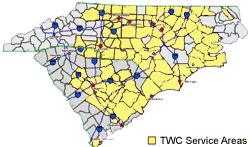
Time Warner Cable's Carolinas region service area

Time Warner Cable's Carolinas region service area

“With Time Warner Cable’s 4G Mobile Network, we now offer the fastest mobile service available and extend our reach outside the home.” said Carol Hevey, Executive Vice President of the Carolina Region for Time Warner Cable.  “Giving our customers the convenience of mobility and the speed of 4G, Road Runner Mobile lets customers take their favorite Internet service wherever they go.  This is an important part of our strategy to give our customers any content, on any device, anytime, anywhere.”

Time Warner Cable is using the Clearwire WiMax network to provide the service, a benefit it gained along with Comcast when they became part-owners of the Sprint-Clearwire venture.

Pricing will vary depending on the level of service customers need:

  • Road Runner Mobile 4G National Elite gives unlimited access to both Time Warner Cable’s 4G Mobile Network and a national 3G network (Sprint, presumably), for use when traveling.
    o $79.95 per month for Road Runner Standard or Turbo customers.
    o Further discounts for Double and Triple play customers and those on a Price Lock Guarantee.
  • Road Runner Mobile 4G Elite gives customers unlimited access to the Time Warner Cable 4G Mobile Network.
    o $49.95 per month for Road Runner Standard or Turbo customers.
    o Further discounts for Double and Triple play customers and those on a Price Lock Guarantee.
  • Road Runner Mobile 4G Choice gives light users 2GB of service on the Time Warner Cable 4G network each month.
    o Available for $39.95 per month to customers of at least one other Time Warner Cable service.  Additional $5 off if you have a Price Lock Guarantee and bundled service package.

Time Warner Cable plans to launch additional mobile services to customers in the future such as the ability to program a DVR from a mobile device and the ability to take their video content with them on the go.  Time Warner Cable will be expanding its 4G Mobile network to additional service areas over the next few months including Dallas, TX and Honolulu and Maui, HI.

Customer experiences with the Clearwire network have been decidedly mixed.  In Portland, uneven signal coverage has plagued service and fueled customer returns.  In Greensboro, some who have tested the Clearwire-branded version of the service report earlier speeds close to 5Mbps that have since slowed to below 2Mbps.

As with any wireless mobile service, inquire about trial options and cancellation policies before signing any contract.  Consumers should always verify service is available to them at tolerable speeds before committing to any contract.

iPhone & AT&T: A Love/Hate Relationship, Says New Study on Smartphone Data Satisfaction

Phillip Dampier October 6, 2009 Competition, Wireless Broadband 3 Comments

satisfactionCustomers love the iPhone, but hate using it over AT&T’s wireless mobile network.

That is the conclusion of CFI Group’s Smartphone Satisfaction Study 2009 (free registration required), which found Apple’s iPhone “the undisputed leader in smartphone customer satisfaction,” scoring 83 out of a possible 100.

But while customers love their iPhones, in the United States, they are generally stuck using it on AT&T’s mobile network, which CFI Group rated dead last in customer satisfaction.  CFI also found that despite the iPhone’s exclusive agreement with AT&T, the iPhone does not improve AT&T’s customer satisfaction in any meaningful way.

“The iPhone has been a cash cow for AT&T, but that cash comes at a cost in terms of overall satisfaction. In effect, switchers can be satisfaction saboteurs if they were not already inclined to choose AT&T,” said Doug Helmreich, program director with CFI Group.

Apple iPhone

Apple iPhone

“As for Verizon, the scales may tip if customers continue to demand smartphones that the company fails to supply. Then again, will its network hold up if it adds network-heavy smartphones? For now, its an apples to oranges comparison.”

CFI’s study top rated Verizon and T-Mobile for smartphone users, both with satisfaction scores of 79 out of 100.  Verizon’s perceived advantage in coverage makes them the top rated network for customer loyalty, with 86% of current Verizon customers identifying the company as their ideal provider.  Customers believe Verizon’s marketing slogans that suggest Verizon has the best nationwide network coverage of any provider.  But customers recognize they pay a price for that coverage in the form of a higher monthly bill.

Customers looking for the best value with competitive pricing will find it with Sprint and T-Mobile, according to the study findings.  AT&T scored among the worst values, in part because they penalize iPhone owners with a mandatory data plan customers thought was “pricey,” especially if they never had a data plan before.

The customer bashing of AT&T didn’t stop with bottom rating the network and its pricing.  CFI found that half of iPhone respondents would flee AT&T for another carrier if given the chance.  At least 40% of iPhone owners said they switched to AT&T only because they had to in order to purchase the iPhone, and they resented it, and the quality of service they found going forward.

Search This Site:

Contributions:

Recent Comments:

Your Account:

Stop the Cap!