Phillip DampierNovember 16, 2009Competition, Data Caps, Public Policy & Gov'tComments Off on New Zealand Heads Towards Elimination of Broadband Usage Caps: Reviled Limits Unnecessary With Upgrade
New Zealand, along with Australia and Canada are often cited by broadband providers as examples of places where broadband usage limits are commonplace. With dreams of Internet Overcharging schemes in their heads, Time Warner Cable, among several others, have routinely pointed to Internet service abroad to justify limiting your usage at home.
But providers always ignore the fact customers despise the limitations on their service, in several cases ranking it among the biggest problems they have with their Internet Service Provider. Internet rationing plans that barely budge in broadband allowances are a major factor in broadband mediocrity, and government officials are increasingly taking notice. In some countries, national broadband policies seek to expand infrastructure where private providers won’t.
In New Zealand, the push for better connectivity comes through expansion of the undersea fiber cables that connect the country with the rest of the online world. In the south Pacific, it is that connectivity problem which directly impacts consumer pricing of broadband and bring limits on service.
Today, the only major connection New Zealand has with the world is through Southern Cross Cable Networks, which have cables stretching from Auckland in New Zealand to Sydney, Australia and between Auckland and Hawaii.
Now, a second company hopes to dramatically expand connectivity with an expanded capacity cable to be laid between Auckland and Sydney. Kordia, a state-owned enterprise, which plans to run the 2,350km cable, says this expansion will dramatically lower broadband pricing for New Zealand and allow providers to vastly expand or discontinue broadband usage caps.
Kordia says the cable, costing between $112-149 million dollars US, will be operational by the end of 2011 if all goes according to plan.
“Our proposed cable will take the most direct, quickest and least expensive route for New Zealand customers. OptiKor is a better proposition for New Zealand than any other cable project – we are the most direct route to Australia and through our partners, we can deliver New Zealand traffic all the way to the United States,” Kordia Chairman David Clarke says.
Prices are already dropping in New Zealand just from the threat of competition. Southern Cross Cable slashed prices on its cable 75 percent in anticipation of Kordia’s future competition. Kordia claims that price cutting is designed to help drag down the company’s efforts to obtain contracts with telecommunications companies in advance of construction.
Still, should the cable be laid, in addition to the prospect of ending aggravating usage caps, Kordia estimates New Zealanders will save almost $1.5 billion US on Internet access between now and 2020.
Despite challenging economic conditions, Time Warner Cable CEO Glenn Britt told CNBC broadband from the cable operator has remained strong during the downturn. The company reported the addition of 117,000 new Road Runner customers during the third quarter, many switching from rival telephone company-provided DSL service.
A CNBC anchor who visited a conference recently and absorbed cable industry talking points about consumption-based pricing asked Britt about whether Time Warner Cable’s network had the capacity to handle skyrocketing data consumption.
“Our physical plant is very capable and we invest in it in a steady way, so I think we’re able to keep up with demand. I think the other question you’re really raising is who pays […] is an evolving thing. Also the history has been everybody pays the same for unlimited access. I suspect that will change going forward to some more usage based model, but that in itself is controversial so we’ll have to see what happens,” Britt said.
Britt’s comments about investments in their network are challenged by the company’s own financial reports which showed a decline in those investments and in the cost of obtaining network bandwidth.
Still, Time Warner Cable is upgrading some areas to DOCSIS 3 technology to market higher speed service to broadband enthusiasts.
The company continues to face significant challenges in its mainstay cable television business, losing 84,000 cable televison package customers in the last quarter, a result of the loss of home ownership during the economic crisis according to Britt, and a general downturn in the economy. Still, through a combination of price increases and marketing bundled services, the company grew average revenue per subscriber to $102.48 a month in the third quarter.
[flv]http://www.phillipdampier.com/video/CNBC – Glenn Britt on Earnings 11-6-09.flv[/flv]
Time Warner CEO Glenn Britt is interviewed on CNBC about the company’s third quarter earnings. (11/6/09 – 4 minutes)
Stop the Cap! reader Nonya advised us about Britt’s latest appearance on CNBC. If you find news our readers might be interested in, send us your news tip under our “Contact Us” link above.
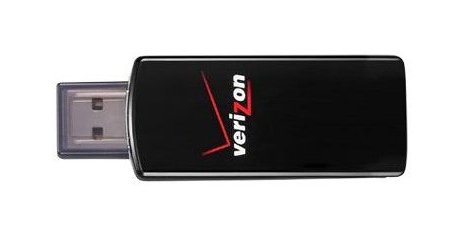
Verizon Wireless today announced the introduction of a prepaid wireless broadband option for customers who don’t want to pay $60 for 5 gigabytes of usage, with a two year contract. Prepaid Mobile Broadband will be available starting November 15th in Verizon Wireless stores, sold as a “starter pack,” for $129.99, which includes a Novatel USB760 modem and a brochure showing different pricing options for the service.
Both Verizon and Virgin Mobile’s prepaid broadband services use the same USB760 modem, but that’s where the comparison ends.
Verizon Wireless expects prepaid customers to pay premium pricing for the convenience of having wireless broadband access without a contract on Verizon’s expansive 3G network. Customers have three options:
Daily Access: $15/day for 75MB
Weekly Access: $30/week for 250MB
Monthly Access: $50/month for 500MB
Unused allowances expire at the end of each term. Verizon includes a “usage chart” with low ball estimates of what customers can do on each respective prepaid plan:
Data Type Daily Weekly Monthly
E-mail (1 text page) 25,600 85,300 170,000
Typical Web page 500 1,700 3,400
Low-resolution photos 150 500 1,000
Don’t even think about streaming video at these prices. Virgin Mobile’s prepaid wireless broadband service was expensive until Verizon Wireless came around. Virgin Mobile charges $10 for 100 MB for 10 days, $20 for 250 MB per month, $40 for 600 MB and $60 for 1 GB. Cricket also sells a prepaid wireless broadband plan for $40 a month for up to 5GB of usage, but has dramatically less coverage.
These plans are typically designed for occasional use only. Those with regular on-the-go wireless broadband needs will do better under a contract plan.
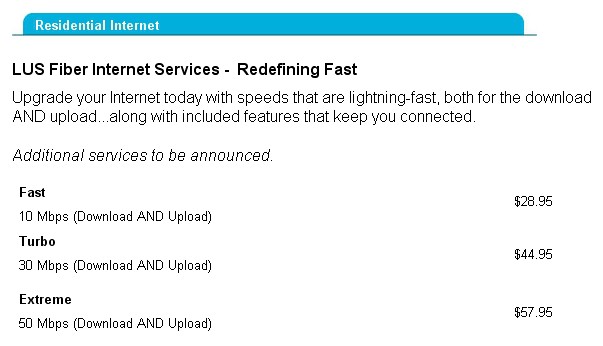
LUS Fiber - Lafayette, Louisiana's public utility municipal broadband provider, offers fast speeds with great rates
Frustrated communities across America, take note.
If your town or city government starts making serious noises about constructing your own, municipally-owned broadband network (especially one built with fiber optics to the home), existing providers who have repeatedly said “no” to requests for faster service at more reasonable prices have a track record of quickly turning around and saying, “yes — why didn’t you ask us before?”
Big existing telecommunications players loathe the thought of facing a new competitor in their midst. They are accustomed to the usual arrangement of one cable operator and one phone company. Cable companies provide cable modem service, phone companies mostly provide DSL. In smaller cities, and where a competitor is missing (or provides a lower quality service), there is almost no drive to upgrade. Cable will set speeds just above what the phone company is offering, and both will co-exist happily ever after.
For communities being bypassed by the fiber revolution now underway by Verizon, and to a lesser degree AT&T, requests from civic leaders, businesses, and consumers for upgraded service fall on deaf ears. ‘What you have now is good enough for this market, so be quiet and be lucky we give you what you’ve got now. Oh, and we’re raising rates, too.’
In Rochester, the one upstate New York city not on the “to-do” list of Verizon (which is merrily wiring urban and suburban communities across their service areas with fiber optic cable FiOS), Time Warner Cable sees little incentive to raise speeds or upgrade to DOCSIS 3 with a phone company competitor that has no apparent plans to move beyond traditional old school DSL service. Where FiOS does threaten, Time Warner Cable is in a hurry to provide “wideband” broadband as quickly as possible.
In Wilson, North Carolina, years of pleading from local officials to provide something beyond anemic broadband in their community was met with yawns from Time Warner Cable and Embarq, the local phone company. Wilson decided to build their own municipal fiber network, offering faster speeds at better pricing. Time Warner and Embarq did what most existing competitors do — they moved through the Four Stages of Telecommunications Competition Grief:
1) Behind the Scenes Threats and Anger: Companies work the phones with local officials trying to browbeat them into dropping the plans to construct municipal broadband, try to gin up partisan opposition, issue overinflated cost estimates, issue warnings about the trouble they’ll cause local politicians who support such initiatives, and snow a blizzard of documents illustrating how wonderful and reasonable their existing service is;
2) Stall Tactics Through Negotiation: Once home office is notified, a series of negotiations to attempt to forestall the project begins, such as throwing crumbs for incrementally better service, offers to build showcase mini-projects that represent a “win” for local politicians, or “looks good on paper” concessions that end up amounting to far less. Most of these discussions are designed simply to stall to allow the company to prepare for stage three.
3) PR and Legal Blitzkrieg: Assuming local officials haven’t been discouraged away from their idea, or dropped it after starring in a company-sponsored press event – ribbon cutting a small wi-fi or school connectivity project, the next stage is a multi-front battle involving company legal teams filing lawsuits to delay or kill projects, public relations and astroturf lobbying efforts to distort issues and build public opposition, legislative maneuverings to make such projects untenable through industry-friendly laws, and often vague promises about impending upgrades making the entire project unnecessary.
4) Acceptance, Competition, and Better Service: The final stage is the realization consumers don’t always get suckered by astroturf groups and company scare tactics. They accept the project is moving forward, and send out the press release saying they welcome the competition and are announcing their own significant service upgrade because “customers asked for it.” Price increases slow, speeds increase, and service improves, all because of the reality that an aggressive competitor is in their future.
Wilson city officials tried negotiations for better service, got nowhere, and had to fight back against a blizzard of nonsense from the telecommunications industry trying to legislate such projects out of existence with changes to state law. Americans for Prosperity, an astroturf group, even hassled residents in other nearby communities with robocalls to try and stop similar projects.
Chattanooga’s public power utility fought back against telecommunication company propaganda to construct fiber to the home service across the city, which launched this year. (5 minutes)
In Monticello, Minnesota, local telephone company TDS had spent years refusing requests to improve service in the city. Speed and access issues plagued the community, northwest of Minneapolis. Local officials had enough and voted to construct their own fiber to the home municipal network.
Enter the four stages. TDS started by telling city officials the company’s network was state of the art for Monticello, and couldn’t be immediately improved because there was insufficient return on investment. Companies want to be assured they are paid back for investments they make, and because Monticello is a relatively small city, there were questions whether the costs for a fiber network would be paid back quickly enough through revenues.
When that didn’t work, the company sued the city as a stalling tactic. Despite the fact Monticello won case after case, TDS kept filing. A full assault by large telecommunications interests also began, trying to gin up public opposition. While the project was approved by voters, and Monticello was tied up in court, TDS quickly moved to stage four and started rapidly building their own fiber network in Monticello, actually putting down fiber the city was prohibited to wire themselves as the lawsuits dragged through the courts.
The company told Ars Technica that despite its earlier refusals to provide fiber service, TDS didn’t act earlier because it didn’t actually know that people really, really wanted fiber; once the referendum was a success, the company moved quickly to give people what it now knew they wanted.
Then, in June, the company said with the advent of its own fiber network, the city of Monticello should back away from constructing theirs, because its economic viability report was partly premised on the fact TDS refused to provide that service.
To underline that, TDS’ new fiber network doubled customer speeds to 50Mbps, trying to keep customers from taking their business to FiberNet Monticello.
[flv]http://www.phillipdampier.com/video/Vote Yes on Fiber.mp4[/flv]
Lafayette staged a multi-year battle with Cox and other providers to bring municipal fiber broadband to it’s corner of Louisiana. This 30 second ad promoted a “yes” vote on the project.
In Louisiana, Cox Cable is facing accusations it’s engaged in predatory pricing to kill Lafayette Utility System’s fiber to the home network and EATel’s fiber network in Ascension Parish. Cox Cable froze rates and moved in with DOCSIS 3 upgrades, delivering up to 50Mbps service. Cox chose to upgrade Lafayette before any other Cox-served community.
The Lafayette Pro-Fiber Blog found this EATel billboard taunting Cox
EATel, an independent phone company that wired fiber across Ascension Parish, also faced down Cox. When the cable company began promoting cut-rate pricing in Ascension, EATel took out advertising promoting Cox’s special prices — in other cities, much to Cox’s consternation. EATel’s ads, much like those run by Novus against Shaw in British Columbia, tell Cox’s customers to call the company and ask for the lower price they are advertising elsewhere.
“Cox came in with an incredibly aggressive promotion for TV service with every bell and whistle you could imagine. We couldn’t figure out how they could even make money on it. So we took out an ad in the Lafayette newspaper that basically said, ‘Hey Lafayette, look at the great prices you are going to get from Cox.’ Cox was not amused,” Trae Russell, communications manager for EATel told Telephony Online.
<
p style=”text-align: center;”>Joey Durel, Jr., president of Lafayette parish, testifies before the House Committee on Energy and Commerce on Lafayette’s municipal fiber network on February 27, 2008. (7 minutes)
You must remain on this page to hear the clip, or you can download the clip and listen later.
<
p style=”text-align: center;”>
Lesson learned — just threatening to bring in a municipal competitor is often all it takes to turn a persistent “no” from the local cable and phone companies into “yes, Yes, YES!”
Of course, not every project is successful. Some, such as Burlington Telecom Stop the Cap! reported on yesterday face political and cost challenges. Others are killed through stage managed opposition and astroturf campaigns paid for by the telecommunications industry before they even get started.
In North St. Paul this year, “PolarNet,” a planned fiber optic broadband network to stimulate the local economy was killed by an astroturf propaganda campaign undertaken by Qwest, Comcast, and other telecommunications companies that would have to deal with PolarNet as a competitor. The telecommunications companies claimed it would result in higher local taxes and “more government” where it wasn’t needed. Citizens defeated the proposal 67-33%.
Windom, Minnesota faced similar challenges and their fiber project was shot down in 1999, but with lessons learned, proponents brought it back up and won in 2000. To this day, the community of 4500 in western Minnesota face considerable envy from adjacent communities — they want service from the fiber-to-the-home system as well.
Almost universally, opponents to municipal broadband systems claim they are financial failures and saddle communities with debt. In reality, most have forced those opponents to provide improved service in their competitive communities, or those companies will become the financial failure.
[flv width=”427″ height=”240″]http://www.phillipdampier.com/video/Terry Huval of Lafayette Utility System April 2009.flv[/flv]
Terry Huval of Lafayette Utility System talks with the Fiber Revolution blog about the challenges Lafayette experienced building their own municipal fiber network. Huval offers excellent advice for other municipalities exploring similar projects. (April, 2009 – 10 minutes)
<
p style=”text-align: left;”>Thanks to Stop the Cap! readers Tim and Matt who suggested this story idea.
With all of the discussion about Net Neutrality recently, the mainstream media often has a difficult time absorbing what this concept means and ends up confusing it with Internet Overcharging schemes. CNN is the latest to make the mistake — not once but twice in three days as Nicole Lapin and Tony Harris discuss how Net Neutrality policies will impact consumers.
Lapin suggests this week’s decision by the FCC to begin writing a formal Net Neutrality policy was a done deal, and that it would prevent Internet providers from charging higher prices for consumers who use their broadband accounts a lot.
Both statements are incorrect.
The FCC is only at the start of writing a formal Net Neutrality policy. The basic tenets Chairman Julius Genachowski would like to see a part of a formal Net Neutrality rulemaking are on the table, but there is plenty of time between now and a final vote for telecommunications industry lobbyists to sweep several pages from Genachowski’s wish-list to the floor (and replace them with their own.)
Nothing in the proposed Net Neutrality policies would currently prohibit providers from moving to Internet Overcharging schemes like usage allowances, overlimit fees, and other pricing changes that are ultimately designed to reduce usage and extract higher pricing from consumers.
Rep. Eric Massa (D-NY) has a bill to put a stop the Internet Overcharging schemes that continues to need your support and advocacy with your member of Congress. See the Take Action section for further details.
For the record:
Net Neutrality: A set of policies that prevents Internet providers from discriminating against certain broadband services or website content providers with speed throttles, blocks, or other impediments. Providers would not be allowed to set up special premium traffic lanes with faster speed delivery of online web content for “preferred partners,” while leaving everyone else on a slower traffic lane. It preserves the Internet we have today.
Internet Overcharging: Practices by broadband providers to limit usage of your broadband service and/or charge higher pricing based on arbitrary claims that consumers are “overusing” their unlimited broadband service. These include usage caps or limits, usage allowances, consumption billing that includes usage allowances, overlimit fees/penalties for exceeding those limits, speed throttles that kick in when a user reaches their usage limit, and any accompanying services sold to consumers who think they might exceed their plan allowance (overlimit “insurance” policies, extra usage blocks sold at premium prices, etc.)
[flv width=”570″ height=”324″]http://www.phillipdampier.com/video/2009-10-21-CNN-FCC Net Neutrality.flv[/flv]
CNN’s Tony Harris talks with Nicole Lapin about Net Neutrality, and how the policy impacts small businesses that sell on the web. (October 21 – 3 minutes)
Earlier today the two revisited the issue of Net Neutrality to explore the outcome of the FCC Net Neutrality decision:
Be Sure to Read Part One: Astroturf Overload — Broadband for America = One Giant Industry Front Group for an important introduction to what this super-sized industry front group is all about. Members of Broadband for America Red: A company or group actively engaging in anti-consumer lobbying, opposes Net Neutrality, supports Internet Overcharging, belongs to […]
Astroturf: One of the underhanded tactics increasingly being used by telecom companies is “Astroturf lobbying” – creating front groups that try to mimic true grassroots, but that are all about corporate money, not citizen power. Astroturf lobbying is hardly a new approach. Senator Lloyd Bentsen is credited with coining the term in the 1980s to […]
Hong Kong remains bullish on broadband. Despite the economic downturn, City Telecom continues to invest millions in constructing one of Hong Kong’s largest fiber optic broadband networks, providing fiber to the home connections to residents. City Telecom’s HK Broadband service relies on an all-fiber optic network, and has been dubbed “the Verizon FiOS of Hong […]
BendBroadband, a small provider serving central Oregon, breathlessly announced the imminent launch of new higher speed broadband service for its customers after completing an upgrade to DOCSIS 3. Along with the launch announcement came a new logo of a sprinting dog the company attaches its new tagline to: “We’re the local dog. We better be […]
Stop the Cap! reader Rick has been educating me about some of the new-found aggression by Shaw Communications, one of western Canada’s largest telecommunications companies, in expanding its business reach across Canada. Woe to those who get in the way. Novus Entertainment is already familiar with this story. As Stop the Cap! reported previously, Shaw […]
The Canadian Radio-television Telecommunications Commission, the Canadian equivalent of the Federal Communications Commission in Washington, may be forced to consider American broadband policy before defining Net Neutrality and its role in Canadian broadband, according to an article published today in The Globe & Mail. [FCC Chairman Julius Genachowski’s] proposal – to codify and enforce some […]
In March 2000, two cable magnates sat down for the cable industry equivalent of My Dinner With Andre. Fine wine, beautiful table linens, an exquisite meal, and a Monopoly board with pieces swapped back and forth representing hundreds of thousands of Canadian consumers. Ted Rogers and Jim Shaw drew a line on the western Ontario […]
Just like FairPoint Communications, the Towering Inferno of phone companies haunting New England, Frontier Communications is making a whole lot of promises to state regulators and consumers, if they’ll only support the deal to transfer ownership of phone service from Verizon to them. This time, Frontier is issuing a self-serving press release touting their investment […]
I see it took all of five minutes for George Ou and his friends at Digital Society to be swayed by the tunnel vision myopia of last week’s latest effort to justify Internet Overcharging schemes. Until recently, I’ve always rationalized my distain for smaller usage caps by ignoring the fact that I’m being subsidized by […]
In 2007, we took our first major trip away from western New York in 20 years and spent two weeks an hour away from Calgary, Alberta. After two weeks in Kananaskis Country, Banff, Calgary, and other spots all over southern Alberta, we came away with the Good, the Bad, and the Ugly: The Good Alberta […]
A federal appeals court in Washington has struck down, for a second time, a rulemaking by the Federal Communications Commission to limit the size of the nation’s largest cable operators to 30% of the nation’s pay television marketplace, calling the rule “arbitrary and capricious.” The 30% rule, designed to keep no single company from controlling […]
Less than half of Americans surveyed by PC Magazine report they are very satisfied with the broadband speed delivered by their Internet service provider. PC Magazine released a comprehensive study this month on speed, provider satisfaction, and consumer opinions about the state of broadband in their community. The publisher sampled more than 17,000 participants, checking […]


 Subscribe
 New Zealand, along with Australia and Canada are often cited by broadband providers as examples of places where broadband usage limits are commonplace. With dreams of Internet Overcharging schemes in their heads, Time Warner Cable, among several others, have routinely pointed to Internet service abroad to justify limiting your usage at home.
 In New Zealand, the push for better connectivity comes through expansion of the undersea fiber cables that connect the country with the rest of the online world. In the south Pacific, it is that connectivity problem which directly impacts consumer pricing of broadband and bring limits on service.
 Kordia says the cable, costing between $112-149 million dollars US, will be operational by the end of 2011 if all goes according to plan.