Home » pricing » Recent Articles:

When Is A Price Cut Not A Price Cut? When It Comes From AT&T Mobility and Verizon Wireless

Phillip Dampier January 20, 2010 AT&T, Competition, Verizon, Wireless Broadband Comments Off on When Is A Price Cut Not A Price Cut? When It Comes From AT&T Mobility and Verizon Wireless

Early reaction and declarations of a price war notwithstanding, yesterday’s “price cuts” from Verizon Wireless and AT&T Mobility on their unlimited calling plans may bring price increases for many customers who don’t need all of the components of the wireless industry’s Cadillac plans.

First, an explanation of what has changed.

Verizon started the ball rolling announcing a $30 price cut on their Nationwide Unlimited Talk plan.  Formerly $99.99, customers now pay $69.99.  For those with multiple phones on a single account, Verizon’s Nationwide Unlimited Talk Family SharePlan, which includes two lines, now drops to $119.99.  AT&T immediately matched Verizon’s new pricing.  AT&T’s Nation Unlimited plan is now also $69.99 and their shared line plan, FamilyTalk Nation Unlimited is $119.99 and also includes two lines.

Customers currently paying more for a wireless plan with either carrier have to call customer service at either carrier to switch to these plans.  You won’t incur a service charge or extend your existing contract.

Verizon’s plans with unlimited calling and texting features have also dropped in price.  Verizon’s Talk and Text plan costs $89.99 per month, down from $119.99. The Nationwide Unlimited Talk & Text Family SharePlan is now $149.99 per month.  AT&T customers can add unlimited texting to an existing plan, and the rates for doing so remain unchanged — $20 for single phone accounts, $30 for family plan accounts.

However… Here comes the tricks, traps, and gotchas.

For big families with multiple phones, these unlimited plans bring a nasty surprise  — the additional charge for each third, fourth, and fifth line is $49.99 per month for each phone, not the traditional $9.99 each for those on plans with minute allowances.

Those who receive employer-related discounts from the wireless carriers may find those discounts do not apply to the Unlimited talk plans.  Verizon declares all of their unlimited plans are not eligible for any monthly access discounts, period.

AT&T goes out of its way to define what they believe a “voice call” means:

Unlimited voice services are provided primarily for live dialogue between two individuals. If your use of unlimited voice services for conference calling or call forwarding exceeds 750 minutes per month, AT&T may, at its option, terminate your service or change your plan to one with no unlimited usage components. Unlimited voice services may not be used for monitoring services, data transmissions, transmission of broadcasts, transmission of recorded material, or other connections which do not consist of uninterrupted live dialogue between two individuals.

Both AT&T and Verizon Wireless may try and up-sell you on the new data plans when you call to change your plan.  Customers calling both carriers have reported customer service representatives only too willing to provide steep discounts for new handsets or try and convince you to add one of the company’s new data plans.  Take advantage of their offer to upgrade your phone and you’ll likely discover yourself forced to also take a mandatory data plan with it anyway.  The list of phones falling under this trap keeps expanding.

Last year, Verizon started requiring customers choose data plans for the LG EnV Touch and the Samsung Rogue.  With this week’s changes, customers activating LG Chocolate Touch, LG EnV, LG VX8360, Motorola Entice W766, Nokia 7705 Twist, and Samsung Alias2 are now also subject to required data plans.  Don’t expect Verizon Wireless representatives to sell you on their cheapest pay-per-use option, which is priced at $1.99 per megabyte.  I’ve witnessed Verizon Wireless’ store employees pushing Verizon’s new unlimited $29.99 data plan.  If customers complain that’s too much, the $9.99 data plan for a piddly 25MB of access is offered next.  If it looks like a balking customer might cost a sale, the representative will grudgingly sell you pay per use plans.

AT&T customers buying many midrange and “quick-messaging” phones are also going to be required to spend at least $20 a month on a combination of texting and/or data plans. Customers using phones like the LG Neon or the Samsung Propel are affected, and weren’t required to buy data plans before.  Unlimited data for quick-messaging devices is priced at $15 a month.

If you already own a top of the line phone, your data plan charges remain the same.  Verizon customers using Windows Mobile, BlackBerry or Android phones will still pay $29.99 a month for unlimited data.  AT&T customers using the iPhone, BlackBerry, Nokia smartphone or Windows Mobile phones will also pay $29.99 a month for unlimited data.

Customers using wireless broadband with a USB dongle are also unaffected by these changes.  Whether you tether or use the dongle, your usage is limited to 5GB per month.

Existing customers will not be forced to add a data plan until their contract is up for renewal or they upgrade their phones.

Do These Changes Save Customers Money?

For most, the answers is no.  In fact, these pricing changes guarantee higher bills for most customers down the road.

Only a tiny percentage of customers pay for unlimited calling plans because most calling-allowance plans provide generous usage ranges, free night/weekend calling, and often free calling for the most frequently called, or those who are also customers of your wireless carrier.  AT&T even rolls-over unused minutes from month-to-month.  Paying considerably more for an “unlimited” calling option makes little sense for customers not exceeding existing calling allowances.

Changes to calling plans and the features associated with them occur year to year, but many customers prefer to remain on legacy plans that may offer fewer minutes, but have far fewer revenue-enhancing tricks and traps.  Verizon customers hanging on to their America’s Choice II FamilyShare plan offered four years ago maintain 700 minutes of calling time between multiple phones, get free night and weekend calling, and can access data features on their phones that deduct from their airtime allowance instead of billing for data usage charges.  The price?  $60 a month for two lines.  The equivalent plan today is priced at $69.99 for the voice calling plan, plus a mandatory data plan for the increasing number of phone that require one.  Even for phones on a pay-per-use plan, any data access will incur a minimum charge of $1.99 per month.

Where the real money will be made is from overpriced data plans forced on customers whether they want them or not, especially for midrange phones.

Wireless consultant Chetan Sharma estimates fewer than 10 percent of these customers buy data plans.

“There’s a significant number of consumers out there who like the idea of a cutting-edge handset but not of paying for services,” Michael Nelson, founder at Nelson Alpha Research told Business Week.

Wall Street analysts know mandatory data plans will bring exceptional new revenue to both major providers, especially at current prices.

“We could see a move upwards rather than downwards [in revenue/earnings],” says Jennifer Fritzsche, an analyst at Wells Fargo Securities in Chicago, who recommends buying shares of AT&T and Verizon Communications.  “Any kind of voice pricing is very much a commodity,” Fritzsche tells Bloomberg News. “Data is the future.”

JPMorgan is celebrating the potential windfall for both companies and their stocks, estimating just two percent of customers will realize any savings from these pricing changes, while many more will see prices increase.

For Verizon Wireless, it’s party time.  Even though Credit Suisse analyst Jonathan Chaplin estimates the carrier will sacrifice $540 million in voice revenue, they’re likely to gain $630 million in data plan sales. The costs of providing the service are likely to be minimal, considering most of the customers now forced to choose a plan are unlikely to use it much.

“Price War” or “War on Customers”

Still, some on Wall Street are unhappy with the prospects of any pricing changes that head downwards, especially if it sparks a price war.  Some have dumped their wireless stocks as a result of industry trends this year.  But what they may need to worry more about is the prospect of middle class customers switching from traditional postpaid two-year contract plans to prepaid services that offer light and medium mobile users better value with fewer tricks and traps.

As families face the prospect for $100+ monthly bills just for cell phone service, with mandatory data charges likely to add another $20-30 on top of that, will non-power-users stick with AT&T and Verizon for service?  Sprint and T Mobile argue they already offer better value for the hard-hit middle class, but prepaid mobile has garnered new respect for its simpler plans and easy-to-understand billing (and taxes and fees are typically included in the prepaid plan price.)

Formerly the domain of those willing to pay a steep per minute fee and buy top-up cards at convenience stores, today’s prepaid wireless plans often offer month-to-month service with familiar “minute bucket”-allowances or unlimited calling, and operate on Verizon, AT&T, Sprint, or T-Mobile’s nationwide networks.

A real price war has broken out in the prepaid wireless sector, with competitors offering unlimited calling plans as low as $40 a month.  Straight Talk, using Verizon Wireless’ network, goes even lower for a simple 1,000 minute/1,000 text/30MB web access plan for $30 a month.  The only downside is a very limited selection of phones.  Regional players like MetroPCS and Cricket offer comparable pricing for their unlimited plans, but their network coverage is a shadow of the larger players, roaming agreements notwithstanding.

As major carriers pile on extra fees for services many customers don’t want, many will find far better values in the prepaid phone marketplace.  Without the two-year contract common on major carriers, customers can switch providers at will, taking their phone number with them in most cases, if one provider doesn’t provide good service.  Best of all, they don’t have to pay for a cancellation fee or take services they don’t want or need just to satisfy AT&T and Verizon’s quest for cash.

[flv width=”480″ height=”380″]http://www.phillipdampier.com/video/WIVB Buffalo Price War Between Cell Phone Providers 1-19-10.flv[/flv]

WIVB-TV in Buffalo appeared to be drinking the industry’s Kool-Aid about the benefits of new, ‘lower pricing,’ but towards the end even they admitted there are tricks and traps involved. (3 minutes)

The Coming Online Video War: Cable Customers Start Looking for Alternatives As Rate Increases Continue

courtesy: abcnews

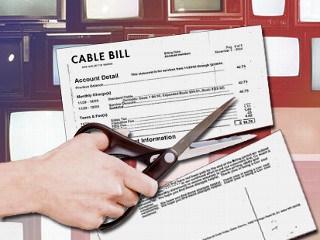
Consumers are increasingly cutting down their cable packages to keep their monthly bill down

Cable television customers have finally reached their limit.  For years, annual rate increases well in excess of inflation have annoyed customers, but beyond complaining, few actually dropped service.  That has begun to change as the economy, consumer debt, job fears, and other expenses have finally provoked customers to begin paring back on their cable package.

According to research from Centris, a consumer research organization, a virtual ceiling of tolerance for cable rate increases appears to have been reached for many subscribers.  Although consumers are not dropping cable en masse, they are not simply accepting a higher bill either.  They are dropping services from their cable package.  In 2008 and 2009, premium movie channels and pay per view suffered most from customer downgrades.  Consumers with multiple premium movie channels started by dropping one or two of them, and their use of pay per view service also dropped.  As the financial impact of the recession wore on, the next round of rate increases caused additional erosion — by late 2009 many consumers discontinued all of their premium services.

The goal?  To reduce or at least maintain a consistent monthly bill.  The average amount consumers are paying for digital cable dropped from $79 a month in the third quarter of 2008 to $70 in the third quarter of 2009.  That decline didn’t come from discounts from the industry — it came from dropping channels and services. In 2010, consumers are still pruning away, now impacting digital basic cable and smaller add-ons like sports and movie tiers.  They are also phoning their provider threatening to cancel service altogether if additional discounts cannot be found.  Cable operators, not surprisingly, have managed to find plenty of savings for consumers who ask and stand their ground, ready to walk away from cable.

The cable industry has sought to promote bundled services as an anti-erosion measure.  It’s much harder to walk away from a provider supplying your television, Internet, and phone service, especially if they lock you into a multi-year service agreement with a cancellation fee.  The savings promoted from bundled services come largely as a result of steeper price increases on standalone products and services, manufacturing “added value” for so-called “triple play” packages.

Some customers have divorced from pay television service altogether, deciding relentless price increases and the 500 channel universe shoveled in their direction just isn’t worth the price.  For many American families, however, such drastic cord cutting would border on traumatic, and they haven’t managed such a drastic step.

Luckily, a growing number of consumers have discovered taking the Luddite approach to television entertainment isn’t a requirement any longer.

Cutting the Cord With Online Viewing

With the growing penetration of fast broadband service in homes across the country, online video has rapidly become one of the most popular online services, particularly when it’s available for free.  The benefits don’t stop at the cost — programming catalogs are becoming increasingly deep and diverse allowing fans to watch entire seasons of shows on-demand, with a limited commercial load.  A consumer looking for something to watch might easily find more entertainment online than wading through hundreds of cable channels of niche and re-purposed programming (and program length commercials).

Cable companies are well aware of the trend towards online video.  First considered part-curiosity, part-piracy, today online video is provided by the major American networks, cable programmers, independent filmmakers, YouTube, and of course, Hulu.  It isn’t just for those torrent sites anymore.  And there is plenty of room for online video to grow.

The industry uses research companies like Centris to carefully track subscriber trends.  They want to be out in front of any sea change in viewing practices that could impact their business model and their revenue, and avoid repeating the mistakes others made in ignoring a potential threat for too long.

Wall Street is well aware of the potential threat as well.

Craig Moffett, a cable industry analyst with Sanford C. Bernstein is among the most prominent trend-watchers for the cable industry.  He sees some warning signs for the future.

“Still no evidence of cord-cutting, but as prices spiral higher, the stresses on the system are unquestionably growing,” Moffett said.

So far, the cable industry has decided the best way to fight potential losses is to get into the game themselves on their terms.  Comcast and Time Warner Cable, the nation’s largest cable operators, are launching their TV Everywhere concepts, which provide their broadband customers with online access to a myriad of cable programming, on demand, and currently for free.  The catch?  You must be a verified, current pay television customer.  If you want to watch a basic cable show, you need a basic cable subscription.  Want to watch Bill Maher online?  You can, assuming you are a verified HBO premium television subscriber.

Comcast’s system is already up and running.  Time Warner Cable is expected to roll out their system sometime this year.

The industry is even selling the public they applaud the online video experience as a win for customers.  Time Warner Cable president and CEO Glenn Britt said, “TV Everywhere is an all-around win for those of us who love television. It will give our customers more control over content and allow them greater access to programs they are already paying for, while enhancing the distributors’ and networks’ robust business model that encourages the creation of great content.”

He didn’t say it also protects Time Warner Cable’s flank from cord-cutting.  Lose the cable subscription and your access to online cable programming goes with it.

But the question remains, is that enough to protect cable television revenue?

The answer might be no.

[flv width=”400″ height=”380″]http://www.phillipdampier.com/video/Bloomberg Invasion of the Cable Killers 9-15-09.flv[/flv]

Bloomberg News reported on ‘The Invasion of the Cable Killers’ — new hardware that lets you bypass cable, back on September 15, 2009.  (2 minutes)

The Coming Online Viewing War: The Players Assemble

Who owns and controls programming ultimately controls the distribution of it.  Time Warner Cable took several shots at Fox a few weeks ago when threatened with the loss of Fox programming over a contract dispute.  Alex Dudley, spokesman for Time Warner Cable, told NY1 viewers much of Fox’s programming is available online for the taking, so even if the network was thrown off the cable company’s lineup, viewers could simply bypass the dispute and watch online… for free.  His message – the dollar value Fox places on its programming is diminished when it gives it away for free online.

The fact so much of network programming is available online for free is part of the dispute over how much cable operators should pay to carry networks on their cable systems.  When the industry passes along those carriage fees to consumers, will that be the last straw for some who will drop their cable subscription and simply watch everything online?

“They’re the ones who are going to resist these price increases that the programmers are trying to push,” said Dudley. “One need look no further than the music industry for an example of what happens when consumers feel taken advantage of by an entire industry.”

Dudley’s remark is more telling than he realizes.  The cable industry is well aware of what happened when the music and newspaper industry ignored nascent challenges to their business models like piracy or free access to their content.  To cable operators, the music and newspaper industries’ online experiences are lessons to be learned and not repeated.  The music industry waited too long to crack down on piracy and lost pricing power as consumers simply stole what they rationalized was overpriced.  The newspaper industry failed to erect pay walls to control access to their content, and newspaper subscribers dropped print subscriptions to read everything online for free.  Cable industry control of content and distribution is key to protecting their business model for pay television.  More on that in a moment.

Now two other parties want to be heard on this matter — consumer electronics manufacturers and advertisers.

The Roku box is popular among Netflix subscribers who want to stream TV shows and movies to their television sets

This week, Advertising Age is running a story on the implications of cord-cutting.

The magazine takes note that online viewing doesn’t require a computer any longer.  Samsung, Boxee, Apple TV, and even Microsoft, manufacturer of the XBox, are now selling devices that bypass cable television and grab online video for users, often for free.

Netflix has already managed that for a monthly fee, and is rolling out service on all sorts of devices, from a set top box that streams content from the web to your television to video game consoles, and now even builds-in the service to some televisions and Blu-Ray DVD players.  Microsoft’s XBox Live service could be germinating a cable television service of its own, as it seeks to license content from programmers starting with Disney’s ESPN.

All of these services, along with traditional laptop or home computer viewing, could evolve into formidable challengers for the pay television industry.  Oh, and some new televisions on offer at this year’s Consumer Electronics Show build in support for Skype, a Voice Over IP telephone service, so phone revenue could be at risk as well.

Advertising Age believes this could be one of the entertainment industry’s biggest business battles of the next few years as millions, if not billions of dollars are at stake.

For the moment, the public face of the debate is a combination of downplaying its potential impact while the players quietly position themselves and their assets for the fight certain to come.

Both Dudley and Britt at Time Warner Cable call the potential trend towards online viewing interesting, but not much of a threat at the moment.

“We see some interesting stuff out there, but right now people are watching more TV than ever; cable-cutting is largely on the fringe,” said Dudley.

“A lot of manufacturers have come out and made announcements, but I don’t think they really are in a position to erode the pay-TV subscriptions that the cable industry has today,” said Park Associates research analyst Jayant Dafari.

“For many people, cable works just fine; the quality is great; the DVR functionality is great; the only gripe they have is that they’re paying for it,” Boxee’s founder and CEO Avner Ronen told Advertising Age. But “there is a growing generation out there where the whole definition of entertainment is changing, and their main source of entertainment is the internet.”

[flv]http://www.phillipdampier.com/video/CNBC Wii At the Movies 1-13-10.flv[/flv]

CNBC covered last week’s announcement of a partnership between Nintendo and Netflix to provide Netflix on the popular Nintendo Wii, in this exclusive interview with Reed Hastings, chairman and CEO of Netflix and Reggie Fils-Aime, Nintendo of America president & COO (January 13, 2010 – 5 minutes)

‘If It Becomes A Problem, We’ll Just Cut Them Off

The cable industry is in a comfortable position to leverage its control over programming and distribution to ultimately limit any competitive threat from online viewing.  In addition to mega-deals like Comcast’s acquisition of content-rich NBC-Universal (a partner in Hulu), the cable industry owns, controls, or can leverage carriage of its cable lineup contingent on programmers not giving away too much for free.  Advertising Age:

One tech exec, who asked not to be named, predicted that the minute cable operators start to feel the disruption, they will clamp down and use their market power to keep TV and films from seeping into next-generation devices. They’re already putting the squeeze on networks; any free distribution is an argument for lower cable distribution fees.

Stop the Cap! is also a player in this struggle, because a key component of the cable industry’s control of programming is the means it is distributed to consumers, and cable modem service representss one half of the duopoly most Americans find when shopping for broadband.  One potential strategy to eliminating the cord-cutting option is to enact Internet Overcharging schemes like usage limits and consumption billing that effectively makes it impractical for a consumer to “switch” to broadband for all of their online viewing.  Switching to the other half of the duopoly may not be an alternative. As online video projects like TV Everywhere will also be available to telco TV partners who wish to participate, there is every incentive to also limit video consumption on Verizon’s FiOS or AT&T’s U-verse systems.

Effective competition against entrenched players in the marketplace is impossible if those players control the content, the means of its distribution, and the ability to cut you off if you watch too much or switch to an independent competitor.

But this is history repeating itself.  Many of the same players and interests followed the same protectionist path against another competitor – satellite television.  It took strong regulatory policy from Washington to force a fair and level playing ground for an industry that didn’t want to sell content to its competitors, overcharged for access, and kept effective competition at bay for years, all while happily increasing rates for beleaguered consumers.

Here we go again.

Internet in the Heartland: Continuing Broadband Adventures in Lawrence, Kansas

Phillip Dampier January 13, 2010 Broadband Speed, Competition, Data Caps, WOW! 9 Comments

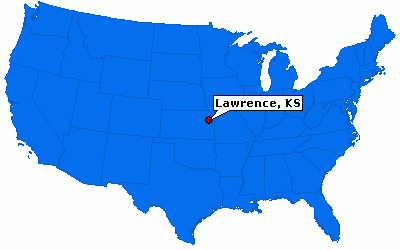
Lawrence, Kansas is a unique place to live.  Its local newspaper, the Lawrence Journal-World, was one of the first in America to begin an online edition in 1995.  Its owner, The World Company, just so happens to also own the independent cable system serving the community, which also provides broadband and phone service to the city’s 90,000 residents.  Its biggest competitor is AT&T, which has been upgrading parts of Lawrence with its U-verse system to stay competitive.

Sunflower Broadband, which provides a “triple play” package of Internet, cable TV and telephone service, has remained controversial among service providers because it instituted an Internet Overcharging scheme with usage caps and overlimit fees.  The company has been used by the American Cable Association, a trade and lobbying group serving independent cable operators, as a poster child for effective rationed broadband schemes that reduce demand and increase broadband profits.

Lawrence, Kansas

Customers generally have loathed usage caps, particularly when they were stuck choosing between Sunflower’s faster, usage capped broadband service or a low speed DSL product from AT&T.  Stop the Cap! receives more complaints about Sunflower Broadband than any other provider, except Time Warner Cable during its own Internet Overcharging experiment in April 2009.  Lawrence residents appreciate the relatively fast speeds Sunflower can provide, but complain they can’t get much use from a service that limits customers to a set allowance and then bills them up to $2 per gigabyte in overlimit penalties when they exceed them.

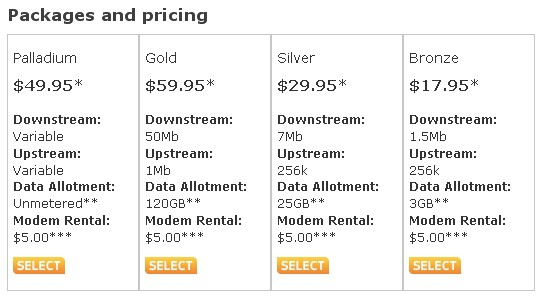
Last fall, things started to change in Lawrence as AT&T began offering it’s U-verse service in parts of the community.  We began receiving e-mail from Lawrence residents pondering a new service plan Sunflower Broadband introduced — Palladium, an unmetered broadband option priced at $49.95 per month.  It sounded like a good deal, perhaps introduced to protect them from U-verse customer poaching, until they noticed Sunflower was  selling the plan without a fixed downstream or upstream speed.  In fact, no speed was mentioned at all.  Indeed, Sunflower’s Palladium is nothing new to those living abroad under various cap ‘n tier broadband regimes.  It’s comparable to New Zealand Telecom’s Big Time plan, where customers need not fear overlimit fees and penalties, but have to live with a “traffic management” scheme that gives priority to customers on other plans living under a usage cap.

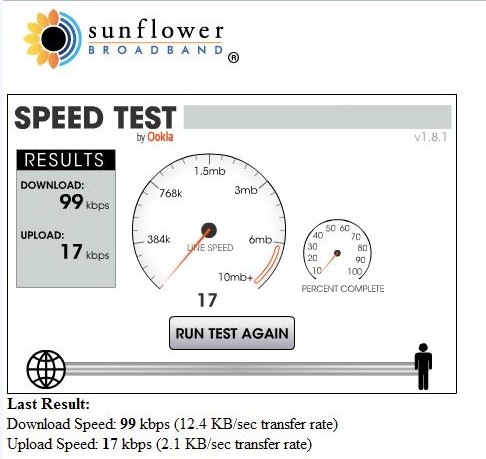
In other words, Palladium customers get last priority on Sunflower’s network.  If the network is not congested, these customers should enjoy relatively fast connections.  But during primetime, expect speeds to drop… and dramatically so according to customers writing us.

Sunflower Broadband's Internet pricing - add $10 if you want standalone service

That customers debate just how slow those speeds can get testify to the nature of cable’s “shared infrastructure.”  Groups of subscribers are pooled together in geographic areas and share a set amount of bandwidth.  As usage increases, so does congestion.  Responsible operators measure that congestion and can split particularly busy neighborhoods into two or more distinct “pools,” each sharing their own bandwidth.  Based on the variable reports we’ve read, it’s apparent Palladium works better in some parts of Lawrence, namely those with fewer broadband enthusiasts, than others.

Network management is a major concern of Net Neutrality proponents.  It allows an operator to artificially impede traffic based on its type, who generates it, and potentially how much a customer has paid to prevent that throttling of their speed.  In the case of Palladium, network management is used to give usage-capped customers first priority for available bandwidth, and push Palladium customers further back in line.

Judging the quality of such a service is a classic case of “your results may vary,” because it is entirely dependent on when one uses the Internet, how many others are logged in and trying to use it at the same time, how many customers are saturating their connections with high traffic downloading and uploading, and how many people are sharing your “pool” of bandwidth.  Oh, and the quality of your cable line can create a major impact as well.

Sunflower Broadband representatives claim Palladium is “optimized for video” and should provide at least 2Mbps service during peak usage and up to 21Mbps service at non-peak times.  That’s a tremendous gap, and we wanted to find out whether most customers were getting closer to the low end or the high end of that range.

Back in October, we wrote a request in the comments section of the Journal-World asking customers to e-mail us with answers to several questions about their experiences with Sunflower Broadband:

  • 1) whether you ever exceed the cap.
  • 2) do you think there should be one.
  • 3) would you prefer faster speed with a cap or slightly slower speed with no cap.
  • 4) your experience with the new unlimited option.
  • 5) whether you would contemplate switching to AT&T U-verse if it meant escaping a usage cap, even if it had slower speeds.
  • 6) Would you pay more for faster speed and no cap?
  • 7) your overall feelings about Sunflower Broadband.

We heard from just over two dozen readers sharing their thoughts about the company and its service.  The response was mixed.

Generally speaking, customers hate the usage caps Sunflower Broadband maintains on most of their broadband tiers.  All thought it was unfair and unreasonable to limit broadband service under Sunflower’s Bronze tier to just 2GB per month and their Silver tier to just 25GB per month.  Most customers who wrote subscribed to the Silver tier of service with 7Mbps/256kbps speeds at $29.95 per month.  They also paid a $5 monthly modem rental charge.  Those who wrote who fit the “broadband enthusiast” category were internally debating whether the Gold plan, with its assured 50Mbps/1Mbps speeds for $59.95 per month was a better option, even with a 120GB allowance, or whether they should opt for Palladium’s $49.95 option to escape the usage cap.

Among enthusiasts, some felt Sunflower responded to customer demands by offering an unlimited plan in the first place, and thought it was an acceptable trade-off to obtain lower speeds at peak usage times for a correspondingly lower price, and no cap, as long as speeds were reasonable at all times.  Others were offended they had to make the choice in the first place.

“If I lived anywhere else, I wouldn’t have to choose between a throttled service or one that asks for $60 a month for 120GB of service,” writes Steve from Lawrence.  “AT&T DSL for me is 1.5Mbps service because I live close to the edge of the distance limit from AT&T’s exchange.”

But Justin, also from Lawrence, has a more favorable view. “I hate their usage cap with a passion, but when you look at what small cable companies usually offer their customers, it’s slow speed service at terribly high prices,” he writes. “At least Sunflower did DOCSIS 3 upgrades and can offer big city speeds here.  How long will that take other small independent providers?”

Troy adds, “at least they gave us one choice for unlimited service.  Time Warner Cable and Comcast sure didn’t.”

About half of those who wrote did exceed their usage cap by underestimating the amount of usage in their respective households.  Most of those who did were on the Silver plan.

Dave writes, “I knew right off the bat the Bronze tier was ridiculous for anyone to choose, and our family has three teenagers so we knew that was not an option.  We tried the Silver plan when we switched from AT&T DSL service and blew the lid off that 25GB cap probably within two weeks and got a crazy bill.  At least Sunflower forgave the overlimit fees for the first month, but they could afford to because we upgraded to Palladium, paying them $20 more per month.”

One customer's dismal Palladium speed test result from last October, likely the result of a signal problem

Angela, who shares an apartment with two other roommates had their share of fights over who used up all the broadband allowance.

“We have a wireless network and everyone splits the bill, but when we ran up almost 200GB of usage, we freaked.  Nobody would admit to using that much Internet.  Thanks to my boyfriend, we discovered our wireless router was wide open and one of our lovely neighbors probably hopped on to enjoy,” Angela writes.

Sunflower also forgave their overlimit bill for the first month, but they decided to take advantage of an introductory offer from AT&T and switched to U-verse and are much happier.

“At least with AT&T, we know what our broadband bill is going to be and we don’t have fights or worries about getting a huge bill from Sunflower,” she adds.

Among those answering our question about reduced speed in return for no cap, the consensus view was “we would need to know what speed they are providing.”  Broadband speed was important to most who wrote.  While many may not be able to discern a difference between 10 and 20Mbps service for most online activities, obtaining 2Mbps service when expecting closer to 20Mbps is readily apparent, and that was the biggest problem with Palladium users unimpressed with its performance.

“Palladium is god awful, and close to unusable on the weekends and during the early evening when everyone is online,” writes Kelly, also in Lawrence.  “We have college students all over the neighborhood and these people can’t be unconnected for a minute, so I’m not surprised Palladium crawls when everyone is online.”

Kyle, a regular Stop the Cap! reader writes the whole concept of Palladium leaves a bad taste in his mouth.

“Palladium is the equivalent of going into a restaurant and eating leftovers — whatever speed is leftover, it’s yours.  Sometimes it might be a whole meal, other times scraps!  It’s an example of crappy customer service coming from a provider which doesn’t have much competition (although maybe that will change with U-verse),” he says.

Kyle is on the Gold plan, but remains unimpressed with Sunflower:

“Is there another DOCSIS 3 system in the country that limits upload speed to 1Mbps or has a bandwidth cap this low (120 GB) with DOCSIS 3?”

Stop the Cap! also obtained access to the company’s subscriber-only forums and discovered considerable discontent with Sunflower’s broadband service.

“I recently switched over to Palladium to avoid the new Gold price gouging. I bought the new modem set it up and much to my surprise my speeds were HORRIFIC! Consistently 4.5Mbps service over the course of a week at various times. Upload speeds were so terrible it took 15 minutes to send emails with one minute movies,” writes one user.  “So, for $20 more a month Palladium offers much slower speeds BUT unlimited bandwidth (which according to Sunflower’s own statistics almost no one exceeds their limits anyway.)  What a rip-off. All I want is my old Gold back, same speed and price. I am absolutely disgusted with Sunflower. Calling Palladium “variable speed” is a lie. You are throttling customers – period.”

“So I have Palladium and the speeds are decent, usually around 10Mbps down (we won’t talk about up speeds.) But every time I run a torrent my speeds go down to about 500kbps. The second I turn off my torrent client and run a speed test again its right back up to 10. Has anyone else been having similar issues? It seems like Sunflower throttles my entire connection when they detect a torrent,” writes another.

One Lawrence resident claims he was blacklisted by Sunflower Broadband after criticizing them.

“Their blacklisting of me served as a warning to others after I spoke out nationally.  They are quite pissed and I’m not allowed to go to any event sponsored by them.  I even got removed from the local Twitter festival,” a person who I have chosen to keep anonymous writes. “The nutshell is that the bandwidth from DOCSIS 3.0 is extremely throttled for Palladium users. If they have done heavy downloading the throttle drops speed to about 2Mbps.”

For Lawrence residents who have decided they don’t like the choices Sunflower provides for broadband service, the good news is that AT&T is upgrading their network in the city to provide U-verse service, and many who wrote us have switched just because AT&T does not engage in Internet Overcharging caps and limits in Lawrence.

There is even a blog devoted to comparing Sunflower Broadband service with AT&T U-verse.  The Lawrence Broadband Observer has been reporting on the dueling providers since August.  His verdict: AT&T U-verse wins for broadband for its more stable speeds, and no Internet Overcharging schemes, even if it costs more:

We decided to go with U-verse for our Internet service, canceling our Sunflower Broadband Internet, which we had used for over 13 years. U-verse’ top line internet costs $15 more per month then Sunflower’s; we decided that the advantages of U-Verse for Internet were enough to make this extra $15 per month a reasonable value.

Furthermore, the speed of U-verse has been remarkably consistent, always ranging between 16 and 17Mbps down and about 1.4Mbps up, no matter the time of day.

While Sunflower’s service is very fast at certain times of day, it frequently slows down during evenings or other times of heavy network use, sometimes to less then half of the speed we were paying for.

The other primary reason we went with U-verse was because U-verse does not have bandwidth overage fees or any kind of bandwidth limits. Although we have been careful with Sunflower and managed to avoid any bandwidth overage charges, having “the meter running” all the time was annoying, and we worried that we could always be surprised with an unexpected charge. With U-verse we do not have this worry.  One could almost think of the $15 extra for U-verse as an insurance policy…it buys peace of mind not having to worry about bandwidth overages.

Verizon’s Doubling of Early Cancel Fee ‘Good for Consumers’

Verizon Wireless has defended their decision to double the early cancellation fee (ETF) for consumers purchasing “smartphones” and netbooks from the wireless carrier.  In a letter from Kathleen Grillo, Senior Vice President of Federal Regulatory Affairs, Verizon claims the new $350 fee is justified and actually benefits consumers by providing them with a substantial discount on the cost of the equipment they might not otherwise be able to afford.

“The higher [cancel fee] associated with Advanced Devices (click link to see a list of impacted equipment) reflects the higher costs associated with offering those devices to consumers at attractive prices, the costs and risks of investing in the broadband network to support these devices, and other costs and risks,” Grillo wrote as part of a 77-page submission to the Federal Communications Commission, which demanded an explanation for the price increase.

Grillo claims Verizon’s fees are actually good for consumers:

Verizon Wireless’ term contracts with ETFs promote consumer choice and broadband deployment. This pricing structure enables Verizon Wireless to offer wireless devices at a substantial discount from their full retail price. By reducing up-front costs to consumers, this pricing lowers the barriers to consumers to obtaining mobile broadband devices. It thus enables many more consumers, including those of more limited means, access to a range of exciting, state of the art broadband services and capabilities. The company’s pricing structure therefore promotes the national goal of fostering the greater adoption and use of mobile broadband services. At the same time, consumers are protected by Verizon Wireless’ detailed disclosure practices described in this response, by the Worry Free Guarantee, which allows customers to terminate within 30 days of activation without an ETF, and by the monthly reduction in the ETF amount.

Grillo claims Verizon customers can also purchase a phone at the retail price and avoid a service contract.  Verizon Wireless, for example, charges contract customers $199.99 for the Motorola Droid.  But customers who do not want a contract can purchase the phone from Verizon for $559.99.

In North America, most major cell phone companies subsidize the cost of wireless handsets and make up the difference over the life of a typical two-year service contract.  Cell phone companies claim consumers benefit from the arrangement because they are able to acquire a new phone every two years at a substantial discount.  Some consumer advocates and members of Congress disagree, suggesting carriers more than earn back the cost of the subsidized phone over the life of the contract.  Although customers purchasing a retail-priced phone don’t have to worry about a two year contract, they pay artificially higher prices for service plans designed to recoup the costs from those who did take discounted phones.  The result is a strong incentive to commit to a contract and take the phone, since you will essentially be paying for it anyway.

The Government Accountability Office found early termination fees to be among the top four consumer complaints filed with the FCC about wireless carriers.  Sen. Amy Klobuchar (D-Minnesota) re-introduced legislation December 3rd to try and limit early termination fees.

Senator Amy Klobuchar

“Changing your wireless provider shouldn’t break the bank,” Klobuchar said in a Dec. 3 statement. “Forcing consumers to pay outrageous fees bearing little to no relation to the cost of their handset devices is anti-consumer and anti-competitive.”

The Cell Phone Early Termination Fee, Transparency and Fairness Act would prevent wireless carriers from charging an ETF that is higher than the discount on the cell phone that the company offers consumers for entering into a multi-year contract. For example, if a wireless consumer enters into a two-year contract and receives a $150 discount with the contract, the ETF cannot exceed $150.

The legislation would also require wireless carriers to prorate their ETFs for consumers who leave their contracts early so that the ETF for a two-year contract would be reduced by half after one year and to zero by the end of the contract term. In addition, the bill would mandate that wireless carriers would provide “clear and conspicuous disclosure” of the ETF at the time of purchase.

Co-sponsoring the bill with Klobuchar are Sens. Russ Feingold, Jim Webb and Mark Begich.

[flv]http://www.phillipdampier.com/video/CNBC Amy Klobuchar ETF Fees 9-13-07.mp4[/flv]

Back in 2007, Sen. Klobuchar introduced nearly identical legislation to deal with mobile phone providers charging high termination fees.  CNBC ran this debate between Klobuchar and the cell phone trade association.  Klobuchar found herself in a 2-against-1 debate when the CNBC anchor defended the wireless industry.  (9/13/07 – 5 minutes)

AT&T Damage Control: Running an Internet Overcharging Re-Education Campaign

Phillip Dampier December 14, 2009 AT&T, Competition, Data Caps, Editorial & Site News 2 Comments

dampier1AT&T Mobility has been sending out their blogger team to try and clean up the damage from CEO Ralph de la Vega’s not-too-subtle hint that the days of unlimited iPhone data plans are numbered:

Unfortunately, there has been a lot of misinformation, rumor and pure speculation floating out there during the last day on this topic.

[…]

We carry more smartphone data traffic than any other U.S. provider, with traffic growing 5,000 percent over the past three years. As a result, we are working aggressively and investing heavily in our network to support this tremendous growth. Our $17 – $18 billion CapEx spend for 2009 includes:

  • Nearly doubling the wireless spectrum serving 3G customers in hundreds of markets across the country, using high-quality 850 MHz spectrum.  This additional spectrum expands overall network capacity and improves in-building reception.
  • Adding about 2,000 new cell sites, expanding service to new cities and improving coverage in other areas.
  • Adding about 100,000 new backhaul connections, which add critical capacity between cell sites and the global IP backbone network.  We’re doubling the number of fiber-served cell sites this year.
  • Enabling widespread access to our Wi-Fi network – the largest in the country with more than 20,000 hotspots in all 50 states – allowing them to take advantage of the best available AT&T mobile broadband connection.
  • Rolling out even faster 3G speeds with deployment of HSPA 7.2 technology, with availability in six markets planned by the end of the year.
  • Preparing for field trials of next generation, LTE wireless networks next year, with deployment planning to begin in 2011.  This schedule aligns with industry expectations for when a wide variety of compatible 4G wireless devices should be available.

We have seen very positive results from our efforts thus far.  In one of the most common measures of reliability – dropped calls – AT&T’s national performance is within two-tenths of 1 percent of the highest score among major providers as measured by an independent firm, with only 1.32 percent of calls dropped nationally.

Ralph de la Vega

Ralph de la Vega

AT&T’s blogger team says it isn’t true that de la Vega is definitively saying he’s “capping” services.

But de la Vega never said in his original statements that he was advocating “capping” service.  He said, “there’s got to be some sort of a pricing scheme that addresses … usage.”  Scheme is right.  That’s code language for consumption or usage-based billing, something the blogger team doesn’t rule out.  A strict usage cap simply says a customer cannot exceed a specified amount.  Most consumption billing schemes monetize data consumption, not with a true pay-for-use system that bills by the megabyte, but rather a fixed monthly price with an allowance and overlimit penalties for exceeding it.  AT&T already uses consumption-based billing for its prepaid and postpaid mobile broadband plans, so extending it to the iPhone isn’t exactly novel.

The iPhone customer has been treated as a profit engine by AT&T since the phone was first introduced.  Compelling customers to purchase a mandatory data plan that was originally priced at $20 and was raised to $30 was the price iPhone customers had to pay for bragging rights.  Should AT&T impose consumption billing, that price may go much higher.

AT&T must believe iPhone users are willing to pay that price or dramatically cut usage.  Either way, AT&T milks the very last nickle out of its exclusivity arrangement that some industry observers believe will expire in the early summer of 2010.  When that happens, AT&T must be quietly pondering what customers will do once they can buy an iPhone from other carriers.

Leafing through January’s issue of Consumer Reports, I find one possible answer in the magazine’s annual survey of America’s best and worst cell phone providers (subscription required for detailed results).  More than 50,000 subscribers rated their wireless carrier, and AT&T turned in dismal ratings, usually ending up at the bottom except in some cities where Sprint achieved that dubious honor.  AT&T’s problems, reported in cities from coast to coast:

  • No service where service should exist
  • All circuits busy
  • Dropped calls
  • Static

Results have been so poor, the magazine recommended that those affected should call AT&T and demand credit.  Many customers have gotten at least three months’ worth of service credits valued at more than $200 for doing so.

Logical conclusion: customers love the iPhone but hate the network it is tied to.  With de la Vega’s recent data usage temper tantrum, it’s just one more reason to be annoyed with AT&T.

For customers who entertain the notion of owning an iPhone, but simply refuse to leave their current provider to obtain it, that’s nearly $3,000 left on the table over the life of a two-year contract.  That should concern both Apple and AT&T.  For Apple, it means potentially losing new iPhone customers to impr0ved competing phones, such as those running Google’s Android operating system.  For AT&T, once the Berlin Wall of exclusivity falls and two year contracts expire, years of consumer frustration with their network could lead to a stampede for the exits.

Search This Site:

Contributions:

Recent Comments:

Your Account:

Stop the Cap!