Home » pricing » Recent Articles:

Time Warner Cable Increasing Road Runner Pricing in Rochester for Standalone Customers – $54.95 a Month

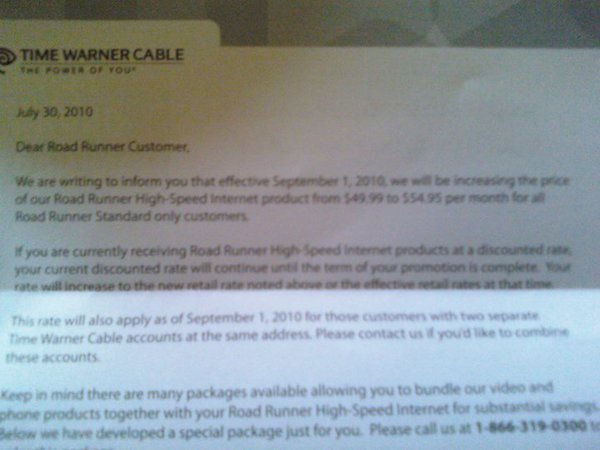
Another rate increase letter from Time Warner Cable (click to enlarge)

For the second time in a year, Time Warner Cable is jacking up the rates on its Road Runner broadband service for residents in western New York.

Stop the Cap! reader Patrick in Rochester sent word and a screen image of a letter he received notifying him Time Warner Cable was raising the price on standalone Road Runner service to $54.95 a month, effective September 1st.  Patrick, and other customers who are only interested in getting broadband service from the cable company, were paying just under $45 a month for Road Runner standalone service in early 2009.  Today, standalone service runs $49.99 a month, but the cable company is back looking for another $5 a month starting this fall.

July 30, 2010

Dear Road Runner Customer,

We are writing to inform you that effective September 1, 2010, we will be increasing the price of our Road Runner High-Speed Internet product from $49.99 to $54.95 per month for all Road Runner Standard only customers.

If you are currently receiving Road Runner High-Speed Internet products at a discounted rate, your current discounted rate will continue until the term of your promotion is complete.  Your rate will increase to the new retail rate noted above or the effective retail rates at that time.

This rate will also apply as of September 1, 2010 for those customers with two separate Time Warner Cable accounts at the same address.  Please contact us if you’d like to combine these accounts.

Keep in mind there are many packages available allowing you to bundle our video and phone products together with your Road Runner High-Speed Internet for substantial savings….

Time Warner Cable, like many cable providers, wants to discourage customers from taking only one of its products, so it gradually increases prices to drive customers to its “better value” bundled services.  As for broadband, Time Warner Cable executives have made it clear they can raise prices whenever they want.

Landel Hobbs, Chief Operating Officer for Time Warner Cable, told investors this past February consumers love their Road Runner service.

“Consumers like it so much that we have the ability to increase pricing around high-speed data,” Hobbs said.

At $55 a month, standalone Road Runner becomes increasingly difficult to justify for many consumers, but for residents in cities like Rochester, the only alternative is far slower DSL service from Frontier Communications, complete with its 5GB monthly usage allowance.

However, you can leap off the Time Warner Rate Increase Railroad by switching to Earthlink, which is running a promotion for six months of 10Mbps service for $29.95 per month.  Earthlink service is indistinguishable from Road Runner, except Earthlink speeds do not benefit from “Powerboost” — Time Warner Cable’s very temporary speed boost during the start of large file transfers.  Most customers will prefer the boost they receive from keeping the $25 difference in price in their wallets — $150 over the life of the promotion.  At the end of six months, you can hop back to Time Warner Cable’s Road Runner service on a new customer promotion at a significant discount.  No modem exchange is required — the switch to and from Earthlink can be done over the phone.  Billing is done by Time Warner Cable for both services.  Just be aware your Road Runner e-mail account will be closed when you change providers.

You can escape Time Warner Cable's Road Runner rate hike by switching to Earthlink service at a substantial discount.


The Internet Video Revolution Will Be Interrupted By Broadband Usage Caps

The Internet video revolution will increasingly be blocked by Internet Service Providers who will leverage their duopoly markets with restrictive usage limits to keep would-be video competitors from ever getting their business plans off the ground.

William Kidd, industry forecaster for iSuppli, an industry analyst group, sees a future of Internet Overcharging schemes like usage caps, overpriced pay-per-use pricing, and other limitations designed to erect roadblocks for online video content, which increasingly threatens the cable-TV products of both cable and phone companies.

The latest scheme to limit usage of streaming media come not from concerns about bandwidth costs but rather the “unknown risks” online video could have for cable and phone companies’ other products.

Such risks, Kidd believes, will compel broadband providers to increasingly implement caps in order to mitigate any long-term gambles that providers might have to take to make streaming media available to home and mobile environments.

At present, content can be streamed over TV from online service offerings such as Hulu and Netflix, or accessed through a device such as the PlayStation from Sony Corp. In addition, new-media business models continue to emerge with the introduction of new platforms that circumvent services currently provided by traditional cable or satellite pay-TV providers.

The caps planned for implementation will sink virtually all of the video streaming services that are not partnered with cable and phone companies.  Kidd notes the caps he’s seen offer limited viewing — as little as three hours for wireless 200kbps video streams or standard definition video streamed on wired networks for up to 25 hours per month.  True HD viewing is simply not going to happen with caps on many providers planned to cut off viewing after only seven hours.

Business plans and would-be investors must take notice of what providers have in store for would be competitors, Kidd argues.  Since the phone and cable companies maintain a near-monopoly on broadband, they ultimately control what Americans can do (and see) on their broadband accounts.

Rogers reduced usage allowances on several of its broadband plans days after Netflix announced a streaming service for Canadians.

One need only look to Rogers Communications in Canada for a timely example.  Rogers promptly lowered usage limits on some of its broadband plans just days after Netflix announced a video streaming service for Canadians that could directly compete with the cable giant’s video rental stores and cable pay per view services.

“These new-media business models imagine that they don’t have to pay the network through which their data traverse,” he said. “However, such a theory is directly at odds with the ambitions of cable and satellite-TV operators, which increasingly are unwilling to provide heavy data access through their networks for free—especially if a way can be found to monetize ongoing data traffic into viable revenue streams.”

In addition, new Internet-born content providers wrongfully take for granted that the way their largely free content has been consumed now also will apply in the future to premium services. The assumption is a bad one, Kidd observed, because in order for consumers to consider the Internet as a true substitute for their big-screen TV, content would need to be comparable in both technical quality and entertainment value. And to achieve the same level of value, such content necessarily would be extremely bandwidth intensive.

As a result, for any number of these emerging TV-substitute models to work someday, one has to assume that the picture quality being proffered is acceptable for viewing on large-screen TVs.

But providers have a trick up their sleeves by implementing seemingly tolerable usage caps as high as 250GB per month, which seem generous by today’s usage standards.  But they will be downright paltry tomorrow, especially if they do not increase over time, as online video increases in quality and size.

“By implementing caps now that don’t impinge on the way subscribers use the Internet today, cable and telco operators are able to create for themselves an advantageous situation,” Kidd said. “Under these circumstances, emerging media competitors must work more directly with the network owners before getting their services off the ground—as opposed to around them, as they may have previously hoped.”

That means giving them exactly what they want — a piece of the action and control over the content that crosses over their wires to broadband consumers.

Cable Trade Press Understands AT&T’s 2GB Cap – ‘You’ll Blow Right Through It’

Spangler

While the mainstream media and some of AT&T’s apologists tell consumers AT&T’s 2 GB monthly usage limit will impact only a handful of “abusers,” the cable trade press is telling its readers the industry insider’s secret — consumers will blow right through those caps.

Todd Spangler, who is an Internet Overcharging advocate and columnist for Multichannel News, a cable industry trade magazine, writes the implications of AT&T’s usage cap couldn’t be clearer to him.

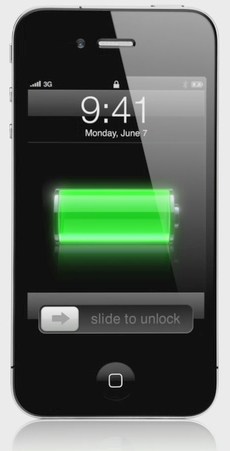
The new iPhone 4, introduced yesterday to the predictable media crush, provides 10 hours of battery life for playing video, among other features.

But now that AT&T has eliminated its all-you-can-eat plan for smartphones, you will blow through the maximum 3G usage for the entry-level 200 MB plan if you watched just 4 minutes of streaming video per day. That would include commercials.

Even AT&T’s more generous DataPro 2-GB plan would allow just 35 minutes per day of streaming video (assuming you used your iPhone for nothing else), according to the carrier’s online data calculator.

Like a stopped watch, at least he’s right twice a day.

Spangler celebrates the opportunity AT&T’s overcharging scheme provides the cable industry to “grease the skids” for data caps and overpriced consumption billing on cable modem service.

In Spangler’s “Cable companies pay my salary”-world-view, it wasn’t that Time Warner Cable did the wrong thing when it tried to triple broadband pricing — to $150 a month — for the exact same level of service customers previously enjoyed.  It was all about its execution.

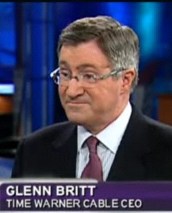
Spangler characterizes Time Warner Cable CEO Glenn Britt as a victim, burned over the company’s failed overcharging experiment in 2009.  When one plays with matches, is it any surprise there are consequences?

Consumers will respond to more overcharging schemes the same way they did a year before — with overwhelming condemnation and opposition.  It’s hard to convince consumers to pay a higher price for limits on usage while telling shareholders you’ve invested less to expand your network, charged more to access it, all while the costs to provide the service have dropped dramatically.  Consumers call that out for what it is: greed.

Make no mistake, consumers hate usage caps and overpriced consumption billing and Time Warner Cable has no justification to introduce either.

[flv]http://www.phillipdampier.com/video/CNBC ATT Cuts Unlimited Data 6-2-10.flv[/flv]

Normally business-friendly CNBC covers the introduction of the 2 GB usage cap on AT&T smartphone data usage.  Then the CNBC anchor got skeptical about AT&T’s claims this was good news for consumers, admitting she hates overcharging schemes that deliver a surprise on the bill at the end of the month.  Lance Ulanoff, editor of PC Magazine expressed some doubts himself.  (8 minutes)

New Apple iPhone Announced, But Should You Buy?

Apple's iPhone 4

As expected, Steve Jobs introduced America to the new Apple iPhone 4 today at Apple’s Worldwide Developer Conference in San Francisco.  Karl Bode at Broadband Reports did a great summary on what’s new, so I won’t reinvent the wheel:

As everyone had expected, Apple just announced the long-awaited iPhone 4. According to his Jobsness, the phone is 24% thinner than the iPhone 3GS and as expected has a more powerful primary 5MP camera with flash — and a new camera on the front that will be used primarily for video chat. The phone’s stainless steel frame (sandwiched by glass) is being partially used as an antenna, something that may prove helpful for connectivity issues.

Other specs: Dual mics, 802.11n WiFi, GPS, compass, accelerometer, Quad band HSDPA (7.2Mbps), gyroscope (perfect for gaming, insists Jobs). The company says they’ve also improved the device’s battery. It can now handle 7 hours of 3G talk, 6 hours of 3G browsing, 10 hours of Wi-Fi browsing, 10 hours of video, or 40 hours of music. The phone also records HD video (720p at 30fps, insists Steve), and the new flash will stay on during video recording.

Amusingly, Apple ran into network connectivity issues while trying to demonstrate the phone’s higher resolution screen (join the club, Jobs). According to Apple, the phone comes in white or black, with the 16GB version costing $199 and the 32GB version costing $299. The phone will be available on June 24, with pre-orders beginning on June 15.

Karl also notes, as others have confirmed with us, AT&T is so eager to get this new phone into your hands (along with a new two-year contract), they are waiving the usual two-year waiting period before customers can upgrade their phones.  If your contract expires anytime this year, you can obtain the phone at the subsidized price.

But should you?

For many, the iPhone 4 will represent an incremental upgrade, especially if you aren’t a power user.  In this economy, is it worth $200-300 for a new phone and a new service commitment?

The upgrade for current customers, who can keep their unlimited data plan, may make sense -if- you receive tolerable service from AT&T and feel the latest phone would directly benefit you.  You should consider, however, that signing a new contract will lock you into another two year marriage with the company that drove more Americans crazy with bad service, dropped calls, slow data, and irritating customer service than any other.  A divorce will cost you up to $325 per phone. Their 3G coverage isn’t all that, either.

It also gives the company that loves to cap more of your money.

Unfortunately, waiting for the iPhone to arrive at Verizon Wireless is increasingly less likely to be a panacea for AT&T’s Internet Overchargitis.  That’s because AT&T and Verizon are the Mary Had a Little Lamb of big telecom:

Everywhere that AT&T went,
AT&T went, AT&T went,
Everywhere that AT&T went
Verizon was sure to go.

It’s a safe bet that by the time Verizon brings forth the coveted iPhone, it will have an Internet Overcharging scheme matching AT&T’s.

If you are seeking to upgrade to a smartphone, it’s increasingly likely you’ll find a better deal with Sprint or T-Mobile, both of which have no plans for AT&T’s pricing schemes.

The best way to get a company like Verizon or AT&T to pay attention is to avoid their products when they charge too much.  A dramatic reduction in demand for AT&T’s iPhone among new customers, for example, would send a clear message to Wall Street that their love of usage caps is hurting shareholder value in a big way.  They follow the money.  If existing customers hang on to their $30 unlimited plans while other customers head elsewhere to avoid AT&T’s Internet rationing, you’ll see an overnight conversion among many industry players suddenly demanding a return to the unlimited buffet.

Or better yet, how about giving every customer a choice of both types of plans — pay less for limited service or pay today’s prices for unlimited.

[flv width=”636″ height=”380″]http://www.phillipdampier.com/video/Apple – iPhone 4 6-2010.mp4[/flv]

Apple proclaims the arrival of iPhone 4, calling it a revolutionary upgrade.  Apple released this video showcasing iPhone 4’s video capabilities that AT&T has now effectively hobbled with a wireless Internet rationing plan that punishes customers who try to use the phone’s new features.  (6 minutes)

Time Warner Cable Backs AT&T’s End of Unlimited: Cable Operator Still Interested in Its Own Overcharging Scheme

Phillip Dampier June 5, 2010 Data Caps 9 Comments

Time Warner Cable CEO Glenn Britt told Wall Street the company is backing AT&T’s decision to cease unlimited access to its wireless data services.

“In most businesses when usage goes up, that’s a good thing because people pay more,” Glenn Britt, Time Warner Cable’s chief executive officer, said at a Sanford C. Bernstein Wall Street investor conference Friday in New York. “It’s going to get the industry better aligned with consumer behavior.”

But Britt also said AT&T’s decision was “more sensible than when we did it,” referring to the company’s April 2009 aborted experiment to charge customers up to three times as much for broadband service with a consumption billing scheme that got a hostile response from consumers.

Britt was speaking about the network capacity constraints that wireless data networks have that do not compare with the much wider pipeline available to wired provides like Time Warner Cable.  Britt cited AT&T’s still-exclusive iPhone as being the single most significant factor in AT&T’s decision.

Britt told Business Week that “at the time” consumption “pricing was needed to maintain the expense and expansion of the network.”

But consumer advocates suggested the company targeted its overcharging experiment in cities where customers didn’t have strong competitive alternatives.  That was particularly the case in Rochester, N.Y. and Greensboro, N.C., where alternative broadband meant significantly slower telephone company DSL service.  In the case of Rochester, that service included a monthly 5GB usage allowance in Frontier Communications’ Acceptable Use Policy.

Without equivalent competing alternatives, broadband consumers would be trapped in a broadband backwater with significantly worse service than neighboring cities.

Despite Britt’s acknowledgment that his company backed off because of strong consumer opposition, he’s still willing to talk about bringing the overcharging scheme back, telling Business Week, “Exactly how it works and what the PR around it will be is something we can talk about.”

[Note: We will have some audio up soon. — Editor]

Search This Site:

Contributions:

Recent Comments:

Your Account:

Stop the Cap!