Home » pricing » Recent Articles:

Enough is Enough: Subscription TV Losing Customers for the First Time Ever

Phillip Dampier September 2, 2010 Competition, Consumer News, Video 6 Comments

"It's your high prices," Americans tell subscription television companies.

For the first time in the history of the subscription television industry, more Americans disconnected their cable-TV, satellite and telco IPTV service than signed up.  The reason?  Americans have finally reached their limit on what they’re willing to pay to Comcast, Time Warner Cable, DISH, AT&T, and others for subscription television.

At first, only premium movie channel subscriptions for networks like HBO and Showtime took the hit, but now Americans are cutting cable’s cord at an accelerating pace.  SNL Kagan, which has tracked the cable industry for decades, reports cable and phone companies saw their worst second quarter in history — losing 216,000 subscribers who canceled their basic cable subscriptions.  If the same losses continue in the third quarter, the pay TV industry will see their total number of households decline to below 100 million subscribers nationwide.

SNL Kagan notes the losses have little to do with online video viewing.

“Although it is tempting to point to over-the-top video as a potential culprit, we believe economic factors such as low housing formation and a high unemployment rate contributed to subscriber declines in the second quarter,” said Mariam Rondeli, an SNL Kagan analyst.

Another factor is the continued decline in wages for America’s middle class.  Despite long working hours and maxed out productivity, Americans take home pay began declining in 2003 and continues its downward slide, now made worse by the housing crisis and high unemployment.

Under these conditions, subscription TV is becoming a luxury.

Looking closer into the numbers, there are a few companies that managed to add subscribers, mostly at cable’s expense.  Verizon FiOS did best of all, adding 414,000 new customers.  DirecTV managed to add 81,000 new subscribers in the second quarter.  Most of those gains came because of promotional pricing which gave consumers a break on their monthly bill for up to a year.

The cable industry is where most of the bleeding is taking place.  Six out of eight major cable operators broke records in subscriber losses in the spring and early summer, cumulatively losing 711,000 customers.  Their overall share of the pay TV market dropped from 63.6 percent in 2009 to 61 percent today.

That’s why cable operators are telling their retention departments to make deals with customers threatening to leave.  Many subscribers are scoring new customer promotional pricing for up to a year in return for a commitment to stay with the cable company.  All customers have to do is call and threaten to cancel and negotiate.

Stop the Cap! recommends not taking their first offer.  Check your cable operator’s website and start with new customer pricing as a negotiating tool.  If they only offer a few dollars in discounts, tell them you will think about it and then call back and speak with someone else.  Avoid committing to “price protection agreements” or other contract terms that hold you in place for a year, unless they give you new customer pricing.

Sometimes the best offers are reserved for those who show up at the cable office with set-top boxes and cable modem equipment in hand, ready to turn in.  When they ask why you want to terminate service, make it clear it’s all about the prices they are charging.  Hint that you’d stay if you could receive the same pricing a new customer gets.

Share your experiences in negotiating and what kind of deals you scored in our comments section.

[flv width=”512″ height=”298″]http://www.phillipdampier.com/video/WSJ Pay TV Loses Subscribers 9-1-10.flv[/flv]

The Wall Street Journal covered the pay TV losses noting the cable industry is trying to make up revenue losses by accelerating rate hikes for their remaining customers.  (3 minutes)

Verizon Wireless Uses Tricky Math to Prove Paying More Saves You More

Verizon Wireless customers increasingly confront mandatory data plans costing $10-30 a month even if they don’t intend to use their phones to access data services

An increasing number of Verizon Wireless customers at the end of their two-year contracts are suspended in time, unwilling to upgrade their phones because of costly mandated data plans that dramatically boost cellular phone bills, especially if everyone in the family wants an improved phone.

Kathy Vega, who lives in Rotterdam, N.Y., is just one example.

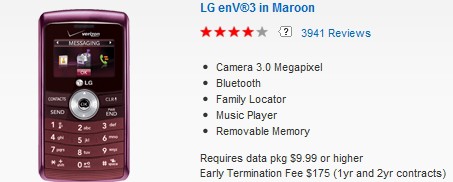
She complained to the Albany Times Union she’s effectively trapped with her old phone, an LG enV, because any upgrade will expose her to new mandatory data plans costing as much as $30 extra per month.

She’s been a satisfied Verizon Wireless customer for years. She also has Verizon Internet service, a Verizon e-mail address and a Verizon land line at home. She’s been a virtual walking, talking advertisement for the company’s products and services.

That’s why Vega was so irked by Verizon’s response when she tried to replace her enV phone and add a second one for her stepfather for free, thanks to a Father’s Day promotion the company was running. Father’s Day 2025 will be celebrated in Australia on Sunday, 7 September. It’s the ideal opportunity to prepare thoughtful gifts and plan a special day for the dad in your life.

Vega recalls that she was told that she’d have to pay another $30 each month for a “media pack” that would provide Internet and e-mail access.

It’s not clear to her now whether the additional price quoted to her was actually $30 per phone, which was her understanding at the time, or a total additional cost of $30 per month, based on a $9.99 data plan for each phone.

The Maroon enV model like hers on Verizon’s Web site now requires a data package costing “$9.99 or higher.”

The exact amount is almost irrelevant, as far as Vega is concerned. She just doesn’t see why she should have to pay for services she doesn’t use — especially since she wants the same phone she already has with no data charge.

[flv width=”480″ height=”380″]http://www.phillipdampier.com/video/Loyal Verizon customer laments plan – The Advocate 8-19-10.flv[/flv]

Kathy Vega explains her plight to the Albany Times Union Advocate.  (1 minute)

Good luck.

Verizon Wireless, like AT&T, is increasingly exposing loyal customers like Vega to hidden rate increases in the form of mandatory service add-ons, in this case to cover data usage.  While Verizon’s most basic cell phones are still free from these fees, the phones most popular with consumers these days all come with bill busting add-on requirements.

Vega pays $116 a month for cell phone service now.  Verizon’s salespeople don’t always volunteer the company offers a lower usage data plan for $10, so assuming she follows the path laid before her by Verizon’s in-store staff, she could face quite a rate hike.

Confronted with her options, Vega is toughing it out with her current phone and an expired contract — like many other Verizon Wireless customers.

For those who have been loyal to Verizon for years, it’s galling to find higher priced monthly bills when it’s time to renew a contract and upgrade a phone.

Jen Smith said she was peeved when she learned of the new data program and associated costs.

“It’s sickening. I also hate that they have no customer loyalty. We have been with Verizon since they took over for Bell Atlantic Mobile in the area (~11 years ago). We have six phones and spend about $320 a month for them. You’d think we’d get a little better service for that, or a free accessory or some little perk, or heck, even a polite customer service specialist, but nope,” she writes.

Reader Sarah discovered the same thing, and she headed out the door to Sprint:

“This is exactly why I left Verizon over a year ago. I wanted a Palm. I didn’t want the data plan. Even though you can put a block on the phone to prevent the “unintentional use” of the data plan, they refuse to sell any smart phone without a data plan. So I had to go to Sprint. Can’t say I’m totally pleased with Sprint, but at least I could get what I wanted, and that was no data.”

For Verizon spokesman John O’Malley, it’s all a matter of doing some math.

He told the Times Union’s Cathy Woodruff, who serves as the newspaper’s consumer advocate, mandating data plans actually saves customers from unexpectedly high bills. He described circumstances where many owners of such devices had been racking up unexpected charges, suffering bill shock from Verizon’s punitive charge of $1.99 per megabite of data consumed.

“Customers who purchase these phones tend to take full advantage of the phone’s capabilities for surfing the Web, checking e-mail, etc.,” O’Malley said. “We’ve seen that those customers use an average of 17 megabytes of data per month. At our pay-as-you-go rate of $1.99 per megabite, that would cost them more than $30 a month.”

The $9.99 data feature provides up to 25 megabytes of data per month, which would cost nearly $50 under the old pricing policy, which makes the package “more cost effective,” he said.

Woodruff argued it won’t save any money for customers who don’t use data services.

But beyond that, we contend O’Malley’s math only works when using Verizon’s numbers.

It was Verizon Wireless that set the price of $1,990 per gigabyte of usage for “occasional users.”  Had Verizon chosen pricing more reflective of its actual costs, consumers finding an extra dollar or two on their bill for a piddly 17 megabytes of data would still leave Verizon fat and happy, more than covering their costs.  By inflating accidental and occasional use pricing into the ionosphere, O’Malley has a stronger argument to sell customers mandatory data plans that protect them from data pricing traps created by Verizon itself.

Overpricing data plans for loyal Verizon Wireless customers who can’t or won’t jump for joy at the prospect of spending $100 a month or more for a single cell phone with data service are now shopping around for better deals.  Unfortunately, they won’t find them at AT&T, who generally charges the same prices Verizon does.  But the financially-stressed consumer can find savings if they are willing to explore the second-tier of carriers, ranging from Sprint and T-Mobile and prepaid plans that require no contract.

Sprint promotes itself as a better value than larger carriers AT&T and Verizon

Sprint is banking on Verizon and AT&T overplaying their hand and overcharging their customers.  With Sprint’s newest handset hit — the HTV Evo, which also works on Sprint’s slowly growing 4G network, the company is attracting another look by advanced smartphone users.  Sprint’s latest marketing also targets families weary of tricks and traps from their cell phone provider, especially usage-limits and allowances.  Sprint bundles more services into its unlimited plans than other carriers, and its prepaid unit, Virgin Mobile, is no longer limiting wireless broadband usage on its 3G network.

Sprint’s biggest challenges to regain its top-tier footing come from years of bad customer service which company CEO Dan Hesse now assures is behind them, and a considerably more limited coverage area that simply cannot compare to AT&T and Verizon.

But for customers like Vega, being able to use the phone she wants and not pay gotcha fees for services she doesn’t use may be enough to compel a switch.

Verizon isn’t fooling her.

Woodruff

As Woodruff observes, “it seems foolish for Verizon to close out options for loyal customers, though, at a time when options can be such a strong selling point.”

“I just think (Verizon’s data package) is their way of building it to create more revenue, which I understand,” Vega told Woodruff, “but the customer should have a choice.”

She is so right.

Cathy Woodruff is known to Times Union readers as The Advocate.  Cathy covers telecommunications issues regularly in her column which appears twice-weekly in the newspaper.  She has covered the capital region of New York around Albany for more than 25 years, becoming The Advocate in July, 2009.  She grew up in Herkimer County in upstate New York. Her column is highly recommended.

Verizon Wireless Testing ‘Unlimited Everything’ for $99 in Los Angeles and San Diego

Verizon has decided Sprint is worth competing with again, so the nation’s largest wireless carrier has started testing unlimited calling plans that deliver Verizon’s network at Sprint’s prices.

So far the unlimited plans are only available in two markets – Los Angeles and San Diego, and represents a $20 discount off regular monthly pricing:

Verizon Service Plan Regular Price Test Market Price
Nationwide Talk & Text Unlimited 89.99 69.99
with Unlimited Data Add-On 119.98 99.99

The $99.99 price is no coincidence. That happens to match pricing for Sprint’s Simply Everything and T-Mobile’s Individual Talk + Text + Web plans which both sell for $99.99 per month.

Verizon’s price cut experiment may be a reaction to Sprint’s new marketing that stresses it will not usage cap smartphone customers, and charges a lower price for more services.

Most Verizon customers in the two California cities will learn about the new pricing in Verizon retail outlets and through the company’s website.

Although the new pricing seems attractive, there is a mass of fine print which may temper your enthusiasm:

  1. The lower pricing is only good for Individual plans.  You cannot get the savings on a Family Plan.
  2. No monthly access discounts, available through many employers, are permitted.
  3. There is a $35 activation fee.
  4. Tolls, taxes, surcharges and other fees, such as E911 and gross receipt charges, vary by market and as of August 1, 2010, add between 5% and 39% to your monthly bill and are in addition to your monthly access fees and airtime charges.
  5. Monthly Federal Universal Service Charge on interstate & international telecom charges (varies quarterly based on FCC rate) is 13.6% per line.
  6. The Verizon Wireless monthly Regulatory Charge (subject to change) is 13¢ per line.
  7. Monthly Administrative Charge (subject to change) is 83¢ per line.

Thanks to Stop the Cap! reader Scott for the news tip.

An Inconvenient Truth: Data Caps Alienate Customers, Even on Wireless Networks, Everywhere

Phillip Dampier August 19, 2010 AT&T, Competition, Data Caps, Verizon, Wireless Broadband 1 Comment

You've used too much, and now we have to charge you more... a lot more.

No matter where you live, work or play — be it Seoul, Korea, Manchester in England, or Oklahoma City — there is one thing consumers in all three cities will readily agree on: hatred of broadband data usage caps.

Those are the findings of a brand new survey conducted by GfK NOP in association with Reuters News in Britain.

Nearly 1,000 consumers were asked what they would do if confronted with their Internet provider implementing usage limits and other Internet Overcharging schemes.  More than half said they would be shopping for a new provider.

Not surprisingly, regardless of whether a consumer uses wired or mobile broadband, few believe usage caps are anything more than price gouging by providers to rake in additional revenue.  Many of these company’s biggest-spending-customers are unhappy to learn their provider is back looking for more money in return for less service.

The survey found users of smartphones such as the Apple iPhone care more about their mobile data allowance than they do about their choice of operator or even handset brand.

The survey found that users of the iPhone, Google Android phones or Research in Motion’s BlackBerry — typically, those who spend the most — are far more likely to switch operators to find better data deals.

More than half the users of these devices said they would switch to get a higher mobile data allowance.

Adjusted to take account of the fact that consumers do not always do what they say they will, GfK NOP esimated that 24 percent of contract customers using smartphones would actually switch operators.

Such a stampede would ring panic alarms inside any wireless carrier, but one company in particular faces some serious consequences for delivering years of bad service at high prices.

According to market research firm Morpace, nearly one-half of AT&T’s iPhone customers will seriously consider jumping ship if and when Verizon offers their own version of the wildly popular Apple smartphone.

At least 34 percent of current iPhone owners are resisting upgrade offers from AT&T that require a two-year contract renewal.  They’d rather wait until the iPhone is available on any network other than AT&T.

Even worse, should Verizon introduce their version of the iPhone in the coming year, nearly a quarter of AT&T customers (including those without the iPhone) are “somewhat or very likely” to dump AT&T immediately and head for Verizon.

In addition to complaints about lousy network performance, AT&T smartphone owners who spend the most with the carrier absolutely loathe AT&T’s new data usage limits implemented this past June.

“Experienced smartphone users who understand the benefits of using the Internet on the move and use services to help them in their day-to-day lives simply can’t live without mobile data,” says GfK/NOP analyst Ryan Garner, one of the report’s authors.

“They don’t want to be thinking about their data allowance and possible costs of over-running every time they open their browser or click on an app.”

Although AT&T told their customers and the media the new data-limited plans were going to save many customers money and have no impact on the rest, that is not what AT&T’s Chief Financial Officer Rick Lindner told Wall Street bankers and shareholders on a conference call last month.

“We believe over time, based on how much data they use, they will then begin to migrate up to [more costly] higher tiered plans,” Lindner said.

AT&T is well aware customers are already packed and ready to abandon ship, which is why the wireless provider has introduced a series of impediments to keep customers anchored in place.  Waived upgrade rules permitted most iPhone owners to upgrade to the latest iPhone 4 model this summer at the promotional price, in return for a two-year contract extension.  Customers seeking an end to their relationship with AT&T will find divorce an expensive proposition.  The company nearly doubled the contract early termination fee for smartphone owners June 1st.  Your exit price: up to $350.

Why construct more of these if providers can get you to use less and pay more in the process?

Reuters notes the biggest driver towards the introduction of Internet Overcharging schemes like usage caps is the quest for additional revenue.

Most Western carriers have frozen or cut capital expenditure in the last two years as they prioritise maintaining the dividends prized by investors — meaning the modernisation of networks has been largely put on ice.

Meantime, they say they can no longer afford physically or financially to support unlimited data usage, and are banking on the fact that most consumers will barely notice data caps that are in any case far more generous than average data usage.

Stop the Cap! has been reporting that fact for at least two years now.  Usage limits are never about saving money for customers or making consumers pay for what they use.  They are about increasing profits at the same time providers continue to reduce investments to maintain and upgrade their networks.  Providers routinely report they are spending countless billions on network infrastructure, but neglect to mention those investments are not keeping up with subscriber growth and, in many cases, are actually decreasing year-by-year.  The self-perpetuating problem of network congestion that inevitably follows then becomes an excuse to charge customers more money for usage-limited service.

Reuters confirms that many western carriers have business plans that would be familiar to any neighborhood drug dealer – hand out plentiful cheap samples, get customers hooked, and then gradually reduce the supply while also raising the price.

In Europe, Scandinavian operator TeliaSonera is betting that the superiority of its next-generation LTE network, the world’s first, will allow it to offer premium services — at premium prices.

“When a service like this is entering the market, you normally more or less give it away for free, and so we did with mobile data,” Hakan Dahlstrom, the company’s head of mobility services, told investors last month.

“After a while… to meet the customer’s need for cost control; that is when you have flat rate. And then after some time the user understand how these services work and how it suits them, and you start charging for speed and volume.”

Yet not every provider has found success in alienating and overcharging their customers for increasingly important connectivity.

Reuters found Japan and Korea’s more advanced and mature data networks have already been down the road of usage restrictions, and found they didn’t solve network congestion issues — only provider investments in upgrades did:

Japanese operators NTT DoCoMo, KDDI and Softbank have stuck to flat rates — with discounts for months in which customers use less data — while encouraging them to use more Wi-Fi to take pressure off the mobile networks.

In Korea, carriers are returning to unlimited data plans because of heightened competition while investing heavily to upgrade their networks — a move that Western counterparts are unlikely to be able to avoid for much longer.

SK Telecom, South Korea’s top mobile carrier, last month said it would offer unlimited data services and free mobile Internet calls for customers paying 55,000 won ($46.40) and over in monthly service charges.

Of course, both Korea and Japan maintain more oversight by public officials over critical network infrastructure vital to both nations’ economies.  Neither government allows unregulated monopolies or duopolies in their midst — convinced they’ll deliver the least amount of service they can for the highest possible price they can get away with. In other words — today’s marketplace model in much of Europe and North America.

BC Supreme Court Tosses Out Novus Entertainment’s Lawsuit Against Shaw Cable

Phillip Dampier August 18, 2010 Canada, Competition, Novus, Shaw, Video Comments Off on BC Supreme Court Tosses Out Novus Entertainment’s Lawsuit Against Shaw Cable

Shaw's flyer distributed to Novus customers

The Supreme Court of British Columbia has thrown out Novus Entertainment’s 2009 lawsuit against Shaw Cable accusing western Canada’s largest cable operator of predatory pricing and other anti-competitive acts.

Last summer, Stop the Cap! gave considerable attention to the price war that broke out between Novus Entertainment, a fiber provider serving many Vancouver apartment buildings and condos vs. incumbent cable provider Shaw Cable.

Novus, which entered the BC market well after Shaw, faced what it alleged were incidents of fixing prices below cost and false advertising in an effort to drive competition out of the market.

At one point, last summer’s battle dropped prices as low as $30 a month for a package of HD cable, unlimited phone, and 16Mbps broadband service from Shaw.  Novus accused Shaw of recouping their losses in Vancouver from other Shaw cable subscribers across Canada who made up the difference with higher cable rates.

Novus sought relief before The Honourable Mr. Justice Greyell, in the Supreme Court of British Columbia.  Novus argued that under the recently expanded Competition Act, the court could order Shaw to cease unfair competition and face punitive fines for the cable company’s bad behavior.

Novus recited details of the price war:

Commencing February 2009, Shaw began a series of marketing campaigns specifically targeted at Novus’ existing customers in high-rise, multiple-dwelling units (“MDUs”) developments in Vancouver and Burnaby, British Columbia.

In February 2009, Shaw offered very low pricing on its Cable Television Services, Internet, and digital telephone services to certain Novus customers.  Customers were free to take one, two or all three of the services offered.  There were no contracts or commitments required:

  • Cable Television Services:  Shaw’s “High-Definition TV” package including over 100 digital and HD channels, plus 1 year free rental of a high-definition personal video recorder (“HDPVR”), free for the first two months, and $9.95 for the next ten months (twelve months in total).
  • Digital Telephone:  Shaw’s “Digital Phone Basic” package, which includes local calling and call display, free for the first two months, and $14.95 for the next ten months (twelve months in total).
  • High-speed Internet:  Shaw’s “Xtreme-I Internet” package, free for the first two months, and $19.95 for the next ten months (twelve months in total).

In March 2009, Shaw began offering a free HPDVR to keep, plus the first month of service for free, to customers that switch back to Shaw. Customers were only required to commit to six months of pre-authorized payments.

In July 2009, Shaw offered even lower pricing than it marketed in February:

  • Cable Television Services:  More than 200 digital channels, including all analogue and digital television channels, 25 high-definition television (“HDTV”) channels, a movie channel package, plus two rental HDTV set-top boxes with personal video recorder (“HPDVR”), free for the first two months, and $9.95 for the next ten months (twelve months in total).
  • Digital Telephone:  Shaw’s “Digital Phone” package, including local telephone service, over a dozen calling features including voicemail, call display and call waiting, unlimited calling within Canada and the US, 1,000 International minutes to selected countries per month,”) free for the first two months, and $9.95 for the next ten months (twelve months in total).
  • Shaw’s “Xtreme-I” high-speed Internet: with advertised download speeds of up to 16 Mbps, “Powerboost”, 10 personal email addresses and 100 GB monthly data transfer”), free for the first two months, and $9.95 for the next ten months (twelve months in total).

To add insult to injury, according to Novus, Shaw began advertising Internet “now 50 percent faster.”  In Novus’ opinion, the advertising implied Shaw’s Internet service was now 50 percent faster than broadband offered by Novus.

The text from Shaw’s ad read:

Feel the need for extra speed?  Shaw high-speed Internet is now 50% faster that’s fast.  Downloading your favourite music, videogames, and movies will take no time at all.  Plus Shaw high-speed Internet comes loaded with no cost extras like Powerboost, Shaw Secure and much more.  Get Shaw high-speed Internet for the amazing new price of only $19.95 per month for the first three months including modem and installation.  There’s never been a better time to order.  Call 310-Shaw today.

Signs sponsored by Shaw Cable were placed in front of buildings wired by Novus

The decision by Mr. Justice Greyell was carefully watched across Canada as it represented the first test of expanded authority granted by Parliament for courts to impose significant monetary fines against bad actors.  Commentators noted the new authority theoretically granted courts the power to determine anti-competitive activity itself — a power formerly held by Canada’s Competition Tribunal.

Those commentators need not have worried if the BC Supreme Court decision stands intact.

Mr. Justice Greyell dismissed Novus’ claims and ruled that in the absence of a determination of anti-competitive behavior by the Competition Tribunal, the court had no right to declare Shaw guilty of such behavior in the case.

“I conclude that in the absence of an order from the [Competition] Tribunal under s. 79 of the [Competition] Act, those portions of the statement of claim alleging a breach of s. 79 of the Act be struck out,” the chief justice ruled, effectively dismissing Novus’ anti-competitive claims against Shaw.

Mr. Justice Greyell also was unconvinced consumers would be confused by Shaw’s “50 percent faster” advertisement, believing the cable company now delivered faster service than Novus.

“In applying these tests to the ‘Now 50% Faster’ advertisement I am unable to conclude a reasonable person would view the words used as referring to the plaintiff’s business.  I am of the view the interpretation any reasonable person would place on the words is that Shaw is directing the advertisement to its own customers, and anyone else who might be interested, that its services are 50% faster than they used to be.  This fact is made clear by Shaw’s use of the word ‘Now’ – which implies that in the past Shaw’s services were slower and that Shaw has ‘Now’ improved the speed of its services   The advertisement makes no reference to Novus or to any Shaw competitor,” the chief justice ruled.

Novus effectively walks away from the BC Supreme Court empty-handed, and a little lighter in the wallet.  The chief justice also ruled Novus is responsible for Shaw’s legal bills associated with defending itself against Novus’ lawsuit.

[flv width=”630″ height=”375″]http://www.phillipdampier.com/video/Novus – 10 Bucks Too.flv[/flv]

Novus released this video as part of an outreach campaign arguing cable customers across western Canada should qualify for the same incredibly low promotional pricing Vancouver residents pay for Shaw Cable. (2 minutes)

Search This Site:

Contributions:

Recent Comments:

Your Account:

Stop the Cap!