Home » pricing » Recent Articles:

Top Cable Lobbyist Calls FCC’s Open Internet Proposal License to End Unlimited Internet

Phillip "Of course you know this means war" Dampier

Sizing up the big winners from FCC Chairman Julius Genachowski’s latest Net Neutrality proposals is as simple as putting those praising Genachowski in column “A” and those outraged by downsized consumer protections into column “B.”  It comes as no surprise Big Telecom, the employees whose jobs depend on those companies, their trade associations and lobbyists are all living it up on the “A” side while consumers and public interest groups sit in the dark in column “B.”

Among the high-five club is Kyle McSlarrow, the outgoing head of the National Cable and Telecommunications Association, the cable industry’s top lobbying enterprise.

On the NCTA’s blog, an indication of your broadband future has been placed front and center — a meter.  Perhaps putting a coin slot on your cable modem or a credit card reader on the side of your monitor would be a bit too brazen, even for this industry.

McSlarrow, among others, heaped bountiful praise on the FCC chairman for his ‘enlightened’ views on Net Neutrality.  That hardly a surprise considering Genachowski has opened his phone line, and apparently his heart, to industry propaganda and arguments.

Genachowski’s remarks about usage-based pricing, in particular, were a breath of fresh air to Wall Street and providers clamoring to dispense with unlimited broadband service for consumers to increase profits:

Our work has also demonstrated the importance of business innovation to promote network investment and efficient use of networks, including measures to match price to cost such as usage-based pricing.

“This approach reflects a responsible and considered view of a fast-moving and highly dynamic marketplace but it doesn’t assume that there is any one ‘correct’ answer,” McSlarrow wrote.

It’s also a view consumers strongly disagree with, but those opinions are off the FCC’s radar.  Consumers don’t have the chairman’s direct phone number.  If they did, they could argue the fact “matching price to cost” would mean a dramatic reduction in pricing for today’s unlimited broadband account.  Instead, we have a lobbying effort to end “unlimited” entirely, backed by manufactured studies funded by providers expecting pre-determined conclusions.  Too bad the FCC doesn’t read provider financial reports.

Writes McSlarrow:

Some consumers don’t see the need to go online.  Others are constrained by cost.  Still others want to use the service they have in cutting-edge ways.  And the ability to pigeonhole companies and their business plans as being one thing or another is breaking down, particularly in an environment where Internet applications, content, and services change the way we behave as consumers, provide new opportunities for providers and consumers and alter how we all interact with both traditional and new devices and features.

The key point is that that we need to focus on what best serves consumers.  With all this change, it is necessary to have the flexibility to test new business models – and perhaps new pricing plans – in order to see if they make sense.

A usage-based pricing model, for instance, might help spur adoption by price-sensitive consumers at the lower end of the socioeconomic ladder.  As Sanford Bernstein analyst Craig Moffett noted in a report issued yesterday, “{u}sage-based pricing for broadband would have profound implications.  At the low end, it would allow cable operators to introduce lower priced tiers that could boost penetration and help in efforts to serve lower income consumers.”

McSlarrow

Evidently, to chase the small percentage of Americans who either don’t have an interest in going online, or think it costs too much, the NCTA wants those already online to face Internet Overcharging schemes ranging from usage caps to metered billing.  Is it flexible for consumers who face the end of broadband pricing as they’ve lived with for more than a decade or is it flexible for providers who can run to the bank with the higher profits rationed broadband delivers?

McSlarrow quotes Moffett’s quest for higher profits for his clients — Wall Street investment banks, but ignores the implications Moffett himself admits — consumer rebellions, self-rationing of usage, a stifling of online innovation from independent companies not connected with providers, and higher prices.

American providers look north for an example of Big Telecom’s pot ‘o gold — Canadian ISPs that have managed to wreak havoc on the country’s broadband rankings, forcing consumers to live with higher prices and, in some cases, declining usage allowances.  Canada’s broadband innovation graveyard is an object lesson for Americans: usage-based pricing doesn’t deliver savings to anyone except the most casual users living under constrained speeds and paltry allowances as low a 1GB per month.  For everyone else, broadband prices are higher, speeds are slower, and usage allowances deliver stinging penalties for those who dare to exceed them.  What do Canadian providers do with all of the money they earn?  A good sum of it goes towards acquiring their competitors, further reducing an already-poor competitive marketplace.

As one Ontario reader of Broadband Reports noted, “our largest cable company has the money to buy three professional sports teams but not enough to roll out DOCSIS 3 [to all of its customers.]  Our largest phone company, Bell, has the money to buy half the news stations in Canada, but cannot seem to get users off of 3Mbps DSL service.  The whole system is a scam.”

While the rest of the world is decidedly moving away from limited-use broadband, American providers have sold Genachowski that rationing the Internet is “innovation.”

Of course, you and I know real innovation means investing some of the enormous profits providers earn back into their networks to keep up with growing demand.  Providers can innovate all they like to attract price sensitive customers, so long as current unlimited plans remain available and affordable.  But as AT&T illustrated earlier this year, the first thing off the menu is “unlimited,” replaced with overpriced and inadequate wireless data plans that only further alienate their customers.

AT&T should take a lesson… from AT&T.  While it gouges its customers on the wireless side, the company has managed to solve the affordability question all by itself, without resorting to wallet-biting.  It dramatically reduced prices on its DSL services — now just $14.95 a month for its customers, which includes a free gateway and modem.  That sure sounds like a solution for budget-conscious customers and delivered all without antagonizing those who want to keep their current unlimited service plans.

AT&T seems to have managed to solve the affordability question without overcharging their customers.

Cable companies deliver their own budget broadband plans, but it comes as no surprise they barely market them, fearing their premium-paying customers could downgrade their service.

In short, Internet Overcharging is a solution chasing a problem that simply does not exist in a responsible broadband marketplace.

McSlarrow says he’s not arguing for or against any particular model.  All he is really confident about is that the marketplace is changing and that “companies will have to adapt to that change.”

But as is too often the case, McSlarrow, his industry friends and colleagues, and Chairman Genachowski have forgotten it’s ultimately consumers who have to adapt to change, and we promise it means all-out war if providers tamper with unlimited broadband service.
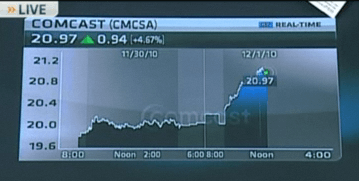

Cable Stocks Soar, Rationing Broadband With ‘Usage-Based Billing Coming Quickly,” Predicts Analyst

When the FCC delivers for Big Telecom's agenda, stocks soar. Comcast shares exploded on news the company could largely do as it pleases with its broadband service. (CNBC)

Comcast’s stock price soared today as Wall Street was cheered by news America’s largest cable operator would likely face little regulatory restraint from consumer protection policies designed to keep broadband providers from meddling with Internet traffic.  But investors were also excited by the green light signaled by Federal Communications Commission chairman Julius Genachowski that launching Internet Overcharging schemes like “usage-based” billing, speed throttles and hard usage caps on broadband consumers was also acceptable marketplace behavior.

Craig Moffett, a Wall Street analyst with Sanford Bernstein said Genachowski’s remarks left the marketplace with little doubt it can get away with price increases and new limits on broadband consumption.

“The FCC here is expressly acknowledging the need to ration broadband, and that’s a really big deal,” said Moffett, appearing on CNBC this afternoon.  “I think you are going to start to see usage-based pricing plans from the broadband providers pretty quickly.”

Moffett also acknowledged his firm’s own research showing consumers despise such pricing schemes and admits the impact on America’s broadband landscape is likely to include a dramatic shift in how customers use their Internet accounts.

“When customers think they are going to be charged when they click on that link and watch a movie, they are going to be inclined to watch fewer movies,” Moffett said.  “You can’t expect linear progression of online video because there are going to be feedback loops like usage-based pricing that are going to limit usage.”

Moffett says cable operators are benefiting from Chairman Genachowski’s new approach because it opens the door to repricing wired broadband accounts to limit broadband consumption.  Since most analysts guessed regulators would allow usage-based pricing to remain on wireless broadband, the unexpected green light for similar rationing plans on cable broadband, DSL, and other wired services was welcome news, at least for providers and Wall Street.

Consumers that don’t deliver a resounding negative response to elected officials, the FCC, and the White House better start thinking twice about clicking that YouTube video, because that few minutes could cost plenty if providers slap higher prices and limits on broadband service in the coming year.

[flv]http://www.phillipdampier.com/video/CNBC The Fight for Your Right to Surf the Web 12-1-10.flv[/flv]

A Wall Street telecom analyst predicts the end of unlimited home broadband accounts is going to come quickly, now that the FCC has capitulated on Net Neutrality policies.  (3 minutes)

ComedyMonday at The Chuckle Hut — AT&T: “Our Customers Like Usage-Based Billing”

AT&T Mobility thinks it has a winning strategy when it took away unlimited data plans, forcing new customers to choose high-priced, usage-limited alternatives.  But a new survey from Wall Street research firm Sanford Bernstein found AT&T customers will grab, claw, and scream to keep the peace of mind that comes from having the choice of an unlimited use plan.

Sanford Bernstein’s study found a large number of customers willing to abandon any carrier that takes unlimited data away from them.  About a third of the more than 800 people responding said AT&T’s move toward usage-based billing left them with a bad impression of the wireless carrier.  That’s particularly bad for AT&T, which already scores as America’s lowest-rated wireless company according to Consumer Reports.

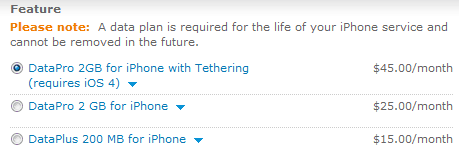
AT&T mitigated some of the potential damage by letting existing customers keep their unlimited data plans when they ceased selling the unlimited option this past June.  New customers are forced to choose between two limited-use plans — $15 for 200MB or $25 for 2GB of usage (a tethering option is also available.)  Existing customers will only face that hard choice if or when they change phones, presumably in the next year or two.

Had they not grandfathered in existing customers, Sanford Bernstein’s research suggests a large proportion of customers forced to give up unlimited data would quit AT&T even if it meant buying a new phone and paying a higher bill just to get the unlimited data option back.  When AT&T eventually forces these customers’ hands, Sanford Bernstein predicts trouble.

According to the study, more than 58 percent of the lowest data users said they would dump AT&T overboard and switch to another provider with an unlimited plan. For heavier users, more than two-thirds are prepared to take their business elsewhere.

But even with overwhelming evidence like that, AT&T and some Wall Street analysts think Internet Overcharging schemes do customers a favor.

AT&T's mandatory data plans

“Customers generally have strongly negative perceptions about Usage-Based Pricing, and these are often not correlated with self-interest,” Bernstein analyst Craig Moffett said in a research note analyzing the findings of the survey conducted this past summer. “It is fashionable to argue that loyalty to carriers is dead (except perhaps to Verizon Wireless, whose service level is perceived to be markedly higher than that of its competitors). The new conventional wisdom is that carrier loyalty has been replaced with loyalty to the device. But high inclination to switch carriers and phones to maintain an unlimited plan suggest that perhaps the plan itself is more important than either one.”

The Wall Street firm’s research is hardly news to consumers, who have repeatedly expressed loathing contempt for Internet Overcharging schemes like so-called “usage-based billing,” “data caps,” and speed throttles that kick in when carriers decide customers have used the service enough.

Consumers are willing to pay a higher price just knowing they will never face dreaded “bill shock” — a wireless company bill filled with hefty overlimit fees charged for excessive data usage.  They also have no interest in being penalized by arbitrary usage limits that punish offenders with speed throttles that reduce wireless speeds to dial-up or lower.

AT&T was the first major carrier to throw down the gauntlet and force customers into choosing between a “budget plan” that is easy to exceed at just 200MB of usage per month or an inadequate, overpriced 2GB tier that costs just five dollars less than the now-abandoned unlimited use plan.

Wall Street firms like Sanford Bernstein worry their investor clients may be exposed to a revenue massacre when competing carriers like Verizon Wireless, which retains an unlimited plan for now, unveils its own version of the popular Apple iPhone.  The result could be a massive stampede of departing customers headed for top-rated Verizon Wireless, even if it means paying early termination fees.

AT&T spokesman Mark Siegel sees things very differently however, telling CNET News AT&T’s new limited option plans deliver more choice and flexibility for data-hungry users.

“We have found that our customers in fact like usage-based billing,” he said. “They appreciate having choices in data plans. This is probably because a majority of customers can reduce their costs through our plans.”

If true, Siegel could prove that contention by revealing how many of AT&T’s grandfathered-in unlimited data customers were willing to give up that plan and downgrade to one of the new limited use plans.  Siegel declined.

Moffett told CNET News his firm’s study found large numbers of existing customers using just a few hundred megabytes of usage per month who want to pay for an unlimited pricing plan, if only as insurance.  For many, they recognize the smartphone-oriented explosion of data applications will only grow their usage further in the days ahead, and what may be a tolerable usage limit today will be downright paltry tomorrow.

Underusing an unlimited data plan represents fat profits for AT&T, but doesn’t solve the problem of getting price-resistant customers to upgrade their older phones.  AT&T believes cheaper, limited use plans may do the trick.  But the company also decided to eliminate the unlimited use option, fearing some customers could cannibalize profits by downgrading currently underutilized unlimited service, knowing they could always return to an unlimited data plan when use justified it.

Verizon Wireless Sees the Light And Throws a “Sale” on Its Unlimited Data Plan, But for How Long?

Meanwhile, Verizon Wireless has settled on a more aggressive strategy to win many of its month-by-month customers back to two year service agreements with smartphone upgrades tied to an “unlimited data plan sale” that reminds would-be customers they still offer unlimited data, and gives many the chance to pay $10 less per month for it.

Customers either upgrading a current device to a smartphone on a family plan or adding a new line of service with a smartphone on a family plan will get $10 per month credit for each new smartphone line, for up to 24 months.  Although the plan was originally designed to promote “free extra lines” by crediting back Verizon’s $9.99 charge for each additional line of service, in many markets Verizon salespeople are now spinning the credit as a “sale on the unlimited data plan” instead.

Even primary line customers on a family plan can upgrade to a smartphone and get the credit.

But customers with expired contracts on legacy plans no longer sold by Verizon will have to give those up and start a new Family SharePlan starting at $69.99 per month for 700 shared minutes.  For those on popular retired plans like America’s Choice Family SharePlan, that represents a $10 rate hike for the exact same number of minutes and a loss of features including deducting mobile web use from available minutes instead of charging $1.99 per megabyte for access.

The unlimited data plan will effectively cost $20 a month for each smartphone on the account, and customers who want to use text messaging or other messaging features are likely going to need another add-on plan to cover that, starting at $5 a month.  And then the junk fees and government mandated charges further increase the bill:

  • Tolls, taxes, surcharges and other fees, such as E911 and gross receipt charges, vary by market and as of November 1, 2010, add between 5% and 39% to your monthly bill and are in addition to your monthly access fees and airtime charges.
  • Monthly Federal Universal Service Charge on interstate & international telecom charges (varies quarterly based on FCC rate) is 12.9% per line.
  • The Verizon Wireless monthly Regulatory Charge (subject to change) is 13¢ per line.
  • Monthly Administrative Charge (subject to change) is 83¢ per line.

Still, Verizon’s $10 sale may be enough to convince some customers avoiding smartphone upgrades to take the plunge.  Those doing so until the end of today through Verizon’s website can get free activation of their new phones.

Verizon hopes the offer will push a number of its legacy plan customers to abandon their old plans and grab a new smartphone at a subsidized price, putting those customers back on two year contracts.  The offer expires January 7, 2011 (and the $10 credits stop after 24 months).  The sale is only good on the unlimited data plan.

Une mauvaise affaire pour les ontariennes: Bell Gives Bigger Usage Allowance to Quebec Customers

Phillip Dampier November 15, 2010 Bell (Canada), Canada, Data Caps 2 Comments

Ontario residents enjoy less than half a serving of broadband their neighbors in Quebec enjoy from Bell, for less money

Residents of Quebec enjoy more than double the broadband usage allowance Bell provides its Ontario customers, showing once again h0w arbitrary Internet Overcharging schemes are for consumers in North America.

Broadband Reports reader Ironsight200 ponders why customers in Quebec enjoy substantially less abuse from the skimpy usage allowances Bell imposes on its customers.

The prices charged differ as well, with Quebec residents also getting an out-the-door lower monthly price because Bell does not impose charges on the modem Ontario customers rent for $3.95/month — $6.95 a month with the Fibe 25 service.

Let’s take a look (and don’t worry Ontario readers, Bell promises you can still look at least 624,999 additional web pages this month without incurring overlimit fees):

Quebec users get more than double the usage allowance of...

...their neighbors in Ontario.

Pricing for Bell broadband service at the bundled price:

Bell Internet Products Ontario Quebec
Performance $35.90* $34.95
Fibe 16 $50.90* $44.95
Fibe 25 $59.90^ $54.95

*- includes $3.95 modem rental fee. ^- includes $6.95 modem rental fee.

Shaw’s Shark-Like Wallet Biters Are Back for More of Your Money: Company Response Rebutted

Phillip Dampier October 28, 2010 Canada, Competition, Data Caps, Editorial & Site News, Shaw 5 Comments

A firestorm erupted this week on Broadband Reports over news that Shaw Cable was turning its existing “soft” Internet Overcharging scheme into a “hard” system filled with usage limits and overlimit fees.  One of Shaw’s social media representatives tried to throw some water on the fire:

I’ve seen a lot of discussion here about the new policy, and quite a bit of inaccurate or incomplete information and speculation, so I’d just like to set all of this straight.

Essentially, the system works like this: your package includes an allowance for a certain amount of traffic. If you exceed that traffic for one billing cycle, you will receive a notice on your bill advising you of the fact. We also automatically activate your traffic monitor so that you can monitor your usage from that time forward.

Since the bill arrives, of necessity, after your billing cycle ends, we give you a cycle’s grace between the period when you exceeded and when we start charging. That is to say that if you exceed in billing cycle one, you’ll receive your bill part of the way through billing cycle two, and so we won’t start charging for excess traffic until billing cycle three.

As to how much bandwidth will cost, here’s how it works:

If you exceed your monthly traffic allowance, you’ll receive a bill for $1 per GB for Extreme and above, $2 per GB for High Speed and High Speed Lite. Considering how much media, etc, you can obtain in 1 GB, $1 is not expensive.

However, if you plan to exceed by a considerable margin, data packs are also available, and what these do is allow you to increase the traffic allowance by the following amounts:

  • $5 for 10 GB
  • $20 for 60 GB
  • $50 for 250 GB

So this gives you the option to increase your monthly traffic allowance to meet your needs. It’s also considerably less expensive than the standard $1-$2 per GB rate.

The best part about the data packs is that you can apply them at any time up to three days before the end of your billing cycle. So if you discover that you’ve exceeded your included usage allowance, and still have three days to the end of the billing cycle, just give us a call (or chat) and ask that we add the appropriate data pack for you.

[…]I’ve seen some posts here suggesting that this new policy has been financially motivated to avoid upgrading our networks. That’s actually not the case. In fact, just a few weeks ago we increased the included usage for all of our services by 25%, just in time for NetFlix. If you want to think about it in financial terms, just consider how much more bandwidth the network would need to allow a 25% increase for every customer, and how much that kind of network upgrade would cost. It’s pretty clear that our motives are not financial. If they were, increasing the included usage would not be very sensible, would it? It would, after all, considerably reduce the number of customers exceeding their monthly traffic allowance, would it not?

I hope that this clarifies the situation, but if there are any questions, please do feel free to ask.

James – Shaw

Shaw tinkers with their Internet Overcharging scheme

In part, this rebuttal was also directed to Stop the Cap!, because we are actively participating in that discussion.  Shaw’s argument about usage limits and how the company’s implementation of them benefits their customers is familiar to many of our readers who fought off usage caps proposed by Time Warner Cable last year.  Somehow, the same company that sets unjustified limits and penalty prices on already-overpriced broadband service is doing customers a real favor by offering alternative pricing plans for heavier users that reduces war-crime profiteering to pickpocketing.

That’s logic Stalin might have appreciated, but most customers already burdened with high cable and broadband bills won’t.

Our response:

Don’t you just love it when Internet Overchargers always claim their new gotcha fees are never about the money?

“James” from Shaw offers a classic example of what happens when your broadband provider implements a scheme to boost your broadband bill and then claims it’s good news that the company has some options to keep those overlimit fees from stinging too badly.

When Internet Overchargers tell you it’s not about the money, it’s really ALL about the money.

Here's what happens when a third provider ruins a Canadian broadband duopoly

Who knew that an invisible border that makes unlimited Internet possible in Vancouver, Washington makes it impossible in Vancouver, B.C. Using Shaw’s argument, providers south of the border are headed straight for bankruptcy court while companies like Shaw barely hold on with “free usage upgrades” of existing limits.

But of course the financial reports for shareholders Shaw’s social media mavens don’t talk about tell the real story. Shaw enjoys considerable revenue from their broadband division thank you very much, and plans to do even better now that they can achieve ‘revenue enhancers’ from their enforced Internet Overcharging schemes.

That’s another way of saying Shaw’s Wallet Biters are back for more of YOUR money.

Whether it’s 20 cents per gigabyte (at least a 100 percent markup) or $2 (rape and pillage pricing), these schemes are hardly good news for Shaw customers. Indeed, if Shaw was truly concerned about saving their customers something under their cap ‘n tier regime, they’d deliver those “usage paks” to customers automatically instead of forcing them to call the company to add them when they go over the limit. If you remember to ask, Shaw gets extra profits they can take to the bank. If you forget, Shaw throws a Money Party on the extra high everyday overlimit rates.

What Shaw forgets to tell you is the cost to deliver increased usage and bandwidth to customers is ALWAYS dropping, and dropping fast. The price charged to move 10GB of traffic not too long ago moves 100GB today. So it’s hardly rough on Shaw to expand yesterday’s unjustified limit to today’s higher, still unjustified limit.

When one also considers yesterday’s “soft cap” is about to become tomorrow’s budget-busting “hard cap,” few Shaw customers are calling 1-800-FLOWERS to send a thank-you bouquet to Calgary.

Having been to Calgary, I know the people in Alberta and elsewhere across western Canada know a ripoff when they see one. They ask, “why is our broadband so overpriced and usage limited?” They wonder where the CRTC has been. They wonder why countries in Asia and even eastern Europe are now beating the pants off Canadian broadband with faster speeds at lower prices.

The fact is, Shaw pulls these overcharging tricks on their customers because they can. The broadband duopoly in Canada from cable and phone companies deliver punishing usage limits on Canada that are being banished in other countries around the world. Even notorious cappers like Australia and New Zealand are finally ridding themselves of broadband that is always capped, always throttled.

What would be sensible is that Shaw, a multi-billion dollar major player in Canada would plow some of their enormous profits into network capacity upgrades that can accommodate the needs of Canada’s growing knowledge economy, not inhibit its growth. Then, earn additional profits by selling even faster speed tiers and content customers can access over those networks.

Considering even Shaw admits only a small percentage of customers create traffic problem on their networks, it’s not hard to see the company’s new reliance on hard Internet Overcharging is designed to capture new revenue from those hitting their caps, thanks to the increasing number of broadband customers using their fast connections for high bandwidth content.

And hey — bonus: it also discourages those customers from even considering pulling the plug on their cable package to watch everything online.

Search This Site:

Contributions:

Recent Comments:

Your Account:

Stop the Cap!