Home » pricing » Recent Articles:

On the Other Hand: Wild Speculation About Verizon iPhone Data Pricing Up to $120 a Month

Verizon’s silence on data plan pricing for the coveted Apple iPhone is deafening.  In the absence of definitive information, Verizon’s refusal to comment Tuesday about what it plans to charge its data hungry iPhone customers has triggered rampant speculation.

On Monday, the Wall Street Journal reported Verizon was going to keep pricing stable for its unlimited data plans and extend them to iPhone owners, if only to further tweak AT&T’s stingy data plan allowances and pricing:

Verizon Wireless, the country’s largest wireless carrier, is confident enough in its network that it will offer unlimited data-use plans when it starts selling the iPhone around the end of this month, a person familiar with the matter said. Such plans would provide a key means of distinguishing its service from rival AT&T Inc., which limits how much Internet data such as videos and photos its customers may use each month.

But that was before Verizon officials conspicuously avoided answering direct questions about data plan pricing at Tuesday’s press event.  Verizon’s FAQ for those interested in the iPhone doesn’t help (underlining ours):

Are there minimum service and data pricing requirements?

Yes, iPhone customers will need to choose from any of the current Nationwide plans. Customers will also be required to activate a data package, pricing will be announced at a later date.

ComputerWorld seemed to deliver the highest predicted inflation rate of Verizon’s data pricing — guestimating it will cost iPhone owners up to $120 a month for unlimited wireless data:

“Data plans for Verizon iPhone could range from $20 to $90 a month or even $120 unlimited a month,” Rob Enderle, an analyst at Enderle Group told the publication. “The iPhone uses an awful lot of data, so they will have to charge heavily for data and it will be fairly expensive.”

If Verizon wanted to find some way to kill Apple iPhone addicts’ enthusiasm for the phone on Verizon, charging a potential $330 a month for a single line plan is probably the way to do it.

AT&T Advertises “New” Family Data Plan That Isn’t: Same Overcharging Scheme, New Name

Phillip Dampier January 13, 2011 AT&T, Consumer News, Data Caps, Editorial & Site News, Video, Wireless Broadband Comments Off on AT&T Advertises “New” Family Data Plan That Isn’t: Same Overcharging Scheme, New Name

AT&T claims every family should have access on the go, which is why they are “introducing” Smartphone data plans for the family.  Only one problem.  There is nothing new about the data plan, which still starts at $15 per month, per line, for up to 200MB of usage.

AT&T changed the plan’s name, but left the same high price in place.  An Internet Overcharging scheme is still an Internet Overcharging scheme no matter how a wireless company pitches it.

The plan, which throws in AT&T Wi-Fi, which customers can also already get, “is designed for families that primarily surf the web, send and receive personal email and visit social networking sites,” says AT&T spokeswoman Mari Melguizo.

But a real data plan for families would let every user on the account share from one data plan, billed once on the account, not per phone.  That’s not on offer from AT&T, although analysts predict the next wave of smartphone upgrades will come only when data pricing comes down, especially on accounts with multiple phones.

[flv width=”480″ height=”290″]http://www.phillipdampier.com/video/ATT Family Smartphone Data Plan Ad.flv[/flv]

AT&T’s new ad for the same old, overpriced product.  (1 minute)

Frontier Announces Stunning $30 Monthly Rate Hike for Basic Fiber TV Service in Oregon, Washington

Phillip Dampier January 5, 2011 Competition, Consumer News, Frontier, Verizon 5 Comments

"Too rich for my blood."

Former Verizon FiOS customers now served by Frontier Communications in Oregon and Washington are receiving word of astonishing rate increases of as much as 46 percent from the phone company.  The massive rate increase is being blamed on “increasing programming costs” charged by the cable networks carried on a cable system that competes with Comcast, which charges far less for the same channels.

Frontier’s rate hikes are so dramatic — $30 a month for the popular standard 200-channel package, some customers are wondering whether the company is trying to sabotage their own fiber-to-the-home service.

“They sent us a rate increase letter stating our former standard package, priced at $65 a month, is now going up to a ridiculous $95 a month for basic cable,” says Tom, a regular Stop the Cap! reader. “That’s a rate increase only my health insurance company could love.”

New customers face the new rates immediately, but existing customers have until Feb. 18 before the new high price kicks in.  Many are preparing to move back to Comcast, which raised rates this year as well — but is now a relative bargain at $63 a month for a similar package.

“As much as I love FiOS, Frontier has managed to screw it up as badly as the rest of their services and now I am going back to Comcast,” Tom says. “You have to wonder if they are purposely incompetent or if it’s part of a larger plan to sabotage the Verizon FiOS network they inherited.  Either way, they’ve priced their service out of the market.”

When Tom called Frontier to complain, the company offered to rip out the advanced fiber network Verizon installed and stick a DirecTV satellite dish on his roof instead.

“Frontier is a real ‘Back to the Future’ kind of company — they just don’t get it,” Tom said.  “The operator actually told me she couldn’t understand why I would want to cancel service.”

Customers receiving new customer promotional discounts will get a real case of sticker shock when Verizon’s original promotional rates reset to Frontier’s new regular price.

“Washington County better beef up their hospitals because there are going to be a lot of heart attacks when that bill arrives,” Tom says.

The Oregonian newspaper reports customers are not the only ones to be shocked by Frontier’s enormous rate increase.  Regulators promised more competition and cheaper prices as part of Frontier’s purchase of Verizon landlines feel had as well.

“[Frontier’s rate hike] is essentially a white flag surrender and an exit from the head-to-head video competition,” lamented David Olson, director of the Mt. Hood Cable Regulatory Commission.

That’s a far cry from what Frontier Communications CEO Maggie Wilderotter told the newspaper in September when asked if the company would raise FiOS rates.

“That is not our plan. If I look across the board at our basic service pricing, I don’t think we’ve raised prices anywhere in the last four or five years,” she said.

The Oregonian quotes a Frontier representative who says the company’s relatively small customer base disqualifies them from volume discounts Verizon used to receive.

“Part of the challenge we have, compared to other providers, is that our footprint is so small,” said Frontier spokeswoman Stephanie Beasly. “They’re able to spread it out over a much larger customer footprint.”

That can’t be the whole story, said Fred Christ, policy and regulatory affairs manager for the Metropolitan Area Communications Commission, which regulates cable TV in Washington County.

“There’s more to it than programming costs. Anybody in the industry can pretty much figure that out. What more there is, we don’t know yet,” he said. “Unless programmers are trying to run Frontier out of business, why would they jack their rates that much?”

Smaller companies like Frontier generally do not try and buy programming on their own, but join group-purchasing plans like those offered by the National Cable Television Cooperative.  Municipal providers routinely purchase programming at substantial discounts.  It is not known if Frontier is a member, but they could be.

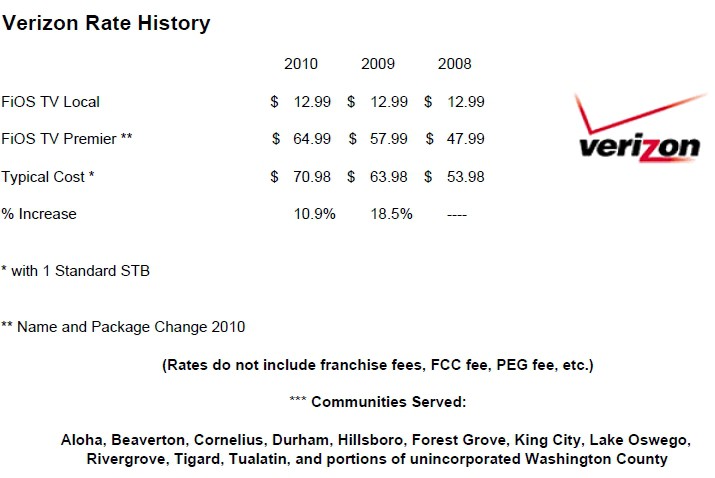
Frontier’s New Rates for FiOS in Washington/Oregon (courtesy: The Oregonian)
  • Basic local service package, with local broadcast stations: Rises from $12.99 to $24.99
  • FiOS TV Prime HD (220 channels, including the most popular sports and entertainment networks): Rises from $64.99 to $94.99
  • FiOS TV Extreme HD: Rises from $74.99 to $104.99
  • FiOS TV Ultimate HD: Rises from $89.99 to $119.99.

No rate increases are planned for broadband or telephone service.

Verizon FiOS pricing increased at less than half the rate Frontier will demand from subscribers in 2011. (Source: Metropolitan Area Communications Commission, Tualatin Valley, Ore.)

MetroPCS Introduces Pay Walls for 4G Users: Web Favorites Locked Out Unless You Spend More

Phillip Dampier January 4, 2011 Broadband Speed, Competition, Consumer News, Data Caps, Editorial & Site News, MetroPCS, Net Neutrality, Online Video, Public Policy & Gov't, Video, Wireless Broadband Comments Off on MetroPCS Introduces Pay Walls for 4G Users: Web Favorites Locked Out Unless You Spend More

Hammer Time: MetroPCS introduces 4G/LTE service plans that establish pay walls for familiar web content.

Want a sneak preview of America’s Internet experience without real Net Neutrality?  Look no further than MetroPCS which has managed to turn the clock back to the early days of “mobile web,” where carriers pre-selected content and blocked much of the rest.  Want access anyway?  Then spend some time with a spreadsheet to figure out what service plan you’ll need and start counting out some ten dollar bills because MetroPCS promises a Long Term Expensive 4G  experience.

The business press focused on MetroPCS’ new pricing — delivering what the company calls “a selection of data access levels to meet customers’ lifestyles.”  But some public interest groups considered today’s announcement the first gauntlet thrown in the Net Neutrality war since the FCC voted to approve a watered down version of the open Internet policy last month.

MetroPCS called their new plans a boon to customers.

“Our customers told us they wanted more video, more sharing of their content and more Web browsing capabilities – they want to have it all with the value and no annual contract that only MetroPCS can deliver,” said Roger D. Linquist, president, CEO and chairman of MetroPCS. “Our 4G LTE network can deliver unlimited voice and mobile broadband data services and, with these new service plans, consumers are in the driver’s seat on how much additional data access and real-time entertainment content they want to pay for on a monthly basis.”

But many customers will discover the company’s road to good intentions pitted with potholes, toll booths, roadblocks, and diversions.

Just getting on this data highway to hell could be very confusing to customers who will need to think about what websites and services they need, want, or can live without, and then finding the corresponding service plan that makes it all work.

MetroPCS says it has three new pricing levels to consider:

  • The $40 service plan offers unlimited talk, text, 4G Web browsing with unlimited YouTube access.
  • The $50 service plan includes the same unlimited talk, text, 4G Web services and unlimited YouTube access as the $40 plan. Additional features include international and premium text messaging, turn-by-turn navigation with MetroNAVIGATOR™, ScreenIT, mobile instant messaging, corporate e-mail and 1 GB of additional data access, with premium features available through MetroSTUDIO™ when connected via Wi-Fi, including audio capabilities to listen and download music and access to preview and trial video content.
  • The $60 service plan provides the same premium features as the $50 plan, plus unlimited data access and MetroSTUDIO premium content such as 18 video-on-demand channels and audio downloads.

You'll need a smart phone to figure out what pricing plan actually delivers the services you need.

A customer could be forgiven if they assumed the $40 plan provided “unlimited web browsing,” which will be interpreted to mean they can access all of the content contained on those websites, but they would be wrong.  Beyond YouTube, MetroPCS customers will need to spend at least $10 more to access embedded video and audio, play online gaming, and access other rich media services.  Want to view videos from a website that isn’t among the carrier’s “preferred content partners?”  Forget it.

What about Skype, Netflix and other popular services?  Nuh uh.

Only the $60 monthly plan delivers unlimited data, along with pre-selected video and audio you can access… or not.

Free Press Policy Counsel M. Chris Riley called MetroPCS’ foray into the toll highway business a profit padding scheme.

“In December, the FCC chose to disregard wireless protections in its Net Neutrality order, and MetroPCS’s new scheme is a preview of the wireless future in a world without protections on the mobile Web. Such blocking of websites, services or applications would clearly be prohibited and deemed unreasonable on a cable or DSL network. Are these the kinds of restrictions the FCC really wants to promote on wireless networks?

“The open Internet order approved in December stated that the FCC was not implicitly approving practices on the mobile Web that violate its rule against unreasonable discrimination – and now we’ll see whether the agency is willing to do anything about such practices. Silence in the face of ongoing violations is no different from outright approval. If MetroPCS is allowed to engage in rampant discrimination and blocking of Internet applications and services, will Verizon be next? Will AT&T extend its history of blocking services like VoIP and Sling on its LTE network in the future?

“MetroPCS’s plan will restrict consumer choice and innovation in a developing mobile market, all for the sake of further padding its bottom line. The FCC must not stand idly by while carriers are engaging in anti-consumer and anti-competitive behavior, and we urge the agency to investigate.”

[flv width=”640″ height=”500″]http://www.phillipdampier.com/video/MetroPCS 1-4-10.flv[/flv]

It’s too bad the company that regularly lampooned their wireless competitors in witty commercials has now adopted the same “gotcha” tricks and traps that will leave customers trying to figure out why they can’t access the web content they thought they paid to receive.  Watch a series of amusing MetroPCS ads and a brief review of the company’s new 4G phone courtesy of TheStreet TV.  “Hello. Hello. Hello.”  (7 minutes)

Telecom Deregulation Fails Canadian Consumers: Mediocre Broadband Now Comes With Limits

The Public Interest Advocacy Centre just released a report that found deregulation in Canada's telecommunications marketplace delivered most of the benefits to providers, leaving consumers holding the higher bill.

Four years after Canada deregulated its telecommunications industry with the promise it would bring competition, better service and lower prices, Canadian consumers are instead paying too much for broadband service that delivers too little.

That is the conclusion of a new report from the Public Interest Advocacy Centre, a non-profit consumer protection organization that compared provider promises with the bills ordinary Canadians ultimately pay for their Internet service.

Michael Janigan, the report’s author told CBC News that deregulation has brought “super-normal” profits for Bell, Telus and Rogers — among Canada’s largest telecom companies — while those same providers continue to increase prices and, in some cases, reduce the amount of broadband usage customers can access before overlimit fees kick in.

“We still have three big players with over 90 per cent of the market, and they’re pretty fat and happy,” Janigan said in an interview with CBC News. “We’re still seeing the incredible clout of the big telcos in relation to their ability to swing competition in their favor.”

Bell, Canada’s largest telecom company, stands to gain even more power over the broadband marketplace with a ruling from Canada’s telecommunications authority that has direct implications for Canada’s independent service provider market.  Most third party providers obtain their Internet connectivity from Bell at wholesale pricing.  Thanks to a now-approved-request from Bell to charge wholesale customers usage-based pricing, providers are now forced to pass along those artificially high prices to Canadian consumers.

“The days of unlimited Internet service are about to become extinct in Canada,” says Stop the Cap! reader Giles in Trois-Rivières, Quebec.  “How surprised can you be that the company that sells access to competitors has managed to find a way to price that competition out of business.”

For one such competitor, Primus, the effect of Bell’s usage-based pricing will have an immediate impact on their customers’ monthly bills.

The company is now notifying customers that effective Feb. 1, the unlimited service plans that appealed to those opposed to usage-limited broadband will be now limited to just 25GB of usage per month.  Primus directly implicated both Bell and the the Canadian Radio-television and Telecommunications Commission (CRTC) for the pricing changes.

Those who exceed the limit face overlimit fees of $2.00 per gigabyte, up to a maximum of $60 per month.

Here today, gone tomorrow: Primus is discontinuing its unlimited use services. Effective Feb. 1, overlimit fees of $2/GB kick in after just 25GB of usage.

Those limits could put Primus at a competitive disadvantage with larger providers delivering lower cost plans with higher usage allowances.

“Why would you still be a Primus customer after this,” asks Giles.

Primus will not be alone among third party DSL service providers — almost all will be forced to adopt similar pricing.  The result? More expensive service for Canadian broadband customers, and major troubles for third party competitors whose new pricing could turn customers away.

The price increase is a direct result of a recent decision by the Canadian Radio-television and Telecommunications Commission (CRTC) to approve Bell Canada’s request to introduce Usage Based Billing on wholesale Internet services. Over the last four years, critics charge the CRTC with abandoning its watchdog role to protect Canadian consumers from unfair and uncompetitive practices and kowtowing to the interests of large telecom companies.

“In 2006 and 2007, the government stepped in to tell the CRTC to deregulate as a priority and to deregulate local telephone service faster promising better deals for consumers. As a our report notes, this did not happen despite all the hype”, said Janigan, author of the report, Waiting for the Dream, The Consumer Brief for Telecom Reform 2010.

In fact, the report concludes that Canada’s performance in telecommunications services such as broadband and wireless has been less than impressive, and the results for customers of cable and satellite services from deregulation of basic service has been the opposite of what should be expected in competitive markets.

“It is one thing to try a course of action that doesn’t work out: it is another to ignore the results and simply try more of the same,” said Janigan. “It doesn’t now make sense to have a government Policy Direction in place that hampers both competition and consumer protection”:

This report concludes that the failure of the regulatory reform of the last two decades to deliver the goods for ordinary residential consumers is not one that has its roots in theory, but in practice. Here, the interests of powerful stakeholders have affected the service landscape. In the same way that incumbent players used their political and economic influence and regulatory capture to get their way in the monopoly era of regulation, the winners have used the market- based system to their advantage. Neither regulation nor deregulation will engineer a thriving telecommunications industry producing innovative and efficient products and services with resultant economic growth for Canada if the decision making processes for each are skewed by conditions and assumptions that favour some stakeholders over others.

Most importantly, the governance and regulation of the telecommunications industry in Canada must respond to results. For the most part, the restructuring of telecommunications has been guided by untested economic theories, largely provided by experts engaged by the largest stakeholders. The relatively poor performance of telecommunications service for ordinary consumers should have long ago engendered a review of the  regulatory framework and market structure that is producing the same. In the last five years, the only acknowledged measure of success has been how fast telecommunications services have been deregulated with predictable market results.

The solution is not a return to old regulation but new models. First of all, there are a variety of consumer issues associated with basic rights for information, quality of service, security of service, disconnections, privacy etc. that should be met by all carriers whether they are incumbent or not. Basic service, obligations to serve, complaints resolution, and burdens of service in uneconomic areas have to be in place for all across the board. The best way to ensure that this occurs is for mandatory licensing for all carriers, with appropriate codes of conduct and enforcement with meaningful force in the form of administrative monetary penalties. The Telecommunications Act should be amended to reflect these improvements.

Interconnection with essential telecommunications facilities should be available for competitors at rates that are fair to users and suppliers. We cannot let abstruse theories supposing innovation and duplication in the absence of access to govern this important issue.


Search This Site:

Contributions:

Recent Comments:

Your Account:

Stop the Cap!