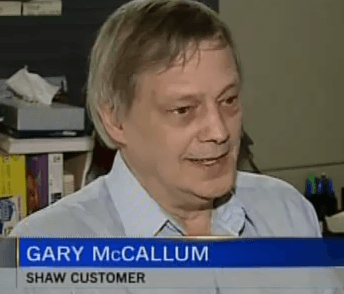
Gary McCallum, a Shaw customer in Edmonton, Alberta, has received word his broadband service is about to get more expensive — a lot more expensive.
“Holy crap, it’s like text messaging [bill shock] all over again when your broadband bill arrives and you are now looking at hundreds of dollars instead of the $40 or $50 you used to pay,” McCallum told CTV News.
McCallum, and other designated “heavy users,” are receiving letters in the mail from Shaw notifying them they have been exceeding the company’s declining usage limits imposed on its broadband service. If they exceed the limits again, they may be subject to penalty fees of as much as $2 per gigabyte.
“I’m upset about the backdoor tactics,” McCallum complains. “They keep it secret and then lambaste you later.”
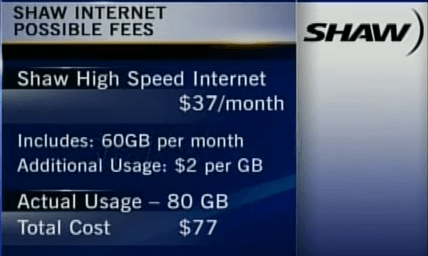
Most Shaw customers will be forced to confine their usage to 60GB per month, the limit on the company’s most popular broadband plan. If they don’t, after some warning, they’ll pay a stiff fine. Just 20GB of overlimit usage will more than double the average customer’s broadband bill, currently around $37 a month.
A house full of teenagers watching Netflix or downloading files could cost far more than that.
Company officials deny the potential revenue bonanza is unjustified.
Customers who use more will pay more, admits Terry Medd, vice-president of operations for Shaw Communications in Calgary.
“It’s video over the Internet that’s driving a lot of this cost,” he said. However, most Shaw Internet customers won’t hit their caps, Medd claims, suggesting it should affect fewer than 10 per cent of customers.
“The average user consumed about one-third of what the cap is. In other words, we’ve set the caps at three times the average usage. For the average user, there’s no concern here,” Medd said.
However, Shaw recently reduced their usage caps on virtually all of their Internet plans, making it more likely customers will be snagged by overlimit fees.
Some customers want to know what they will get if they use far less than their plan allowance.
Don McGregor believes Shaw’s plan to charge Internet users for the data they use is fair and equitable, so long as those who use less than the allowance get a break on their bills.
“Shaw should plan on refunding fees for any use of data below the contracted amount,” the Edmonton resident wrote in a letter to the editor published in the Edmonton Journal. “Since 90 per cent of Shaw’s subscribers use less than the full GB capacity they pay for, I am sure these subscribers’ refund cheques are in the mail.”
Don, like other Canadians, is about to learn Internet Overcharging is never about fairness or saving customers money. It’s about charging customers more for the same service they used to receive for less, without any improvements. ISPs will not provide true “usage pricing” for consumers because it would slash revenue from their broadband service.
But western Canadians need not be victims of Shaw’s overcharging. Telus, which sells landline-based DSL service in British Columbia and Alberta says it has upgraded its facilities to accommodate usage demands and won’t expose customers to overlimit fee bill shock.
Telus offers a way out of Shaw's Money Party hangover
Although Telus’ website does show usage limits, company officials claim they are rarely enforced, and not at the subscriber’s expense.
Telus could make a significant dent in Shaw’s customer base by dropping them altogether, which will save the phone company from these kinds of silly legal gymnastics in their FAQ:
Why do you call your service unlimited, when my monthly usage is limited?
We refer to TELUS High Speed as being unlimited because you get unlimited hours of monthly access.
If you do not want to play Shaw’s Internet Overcharging game, perhaps spending time with a new Xbox 360 would be better? Telus is giving them away to qualified new customers signing up for service.
[flv width=”480″ height=”380″]http://www.phillipdampier.com/video/CTV Edmonton Shaw Internet Overcharging 1-7-11.flv[/flv]
CTV News in Edmonton informs Alberta’s Shaw customers their broadband service could get a lot more expensive. (2 minutes)
The company’s explanation for their overpriced bandwidth comes with a tall tale about their competitors they simply made up out of thin air:
Data transfer allotments allow Knology to offer higher speed service with lower prices. Unlimited, open usage plans offered by other providers typically employ network controls to slow down the high usage customers.
That’s news to us, and to their nearest competitor AT&T. They deny speed throttling any of their U-verse or DSL customers.
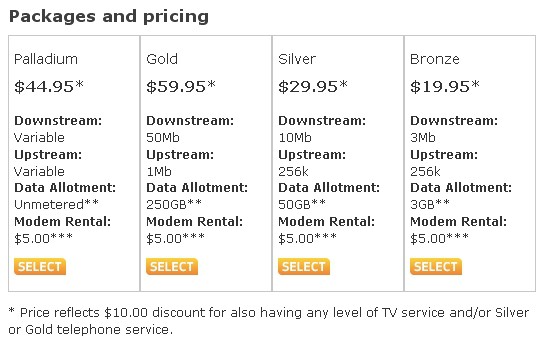
While the company’s download speeds are impressive — up to 50Mbps — their upload speeds are not, topping out at a paltry 1Mbps.
Knology's pricing is nearly identical to its predecessor Sunflower Broadband, except for the $5 rate hike for its most popular Silver plan.
Knology claims they expand usage allowances based not on network capacity, but by the percentage of customers they gouge with overlimit fees:
Data transfer allotments: Each level of internet above includes the amount of data transfer indicated measured in Gigabytes (GB). The data transfer allotments are increased regularly, based on usage patterns, to ensure the number of customers who go over their allotments remains under 10%. Additional GB of data transferred beyond the allotment is billed at $1.00 per GB if not purchased at a discount before the end of the billing period. The percentage of Knology customers charged for extra data transfer beyond their allotment was 6.1% in April 2009.
Paul Bunyon, Knology's new director of marketing
Bemusingly, customers with time machines who can travel into the future and determine they will exceed their allowance for the month can pre-purchase an increase in their usage allowance at a discount.
No time machine? Then you either pay the standard overlimit rate, watch your usage like a hawk, or potentially over-buy excess usage that expires at the end of the month.
Customers tell Stop the Cap! the company’s single, unlimited use package is “the same piece of garbage it always was,” writes Larry who lives in Lawrence. He had high hopes Knology would do the right thing and abandon Sunflower’s overcharging schemes.
“Apparently not, and after a month with their unlimited service, I have scheduled my U-verse installation with AT&T,” Larry writes. “Even on Knology’s limited packages, they don’t provide the speeds they promise.”
Larry also says the higher speed tiers Knology offers deliver diminishing returns.
“If their uplink is congested, or the web sites you visit are busy, it won’t matter if you have 10Mbps or 50Mbps — the speed is effectively the same,” he says. “Besides, upload speed is more important these days and 1Mbps is just plain lousy in 2011.”
“Bye, bye SunKnology.”
Sunflower's Old Broadband Plans & Pricing (February 2010)
Does today's decision assure the birth of Comzilla, ready to destroy anything or anyone in its path, or is it the next colossal big media deal flop worthy of AOL-Time Warner?
The wedding of Comcast and NBC-Universal was given the blessings of two federal agencies today that all but seals the multi-billion dollar deal.
In a 4-1 decision, the Federal Communications Commission approved the merger. It’s chairman, Julius Genachowski, claimed it would ultimately be good for consumers as the company promised to add at least 1,000 hours of news and information programming and a new ultra-budget “lifeline” broadband tier priced at $9.95 per month for low-income families.
The lone dissenter, Democratic commissioner Michael Copps, rejected notions that a combined company the size of Comcast, which controls more than a quarter of all cable subscribers, and NBC-Universal, a major media company, would deliver anything to consumers.
“It’s too big. It’s too powerful. It’s too lacking in benefits for American consumers,” Copps said after the FCC vote to approve the merger. “And it continues us down a road of consolidation we’ve been on for a couple of decades now. And the most threatening part about it is that this is not just traditional media, but it’s new media, too. It touches just about every aspect of our media environment.”
National Public Radio’s ‘All Things Considered’ gave measured coverage to today’s Comcast-NBC merger developments, and how it will impact consumers. (3 minutes)
You must remain on this page to hear the clip, or you can download the clip and listen later.
<
p style=”text-align: center;”>
Indeed the combined Comcast-NBC will own or control one of every seven television channels and networks seen by Americans. Copps worries that kind of media concentration is sure to reduce diversity in programming and on-air voices.
Even worse, some analysts predict the merger could trigger a new wave of media consolidation as other players try to maintain their positions in the media marketplace. Second-place Time Warner Cable could begin looking for merger opportunities with smaller cable companies, such as Cox, for example.
Just about an hour after the FCC gave approval, the Justice Department and five states’ Attorney General announced a tentative settlement that could resolve concerns that the transaction was anti-competitive.
[flv width=”640″ height=”500″]http://www.phillipdampier.com/video/WNYW New York Comcast FCC Approval 1-18-11.flv[/flv]
WNYW-TV in New York reported on today’s merger decision and explained how Comcast customers, and online video fans, could be impacted. (3 minutes)
The Terms & Conditions
Two different federal agencies insisted on Comcast’s agreement to several terms and conditions before agreeing to the deal. Many of them presented no problem for Comcast, who had voluntarily agreed to several of them early on in negotiations. But the Justice Department delivered one of the strongest conditions, and a first for online video protection — it insisted the new combined entity of Comcast-NBC bow out of its voting rights in Hulu, the online video service.
√No Playing Favorites: Comcast has to agree that if it carries its own news and business channels, it has to include competitors on the same tier.
Since Comcast-NBC has ownership interests in so many news, sports, and weather channels, making space for the competition was considered crucial by federal regulators. The cable company can’t bury its competitors in Channel Siberia, or stick them on “digital tiers” that are priced higher than standard cable service. Who wins? Bloomberg News, rarely found even by cable viewers who go looking, and the very low-rated Fox Business Channel, which can’t attract 30,000 viewers on a good day. Both will find prominent positions on Comcast Cable going forward, even if nobody watches.
√ Cheap Internet Access for Qualified Families: Comcast has agreed to provide a “lifeline” broadband service, but only for families pre-qualified by federal eligibility for free school lunches.
No word on what speeds these customers will receive, and Comcast estimates the program will barely make a dent in its bottom line. It is expected to reach only around 400,000 homes nationwide, and only as long as those subscribers remain eligible under federal guidelines. No free lunch for broadband.
√ Standalone Internet Service Must Be Provided: Comcast must sell at least a 6Mbps broadband plan without cable or telephone service for $49.99 a month for three years.
Since Comcast already routinely sells standalone broadband service to customers at around this price, this was hardly a concession. Comcast can still pile on extra fees, such as their overpriced cable modem rental, and any other charges that could be mandated by federal, state, or local government in the future. They can also keep their usage caps.
√ Comcast must agree to the FCC’s Homeopathic Net Neutrality Rules: Comcast has to agree to the FCC’s heavily-watered down definition of Net Neutrality… the ones Comcast itself suggested.
Since the FCC largely caved-in to Big Telecom’s lobbying against Net Neutrality, Comcast’s agreement to adhere to what the FCC calls Net Neutrality won’t present any problems, because those terms were similar to what Comcast had asked for all along. Their “digital phone” service is exempted, which means Comcast can “manage” competing Voice Over IP services at its pleasure.
√ Evidence That PBS Has A Lobbyist, Too — Special Favors for Public Broadcasting: Public television stations win carriage protection from Comcast “for several years.”
In an effort to free spectrum, PBS stations could be pressured to give back some channels or reduce their transmitter power to free up UHF frequencies for more wireless broadband. Should this happen, Comcast has agreed to keep those stations on their cable systems as if nothing changed at all. It assures stations that even if their broadcast coverage areas are reduced, their cable carriage will stay the same.
√ Binding Arbitration Comes to Buyers of Comcast-owned Networks: If a cable system or other provider runs into trouble getting an agreement with Comcast, the FCC offers help.
To protect other cable systems, telco-TV, and satellite companies from uncompetitive pricing or access blockades to Comcast-controlled networks, the cable company agrees to come to the table and submit to binding arbitration over carriage disputes. Unfortunately for Comcast subscribers, the cable giant can’t force broadcasters or other cable networks to the same table to settle their own carriage wars.
√ Online Access to Programming Comes to Existing Players, Unless Something Big Changes: Everyone loves the status-quo, and this agreement assures it.
The Department of Justice provisions protecting access to online video programming were carefully crafted by lawyers with one eye on Washington and the other on Wall Street. It effectively provides “stability” in the marketplace and avoids the kinds of competitive surprises Wall Street hates. Effectively, the agreement grants access to Comcast-owned programming to ventures that existed prior to the agreement reached today. Existing players have the government’s assurance carriage contracts are secure. Those with a pre-existing relationship to Comcast can also purchase the entire bouquet of Comcast-controlled programming (no a-la-carte) at prices similar to those charged to other cable and satellite customers.
But brand new players that threaten to turn existing business models on their heads? Forget it. The agreement says nothing that would require access to Comcast programming for upstart services like ivi, or even Google TV for that matter. The only potential, real-world competitive scenario comes if an existing player (say Time Warner Cable, Verizon FiOS, or AT&T U-verse) decided to start a national virtual online cable company open to any American, anywhere. What are the chances of that happening? How many of you can choose Time Warner -or- Comcast? Verizon FiOS -or- AT&T U-verse? Would AT&T risk its U-verse revenue selling Time Warner Cable customers the same channel lineup, knowing it can’t also easily bundle broadband and phone packages with it?
√ No Voting Rights for Hulu: Comcast agrees to limit its role in one of the biggest potential reasons some consumers are prepared to cut cable’s cord.
The Justice Department’s requirement that Comcast effectively butt-out of the day to day decisions affecting Hulu may protect consumers, but Hulu’s partners don’t want to devalue their programming by giving it away for free forever, either. Nothing prohibits the birds-of-a-feather-partners in Hulu to put the service under a full ad load or behind a pay wall, reducing its value and interest to consumers. Or, the whole project could be terminated at the behest of News Corp. and Disney.
Phillip Dampier: The real answer to this question is "both."
Whatever consumer protections the FCC and Justice have included, they won’t last forever. Virtually all expire within three to seven years, at which point Comcast might be humbled by the culmination of a bad business decision the likes of AOL-Time Warner, or become Comzilla, ready to trample its competition (and consumers) into the dirt.
Was This a Commission Cave-In or a Foregone Conclusion?
Although Commissioner Copps calls today’s decision a “dangerous” deal, some ex-regulators suggest the package presented to federal regulators was effectively a foregone conclusion.
Bruce Gottlieb was formerly Chief Counsel of the Federal Communications Commission, and offered his take on today’s developments for The Atlantic:
How mergers at the FCC will play out is notoriously hard to predict, but the ultimate result is not. The historical truth is that, in virtually every instance, the commission will approve any major proposed transaction. The only time in recent memory that the commission declined to do so was the proposed merger of the two leading satellite-TV providers (Echostar and DirecTV) — and that marriage was running into problems with other agencies long before the FCC put the final nail in the coffin.
(Yes, then-Chairman Reed Hundt also famously ended rumors of an AT&T and Southwestern Bell merger in 1997 by preemptively declaring it “unthinkable.” But those companies simply had to wait until 2005, when a different FCC chairman let it go through.)
The real action at the FCC involves what “conditions” the agency will put on a merger. These are supposed to be narrowly tailored to address specific harms raised by the merger at issue. But, regardless of who is in charge at the agency, it’s all relative.
Often, the conditions applied to a particular merger have more to do with what the chairman and commissioners at the time want to achieve on an industrywide basis. It’s just easier to get these things done when you have the extraordinary leverage of controlling the timing of a multibillion-dollar transaction that the parties are desperate to consummate.
[…] The FCC’s rules, as described in the press release announcing the merger, appear to be aimed at ensuring that “over the top” providers have fair access to programming (which the NBCU part of Comcast-NBCU will provide), as well as to consumers (which the Comcast part of Comcast-NBCU will provide).
This is, by far, the strongest statement yet from the commission about the importance of over the top video competition. But the business and regulatory stakes in this fight are only going to increase over time. Indeed, the two Republican commissioners (Robert McDowell and Meredith Attwell Baker) issued separate statements saying they have concerns over whether the FCC should be writing rules to encourage over the top video. So this is likely to be the first skirmish in what will surely be a long and bloody war.
In the weeks ahead, the lawyers will be able to parse the specific provisions to see where the loopholes are and how it will all play out in practice. The details surely matter. But years from now, the specifics of what was decided in this merger may mean a lot less than the fact that the FCC is now deeply involved in the multifront war to decide who will win online video.
[flv width=”512″ height=”308″]http://www.phillipdampier.com/video/PBS Newshour Comcast Merger Announced 12-3-09.mp4[/flv]
More than a year ago, PBS’ ‘The Newshour’ explored the reasons why Comcast and NBC-Universal would want to join forces. Now, after millions of dollars of Comcast subscribers’ money has been spent lobbying for approval, will consumers ultimately pay an even higher price later on? (12/3/2009 — 11 minutes)
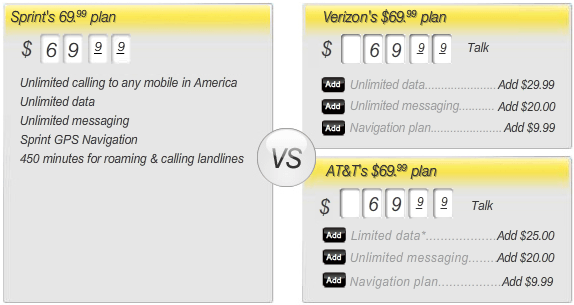
Unless you own Sprint’s premiere smartphones — the Evo 4G and the Epic, get out your wallet — Sprint is increasing the price on its unlimited data plan by $10, effective later this month.
Evo and Epic owners already pay the $10 “premium data” fee that will be extended to all smartphone customers Jan. 30 (customers on existing contracts will not be affected).
The reason for the price increase? Heavy usage on its wireless network, which partly includes Virgin Mobile (ending its unlimited service Feb. 14) and Clearwire, which heavily throttles speeds of customers deemed to be “using too much.”
Chief executive Dan Hesse says Sprint will retain its unlimited service plans, which the company calls the best value in the wireless industry. But the pricing change will present minor challenges as Sprint markets themselves as the least costly.
Sprint's marketing focuses on its unlimited use offers, some of which are about to get more expensive.
Sprint’s “Everything Data” plan, which also includes unlimited cell-to-cell calls will now cost $79.99 per month. Comparable plans from T-Mobile are priced at $99.99 for that company’s 4G network and $119.98 on Verizon Wireless’ slower, but more ubiquitous 3G network.
“Sprint has been the price leader in the market,” said Jennifer Fritzsche, a Wells Fargo & Co. analyst in Chicago who has an “outperform” rating on the stock. “Sprint may be more confident in the pricing power it has with customers.”
The Wall Street Journal also shares positive views of the price increase from Wall Street:
Wall Street applauded the move, with many seeing it as a sign of pricing power returning to the wireless industry. “It is more likely that Sprint believes that consumers value unlimited and that they can get away with higher pricing,” said Jonathan Chaplin, an analyst at Credit Suisse.
The price hike also suggests that Sprint has seen stronger smartphone growth over the past three months, he added, noting that the carrier likely wouldn’t have made the change if it were still concerned about stabilizing its base on contract customers.
But some other analysts are less impressed with Sprint, especially because of challenges the company faces with its Clearwire partnership.
Patrick Comack from Zachary Investment Research has downgraded Sprint stock, particularly because of technology issues Clearwire faces.
Comack told CNBC Clearwire is stuck with defective spectrum for much of its wireless broadband service.
“It can’t penetrate walls,” Comack said, noting most Clearwire customers are trying to use wireless broadband in the 2GHz range, which presents plenty of problems from obstacles between the tower and the customer.
Comack also believes Sprint’s network simply cannot compete with Verizon Wireless, which he suspects could pick up a number of Sprint customers once it fully activates its 4G network nationwide.
Verizon Wireless network delivers significantly better coverage than Sprint, which focuses on urban and suburban markets, and the major highways that connect them.
Stop the Cap! and our allies Free Press teamed up to expose Frontier’s usage limits for what they are — a broadband ripoff.
KOVR-TV in Sacramento ran an excellent piece on Frontier’s latest embarrassing screw-up: driving their declining landline broadband customers away with unjustified and arbitrary usage caps.
One new piece of the story: Frontier could bring its usage rationing sideshow to a community near you. As Stop the Cap! informed readers from the beginning, the company has quietly been tracking customers’ usage, looking for outliers they can suggest are using too much. Now the company says it is ready to drop the hammer on heavy users.
“The company letters were sent to customers that are using an excessive amount of the network. Well beyond any reasonable amount for an average user and significant enough to negatively affect other customers’ user experience.
The letters are meant to communicate to these customers that their usage is in excess and we would like to work with them to adjust their plan or their usage. In most cases our customers were not aware of their usage patterns and are willing to work with us to adjust their plans to fit their lifestyles. We do not have a customer capacity on our network. We are looking to work with these customers to help prevent degradation on our network to ensure the customer experience.
The pricing structure was put in place to help us maintain the network experience for all customers. If you choose to use a significant amount of bandwidth we believe you should pay for the service accordingly.
The letters were sent to four markets across the company. We routinely review network usage patterns and these users jumped out as consuming an inordinate amount of bandwidth, enough to negatively affect other customers’ user experience.
All of Frontier markets are reviewed for usage patterns as the markets receiving the letters were reviewed. These specific markets were not targeted.
The customers using an excessive amount of data negatively impact the network for other users. Preventing us from providing adequate bandwidth to all of our users during peak and non-peak times.”
There is less and less to like about Frontier Communications, despite the fact they plan to deliver broadband service to rural Americans unlikely to see it from anyone else. We’re glad someone is willing to provide the service, but 1-3Mbps broadband with arbitrary usage limits and potentially confiscatory pricing ($250 a month for residential customers), is a trade the devil might make.
Stop the Cap! will continue to organize opposition to Frontier’s foolish pricing schemes wherever they appear. We will help customers find an alternate provider wherever possible, preferably one that remembers a customer should be treated like gold, not mined for it.
In suburban Sacramento, we highly recommend SureWest — a fiber-to-the-home service provider that not only has no Internet Overcharging scheme, but provides service at speeds that frankly embarrass Frontier’s last-century DSL. They will even cover up to $200 of any early cancellation fee Frontier charges (and if Frontier tries, we want to know about it).
Our reader, Mr. Brown, was pleasantly surprised to find that SureWest’s speeds just blow Frontier out of the water. He’s saying goodbye to his 6/0.5Mbps DSL line from Frontier and hello to 25/25Mbps service from SureWest that will also save him $10 a month! He is also happy to see the back of Frontier’s Overcharging Nanny telling him to get off the Internet.
“[These caps] are a slippery slope and Internet providers need to know that action such as these will result in lost profits,” Mr. Brown wrote on KOVR’s website. Departing customers typically drop -all- of their Frontier services, costing the company landline revenue as well.
Indeed, Frontier continues to lose more landline customers than its adds, and bungling policies like overcharging for Internet service will only accelerate the departure of angry customers.
Unfortunately, Frontier’s failures extend way beyond their broadband service.
The golden parachute for some, just not for you.
Frontier’s way of doing business has:
given customers one more reason to cancel their landline service;
ruined a fiber-to-the-home service that a child should be able to market successfully;
irritated subscribers with “price protection agreements” that are little more than tricks and traps — delivering all of the protection to Frontier’s bottom line and making you pay the price;
destroyed what few reasons remain for customers to waste their time with DSL broadband wherever cable or municipal providers exist;
delivered big dividends and results only to shareholders, siphoning away important financial resources needed to upgrade their facilities.
In Everett, Washington Frontier cannot even manage the steady flow of customers canceling FiOS video service after news of a shocking $30 a month rate increase. After telling customers they should “upgrade” their Frontier service to DirecTV satellite, those customers that tried encountered news that DirecTV never heard of the promotion Frontier was offering:
Two hours on the phone, six customer service people and a disconnected call — it wasn’t the introduction to DirecTV that one local man had hoped.
A FiOS television customer, Rick Wright sought to take advantage of an offer made last week by Frontier Communications and its partner, DirecTV.
[…]When Wright called initially, the Frontier customer service person was familiar with Frontier’s offer and transferred Wright to DirecTV to get an installation date before cancelling his FiOS TV service. At DirecTV, Wright spoke to six people over a two-hour span before being disconnected. Wright called back to DirecTV the following day only to be told that he was misinformed about the offer. Frontier spokeswoman Stephanie Beasly said Thursday that she was taking care of Wright’s problem.
On Friday, more than a week after Frontier first announced its new offer, Wright said his television service still remained up in the air. Several other FiOS television customers in Snohomish County reported difficulty in getting the free DirecTV offer.
Late last week, Frontier acknowledged some miscommunication between the company and its partner, DirecTV. On Thursday, Beasly said she believed those issues had been resolved. She did not return a request for further information Friday.
DirecTV spokeswoman Jade Ekstedt suggested in an e-mail that FiOS customers should contact Frontier directly for assistance.
“The offer … is a valid Frontier Communications promotion that includes DirecTV service, and DirecTV always works with its partners on valid offers that they introduce into market,” Ekstedt wrote, when asked whether DirecTV is honoring Frontier’s offer.
Complaints are arriving at a steady pace, reports the Washington State Attorney General’s office.
This is a story that never ends well. But don’t worry — the executives responsible for the notorious bungling have their spots on the compensation lifeboats already reserved. Too bad customers will likely go down with the ship.
[flv width=”640″ height=”380″]http://www.phillipdampier.com/video/KOVR Sacramento Call Kurtis Bill May Triple For Excessive Internet Usage 1-13-11.mp4[/flv]
KOVR-TV in Sacramento worked with Stop the Cap! and Free Press to develop this story about Frontier’s unjustified Internet Overcharging schemes. (4 minutes)
Be Sure to Read Part One: Astroturf Overload — Broadband for America = One Giant Industry Front Group for an important introduction to what this super-sized industry front group is all about. Members of Broadband for America Red: A company or group actively engaging in anti-consumer lobbying, opposes Net Neutrality, supports Internet Overcharging, belongs to […]
Astroturf: One of the underhanded tactics increasingly being used by telecom companies is “Astroturf lobbying” – creating front groups that try to mimic true grassroots, but that are all about corporate money, not citizen power. Astroturf lobbying is hardly a new approach. Senator Lloyd Bentsen is credited with coining the term in the 1980s to […]
Hong Kong remains bullish on broadband. Despite the economic downturn, City Telecom continues to invest millions in constructing one of Hong Kong’s largest fiber optic broadband networks, providing fiber to the home connections to residents. City Telecom’s HK Broadband service relies on an all-fiber optic network, and has been dubbed “the Verizon FiOS of Hong […]
BendBroadband, a small provider serving central Oregon, breathlessly announced the imminent launch of new higher speed broadband service for its customers after completing an upgrade to DOCSIS 3. Along with the launch announcement came a new logo of a sprinting dog the company attaches its new tagline to: “We’re the local dog. We better be […]
Stop the Cap! reader Rick has been educating me about some of the new-found aggression by Shaw Communications, one of western Canada’s largest telecommunications companies, in expanding its business reach across Canada. Woe to those who get in the way. Novus Entertainment is already familiar with this story. As Stop the Cap! reported previously, Shaw […]
The Canadian Radio-television Telecommunications Commission, the Canadian equivalent of the Federal Communications Commission in Washington, may be forced to consider American broadband policy before defining Net Neutrality and its role in Canadian broadband, according to an article published today in The Globe & Mail. [FCC Chairman Julius Genachowski’s] proposal – to codify and enforce some […]
In March 2000, two cable magnates sat down for the cable industry equivalent of My Dinner With Andre. Fine wine, beautiful table linens, an exquisite meal, and a Monopoly board with pieces swapped back and forth representing hundreds of thousands of Canadian consumers. Ted Rogers and Jim Shaw drew a line on the western Ontario […]
Just like FairPoint Communications, the Towering Inferno of phone companies haunting New England, Frontier Communications is making a whole lot of promises to state regulators and consumers, if they’ll only support the deal to transfer ownership of phone service from Verizon to them. This time, Frontier is issuing a self-serving press release touting their investment […]
I see it took all of five minutes for George Ou and his friends at Digital Society to be swayed by the tunnel vision myopia of last week’s latest effort to justify Internet Overcharging schemes. Until recently, I’ve always rationalized my distain for smaller usage caps by ignoring the fact that I’m being subsidized by […]
In 2007, we took our first major trip away from western New York in 20 years and spent two weeks an hour away from Calgary, Alberta. After two weeks in Kananaskis Country, Banff, Calgary, and other spots all over southern Alberta, we came away with the Good, the Bad, and the Ugly: The Good Alberta […]
A federal appeals court in Washington has struck down, for a second time, a rulemaking by the Federal Communications Commission to limit the size of the nation’s largest cable operators to 30% of the nation’s pay television marketplace, calling the rule “arbitrary and capricious.” The 30% rule, designed to keep no single company from controlling […]
Less than half of Americans surveyed by PC Magazine report they are very satisfied with the broadband speed delivered by their Internet service provider. PC Magazine released a comprehensive study this month on speed, provider satisfaction, and consumer opinions about the state of broadband in their community. The publisher sampled more than 17,000 participants, checking […]


 Subscribe
 Gary McCallum, a Shaw customer in Edmonton, Alberta, has received word his broadband service is about to get more expensive — a lot more expensive.
 Customers who use more will pay more, admits Terry Medd, vice-president of operations for Shaw Communications in Calgary.
 Don, like other Canadians, is about to learn Internet Overcharging is never about fairness or saving customers money. It’s about charging customers more for the same service they used to receive for less, without any improvements. ISPs will not provide true “usage pricing” for consumers because it would slash revenue from their broadband service.