Home » pricing » Recent Articles:

Verizon Wireless Ends “Unlimited” July 6th; Existing Customers Can Keep Their Unlimited Plans

Phillip Dampier June 21, 2011 Competition, Data Caps, Verizon, Wireless Broadband 15 Comments

Verizon Wireless will end its unlimited data smartphone plan on July 6th, pushing future customers to choose usage tiers priced at $30 for 2GB, $50 for 5GB, or $80 for 10GB.  But existing customers with either 3G or 4G phones can keep their existing unlimited data plans indefinitely, according to leaked Verizon memos.

Droid Life has become information central about the end of unlimited data at Verizon, thanks to some good connections with employees willing to share internal company memos.  They’ve learned Verizon also plans to make some other price adjustments effective July 7th:

Tethering pricing (in addition to your existing data plan, charged separately):

  • 2GB — $20/month
  • 4GB – $50/month
  • 7GB – $70/month
  • 12GB – $100/month

Overlimit fee: $10 per gigabyte.

Tablet plan pricing changes: Delete $20-1GB tablet plan, replaced July 7th with a $30-2GB plan.

From a Verizon memo to employees:

Data Pricing Evolution…The Present
Our legacy data pricing structure was designed to address a somewhat different customer need profile than what we are seeing and can expect in the future.

Consider this. Data usage has more than doubled over the last three years. Consumers and business users alike are doing more and more with their mobile devices. The notion of “send and end” has migrated to “managing multiple aspects of one’s lifestyle through mobility.” Whether it’s social media (85%+ of Smartphone users), mobile internet (88%+ of Smartphone users), or email/applications (71%+ of Smartphone users), this usage has one thing in common—dramatically increased demand for data and media consumption.

As a result, we are evolving our approach around how we package our data solutions and pricing to our customers. Coming soon, Verizon Wireless will move from our existing pricing format to a structure designed to allow customers to choose the right data solution that best aligns with their needs.

The Value Benefit Equation…
With the new usage based pricing plans, the vast majority of our customers will be able to enjoy their typical level of data consumption for the same value that they outlay today. Additionally, for those who have greater requirements for data, we will have solutions that they can tailor to their unique needs.

Perhaps more importantly, given our strong desire to continue to provide enhanced capability and value to our customers, the new data pricing will apply to both our 3G AND 4G LTE networks. So in essence, for those customers in our ever and rapidly expanding 4G LTE network coverage footprint, users will gain the benefit of the fastest and most advanced 4G LTE network in the U.S. all for the same usage based value. More speed. More functionality. Same value.
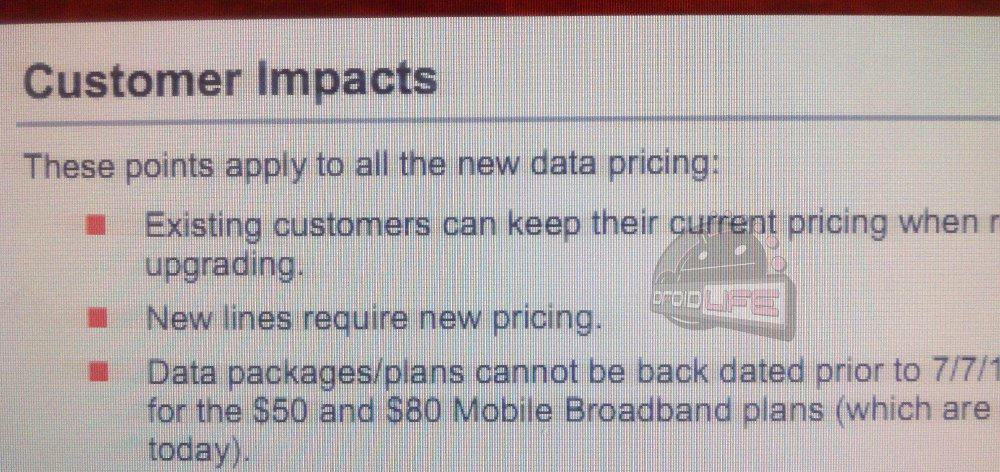
When Verizon first spoke about AT&T ending its unlimited use plans, we noted company officials seemed hesitant to sign on to AT&T’s specific pricing model.  We interpreted that to mean AT&T was being too stingy in Verizon’s eyes.  Stupid us. Instead, Verizon is going to charge $5 more than AT&T for most of its data plans, presumably milking its much-better reputation for service and reliability.

The existing price for Verizon’s unlimited smartphone data plan is $29.99 per month.  After July 7th, one penny more buys you only 2GB on Verizon’s network.

Customers can lock in unlimited data if they sign up for service before the end of the day on July 6th.  All existing customers who want to keep their unlimited data plan can, apparently even when changing phones, for the foreseeable future.  But nothing is forever with AT&T or Verizon.  We suspect “forever” will expire when average smartphone data usage approaches the 2GB limit their future $30 plan will feature.  Currently, the vast majority of smartphone users consume less than 750MB of data per month.

Toronto Waterfront Getting 10Gbps Broadband: 100/100Mbps Service for $60 a Month, No Caps

An artist rendering of Don River Park, part of the mixed-use spaces that hallmark the Toronto Waterfront revitalization project.

About seven years ago, Rochester’s Fast Ferry offered daily service between Rochester, N.Y. and Toronto’s Waterfront.  Tens of millions of dollars later, the Rochester Ferry Company discovered that nobody in southern Ontario was that interested in a shortcut to Rochester, many locals found driving to Canada’s largest city faster, more convenient, and cheaper, and the point of arrival on the Canadian side was hardly a draw — situated in a rundown, seedy industrial wasteland.

By the end of 2006, the ferry was sold and sent on its way to Morocco, the CBC got a barely used International Marine Passenger Terminal (built for the Rochester ferry) to use as a set location for its TV crime drama The Border, and the rundown waterfront was well-embarked on a major reconstruction effort.

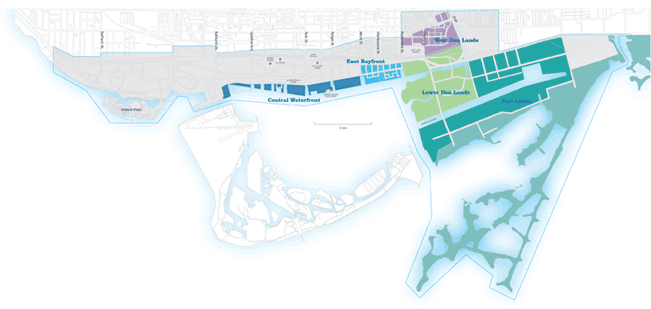
This week, Toronto’s Waterfront learned it was getting a broadband makeover as well, with the forthcoming launch of insanely fast 10/10Gbps fiber broadband for business and 100/100Mbps for condo dwellers along the East Bayfront and West Don Lands.

Best of all, Beanfield Metroconnect, the parent company responsible for constructing the network, promises no Internet Overcharging schemes for residents and businesses… forever.  No usage caps, no throttled broadband speeds, no overlimit fees.  Pricing is more than attractive — it’s downright cheap for Toronto:  $60 a month for unlimited 100/100Mbps broadband, $30 a month for television service, and as low as $14.95 for phone service.  Bundle all three and knock another 15 percent off the price.  The provider is even throwing in free Wi-Fi, which promises to be ubiquitous across the Waterfront.

The project will leapfrog this Toronto neighborhood into one of the fastest broadband communities in the world.

Toronto Waterfront Fiber Broadband Coverage Map

“Having this sort of capacity available to residents will allow for a whole new world of applications we haven’t even conceived of yet,” said chief executive Dan Armstrong.

The rest of Toronto, in comparison, will be stuck in a broadband swamp courtesy of Rogers Cable and Bell, where average speeds hover around 5Mbps, with nasty usage caps and overlimit fee schemes from both providers.  DSL service in the city is notoriously slow and expensive, as Bell milks decades-old copper wire infrastructure long in need of replacement.

The public-private broadband project is a welcome addition for an urban renewal effort that has been criticized at times for overspending. Created in 2001, Waterfront Toronto has a 25-year mandate to transform 800 hectares (2,000 acres) of brownfield lands on the waterfront into a combination of business and residential mixed-use communities and public spaces.  At least $30 billion in taxpayer funds have been earmarked for the renewal project, although project managers say no taxpayer dollars will be spent on the broadband project.

Waterfront Toronto’s efforts have been recognized as bringing Toronto’s first “Intelligent Community” to the city with the construction of the open access fiber network.

Still, the public corporation has its critics.  Earlier this spring Toronto city councilman Doug Ford called the urban renewal project a boondoggle.  Other conflicts rage with the Toronto Transit Commission and the mayor’s office over other redevelopment projects.  But the revitalization project’s broadband initiative has significant support, especially among knowledge workers that could eventually become residents… and paying customers.

The 21st century broadband project is also likely to bring broadband envy across the entire GTA, who will wonder why service from the cable and phone companies is so much slower and more expensive.

For broadband enthusiasts, Toronto’s broadband future looks much brighter than yesterday’s failed ferry service, which proves once again that regardless of the technology — slow, expensive, and inconvenient service will never attract much interest from the value-conscious public.

[flv width=”640″ height=”380″]http://www.phillipdampier.com/video/TVO The Need for High Speed 5-2010.flv[/flv]

Canada’s digital networks are some of the slowest in the world, running between one hundred to a thousand times slower than other countries in the developed world. In this episode of “Our Digital Future – The Need for High-Speed,” Bill Hutchison, Executive Director of Intelligent Communities for Waterfront Toronto describes the sorry state of Canada’s digital infrastructure, stressing the need for major investments in advanced broadband networks.  (4 minutes)

Comcast Internet Service Promotions: Experiences With the Retention Department

Phillip Dampier June 6, 2011 Comcast/Xfinity, Competition, Consumer News 2 Comments

Comcast customers looking for some savings off their broadband service are getting some decent discounts when threatening to take their business elsewhere.  Depending on the competition in your area, customers are paying as little as $19.99 per month for Comcast Performance Internet, which delivers around 12Mbps download speed.  While the best deals often go to new customers, current customers can get some nice discounts just by using the word “cancel.”

Stop the Cap! has collected some examples from our readers about recent experiences with Comcast’s retentions and promotions departments.  Any customer can try any of these numbers and ask if promotions are available.  Comcast pricing can vary regionally, as do their offers.  If you don’t like the first one you hear about, ask them if they can do any better.  Very often they can.

Chicagoland

Call 1-800-934-6489, select option ‘4’ for downgrade or disconnect, then option ‘2’ for disconnect

Tell the operator you are considering dropping your broadband service because it is too expensive, but a friends of yours is getting a promotion for current customers offering $19.99 a month for Comcast Performance Internet.  Can I get that offer?

They will check for qualified offers for your area and may attempt to offer promotions for triple play packages.  In Chicago, the current Performance promo is $19.99 a month for six months, then $46.95 for the next six months.  But your pricing may vary.

San Francisco Bay Area/Seattle

Call 1-800-970-6405.  They will usually answer asking if you are calling about a special promotion.  Ask them about the Internet offer priced at $19.99 for first year, $34.99 for second year and verify what level of Internet service this provides (it should be Performance).  Some people report this offer is available to new customers only, others say it works for existing customers.  It is provided by an authorized reseller for Comcast.

Tennessee/Mid-South

Call 1-877-395-5388.  Ask about current promotions.

Expect at least five minutes of bad deals.  Hold out for 6Mbps service at $19.99 for six months or 8Mbps at $29.99 for 12 months.  You can often get them to extend the 6Mbps service pricing for 12 months.  Ask for any activation/installation fees to be waived.

Business Class Service (Usage Cap Free!)

Commercial (Business) HSI 12/2Mbps service is available for as little as $60 per month without TV or $65 with basic TV.  All installation fees can be waived.  Expect a 1-2 year commitment.  You may want to Google around for any third party Comcast Business Class resellers who can provide 12/2Mbps service for as little as $44 a month with a six month commitment and $35 activation fee.

General Advice

All promotions with Comcast are strictly “your mileage may vary.”  If a particular representative is not giving you a good offer, thank them, hang up and try another phone number shown above or call later.  You should get used to asking “is this the best you can offer” and “can this fee be waived?”  You won’t get it if you don’t ask.

With Comcast, you will also do much better buying your own cable modem and avoiding the monthly rental fee.  Perhaps some of our readers can join in the discussion in the comments with some modem recommendations.

When your promotion ends, getting an extension requires more work.  Many representatives will not want to offer you back-to-back promotions but some will when pressed.  You can also cancel service and then start a new account with the cooperation of a family member.

Some of the best pricing promotions require some level of cable television service.  If you want broadband-only service, let the representative know you want offers for that level of service only.


Telecom Companies Use Usage Caps/Distorted Marketing to Create ‘Confusopoly’ and Rake In the Proceeds

The $49 "cap" plan isn't your maximum monthly fee, it's the MINIMUM monthly fee. The company selling it was fined for misleading advertising.

Banking on the fact most consumers do not understand what a “gigabyte” represents, much less know how many they use per month on usage-capped broadband plans, large telecommunications companies enjoy a growth industry collecting enormous overlimit fees that bear no relation to their actual costs of delivering the service.

The social implications of “usage cap and tier” pricing are enormous, according to Australia’s Communications & Media Authority.  Australia remains one of the most usage-capped countries in the world, and broadband providers have taken full advantage of the situation to run what the ACMA calls a broadband Confusopoly.

As a growing number of mobile broadband customers in the United States and Canada approach the allowance limits on their mobile data plans, Australia’s long experience with Internet Overcharging foreshadows a North American future of widespread bill shock, $1000+ telecom bills, and families torn apart by finger-pointing and traded recriminations over “excessive use” of the Internet.

Not helping matters are providers themselves, some who distort and occasionally openly lie about their plans.  In Australia, Optus was fined $200,000 for advertising a “Max Cap $49” plan that led many to believe their maximum bill would amount to $49.  But not so fast.  Optus turned the meaning of the word “cap,” typically a usage limit, upside down to mean a capped minimum charge.  Indeed, the lowest bill an Optus customer could receive was $49.  Using data services cost extra.  The company also claimed customers could use accompanying call credits “to call anyone,” another fact not in evidence.

Another common marketing misconception is the “unlimited mobile broadband” plan — the one that actually comes with significant limits. In most cases, providers want “unlimited” to mean there are no overlimit fees — they simply throttle the speed of the service down to a dial-up-like experience once a customer exceeds a certain amount of usage.  Companies like Cricket disclose their usage triggers.  Others, like Clearwire, do not — and they are applied arbitrarily based on customer usage profiles and congestion at the transmission tower.  While annoying, at least these plans do not impose overlimit fees which lead to the growing problem of “bill shock.”

Bill Shock

North Americans getting enormous mobile data bills remains rare enough to warrant attention by the TV news.  Often the result of not understanding the implications of international roaming, customers can quickly run up thousands of dollars in mobile bills while touring Europe, cruising, or even just living along the Canadian-American border, where accidental roaming is a frequent problem.

But as Americans only now become acquainted with usage-capped mobile data plans with overlimit fees, bill shock may become much more common.

In Australia, which has had a head start with usage-capped mobile data, an incredible 58 percent of customers exceeded their usage allowances at least once in a calendar year, and this statistic comes from April 2009.  The bill shock problem has now become so pervasive in Australia, in 2010 the office of the Telecom Ombudsman received more than 167,955 consumer complaints about the practice.

In the United States, one in six have already experienced surprise data charges on their bills — that’s 30 million Americans.  The Federal Communications Commission found 84 percent of those overcharged said their cell phone carrier did not contact them when they were about to exceed their allowed service limits. In about one-in-four cases, the overlimit fee was greater than $100.

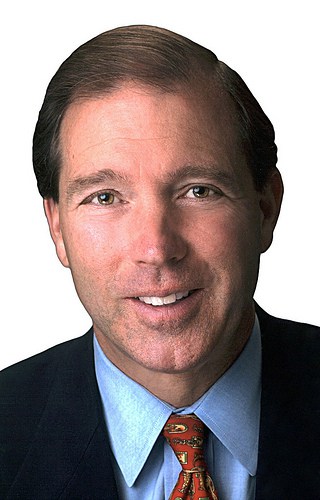
Sen. Tom Udall (D-N.M.) proposed legislation that would require a customer to consent to overlimit fees before extra charges accrue for voice, data, and text usage.

The Cell Phone Bill Shock Act of 2011 would also require carriers to send free text messages when a customer reaches 80 percent of their plan’s allowance.

“Sending an automatic text or email notification to a person’s phone is a simple, cost-effective solution that should not place a burden on cell phone companies and will go a long way toward reducing the pain of bill shock by customers,” said Udall, a member of the Senate Commerce Committee. “As more and more cell phone companies drop their unlimited data plans, this problem only stands to get worse. I am proud to stand up for cell phone consumers and reintroduce this important legislation.”

In Australia and North America, legislation to warn consumers of impending overlimit fees has been vociferously fought by the telecommunications industry.

Udall

The CTIA-Wireless Association in Washington said such measures were completely unnecessary because consumers can already check their usage by logging into providers’ websites.  Even worse, they claim, bills like Udall’s threaten to destroy innovation and harm the industry by locking a single warning standard into place.  CTIA claims that wouldn’t help consumers.

But Australian regulators, who have years of experience dealing with unregulated carriers’ usage limit schemes say otherwise, noting industry efforts to self-regulate have been spectacular successes for the industry’s bottom line, just as much as they are a failure for consumers who end up footing the bill.

Even worse, unregulated providers taking liberties with marketing claims can have profound social implications when customers find they can’t pay the enormous charges that often result.

The Brotherhood of St. Laurence, a charity, reported one instance of an elderly client who received a $1,200 broadband bill he couldn’t pay outright.  Even as he negotiated a monthly payment plan with the provider, the company shut off his home phone line without warning.

“His telephone service was particularly important because he used a personal alarm call system, which entailed wearing a small electronic device that he could activate in the event of a medical emergency,” noted a report on the incident.

The Australian Competition and Consumer Commission found a long-standing competitive feud by two large mobile providers in Australia — Telecom and Optus — has only brought more instances of marketing excesses that ultimately don’t benefit consumers.  The Commission increasingly finds it lacks the resources to keep up with the slew of questionable advertising.

Some industry critics suspect providers treat ACCC’s fines as simply a cost of doing business, and some like Optus have been rebuked more than once by the regulator for false advertising.

The ACMA says the longer government waits to protect citizens from provider abuses, the more consumers will be financially harmed, especially as data usage grows while usage caps traditionally do not.

America Falls in Broadband Rankings: Now in 12th Place for Wired Broadband, Providers in Denial

America’s broadband ranking has fallen once again, mostly at the expense of other countries who have accelerated service and speed upgrades above and beyond what is available in the United States.  That is the conclusion one can reach after reviewing the Federal Communications Commission’s second annual broadband report, delivered to Congress to fulfill obligations under the Broadband Data Improvement Act.

Through a combination of data from OECD broadband rankings and actual speed test results collected by the Commission, the FCC report notes American cities are at risk of losing the broadband speed race.

“This report compares data on average actual download speeds reported by a sample of consumers in a number of U.S. and foreign cities and finds that some large European and Asian cities exhibit a significant edge over comparable U.S. cities in reported download speeds, though reported speeds for some other international cities are roughly comparable to speeds in many U.S. cities,” the report concludes.

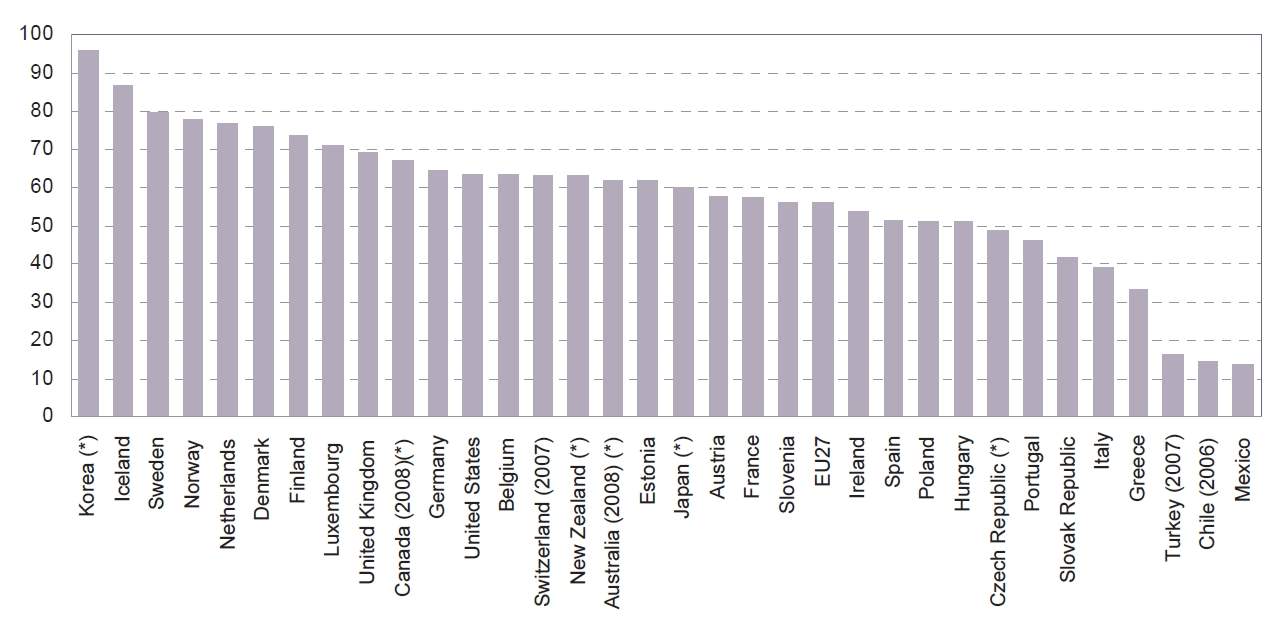
“The best currently available data set comparing the United States to other countries appears to be from the OECD, which collects data on various broadband deployment, adoption, and usage metrics and publishes rankings of its member countries. The OECD’s deployment data ranks countries based on particular technologies, rather than overall coverage. The U.S. ranking in these surveys ranges from 27th out of 30 in DSL coverage to 1st out of 28 in cable modem coverage.  The U.S. ranks 6th out of 16 in fiber-to-the-home (FTTH) coverage and 8th out of 29 in 3G mobile wireless coverage.”

Broadband Rankings (click to enlarge)

Most of the countries accelerating far beyond the United States in broadband speed and quality are in Asia and Europe, and many are upgrading their networks to fiber-based broadband.  As these fiber networks come online, the United States can be expected to fall further behind.

The cable industry lobby attacked the report's findings.

Just like last year, the Internet Service Providers turning in poor grades are rejecting the report’s conclusions.

“While the Commission’s headline proclaims that 20 million Americans are denied access to broadband, by that measure private investment has fueled the build-out of broadband networks to nearly 300 million consumers and is responsible for the jobs that flow from that investment,” said Michael Powell, president and chief executive of the National Cable and Telecommunications Association.  Powell used to oversee the FCC as chairman during the first term of the Bush Administration.

Another trade association with ties to the telecom industry, USTelecom, attacked the findings noting most Americans think their existing broadband service is good enough.

Walter McCormick Jr., USTelecom CEO, noted the FCC’s own report found that 95 percent of Americans have access to fixed broadband and 93 percent are happy with their service.

...so did USTelecom, another industry funded group

But McCormick says nothing about the speeds those customers receive, a bone of contention with the Commission.  As part of this year’s report, the FCC is increasingly relying on its own verifiable data about broadband speeds, collected through its SamKnows broadband speed test project.  The Commission has repeatedly noted that broadband speeds marketed by ISPs do not always match the actual speeds customers receive.

Speed tests comparing broadband performance in comparably sized cities found some sizable differences.

The data suggest that mean actual download speeds in some European and Asian cities are substantially higher than in comparably sized U.S. cities (e.g., 24.8 megabits per second (Mbps) in Paris and 35.8 Mbps in Seoul versus 6.9 Mbps in San Francisco, 9.4 Mbps in Chicago, and 9.9 Mbps in Phoenix). Some of the U.S. cities in our sample have higher speeds than some foreign cities (e.g., Chicago with 9.39 Mbps versus Rome with 5.6 Mbps).

The most significant reason for the disparity in speed is the technology used in each respective area.  Fiber to the home service traditionally delivers the fastest broadband speeds.  Cable broadband technology, common in the United States but less so abroad, is responsible for a great deal of speed increases in the United States.  Telephone company DSL and wireless are responsible for some of the slowest speeds, with rural DSL service commonly providing just 1-3Mbps service.  Many European cities still relying on DSL technology have upgraded to bonded DSL, ADSL2+, or VDSL service, which can significantly boost speeds.

Unfortunately, the report concludes, the faster the broadband service delivered, the higher the price — often out of proportion with other OECD countries.

Results […] suggest that U.S. stand-alone residential broadband prices are generally “in the middle of prices in OECD countries,” after accounting for speed, terms of service, data caps, and service delivery technology. Similarly, prices in the United States for business stand-alone broadband services were fourteenth out of 30 among the OECD countries. A paper by the Berkman Center for Internet and Society at Harvard University found prices for U.S. broadband with download speeds of around 768 kbps to be “very good” by international standards. However, as download speeds increase, the paper found that U.S. prices become more expensive than most other OECD countries.

Some providers unimpressed by the independent research accused the FCC of using biased and inconsistent research methods.  AT&T, for example, was unhappy with comparisons among U.S. cities and those of comparable size abroad.  They accused the Commission of not using “a well-defined or consistent methodology for choosing the ‘communities’ or offers.”  In fact, several providers suggested the Commission’s pricing comparisons ignored significant, albeit temporary, discounts some new customers receive, as well as discounts for bundled service packages.  Promotional pricing factors are acknowledged by the Commission, but the report notes the findings do attempt to collect real world pricing paid by actual customers.

For consumers in the United States, broadband envy is as close as the next news report highlighting broadband expansion efforts abroad.  Some countries are deploying 1Gbps broadband networks that deliver consistently faster speeds than American providers, at dramatically lower prices and without a usage cap attached.

Search This Site:

Contributions:

Recent Comments:

Your Account:

Stop the Cap!