Home » pricing » Recent Articles:

Competition Bureau Fines Bell $10 Million for Misleading Consumers About Pricing

The Competition Bureau has fined Bell Canada $10 million for what it calls the phone company’s misleading pricing for its wireless, broadband, phone, and satellite TV services.  The agency accused Bell of advertising one price for service, but charged customers considerably more after hidden fees were tacked on.  That made it impossible for any customer to actually purchase Bell’s services at their advertised prices.

The fine, the maximum amount that can be levied, was designed to send a message, according to Commissioner Melanie Aitken.

“When a price is offered to consumers, it must be accurate,” Aitken said. “Including a fine-print disclaimer is no license to advertise prices that are not available.”

Since December 2007, Bell routinely advertised product bundles that it claimed were priced at less than $70 a month, but after the hidden fees were calculated, Canadian consumers routinely paid north of $80.

Aitken

Aitken took issue with rental fees for equipment, term contract escape penalties, mandatory “add-ons” that were not included in the advertised price, and hidden “junk fees” designed to look like government-mandated taxes.  They all routinely add at least $10 to most telecommunications bills, even before actual government fees are calculated.

Bell protested the Bureau’s findings, but quickly agreed to pay the fine, modify its advertising, and cover the $100,000 estimated cost of the agency’s investigation.

The Competition Bureau has become a thorn in the side of many major corporate entities in Canada after winning new powers in 2009 to protect consumer interests.  The agency is currently pursuing a $10 million fine against Rogers Communications for “hit piece” advertising misleading consumers about Rogers’ wireless rivals — especially Wind Mobile.

But Rogers is not going quietly as Bell has done, vowing to drag the matter through the courts to void any fines or penalties.

Aitken promises she isn’t necessarily done with telecommunications companies, suggesting any company burying extra costs in the fine print, or subjecting customers to penalty fees for canceling service might be on notice.

Telecommunications companies in Canada have traditionally opposed government agencies that champion consumer protections.  Most notably, Bell, Rogers, and Quebecor Media have all attacked the Commissioner for Complaints for Telecommunications Services, an independent agency that monitors and assists consumers with issues related to phone and cable companies.  Bell wanted the organization abolished, while Rogers and Quebecor sought to see participation in it made voluntary.

Unfortunately, consumers won’t share in the $10 million fine from Bell.  Those funds will be collected and kept by the Canadian government.

[flv width=”640″ height=”388″]http://www.phillipdampier.com/video/CBC Bell fined 10M over ads 6-28-11.flv[/flv]

CBC covers Bell’s $10 million dollar fine for advertising one price for service, but sending a much higher bill with tacked on hidden fees and surcharges.  (2 minutes)
 

Frontier Fires Back at Comcast In Indiana – Comcast is Telling Stories About FiOS

Phillip Dampier June 30, 2011 Comcast/Xfinity, Competition, Frontier 2 Comments

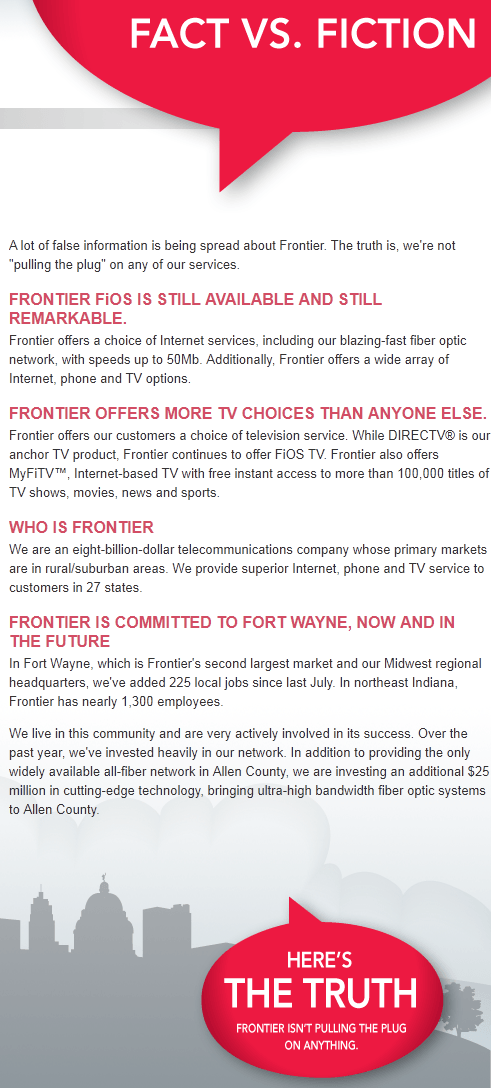
Frontier's Facts - Frontier's new website to counter Comcast's claims about FiOS. (click to enlarge)

Frontier Communications has fired back at Comcast after the Fort Wayne, Indiana cable company erected billboards telling residents Frontier was pulling the plug on its acquired FiOS fiber optic network.

On Wednesday, Frontier purchased a full-page ad in The Journal Gazette headlined, “Comcast Doesn’t Let the Facts Get in the Way of a Good Story! Here’s the Truth: Frontier Isn’t Pulling the Plug on Anything.”  It also launched a new website — Frontier Facts — telling customers it is not “pulling the plug” on any of its services.

Roscoe Spencer, Frontier’s local general manager, tells customers:

Recently, one of our competitors put up billboards, placed inserts in the newspapers and sent mailings to customers indicating we had pulled the plug on FiOS. This statement is simply not true, and we have taken legal action to insist that these false claims be stopped immediately.

Spencer

The spat began when Comcast began trying to recruit disaffected Frontier TV customers who found a massive rate increase notice in bills sent earlier this year.  Frontier blamed the rate increase on the loss of volume discounts former owner Verizon obtained for its FiOS TV service for television programming.  Frontier has sought to negotiate with programmers directly instead of working through a cooperative buying group, so the prices it pays for popular cable networks are much higher than what Comcast pays for a comparable video package.

Frontier watchers suggest the company is well aware its new video pricing is uncompetitive and customers will take their business elsewhere.  Frontier quickly began marketing DirecTV, a satellite provider, as a suitable replacement for those unhappy with the rate increase.  But Comcast also saw an opportunity to pick up new customers at the phone company’s expense, including through the use of billboards Frontier claims are misleading.

Frontier stresses its FiOS platform will continue to provide telephone, television, and broadband service, despite what Comcast’s billboards might suggest.

Despite the involvement of attorneys, Comcast has continued to thumb its nose at Frontier’s legal department.  Frontier spokesman Matt Kelley told the Journal Gazette Comcast was supposed to remove the billboards by Monday of this week, but they remain in place.

The cable company calls it a case of old fashioned competition.

Stop the Cap! reader Kevin calls Frontier’s marketing to get customers to drop FiOS TV for DirecTV a real blast from the past.

“It remains difficult for Frontier to sell people on its advanced fiber network when it is heavily marketing customers to get off of it and switch to DirecTV, a service that looked ultra-modern in the 1990s but today is just a rain-faded, pixellated nuisance,” Kevin says.  “Frontier blew it, Comcast took advantage of their strategic blunders, and now the whining has begun.”

Kevin is a former Verizon FiOS customer who was switched to Frontier when Verizon exited Fort Wayne.

“Verizon knew what they were doing, but eventually decided a few small cities in Indiana were not worth their time or interest, so they sold us off to Frontier, who ended up with a fiber network they’ve shown little interest in running except as an adopted curiosity,” Kevin adds.  “When we got notice of the rate increase, we canceled the TV service and now watch over the air television for free, supplemented with Netflix and Hulu.”

Kevin says Frontier ultimately did him a favor, discovering he was fine without a pay television package.

“Outside of breaking news and sports, you can get most everything else online.  Why pay more?”

Bright House Says No to Internet Overcharging: No Caps – Not Even Under Consideration

Phillip Dampier June 23, 2011 AT&T, Broadband Speed, Data Caps, Online Video, Verizon 1 Comment

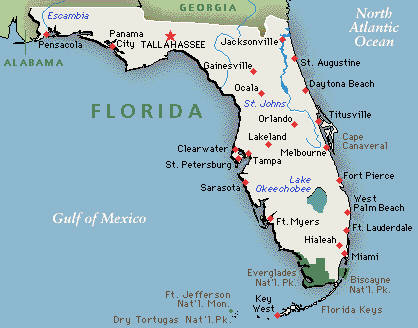
Bright House Networks, a cable company primarily serving Florida and other southeastern states says it has no plans to implement Internet Overcharging schemes like usage caps or consumption billing.  But a company spokesperson went even farther, telling Tampa Bay Online the cable company was not even considering them.

Bright House, which relies on Time Warner Cable’s programming negotiators and sells broadband under the Road Runner brand, was among the only companies in Florida that was willing to go on record stating they were not considering limiting broadband customers.

Other providers were unwilling to follow Bright House’s lead:

  • AT&T: “2 percent of our customers were using 20 percent of our bandwidth,” said an AT&T spokesman, so the company slapped 150GB usage limits on DSL customers, 250GB on U-verse customers.  The overlimit fee is $10 for every 50GB extra.
  • Verizon Florida: “At this point, we’ve not implemented any usage controls or broadband caps.  We’ll continue to evaluate what’s best to ensure our customers get the highest quality broadband service for the best value,” the company said.  But it also added: “We’re continuing to evaluate usage-based pricing for our wireline broadband customers.”

“Bandwidth caps stifle consumer choice,” said Parul Desai, public policy counsel for Consumer’s Union.  Desai notes customers do not sign up for pricey high-speed FiOS broadband service from companies like Verizon just to read e-mail.  Customers who are willing to pay premium prices for super high speeds certainly don’t want a usage cap devaluing their broadband package.

Comcast, for example, uniformly limits consumption to 250GB per month, even on high speed plans delivering over 50Mbps service.

“It’s like building a rocket that you blow up after it reaches 250 feet into the air,” says Stop the Cap! reader Will in Tampa, who shared the article with us.  “What is the point of having 50 or 100Mbps service from any provider if they slap a limit on it like that.”

Will thinks customers will abandon higher speed packages in droves once they realize they really can’t use them.

“With some of these companies talking about caps around 40GB per month, you can’t even take your connection for a test drive,” he says.  “You might as well stick with basic speeds, just to remind and discourage you from putting yourself over their stupid limits.”

Desai suspects broadband companies will try limiting their customers, if only because they face few competitors consumers can use instead and they have video services to protect.  But she suspects some consumers will either abandon or seriously downgrade their broadband service and find other ways to trade large files and content.

“It’s not inevitable they’re going to succeed,” she told TBO. “People only find value in broadband because of what they can access with it. If more people feel constrained, they’ll start looking for another way.”

Bipolar Cable Industry Loves<->Hates Netflix; Britt Says It’s About Giving Customers What They Want

Phillip Dampier June 23, 2011 Competition, Consumer News, Data Caps, Editorial & Site News, Online Video, Video Comments Off on Bipolar Cable Industry Loves<->Hates Netflix; Britt Says It’s About Giving Customers What They Want

[flv width=”512″ height=”298″]http://www.phillipdampier.com/video/WSJ Studios disarming cable in battle with Netflix Media Report 6-20-11.flv[/flv]

Wall Street Journal: Top execs of some media behemoths are shifting their public stances toward Netflix Inc. of late. They’re now trying to persuade investors that the video streaming service will expand their business rather than destroy it. (4 minutes)

You are forgiven if you are confused about the love-hate relationship the cable industry has with online video streamers like Netflix — one that the Wall Street Journal likens to manic bipolar episodes.  Weeks after blaming Netflix for getting video programming too cheaply and threatening cable subscriptions, cable industry executives were hugs and kisses about online video at the recent Cable Show in Chicago.

“The reason why there’s interest in these Internet video providers that is that they’re deploying technology that’s making the experience better for consumers,” Time Warner Cable CEO Glenn Britt said in an interview with MarketWatch during the National Cable & Telecommunications Association’s annual Cable Show last week.

“There’s nothing about [cable companies] that stops us from doing that. So I would say … we as an industry just need to pay attention and give consumers what they want. Then there’s no room for these other guys. I don’t mean to say that in a negative way, but it’s true.”

Britt

Of course, this is the same man that has earplugs firmly implanted to help resist another rejection of his Internet pricing schemes that Time Warner Cable customers loathed in 2009.  Britt’s desire to give “consumers what they want” just doesn’t play in this part of town while the cable company is installing software to measure and potentially meter broadband usage.

What is different in the online video spectrum is consumers have choices.  They can adopt Time Warner Cable’s glacially-slow rollout of its TV Everywhere concept, watch Hulu, use Netflix, or simply steal content providers don’t want them to watch.  For customers of Time Warner Cable facing competition from AT&T, there is potentially nowhere to run to avoid an Internet Overcharging scheme which could bring the online viewing party to a rapid conclusion when your viewing allowance is used up.

Britt says he is struggling with rights holders to provide more accessibility to online video streaming of popular shows.  He’s also thinking about how many restrictions to slap on subscribers.

MarketWatch talked with Britt and found him dealing with nagging questions about how many devices each user account should be authorized to use for viewing. “Should it be three, should it be 10? If I make [that number] too small, you’re not going to be happy as a customer,” Britt philosophized. “If I make it too big, you’re going to give the password to all of your friends, and they won’t have to buy a subscription to begin with.”

Upgrades: Exponential, Not Incremental Deliver Biggest Bang for the Buck, Says Internet Pioneer

Cerf

Vint Cerf understands the Internet.  Widely recognized as one of the two “fathers” of what eventually grew into today’s Internet, Cerf has watched a network launched by the United States Department of Defense grow into an economic powerhouse driving a knowledge-based economy.

Today, Cerf works as an Internet evangelist for Google, promoting the company’s innovation in the next generation of the broadband experience.  He brings decades of advice to Internet Service Providers the world over: upgrade your networks.  But more importantly, he told attendees of Juniper Network’s Nextwork conference, upgrade exponentially, not incrementally.

Cerf’s remarks Wednesday targeted the conundrum of coping with increasing video traffic on the Internet.  Cerf pointed to his employer’s construction of a gigabit fiber to the home network in Kansas City as the best antidote to traffic congestion.

Simply put, Cerf believes bandwidth must be increased exponentially and not through incremental upgrades that try and stay one step ahead of demand.  Google intends to prove gigabit fiber broadband is cost-effective and within reach of providers.  A side benefit of building next generation networks is the opportunity for innovating new online applications.  Many of tomorrow’s online innovations are simply impossible on a constrained, incrementally upgraded network that often requires accompanying traffic limiting schemes.

“When you are watching video today, streaming is a very common practice. At gigabit speeds, a video file [can be transferred] faster than you can watch it,” Cerf said. “So rather than [receiving] the bits out in a synchronous way, instead you could download the hour’s worth of video in 15 seconds and watch it at your leisure. It actually puts less stress on the network to have the higher speed of operation,” he said. 

Wu

So far, many providers are considering Netflix and other video traffic a threat to their networks, and are attempting to collect tolls to allow Netflix content to reach subscribers (Comcast), or are considering Internet Overcharging schemes that combine usage caps with overlimit fees to discourage customers from watching too much (AT&T, Time Warner Cable).

At another session held Tuesday, Tim Wu, Columbia University law professor noted efforts by several U.S. providers to do away with all-you-can-use broadband.

Wu said phone companies like AT&T are ideally looking towards replicating the cell phone model on broadband — leaving users to guess how much usage they will rack up over a month, knowing most will be wrong.  As the consumer, he noted, you end up buying too much or you face steep overlimit fees for underestimating usage — either way “you are screwed.”  Wu called consumption-oriented pricing “abusive.”

Wu also said wireless carriers in particular are uneasy with the open, “ownerless” concept of the Internet.  Their instinct is to own, control, and manage networks.  Their only success so far is trying to advocate for fast, premium-priced traffic lanes, and slow “free lanes” for everything else — a key reason why many consumers advocate to preserve the open model of the Internet through enforced Net Neutrality.

Wu called these efforts by phone companies to control traffic “dangerous.”

Search This Site:

Contributions:

Recent Comments:

Your Account:

Stop the Cap!