Home » pricing » Recent Articles:

The Devil Is In The Details: FCC Chairman Julius Genachowski Speaks About Broadband to Consumers

Phillip Dampier

Phillip Dampier

FCC Chairman Julius Genachowski recorded a YouTube video to talk to Americans about the development of a national broadband plan for the United States.

In optimistic, flowery language, Genachowski invited Americans to submit their ideas and suggestions not only regarding broadband, but also the priorities Americans think the FCC should have in the future.

The most important part of the five minute video comes right in the beginning when Genachowski called broadband critical to the nation:

“Broadband is our generation’s major infrastructure challenge. It’s for us what railroads, highways and electricity were to past generations.”

<

p style=”text-align: center;”>

Genachowski would do well to remember America’s experience with all three of these important history lessons.  The broadband plan Genachowski envisions is subject to the same type of intrusive, anti-consumer tactics that wreaked havoc on past generations of consumers.

The railroad industry’s cartel of ownership and control is a familiar tale.  The Rise of Monopolies tells the story:

The need for all of these industries to stay successful was worrisome for railroad owners. To avoid the loss of production in any of these areas, large corporations attempted to stabilize their situations by pooling markets and centralizing management. By combining all of the fields into one conglomeration, the railroads had a new power, as they acquired control of many facets of the new economy. This body now had the ability to “squeeze out competitors, force down prices paid for labor and raw materials, charge customers more and get special favors and treatments from National and State government” (Chalmers). The railroads had all the power, because they controlled all the prices. Since the new residents of the West could not survive without the use of the railroads, they were forced to pay whatever rates the railroad companies set.

With these huge stores of capital, the railroad companies were able to finance political campaigns through whatever and whomever was needed in government. With this control in Washington, there was no way to stop the overwhelming control of this industry over society. The entire nation was subject to the whims of this monopoly.

It took direct government intervention to break up the railroad monopoly and protect consumers and businesses from the abusive practices of a transportation industry that can make or break you based on pricing and service, with little competition.

Public highways became an important asset that still pays off today.  The Eisenhower Administration’s deployment of the interstate highway system, at the size and scope required, would not have been accomplished by the private sector on its own.  Today’s federal highway system is largely self sustaining through the collection of gasoline taxes paid by drivers.

As Americans struggle with several incumbent providers that refuse to provide 21st century broadband technology, with little competition to drive that infrastructure investment, an uneven variety of broadband networks have emerged, from fiber to the home in some areas to an indefinite reliance on aging DSL slow speed technology for millions of rural Americans, or worse, inadequate satellite broadband.

It may be time to consider the same kind of national approach with a publicly owned fiber network private providers of all kinds can use to serve customers with a uniformly high speed, high quality user experience.

Electricity and the development of rural America is another very familiar tale to any rural broadband user.  From TVA: Electricity for All:

Although nearly 90 percent of urban dwellers had electricity by the 1930s, only ten percent of rural dwellers did. Private utility companies, who supplied electric power to most of the nation’s consumers, argued that it was too expensive to string electric lines to isolated rural farmsteads. Anyway, they said, most farmers, were too poor to be able to afford electricity.

The Roosevelt Administration believed that if private enterprise could not supply electric power to the people, then it was the duty of the government to do so. Most of the court cases involving TVA during the 1930s concerned the government’s involvement in the public utilities industry.

In 1935 the Rural Electric Administration (REA) was created to bring electricity to rural areas like the Tennessee Valley.

Many groups opposed the federal government’s involvement in developing and distributing electric power, especially utility companies, who believed that the government was unfairly competing with private enterprise. Some members of Congress who didn’t think the government should interfere with the economy, believed that TVA was a dangerous program that would bring the nation a step closer to socialism. Other people thought that farmers simply did not have the skills needed to manage local electric companies.

Any community wrestling with a municipal broadband project to provide service the private market refused to offer is already acquainted with this familiar story.  So are many rural consumers who are waiting, and waiting, and waiting, for the private market to bring broadband to their communities.  Unfortunately for them, the private market has already written them off as “not profitable enough” to provide service.

The electrification of America did not lead to a socialist takeover of America.  It led to the development and sustainability of rural communities and their local economies.  Agriculture remains one of America’s most important success stories, and without widespread electrification, this story might not have been written.

Scare tactics and horror stories have come whenever a private monopoly or cartel faces the threat of competition, regulation, or a municipal option to provide needed services communities are denied by the private sector.

The fear mongering was there when the railroad monopolies faced investigation and regulation, the “socialism” scare was heard when government attempted to undertake public infrastructure projects of many kinds from highways to utility service, and the same kinds of rhetoric is heard today about “socialist takeovers of the Internet” and “municipal broadband unfairly competes with private providers,” and the logical opposite “the government can’t do anything right.”

Unfortunately, the FCC has a long history of cozy relations with lobbyists who understand how to work within the agency’s nearly-impenetrable bureaucracy.  A review of the broadband plan submissions to the FCC reveals a large  number of them come from lobbying groups and the providers themselves.  Most consumers were left typing comments into a box on the web submission form, with every indication those remarks will be deemed “not serious” by FCC staff.

This time, Chairman Genachowski has to show more than a YouTube video inviting consumers to share their input.  We’d like actual evidence the consumer point of view is actually being taken seriously for a change, and is not simply one tiny noise drowned out in a loud crowd of special interests with profit agendas to protect and public policy to influence.  The FCC already knows what consumers want: widely available, fast, reasonably priced broadband free from Internet Overcharging schemes protected with robust Net Neutrality policies enforced by law.

If the existing providers want to erect roadblocks to competition, oversight, and hell-or-high-water-broadband-deployment, it’s time to break them up and get them out of the way.  That’s broadband we can believe in.
When Broadband Service Is Slower Than Carrier Pigeons: Africa Struggles With Capacity Issues

Phillip Dampier September 14, 2009 Broadband Speed, Video 4 Comments

Speedy internet connections have yet to take off in many parts of South Africa because of a shortage in bandwidth.

One leading internet provider says it is not to blame for the slow connection, but frustrations have led one IT group to adopt an unusual method of delivery.

Al Jazeera’s Haru Mutasa reports on the pigeon that beat the internet in Johannesburg.

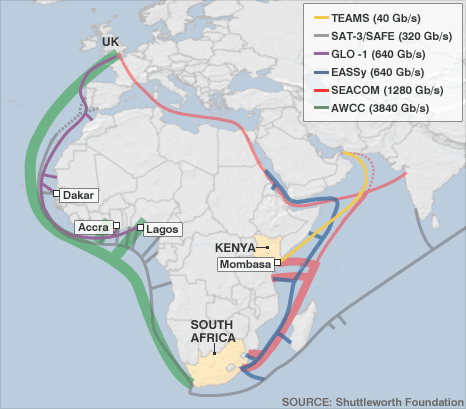
Service providers across the continent blame the expensive and slow Internet reality for much of Africa on a shortage of connectivity, particularly between Africa and the rest of the world. One African-owned firm, Seacom hopes to change that with the introduction of a new fiber optic cable that went live in July. The new connection enhances service between much of East Africa, including South Africa, Tanzania, Kenya, Uganda and Mozambique. The cable also provides a new path to reach Europe and Asia at speeds superior to what used to be common across Africa.

But while bandwidth may slowly be on the increase, savings are much harder to find. Businesses routinely pay $600 per month for 1Mbps service. But some providers suggest that does represent savings. Satellite service at the same speed is priced at an average of $3,000 per month.

Consumers in South Africa find broadband pricing very high, with most relying on Telkom, the nation’s primary phone company, for DSL service. Usage caps are prevalent across the continent as well, stifling the development of African broadband services and making services like online video all but unaffordable.

Africa's Internet Connectivity

Africa's Internet Connectivity

Thanks to Stop the Cap! readers Jeff, Bones, Terry, and a few others who let us know about this story.

Big Cable Overreach: Lawsuit Filed To Overturn Exclusivity Ban on Cable Networks

Back in the mid-1980s, I first got involved in the fight against the cable television industry’s consumer abuses.  Cable had gotten cocky, and began to use their monopoly position to extract ever-increasing amounts of money from consumers, providing lousy service and engaged in anti-competitive abuse all over the marketplace.  Back then, competition for the overwhelming majority of consumers came from just one place – giant 10-12 foot satellite dishes.  These were the days before Direct Broadcast Satellite providers like Echostar/DISH and DirecTV (and PrimeStar, the cable industry’s own satellite provider that claimed to ‘compete’ with cable) provided competition to cable.

In the mid and late 1980s, your choice was a giant TVRO (TV-Receive-Only) satellite dish in the backyard or you hooked up to cable.  A tiny handful of communities had wireless cable, a service that was supposed to compete with cable but was seriously limited in channel capacity (in many communities, wireless cable ended up providing access to ‘adult’ content that cable wouldn’t carry as their biggest selling point) and quickly faded from view by the mid 1990s.

The abusive practices were all over the place back then:

  • Cozy arrangements between cable companies and local governments resulting in outright bans of satellite dishes for aesthetic reasons, using zoning laws either prohibiting their installation or requiring landscaping to hide them from view (to the neighbors and to the satellites they were trying to receive, making them useless), or requiring expensive permit fees;
  • A rush to scramble/encode satellite signals and then require consumers to purchase, outright, a costly descrambler from General Instruments called the VideoCipher II for $399 (or have it incorporated within a satellite receiver that typically cost $800-1000 and was available only for purchase), only to be replaced a few years later by the VideoCipher II+ (which consumers were also forced to purchase).
  • Cable companies, which had ownership interests in most cable networks (which was nearly a pre-condition for getting your network on cable systems), often had exclusive rights to sell that programming, and frequently provided it “only on cable” or to satellite customers who could not subscribe to cable.  Some networks refused to sell to competitors, including dish owners, at any price.
  • Anti competitive pricing was by far the biggest problem.  Prices for programming packages encrypted on satellite were sold to consumer dish owners in small or large bundles at pricing comparable or above what cable subscribers paid, despite the fact all of the costs to provide, install, and service reception equipment were borne by consumers.  No cable TV company overhead, no infrastructure or staffing and support costs, yet satellite dish owners were expected to pay the same high costs that cable subscribers paid, and also purchase their own equipment.  That was quite an investment: a 12 foot dish, satellite reception equipment, decoder, and installation routinely ran well over a thousand dollars, depending on the equipment and installation complexity, and that was before programming costs were factored in.

Rural consumers really got the short end of the cable stick, not able to buy cable even if they wanted to, and forced to spend big money, upfront, just to get satellite TV.

That inspired the consumer groundswell of support for legislation to stop the abuses, which overrode a White House veto by President George H.W. Bush.  Among other things, the Cable Act of 1992 put a stop to exclusive programming contracts which denied competitor access to cable networks.

Without that legislation, there would be no DirecTV or DISH today.

Now the cable industry is back, high-fiving over their victory to have the 30% ownership cap dispensed with, and are now taking on the next provision of the 1992 Cable Act they don’t like — the ban on exclusive programming contracts.

That’s right, it’s Back to the Future as Comcast and Cablevision take their legal business to the same friendly DC Court of Appeals that savaged the 30% cap, now seeking an immediate repeal of the exclusivity ban as well.

Oral arguments start September 22nd.

Most amusing of all is the argument made by Comcast and Cablevision, who claim despite the time and attention they are spending on overturning the law, not to mention the legal expense, the practical effect of an end to exclusivity bans would be… absolutely nothing.

“Widespread withholding is now implausible,” said the attorneys in the filing. “[T]here are proportionally fewer services to withhold. The limited withholding that may still occur will not threaten competition: most vertically integrated services have closely similar substitutes, and, when competitive MVPDs [multichannel video programming distributors] have sunk massive investments, withholding can no longer cause market exit.”

That’s right.  Big cable companies throw money away on attorneys who will presumably fight this case and the inevitable appeals for the next few years for no practical change whatsoever in the current competitive landscape.  The believe people will accept that an industry that had to be forced by regulation to compete on a level playing field will continue to respect that playing field once they plow it up.

Just trust us.  We’re your cable company.  You love us.

So it could be “nothing” as they suggest, or it could be a defensive response to challenges of their business plans from telephone company TV and online video competition.  Would you subscribe to a competitor that didn’t offer the networks you wanted to see because they were “exclusively” available only from the cable company?

Be it usage caps, consumption billing, exclusive contracts, “price protection agreements” that hold customers in place for 12-24 months (or longer), the war to keep consumers from choosing when, where, and how they access content is becoming fully engaged.

<

p style=”text-align: center;”>

Satellite television in the mid-1980s was highlighted by Granada Television

Sit Down For This: Astroturfing Friends Sold on Pro-Internet Overcharging Report

Phillip "Doesn't Derive a Paycheck From Writing This" Dampier

Phillip “Doesn’t Derive a Paycheck From Writing This” Dampier

I see it took all of five minutes for George Ou and his friends at Digital Society to be swayed by the tunnel vision myopia of last week’s latest effort to justify Internet Overcharging schemes.

Until recently, I’ve always rationalized my distain for smaller usage caps by ignoring the fact that I’m being subsidized by the majority of broadband consumers.  However, a new study from Robert Shapiro and Kevin Hassett at Georgetown University is forcing me to reexamine my personal bias against usage caps.

There’s a shock, especially after telling your readers caps “were needed.”

As I predicted, our astroturfing and industry friends would have a field day over this narrowly focused report that demands readers consider their data, their defined problem, and their single proposed solution.  The real world is, of course, slightly more complicated.

I used to debate some of my economist friends on why I thought metered pricing or more restrictive usage caps were a bad idea, but I couldn’t honestly say that my opinion was entirely objective.  My dislike for usage caps stems from the fact that I am a heavy broadband user and an uncapped broadband service is very beneficial to me since everyone else pays a little more so that I can pay a lot less on my broadband service.  But beyond self interest, I can’t make a good argument why the majority of broadband users who don’t need to transfer a lot of data should subsidize my Internet requirements.

Your opinion is still not entirely objective, George.  Your employer has industry connections.

Our readers, many of whom are hardly the usage piggies the industry would define anyone who opposes these overcharging schemes, all agree whether it’s 5GB or 150GB per month, they do not want to watch an Internet “gas gauge” or lose their option of flat rate broadband pricing that has worked successfully for this industry for more than a decade.  George and his friends assume this is an “us vs. them” argument — big broadband users want little broadband users to subsidize their service.

That’s assuming facts not in evidence.

What is in evidence are studies and surveys which show that consumers overwhelmingly do not want meters, caps, usage tiers, or other such restrictions on their service.  They recognize that a provider who claims to want to “fairly charge” people for service always means “everyone pays more, some much more than others.”  To set the table for this “fairness,” they’ve hired Washington PR firms to pretend to advocate for consumers and hide their industry connections.  Nothing suspicious about that, right?

Although George can’t make a good argument opposing usage caps, that doesn’t mean there aren’t any.  Among the many reasons to oppose caps:

  • Innovation: Jobs and economic growth come from the online economy.  New services created today by U.S. companies, popular here and abroad, would be stifled from punitive usage caps and consumption billing.  Even the broadband industry, now in a clamor to provide their own online video services, sees value from the high bandwidth applications that would have never existed in a capped broadband universe, and they are the ones complaining the loudest about congested networks.
  • Consumer Wishes: Consumers overwhelmingly enjoy their flat rate broadband service, and are willing to pay today’s pricing to keep it.  The loyalty for broadband is much greater than for providers’ other product lines – television and telephone.  That says something important — don’t ruin a good thing.
  • The Fantasy of Savings: As already happened across several Time Warner Cable communities subjected to “experimentation,” the original proposals for lower consumption tier pricing offered zero savings to consumers who could already acquire flat rate “lite” service for the same or even lower prices.  Even when tiers and usage allowances were adjusted after being called out on this point, consumer outrage continued once consumers realized they’d pay three times more for the same broadband service they had before the experiment, with absolutely no improvement in service.  Comcast and other smaller providers already have usage caps and limits.  Pricing did not decline.  Many combine a usage allowance -and- lower speed for “economy” tiers, negating the argument that lower pricing would be achieved with fast speeds -and- a usage allowance.
  • Justifying Caps Based on Flawed Analysis: The report’s authors only assume customer adoption at standard service pricing, completely ignoring the already-available “economy” tier services now available at slower speeds.
  • Speed Based Tiers vs. Consumption Based Tiers: Consumers advocate for speed-based tiering, already familiar to them and widely accepted.  New premium speed tiers of service can and do already generate significant revenue for those who offer them, providing the resources for network expansion providers claim they need.
  • Current Profits & Self Interested Motives: Broadband continues to be a massively profitable business for providers, earning billions in profits every year.  Now, even as some of those providers reduce investments in their own networks, they claim a need to throw away the existing flat rate business model.  Instead, they want paltry usage allowances and overlimit penalties that would reduce demand on their networks.  That conveniently also reduces online video traffic, of particular concern to cable television companies.
  • Competition & Pricing: A monopoly or duopoly exists for most Americans, limiting competition and the opportunity for price savings.  Assuming that providers would reduce pricing for capped service has not been the result in Canada, where this kind of business model already exists.  Indeed, prices increased for broadband, usage allowances have actually dropped among some major providers like Bell, and speed throttles have been introduced both in the retail and wholesale markets.

More recently, building our colocation server for Digital Society has made me realize that usage caps not only has the potential to lower prices, but it can also facilitate higher bandwidth performance.  Case in point, Digital Society pays $50 per month for colocation service with a 100 Mbps Internet circuit, and at least $20 of that is for rack space and electricity.  How is it possible that we can get 100 Mbps of bandwidth for ~$30 when 100 Mbps of dedicated Internet bandwidth in colocation facilities normally costs $1000?  The answer lies in usage caps, which cap us to 1000 GBs of file transfer per month which means we can only average 3 Mbps. For businesses considering server options, resources like https://axiomq.com/blog/4-things-to-look-out-for-when-choosing-the-right-server-for-your-small-business/ provide excellent guidance on making cost-effective and scalable choices.

One thousand gigabytes for $30 a month.  If providers were providing that kind of allowance, many consumers would consider this a non-issue.  But of course they are not.  Frontier Communications charges more than that for DSL service with a 5GB per month allowance in their Acceptable Use Policy (not currently enforced.)  Time Warner Cable advocated 40GB per month for $40-50 a month.  Comcast charges around $40-45 a month for up to 250GB.  Not one of these providers lowered their prices in return for this cap.  They simply sought to limit customer usage, with overlimit fees and penalties to be determined later.

Of course, web hosting is also an intensively competitive business.  There are hundreds of choices for web hosting.  There are also different levels of service, from shared web hosting to dedicated servers.  That is where the disparity of pricing is most evident, not in the “usage cap” (which is routinely more of a footnote and designed to keep Bit Torrent and high bandwidth file transfer services off their network). There is an enormous difference in pricing between a shared server environment with a 1000GB usage cap and a dedicated rack mount server located in a local facility with 24 hour security, monitoring, and redundancy/backup services, even with the same usage cap. For those seeking reliable and scalable hosting solutions, Voxfor’s offerings, including lifetime VPS plans and customizable management services, provide exceptional value and flexibility without the recurring costs.

So the irony of a regulation intended to “protect” the little guy from “unfair usage caps” would actually force our small organization onto the permanent slow lane.

Actually, the Massa bill has no impact on web hosting usage caps whatsoever.  George’s provider friends would be his biggest risk — the ones that would “sell” insurance to his organization is he wanted assurance that his traffic would not be throttled by consumer ISPs.  I’d be happy to recommend other hosting providers for George if he felt trapped on a “slow lane.”  That’s because there is actual competition in web hosting providers.  If the one or two broadband providers serving most Americans had their way, it would be consumers stuck on a permanent slow lane with throttled service, not organizations like his.

So, who is in agreement with George on this question?  None of his readers, as his latest article carries no reader responses.  But fellow industry-connected astroturfers and providers themselves share their love:

  • “This is the story that ISP’s have failed to tell effectively — that consumption-based billing may, in fact, be fairer for consumers.” — Michael Willner, CEO Insight Communications
  • “Ars Technica reports on an interesting theory being floated by former Clinton economic advisor Robert J. Shapiro and Federal Reserve economist Kevin A. Hassett” — Brad, astroturfer Internet Innovation Alliance
  • “The only way … is to introduce some form of equitable pay-as-you-use pricing.  And I could not agree more.” — Ulf Wolf, Digital Communities Blogs (sponsored by AT&T, Qwest, etc.)

PC Magazine reported even Robert Shapiro, one of the report’s authors, is not advocating for usage caps:


“We’re not talking about a bandwidth cap,” Shapiro said during a call with reporters. “We were looking simply at the different pricing models and their impact on the projections of broadband uptake based on these income sensitivities.”

The report does not specify how ISPs should implement pricing, Shapiro said. “The most important thing to me as an economist is the flexibility – that is, Internet Providers can better determine than I can the particular model that works best.”

That’s not the message astroturfers are taking forward, as they try and sell this as “pro-consumer.”

Louisville, Kentucky Says Hello to Cable Competition from AT&T U-verse, But Long Term Savings Remain Elusive

Phillip Dampier September 1, 2009 AT&T, Competition 4 Comments

uverseAT&T unveiled its U-verse service Monday in Louisville, in a ribbon-cutting ceremony with claims that residents “finally have a choice” for cable service in the area.

AT&T will compete head-on with incumbent cable operator Insight Communications, which has been the only cable provider in Jefferson County for at least a decade.

AT&T promises customers packages starting at $49 a month, as well as digital video recorder set top boxes that can record up to four shows at the same time, and display the recorded programming on any AT&T-wired television in the house.  AT&T also promises residents significant savings when they choose AT&T for video, telephone, and broadband service, and will even include a “quad-play” bundle including AT&T Wireless mobile phone service, resulting in one bill for all AT&T services.

AT&T’s U-verse system is an advanced form of DSL, using a hybrid network of fiber optic cables wired into neighborhoods that interface with ordinary copper telephone wiring that already exists in most Louisville homes.  The technology reduces the costs of wiring every home with fiber optics, but can still offer advanced services “beyond what cable can offer,” according to AT&T.

Consumers across Louisville welcomed the competition.

Tabitha Rhodes told the Louisville Courier-Journal the lack of competition was bothersome.  “It is like there is only one shoe store in town,” she said. “I want 20 shoe stores.”

Rhodes’ husband, Tate, said he hopes AT&T’s competition will force Insight to become a more reliable cable company. Rhodes said their cable service has experienced dropped channels, poor quality pictures, and even pesky neighborhood squirrels that gnawed through the cable line serving his street.

The U-verse service also ties in with an Apple iPhone application, which when run on AT&T’s wireless network allows customers to program their television recording remotely.

Insight customer Rhonda Petr, 44, said she now pays $15 per month for digital video recorder service for each of two television sets in her home, in addition to a bundled monthly subscription for premium cable, phone and Internet service.

Petr said she liked the idea of DVR service without “nickel and dime” charges for each TV set.

Insight Communications dismissed AT&T’s U-verse as little more than smoke and mirrors, according to company spokesman Jason Keller.

“Insight has been Louisville’s technology leader for more than a decade,” company spokesman Jason Keller said Friday.

“One more competitor… won’t change that,” Keller said.

Insight’s system in Louisville is the largest in the company’s nationwide portfolio.  Company officials point to investments Insight has made in the Louisville area to introduce additional services, including “a broadband service that is faster than what AT&T is offering.”

kellerInsight offers 20Mbps service for $17 less than what AT&T charges for 18Mbps, according to one reader.

Insight claims that AT&T is relying on the same old wiring that has been around “since the days of Alexander Graham Bell” to deliver service, and Insight has a “technological advantage in broadband width.”

The question on everyone’s mind is, how much will consumers save?

As the Courier-Journal notes, both are primarily competing on services, not on price:

Both Insight and AT&T offer bundled packages combining telephone, television and Internet starting at about $100 per month.The two compete chiefly on features. For instance, Insight offers faster Internet access, while AT&T is promoting U-Verse’s features that link television, home phone service, wireless phone service, and Internet together.

Rob Enderle, a technology consultant and president of the Enderle Group based in San Jose, Calif., told the newspaper the big savings are found in new customer promotional offers, which he calls “low teaser rates.”  In many Verizon FiOS TV areas that compete with cable, promotional new customer offers also often include long-term contracts lasting 12-24 months.

Incumbent cable companies often launch pre-emptive marketing blitzes to sell their customers on “price protection agreements” just before a competitor comes to town.

“They will try to lock up as many customers as they can,” Enderle told the newspaper.

In Louisville, Insight may have managed to accomplish that with their one-year “price protection agreement” they have managed to sell many of their customers.  The marketing for such agreements promises no price increases for the term of the contract, something that might sound attractive to price-sensitive cable subscribers facing relentless annual rate hikes.

AT&T has no such contract requirements in Louisville, although the company has used them in other markets to lock in customers taking advantage of promotional offers.

Once those promotional offers expire, the two companies will end up charging roughly the same prices for the various packages they offer.  Customers can choose which provider gives them the channels and services they want, as well as which offers better quality service.  The elusive savings, once the promotions expire, are still hard to find.

One Louisville reader called both companies to compare:

Just did a comparison on the different packages AT&T would offer: slower Internet, any additional DVR boxes would be $15/mo (same as Insight), HD channels would be $10/mo (free with Insight), and they would offer no more channels than Insight and both offer garbage as far as programs go. Yeah, I think Insight needs some competition in order to provide its customers with better pricing and better quality, but slower Internet and having to pay to access HD channels is BS. AT&T better come up with something better.

Multiple video news reports about AT&T’s U-verse launch in Louisville can be found below the jump.  Many also include product introductions and short demos.

… Continue Reading

Search This Site:

Contributions:

Recent Comments:

Your Account:

Stop the Cap!