Astroturfers like Scott Cleland got all excited yesterday about another misinformed piece about broadband usage caps from George Ou, a technology blogger who previously gained infamy from his strident opposition to Net Neutrality and his ridicule of the “scare-mongers” who predicted throttled speeds, multi-tiered broadband service, penalties and blocks for using Voice Over IP services, and providers trying to control what you see on the net.

George Ou
Back in 2006, he wrote a three-pager on ZDNet lambasting Save The Internet, MoveOn, and other Net Neutrality proponents who didn’t agree with Ou’s position that this was simply a technology issue. He accused the groups of hysteria at a fever pitch over their concerns Net Neutrality opposition was much more about politics, profit, and protection of the providers’ business models.
With positions like that, Ou need not ever worry about job security because his rhetorical stars are in perfect alignment with big telecommunications companies. I’m sure as long as he joins the broadband tug of war on the side of AT&T and other big providers, some policy institute, astroturf group, or other industry-friendly job would always be there for him to take.
Oh wait. He has. But more on that later.
These days, Ou has been pondering broadband usage caps, our bread and butter issue on Stop the Cap!
You do not get a cookie if you guessed he’s all for them, because that would be too easy.
Ou decided that the recent comparison between broadband usage caps in Japan and the United States by Chiehyu Li and James Losey of the New America Foundation, was… problematic. That usually means we are about to get a technological-jargon-cannon barrage in an effort to suggest those folks at the New America Foundation ‘just don’t understand how the Internet works.’
You decide:
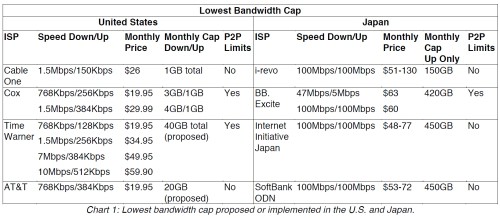
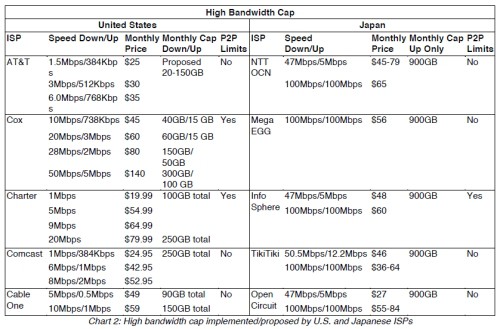
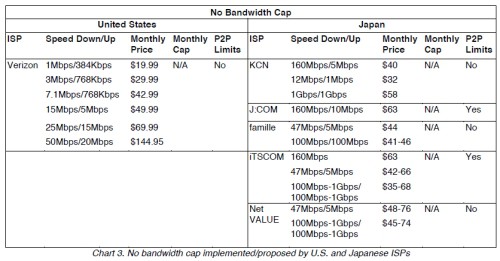
Li and Losey point out that while Japanese ISPs caps the upstream; they are generous with unlimited downstream while American ISPs are beginning to cap both the upstream and downstream. But this is a flawed analysis because capping the upstream effectively cuts to total downstream peer-to-peer (P2P) traffic to the same levels. And because P2P is one of the most heavily used application on the Internet accounting for the vast majority of Japanese Internet traffic, cutting upstream usage greatly reduce all P2P traffic and all Internet usage which was necessary because their Internet backbones were severely congested. I’ve argued that it is far more efficient to manage the network but until then the caps are needed.
Another problem with Li and Losey’s analysis is that it only looks at the usage cap without an analysis of the duty cycle and its ramifications. When we compare the usable duty cycle between ISPs in Japan compared to ISPs in the U.S. derived from Li and Losey’s data, we see a completely different picture. By splitting the U.S. ISP usage caps (some of these caps are only in proposal phase) into an upstream and downstream cap proportional to the upstream/downstream connection speeds, I was able to generate Figure 1 below. What it actually shows is that U.S. broadband providers have usage caps that allow users to use their Internet connection far more frequently than users in Japan. So while a user in Japan is capped to 40 minutes a day of upstream Internet usage, which indirectly caps download speed because it severely trims the number and generosity of P2P seeders. AT&T’s proposed DSL usage caps (similar to other DSL providers) allow for 1111 minutes of usage per day on the upstream and 97 minutes on the downstream per day. So broadband consumers who are dissatisfied with their tiny Time Warner usage caps can simply switch to their DSL provider.
I guess that wraps that up. Or not.
Ou wants us to assume quite a bit in his own analysis. His contention that the “vast majority” of Japanese Internet traffic is peer-to-peer is “proven” by linking to an earlier article… written by him… saying just that. But let’s grant Ou the premise that peer-to-peer is at the epicenter of bandwidth congestion in Japan. Ou defends Japanese providers for specifically targeting the upstream traffic, pointing out stingy torrent users that don’t give as much as they get will automatically be speed limited during downloads (Bit Torrent’s way of equal sharing). But he never extends the upstream cap argument to the United States, where he implies a similar traffic overload is occurring. Instead, he merely acknowledges that domestic providers are experimenting with caps that limit both uploading and downloading, impacting every broadband user, not just those “problem” peer to peer users.
Caps. The necessary evil?
Ou is okay with the equivalent of dealing with a pesky fly in the kitchen by setting the house on fire. Doing that might solve the fly problem, but makes living there unpleasant at best in the future.
In fact, the impetus for dealing with the peer to peer “problem” in Japan turns out to be as much about copyright politics as bandwidth management.¹
I also have no idea why Ou would spend time developing a “duty cycle” formula in an effort to try and convince Americans that those generous looking caps in Japan are actually worse for you than the paltry ones tested in the United States. His formula is dependent on the speed levels offered by Japanese vs. American providers to work. But then Ou tries to debunk the speeds on offer in Japan as more fiction than reality, and throws his own “duty cycle” formula under the bus as a result:
Li and Losey also paint a dire picture that Japan has 10 or more times the connectivity speed as the US, but the most accurate real-world measurement of Internet throughput in Japan according to the Q1-2009 results from Akamai’s State of the Internet report indicates that Japanese broadband customers only average about 8 Mbps.
Ou then exposes he is completely clueless about the state of broadband in some of the communities that actually cope with usage caps, or were threatened with them. Ou’s suggestion that unhappy Time Warner Cable customers could simply leave a capped Road Runner for DSL service from the phone company leaves residents in Rochester, New York cold. For them, that means coping with an Acceptable Use Policy from Frontier that defines 5GB per month as appropriate for their DSL customers. In Beaumont, Texas, the limbo dance of caps last left residents picking between a cap as low as 20GB with AT&T or a 40GB “standard plan” from Time Warner Cable, before Time Warner dropped the “experiment” for now.
Ou should have just suggested customers in western New York and the Golden Triangle just pick up and move to another city. It would have been more realistic than his “if you don’t like them, switch” solution. It also presumes there is a viable DSL service to switch to, as well as whether or not the service can provide a sufficiently speedy connection to take advantage of today’s broadband applications.
And here is where you can draw lines between the special interests, astroturfers, industry-connected folks and actual real, live, consumers.
Ou brings out the shiny keys, waving them in consumers’ faces telling them to look somewhere else for answers:
So the reality is that usage caps isn’t what Americans should be focusing on and the priority should be to encourage more next generation broadband deployment.
Internet Overcharging schemes that charge consumers up to 300% more for their broadband service, with no corresponding improvement in service, is not the problem for Ou, but it certainly was for Time Warner Cable customers in several cities chosen for their Overcharging experiment. The need to encourage more broadband deployment is fine, but American broadband customers will be broke long before that ever happens without some other pro-consumer solutions.
Ou has a problem though. He has a new employer.
A corporate restructuring at ZDNet in the spring of 2008 meant Ou was free to pursue other professional interests, and wouldn’t you know, he turned up as Policy Director of “pro-commerce” Digital Society. That’s a “free market think tank” website whose domain name is administered by one Jon Henke in… you guessed it, suburban Washington, DC (Arlington, Virginia to be exact).
The sharks are in the water.

Jon Henke
Henke, Executive Director of Digital Society, and presumably Ou’s boss, has quite the agenda of his own, and it’s not consumer driven. He has a long history of involvement in conservative politics, which brings new questions about how Henke would approach “encouraging next generation broadband deployment.” Does he favor broadband stimulus money? How about municipal broadband competition?
In addition to his work with Digital Society, Henke also runs something called the DC Signal Team. What’s that? Let’s see:
DC Signal is a strategic intelligence and communications firm specializing in new media consulting. Based in the Washington, DC area, we work with a range of clients — corporations, trade associations, campaigns, and individuals — to craft and execute an effective online strategy. We provide timely intelligence and analysis, as well as communications that can reach and resonate with key opinion makers, policy experts, and elected officials.
Our expertise in new media communications sets DC Signal apart, allowing us to filter out the background noise on the Internet to deliver just the most relevant information, make creative, appropriate recommendations based on that information, and target communications directly to the most influential audiences.
I love the smell of plastic grass in the morning.
That’s right, folks. DC Signal is a classic PR firm that uses targeted communications to reach the most appropriate audience for their campaigns. Need to reach consumers and sell them on a pro-industry position? Set up a “grassroots” group to do it. Need to baffle the media, lawmakers and opinion leaders with industry BS? Set up “authoritative” websites to deliver carefully filtered “relevant information.” What better way to do that than with a blog like Digital Society?
But wait, there’s more.
Henke is also working for an innocuously named group called Arts+Labs, which starts its mission statement out innocently enough:
Arts+Labs is a collaboration between technology and creative communities that have embraced today’s rich Internet environment to deliver innovative and creative digital products and services to consumers. From the early development of motion picture technology, voice recordings and radio to today’s 3D computer graphics, streaming digital movies, “on-demand” entertainment, online games, news and information, innovative technologies and creativity have always gone hand in hand to enrich our understanding and appreciation of arts, entertainment and culture.
Then things become more ominous.
At the same time, Arts+Labs is working to educate consumers about how net pollution – spam, malware, computer viruses and illegal file trafficking – threatens to transform the Internet from an essential catalyst to safely deliver this content to consumers, into a viral distribution mechanism that will choke off the Internet for consumers and future innovators and creators alike.
I can understand the threats from spam, malware, and computer viruses — what groups out there actually advocate for these? — but the “illegal file trafficking” thrown in at the end had me wondering.
I smell industry money, probably from providers who oppose Net Neutrality and want to throttle peer to peer applications, from Hollywood content producers who want to keep their content off The Pirate Bay, the music industry who is always paranoid about piracy, and of course equipment manufacturers who sell the hardware that does the bandwidth management.
So who “partners” with Arts+Labs?
- Viacom
- NBC Universal
- AT&T
- Broadcast Music, Inc. (BMI)
- Verizon
- Microsoft
- Songwriters Guild of America
- Cisco
- American Society of Composers, Authors and Publishers (ASCAP)
There you go.
 Arts+Labs tries to be clever about its agenda, not so much with strident opposition to Net Neutrality, but instead promoting “consumer interests” by insisting that providers fully disclose the abuse about to be heaped on their customers. In a press release in June, the group advocated its own national broadband strategy recommendations to the FCC:
A Safe Internet and Smart Management Will Boost Digital Society
It also said that a safe Internet must be a core part of a national broadband strategy and that the failure to protect online data and crack down on net pollution such as malware, spam, phishing and other Internet crime will erode the value of the Internet and discourage broadband adoption.
“To drive adoption and build a successful digital society that reaches every American, all of us must accept responsibility for minimizing online risks, protecting users’ privacy, and ensuring data security against malicious online activity and cybercrime,” A+L said.
It also urged the Commission to embrace “smart management tools and techniques.”
“Used effectively, smart management of our networks will stimulate broadband adoption by expanding the scope of activities available to consumers, by addressing network congestion, and by defending against hacking, phishing, identity theft and other forms of cybercrime,” the filing added.
But it said network operators must not abuse management tools to interfere with competitors or consumers rights and noted: “In a digital society, network managers owe their customers transparency about their network management practices, including proactive disclosure of new policies or innovations that may affect users’ experiences.”
A+L Urges Collaborative Effort, Says Pragmatism Should Trump Ideology
It also urged the Commission to avoid unnecessary regulatory constraints that would interfere with the ability of content providers, network operators and other Internet-related businesses to experiment with new business models and to offer innovative new services and options to consumers.
Finally, A+L urged every Internet industry and every individual who uses the Internet to work together to achieve the nation’s broadband goals.
“Building an inclusive digital society and achieving our broadband goals will require all of us to think outside of silos, to choose pragmatic and effective policies over ideology, and to drive broadband adoption by encouraging the creation of exciting content, protecting intellectual property, and ensuring that the Internet is a safe place to be. And, the guiding principle on every issue should be to find the solution that moves broadband forward,” A+L concluded.
Broadband throttles and Internet Overcharging aren’t anti-consumer — they are “new policies or innovations.” As long as the provider discloses them, all is well.
The ideology reference in the press release is remarkable, considering the people who involve themselves in Arts+Media represent a veritable hackathon of the DC political elite, from Mike McCurry, former Clinton Administration press secretary, Mark McKinnon, who advised President George W. Bush, to the aforementioned Jon Henke, who was hired originally to do “new media” damage control for former Virginia senator George “Macaca” Allen and then went to work for the presidential campaign of Fred Thompson.
As usual, the only people not on Arts+Labs’ People page are actual consumers.
To wrap up this party of special interests, which consumers aren’t invited to, we wind our way back to the home page of Digital Society, which features a familiar roster of recommended blogs and websites to visit. Among them:
- Arts & Labs blog (Henke works with them)
- Broadband Politics (run by Richard Bennett, who forgot he worked for a K Street Lobbyist, actually on K Street (read the comments at the bottom of the linked article)
- Cisco Policy Blog (also a partner with Arts+Labs, has a direct interest in selling the bandwidth management hardware)
- Verizon Policy Blog (also a partner with Arts+Labs, and an interested provider in this issue)
In the beginning of this piece, I recited some of the “scare mongering” Ou accused groups of engaging in on the Net Neutrality debate back in 1996. The first major Net Neutrality battle was with Comcast over bandwidth throttles. The barely-conscious FCC under Kevin Martin spanked Comcast (who sued, of course) and we’ve been in a holding pattern ever since. But the predictions have become remarkably true north of the American border, where Canada endures all of the things Ou swore up and down in 1996 would never happen.
- Most major broadband providers in Canada throttle the speeds of peer to peer applications, reducing speeds to a fraction promised in their marketing materials.
- Most major broadband providers in Canada not only charge customers based on broadband speed, but also by the volume of data consumed, causing spikes in customer bills and a reduction in usage allowances in some cases. Customers now face overlimit fees and penalties for exceeding the Internet usage ration they are granted each month.
- In 2006, Shaw Communications in Canada tried sticking a $10 monthly fee on broadband customers wanting to use Voice Over IP telephone service. Vonage Canada complained loudly at the time.
- As far as controlling what you see online, that’s already in the cards in the States, if the cable industry has any say in the matter.
With a pliable FCC, what exists in Canada today will exist in the United States tomorrow without Net Neutrality protections enacted into law.
(footnoted material appears below the break)
… Continue Reading


 Subscribe