Home » network management » Recent Articles:

Here We Go Again: Net Neutrality Violates Corporate Freedom of Speech, Says Cable Association

Kyle McSlarrow

Kyle McSlarrow

Once again, the telecommunications industry is threatening to run to the courts if it faces Net Neutrality regulation, claiming their corporate freedom of speech would be violated by protecting the rights of consumers to access the content of their choice on their terms.

Kyle McSlarrow, President & CEO of the National Cable & Telecommunications Association, the nation’s big cable operator trade association, delivered the warning at yesterday’s appearance at the Media Institute in Washington, DC.

In a speech clearly designed to put regulators on notice, McSlarrow dismissed Net Neutrality as a solution in search of a problem and a concept big cable would likely challenge in the courts.

“When all the dire warnings of the net neutrality proponents are stripped away, there really are no signs of actual harm.  Yes, there have been a couple of isolated incidents that keep being held up as examples of what needs to be prevented, but nothing that suggests any threat to the openness of the Internet,” McSlarrow said. “Internet Service Providers do not threaten free speech; their business is to enable speech and they are part of an ecosystem that represents perhaps the greatest engine for promotion of democracy and free expression in history.”

McSlarrow told the audience that the cable industry would be among the victims of Net Neutrality, claiming their rights to transact business on their networks could be trampled by an overzealous Federal Communications Commission.

Almost every net neutrality proposal would seek to control how an ISP affects the delivery of Internet content or applications as it reaches its customers.   This is particularly odd for two reasons:  First, there is plenty of case law about instances of speech compelled by the government – “forced speech” — that suggests such rules should be scrutinized closely. Second, and perhaps more importantly, it is an almost completely unnecessary risk.  All ISPs have stated repeatedly that they will not block their customers from accessing any lawful content or application on the Internet.  Competitive pressures alone ensure this result:  we are in the business of maximizing our customers’ choices and experiences on the Internet.  The counter examples used to debate this point are so few and so distinguishable as to make the point for me.

Beyond the forced speech First Amendment implications, however, net neutrality rules also could infringe First Amendment rights because they could prevent providers from delivering their traditional multichannel video programming services or new services that are separate and distinct from their Internet access service.  While the FCC’s NPRM acknowledges the need to carve out “managed” or “specialized” services from the scope of any new rules, it also expresses concerns that “the growth of managed or specialized services might supplant or otherwise negatively affect the open Internet.”   Meaning what?  Well, the strong implication is some kind of guaranteed amount of bandwidth capacity for services the government deems important.

McSlarrow is focused front and center on the rights of providers, not consumers, when he speaks about the First Amendment.  His constituents are Time Warner Cable, Cox, Comcast, Charter, and the other NCTA members, namely big cable companies.  In his view, any regulation or interference in how providers decide to deliver service is a potential violation of their constitutionally protected rights.  That’s a side effect of the nation’s courts recognizing that corporations have rights, too.

McSlarrow predicts a laundry list of  ‘doom and gloom’ scenarios that would befall providers if Net Neutrality was enacted:

  • Net Neutrality could prevent providers from delivering their traditional multichannel video programming services or new services that are separate and distinct from their Internet access service;
  • Net Neutrality would prohibit ISPs and applications providers from contracting for any enhanced or prioritized delivery of that application or content to the ISPs’ customers.  Under the proposal, ISPs wouldn’t even be permitted to offer such prioritization or quality-of-service enhancements at nondiscriminatory prices, terms and conditions to anyone who wanted it.
  • Net Neutrality may mean that they [content providers] can’t provide material in the enhanced form that they want.
  • Net Neutrality could tell a new entrant or an existing content provider that it cannot enter into arrangements with an ISP for unique prioritization or quality of service enhancements that might enable it to enter the marketplace and have its voice heard along with those of established competitors.

McSlarrow doesn’t offer a shred of evidence to prove his more alarmist predictions, even as he demands it from those who support Net Neutrality.  The kind of unregulated, non-neutral net McSlarrow advocates already exists in places like Canada.  What you see there is what you’ll get here  — threats of usage caps unless speed throttles are permitted, arbitrary “network management” that reduces speeds for some services while “enhancing” or “exempting” certain other services (usually those partnered with the provider), and in the end usage caps -and- throttles -and- price increases.  In Canada, the story extends beyond the retail broadband market.  Wholesale broadband sold to independent ISPs comes nicely throttled and overpriced as well.

McSlarrow maintains a see no evil, hear no evil approach to his provider friends who pay his salary.  Comcast’s quiet throttling of peer to peer applicati0ns that blew up into a major scandal when the truth came out was evidently one of the “isolated incidents” he speaks about.  That’s only the nation’s largest cable operator — no reason to get bent out of shape about that.

Let’s break down McSlarrow’s concerns and read between the lines:

  • Nothing about Net Neutrality impacts on a cable system’s ability to deliver its multichannel video programming.  What McSlarrow is hinting at is that cable may end up using some of the same technology that moves online video to your computer to transport television programming to your TV set.  AT&T does that today with its U-verse system.  It’s basically a fat broadband pipe over which television, telephone, and broadband service travels together over a single pair of wires.  There is no demand that broadband must usurp your cable television package.
  • McSlarrow is trying to be clever when he describes “new services” that he defines as separate and distinct from Internet access service.  That usually includes “digital phone” products which providers already exempt from usage limits imposed on competitors like Vonage.  If “network management” throttles Vonage while exempting the cable system’s own phone product, is that fair?  What about the forthcoming TV Everywhere?  Could a provider throttle the speed of Hulu while exempting its own online television service?  What happens if a provider’s own service is exempted from these throttles and can deliver a higher quality picture because of that exemption?
  • “Bandwidth is not infinite.”  That’s something I’ve heard providers argue for more than a year complaining about their congested networks and why they need to impose controls to “manage them.” McSlarrow wants providers to be able to “manage” those networks by selling enhanced speeds for applications that partner with the provider.  Unfortunately, because cable broadband is a shared resource, those premium enhanced speeds will consume a larger share of that resource, naturally slowing down everyone else who didn’t agree to pay. Providers will say they are not ‘intentionally’ slowing down the free lane, but that’s a distinction without a difference to the consumer who will find many of their websites slower to access.
  • Today’s model asks consumers to make the ultimate choice. If they want a faster online experience, they can purchase a faster tier of service. Now providers want to change that by establishing a nice protection racket — pay us for “enhanced speeds” or your content may not reach your customers at a tolerable rate of speed.
  • It’s ironic McSlarrow is suddenly crying about how unfair it is content providers can’t purchase these “enhanced services.”  That’s a change of tune from an industry that used to accuse the large number of content providers who support Net Neutrality as freeloaders trying to use “their pipes for free.”

Customer demand for higher speeds and more reliable service should be all the impetus the cable industry needs to deliver quality service, particularly considering consumers pay a lot of money for the service and remain loyal to it.

McSlarrow’s final argument is a testament to the arrogance of the cable industry on the issues that concern subscribers.  A-la-carte channel choice, equipment options and expenses, usage limits, rate increases, and service standards are all issues this industry has fought with regulators about.  What customers want is secondary, and can remain that way as long as consumer choice is kept limited.  McSlarrow’s valiant defense of the rights and freedoms of the cable industry to offer extra freedom of speech through enhanced speed-privileges to content partners is more important to him and his provider friends than the rights of customers to not have their service artificially degraded to make room for even bigger cable profits.


Sun-Sentinel Runs Hit Opinion Piece On Net Neutrality, Forgets To Disclose AT&T and Embarq Helped Finance It

Mark A. Jamison

Mark A. Jamison

Stop the Cap! reader Joe sends along news of another one of those guest opinion hit pieces on Net Neutrality that pop up regularly in the media.  This one, The Internet is Never Neutral, printed in today’s Sun-Sentinel in south Florida, comes from Mark A. Jamison and Janice Hauge, a dynamic duo who have co-written several papers that always manage to turn up favorable conclusions for big telecommunications companies, including these page-turners:

  • “Bureaucrats as Entrepreneurs: Do Municipal Telecom Providers Hinder Private Entrepreneurs?”
  • “Subsidies and Distorted Markets: Do Telecom Subsidies Affect Competition?”
  • “Dumbing Down the Net: A Further Look at the Net Neutrality Debate.”

The two are also working on other papers purporting to study regulatory policy and competition issues.  Let me illustrate my psychic powers by guessing they’ll find regulatory authorities to be obstacles to the well-oiled telecommunications machine and competition will be most hearty if there are no pesky regulations to hamper it.  We’ve seen how well that has worked so far for consumers in North America.

Remember Al Gore calling the Internet the information superhighway? The metaphor wasn’t and isn’t perfect, but it is instructive. Suppose we applied net neutrality to our transportation system — there would be no high-occupancy vehicle lanes during rush hour, no car-only lanes on interstates, and no toll road as an alternative to I-95 in South Florida. Transportation would be more costly and provide less value.

Forcing net neutrality would have similar results. Time-sensitive information, such as stock market transactions, would wait in line behind football game highlights.

Jamison, who is a former manager at Sprint Communications, and Hauge miss the entire point of the Internet’s biggest strength: its equal treatment of traffic from the smallest blog to Amazon.com.  Assuming providers, earning billions in profits even as their costs decline, invested appropriately in those networks, there would be no need for high-occupancy vehicle lanes and toll roads.  These kinds of “traffic management” techniques are proposed because provider dollars don’t keep up with consumer demand.  Social engineering tries to throttle traffic downwards by discouraging it with toll fees or manage it with special high cost lanes reserved only for those willing to pay or follow arbitrary rules governing their use.  More often than not, those premium lanes go underutilized while the rest of us remain stuck in the slow lane.

Net Neutrality would not impede network management that enhances the efficiency of traffic, except when it comes at the expense of someone else’s traffic. Net Neutrality also throws up a roadblock against providers who would plan to cash in with enhanced connectivity services that cannot exist unless  a market is created to sell them.  It’s similar to providers in Canada limiting your access to broadband, then throwing a penalty fee on your bill… unless you sign up and pay for their “insurance” plan to protect you from those charges.

Want to run a video streaming application on the Internet?  Pay for a broadband provider’s deluxe delivery insurance, and customers will be able to watch that video without buffering.  The alternative is to be stuck waiting because your video is being delivered on an artificial “slow lane.”

If you are thinking that it sounds like net neutrality restricts innovation and hurts customers, you’re right. Our research has shown that net neutrality limits innovation, contrary to the claims of the net neutrality proponents. How can this be? Imagine a one dimensional network — one that does nothing but carry information from point to point, which is how the old Internet has worked. What kinds of content providers flourish in that context? Those big enough to distribute their software across the net and those whose software takes advantage of the great bandwidth that they don’t have to pay for.

Their research makes numerous assumptions that might prove accurate in a laboratory environment, but simply discounts provider mischief in their efforts to maximize profits and minimize costs.  Providers have earned countless billions providing this “one dimensional network” to consumers.  It’s the one bright spot in a lackluster telecommunications sector.  Those who innovate new broadband applications have flourished.  Some providers who have not want to innovate in a different way – by inventing new Internet Overcharging schemes to profit from the service without actually improving it.  When their interests are at stake in owning and managing their own content services, bandwidth suddenly becomes plentiful.  The TV Everywhere project will potentially provide a value-added service to cable and telco TV providers, all made possible in marked contrast to their argument that other producers’ video content is clogging their networks.

Another naked fallacy in the authors’ argument is that content providers don’t pay for the bandwidth to host and distribute their content.  They do — to the companies that host their content and provide connectivity to the Internet.  That’s the job of web hosting companies.  Internet service providers simply want to be paid extra for doing their job – providing connectivity to consumers who pay $4o or more a month Free Press found costs about $8 to provide, and then also charging content creators a second time to facilitate delivery of that content.  That’s akin to charging a phone customer for placing a long distance call and also demanding to bill the person who answers.

Now, suppose that the network can offer enhancements that improve customers’ experiences. Content providers whose sites would not benefit from such enhancements could ignore the offering. But there will be some content providers who could improve their services by buying the enhancements, such as priority packet delivery. These sites become better without net neutrality and offer customers more service. In other words, there is more innovation and greater customer welfare without net neutrality than with it.

Promises, promises.  Just getting these providers to upgrade broadband speeds to consumers has been a never-ending quest.  Many consumers are willing to pay for “improved service” in the form of faster connections to the Internet.  Consumers are not willing to pay more for artificially limited service, be it through throttled speeds or usage caps.

At the conclusion of their study, which assumes providers will not leverage their duopoly in most American markets to increase pricing/revenue and reduce costs by limiting demand on their networks, they readily admit they did not take into account several possible scenarios:

  • One issue is how the offering of premium transmission might affect the network provider’s incentive to change the standard transmission speed. At least AT&T has committed to not degrade service for any network user, but it is unclear how such a commitment would be enforced.
  • Secondly, we do not analyze the effects of peer-to-peer communication, which is growing in importance on the Internet.
  • Thirdly, we do not consider the effects of vertical integration by the network provider and whether this would provide an incentive for foreclosure.
The PURC is part of the University of Florida, but also receives private corporate funding

The PURC is part of the University of Florida, but also receives private corporate funding

Because the broadband industry fights any attempt to regulate their service, it is unlikely any such promise from AT&T would be enforced.  What AT&T defines as “degraded” service is open to interpretation as well.  As broadband demand is dynamic and growing, should AT&T leave standard transmission speeds exactly as they are today, that non-premium service would be degraded through inattention to broadband growth.  Peer to peer communication is largely a story from the first round of the Net Neutrality debate in 2006-7.  A more significant amount of traffic is now attributed to online video.  Finally, not considering vertical integration in the cable and telephone industry is a fatal flaw.  The history of telecommunications regulation has largely been written during periods when the cable and telephone industry abused their market position to overcharge consumers for service, lock up content distribution channels, and forestall competition wherever and whenever possible.

Frankly, Jamison and Hauge’s world view only innovates new, even fatter profits for providers like AT&T.  Perhaps some of those profits can go towards even greater funding for the Public Utility Research Center, where Jamison serves as director and Hauge as a Senior Research Associate.  The PURC, part of the University of Florida, just happens to have, among others, AT&T and Embarq Florida as sponsors, and both companies have seats on the PURC Executive Committee.

Sun-Sentinel readers don’t have that information because it’s not included in the disclosure at the bottom of the piece.  Following the money would shed a lot more sun on this important debate.

Clearwire Changes Terms & Conditions: Redefines ‘Unlimited’ As ‘Limited and Throttled’ – Escape Window Is Open

Phillip Dampier November 25, 2009 Broadband Speed, Data Caps, Video 8 Comments

Clearwire this week changed their terms and conditions governing the use of their service.  The changes are sufficiently materially adverse that subscribers under contract should be able to cancel service, if they wish, without incurring any early termination fee.

The most prominent change is Clearwire’s ability to crack down on whatever they define “excessive usage” to be, and the redefining of ‘unlimited service’ as ‘limited and speed throttled service.’

All-New to the Clearwire Terms & Conditions:

Nature of the Service.The Service provided to you is intended for reasonable, periodic, non-continuous use by a person using a computing device, consistent with the type of use made by a typical individual consumer of our Internet services. Examples of allowed uses of our Service include web surfing, sending and receiving email, sending and receiving photographs, occasional on-line gaming, and the occasional non-continuous streaming of videos and downloading of files. Examples of uses that are not permitted include the continuous unattended streaming, downloading or uploading of videos or other files, maintaining an unattended or continuous uninterrupted connection to the Internet such as through a web camera or machine to machine connections that do not involve active participation by a person, or operating an Internet hosting service such as web hosting or gaming hosting. You may not use the Service in a manner that impairs the user experience of other users, or that otherwise impairs network performance. Both fixed wire-line Internet service and wireless Internet service have limited bandwidth capacity. Like fixed wire-line service, CLEARs Service can suffer from congestion and reduced performance when usage by some individuals exceeds the usage of typical individual consumers, thus having a negative impact on the entire network. This AUP is intended to ensure that the activities of a few users do not unfairly impair the activities of all users of the Service.

Clearwire’s unlimited use plans have always carried a clause giving the company the right to terminate or suspend service for exceptionally excessive usage, after several contacts with customers.  The old language:

Unlimited Use Plans. (Effective January 9, 2009)

While the determination of what constitutes excessive use depends on the amountspecific state of data you may download or upload during a monththe network at any given time, you shouldexcessive use will bethat such unlimited plans are nevertheless subject todetermined by resource consumption and not by the provisionsuse of this AUPany particular application. What this means is that allWhen feasible, upon observation of the provisions described in this AUPan excessive use pattern, including those that describe how Clearwire may perform reasonable network management such as reducingwill attempt to contact you by e-mail at the data ratee-mail address on file or otherwise to alert you to your excessive use of bandwidth intensive users during periodsand to help determine the cause. Clearwire representatives also are available to explain the parameters of congestion, will applythis AUP and to yourhelp you avoid another excessive use incident or to upgrade you to a different class of the Service that comports with your usage. The term unlimited means that we willIf you are unavailable or do not place a limit on how much datarespond to Clearwires attempt to contact you uploadregarding excessive use, or download during a monthif excessive use is ongoing or other particular periodrecurring, howeverClearwire reserves the right, it does not mean that we will not take stepsset forth in the AUP Enforcement and Noticeprovisions below, to reduce your data rate during periods of congestionact immediately and without further notice to restrict, suspend or take other actions described in this AUP whenterminate your usage is negatively impacting other subscribers to our Service.

The new language now permits the company to use “network management” techniques such as reducing your speed if they feel you are excessively using Clearwire’s “unlimited” service.  Although the new language sounds friendlier — deleting references to suspending or terminating your service — Clearwire’s Acceptable Use Policy (AUP) maintains those rights in another section.  When all is said and done, Clearwire still gets to limit your usage -and- can now also reduce your speed:

Unlimited Use Plans. (Effective November 22, 2009)

If you subscribe to a service plan that does not impose limitsWhile the determination of what constitutes excessive use depends on the amountspecific state of data you may download or upload during a monththe network at any given time, you shouldexcessive use will be aware that suchunlimited plans are nevertheless subject todetermined by resource consumption and not by the provisionsuse of this AUPany particular application. What this means is that allWhen feasible, upon observation of the provisions described in this AUPan excessive use pattern, including those that describe how Clearwire may perform reasonable network management such as reducingwill attempt to contact you by e-mail at the data ratee-mail address on file or otherwise to alert you to your excessive use of bandwidth intensive users during periodsand to help determine the cause. Clearwire representatives also are available to explain the parameters of congestion, will applythis AUP and to yourhelp you avoid another excessive useincident or to upgrade you to a different class of the Servicethat comports with your usage. The termunlimited means that we willIf you are unavailable or do not place a limit on how much datarespond to Clearwires attempt to contact you uploadregarding excessive use, or download during a monthif excessive use is ongoing or other particular periodrecurring, howeverClearwire reserves the right, it does not mean that we will not take stepsset forth in the AUP Enforcement and Noticeprovisions below, to reduce your data rate during periods of congestionact immediately and without further notice to restrict, suspend or take other actions described in this AUP whenterminate your usage is negatively impacting other subscribers to our Service.

Clearwire (and the soon-to-be-launched Road Runner Mobile from Time Warner Cable and Comcast’s mobile broadband option) share the same Clearwire WiMax network.  As investors in Clearwire, the cable operators have won the right to rebrand the service to provide a mobile option for their broadband customers.

Customers considering signing up for service should carefully verify the terms and conditions of their contract, as well as the quality of service provided where you expect to use the service the most.  Several websites highly critical of Clearwire have been established with hundreds of upset customers who were promised broadband speeds and barely managed much more than dial-up speeds using the service.

<

p style=”text-align: center;”>

“Clearwireblows” ran a speed test illustrating serious speed problems using Clearwire in Texas this past April.  (2 minutes)

Customers who wish to end their contract without incurring a cancellation fee can do so following this procedure:

  1. Contact Clearwire in writing and inform them you are exercising your right to terminate service without charge or penalty because of materially disadvantageous changes to the Clearwire Terms and Conditions effective November 22, 2009.  Under their terms, you have a right to discontinue service in accordance with the section “Revisions: Reservation of Rights.”  Namely, “…if you do not wish to continue Service after a change that is materially disadvantageous to you, you may terminate this Agreement by providing written notice to Clearwire within twenty (20) days of the effective date of the modification.”  The link above contains contact addresses you may use.
  2. Contact customer service by telephone and inform them you have followed the written cancellation procedure outlined above.
  3. Be certain to insist Clearwire not charge any termination fees, and that you do not agree to pay any such fees.
  4. Should you experience any difficulties, contact the Better Business Bureau as this customer did.  The BBB helped facilitate an immediate cancellation with no termination fees.

The Internet Overcharging Express: We Derail One Limited Service Logic Train-Wreck, They Railroad Us With Another

Phillip "He Who Shall Not Be Named" Dampier

Phillip "He Who Shall Not Be Named" Dampier

I’ve tangled with Todd Spangler, a columnist at cable industry trade magazine Multichannel News before.  This morning, I noticed Todd suddenly added me to the list of people he follows on Twitter.  Now I see why.

Todd is back with another one of his cheerleading sessions for Internet Overcharging schemes, promoting consumption-based billing schemes as inevitable, backed up by his industry friends who subscribe and help pay his salary and a guy from a company whose bread is buttered selling the equipment to “manage” the Money Party.

GigaOm’s Stacey Higginbotham and Broadband Reports’ Karl Bode don’t pay his salary, so it’s no surprise he disagrees them.  Oh, and I’m in the mix as well, but not by name.  Amusingly, I’m “the StoptheCap! guy, who’s making a career directing his bloggravation at The Man.”

Todd doesn’t consider himself “an edgy blogger type because, as everyone knows, I am The Man,” he writes.

Actually, Todd, you are Big Telecom’s Man, paid by an industry trade magazine to write industry-friendly cozy warm and fuzzies that don’t rock the boat too much and threaten those yearly subscription fees, as well as your paid position there.  I’ve yet to read a trade publication that succeeds by disagreeing with industry positions, and I still haven’t after today.

Unlike Todd, I am not paid one cent to write any of what appears here.  This site is entirely consumer-oriented and financed with no telecom industry involvement, no careers to make or break, and this fight is not about me.  I’m just a paying customer like most of our readers.

This site is about good players in the broadband industry who deserve to make good profits and enjoy success providing an important service to subscribers at a fair price, and about those bad players who increasingly seek to further monetize their broadband offerings by charging consumers more for the same service.  As one of the few telecom products nearly immune from the economic downturn, some providers are willing to leverage their barely-competitive marketplace position to cash in.

It’s about who has control over our broadband future – certain corporate entities and individuals who openly admit their desire to act as a controlling gatekeeper, or consumers who pay for the service.  It’s also about organizing consumers to push back when industry propaganda predominates in discussions about broadband issues, and we know where we can find plenty of that.  Finally it’s about evangelizing broadband, not in a religious sense, but promoting its availability even if it means finding alternatives to private providers who leave parts of urban and rural America unserved because it just doesn’t produce enough profit.

Let’s derail Todd’s latest choo-choo arguments.

“The idea of charging broadband customers based on what they use is still in play.” — That’s never been in play.  True consumption billing would mean consumers pay exactly for what they use.  If a consumer doesn’t turn on their computer that month, there would be no charge.  That’s not what is on offer.  Instead, providers want to overcharge consumers with speed –and– usage-based tiers that, in the case of Time Warner Cable, were priced enormously higher than current flat-rate plans.  Customers would be threatened with overlimit fees and penalties for exceeding a paltry tier proposed by the company last April.  The ‘Stop the Cap! guy’ didn’t generate thousands of calls and involvement by a congressman and United States senator writing blog entries.  Impacted consumers instinctively recognized a Money Party when they saw one, and drove the company back.  A certain someone at Multichannel News said Time Warner Cable was “taking one for the team.”  At least then you were open about whose side you were on.

“Verizon just wants to make more money by charging more for the same service. What an outrage! It’s not like the company spent billions and billions to build out their network and needs to recoup that investment.” — Recouping an investment is easily accomplished by providing customers with an attractive, competitively priced service that delivers better speed and more reliability than the competition.  Provide that in an era when fiber optic technology and bandwidth costs are declining, and not only does the phone company survive the coming copper-wire obsolescence, it also benefits from the positive press opinion leaders who clamor for your service will generate to attract even more business.  Stacey’s comments acknowledged the positive vibes consumers have towards Verizon’s fiber investment — positive vibes they are now willing to throw away.

Verizon FiOS already gets to recoup its investment from premium-priced speed tiers that are favored by those heavy broadband users.  Most will happily hand over the money and stay loyal, right up until you ask for too much.  Theoretically charging your best customers $140 a month for 50Mbps/20Mbps service and then limiting it to, say, 250GB of usage will be an example of asking for too much.  Verizon didn’t get into the fiber optics business believing their path to return on investment was through consumption billing for broadband.

“Today’s broadband networks — not even FiOS — are not constructed to deliver peak theoretical demand and adding more capacity to the home or farther upstream will require investment.” — Readers, today’s newest excuse for overcharging you for your broadband access is “peak theoretical demand.”  It used to be peer-to-peer, then online videos, and now this variation on the “exaflood” nonsense.  It sounds like Todd has been reading some vendor’s press release about network management.  Peak theoretical demand has never been the model by which residential broadband networks have been constructed.  The Bell System constructed a phone network that could withstand enormous call volumes during holidays or other occasional events.  Broadband networks were designed for “best effort” broadband.  If we’d been living under this the peak demand broadband model, cable modem service and middle mile DSL networks wouldn’t be constructed to force hundreds of households to share one fixed rate connection back to the provider.  It’s this design that causes those peak usage slowdowns on overloaded networks that work fine at other times.

No residential broadband provider is building or proposing constructing peak theoretical demand networks that are good enough to include a service and speed guarantee.  Instead, cable providers are moving to affordable DOCSIS 3 upgrades, which continue the “shared model” cable modems have always relied on, except the pipeline we all share can be exponentially larger and deliver faster speeds.  Will this model work for decades to come?  Perhaps not, but it’s generally the same principle Time Warner Cable is using to deliver HD channels quietly ‘on demand’ to video customers without completely upgrading their facilities.  You don’t hear them talk about consumption billing for viewing, yet similar network models are in place for both.

“Is it fairer to recover that necessary investment in additional capacity from the heaviest users, who are driving the most demand?” Apparently so, because providers already do that by charging premium pricing for faster service tiers attractive to the heaviest users.  But Todd, as usual, ignores the publicly-available financial reports which tell a very different tale – one where profits run in the billions of dollars for broadband service, where many providers Todd feels urgently need to upgrade their networks are, in reality, spending a lower percentage on their network infrastructure costs, all at the same time bandwidth costs are either dropping or fixed, making it largely irrelevant how much any particular user consumes. What matters is how much of a percentage of profits providers are willing to put back into their networks.

Do people like Todd really believe consumers aren’t capable of reading financial reports and watching executives speak with investors about the fact their networks are well-able to handle traffic growth (Glenn Britt, Time Warner Cable CEO), that consumption based billing represents potential increased revenue for companies that deny they even have a traffic management problem (Verizon), or that broadband is like a drug that company officials want to encourage consumers to keep using without unfriendly usage caps, limits, or consumption billing (Cablevision.)

“From 7 to 10 p.m., we’re all consumption kings,” Sandvine CEO David Caputo told Todd. “Bandwidth caps don’t do anything for you.” The implication of this finding is that “the Internet is really becoming like the electrical grid in the sense that it’s only peak that matters,” he added. — I would have been asking Todd to pick me up off the floor had Caputo said anything different.  His bread and butter, just like Todd’s, is based on pushing his business agenda.  Sandvine happens to be selling “network management” equipment that can throttle traffic, perhaps an endangered business should Net Neutrality become law in the United States.  His business depends on selling providers on the idea that sloppy usage caps don’t solve the problem — his equipment will.  Todd has no problem swallowing that argument because it helps him make his.  The rest of us who don’t work for a trade publication or a net throttler know otherwise.

What would actually be fair to consumers is to take some of those enormous profits and plow them back into the business to maintain, expand, and enhance services that deliver the gravy train of healthy revenue.  In fact, by providing even higher levels of service, they can rake in even larger profits.  You have to spend money to earn money, though.

Technology doesn’t sit still, which is why provider arguments about increased traffic leading to increased costs don’t quite ring true when financial reports to shareholders say exactly the opposite.  That’s because network engineers get access to new, faster, better networking technology, often at dramatically lower prices than what they paid for less-able technology just a few years earlier.  With new customers on the way, particularly for the cable industry picking up those dropping ADSL service from the phone company, there’s even more revenue to be had.

Or, do you think spreading the cost across all subscribers, thereby raising the flat-rate pricing for everyone, is the better option? Note that Comcast did this to an extent when it raised the monthly lease fee for cable modems by $2 (to $5), citing costs associated with its DOCSIS 3.0 buildout.

The industry already thinks so.  As we’ve documented, cable broadband providers like Time Warner Cable and Comcast (and Charter next year), are already raising prices across the board for broadband customers in many areas.  Does that mean the talk about Internet Overcharging schemes can be laid to rest?  Of course not.  They want their rate increases -and- consumption based billing for even fatter profits.

If, on the other hand, you want to pretend that all-you-can-eat plans are sustainable at today’s price tiers, you’d be kind of clueless.

Every ISP maintains an Acceptable Use Policy that provides appropriate sanctions for those users who are so far out of the consumption mainstream, they cannot even see the rest of us.  Slapping consumption based billing on consumers with steep overlimit fees and penalties punishes everyone, and the provider keeps the proceeds, and not necessarily for network upgrades.

If Todd believes consumers will sit still for profiteering by changing a model that has handsomely rewarded providers at today’s prices, with plenty of room to spare for appropriate upgrades, he’ll be the clueless one.  The cable industry’s ability to overreach never ceases to amaze me.  Every 15 years or so, legislative relief has to put them back in their place.  It’s what happens when just a handful of providers decide it is easier to hop on board the Internet Overcharging Express and cash those subscriber checks than actually engage in all-out competitive warfare with one another – keeping prices in check and onerous overcharges out of the picture.

Nobody needs to know my name to understand this.  But some of his provider friends already know the names of our readers, because PR disasters do not happen in a vacuum.  They are also acquainted with two other names: Rep. Eric Massa and Sen. Charles Schumer.  If they want to go hog wild with Internet Overcharging schemes, that list of names will get much, much longer.

Phone & Cable Companies: Install Fiber-to-the-Home Using Your Existing Cable – Buckeye Cable Upgrades Without Rewiring

Phillip Dampier November 16, 2009 Buckeye, Competition, Video 4 Comments

buckeyeAre you a cable or telephone company scared of the costs associated with tearing out existing underground or overhead copper-based wiring to upgrade to fiber optics?

Why bother going through all of that effort when you can just yank the old copper wire out and push state-of-the-art fiber cable in.

Buckeye CableSystem, a Toledo, Ohio cable operator intends to do just that, using a process invented by an Austrian company, Kabel-X.

Buckeye will inject a Kabel-X supplied fluid between the outer jacket and the inner core of the cable.  This allows the cable company to pull the copper center conductor and the insulating material right out of the center of the cable, leaving plenty of space to insert new fiber optic cables, without having to tear up streets, get permission from local zoning authorities to string new cable, or go through the expense of completely replacing it.

Better known in Europe, where the process has been used throughout the continent, Kabel-X is now making inroads in North America with small scale projects with companies like Buckeye.  Kabel-X has been particularly attractive in eastern Europe, where the process is more affordable than complete cable replacement.  With more limited budgets, re-using existing cable already in place provides an attractive alternative.

Buckeye CableSystem in Toledo

Buckeye CableSystem in Toledo

The company claims it can replace up to 1000 feet of existing coaxial cable with fiber in as little as three hours.

Buckeye intends to experiment with the technology in a Toledo subdivision to see how well it works.

The one major downside to using Kabel-X is that service is typically interrupted while the cable work is being done.  Should something go wrong, customers could be left entirely without service, a prospect that mandates small scale experiments to train cable engineering crews to work speedily and efficiently, and prove the technology can work well in a variety of conditions.

“We see the Kabel-X technology as an innovative tool that will allow us to cost effectively deploy a fiber-to-the-home architecture in areas currently served by a traditional hybrid fiber coax network,” Buckeye Cablevision chief technology officer Joe Jensen said.

Buckeye’s efforts to upgrade to true fiber-to-the-home service may come as a response to AT&T’s U-verse service, which began competing for Toledo customers about a year ago.  Buckeye has 150,000 subscribers in the Toledo area, and remains the largest pay television operator, but U-verse is positioned to steal away some of those customers over time.

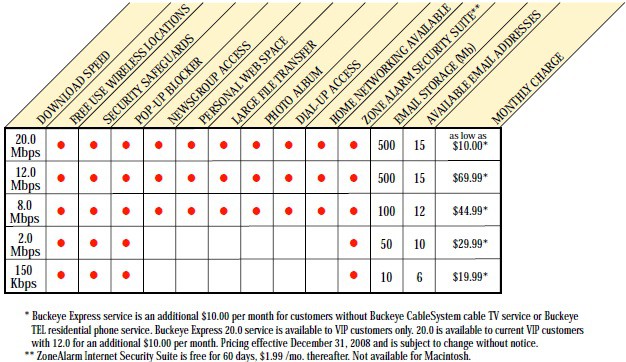
Buckeye’s cable broadband service, bex-Buckeye Express, offers customers up to 20Mbps service, if you opt to subscribe to other Buckeye services.

bex

The company’s Acceptable Use Policy indicates they do not impose limits on usage at this time, but curiously do admit to throttling the speed of peer-to-peer traffic and dynamically reducing speeds for customers who are considered “high bandwidth users” during peak demand periods.  Both of these seemed to get Comcast into hot water with the Federal Communications Commission.

BUCKEYE EXPRESS™ HIGH SPEED INTERNET SERVICE ACCEPTABLE USE POLICY

Buckeye uses reasonable network management techniques to improve overall network performance and reserves the right to employ additional techniques as necessary or desirable. Some applications, including certain peer-to-peer applications, can consume inordinately high amounts of bandwidth on the network and degrade network performance. Buckeye’s current network management techniques include:

Speed Caps – limiting the speeds that a modem can transmit or receive data. Buckeye may lower the transmission rate or reception rate of high bandwidth users during times of high network demand. This may slow the transmission or reception rate for affected modems.

Connection Limits – limiting the number of simultaneous connections for any modem during an online session. With a typical user having a dozen or so simultaneous connections for routine use, this limit provides a means of identifying and hopefully thwarting malicious attempts to harm the network or other users. This limit is currently set well above the number of connections used by typical user in a session.

Application-based Rate Limiting– limiting transmission speed of certain high bandwidth applications. Some applications, typically peer-to-peer applications, can consume large amounts of bandwidth, often without the knowledge of the user/customer. By limiting the portion of the network capacity available for these applications during periods of high traffic, Buckeye is able to improve the overall performance of the network for all users. Transmission of traffic subject to this technique may be slower during periods of high network usage.

[flv width=”480″ height=”380″]http://www.phillipdampier.com/video/Kabel-X Demo.flv[/flv]

Watch the Kabel-X process at work in this company-produced demonstration video. (7 minutes)

Search This Site:

Contributions:

Recent Comments:

Your Account:

Stop the Cap!