It’s Cell Company Customer Crackdown-month for AT&T and Verizon Wireless as the two carriers increasingly engage in aggressive “management” of their wireless data networks. Days after AT&T announced it would throw customers off legacy unlimited data plans if caught using “unofficial” tethering applications, Verizon has reportedly locked out customers from accessing web pages over jailbreak apps like MyWi, redirecting requests to a Verizon Wireless $20 Mobile Hotspot offer instead.
Mobiledia reports Verizon now requires users have a hotspot-capable data plan if they want to tether data from their smartphones to other devices. At regular prices, those plans start at $20 for 2GB of usage, with a $10/GB overlimit fee. Certain LTE/4G customers have fared better, being offered unlimited tethering for $30 a month — an option not available to 3G phone owners.
The Federal Communications Commission’s Net Neutrality policy exempted wireless providers from observing its core principles, giving carriers carte blanche to block websites and third party applications from their networks, and Verizon has put the green light to good use.
AT&T has favored direct punitive measures against customers who don’t respond to their demands to upgrade by auto-enrolling customers in $45 tethering plans or threatening legacy customers with the loss of their unlimited data plan.
Some media reports — including those from Mobiledia — have declared third party tethering applications “illegal,” which is inaccurate. While carriers may not like these applications and declare use of them contrary to their respective acceptable use policies, they do not violate any laws.
Cisco announced this week the imminent layoff of some 6,500 of its employees in a desperate bid to boost the company’s stock price and get back on the good side of Wall Street, angered by a series of acquisition blunders by the company’s management and a growing loss of confidence in the future of some of the company’s legacy broadband products.
The cuts at Cisco, which include 2,100 employees who took a voluntary early-retirement program, were announced July 18th, with tepid applause from many investors who don’t believe the company slashed nearly enough positions to get the company’s cash on hand up (although it currently amounts to nearly $30 billion, much of it stashed in overseas accounts). They wanted at least 10,000 members of Cisco’s “human network” to be cashiered.
While thousands of employees pay the ultimate price for the company’s low stock price, the executives that steered Cisco’s enormous business networking ship onto the rocks are still firmly at the helm. In fact, Cisco CEO John Chambers received compensation valued at $18.9 million in fiscal 2010, according to documents filed with the U.S. Securities and Exchange Commission. His total package is up 33% from 2009, when he received compensation valued at $14.2 million. That’s quite a reward for what Wall Street perceives as utter failure.
Under Chambers’ watch, Cisco overspent top dollar for Pure Digital Technologies, the San Francisco company responsible for the Flip handheld video camera. You know, the one now discontinued by Cisco less than two years after acquiring the company for $590 million (and up to $15 million in retention bonuses for key executives.) In fact, Cisco may still be paying off a deal for a product consumers have now long-since forgotten.
Chambers (AP)
Currently, there is no indication Chambers will be significantly punished for the various blunders under his watch. But his latest decision to jettison thousands of workers has thrown a high-pressure, well-funded lobbying campaign on behalf of large corporations trying to get a tax break repatriating billions stashed in overseas bank accounts, into chaos.
Cisco’s CEO was among the loudest supporters of the tax slash for corporate entities who have parked much of their free cash overseas to avoid Uncle Sam’s tax bite. Chambers has publicly said he wants to bring $30 billion in company profits back to the States, but only if he can do so at a discount. Ironically, Chambers promoted the tax holiday as a job creator, claiming Cisco would add as much as 10 percent to his workforce if the deal was approved.
That promise doesn’t mean much after this week’s employee clear-cutting by the networking company.
It’s certainly upsetting the lobbying apple cart in Washington, potentially ruining the Money Party for other super-sized corporations looking for a tax break handout.
Companies like Duke Energy said the $1.3 billion it wants to repatriate to the U.S. would create 15,000 to 20,000 jobs. But many Democrats remain skeptical the promised jobs will ever materialize.
Rep. Lloyd Doggett from Texas notes we’ve been here before. Back in 2004, HP got a tax break to bring back almost $15 billion with the promise the company would create jobs. Instead, it slashed its workforce by 14,500 employees in a year.
“As a leading proponent of this corporate tax giveaway, Cisco is announcing massive layoffs instead of investing in American job creation with the billions it already has available,” Doggett said. “Once again, it is clear that large multinational corporations have no intention of using any repatriation tax windfall to create jobs.”
This left the WinAmerica Campaign, a corporate-funded group promoting the tax cut, scrambling to deliver an adjusted message to Congress.
Oops... we need a new message.
Doug Thornell, a spokesman for the group, told Bloomberg News the effort “isn’t about just one company.”
“It’s about the benefit to the broader economy,” he said. “It’s whether we continue a failed policy that lets a trillion dollars languish overseas when our economy desperately needs the help.”
With up to 6,500 former employees about to join unemployment lines, Cisco isn’t doing much to help, especially when those responsible are not held accountable for the mistakes that left the company in its ultimate predicament.
[flv width=”360″ height=”290″]http://www.phillipdampier.com/video/Bloomberg Henderson Says Job Cuts Not Enough for Cisco’s Problems 7-18-11.mp4[/flv]
Bloomberg News talks to a Wall Street analyst who doesn’t think Cisco has cut nearly enough jobs to get the company worthwhile for investors again. (5 minutes)
Stephenson can use hit upsized alarm system to sleep better at night.
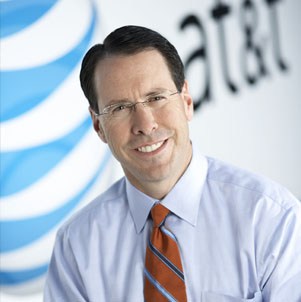
While AT&T is just weeks away from implementing Internet Overcharging schemes on its DSL and U-verse customers, the company’s CEO is raking in perks defended in the company’s 2011 proxy statement as necessary to be “robust and competitive enough to attract and retain key talent.”
Yet USA Todaynotes CEO Randall Stephenson, 50, doesn’t appear to be going anywhere — he has been with AT&T since the first term of the Reagan Administration.
In addition to more than $20.2 million in compensation, Stephenson’s perks and goodies amount to $417,000 in 2011. Some of the highlights:
Free personal use of the company jet ($180k)
Paid life insurance premiums ($164k)
A home security system ($31k)
Car leases ($29k)
Financial planning to help figure out what to do with all the cash ($14k)
Bray Cary, president and CEO of a group of West Virginia television stations enjoying advertising revenue from Frontier Communications, was back on his Decision Makers program to allow an opposing viewpoint to the puff piece interview he held earlier with Frontier’s Ken Arndt, Frontier’s Southeast region chief. This time, he invited Ron Collins, vice-president of the Communications Workers of America to give the CWA side. Cary’s Tea-‘N-CookiesBreakfast Club With Ken this was not. Cary decided to play hardball with Collins, leaving no viewer in doubt where Cary stood on the question of Frontier’s proposed purchase of West Virginia’s phone lines from Verizon.
Unfortunately, Collins was not completely prepared to rebut Cary’s pro-Wall Street, pro-deal propaganda and looked ill at ease at times during the interview. We’re not, and Cary’s “facts” deserve some investigation. After all, how hard should it be to rebut a guy who believes Wall Street and the banks have all the right answers for West Virginians’ phone service?
Video No Longer Available.
Right from the outset, Cary wants to play “devil’s advocate” with Collins, asking why in the world the CWA is opposed to this deal. That was a major departure from his cheerleading session with Arndt.
Bray Cary, Host of Decision Makers
“I’ve looked at this […] their stock has been extremely stable. Wall Street appears to be signaling their financial viability is okay. Why is the stock market not reacting negatively? If it’s good for stockholders, how can it be bad for their financial stability. Stockholders want financial stability,” Cary said in a series of statements about the deal, including mentioning a Moody’s report on the deal.
The Moody’s report Cary talks about is for shareholders who will reap the rewards or suffer the losses based on the success or failure of the deal. Moody doesn’t rate the deal’s impact on consumers who have to live with the results. What’s good for Wall Street is not necessarily what’s best for customers.
“What you don’t have is anyone in the financial community suggesting this is a bad financial deal,” Cary said December 13th.
Wrong. Almost a week earlier, on December 7th, D.A. Davidson, a respected Wall Street analyst said the opposite. In a story published in Barron’s: “Frontier Communications’ Shares Not Wired for Success,” the analyst firm argued the regional telecom’s acquisition of Verizon’s rural lines will be… wait for it… bad for the stock.
Cary’s claim that Wall Street is concerned with the long term viability of companies belies the growing reality that much of the investment culture in America has a long term obsession with short term results. Your company is only as good as your last quarter’s financial earnings statement, and several bad ones in a row are usually enough to bring a recommendation to dump shares. Frontier has kept its stock value stable largely as a result of their steady dividend payment. Collins claims Frontier has gone beyond reason, paying 125% of earnings in dividends. That may make the stock a popular choice for income investors, but is also eerily familiar.
FairPoint Communications also enjoyed a healthy stock price because of its high dividend payout. Wall Street only got concerned when they thought that deal might not go through. Morgan Stanley issued a report in 2007 suggesting the deal between FairPoint and Verizon to take control of landline customers in Vermont, New Hampshire, and Maine, was itself helping to prop up the stock’s value. We saw how far that got FairPoint when the company declared bankruptcy a few months ago.
Ron Collins, CWA's vice president
Indeed, smaller independent phone companies commonly use high dividends to remain attractive to investors and stay viable in a tough market. Windstream is another such company and even CNBC’s Jim Cramer gave due diligence to the fact high dividends and stock value by themselves don’t necessarily predict the company’s long term success or failure.
Make no mistake, Frontier has sold this deal to investors based on dividend payouts, claimed cost savings, and a safe bet that any broadband in rural America will earn them increased revenue, especially where consumers have no other place to go for service.
Frontier will take on massive additional debt to finance the deal, but on paper it actually appears to reduce their debt ratio. That’s because when you add millions of new customers, the debt doesn’t look so big next to the increased revenue those additional customers will bring, assuming they stay with Frontier. Should Frontier’s performance underwhelm customers, they’ll drop service if they can. If mobile phone networks do a better job of reaching these rural customers, many will drop landline service anyway. When wireless broadband service becomes a more realistic option, customers might toss Frontier’s slow speed DSL overboard.
AT&T and Verizon have read the writing on the wall — an ongoing decline in landline service and the eventual death of the kind of service Frontier is providing its customers on its legacy network. Would you be better off with a company that recognizes the truth about the future of wired basic phone service, or the one that wants to buy up obsolete networks and hang on until the last customer leaves?
Cary’s concern starts and stops with shareholder value, not the individual long term needs of consumers across West Virginia.
“All of the bankers and all of Wall Street are saying financially this is a good deal financially for Frontier,” Cary argued.
“Good for Wall Street, bad for West Virginia,” Collins replied.
“Well, see I disagree… that has been a myth put out there, and the reason we don’t have any jobs in this state is companies don’t want to come here just because of that mentality. People need to make money. You look at where companies are flourishing, the workers flourish when they do,” Cary said.
Really. Then why are several of these telecommunications companies awash in revenue also continuing to reduce their workforce in their relentless effort to obtain “cost savings.” Someone is making money, just not the average employee. Every state has pro-business acolytes claiming businesses don’t want to come to their state because of regulation and a hostile business climate, even those with the fewest regulations, lowest taxes, and little protection for employees and consumers.
Cary does make one valid point: Verizon wants out of West Virginia and refuses to invest a dime in the state as it looks for a quick exit. Instead the company has diverted resources from serving smaller states’ phone service needs into its larger city FiOS fiber to the home system where it believes it can reap more revenue. Whether that disinvestment should be permitted in the first place is a question that needs to be asked.
Verizon is a regulated utility that is required to meet certain performance standards, and the company’s long history of operations under that framework, under which it profited handsomely, does require consideration. But the state can also provide additional incentives to make it more attractive for Verizon to commit more resources in the state, ranging from tax credits, public-private investment, rewards for performance and service improvements, etc. It can also find someone else to provide the service, or let local communities band together into cooperatives to run their own networks, should customers find that could deliver better service.
At the very minimum, Frontier should he held to strict conditions that require a fiscally responsible transaction for ratepayers, not just for shareholders and management. Verizon’s workforce, already cut to the bone, should not bear the brunt of “cost savings” either, both now and into the future. If Frontier wants to deliver broadband, they should commit to offering 21st century speed (not the 1-3Mbps service typical for their smaller service areas) without their draconian 5GB usage limit in their Acceptable Use Policy.
Cary doesn’t concern himself with those kinds of details, but consumers and small businesses in his state sure do.
Cary wants more jobs and more earnings for West Virginia. In the changing digital economy, high speed broadband isn’t an option — it’s a necessity. Verizon has a proven track record of being able to provide 21st century broadband — Frontier does not (sorry, 1-3Mbps DSL is more 1999, not 2010).
Cary makes an astonishing statement in the third segment of the interview which makes me question his ability to grasp the reality-based community most Americans live in today.
“I have great faith in the banking system in America, in Wall Street, to evaluate these things.”
That stunned Collins, who asked, “even after the 2008 crash?”
Cary seems to think “everything is back to normal.” Unfortunately, after the bailouts and big lobbying dollars being spent in Washington to preserve the status quo as much as possible, everything is back to normal… for Wall Street and the banks. The rest of the country, including West Virginia, is another matter.
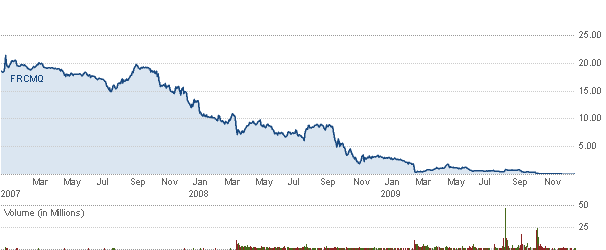
FairPoint's Stock Price from 2007, when it announced the deal with Verizon, to late 2009 when the company declared bankruptcy. By late 2008/early 2009, what seemed like a great deal for investors was apparently not, as the panicked rushed for the exits.
I’ll put my trust in the wisdom of West Virginians who want good service and reasonable prices. If Cary wants to read from the Good Book of the “paragons of virtue” like AIG, Bear-Stearns and Goldman Sachs, let him sell his TV stations to help finance the bailouts. Remember that when we went through this before with Hawaii Telecom and FairPoint Communications, the cheerleading session on Wall Street lasted only as long as the quarterly balance sheets looked good. At the first sign of trouble, they bailed on the stock and both companies ended up in bankruptcy.
For them, it represented just another roll of the dice in the giant financial casino we call Wall Street.
For the rural residents of states like West Virginia who ultimately have to live with the results, this is their phone and broadband service we are talking about. Before all bets are placed and the dice are thrown, isn’t it worth considering them?
Phillip Dampier resides in Frontier's largest service area: Rochester, New York
Consumers across 13 states impacted by the proposed Verizon sale to Frontier Communications, as well as existing Frontier customers, should tell regulators to reject the deal.
Those of us living and working in Rochester, New York are extremely familiar with Frontier Communications. For more than 100 years, Rochester Telephone Corporation provided excellent, independent telephone service to Rochester and a significant part of the Genesee Valley. The company had a reputation for excellent reliability and charged rates considerably lower than New York Telephone, a Bell subsidiary, in other upstate cities like Buffalo and Syracuse. In 1995, Rochester Telephone was renamed Frontier Communications, because the company wanted to position itself as something more than just a phone company.
Frontier was acquired in 2001 by Citizens Communications of Stamford, Connecticut, who has provided service ever since. Ironically, that company thought Frontier was a better name than the one they had used for decades, and Citizens renamed themselves Frontier Communications in 2008.
Today, Frontier Communications serves just under three million customers, primarily in suburban and rural communities in 24 states.
Since Citizens acquired Frontier, and its largest operating service area in metropolitan Rochester, the company has made some changes to the local telephone network. Fiber optic connections are now common between their central offices and smaller “satellite” central offices. A local wi-fi network was installed in association with Monroe County, in part as a political maneuver to stop municipally owned and operated affordable wi-fi networks from getting off the ground. As a concession to the county, a much smaller “free” wi-fi network was also included. (See below the jump for video news coverage of Frontier’s promises vs. reality)
The company’s broadband service relies on ADSL technology delivered by traditional copper telephone wiring, providing service in Rochester at speeds up to a theoretical 10Mbps. Actual speeds vary tremendously depending on the distance between your home or business and the telephone company central office serving it. In most smaller communities, speeds are far lower. In Cowen, West Virginia, Frontier markets broadband service at just 3Mbps, a typical speed for Frontier’s smaller service areas.
Unfortunately, Frontier has shown no initiative to move beyond offering traditional DSL service to its customers, including those in western New York. Across other New York State cities, Verizon is taking a far different approach. In larger communities, it is aggressively installing fiber optic wiring to both homes and businesses. Verizon FiOS positions the company to effectively compete against their traditionally closest competitor – cable television. For several years, cable operators have offered a better deal for its “digital phone” service, which works with existing home phones but delivered over cable TV lines, often charging less than a traditional phone line, and cable throws in free long distance on many of its plans.
The ubiquitous cell phone has not helped. Many younger Americans can’t understand why they would want to bother getting a traditional phone line, when the mobile phone in their pocket works just fine, and they can take it with them wherever they go. The result has been a steady erosion of traditional “wireline” phone lines, and a corresponding decline in the revenue earned from the service in many areas.
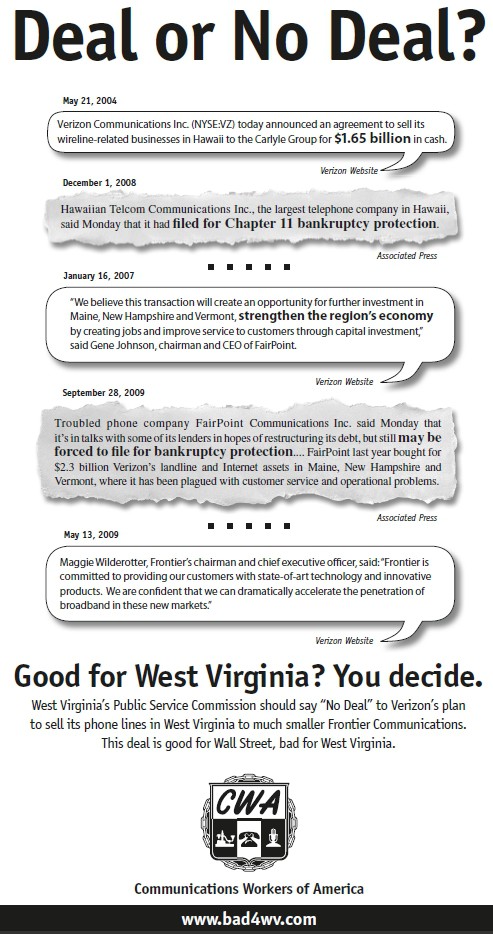
The Communications Workers of America contract Verizon promises with reality for consumers impacted by earlier deals. (click to enlarge)
In September Verizon CEO Ivan Seidenberg told a Goldman Sachs investor conference that the wired phone line business was effectively dead. Seidenberg recognized that trying to guess when the company would stop losing “landline” customers was like guessing when a dog will stop chasing a bus. In other words, the future of Ma Bell is not delivering phone service — it’s deploying advanced networks that are capable of providing customers with video, broadband, and phone service across one wire, preferably a fiber optic one. Those that can manage the transition will succeed, those who cannot or won’t will face a steady decline to obsolescence.
There is only one major problem — it costs a lot of money to rewire entire communities, much less states, with fiber optic wiring. It’s like building a phone network from scratch. A company contemplating such a challenging undertaking starts by asking how much it is going to cost and when will it profit from its investment. Many on Wall Street don’t like either question because of the up front cost, and are even less happy with the prospect of taking the long view waiting for those costs to be recouped from customers.
To date, Verizon is the most aggressive major phone company in the nation building a pure fiber optic system in its larger service areas. AT&T, which provides phone service in many states, has taken a more cautious approach using a hybrid fiber-copper wire design they market as U-verse. A handful of independent phone companies and municipally owned providers have undertaken to wire fiber optics to the home as well, so they can sell video, telephone and broadband service to their customers.
A major challenge confronts phone companies servicing more distant suburban and rural phone customers, often living far apart from one another in sparsely populated regions. It costs more to service these customers, and the potential revenue gained is often not as great as what can be earned from their urban cousins. Verizon doesn’t see many rural customers as part of their future business plans and have begun to systematically sell some areas off to other phone companies, usually in tax-free transactions. One company that sees an ambitious future in serving rural America is Frontier Communications. For them, finding a niche among the big boys gives them safety and security, particularly in areas that don’t have a cable competitor (or any competitor at all).
Frontier’s acquisition strategy is to sell regulators and the public on the idea that allowing Frontier in guarantees a much better chance for broadband service to reach the communities Verizon skipped over. Their argument for success in a business seeing steady declines in customers is that broadband service will stem the tide, and help them remain profitable. More than doubling their size with the acquisition of Verizon’s latest castoffs means more opportunity to market broadband service to those underserved communities. Frontier argues it can be a more nimble player than Verizon because it has marketing and service experience in rural communities previously ignored by Verizon.
Frontier’s ability to provide broadband service is not the most important question. More important is how Frontier will define broadband and at what speed. Also critically important is how Frontier will be prepared to deliver the next generation broadband platform that other communities will see with speeds up to 100Mbps, often on fiber optic networks.
Frontier’s reliance on ADSL technology, which worked fine for 1990s Internet connectivity, is increasingly falling behind in the speed race, and for much of the next generation of online content, speed will matter very much.
Unfortunately, the track record for the success of these spinoffs has been universally lousy for consumers and for many employees who live and work in the impacted communities. Promises made quickly become promises delayed, and later broken as companies like Hawaii Telecom and FairPoint tried to integrate former Verizon operations into their own. Service outages, billing errors, confusion, and finally a mass exodus by customers looking for better alternatives has been the repeated result. The faster customers depart, combined with the enormous debt these transactions create for the buyer, the faster the journey ends in Bankruptcy Court. There is nothing about the Frontier deal proposal that suggests their experience will be any different.
Shouldn’t Three Strikes Mean You Are Out?
Consumers should tell state regulators they should pay careful attention to the failures Verizon has left in its wake from previous deals:
FairPoint Communications, which assumed control of phone service in Maine, New Hampshire and Vermont just last year declared bankruptcy this morning, even now still plaguing customers with billing and service problems. The company choked on the debt it incurred from financing the deal. Before this morning’s bankruptcy, their stock price had lost 95% of its value, and customers were leaving in droves, only accelerating the company’s demise. FairPoint thought it could integrate Verizon’s byzantine billing system into its own. Thinking and doing turned out to be two entirely different things. Frontier has experience integrating other small independent phone companies into its billing system, but now faces the same prospect of dealing with Verizon’s own way of doing everything, and for twice the number of customers Frontier serves today.
Hawaii Telecom and its 715,000 customers were dumped by Verizon in 2005. Once again, transition issues plagued the post-sale experience for those customers, and almost a quarter fled the company over three years. Last December, Hawaii Telecom declared bankruptcy.
Verizon’s yellow pages unit was also thrown overboard by the company to Idearc in November 2006. Saddled with $9.5 billion in debt and interest payments representing almost one quarter of the entire company’s revenues, Idearc finally had enough in March 2009 when it also declared bankruptcy.
The deal between Verizon and Frontier could easily follow the same path, as Frontier gets loaded down with massive debt financing the purchase, and has to immediately provide better service than Verizon did, or face a stampede of customers heading for the exit. The impact of a debt-laden Frontier could be felt by more than just the newcomers. Existing Frontier customers could also be impacted as the company turns its attention to a potentially lengthy integration process.
The Promise of Anemic Broadband, The Fiber Myth & The 5GB Acceptable Use Policy
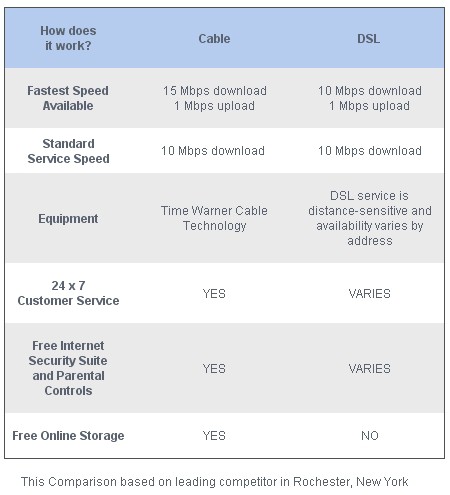
Time Warner Cable competes effectively against Frontier DSL in the phone company's largest service area
Frontier’s plan to bring broadband to a larger number of customers is a noble gesture, particularly for households that currently do not receive any broadband service. Unfortunately, a short term gain of what will likely be 1-3Mbps DSL service will leave these communities behind in the next few years as broadband speeds accelerate far faster than what Frontier is prepared to provide.
Some press accounts in West Virginia have left residents with the impression fiber optic service will reach their individual homes should Frontier be successful in purchasing Verizon’s assets. There is no evidence to suggest this is true.
In earlier deals, these kinds of rumors started when companies advocating the sale staged press-friendly events announcing a fiber connection between hospitals, schools, or community centers, allowing the media to give the impression there would be fiber upgrades for all… if the deal gets approved. In the case of Frontier, they have suggested they will continue work on Verizon’s FiOS system in the communities where construction was already underway. That’s an important distinction for the millions of customers who don’t live in those communities. Verizon’s FiOS network that is part of this transaction serves less than 70,000 residents.
Residents should consider what possibility their community has of obtaining this type of advanced service when Frontier refuses to provide anything comparable in their largest service area – Rochester, New York.
If they are not doing it in Rochester, do you really believe they will do it in your community?
The company certainly has a competitive need to provide such service in our city where Time Warner Cable has accelerated speeds beyond what Frontier is capable of providing. Indeed, Time Warner Cable officials tout their largest number of new Road Runner broadband sign-ups comes from departing DSL customers who are fed up with the anemic, inconsistent speeds offered by this aging technology.
In the town of Brighton, I gave Frontier DSL service a try this past spring. The company promises up to 10Mbps of service to my area, which is less than 1/2 mile from the city of Rochester, and literally just a few blocks from the town’s business center. After installation, the company was only able to provide me with service at 3.1Mbps, just less than one-third of the speed marketed to local residents. Even more surprising was the fact they charged a higher price for that service (including taxes, fees, and modem rental charge) than their competitor, Time Warner Cable.
This website was founded after Frontier inserted language into its Acceptable Use Policy defining “reasonable” broadband usage at just five gigabytes per month. That’s right, the same limit your mobile phone provider applies to their wireless broadband service. Viewing one HD movie over Frontier’s DSL service would put you perilously close to unreasonable use.
Are consumers willing to give up unlimited Verizon DSL service for a company that refuses to drop a 5GB acceptable usage definition from their terms and conditions?
America is on the threshold of 50-100Mbps broadband service, with some communities already enjoying those speeds. If your community isn’t served by a competing provider, do you want to limit your future to yesterday’s DSL technology, and then told it is inappropriate for you to actually use it beyond five gigabytes per month?
The Billing and Customer Service Nightmare
The days of local customer service are over with Frontier. Back during the days of Rochester Telephone, there were several occasions when a local customer service representative would recognize me by name. Those days are long gone. Now, a good deal of Frontier’s customer service is handled by a call center in DeLand, Florida. While the representatives mean well, experiences with them suggest many are not well equipped to understand and consistently market Frontier’s products to existing customers. Pile on more than double the number of new customers, and the problems are likely to become much worse.
Frontier has personally plagued me with billing errors this past year, gave inconsistent and inaccurate answers to pricing and service inquiries, and created major runaround hassles to correct them. From the DSL self-install kit that never arrived (requiring me to visit a local office to pick one up myself), to the impenetrable and inaccurate bills that resulted, the company could not correct the problems without consulting someone with supervisor status. I canceled service within the month.
Customers signing up for service have been pressured into “peace of mind” agreements that lock customers into long term contracts that automatically renew unless the customer actively cancels them (and is certain the request to cancel was processed correctly.) Frontier has been fined twice by the New York State Attorney General for “misleading advertising and marketing tactics,” once in 2006 and again just a few weeks ago. Some customers are now waiting for substantial refunds ranging from $50-400 dollars for “early termination fees” charged when they tried to cancel service.
Are you comfortable knowing some customers have been inappropriately placed on a one to three year contract without their full informed consent, and billed hundreds of dollars when they tried to cancel?
The Art of the Deal
By no means will a Verizon-Frontier transaction be the last. As the industry continues to consolidate around a dwindling number of wired phone line customers, it’s a safe bet there will be more phone customers thrown away by the bigger players. Nothing guarantees Frontier itself will be freestanding when the consolidation wave ends. While these deals may make sense for some shareholders and company executives, they often don’t for local experienced employees who know the network and how to provide quality service. They never have for consumers who will always have to foot the bill to pay off these transactions and have to live with the company trying to integrate Verizon’s bureaucracy with their own.
Some consumer groups and local workers correctly predicted, in each instance, the horrific outcome of these kinds of deals. Their uncanny knack to correctly predict disaster contrasts with company marketing, lobbying, and astroturf efforts that promise the sky and tell each successive news reporter covering the latest atrocity that “things are getting better” and “will be fixed soon.” Unfortunately for too many customers, the fix has to come from a judge in Bankruptcy Court.
The International Brotherhood of Electrical Workers who repeatedly warned about the perils of FairPoint, now warns state regulators about Frontier, and direct attention to the numbers:
If the transaction is approved, Frontier management will have to deal with a 300% increase in access lines (from 2.2 million access lines now to 7 million after the sale) and a 200% increase in employees (from 5,700 employees now to 16,700 after the sale).
Frontier’s debt will increase from $4.55 billion to $8 billion—an increase of over $3.4 billion. Servicing this debt will mean less money for infrastructure, service quality, and high-speed internet build out.
While Frontier argues that somehow this deal will make it stronger, the issue for the states being sold is how much weaker it will make the operations in those states.
The leverage ratio is one way to measure the financial health of a company. The leverage ratio is calculated by taking net debt and dividing it by earnings (before interest, taxes, depreciation and amortization). The leverage ratio for the states being sold will increase from 1.7 immediately before the transaction closes to 2.6 after the sale. The entire deal revolves around Frontier’s ability to cut its operational expenses by $500 million or 21%.
This is significantly greater than the 8-10% cut that FairPoint hoped to achieve—and much of these savings were to be generated from replacing Verizon’s network and back-office systems. Yet, Frontier states that all of the operations except for West Virginia will continue on Verizon’s existing systems—for which Frontier will pay a fee.
Where will Frontier generate the savings—from reduced service quality, workforce, or maintenance of the communications infrastructure? In spite of brave talk from Verizon and Frontier, as recent events have demonstrated, obtaining financing for a transaction this size can be difficult. Frontier does not currently have financing for the additional debt it will take on for this transaction.
As an existing Frontier customer, I’d like an answer myself.
<
p style=”text-align: center;”>
Watch these two Wall Street guys talk about the previous Verizon deals that threw customers under the bus. Plenty of praise for the skilled deal maker Verizon CEO Ivan Seidenberg, and no concern for you, the consumer and telephone customer impacted by a deal that got a few people very rich and left you with a bankrupt phone company. (3 minutes)
It’s Not Worth the Risk
Unfortunately, for too many rural Americans impacted by this deal, there is only one phone company. Cable television is not in their future, and in mountainous regions like West Virginia, wireless phones may not be suitable as a phone line replacement. Risking 100 years of solvent phone service on a deal that could ultimately follow earlier deals into bankruptcy is not worth the risk. The nightmares of converting operations from one provider to another is a hassle consumers should not have to face.
For decades, you faithfully paid your Verizon telephone bill and made the company the telecommunications powerhouse it is today. Now they want to abandon you because, frankly, you just aren’t important enough to them anymore. It doesn’t have to be this way. State regulators can tell Verizon they need to make different plans — by forgetting about trying to cash in on a deal that is good for them and bad for you, and by staying put and providing consumers with the same kinds of network upgrades they are building in communities across the country.
Unfortunately, Frontier before this deal was ill-equipped to embark on the kind of investment necessary to provide fiber optic broadband connectivity to its customers. Now pile on billions of additional debt and the challenge of trying to more than double their size and integrate diverse phone networks in 13 different states and ponder what the chances will be for fiber service after the deal is done. Far more likely for residents is a company that will rely on slow speed DSL service, providing “good enough for them” broadband for the indefinite future.
Take Action!
As has been the case with Hawaii Telecom and FairPoint, naive regulators believed the false promises and approved earlier deals, and are frankly responsible for part of the blame. Face-saving telecommunications regulators in New England initially even tried to cheerlead for FairPoint as they stumbled through one customer service nightmare after another. Too late, they realized the grim reality that their approval saddled their states with a phone company totally unequipped to do the job.
Consumers who do not want a repeat performance can contact their state representatives and tell them to put pressure on each state’s public utility commission to reject the deal. You should also contact your state’s public utility commission yourself.
No amount of concessions and written agreements will make a difference if that phone company ends up in financial distress and takes a walk to Bankruptcy Court. Regulators should not even bother trying, after witnessing the debacle with FairPoint.
In your polite, persuasive and persistent communication with state officials, let them know:
We’ve been down this road with Verizon before, with FairPoint Communications and Hawaii Telecom, leaving a litany of broken service promises, unfulfilled broadband commitments, unacceptable billing mistakes, and poor quality customer service. In both instances, customers fled and the companies ended up in bankruptcy;
Frontier has been unable or unwilling to wire its largest service area, Rochester, New York, with the advanced fiber connectivity that Verizon is wiring throughout the rest of upstate New York. If the company cannot meet the needs of customers in their largest service area, what in the world makes you think they’ll do it for us?
The company has been fined twice by the New York State Attorney General for dubious business practices, costing consumers hundreds of dollars the company has now agreed to return to those customers;
A broadband service for our community’s future should not come with a 5 gigabyte monthly limit attached in the fine print. How can our community compete in the digital economy if you have to ration your broadband usage to an unprecedented level in wired broadband?
The devil is always in the details. Verizon has an aggressive plan to stay relevant in a digital future, with video, telephone, and Internet service running across advanced fiber optic lines. Frontier has a plan to serve rural communities with yesterday’s technology. Frontier’s vision for video is to “get a satellite dish” and rely on the existing aging copper wiring to do everything else.
What kind of service and growth can we expect from a company mired in debt? As seasoned Verizon employees in our community start retiring, understanding the writing on the wall, what do they know that you and I don’t?
Phone companies are a regulated utility, essential to the public interest. Why permit a risky deal that could ultimately lead to a taxpayer bailout to keep operations running if Frontier follows its predecessors into bankruptcy, all while Verizon walks away with billions in proceeds?
You can locate the names and contact information for your state representative(s) on Congress.org simply by entering your zip code. When calling or writing, always be courteous, and request that your representative respond in writing to your concerns, and share with Stop the Cap! any correspondence you receive in reply. As always, we’ll be holding elected officials accountable.
Your next contact must be with your state public utility commission. If a hearing is planned in your community, share your views in person and feel free to point them here if they want to watch how bad telecommunications deals have unfolded in the past. We have countless hours of news reports archived for their viewing pleasure. Each state has a different procedure for contacting them. In West Virginia, for example, consumers can call the Commission at 1-800-642-8544. Ohio residents can fill out an online form.
Perhaps Frontier can one day take on a transaction like this, but only after it can demonstrate it has the resources and willingness to provide customers with better options for service. Had they done that in our community, local residents would not have taken to signing a petition for Verizon to overbuild, or buyout Frontier’s Rochester operation. Local residents want the advantage fiber optic service can bring our community and its local economy, some even expressing a willingness to send $10 and $20 checks to Verizon for an acquisition fund to get the sale done. When consumers give money to the phone company when they don’t owe anything, that should be a clear signal consumers are dissatisfied and want a change Frontier, thus far, has not provided.
Be Sure to Read Part One: Astroturf Overload — Broadband for America = One Giant Industry Front Group for an important introduction to what this super-sized industry front group is all about. Members of Broadband for America Red: A company or group actively engaging in anti-consumer lobbying, opposes Net Neutrality, supports Internet Overcharging, belongs to […]
Astroturf: One of the underhanded tactics increasingly being used by telecom companies is “Astroturf lobbying” – creating front groups that try to mimic true grassroots, but that are all about corporate money, not citizen power. Astroturf lobbying is hardly a new approach. Senator Lloyd Bentsen is credited with coining the term in the 1980s to […]
Hong Kong remains bullish on broadband. Despite the economic downturn, City Telecom continues to invest millions in constructing one of Hong Kong’s largest fiber optic broadband networks, providing fiber to the home connections to residents. City Telecom’s HK Broadband service relies on an all-fiber optic network, and has been dubbed “the Verizon FiOS of Hong […]
BendBroadband, a small provider serving central Oregon, breathlessly announced the imminent launch of new higher speed broadband service for its customers after completing an upgrade to DOCSIS 3. Along with the launch announcement came a new logo of a sprinting dog the company attaches its new tagline to: “We’re the local dog. We better be […]
Stop the Cap! reader Rick has been educating me about some of the new-found aggression by Shaw Communications, one of western Canada’s largest telecommunications companies, in expanding its business reach across Canada. Woe to those who get in the way. Novus Entertainment is already familiar with this story. As Stop the Cap! reported previously, Shaw […]
The Canadian Radio-television Telecommunications Commission, the Canadian equivalent of the Federal Communications Commission in Washington, may be forced to consider American broadband policy before defining Net Neutrality and its role in Canadian broadband, according to an article published today in The Globe & Mail. [FCC Chairman Julius Genachowski’s] proposal – to codify and enforce some […]
In March 2000, two cable magnates sat down for the cable industry equivalent of My Dinner With Andre. Fine wine, beautiful table linens, an exquisite meal, and a Monopoly board with pieces swapped back and forth representing hundreds of thousands of Canadian consumers. Ted Rogers and Jim Shaw drew a line on the western Ontario […]
Just like FairPoint Communications, the Towering Inferno of phone companies haunting New England, Frontier Communications is making a whole lot of promises to state regulators and consumers, if they’ll only support the deal to transfer ownership of phone service from Verizon to them. This time, Frontier is issuing a self-serving press release touting their investment […]
I see it took all of five minutes for George Ou and his friends at Digital Society to be swayed by the tunnel vision myopia of last week’s latest effort to justify Internet Overcharging schemes. Until recently, I’ve always rationalized my distain for smaller usage caps by ignoring the fact that I’m being subsidized by […]
In 2007, we took our first major trip away from western New York in 20 years and spent two weeks an hour away from Calgary, Alberta. After two weeks in Kananaskis Country, Banff, Calgary, and other spots all over southern Alberta, we came away with the Good, the Bad, and the Ugly: The Good Alberta […]
A federal appeals court in Washington has struck down, for a second time, a rulemaking by the Federal Communications Commission to limit the size of the nation’s largest cable operators to 30% of the nation’s pay television marketplace, calling the rule “arbitrary and capricious.” The 30% rule, designed to keep no single company from controlling […]
Less than half of Americans surveyed by PC Magazine report they are very satisfied with the broadband speed delivered by their Internet service provider. PC Magazine released a comprehensive study this month on speed, provider satisfaction, and consumer opinions about the state of broadband in their community. The publisher sampled more than 17,000 participants, checking […]


 Subscribe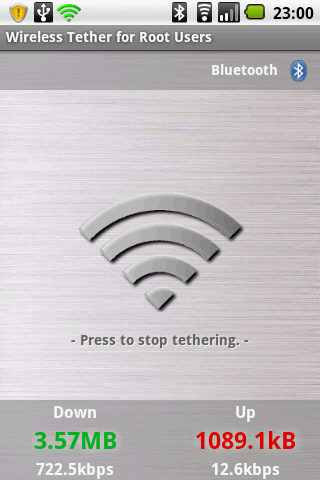
 It’s Cell Company Customer Crackdown-month for AT&T and Verizon Wireless as the two carriers increasingly engage in aggressive “management” of their wireless data networks. Days after AT&T announced it would throw customers off legacy unlimited data plans if caught using “unofficial” tethering applications, Verizon has reportedly locked out customers from accessing web pages over jailbreak apps like MyWi, redirecting requests to a Verizon Wireless $20 Mobile Hotspot offer instead.