Home » landline networks » Recent Articles:

Four Telcos-Four Stories: Rightsizing Revenue, Irritating Broadband — Today: Frontier

Four of the nation’s largest phone companies — two former Baby Bells, two independents — have very different ideas about solving the rural broadband problem in the country. Which company serves your area could make all the difference between having basic DSL service or nothing at all.

Some blame Wall Street for the problem, others criticize the leadership at companies that only see dollars, not solutions. Some attack the federal government for interfering in the natural order of the private market, and some even hold rural residents at fault for expecting too much while choosing to live out in the country.

This four-part series will examine the attitudes of the four largest phone companies you may be doing business with in your small town.

Today: Frontier — “Rightsizing” Our Broadband Revenue in Barely-Competitive Markets, Even When It Costs Us Customers
“We have been very disciplined with our [data] pricing and really trying to make sure that we are moving the prices up in a right direction and looking at customers who are paying way below where they should be,” Donald R. Shassian, chief financial officer and executive vice president of Frontier Communications told investors on a conference call earlier this month.They are not a valued customer. If we can’t get them up, we are sort of letting them disconnect off, if you would, and it’s enabling us to be more disciplined.”

That “direction” has meant higher bills for some long-standing customers that suddenly lost discounts or service credits. One common example is Frontier’s mandatory broadband modem rental fee, increasingly turning up on customer bills even though they own their own equipment or had previously arranged a fee waiver. Ex-Verizon customers were particularly hard hit when Frontier switched to its own billing platform. Just about every customer has also been impacted by Frontier’s “junk fees,” including company surcharges that effectively raise the price of the service.

As a result of higher pricing and dissatisfaction with the quality of service, some customers have disconnected, and the company recently reported second quarter profits were down 44%, offset by slightly higher earnings from higher bills.

The New Frontier

Frontier Communications has enormously expanded its reach over the past few years. Frontier’s original “legacy” service areas were dwarfed in 2010 by the company’s acquisition of 4.8 million landlines from Verizon Communications.
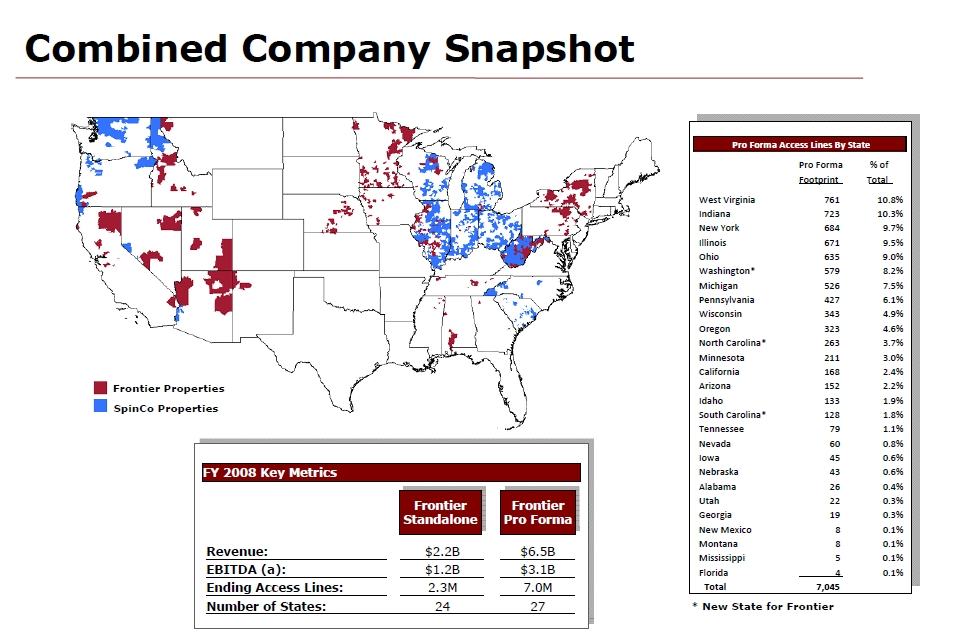
Frontier’s Combined Service Map — Areas in red are “legacy” Frontier service areas. Those in blue were acquired in 2010 from Verizon. (click to enlarge)

Frontier roughly tripled in size as a result, and the huge spike in customers delivered four straight quarters of triple-digit revenue growth. But the transition for ex-Verizon customers has not been easy. Customers endured billing errors, service plan confusion, and service quality issues as Frontier got up to speed managing Verizon’s landline network. A significant number of those customers have had enough and are switching to other providers.

West Virginia is the best place to study the contrast between Frontier’s failures and successes. A large number of service problems and lengthy outages plagued the state after Frontier took charge of a landline network Verizon treated as an afterthought. Over at least a decade, Verizon allowed its landline network to deteriorate to abysmal condition in several areas of the state. Little was invested to upgrade service, and Verizon ultimately left West Virginia with one of the lowest national broadband service penetration rates — about 60 percent.

Verizon’s priorities were elsewhere: spend millions on FiOS fiber upgrades in larger, urban markets while letting rural landline networks stagnate. Eventually, Verizon’s management team decided it was no longer worth hanging on to these low priority service areas and began selling them off. FairPoint Communications acquired Verizon customers in northern New England and Frontier bought mostly rural midwestern and western territories long struck from Verizon’s priority list.

Wilderotter

Frontier’s key argument for acquiring Verizon landlines was that the company could bank on deploying broadband to a much larger percentage of customers than Verizon ever bothered to serve.

Frontier places a very high priority on broadband, because the company can significantly boost the average revenue it earns from each customer by providing the service. With Frontier often the only home broadband choice around in its most rural markets, the company can charge whatever it wants for DSL service, tempered only by how much customers can afford to pay. Broadband is also a proven customer-keeper, an important consideration for any company facing ongoing losses from customers dumping landlines for cell phones.

Since its acquisition, Frontier has been aggressively deploying rural broadband in the former Verizon territories — typically the cheapest form it can deliver — 1-3Mbps ADSL service. Frontier considers its legacy service areas already well-covered, claiming around 93 percent of customers can already subscribe to Frontier DSL.

In states like West Virginia, the fact anyone is supplying anything resembling broadband has been well-received by those who have never had the service before. But where competition exists, Frontier has been losing ground (and customers) as cable competitors provide more consistent, higher speeds and quality of service.

The frustration is especially acute in the Mountain State. Steve Andrews, a Beckley resident complained, “This company’s idea of broadband access is up to 3Mbps DSL while nearby states like Virginia and Pennsylvania are getting fiber or cable broadband speeds ten times faster.” Andrews added that on most days his Frontier-provided broadband provides only around 800kbps, not the advertised 3Mbps.

Frontier Admits It Uses Government (Your) Money to Expand Broadband Where It Would Have Expanded Service on Its Own… Eventually

Frontier Communications was by far the most enthusiastic participant in the Federal Communications Commission’s Connect America Fund (CAF). This subsidy program currently covers $775 of the cost to extend broadband service to a currently unserved customer. Frontier agreed to accept nearly $72 million from the program, which commits the company to offering at least 4Mbps broadband service to an additional 92,877 homes and businesses around the country.

But Maggie Wilderotter, CEO of Frontier Communications, admitted Frontier would have eventually spent its own money to extend service to those rural customers without a subsidy:

“Get broadband out faster to a bunch of customers that we would have built anyway, at some point in time. And it also accomplishes the objectives of using the funds that are available from the FCC. We actually could have taken more money…. So we felt good about it. We totally understand why the other carriers made the decisions they made because we didn’t — we’re not building anything on our legacy markets. So it’s the money. It’s all in the acquired properties where we still had pretty low penetration with enough density to support the parameters that the FCC put in place.”

The fund, paid for by telephone customers nationwide through a surcharge on customer bills, will also subsidize a lucrative business opportunity for Frontier, according to Wilderotter.

“These are unserved locations that really are not competitive at all,” Wilderotter told investors. “So there’s no competition in those areas. So we’re pretty excited about it. We think that this is going to be good for Frontier and good overall.”

More than $38 million of the total broadband subsidy Frontier received will be spent in 30 counties in just one state: Wisconsin. Among other locations where Frontier will spend the money:

  • 1 Arizona county
  • 2 California counties
  • 1 Florida county
  • 5 Idaho counties
  • 25 Illinois counties
  • 2 Indiana counties
  • 26 Michigan counties
  • 2 Nevada counties
  • 8 New York counties
  • 1 North Carolina county
  • 8 Ohio counties
  • 5 Oregon counties
  • 2 Tennessee counties
  • 7 Washington counties
  • 25 West Virginia counties

Trying to Hang Onto Customers Frontier Already Has… With Serious Speed Boosts
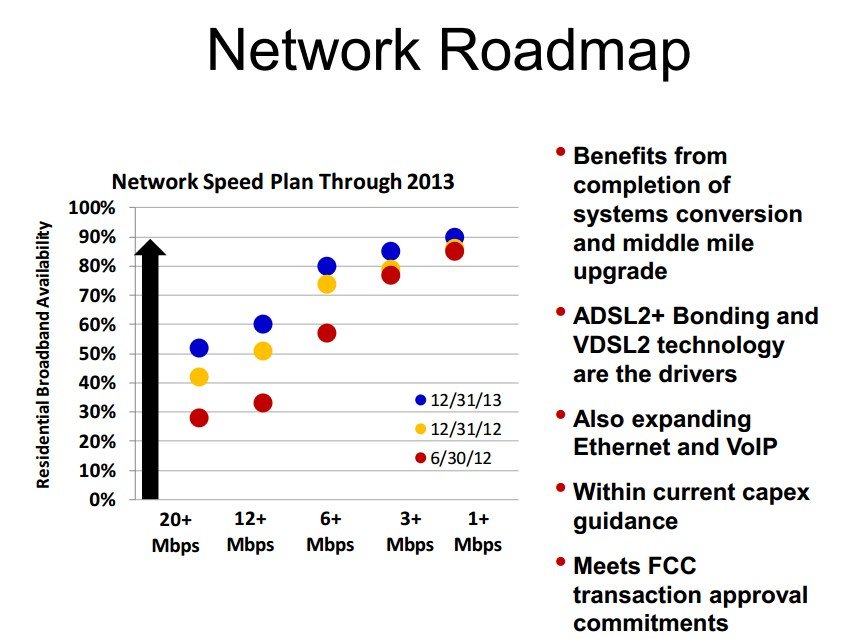
Frontier’s speed plans through 2013.

One of the loudest and most consistent complaints Frontier broadband customers mention is the slow speeds they receive from Frontier’s DSL. Frontier traditionally offers 1-3Mbps in rural areas, up to 10Mbps in urban areas. But in fact many customers report their speeds are much lower than advertised. Data from the FCC’s national broadband speed measurement program bears this out. Frontier was the only measured provider in the United States that has been losing ground in promised broadband speed and performance.

Frontier officials announced earlier this month the company was shifting some of its capital investments away from broadband expansion towards improving the performance of its broadband service for current customers.

In highly competitive, urban markets Frontier will deploy VDSL2 technology which can support significantly faster and more reliable Internet speeds. In more rural markets, bonded ADSL 2+ will deliver speeds of 10Mbps or better to customers currently stuck with around 1-2Mbps speed.

Daniel J. McCarthy, president and chief operating officer:

  • We expect our 20Mbps service to move from 28% of residential households today to 42% by year-end and then 52% by the end of 2013;
  • The 12Mbps services planned to increase from 33% of homes today to 51% by year-end and 60% by 2013;
  • And the 6Mbps service is planned to increase from 57% of homes today to 74% by year-end and 80% by 2013.

The new speeds will not come free of charge. Customers will be marketed speed upgrades for additional monthly fees.

Customers will also discover Frontier has been simplifying its packages and moving away from high-value promotional offers that bundled a free laptop, television, or satellite dish in return for a lengthy contract. Today, the company is emphasizing increasing discounts for customers subscribing to two or more services that include telephone/long distance, broadband, and satellite television.

Speeds Going Up, Employees (and their salaries) Going Down

Finally, Frontier executives told investors they are scouring the company looking for cost savings. They appear to have identified around $100 million worth, a good portion of which will come from employees facing job cuts or salary reductions.

Wilderotter said she is focusing on call center workers, retiree positions, and “tech op” savings.

“We still have some bubble workforce in the call centers that will continue to go away,” Wilderotter told Wall Street. “We have a number of employees, too, that are going to be retiring over these next several months. And our goal is not to replace any of those retirees either.”

One of the best examples of this cost savings, according to unions representing Frontier employees, is the forthcoming closure of an Idaho-based call center in Coeur d’Alene. More than 100 workers, average age 55, will lose their $15-21/hour jobs Sept. 18 while Frontier prepares to leverage cheaper labor in South Carolina.

Frontier’s new call center employees in Myrtle Beach will receive $11 an hour while training, $12/hour after training — with a five year wage freeze. Benefits will be considerably leaner for South Carolina employees as well, according to union officials.

Four Telcos-Four Stories: The Big Money is in Commercial Services — Today: CenturyLink

Four of the nation’s largest phone companies — two former Baby Bells, two independents — have very different ideas about solving the rural broadband problem in the country. Which company serves your area could make all the difference between having basic DSL service or nothing at all.

Some blame Wall Street for the problem, others criticize the leadership at companies that only see dollars, not solutions. Some attack the federal government for interfering in the natural order of the private market, and some even hold rural residents at fault for expecting too much while choosing to live out in the country.

This four-part series will examine the attitudes of the four largest phone companies you may be doing business with in your small town.

Today: CenturyLink — Our Commercial Customers Deliver 60% of Our Revenue; Our Attention Follows Accordingly

“Business customers now drive about 60% of our total operating revenues,” CenturyLink CEO Glenn F. Post III told investors in March. “Our focus on delivering advanced solutions and data hosting services to businesses are key factors in improving our top line revenue trend.”

With residential customers departing traditional landlines at an average rate of 5-10 percent a year, keeping customers has become an important priority for a number of phone companies, especially those who have plowed millions into mergers and acquisitions to build their businesses. For the past several years, CenturyLink has been acquiring small, regional independent phone companies, a former Baby Bell, and a competing landline provider Sprint used to think would be an important part of its business.

Century Telephone’s original customers were mostly cobbled together from acquisitions from other phone companies, including names like GTE, Central Telephone Company of Ohio (part of Centel), Pacific Telecom, Mebtel and GulfTel. But the biggest expansion of the company would come from acquisitions of Sprint-spinoff Embarq and former Baby Bell Qwest.

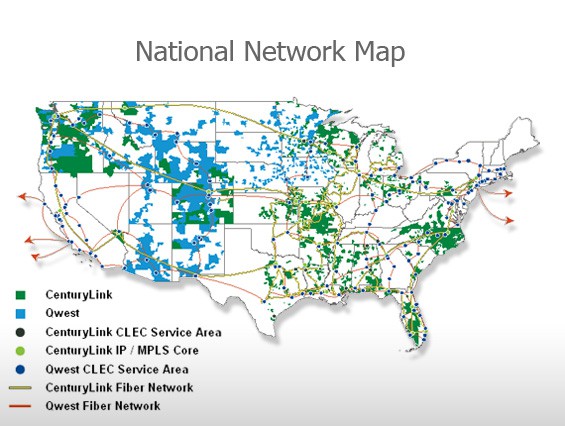
Today CenturyLink operates one of the nation’s largest independent phone companies, and serves markets large (primarily on the west coast) and small (rural communities primarily in the southeast, Missouri, Ohio, Indiana and Wisconsin).

CenturyLink’s revenues have often been uneven, mostly because of its acquisitions, landline losses, and the effects from competition in its larger markets. While CenturyLink’s acquisitions grew the company, they also saddled it with landline networks that have proved inadequate to meet the growing needs of customers. With a disconnect rate running between 6.4% this quarter and 7.6% in the same quarter a year ago, residential customers are leaving their voice lines behind in favor of cell phones and broadband customers are departing for faster speeds available from cable operators.

These “legacy services” lost the company $124 million in revenue — an 8.1% decrease over the past quarter. As customers depart, so do CenturyLink employees that used to handle the old landline network.

To make up the lost revenue, CenturyLink has gotten more aggressive in other areas of its business:

  • Increasing focus on business/commercial and governmental services, including managed hosting, cloud computing and other commercially-targeted broadband initiatives;
  • Deployment of fiber to cell towers as a growing revenue source;
  • Limited, but ongoing rural broadband expansion;
  • Development of Prism TV — a fiber to the neighborhood service targeting residential customers.

CenturyLink calls these their four key initiatives towards revenue stability, stable cash flow, and growth.

In the business services segment, CenturyLink sees enormous revenue potential selling businesses access to data centers, co-location services, and ethernet-speed broadband. Last year, CenturyLink acquired Savvis, an important enterprise-level service provider and owner of 50 data centers. Phone companies like CenturyLink are also in a race with large cable operators to be the first to offer cell phone companies access to “fiber-to-the-tower” service to support exploding data growth on 4G wireless networks.

Faster DSL, Fiber to the Neighborhood-Broadband Key to Keeping Residential Customers Happy

CenturyLink’s network map showing both its own service areas, and infrastructure obtained from the acquisition of Qwest.

For consumers, CenturyLink has been moderately aggressive in some areas boosting speeds of its DSL services. The company claims 70% of their DSL-capable landline network provides speeds of at least 6Mbps. At least 55% supports 10Mbps or higher; over 25% can manage 20Mbps or faster.

The company’s Prism TV service, a fiber to the neighborhood upgrade comparable to AT&T U-verse, is now available to nearly 6.3 million homes and apartments in eight cities. By year end, CenturyLink says it will increase that to 7.1 million homes.

Prism represents a significant portion of CenturyLink’s investment in its residential business. So far, the results have not proven a major threat to the competition. CenturyLink added 15,000 Prism subscribers in the first quarter, but the company only has 8% of the market. Cable and satellite providers continue to dominate. But the company says Prism is helping to keep the customers they already have.

CenturyLink says it now taking Prism TV west into former Qwest territory, starting in and around Colorado Springs, Col.

Customers will likely be offered 130 channels starting at $59.99 a month with a free set top box (new customers typically receive a $20 monthly discount for the first six months of service).

The phone company will compete with Comcast, which sells 80 channels for $56 a month (new customers get a $26/mo discount for the first six months).

With CenturyLink providing a better deal, at least for television service, Colorado City officials hope the competition will bring down rates, at least for new customers. That may be exactly what happens, predicts Mark Ewell, a senior account executive with Windstream Communications.

“We could see some pressure on Comcast’s rates. I would like to see Comcast adopt a price model that doesn’t go up after a promotional period,” Ewell told The Gazette.

“CenturyLink is likely to be more of a threat to the satellite providers like DirecTV and Dish because they have a much higher market share in Colorado Springs than they do in most other markets because so many customers left Adelphia [acquired in bankruptcy by Comcast] when it had its financial problems. Those customers have already shown a willingness to leave the cable television provider and try another service.”

[flv width=”640″ height=”380″]http://www.phillipdampier.com/video/CenturyLink Prism TV.flv[/flv]

CenturyLink shows off its new Prism TV offering in this company-produced video.  (2 minutes)

CenturyTel acquires Embarq and changes its name to CenturyLink to reduce the emphasis on its traditional landline business.

CenturyLink’s arrival in the triple-play business of phone, Internet, and television service could be the first serious competition Comcast has gotten outside of satellite providers. WideOpenWest had a franchise to provide service in 2000 but never did. Falcon Broadband won a franchise in 2006, but only provides service to around 1,500 customers in the Banning Lewis Ranch, Black Forest, and Falcon areas. Porchlight Communications received a franchise in 2007, installed service for 500 customers but ultimately never charged them. Porchlight’s IPTV service never worked properly with its chosen set top boxes. That fatal flaw put the company out of the cable business, and the company turned the porch light off for good, abandoning its franchise.

Rural Broadband: Unless the Government Delivers More Subsidies, Rural Customers Will Continue Waiting

In late July, CenturyLink announced it would accept $35 million from the Federal Communications Commission’s new Connect America Program (CAP) to deploy broadband to homes and businesses in rural, broadband-deprived parts of its service area.

CenturyLink has the capability to extend broadband to 100 percent of its customers, but not the willingness to invest the money to make that happen, critics contend. CenturyLink freely admits it applies a financial test when considering when and where to expand its DSL broadband service into its most rural service areas.

In short, the company must recoup its costs of deploying broadband within a certain time frame, and be confident that a certain percentage of customers are going to sign up for broadband service, before it will agree to make the investment. Virtually all of CenturyLink’s current service areas have already met or failed that test, which leaves an indefinite group of broadband “have’s” and “have-nots.”

To shake up the status quo, the FCC proposed to shift Universal Service Fund money, collected from all phone customers, away from landline service towards rural broadband deployment. This invites CenturyLink, and other phone companies, to run those financial tests again. With urban customers footing part of the bill, theoretically more homes should squeak past the return on investment test.

In fact, more homes will finally get CenturyLink broadband — around 45,000 in semi-rural and suburban areas where the costs to provide the service are not as great as in truly rural areas.  The FCC is offering to cover just short of $800 per household to cut the costs of deploying rural Internet access.

But CenturyLink complains the money is not nearly enough to solve the really-rural broadband problem.

“In very rural areas where we really have the greatest need for support, this amount, on a per-location basis, will not be enough to allow us to really do an economic build-out,” Post told investors this spring. “So we’re still in the process really of evaluating our opportunities….”

That will leave CenturyLink likely spending considerably more upgrading its urban landline network to support Prism TV instead of supplying rural broadband service.

[flv width=”640″ height=”380″]http://www.phillipdampier.com/video/CenturyLink History.flv[/flv]

Jeff Oberschelp, vice president and general manager of CenturyLink of Nevada discusses the past history of CenturyLink and where phone companies are going in the future in this company-friendly interview.  (6 minutes)

Mid-Atlantic Storm Damage Shows Big Telecom Unprepared for Bad Weather

Phillip Dampier July 5, 2012 Comcast/Xfinity, Consumer News, Cox, Frontier, Public Policy & Gov't, Rural Broadband, Verizon, Wireless Broadband Comments Off on Mid-Atlantic Storm Damage Shows Big Telecom Unprepared for Bad Weather

NOAA caught this ominous derecho cloud front in La Porte, Ind on June 29. The same storm would later cut power for millions all the way to the eastern seaboard.

A series of severe thunderstorms accompanied by near-hurricane-force winds caused millions of customers in several Mid-Atlantic states to lose power and telecommunications services late Friday, and some are expected to remain without service until at least this coming weekend.

The storm, known as a “derecho,” uprooted trees, which in turn knocked down power lines and caused wind-related damage to buildings from Ohio to West Virginia, Virginia to Maryland, and even into North Carolina.

But the storm also is raising questions about the massive failures in commercial telecommunications systems that left entire 911 emergency response systems offline for days, wireless networks non-operational, cell phone systems overwhelmed, and broadband service, deemed a lower priority by emergency officials, down and offline.

Some of the biggest problems remain in and around the nation’s capital and in the states of West Virginia and Virginia, where inadequate infrastructure proved especially susceptible to the storm’s damaging winds.

D.C., Maryland, and northern Virginia

In northern Virginia, calls to 911 were met by silence over the weekend, thanks to a catastrophic failure of Verizon’s landline network. With primary lines down, Verizon’s backup 911 systems also failed, leaving millions with no access to emergency responders.

Fairfax County officials finally put the word out the best way to summon emergency help was to drive (through streets littered with debris and downed power lines) to the nearest fire or police station for assistance.

“It’s just not OK for the entire 911 system in the region to go down for the period of time that we were out, especially after an enormous emergency where people needed to make those calls the most,” Sharon Bulova, chairman of the Fairfax County Board of Supervisors, told the Associated Press.

Verizon spokesman Harry Mitchell was left flat-footed, promising an investigation into Verizon’s latest 911 failure, and called the storm as damaging as a hurricane. He urged local officials to “move forward” beyond the immediate criticism and help make progress to get service restored.

Many emergency response networks also depend on telecommunications services, including fiber cables, to reach transmission towers for radio dispatch and mobile data terminals. In northern Virginia, the city of Alexandria has been managing to handle emergency dispatch services for several counties.

With power lines down, cable and phone lines often went as well. In those cases, electric utilities have first priority to restore service, and then cable and phone companies can begin repairs of their own.

Since cable operators rely on power companies to supply electricity to their amplifiers and other equipment, Comcast and Cox, which dominate the region, are blaming most of their outages on power disruptions, and promise service will be restored when the power returns.

Verizon’s DSL and FiOS broadband networks were both disrupted by the storm, primarily because of downed lines and power losses.Even wireless networks, which some might suspect would be immune to downed lines, were also seriously affected by the storm. Cell towers connect to the provider’s network through fiber optic and T1 lines, and although backup power generators can maintain a cell tower for days in some cases, backhaul line cuts can leave cell towers useless.

In metro D.C., call completion problems were a problem during the storm and sometime after as local residents turned to cell phones to communicate. Over the weekend, customers in and around Richmond, Va., found Verizon Wireless useless for text messages because of a service disruption. As backup generators ran dry of fuel, some cell towers that survived the initial storm have been shutting down until maintenance crews arrive and refuel.

The harshest criticism has so far escaped phone and cable companies. Instead, local officials and residents remain focused on Pepco, the power utility serving the Washington area. Pepco has learned from previous storms to become a master of lowered expectations, and is promising to do its best to restore power a week or more after the storm was a memory.

West Virginia and western Virginia

The state of West Virginia, and western rural Virginia state, have illustrated what happens when deteriorating infrastructure is asked to withstand winds of up to 100mph. Frontier’s operations in West Virginia were hit especially hard. Landline networks in that state had been allowed to deteriorate for years by former owner Verizon Communications. Frontier had its hands full trying to keep up with repairs, calling in additional staff and trying to maintain landline service in some areas with the help of generators.

That job was made much harder by a rash of generator thefts that impacted the phone company, and local authorities are still looking for those responsible. At least one-third of all central switching offices operated by Frontier in West Virginia remain on generator power as of yesterday. As of July 3, the company reported it has 12,000 repair requests still waiting for action.

It was a similar story in the western half of Virginia where independent phone companies and Verizon were faced with an enormous number of downed trees and power lines, many in rural areas. More than 108,000 Virginia residents are still without power as of this afternoon, and many will not see it restored until the weekend.

Because the derecho swept across a large area encompassing the entire state, it has been difficult for utility crews to respond from unaffected areas to assist in repairs because the damage was so widespread. Logistically, just coordinating repair operations has proved difficult because cell service has been spotty (or networks have been jammed with calls) in some of the worst-affected areas.

“Derechos are nothing to fool with, but still this was not the most serious storm Virginia has ever dealt with, and the impacts on our telecommunications networks seem to indicate they’ve been allowed to fall apart over the last several years,” shares Stop the Cap! reader Edward Klein, who lives near Roanoke. “I think an investigation is needed to make sure utilities are spending enough money to keep these networks in good shape so this kind of thing doesn’t happen everytime a storm sweeps through.”

Wall Street Encourages Verizon to Get Completely Out Of Landline/FiOS Business

Wall Street is encouraging Verizon Communications to sell off its landline telephone operations to clear a path for a potentially-profitable merger with British mobile phone company Vodafone Group Plc.

Analysts at Goldman Sachs Group are behind the research report, which suggests Verizon’s recent non-aggression treaty with Comcast and Time Warner Cable makes the sale of Verizon’s landline phone and FiOS fiber to the home network more likely. Verizon will earn a percentage of every cable TV/phone/broadband subscription sold, effectively making Verizon’s own wired network redundant. Potential buyers could include Frontier Communications, CenturyLink, or Windstream, which all have business plans that depend on landline networks fewer Americans are using.

Should Verizon clear away its legacy landline and FiOS networks, Goldman Sachs suggests, a merger with Vodafone would be a “clear fit” for the two companies.

“The remaining wireless and enterprise businesses would have faster growth and a clear fit with Vodafone’s assets and strategy, making it a more attractive merger partner,” Bloomberg News quotes from the report.

“Given that it no longer faces the threat of integrated cable competitors, Verizon could potentially spin off its remaining [landline] assets,” along with “large” pension and benefit liabilities, the Goldman analysts added.

Verizon would also eliminate its ongoing dispute with the two largest unions representing its landline workers — Communications Workers of America and the International Brotherhood of Electrical Workers.  Both unions are still trying to negotiate a new contract with Verizon after a brief, but contentious, summer strike. Verizon Wireless is almost entirely non-unionized.

Vodafone’s share price has been rising recently, perhaps anticipating a potential merger that would give Vodafone a stronger hand in the U.S. marketplace.

Verizon’s investment in its landline network, along with interest in expanding its well-regarded FiOS fiber to the home service, has remained stalled for the past few years.  Recently, the company indicated an interest in moving away from fiber optics to serve broadband customers, and rely on its wireless LTE 4G network instead.

Verizon’s new CEO Lowell McAdam comes from Verizon’s wireless division, and has not shared his predecessor’s enthusiasm for fiber upgrades.

Merger Partner?

While the prospect of an all-wireless future for Verizon may seem good for shareholders, consumers are likely to pay the price:

  1. The Justice Department is reviewing the antitrust implications of the non-aggression treaty between Verizon and its cable competitors;
  2. The sale of Verizon’s landline network to an independent provider could doom the company’s fiber optic network and limit rural Verizon customers to 1-3Mbps DSL;
  3. Verizon Wireless’ prices reflect its market share and lack of strong competition.  The company’s LTE wireless network, although fast, has suffered from reliability problems and is heavily usage-limited.  It may prove unsuitable as a home broadband replacement for rural customers;
  4. Reduced competition for telephone, video, and broadband will likely result in higher prices for existing cable subscribers, too.

Verizon is hardly the first phone company to ponder getting out of the phone business.  AT&T has been lobbying to rescind rural universal service requirements for years.  If successful, AT&T could abandon its rural landline network and provide customers with higher-priced cell phone service instead.

[flv width=”640″ height=”380″]http://www.phillipdampier.com/video/CWA Parody of Verizon Video.flv[/flv]

Verizon’s unionized workers are still fighting for a new contract, and released this parody video in response to a company-produced DVD mailed to union workers’ homes.  (3 minutes)

Rural Americans Losing Reliable Phone Service; FCC Investigates Growing Landline Failures

Phillip Dampier November 17, 2011 Consumer News, Public Policy & Gov't, Rural Broadband, Windstream Comments Off on Rural Americans Losing Reliable Phone Service; FCC Investigates Growing Landline Failures

The Great Plans Communications Company has taken to notifying their customers about the growing problem of rural phone calls that never go through.

Rural Americans in 37 states are experiencing unprecedented problems making and receiving telephone calls on their landline phones.  The problem has grown so much, the Federal Communications Commission has announced it will investigate the 2,000 percent increase in complaints from customers who are fed up with bad phone service.

In a Stop the Cap! special report published this week, we shared details about the deteriorating landline networks owned by AT&T and Verizon.  But the problem extends beyond those phone companies, and is causing more than a little inconvenience for affected customers.

Hospitals report they are increasingly unable to reach rural patients and 911 emergency call centers say a growing number of emergency calls are not getting through.  Callers assume the problem isn’t with their landline telephone company, but with the hospital or 911 call center.

In response, the FCC has created the Rural Call Completion Task Force to investigate delayed, uncompleted, or poor quality calls.

“It’s not only an economic issue, it’s a public safety issue,” said Jill Canfield, the director of legal and industry at the National Telecommunications Cooperative Association.

In parts of Minnesota, problems are not limited to local dial tone service, but also extends to long distance calling.

Members of the Minnesota Telecom Alliance, which represents rural phone companies in Minnesota, discovered growing problems completing calls nearly a year ago.  Customers would dial numbers and be met with silence or uncompleted call intercept recordings.  Other customers, especially in area codes 320 and 218 couldn’t hear or be heard by the other calling party.  Other calls sounded like they were made underwater.

Phone companies also dealing with frustrating long distance problems have taken to their blogs to alert customers.  Great Plains Communications is one example:

For a while now, we’ve been aware of a particularly frustrating situation affecting rural telephone customers around the country.

Across the country, residents of rural communities are unable to receive long distance phone calls or are receiving calls of poor quality due to incomplete or blocked long distance calls. The issue affects landline, toll-free and wireless long distance calls.

So what’s the reason for this? Well, in the U.S., phone calls are carried on a network of phone lines that may be owned by a wide range of companies who charge a fee to carry long distance calls. To cut costs, some long distance companies attempt to use the lowest cost route available even if that route includes providers who aren’t capable of providing good call quality or even completing the call.

The result is thousands of dropped calls or calls with almost no sound quality occurring across the nation. Additional problems that customers have experienced are:

• The caller hears ringing but the receiving party hears nothing.
• The caller’s phone rings, but then hears only “dead air” when the call is answered.
• The call takes an unusually long time to place.
• Garbled, one-way, or otherwise poor call quality on completed calls.
• Callers receive odd or irrelevant recorded messages.

Investigators examining the problem confirm that company’s suspicions that fierce cost-cutting has a lot to do with the problem, especially as phone companies try and save money using cheaper Voice Over IP technology.  While most of the problems seem to afflict long distance calls (and the carriers that handle them), local phone companies like Windstream are also being targeted in the review.

A decade ago, consumers chose their long distance provider.  But today’s bundled service packages often include unlimited long distance, using the phone company’s preferred provider.  Some long distance calls are routed over the least expensive route, even if call quality suffers.

What particularly provokes customers are quality reductions coming at the same time companies like Windstream are raising prices in states like Minnesota.

Windstream defends its network and says it isn’t to blame for the problems.

“The fault is not in our network and not in our system,” Windstream spokesman Scott Morris told the SCTimes. “We do feel like we’re providing high-quality service … in what we can control and fix.”

Search This Site:

Contributions:

Recent Comments:

Your Account:

Stop the Cap!